


Joshua 11:6
Bible text: King James Version (1769 Blayney text) · Public domain
Bible text: King James Version with Strong's numbers · Public domain
Bible text: Berean Standard Bible · Public domain
Bible text: American Standard Version (1901) · Public domain
Bible text: World English Bible, Messianic edition · Public domain
Bible text: Geneva Bible (1599) · Public domain
Bible text: Young's Literal Translation · Public domain
- וַיֹּאמֶרvai·Yo·merand he saidH559Conj-w ¦ V-Qal-ConsecImperf-3msVerb Qal Consecutive Imperfect 3rd Singular Masculineוַandיֹּאמֶרhe said
- יְהוָהYah·wehYahwehH3068N-properNoun Proper Title
- אֶל'eltoH413PrepPreposition
- יְהוֹשֻׁעַye·ho·shu·a'JoshuaH3091N-proper-mNoun Proper Masculine
- אַל'almay notH408NegParticle Negative
- תִּירָאti·Ra'you be afraidH3372V-Qal-Imperf-2msVerb Qal Imperfect 2nd Singular Masculine
- מִפְּנֵיהֶםmi·pe·nei·Hem<from> because of themH6440Prep-m ¦ N-mpc ¦ 3mpNoun Plural Masculine Constructמִ<from>פְּנֵיbecause ofהֶםthem
- כִּיkiforH3588PrtParticle Conditional
- מָחָרma·ChartomorrowH4279N-msNoun Singular Masculine Absolute
- כָּעֵתka·'Etabout the timeH6256Prep-k ¦ N-csNoun Singular common gender Absoluteכָּabout theעֵתtime
- הַזֹּאתha·Zot<the> thisH2063Art ¦ PrtParticle Demonstrativeהַ<the>זֹּאתthis
- אָנֹכִי'a·no·KhiIH595Pro-1csPronoun Personal 1st Singular common gender
- נֹתֵןno·Ten[am] delivering upH5414V-Qal-Prtcpl-msVerb Qal Participle Singular Masculine Absolute
- אֶת'et<obj.>H853DirObjMParticle Object Indicator
- כֻּלָּםku·Lamall of themH3605N-msc ¦ 3mpNoun Singular Masculine Constructכֻּלָּall ofםthem
- חֲלָלִיםcha·la·LimslainH2491Adj-mpAdjective Plural Masculine Absolute
- לִפְנֵיlif·Nei<to> beforeH6440Prep-l ¦ N-mpcNoun Plural Masculine Constructלִ<to>פְנֵיbefore
- יִשְׂרָאֵלYis·ra·'ElIsraelH3478N-properNoun Proper Location
- אֶת'et<obj.>H853DirObjMParticle Object Indicator
- סוּסֵיהֶםsu·sei·Hemtheir horsesH5483N-mpc ¦ 3mpNoun Plural Masculine Constructסוּסֵיhorsesהֶםtheir
- תְּעַקֵּרte·'a·Keryou will hamstringH6131V-Piel-Imperf-2msVerb Piel Imperfect 2nd Singular Masculine
- וְאֶתve·'Etand <obj.>H853Conj-w ¦ DirObjMParticle Object Indicatorוְandאֶת<obj.>
- מַרְכְּבֹתֵיהֶםmar·ke·vo·tei·Hemtheir chariotsH4818N-fpc ¦ 3mpNoun Plural Feminine Constructמַרְכְּבֹתֵיchariotsהֶםtheir
- תִּשְׂרֹףtis·Rofyou will burnH8313V-Qal-Imperf-2msVerb Qal Imperfect 2nd Singular Masculine
- בָּאֵשׁba·'Eshwith <the> fireH784Prep-b ¦ N-csNoun Singular common gender Absoluteבָּwith <the>אֵשׁfire
English is a literal word-by-word gloss of the Hebrew, not the KJV's wording. Why?
This is the original text the KJV's translators worked from — each Hebrew word with its own literal English meaning in this verse, prepared by scholars at Tyndale House, Cambridge. The KJV translates whole sentences, not word by word, so its wording differs: one Hebrew word can become several English words, and the KJV may choose “the LORD” where the gloss reads “Yahweh”. Both are faithful — they answer different questions. For the KJV's own rendering, switch to the KJV text.
Details
See on the biblical-era maps
Study this verse
Public-domain commentary
Matthew Henry
From his Commentary on the Whole Bible. Henry comments on passages, not single verses — this entry covers Joshua 11:1–9. His three-level outline is real structure in the source text, so it is rendered as structure.
We are here entering upon the story of another campaign that Joshua made, and it was a glorious one, no less illustrious than the former in the success of it, though in respect of miracles it was inferior to it in glory. The wonders God then wrought for them were to animate and encourage them to act vigorously themselves. Thus the war carried on by the preaching of the gospel against Satan's kingdom was at first forwarded by miracles; but, the war being by them sufficiently proved to be of God, the managers of it are now left to the ordinary assistance of divine grace in the use of the sword of the Spirit, and must not expect hail-stones nor the standing still of the sun. In this story we have,
I.The Canaanites taking the field against Israel.
They were the aggressors, God hardening their hearts to begin the war, that Israel might be justified beyond exception in destroying them. Joshua and all Israel had returned to the camp at Gilgal, and perhaps these kings knew no other than that they intended to sit down content with the conquest they had already made, and yet they prepare war against them. Note, Sinners bring ruin upon their own heads, so that God will be justified when he speaks, and they alone shall bear the blame for ever. Judah had now couched as a lion gone up from the prey; if the northern kings rouse him up, it is at their peril, Gen 49:9. Now,
1.Several nations joined in this confederacy, some in the mountains and some in the plains, Jos 11:2. Canaanites from east and west, Amorites, Hittites, Perizzites, etc. (Jos 11:3), of different constitutions and divided interests among themselves, and yet they here unite against Israel as against a common enemy. Thus are the children of this world more unanimous, and therein wiser, than the children of light. The oneness of the church's enemies should shame the church's friends out of their discords and divisions, and engage them to be one.
2.The head of this confederacy was Jabin king of Hazor (Jos 11:1), as Adoni-zedec was of the former; it is said (Jos 11:10) Hazor had been the head of all those kingdoms, which could not have revolted without occasioning ill-will; but this was forgotten and laid aside upon this occasion, by consent of parties, Luk 23:12. When they had all drawn up their forces together, every kingdom bringing in its quota, they were a very great army, much greater than the former, as the sand on the sea shore in multitude, and upon this account much stronger and more formidable, that they had horses and chariots very many, which we do not find the southern kings had; hereby they had a great advantage against Israel, for their army consisted only of foot, and they never brought horses nor chariots into the field. Josephus tells us that the army of the Canaanites consisted of 300,000 foot, 10,000 horses, and 20,000 chariots. Many there be that rise up against God's Israel; doubtless their numbers made them very confident of success, but it proved that so much the greater slaughter was made of them.
II.The encouragement God gave to Joshua to give them the meeting, even upon the ground of their own choosing (Jos 11:6):
Be not afraid because of them. Joshua was remarkable for his courage - it was his master grace, and yet it seems he had need to be again and again cautioned not to be afraid. Fresh dangers and difficulties make it necessary to fetch in fresh supports and comforts from the word of God, which we have always nigh unto us, to be made use of in every time of need. Those that have God on their side need not be disturbed at the number and power of their enemies; more are those that are with us than those that are against us; those have the hosts of the Lord that have the Lord of hosts engaged for them. For his encouragement,
1.God assures him of success, and fixes the hour: Tomorrow about this time, when an engagement (it is probable) was expected and designed on both sides, I will deliver them up slain. Though they were to be slain by the sword of Israel, yet it is spoken of as God's work, that he would deliver them up.
2.He appoints him to hough their horses, hamstring them, lame them, and burn their chariots, not only that Israel might not use them hereafter, but that they might not fear them now, their God designing this contempt to be put upon them. Let Israel look upon their chariots but as rotten wood designed for the fire, and their horses of war as disabled things, scarcely good enough for the cart. This encouragement which God here gave to Joshua no doubt he communicated to the people, who perhaps were under some apprehensions of danger from this vast army, notwithstanding the experience they had had of God's power engaged for them. And the wisdom and goodness of God are to be observed,
(1.)In infatuating the counsels of the enemy, that all the kings of Canaan, who were not dispersed at such a distance from each other but that they might have got all together in a body, did not at first confederate against Israel, but were divided into the southern and northern combination, and so became the less formidable. And,
(2.)In preparing his people to encounter the greater force, by breaking the less. They first engage with five kings together, and now with many more. God proportions our trials to our strength and our strength to our trials.
III.Joshua's march against these confederate forces, Jos 11:7.
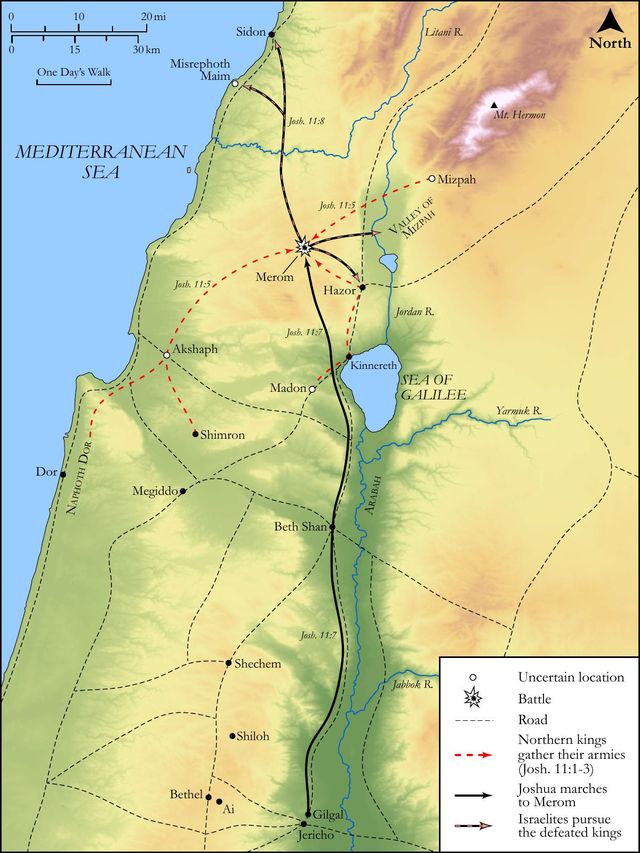
He came upon them suddenly, and surprised them in their quarters. He made this haste,
1.That he might put them into the greater confusion, by giving them an alarm, when they little thought he was near them.
2.That he might be sure not to come short of the honour God had fixed, to give him the meeting at the enemies' camp, tomorrow about this time. It is fit we should keep time with God.
IV.His success, Jos 11:8.
He obtained the honour and advantage of a complete victory; he smote them and chased them, in the several ways they took in their flight; some fled towards Zidon, which lay to the northwest, others towards Mizpeh, eastward, but the parties Joshua sent out pursued them each way. So the Lord delivered them into the hand of Israel; they would not deliver themselves into the hands of Israel to be made proselytes and tributaries, and so offered up to God's grace (Rom 15:16), and therefore God delivered them into their hands to be made sacrifices to his justice; for God will be honoured by us or upon us.
V.His obedience to the orders given him, in destroying the horses and chariots (Jos 11:9), which was an instance,
1.Of his subjection to the divine will, as one under authority, that must do as he is bidden.
2.Of his self-denial, and crossing his own genius and inclination in compliance with God's command.
3.Of his confidence in the power of God engaged for Israel, which enabled them to despise the chariots and horses which others trusted in, Psa 20:7; Psa 33:17.
4.Of his care to keep up in the people the like confidence in God, by taking that from them which they would be tempted to trust too much to. This was cutting of a right hand.
Historical interpretation
Fifteen Centuries of Reception
2 surviving comments on this verse. Each one is dated, so this reads as a timeline rather than a list.
Select a marker to jump to its quote. Markers stagger vertically where authors wrote within a few decades of each other.
Such is the list, therefore, of the entire army of invisible foes who are assembled by King Jabin in order to fight against us who follow Jesus, our leader and Savior. But what does the Lord declare? "Do not shrink back from their appearance," he says "because by tomorrow at this hour, I shall deliver them into your hands." I observe that today we are not able to overwhelm all those powers or to destroy them all, but they will be entirely taken away tomorrow, that is, after the consummation of this age.For, at that time, every opposing power will be pulled down and the inmost part will be conquered when you see that those who are on the left are told, "Go into the eternal fire that God has prepared for the devil and his angels." Then if, following Jesus the leader, we have conquered and have been able to take possession, even we shall occupy the kingdom that the Father has prepared for his saints and for these who "have fulfilled" his commandments and "righteousnes" through our Lord Jesus Christ himself, "to whom is the glory and the dominion forever and ever. Amen!"
Burn their chariots with fire: God so ordained, that his people might not trust in chariots and horses, but in him.
Continue studying Joshua 11:6 across the web’s major study libraries — every link below opens this exact verse, chapter, or book on the destination site.
Read & Compare
 BibleGatewayThis verse in more than 200 translations and 70 languages.
 Bible.comThe YouVersion reader — hundreds of translations, reading plans, and highlights.
 ESV.orgCrossway's official English Standard Version reader.
 NET BibleThe NET translation with 60,000+ translators' notes on every rendering decision.
 STEP BibleTyndale House's free study tool — original text, vocabulary, and scholarly resources.
 BibliaLogos Bible Software's free web reader.
 USCCBThe New American Bible (Revised Edition) with the U.S. bishops' study notes.
Commentaries
 BibleHub CommentariesDozens of classic commentaries on this verse, gathered on one page.
 StudyLightMore than 100 commentary sets — the largest collection on the web.
 BibleRefPlain-English commentary on what this verse means, verse by verse.
 Enduring WordDavid Guzik's free commentary on this chapter, widely used by Bible teachers.
 Bible Study ToolsVerse commentary alongside Greek and Hebrew study aids.
Original Language & Research
- BibleHub InterlinearThe verse word by word — original language, transliteration, and English.
- BibleHub LexiconEvery word's original-language definition and Strong's entry.
 Blue Letter BibleDeep-study tools — Strong's numbers, concordance, and word studies.
 SefariaThe Hebrew text with Rashi and centuries of Jewish commentary.
Sermons, Hymns & Audio


TrulyRandomVerse is not affiliated with these sites and doesn’t control their content. They’re linked because they’re genuinely useful.
Summary
Joshua 11:6 presents a crucial divine mandate and promise from the LORD to Joshua, delivered as Israel prepared to face a formidable northern coalition. This verse reassures Joshua against fear, guarantees a decisive victory by the following day, and issues specific, counter-intuitive instructions to hamstring the enemy's horses and burn their chariots. It profoundly underscores God's absolute sovereignty in warfare, demands Israel's radical obedience, and establishes the theological principle that divine power, not worldly might, is the sole source of true victory.
Context
ShowHideLiterary Context
Joshua 11:6 is strategically placed within the narrative of Israel's conquest of Canaan, marking a pivotal shift from the southern and central campaigns (chapters 6-10) to the decisive northern campaign. The preceding verses, Joshua 11:1-5, meticulously describe the unprecedented scale of the northern confederacy, led by Jabin, king of Hazor, and comprising numerous kings and their vast armies, notably equipped with "many horses and chariots, very many" (Joshua 11:4). This formidable military display sets the stage for God's direct intervention and specific instructions to Joshua in verse 6, which immediately precedes the climactic battle at the Waters of Merom (Joshua 11:7-9). The subsequent verses detail Israel's crushing victory, the complete destruction of Hazor as the "head of all those kingdoms" (Joshua 11:10), and Israel's adherence to God's directives regarding plunder, thus demonstrating the direct fulfillment of the divine promise and command.
Historical & Cultural Context
In the days of the Israelite conquest, chariots represented the apex of military technology, serving as powerful, mobile platforms for archers and spearmen, akin to modern armored vehicles. Major regional powers such as Egypt, the Hittites, and the Canaanite city-states heavily relied on chariotry for military dominance, particularly in open terrain. Hazor, identified as the preeminent city in northern Canaan (Joshua 11:10), was a massive, fortified urban center controlling vital trade routes, and thus possessed a formidable military. For Israel, a people primarily composed of infantry with no cavalry or chariot tradition, confronting such a technologically superior force would have been profoundly intimidating. The divine command to "hough their horses, and burn their chariots" was not merely an act of military destruction but a counter-cultural and economically counter-intuitive directive. It prevented Israel from assimilating these powerful assets, thereby reinforcing their unique mode of warfare, which prioritized absolute reliance on God over conventional military accumulation or human strategic advantage.
Key Themes
ShowHideThis verse powerfully articulates several foundational themes central to the book of Joshua and the broader biblical narrative. Firstly, it reiterates the theme of Divine Assurance and Presence, echoing God's consistent encouragement to Joshua to "be strong and courageous" and "be not afraid" (e.g., Joshua 1:9). This repeated divine reassurance underscores that Israel's success is entirely predicated on God's active presence and unwavering promise, rather than their own inherent strength or military prowess. Secondly, the verse highlights God's Sovereignty in Battle, with the LORD explicitly declaring, "I will deliver them up all slain before Israel." This emphasizes that victory is a divine act, a gift from God, not an achievement wrought by human might or strategic genius, a principle consistently affirmed throughout Scripture (Psalm 20:7). Finally, the command to destroy the horses and chariots introduces the profound theme of Radical Obedience and Trust. This seemingly illogical directive prevented Israel from acquiring the very military assets that could tempt them to trust in their own power rather than in the LORD, thereby reinforcing their absolute dependence on God for future victories. This theme resonates deeply with the broader biblical message that "it is not by might nor by power, but by my Spirit, says the LORD of hosts" (Zechariah 4:6).
Exposition and Analysis
ShowHideKey Word Analysis
ShowHideThis imperative, derived from H3372, carries the meaning "do not fear," "do not dread," or "do not be terrified." It is a foundational command frequently given by God to His chosen leaders throughout the Bible, often coupled with a promise of divine presence or assistance. In this specific context, it directly counters the natural human response to an overwhelming military threat, calling Joshua to place his trust in God's omnipotence and unwavering promise rather than succumbing to intimidation by the enemy's superior forces. It is a call to courageous faith in the face of daunting circumstances.
The verb "deliver" (H5414) here signifies God's active, decisive agency in granting victory. It is not merely a passive allowance or a general blessing, but an emphatic declaration of direct divine action: "I will deliver them up." This choice of word highlights God's absolute sovereign control over the outcome of battles and His unfailing faithfulness to His covenant promises to Israel. The victory is unequivocally a gift from God, a direct result of His intervention, rather than an achievement of Israelite military prowess or strategic acumen.
This verb (H6131) literally means "to uproot," "to pluck up," or, in the context of animals, "to hamstring." It refers to the severe act of severing the tendons in the hind legs of horses, rendering them permanently lame and utterly unfit for use, especially in warfare. This was a deliberate and irreversible act of incapacitation, ensuring that the enemy's primary military advantage—their cavalry and chariot forces—could not be repurposed, reused, or even salvaged by Israel. It powerfully symbolizes a complete and irreversible neutralization of worldly power and a rejection of its utility for God's purposes.
Verse Breakdown
ShowHide"And the LORD said unto Joshua, Be not afraid because of them:"
This opening clause immediately establishes the divine origin and authoritative nature of the message, underscoring Joshua's direct and intimate relationship with God. The command "Be not afraid" directly addresses the very real and understandable apprehension Joshua and the Israelites would feel when confronting such a numerically and technologically superior coalition. It serves as a profound reassurance, grounding their courage not in their own strength or numbers, but solely in the divine presence and unfailing promise. This echoes earlier divine assurances to Joshua, reinforcing a core theological principle of the book: God's people are called to fight from a position of divine strength and confidence, not human weakness or fear.
"for to morrow about this time will I deliver them up all slain before Israel:"
This segment provides the immediate and compelling reason for Joshua's command to "Be not afraid": God's explicit, precise, and time-bound promise of a decisive victory. The phrase "to morrow about this time" indicates a swift, imminent, and utterly conclusive divine intervention. Crucially, the LORD emphatically declares "I will deliver them up," underscoring His active and primary role as the agent of Israel's triumph. The outcome of the battle is presented as entirely contingent on God's sovereign will and power to bring about a complete and utter defeat of their enemies, laying them "all slain before Israel." This pre-announcement of victory serves to bolster faith and eliminate any doubt regarding the battle's outcome.
"thou shalt hough their horses, and burn their chariots with fire."
This final clause provides specific, radical, and counter-intuitive instructions for the aftermath of the battle. The command to "hough their horses" (hamstring them) and "burn their chariots" means the complete and irreversible destruction of the enemy's most valuable and technologically advanced military assets. This directive is profoundly significant: it explicitly prevents Israel from integrating these powerful weapons into their own military arsenal, thereby ensuring their continued and absolute reliance on God for future victories rather than on conventional military might. It is a tangible act of radical obedience that demonstrates Israel's trust in God's unconventional methods and their complete rejection of worldly means of power and self-sufficiency.
Literary Devices
ShowHideJoshua 11:6 employs several potent literary devices that amplify its theological message. The most prominent is Divine Command, delivered directly from the LORD to Joshua, establishing the absolute authority, certainty, and non-negotiable nature of the message. This command is immediately paired with Divine Assurance, explicitly stating "Be not afraid," which serves to bolster Joshua's faith and leadership in the face of overwhelming odds and potential human fear. The subsequent phrase, "I will deliver them up," functions as a clear Divine Promise, guaranteeing victory and emphasizing God's active, primary role as the sole agent of Israel's success, thereby minimizing human agency in the outcome and ensuring all glory redounds to Him. The specific instructions to "hough their horses, and burn their chariots" serve as powerful Symbolism. Horses and chariots represent the pinnacle of worldly military might, human strength, and self-reliance. Their mandated destruction symbolizes Israel's absolute dependence on God's power rather than conventional warfare, and their rejection of the very tools that could lead them to trust in human strength or accumulate worldly power. This act also functions as Foreshadowing of a recurring biblical principle where God often chooses to work through weakness, unconventional means, or seemingly illogical directives to display His glory, ensuring that the victory is undeniably His and that His people learn to walk by faith, not by sight or worldly might.
Theological and Thematic Connections
ShowHideJoshua 11:6 profoundly illustrates God's active, sovereign involvement in the affairs of His people and His unwavering commitment to fulfilling His covenant promises. The command to utterly destroy the enemy's most potent military assets, rather than integrating them into Israel's own forces, serves as a powerful theological statement about the nature of God's kingdom and the means by which it advances. It teaches a fundamental truth: true power, security, and lasting victory for God's people do not reside in human strength, military technology, strategic brilliance, or worldly resources, but solely in unwavering trust and absolute obedience to the LORD. This principle ensures that all glory for victory redounds to God alone, preventing Israel from developing a sense of self-sufficiency or pride that could lead to spiritual apostasy and a departure from their unique identity as God's chosen people. It is a foundational lesson in divine providence, the call to radical dependence on the Creator, and the rejection of reliance on the created.
Reflection and Application
ShowHideJoshua 11:6 offers profound and enduring lessons for believers navigating the complexities and challenges of life today. Just as Joshua faced an overwhelming military coalition, we frequently encounter "giants" in our own lives—whether they manifest as daunting personal struggles, seemingly insurmountable professional obstacles, intense spiritual battles against temptation, or pervasive injustices that appear too vast to overcome. In these moments, God's timeless message to Joshua echoes with powerful relevance: "Be not afraid." Our confidence should never be placed in our own limited resources, our strategic brilliance, or the conventional "chariots and horses" of our age (e.g., accumulated wealth, influential connections, human wisdom, or self-reliance), but entirely and exclusively in God's unfailing promises and His omnipotent ability to deliver. The radical command to "hough their horses, and burn their chariots" challenges us to prayerfully identify and courageously dismantle those things in our lives that we might be tempted to rely on instead of God. This could mean letting go of control, surrendering our self-sufficiency, forsaking worldly advantages that, while seemingly beneficial, ultimately hinder our complete dependence on Christ, or even relinquishing comfortable idols of security. True victory, spiritual flourishing, and genuine peace come not from accumulating worldly power or striving in our own strength, but from radical obedience and unwavering trust in the LORD, knowing that His ways are always higher and His strength is made perfect in our weakness.
Questions for Reflection
ShowHideFAQ
ShowHideWhy did God command Joshua to destroy the horses and chariots instead of using them for Israel's own military?
ShowHideGod commanded the complete destruction of the horses and chariots for several crucial theological and practical reasons, all designed to reinforce Israel's unique identity and mission. The primary reason was to prevent Israel from placing their trust in conventional military might rather than in the LORD. Chariots and horses represented the pinnacle of military technology in that era, and acquiring them could have led Israel to believe their future victories depended on their own strength, advanced armaments, or strategic prowess, rather than on God's divine intervention and covenant faithfulness. This command powerfully reinforced the principle that "it is not by might nor by power, but by my Spirit, says the LORD of hosts" (Zechariah 4:6). Furthermore, it ensured that Israel remained distinct from the surrounding nations, whose warfare relied heavily on such assets. By destroying them, God was teaching Israel a fundamental lesson in radical obedience and absolute dependence, ensuring that His glory alone would be magnified in their conquests and that they would not be tempted to adopt the ways of the world. This also aligns with the later Mosaic law that kings should not acquire many horses (Deuteronomy 17:16), demonstrating a consistent divine principle for His chosen people.
Christ-Centered Fulfillment
ShowHideJoshua 11:6 finds its ultimate and profound fulfillment in the person and redemptive work of Jesus Christ, who triumphed over spiritual enemies not by conventional power or worldly might, but through radical obedience, self-sacrifice, and divine authority. The commanded destruction of the enemy's "horses and chariots" in Joshua foreshadows Christ's decisive victory over the powers of sin, death, and the devil, achieved not through military conquest or human strength, but through His seemingly humble crucifixion and glorious resurrection. Just as God sovereignly delivered the Canaanites into Israel's hands, Christ "spoiled principalities and powers," and "made a shew of them openly, triumphing over them in it" (Colossians 2:15). The "Be not afraid" command to Joshua finds its perfect echo in Christ's constant reassurances to His disciples, "be of good cheer; I have overcome the world" (John 16:33), and His promise that He would never leave them nor forsake them. The spiritual warfare believers engage in today is not "against flesh and blood, but against principalities, against powers, against the rulers of the darkness of this world, against spiritual wickedness in high places" (Ephesians 6:12). Our victory, like Israel's, comes not from our own strength or worldly armaments, but from the power of God manifested in Christ's finished work on the cross. Ultimately, the image of God's decisive victory over His enemies, culminating in the destruction of their means of power, points forward to the Lamb of God who rides forth to conquer, not on a warhorse of human design, but on a white horse, representing divine purity, righteousness, and ultimate judgment, to establish a kingdom that is not of this world (Revelation 19:11-16).