


1 Samuel 11:9
Bible text: King James Version (1769 Blayney text) · Public domain
Bible text: King James Version with Strong's numbers · Public domain
Bible text: Berean Standard Bible · Public domain
Bible text: American Standard Version (1901) · Public domain
Bible text: World English Bible, Messianic edition · Public domain
Bible text: Geneva Bible (1599) · Public domain
Bible text: Young's Literal Translation · Public domain
- וַיֹּאמְרוּvai·yo·me·Ruand they saidH559Conj-w ¦ V-Qal-ConsecImperf-3mpVerb Qal Consecutive Imperfect 3rd Plural Masculineוַandיֹּאמְרוּthey said
- לַמַּלְאָכִיםla·mal·'a·Khimto the messengersH4397Prep-l ¦ N-mpNoun Plural Masculine Absoluteלַto theמַּלְאָכִיםmessengers
- הַבָּאִיםha·ba·'Imwho had comeH935Art ¦ V-Qal-Prtcpl-mpVerb Qal Participle Plural Masculine Absoluteהַwhoבָּאִיםhad come
- כֹּהkohthusH3541AdvAdverb
- תֹאמְרוּןto·me·Runyou will say !H559V-Qal-Imperf-2mp ¦ SfxVerb Qal Imperfect 2nd Plural Masculineתֹאמְרוּyou will sayן!
- לְאִישׁle·'Ishto [the] man ofH376Prep-l ¦ N-mscNoun Singular Masculine Constructלְtoאִישׁ[the] man of
- יָבֵישׁya·VeishJabeshH3003N-properNoun Proper Location
- גִּלְעָדgil·'AdGileadH1568N-properNoun Proper Location
- מָחָרma·ChartomorrowH4279N-msNoun Singular Masculine Absolute
- תִּהְיֶהtih·yehit will belongH1961V-Qal-Imperf-3fsVerb Qal Imperfect 3rd Singular Feminine
- לָכֶםla·Khemto <the> youPrep-l ¦ 2mpSuffix Personal 2nd Plural Masculineלָto <the>כֶםyou
- תְּשׁוּעָהte·shu·'AhdeliveranceH8668N-fsNoun Singular Feminine Absolute
- כְּחֹםke·chomlike [the] heat ofH2527Prep-k ¦ V-Qal-InfVerb Qal Infinitive Constructכְּlikeחֹם[the] heat of
- הַשָּׁמֶשׁha·Sha·meshthe sunH8121Art ¦ N-csNoun Singular common gender Absoluteהַtheשָּׁמֶשׁsun
- וַיָּבֹאוּvai·ya·Vo·'uand they wentH935Conj-w ¦ V-Qal-ConsecImperf-3mpVerb Qal Consecutive Imperfect 3rd Plural Masculineוַandיָּבֹאוּthey went
- הַמַּלְאָכִיםha·mal·'a·Khimthe messengersH4397Art ¦ N-mpNoun Plural Masculine Absoluteהַtheמַּלְאָכִיםmessengers
- וַיַּגִּידוּvai·ya·Gi·duand they toldH5046Conj-w ¦ V-Hiphil-ConsecImperf-3mpVerb Hiphil Consecutive Imperfect 3rd Plural Masculineוַandיַּגִּידוּthey told
- לְאַנְשֵׁיle·'an·Sheito [the] men ofH582Prep-l ¦ N-mpcNoun Plural Masculine Constructלְtoאַנְשֵׁי[the] men of
- יָבֵישׁya·VeishJabeshH3003N-properNoun Proper Location
- וַיִּשְׂמָחוּvai·yis·Ma·chuand they were gladH8055Conj-w ¦ V-Qal-ConsecImperf-3mpVerb Qal Consecutive Imperfect 3rd Plural Masculineוַandיִּשְׂמָחוּthey were glad
English is a literal word-by-word gloss of the Hebrew, not the KJV's wording. Why?
This is the original text the KJV's translators worked from — each Hebrew word with its own literal English meaning in this verse, prepared by scholars at Tyndale House, Cambridge. The KJV translates whole sentences, not word by word, so its wording differs: one Hebrew word can become several English words, and the KJV may choose “the LORD” where the gloss reads “Yahweh”. Both are faithful — they answer different questions. For the KJV's own rendering, switch to the KJV text.
Details
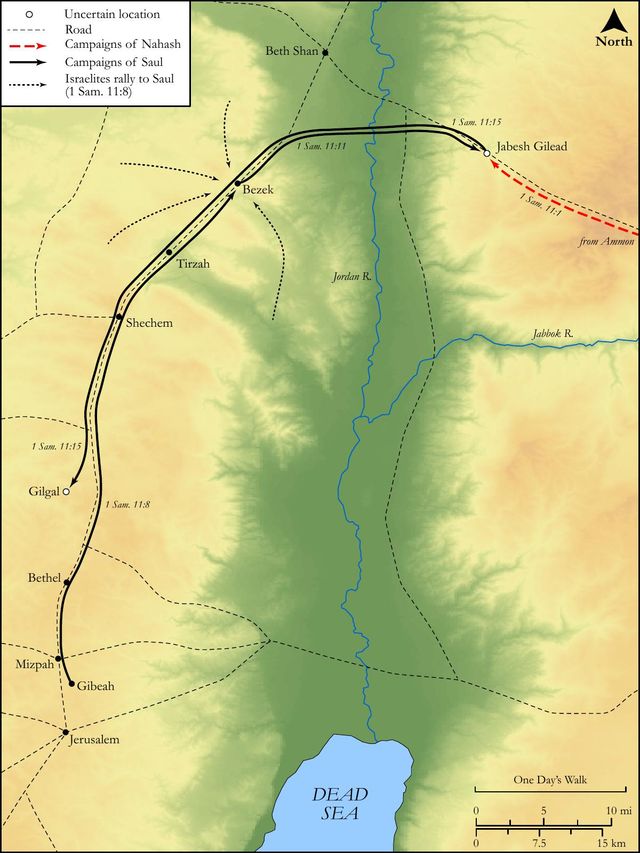
See on the biblical-era map
Study this verse
Public-domain commentary
Matthew Henry
From his Commentary on the Whole Bible. Henry comments on passages, not single verses — this entry covers 1 Samuel 11:5–11. His two-level outline is real structure in the source text, so it is rendered as structure.
What is here related turns very much to the honour of Saul, and shows the happy fruits of that other spirit with which he was endued. Observe here,
I.His humility.
Though he was anointed king, and accepted by his people, yet he did not think it below him to know the state of his own flocks, but went himself to see them, and came in the evening, with his servants, after the herd out of the field, Sa1 11:5. This was an evidence that he was not puffed up with his advancement, as those are most apt to be that are raised from a mean estate. Providence had not yet found him business as a king; he left all to Samuel; and therefore, rather than be idle, he would, for the present, apply himself to his country business again. Though the sons of Belial would, perhaps, despise him the more for it, such as were virtuous and wise, and loved business themselves, would think never the worse of him. He had no revenues settled upon him for the support of his dignity, and he was desirous not to be burdensome to the people, for which reason, like Paul, he worked with his hands; for, if he neglect his domestic affairs, how must he maintain himself and his family? Solomon gives it as a reason why men should look well to their herds because the crown doth not endure to every generation, Pro 27:23, Pro 27:24. Saul's did not; he must therefore provide something surer.
II.His concern for his neighbours.
When he perceived them in tears, he asked, "What ails the people that they weep? Let me know, that, if it be a grievance which can be redressed, I may help them, and that, if not, I may weep with them." Good magistrates are in pain if their subjects are in tears.
III.His zeal for the safety and honour of Israel.
When he heard of the insolence of the Ammonites, and the distress of a city, a mother in Israel, the Spirit of God came upon him, and put great thoughts into his mind, and his anger was kindled greatly, Sa1 11:6. He was angry at the insolence of the Ammonites, angry at the mean and sneaking spirit of the men of Jabesh-Gilead, angry that they had not sent him notice sooner of the Ammonites' descent and the extremity they were likely to be reduced to. He was angry to see his neighbours weeping, when it was fitter for them to be preparing for war. It was a brave and generous fire that was now kindled in the breast of Saul, and such as became his high station.
IV.The authority and power he exerted upon this important occasion.
He soon let Israel know that, though he had retired to his privacy, he had a care for the public, and knew how to command men into the field, as well as how to drive cattle out of the field, Sa1 11:5, Sa1 11:7. He sent a summons to all the coasts of Israel, to show the extent of his power beyond his own tribe, even to all the tribes, and ordered all the military men forthwith to appear in arms at a general rendezvous in Bezek. Observe,
1.His modesty, in joining Samuel in commission with himself. He would not execute the office of a king without a due regard to that of a prophet.
2.His mildness in the penalty threatened against those that should disobey his orders. He hews a yoke of oxen in pieces, and sends the pieces to the several cities of Israel, threatening, with respect to him who should decline the public service, not, "Thus shall it be done to him," but, "Thus shall it be done to his oxen." God had threatened it as a great judgment (Deu 28:31), Thy ox shall be slain before thy eyes, and thou shalt not eat thereof. It was necessary that the command should be enforced with some penalty, but this was not nearly so severe as that which was affixed to a similar order by the whole congregation, Jdg 21:5. Saul wished to show that his government was more gentle than that which they had been under. The effect of this summons was that the militia, or trained bands, of the nation, came out as one man, and the reason given is, because the fear of the Lord fell upon them. Saul did not affect to make them fear him, but they were influenced to observe his orders by the fear of God and a regard to him who had made Saul their king and them members one of another. Note, Religion and the fear of God will make men good subjects, good soldiers, and good friends to the public interests of the country. Those that fear God will make conscience of their duty to all men, particularly to their rulers.
V.His prudent proceedings in this great affair, Sa1 11:8.
He numbered those that came in to him, that he might know his own strength, and how to distribute his forces in the best manner their numbers would allow. It is the honour of princes to know the number of their men, but it is the honour of the King of kings that there is not any number of his armies, Job 25:3. In this muster, it seems, Judah, though numbered by itself, made no great figure; for, as it was one tribe of twelve, so it was but an eleventh part of the whole number, 30,330, though the rendezvous was at Bezek, in that tribe. They wanted the numbers, or the courage, or the zeal for which that tribe used to be famous; so low was it, just before the sceptre was brought into it in David.
VI.His faith and confidence, and (grounded thereon) his courage and resolution, in this enterprise.
It should seem that those very messengers who brought the tidings from Jabesh-Gilead Saul sent into the country to raise the militia, who would be sure to be faithful and careful in their own business, and them he now sends back to their distressed countrymen, with this assurance (in which, it is probable, Samuel encouraged him): "Tomorrow, by such an hour, before the enemy can pretend that the seven days have expired, you shall have deliverance, Sa1 11:9. Be you ready to do your part, and we will not fail to do ours. Do you sally out upon the besiegers, while we surround them." Saul knew he had a just cause, a clear call, and God on his side, and therefore doubted not of success. This was good news to the besieged Gileadites, whose right eyes had wept themselves dry for their calamities, and now began to fail with looking for relief and to ache in expectation of the doom of the ensuing day, when they must look their last; the greater the exigence the more welcome the deliverance. When they heard it they were glad, relying on the assurances that were sent to them. And they sent into the enemies' camp (Sa1 11:10) to tell them that next day they would be ready to meet them, which the enemies understood as an intimation that they despaired of relief, and so were made the more secure by it. If they took not care, by sending out scouts, to rectify their own mistake, they must thank themselves if they were surprised: the besieged were under no obligation to give them notice of the help they were assured of.
VII.His industry and close application to this business.
If he had been bred up to war from his youth, and had led regiments as often as he had followed droves, he could not have gone about an affair of this nature more dexterously nor more diligently. When the Spirit of the Lord comes upon men it will make them expert even without experience. A vast army (especially in comparison with the present usage) Saul had now at his foot, and a long march before him, nearly sixty miles, and over Jordan too. No cavalry in his army, but all infantry, which he divides into three battalions, Sa1 11:11. And observe,
1.With what incredible swiftness he flew to the enemy. In a day and a night he came to the place of action, where his own fate, and that of Israel, must be determined. He had passed his word, and would not break it; nay, he was better than his word, for he promised help next day, by that time the sun was hot (Sa1 11:9), but brought it before day, in the morning-watch, Sa1 11:11. Whom God helps he helps right early, Psa 46:5.
2.With what incredible bravery he flew upon the enemy. Betimes in the morning, when they lay dreaming of the triumphs they expected that day over the miserable inhabitants of Jabesh-Gilead, before they were aware he was in the midst of their host; and his men, being marched against them in three columns, surrounded them on every side, so that they could have neither heart nor time to make head against them.
Lastly, To complete his honour, God crowned all these virtues with success. Jabesh-Gilead was rescued, and the Ammonites were totally routed; he had now the day before him to complete his victory in, and so complete a victory it was that those who remained, after a great slaughter, were scattered so that two of them were not left together to encourage or help one another, Sa1 11:11. We may suppose that Saul was the more vigorous in this matter, 1. Because there was some alliance between the tribe of Benjamin and the city of Jabesh-Gilead. That city had declined joining with the rest of the Israelites to destroy Gibeah, which was then punished as their crime, but perhaps was now remembered as their kindness, when Saul of Gibeah came with so much readiness and resolution to relieve Jabesh-Gilead. Yet that was not all; two-thirds of the Benjamites that then remained were provided with wives from that city (Jdg 21:14), so that most of the mothers of Benjamin were daughters of Jabesh-Gilead, for which city Saul, being a Benjamite, had therefore a particular kindness; and we find they returned his kindness, Sa1 31:11, Sa1 31:12. 2. Because it was the Ammonites' invasion that induced the people to desire a king (so Samuel says, Sa1 12:12), so that if he had not done his part, in this expedition, he would have disappointed their expectations, and for ever forfeited their respect.
Historical interpretation
Historical reception
2 surviving comments on this verse. Each one is dated, so this reads as a timeline rather than a list.
So the messengers came, and announced to the men of Jabesh, etc. Those who first feared the wiles of the heretics and the thorns of their arguments, later, being strengthened by the consolations of stronger and more learned doctors, promise that they will not come to them now in the night of dialectical deception, but in the manifestation of the most radiant truth and virtue, not now to be condemned with them by the Church, but to bear arms against them with the Church.
And they said to the messengers who came: Thus you shall say, etc. They once said with a living voice to those present, they also speak to us today consulting their writings, the defenders of the Church, and they command to be sent to the members of the same Church in peril, never to go out to listen to heretics, certain of their salvation, where the truth of the evangelical sun has shone. It is also said to all who suffer persecution for the sake of righteousness; because the patience of the poor shall not perish forever (Psalm IX). But when the day of judgment will have inclined, eternal salvation will be given.
Continue studying 1 Samuel 11:9 across the web’s major study libraries — every link below opens this exact verse, chapter, or book on the destination site.
Read & Compare
 BibleGatewayThis verse in more than 200 translations and 70 languages.
 Bible.comThe YouVersion reader — hundreds of translations, reading plans, and highlights.
 ESV.orgCrossway's official English Standard Version reader.
 NET BibleThe NET translation with 60,000+ translators' notes on every rendering decision.
 STEP BibleTyndale House's free study tool — original text, vocabulary, and scholarly resources.
 BibliaLogos Bible Software's free web reader.
 USCCBThe New American Bible (Revised Edition) with the U.S. bishops' study notes.
Commentaries
 BibleHub CommentariesDozens of classic commentaries on this verse, gathered on one page.
 StudyLightMore than 100 commentary sets — the largest collection on the web.
 BibleRefPlain-English commentary on what this verse means, verse by verse.
 Enduring WordDavid Guzik's free commentary on this chapter, widely used by Bible teachers.
 Bible Study ToolsVerse commentary alongside Greek and Hebrew study aids.
Original Language & Research
- BibleHub InterlinearThe verse word by word — original language, transliteration, and English.
- BibleHub LexiconEvery word's original-language definition and Strong's entry.
 Blue Letter BibleDeep-study tools — Strong's numbers, concordance, and word studies.
 SefariaThe Hebrew text with Rashi and centuries of Jewish commentary.
Sermons, Hymns & Audio


TrulyRandomVerse is not affiliated with these sites and doesn’t control their content. They’re linked because they’re genuinely useful.
Summary
1 Samuel 11:9 captures the pivotal moment when King Saul's Spirit-empowered promise of imminent deliverance transformed the desperate despair of Jabesh-Gilead into profound gladness. This verse encapsulates Saul's emerging leadership, demonstrating his decisive action and strategic confidence as he rallied Israel to rescue their brethren from the brutal Ammonite threat, thereby solidifying his nascent kingship through a tangible act of salvation and hope.
Context
ShowHideLiterary Context
This verse is strategically placed at a critical juncture in the narrative of Saul's early kingship, immediately following his anointing and public affirmation, yet preceding his full establishment as Israel's leader. The preceding verses detail the dire situation: Nahash the Ammonite besieges Jabesh-Gilead, demanding the gouging out of every man's right eye as a condition for peace, a horrific act of subjugation detailed in 1 Samuel 11:2. Messengers from Jabesh-Gilead, having exhausted all other options, arrive in Gibeah, where Saul, upon hearing their desperate plea, is profoundly moved as "the Spirit of God rushed upon Saul in power. This divine empowerment ignites a righteous anger that propels him from his quiet life to a decisive call to arms, rallying Israel's tribes with a powerful symbolic act. Verse 9 serves as the crucial communication of hope, directly bridging the initial crisis with the swift and successful military campaign detailed in 1 Samuel 11:11, thereby setting the stage for the dramatic rescue.
Historical & Cultural Context
The city of Jabesh-Gilead held a unique and deeply significant historical bond with the tribe of Benjamin, which was Saul's own tribe. This connection stemmed from a devastating civil war against Benjamin, recounted in Judges 21, where Jabesh-Gilead was the only city that did not participate, leading to its men being spared and their daughters given as wives to the surviving Benjaminite men to prevent the tribe's extinction. This historical act created a profound sense of obligation and kinship, making Jabesh-Gilead's plight particularly poignant for Saul and the Benjaminites. The Ammonites, under Nahash, were a long-standing enemy of Israel, frequently raiding and oppressing the tribes, especially those east of the Jordan. The demand to gouge out the right eye was a cruelty of war designed to incapacitate warriors (rendering them unable to effectively use a shield and sword) and publicly humiliate the conquered, ensuring their permanent subservience. Saul's specific timing of "by [that time] the sun be hot" (mid-morning to noon) was not merely a casual promise but a confident, strategic declaration, indicating a precise deadline for a planned, decisive military operation.
Key Themes
ShowHideThis verse powerfully contributes to several overarching themes within 1 Samuel and the broader biblical narrative. Firstly, it highlights the theme of Divine Deliverance, showcasing God's active intervention through a chosen leader to rescue His people from oppression, echoing the pattern seen throughout the book of Judges where God raised up deliverers. Secondly, it underscores the theme of Hope in Despair, illustrating how a clear, confident promise of help can transform utter hopelessness into profound relief and joy, a spiritual truth applicable to all who await God's intervention. Thirdly, it is pivotal for the theme of Saul's Emerging Leadership. This initial, decisive act of rallying Israel and delivering Jabesh-Gilead cemented Saul's authority and demonstrated his capability as Israel's first king, unifying the disparate tribes under a common cause and fulfilling the people's desire for a king who could "go out before us and fight our battles" as stated in 1 Samuel 8:20. Finally, the Timeliness of Help is emphasized, demonstrating God's precise and often urgent response to the cries of His people, reinforcing trust in His perfect timing.
Exposition and Analysis
ShowHideKey Word Analysis
ShowHideThis word (H2527) refers to "heat" or "to be hot." In the phrase "by [that time] the sun be hot," it forms an idiomatic expression (often rendered "as the heat of the sun") referring to the warmest part of the day, typically mid-morning to noon (around 9 AM to 12 PM). Saul's use of this specific timing conveyed absolute confidence in his ability to mobilize and strike, assuring the men of Jabesh-Gilead that help was not merely coming, but would arrive by a definite, measurable point on the very next day. This precision was crucial for instilling hope and preventing surrender.
The Hebrew word (H8668) carries a strong connotation of "salvation," "deliverance," or "rescue," often from an oppressive or dangerous situation. It is not merely assistance but a decisive act that brings about complete liberation and relief. In this context, it refers to military deliverance from the Ammonite siege and the horrific mutilation threatened by Nahash. The promise of "help" was a promise of complete liberation and restoration of their dignity.
This verb (H8055) denotes a deep sense of joy, delight, or rejoicing. It goes beyond mere relief, indicating a profound emotional shift from the terror and despair they had been experiencing. The news of impending help brought a complete psychological turnaround, demonstrating the powerful impact of a credible promise of rescue on a desperate people. Their "gladness" was a testament to the life-saving nature of Saul's message.
Verse Breakdown
ShowHide"And they said unto the messengers that came, Thus shall ye say unto the men of Jabeshgilead"
This opening clause establishes Saul's authority and his direct command. "They" refers to Saul and his newly assembled forces, or more specifically, Saul himself as the one issuing the directive through his messengers. The formal "Thus shall ye say" underscores the gravity and official nature of the message, ensuring it is delivered precisely as intended to the beleaguered city.
"To morrow, by [that time] the sun be hot, ye shall have help"
This is the core of Saul's confident promise. "To morrow" indicates immediate action, emphasizing the urgency. The specific timing, "by [that time] the sun be hot," conveys Saul's strategic planning and certainty, assuring the men of Jabesh-Gilead that their deliverance was not a distant hope but an imminent reality. The declaration "ye shall have help" is a powerful, unequivocal assurance of rescue, designed to instill courage and prevent surrender.
"And the messengers came and shewed [it] to the men of Jabesh; and they were glad"
This final clause highlights the immediate and profound impact of Saul's message. The swift return of the messengers demonstrates the urgency of the situation and Saul's efficiency. The reaction of the men of Jabesh-Gilead—their transformation from despair to "gladness"—underscores the life-giving power of hope and the immense relief brought by the promise of divine intervention through their newly appointed king.
Literary Devices
ShowHideThe verse employs several impactful literary devices. The most prominent is Foreshadowing, as Saul's confident promise of "help" directly anticipates and sets the stage for the decisive victory described in the subsequent verses. There is also a strong element of Contrast, juxtaposing the initial despair and terror of Jabesh-Gilead with the sudden, overwhelming "gladness" brought by the news. This highlights the transformative power of hope and divine intervention. The phrase "by [that time] the sun be hot" serves as vivid Imagery, conjuring a precise temporal setting and conveying a sense of urgency and strategic planning. Furthermore, the narrative demonstrates a clear Narrative Arc, moving from crisis (the siege and Nahash's demand) to the turning point of hope (Saul's promise) before the ultimate resolution (the battle and victory). The very act of sending messengers and their reception also functions as a form of Dramatic Tension and Release, building anticipation for the promised deliverance and then providing immediate emotional relief.
Theological and Thematic Connections
ShowHide1 Samuel 11:9 powerfully illustrates God's faithfulness to His covenant people, even when they have chosen a king like the nations around them. Though Israel sought a human king, it is God who empowers Saul, and it is His divine "help" that is ultimately extended through Saul's leadership. This passage reinforces the biblical truth that God is the ultimate source of salvation and deliverance, often working through human instruments. The specific, timely promise of "help" speaks to God's precise timing in addressing the needs of His people, reminding us that even in our darkest hours, God's intervention is often imminent and perfectly orchestrated. The transformation from despair to gladness underscores the profound spiritual impact of receiving a word of hope and the assurance of God's presence in times of distress.
Reflection and Application
ShowHideThe profound shift from despair to gladness in Jabesh-Gilead, sparked by a confident promise of help, offers timeless lessons for our own lives and ministries. In a world often plagued by fear, hopelessness, and overwhelming challenges, we are reminded of the transformative power of a timely word of encouragement and the assurance of God's presence. Just as Saul's messengers brought life-altering news, we too are called to be conduits of hope, sharing the good news of God's faithfulness and intervention with those who are suffering or in distress. This verse challenges us to trust in God's perfect timing, even when our circumstances seem dire and immediate relief appears impossible. It encourages us to pray for and actively seek God's "help" in our personal battles and to respond courageously, as Saul did, when we perceive a need for divine intervention in the lives of others, remembering that God often works through willing vessels.
Questions for Reflection
ShowHideFAQ
ShowHideWhat was the significance of "by [that time] the sun be hot"?
ShowHideThe phrase "by [that time] the sun be hot" (Hebrew: kachom hashshemesh) is an idiomatic expression in ancient Hebrew that refers to the warmest part of the day, typically mid-morning to noon (approximately 9 AM to 12 PM). Its significance lies in its precision and the confidence it conveyed. It was not a vague promise of future assistance but a specific, measurable deadline for deliverance. For the besieged men of Jabesh-Gilead, this precision instilled immediate hope and trust, indicating that Saul had a clear plan and the capability to execute it swiftly. For Saul, it demonstrated his strategic intent and military resolve, suggesting a planned dawn march and a mid-morning assault, a common tactic to catch an enemy off guard after a night of watch.
Why was Jabesh-Gilead so important to Saul and Israel?
ShowHideJabesh-Gilead held a unique and deeply significant historical connection to the tribe of Benjamin, Saul's own tribe. As recorded in Judges 21, after a devastating civil war that nearly annihilated the tribe of Benjamin, the men of Jabesh-Gilead were the only ones who did not participate in the war. Consequently, their virgins were spared and given as wives to the surviving Benjaminite men to prevent the tribe's extinction. This act created a profound and lasting bond of gratitude and kinship between Benjamin (and by extension, all Israel) and Jabesh-Gilead. For Saul, a Benjaminite, the plight of Jabesh-Gilead was not merely a distant crisis but a personal and tribal obligation, making his swift and decisive response all the more understandable and imperative.
How did this event solidify Saul's kingship?
ShowHideThis event was Saul's first major act of decisive leadership and military success as king, effectively solidifying his nascent monarchy. Prior to this, his kingship was primarily established through prophetic anointing (1 Samuel 10:1) and public acclamation (1 Samuel 10:24), but he had not yet performed a significant act of deliverance. His Spirit-empowered response to the crisis, his ability to rally all the tribes of Israel (1 Samuel 11:7), and his subsequent overwhelming victory over the Ammonites (1 Samuel 11:11) proved his capability as a military leader and a deliverer. This success led to a renewed and enthusiastic affirmation of his kingship at Gilgal (1 Samuel 11:15), demonstrating that he was indeed the king God had provided to "save us from the hand of our enemies" (1 Samuel 9:16).
Christ-Centered Fulfillment
ShowHideThe timely "help" promised by Saul in 1 Samuel 11:9, which brought gladness and deliverance to Jabesh-Gilead, serves as a powerful foreshadowing of the ultimate and eternal "help" provided by Jesus Christ. While Saul delivered Israel from a physical enemy and a temporal threat, Jesus, the true King of Israel, came to deliver humanity from a far greater enemy: sin and death. The despair of Jabesh-Gilead under the threat of mutilation and subjugation mirrors the spiritual bondage and hopelessness of humanity under the curse of sin, a plight from which no human king or military might could truly rescue us. Just as Saul's promise brought immediate gladness, the Gospel message of Christ's finished work on the cross brings profound and lasting joy to all who believe, for He is the Lamb of God who takes away the sin of the world!. He entered our desperate situation, not with a promise of temporal aid, but with the definitive act of salvation, conquering death and the devil (Hebrews 2:14-15). Christ's deliverance is not merely "by the time the sun be hot" but is an eternal reality, secured by His death and resurrection, offering true freedom and everlasting life (Romans 5:8). He is the ultimate deliverer who has "delivered us from the domain of darkness and transferred us to the kingdom of his beloved Son" (Colossians 1:13-14), ensuring our victory over sin and death forever (1 Corinthians 15:54-57).