


1 Samuel 11:10
Bible text: King James Version (1769 Blayney text) · Public domain
Bible text: Berean Standard Bible · Public domain
Bible text: American Standard Version (1901) · Public domain
Bible text: World English Bible, Messianic edition · Public domain
Bible text: Geneva Bible (1599) · Public domain
Bible text: Young's Literal Translation · Public domain
- וַיֹּאמְרוּvai·yo·me·Ruand they saidH559Conj-w ¦ V-Qal-ConsecImperf-3mpVerb Qal Consecutive Imperfect 3rd Plural Masculineוַandיֹּאמְרוּthey said
- אַנְשֵׁי'an·Shei[the] men ofH582N-mpcNoun Plural Masculine Construct
- יָבֵישׁya·VeishJabeshH3003N-properNoun Proper Location
- מָחָרma·ChartomorrowH4279N-msNoun Singular Masculine Absolute
- נֵצֵאne·Tze'will we go outH3318V-Qal-Imperf-1cpVerb Qal Imperfect 1st Plural common gender
- אֲלֵיכֶם'a·lei·Khemto youH413Prep ¦ 2mpPreposition Definiteאֲלֵיtoכֶםyou
- וַעֲשִׂיתֶםva·'a·si·Temand you will doH6213Conj-w ¦ V-Qal-ConsecPerf-2mpVerb Qal Consecutive Perfect 2nd Plural Masculineוַandעֲשִׂיתֶםyou will do
- לָּנוּLa·nuto <the> usPrep-l ¦ 1cpSuffix Personal 1st Plural common genderלָּto <the>נוּus
- כְּכָלke·kholaccording to allH3605Prep-k ¦ N-mscNoun Singular Masculine Constructכְּaccording toכָלall
- הַטּוֹבha·Tovthe goodH2896Art ¦ Adj-msAdjective Singular Masculine Absoluteהַtheטּוֹבgood
- בְּעֵינֵיכֶםbe·'ei·nei·Khemin your viewH5869Prep-b ¦ N-fdc ¦ 2mpNoun Dual Feminine Constructבְּinעֵינֵיviewכֶםyour
English is a literal word-by-word gloss of the Hebrew, not the KJV's wording. Why?
This is the original text the KJV's translators worked from — each Hebrew word with its own literal English meaning in this verse, prepared by scholars at Tyndale House, Cambridge. The KJV translates whole sentences, not word by word, so its wording differs: one Hebrew word can become several English words, and the KJV may choose “the LORD” where the gloss reads “Yahweh”. Both are faithful — they answer different questions. For the KJV's own rendering, switch to the KJV text.
Details
See on the biblical-era map
Study this verse
Public-domain commentary
Matthew Henry
From his Commentary on the Whole Bible. Henry comments on passages, not single verses — this entry covers 1 Samuel 11:5–11. His two-level outline is real structure in the source text, so it is rendered as structure.
What is here related turns very much to the honour of Saul, and shows the happy fruits of that other spirit with which he was endued. Observe here,
I.His humility.
Though he was anointed king, and accepted by his people, yet he did not think it below him to know the state of his own flocks, but went himself to see them, and came in the evening, with his servants, after the herd out of the field, Sa1 11:5. This was an evidence that he was not puffed up with his advancement, as those are most apt to be that are raised from a mean estate. Providence had not yet found him business as a king; he left all to Samuel; and therefore, rather than be idle, he would, for the present, apply himself to his country business again. Though the sons of Belial would, perhaps, despise him the more for it, such as were virtuous and wise, and loved business themselves, would think never the worse of him. He had no revenues settled upon him for the support of his dignity, and he was desirous not to be burdensome to the people, for which reason, like Paul, he worked with his hands; for, if he neglect his domestic affairs, how must he maintain himself and his family? Solomon gives it as a reason why men should look well to their herds because the crown doth not endure to every generation, Pro 27:23, Pro 27:24. Saul's did not; he must therefore provide something surer.
II.His concern for his neighbours.
When he perceived them in tears, he asked, "What ails the people that they weep? Let me know, that, if it be a grievance which can be redressed, I may help them, and that, if not, I may weep with them." Good magistrates are in pain if their subjects are in tears.
III.His zeal for the safety and honour of Israel.
When he heard of the insolence of the Ammonites, and the distress of a city, a mother in Israel, the Spirit of God came upon him, and put great thoughts into his mind, and his anger was kindled greatly, Sa1 11:6. He was angry at the insolence of the Ammonites, angry at the mean and sneaking spirit of the men of Jabesh-Gilead, angry that they had not sent him notice sooner of the Ammonites' descent and the extremity they were likely to be reduced to. He was angry to see his neighbours weeping, when it was fitter for them to be preparing for war. It was a brave and generous fire that was now kindled in the breast of Saul, and such as became his high station.
IV.The authority and power he exerted upon this important occasion.
He soon let Israel know that, though he had retired to his privacy, he had a care for the public, and knew how to command men into the field, as well as how to drive cattle out of the field, Sa1 11:5, Sa1 11:7. He sent a summons to all the coasts of Israel, to show the extent of his power beyond his own tribe, even to all the tribes, and ordered all the military men forthwith to appear in arms at a general rendezvous in Bezek. Observe,
1.His modesty, in joining Samuel in commission with himself. He would not execute the office of a king without a due regard to that of a prophet.
2.His mildness in the penalty threatened against those that should disobey his orders. He hews a yoke of oxen in pieces, and sends the pieces to the several cities of Israel, threatening, with respect to him who should decline the public service, not, "Thus shall it be done to him," but, "Thus shall it be done to his oxen." God had threatened it as a great judgment (Deu 28:31), Thy ox shall be slain before thy eyes, and thou shalt not eat thereof. It was necessary that the command should be enforced with some penalty, but this was not nearly so severe as that which was affixed to a similar order by the whole congregation, Jdg 21:5. Saul wished to show that his government was more gentle than that which they had been under. The effect of this summons was that the militia, or trained bands, of the nation, came out as one man, and the reason given is, because the fear of the Lord fell upon them. Saul did not affect to make them fear him, but they were influenced to observe his orders by the fear of God and a regard to him who had made Saul their king and them members one of another. Note, Religion and the fear of God will make men good subjects, good soldiers, and good friends to the public interests of the country. Those that fear God will make conscience of their duty to all men, particularly to their rulers.
V.His prudent proceedings in this great affair, Sa1 11:8.
He numbered those that came in to him, that he might know his own strength, and how to distribute his forces in the best manner their numbers would allow. It is the honour of princes to know the number of their men, but it is the honour of the King of kings that there is not any number of his armies, Job 25:3. In this muster, it seems, Judah, though numbered by itself, made no great figure; for, as it was one tribe of twelve, so it was but an eleventh part of the whole number, 30,330, though the rendezvous was at Bezek, in that tribe. They wanted the numbers, or the courage, or the zeal for which that tribe used to be famous; so low was it, just before the sceptre was brought into it in David.
VI.His faith and confidence, and (grounded thereon) his courage and resolution, in this enterprise.
It should seem that those very messengers who brought the tidings from Jabesh-Gilead Saul sent into the country to raise the militia, who would be sure to be faithful and careful in their own business, and them he now sends back to their distressed countrymen, with this assurance (in which, it is probable, Samuel encouraged him): "Tomorrow, by such an hour, before the enemy can pretend that the seven days have expired, you shall have deliverance, Sa1 11:9. Be you ready to do your part, and we will not fail to do ours. Do you sally out upon the besiegers, while we surround them." Saul knew he had a just cause, a clear call, and God on his side, and therefore doubted not of success. This was good news to the besieged Gileadites, whose right eyes had wept themselves dry for their calamities, and now began to fail with looking for relief and to ache in expectation of the doom of the ensuing day, when they must look their last; the greater the exigence the more welcome the deliverance. When they heard it they were glad, relying on the assurances that were sent to them. And they sent into the enemies' camp (Sa1 11:10) to tell them that next day they would be ready to meet them, which the enemies understood as an intimation that they despaired of relief, and so were made the more secure by it. If they took not care, by sending out scouts, to rectify their own mistake, they must thank themselves if they were surprised: the besieged were under no obligation to give them notice of the help they were assured of.
VII.His industry and close application to this business.
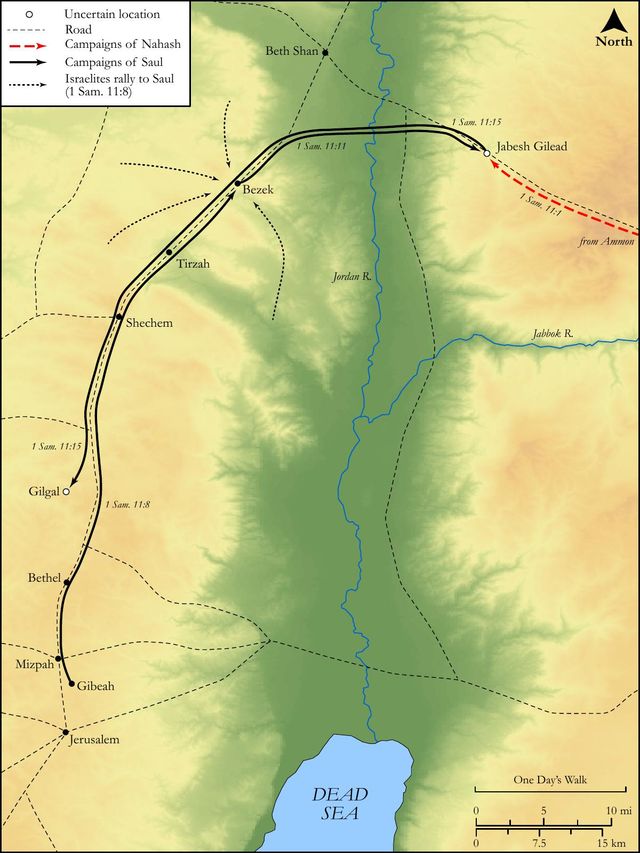
If he had been bred up to war from his youth, and had led regiments as often as he had followed droves, he could not have gone about an affair of this nature more dexterously nor more diligently. When the Spirit of the Lord comes upon men it will make them expert even without experience. A vast army (especially in comparison with the present usage) Saul had now at his foot, and a long march before him, nearly sixty miles, and over Jordan too. No cavalry in his army, but all infantry, which he divides into three battalions, Sa1 11:11. And observe,
1.With what incredible swiftness he flew to the enemy. In a day and a night he came to the place of action, where his own fate, and that of Israel, must be determined. He had passed his word, and would not break it; nay, he was better than his word, for he promised help next day, by that time the sun was hot (Sa1 11:9), but brought it before day, in the morning-watch, Sa1 11:11. Whom God helps he helps right early, Psa 46:5.
2.With what incredible bravery he flew upon the enemy. Betimes in the morning, when they lay dreaming of the triumphs they expected that day over the miserable inhabitants of Jabesh-Gilead, before they were aware he was in the midst of their host; and his men, being marched against them in three columns, surrounded them on every side, so that they could have neither heart nor time to make head against them.
Lastly, To complete his honour, God crowned all these virtues with success. Jabesh-Gilead was rescued, and the Ammonites were totally routed; he had now the day before him to complete his victory in, and so complete a victory it was that those who remained, after a great slaughter, were scattered so that two of them were not left together to encourage or help one another, Sa1 11:11. We may suppose that Saul was the more vigorous in this matter, 1. Because there was some alliance between the tribe of Benjamin and the city of Jabesh-Gilead. That city had declined joining with the rest of the Israelites to destroy Gibeah, which was then punished as their crime, but perhaps was now remembered as their kindness, when Saul of Gibeah came with so much readiness and resolution to relieve Jabesh-Gilead. Yet that was not all; two-thirds of the Benjamites that then remained were provided with wives from that city (Jdg 21:14), so that most of the mothers of Benjamin were daughters of Jabesh-Gilead, for which city Saul, being a Benjamite, had therefore a particular kindness; and we find they returned his kindness, Sa1 31:11, Sa1 31:12. 2. Because it was the Ammonites' invasion that induced the people to desire a king (so Samuel says, Sa1 12:12), so that if he had not done his part, in this expedition, he would have disappointed their expectations, and for ever forfeited their respect.
Historical interpretation
Historical reception
1 surviving comment on this verse from the historical church.
And you shall do to us everything that pleases you. They said, being glad this night, although a conflict was approaching, those who knew most certainly that the morning of faith was approaching, would soon be pleasing to the enemies, not adverse to the punishments of truth by the syllogisms, but seeking only the comforts of fleeing and returning to their own darkness.
Continue studying 1 Samuel 11:10 across the web’s major study libraries — every link below opens this exact verse, chapter, or book on the destination site.
Read & Compare
 BibleGatewayThis verse in more than 200 translations and 70 languages.
 Bible.comThe YouVersion reader — hundreds of translations, reading plans, and highlights.
 ESV.orgCrossway's official English Standard Version reader.
 NET BibleThe NET translation with 60,000+ translators' notes on every rendering decision.
 STEP BibleTyndale House's free study tool — original text, vocabulary, and scholarly resources.
 BibliaLogos Bible Software's free web reader.
 USCCBThe New American Bible (Revised Edition) with the U.S. bishops' study notes.
Commentaries
 BibleHub CommentariesDozens of classic commentaries on this verse, gathered on one page.
 StudyLightMore than 100 commentary sets — the largest collection on the web.
 BibleRefPlain-English commentary on what this verse means, verse by verse.
 Enduring WordDavid Guzik's free commentary on this chapter, widely used by Bible teachers.
 Bible Study ToolsVerse commentary alongside Greek and Hebrew study aids.
Original Language & Research
- BibleHub InterlinearThe verse word by word — original language, transliteration, and English.
- BibleHub LexiconEvery word's original-language definition and Strong's entry.
 Blue Letter BibleDeep-study tools — Strong's numbers, concordance, and word studies.
 SefariaThe Hebrew text with Rashi and centuries of Jewish commentary.
Sermons, Hymns & Audio


TrulyRandomVerse is not affiliated with these sites and doesn’t control their content. They’re linked because they’re genuinely useful.
Summary
1 Samuel 11:10 captures the strategic and deceptive response of the men of Jabesh-gilead to Nahash, the Ammonite king, who had laid siege to their city and issued a brutal ultimatum: the gouging out of their right eyes as a condition for a peace treaty. Having received a promise of imminent deliverance from Saul, Israel's newly anointed king, the men of Jabesh-gilead feigned complete and unconditional submission. Their declaration, "Tomorrow we will come out unto you, and ye shall do with us all that seemeth good unto you," was a masterful ruse designed to lull Nahash into a false sense of security, buying crucial time for Saul's army to arrive and execute a devastating surprise attack, thereby transforming apparent capitulation into a prelude to a miraculous and decisive victory.
Context
ShowHideLiterary Context
This verse is a pivotal moment within the broader narrative of Saul's emergence as Israel's first king and his initial act of national deliverance. It immediately follows Saul's Spirit-empowered response to the desperate plea from Jabesh-gilead. The preceding verses (1 Samuel 11:1-4) detail Nahash's cruel demands and the despair of the besieged city. The seven-day reprieve granted to Jabesh-gilead (1 Samuel 11:3) is the temporal window that allows for Saul's dramatic intervention. Saul, filled with the Spirit of God (1 Samuel 11:6), rallies Israel with a powerful, symbolic act (1 Samuel 11:7) and sends messengers back to Jabesh-gilead with his promise of deliverance "tomorrow" (1 Samuel 11:9). Thus, 1 Samuel 11:10 is the calculated, deceptive reply of Jabesh-gilead to Nahash, directly setting the stage for the climactic, victorious battle described in 1 Samuel 11:11. This strategic deception highlights the recurring biblical motif of divine strength manifesting through apparent weakness or cunning.
Historical & Cultural Context
The Ammonites were a formidable and often hostile neighbor to Israel, frequently engaging in raids and oppression, as evidenced during the period of the Judges (Judges 10:7-9). Nahash's demand to gouge out the right eyes of the men of Jabesh-gilead was not merely an act of cruelty but a calculated military and psychological tactic common in the warfare of the nations round about. Such mutilation would effectively disable soldiers (making it impossible to hold a shield in the left hand and wield a sword effectively with the right) and serve as a public spectacle of humiliation and a deterrent to other potential rebels. Jabesh-gilead, located east of the Jordan River, held significant historical ties to the tribe of Benjamin (Judges 21:8-14), Saul's own tribe, which likely fueled Saul's swift and personal response. The declaration of surrender "tomorrow" was a culturally understood diplomatic maneuver in siege warfare, often signaling the end of resistance. The men of Jabesh-gilead skillfully subverted this cultural expectation, leveraging Nahash's anticipated easy victory for their strategic advantage.
Key Themes
ShowHideThis verse powerfully contributes to several foundational themes within 1 Samuel and the broader biblical narrative. Firstly, it underscores the theme of Divine Deliverance through Human Agency. While God empowers Saul, it is through the strategic wisdom and courage of the men of Jabesh-gilead, coupled with Saul's decisive leadership, that deliverance is achieved, illustrating God's sovereign use of human means. Secondly, the verse highlights Strategic Wisdom in Adversity. Faced with an unthinkable ultimatum, the men of Jabesh-gilead choose cunning and patience over immediate despair or futile resistance. Their feigned surrender is a testament to the wisdom that can be found even in desperate circumstances, demonstrating their trust in a promised, albeit unseen, rescue, echoing the principle found in Proverbs 21:30. Thirdly, it emphasizes Saul's Inaugural Leadership and Divine Anointing. This event serves as Saul's first major test as king, and his successful rallying of Israel and subsequent victory confirm his anointing and establish his authority, fulfilling the expectation of a deliverer king promised in 1 Samuel 9:16. Finally, the narrative showcases the theme of Hope in Despair, as the people of Jabesh-gilead cling to the promise of help, even when their outward actions suggest resignation, a hope that aligns with the trust encouraged in Psalm 37:5.
Exposition and Analysis
ShowHideKey Word Analysis
ShowHideMeaning "properly, deferred, i.e. the morrow; usually (adverbially) tomorrow; indefinitely, hereafter." In this context, "tomorrow" carries immense strategic weight. For Nahash, it signifies the imminent future of Jabesh-gilead's complete surrender and his easy triumph. For the men of Jabesh-gilead and the audience, it signifies the precise, imminent moment of Saul's promised intervention and their miraculous deliverance. This temporal marker creates a critical window of anticipation and sets up the dramatic irony of the narrative.
Meaning "good (as an adjective) in the widest sense; used likewise as a noun... beautiful, best, better, bountiful, cheerful, at ease, fair (word), (be in) favour, fine, glad, good (deed, -lier, -liest, -ly, -ness, -s), graciously, joyful, kindly, kindness, liketh (best), loving, merry, most, pleasant, pleaseth, pleasure, precious, prosperity, ready, sweet, wealth, welfare, (be) well(-favoured)." The phrase "all that seemeth good unto you" (literally, "all the good in your eyes") is a conventional expression of complete submission to a conqueror's will, as when the Gibeonites said to Joshua, "as it seemeth good and right unto thee to do unto us, do." However, in this verse, the word "good" is imbued with profound irony. The men of Jabesh-gilead are not genuinely submitting to Nahash's "good" (which would be their mutilation and enslavement); rather, they are using this culturally understood formula to deceive him, knowing that their true "good" (deliverance by Saul) is imminent and entirely contrary to Nahash's intentions.
A primitive root meaning "to go (causatively, bring) out, in a great variety of applications, literally and figuratively, direct and proxim.; after, appear, assuredly, bear out, begotten, break out, bring forth (out, up), carry out, come (abroad, out, thereat, without), be condemned, depart(-ing, -ure), draw forth, in the end, escape, exact, fail, fall (out), fetch forth (out), get away (forth, hence, out), (able to, cause to, let) go abroad (forth, on, out), going out, grow, have forth (out), issue out, lay (lie) out, lead out, pluck out, proceed, pull out, put away, be risen, scarce, send with commandment, shoot forth, spread, spring out, stand out, still, surely, take forth (out), at any time, to (and fro), utter." The phrase "we will come out unto you" typically signifies the act of ending a siege by surrendering and exiting the city gates to face the conqueror. Here, it is a deliberate misdirection. While the men of Jabesh-gilead indeed intend to "come out," it will not be in submission, but as part of a coordinated attack with Saul's forces. This word, therefore, encapsulates the deceptive nature of their message, hinting at the unexpected outcome.
Verse Breakdown
ShowHide"Therefore the men of Jabesh said,"
This opening clause establishes the speaker and the immediate context of their declaration. Their words are a direct response to Nahash's ultimatum and, more importantly, a strategic move following Saul's promise of deliverance. It signals a calculated, rather than desperate, utterance.
"To morrow we will come out unto you,"
This is the tactical core of their deception. By setting a specific deadline for their supposed surrender, they create a false sense of security for Nahash, who would interpret this as the final act of capitulation. However, for the men of Jabesh-gilead, "tomorrow" is the promised day of salvation, the precise moment Saul's army is poised to strike, transforming an expected surrender into a surprise attack.
"and ye shall do with us all that seemeth good unto you."
This phrase is a conventional expression of complete and unconditional submission to a conqueror's will, as in the Gibeonites' words to Joshua. Its use here is a masterstroke of dramatic irony. The men of Jabesh-gilead verbally agree to terms they have no intention of fulfilling, leveraging Nahash's pride and overconfidence against him. They know that what "seems good" to Nahash (mutilation and conquest) will not come to pass; instead, what "seems good" to God (deliverance through Saul) will prevail, turning the tables on the oppressor.
Literary Devices
ShowHideThe primary literary device at play in this verse is Dramatic Irony. The audience, along with the men of Jabesh-gilead, are privy to the knowledge of Saul's impending arrival and the true meaning of "tomorrow," while Nahash remains entirely oblivious, believing he has secured an effortless victory. This creates significant tension and anticipation, as the reader awaits the inevitable clash between Nahash's false sense of security and Saul's devastating surprise attack. The phrase "all that seemeth good unto you" further amplifies this irony, as it is uttered as a sign of submission but is, in reality, a declaration of strategic defiance. Additionally, there is a strong element of Foreshadowing, as this seemingly submissive declaration implicitly points to the decisive victory that Saul will achieve on the very "tomorrow" they speak of, thereby establishing his kingship and validating his divine anointing.
Theological and Thematic Connections
ShowHideThe strategic deception employed by the men of Jabesh-gilead, while seemingly pragmatic, points to a deeper theological truth: God often works through unexpected means and empowers His people with wisdom to navigate seemingly impossible situations. Their "surrender" was not an act of despair, but an act of profound faith, trusting in Saul's promise which was, ultimately, God's provision. This echoes themes of divine timing and the sovereign hand of God orchestrating events for the deliverance of His people, even when circumstances appear bleak. It reminds us that appearances can be deceiving, and God's ultimate "good" for His people often unfolds in ways that initially seem counterintuitive or challenging, requiring patience and unwavering trust in His promised intervention.
Reflection and Application
ShowHideThe narrative of Jabesh-gilead and Saul's deliverance offers profound and enduring lessons for contemporary believers. We frequently encounter situations that feel overwhelming, where the demands of the world, personal trials, or the pressures of life seem to corner us into impossible choices, much like Nahash's cruel ultimatum. In such moments, this verse encourages us not to succumb to despair or rush into futile, self-reliant resistance, but rather to seek strategic wisdom and trust implicitly in God's perfect timing. The men of Jabesh-gilead's "tomorrow" was a calculated risk, an act of faith in a promise yet unseen and a deliverer not yet physically present. For us, this means holding fast to God's promises in Scripture, even when our immediate circumstances dictate otherwise. It teaches us that sometimes, waiting patiently, acting shrewdly with divine wisdom, and relying on God's sovereign intervention, rather than our own limited strength or immediate impulses, is the truest and most effective path to deliverance. Our "surrender" to God's will, even when it feels like a concession or a moment of weakness, can paradoxically be the very posture through which He orchestrates our greatest victories, turning apparent defeat into glorious triumph.
Questions for Reflection
ShowHideFAQ
ShowHideWas it morally acceptable for the men of Jabesh-gilead to lie to Nahash?
ShowHideThe question of the morality of deception in warfare or extreme circumstances is complex within biblical ethics. While the Bible generally condemns lying and falsehood (Proverbs 12:22), there are instances where deception is employed by biblical figures (e.g., Rahab in Joshua 2:1-7, the Hebrew midwives in Exodus 1:15-21) and is presented within the narrative as contributing to God's redemptive purposes or the protection of His people. In this specific context, the men of Jabesh-gilead were under an existential threat, facing a cruel and unjust demand for mutilation. Their deception was a strategic act of self-preservation and resistance against a hostile aggressor, aimed at facilitating a divinely promised deliverance. The narrative does not condemn their action but rather portrays it as a clever and necessary tactic that enabled Saul's successful intervention and the salvation of their city. This highlights that in extreme cases of warfare and defense against overt evil, conventional ethical rules can sometimes be nuanced by the larger context of justice, survival, and God's overarching plan.
Christ-Centered Fulfillment
ShowHideThe strategic "surrender" of the men of Jabesh-gilead, which ingeniously paved the way for Saul's triumphant deliverance, powerfully foreshadows the ultimate, paradoxical victory achieved through Christ's apparent weakness and willing surrender on the cross. Just as the men of Jabesh-gilead declared, "ye shall do with us all that seemeth good unto you," Jesus, the true King of Israel and the Son of God, willingly submitted to the will of His Father and the evil intentions of sinful humanity, allowing Himself to be crucified (Philippians 2:8). His death, which appeared to be the ultimate defeat and an act of absolute submission to the powers of darkness and sin, was in fact the divinely orchestrated "tomorrow" of ultimate deliverance for all humanity. Through this seeming surrender, Christ disarmed the principalities and powers of evil (Colossians 2:15), conquered sin and death, and secured eternal salvation for all who believe. His cry, "It is finished" (John 19:30), was not a cry of defeat but a triumphant declaration of the completion of His redemptive work, much like the deceptive words of Jabesh-gilead were a prelude to their unexpected triumph. Thus, 1 Samuel 11:10 points to the profound truth that God's greatest victories are often achieved through what appears to be weakness, submission, or even death, culminating in the resurrection of Christ and the establishment of His eternal kingdom (1 Corinthians 15:54-57).