


1 Samuel 11:3
Bible text: King James Version (1769 Blayney text) · Public domain
Bible text: King James Version with Strong's numbers · Public domain
Bible text: Berean Standard Bible · Public domain
Bible text: American Standard Version (1901) · Public domain
Bible text: World English Bible, Messianic edition · Public domain
Bible text: Geneva Bible (1599) · Public domain
Bible text: Young's Literal Translation · Public domain
- וַיֹּאמְרוּvai·yo·me·Ruand they saidH559Conj-w ¦ V-Qal-ConsecImperf-3mpVerb Qal Consecutive Imperfect 3rd Plural Masculineוַandיֹּאמְרוּthey said
- אֵלָיו'e·Lavto himH413Prep ¦ 3msPreposition Definiteאֵלָיtoוhim
- זִקְנֵיzik·Nei[the] elders ofH2205Adj-mpcAdjective Plural Masculine Construct
- יָבֵישׁya·VeishJabeshH3003N-properNoun Proper Location
- הֶרֶףHe·refrefrainH7503V-Hiphil-Imp-2msVerb Hiphil Imperative 2nd Singular Masculine
- לָנוּla·nuto <the> usPrep-l ¦ 1cpSuffix Personal 1st Plural common genderלָto <the>נוּus
- שִׁבְעַתshiv·'AtsevenH7651N-cscNoun Singular common gender Construct
- יָמִיםya·MimdaysH3117N-mpNoun Plural Masculine Absolute
- וְנִשְׁלְחָהve·nish·le·Chahso let us sendH7971Conj-w ¦ V-Qal-Imperf-1cpVerb Qal Imperfect 1st Plural common genderוְsoנִשְׁלְחָהlet us send
- מַלְאָכִיםmal·'a·KhimmessengersH4397N-mpNoun Plural Masculine Absolute
- בְּכֹלbe·Kholin allH3605Prep-b ¦ N-mscNoun Singular Masculine Constructבְּinכֹלall
- גְּבוּלge·Vul[the] territory ofH1366N-mscNoun Singular Masculine Construct
- יִשְׂרָאֵלYis·ra·'ElIsraelH3478N-properNoun Proper Location
- וְאִםve·'imand ifH518Conj-w ¦ PrtParticle Conditionalוְandאִםif
- אֵין'einthere notH369N-mscNoun Singular Masculine Construct
- מוֹשִׁיעַmo·Shi·a'[is one who] deliversH3467V-Hiphil-Prtcpl-msVerb Hiphil Participle Singular Masculine Absolute
- אֹתָנוּ'o·Ta·nu<obj.> usH853DirObjM ¦ 1cpParticle Object Indicatorאֹתָ<obj.>נוּus
- וְיָצָאנוּve·ya·Tza·nuand we will come outH3318Conj-w ¦ V-Qal-ConsecPerf-1cpVerb Qal Consecutive Perfect 1st Plural common genderוְandיָצָאנוּwe will come out
- אֵלֶיךָ'e·Lei·khato youH413Prep ¦ 2msPreposition Definiteאֵלֶיtoךָyou
English is a literal word-by-word gloss of the Hebrew, not the KJV's wording. Why?
This is the original text the KJV's translators worked from — each Hebrew word with its own literal English meaning in this verse, prepared by scholars at Tyndale House, Cambridge. The KJV translates whole sentences, not word by word, so its wording differs: one Hebrew word can become several English words, and the KJV may choose “the LORD” where the gloss reads “Yahweh”. Both are faithful — they answer different questions. For the KJV's own rendering, switch to the KJV text.
Details
See on the biblical-era map
Study this verse
Public-domain commentary
Matthew Henry
From his Commentary on the Whole Bible. Henry comments on passages, not single verses — this entry covers 1 Samuel 11:1–4. His two-level outline is real structure in the source text, so it is rendered as structure.
The Ammonites were bad neighbours to those tribes of Israel that lay next them, though descendants from just Lot, and, for that reason, dealt civilly with by Israel. See Deu 2:19. Jephthah, in his time, had humbled them, but now the sin of Israel had put them into a capacity to make head again, and avenge that quarrel. The city of Jabesh-Gilead had been, some ages ago, destroyed by Israel's sword of justice, for not appearing against the wickedness of Gibeah (Jdg 21:10); and now being replenished again, probably by the posterity of those that then escaped the sword, it is in danger of being destroyed by the Ammonites, as if some bad fate attended the place. Nahash, king of Ammon (Ch1 19:1) laid siege to it. Now here,
I.The besieged beat a parley (Sa1 11:1):
"Make a covenant with us, and we will surrender upon terms, and serve thee." They had lost the virtue of Israelites, else they would not have thus lost the valour of Israelites, nor tamely yielded to serve an Ammonite, without one bold struggle for themselves. Had they not broken their covenant with God, and forsaken his service, they needed not thus to have courted a covenant with a Gentile nation, and offered themselves to serve them.
II.The besiegers offer them base and barbarous conditions; they will spare their lives, and take them to be their servants, upon condition that they shall put out their right eyes, Sa1 11:2. The Gileadites were content to part with their liberty and estates for the ransom of their blood; and, had the Ammonites taken them at their word, the matter would have been so settled immediately, and the Gileadites would not have sent out for relief. But their abject concessions make the Ammonites more insolent in their demands, and they cannot be content to have them for their servants, but,
1.They must torment them, and put them to pain, exquisite pain, for so the thrusting out of an eye would do.
2.They must disable them for war, and render them incapable, though not of labour (that would have been a loss to their lords), yet of bearing arms; for in those times they fought with shields in their left hands, which covered their left eye, so that a soldier without his right eye was in effect blind.
3.They must put a reproach upon all Israel, as weak and cowardly, that would suffer the inhabitants of one of their chief cities to be thus miserably used, and not offer to rescue them.
III.The besieged desire, and obtain, seven days' time to consider of this proposal, Sa1 11:3.
If Nahash had not granted them this respite, we may suppose the horror of the proposal would have made them desperate, and they would rather have died with their swords in their hands than have surrendered to such merciless enemies: therefore Nahash, not imagining it possible that, in so short a time, they should have relief, and being very secure of the advantages he thought he had against them, in a bravado gave them seven days, that the reproach upon Israel, for not rescuing them, might be the greater, and his triumphs the more illustrious. But there was a providence in it, that his security might be his infatuation and ruin.
IV.Notice is sent of this to Gibeah.
They said they would send messengers to all the coasts of Israel (Sa1 11:3), which made Nahash the more secure, for that, he thought, would be a work of time, and none would be forward to appear if they had not one common head; and perhaps Nahash had not yet heard of the new-elected king. But the messengers, either of their own accord or by order from their masters, went straight to Gibeah, and, not finding Saul within, told their news to the people, who fell a weeping upon hearing it, Sa1 11:4. They would sooner lament their brethren's misery and danger than think of helping them, shed their tears for them than shed their blood. They wept, as despairing to help the men of Jabesh-Gilead, and fearing lest, if that frontier-city should be lost, the enemy would penetrate into the very bowels of their country, which now appeared in great hazard.
Historical interpretation
Historical reception
1 surviving comment on this verse from the historical church.
And the elders of Jabesh said to him, etc. The more prudent and cautious ones in faith said to the heretics, in whom they recognized the voice of the dragon, the ancient serpent, who is the devil and Satan, just as Christ spoke differently in Paul and his followers: Do not force us to believe your new doctrine until, in seeking the light of the Holy Spirit, who was given to the sevenfold Church, we have thoroughly examined the writings of the Fathers; and if in them there is no one who defends our faith, we will come out to you, and, abandoning the Catholic unity which is within, we will instead join you, who have long since gone out from it and now attack it from outside, and we will listen as it is also read against us in it. They went out from us, but they were not of us: for if they had been of us, they would no doubt have continued with us (1 John 2). These things they spoke not with any intention of assenting to the heretics, but being most certain of the paternal faith, they intended to conquer them by the just reasoning of their argument. This is similar to what the Psalmist says: If I have returned evil to those who rewarded me, I will fall empty by my enemies (Psalm 7). And what the Apostle says: For if the dead do not rise, then Christ is not risen. And if Christ is not risen, then our faith is in vain, our preaching is also in vain. And we are found to be false witnesses of God, because we have testified against God that He raised up Christ; whom He did not raise if the dead do not rise (1 Corinthians 15). These things were said not so that either the resurrection of Christ is denied, or the prophet is taught to return evil to those who rewarded him; but that by means of those things which could not be proven false, also those things about which there was doubt might be established as true.
Continue studying 1 Samuel 11:3 across the web’s major study libraries — every link below opens this exact verse, chapter, or book on the destination site.
Read & Compare
 BibleGatewayThis verse in more than 200 translations and 70 languages.
 Bible.comThe YouVersion reader — hundreds of translations, reading plans, and highlights.
 ESV.orgCrossway's official English Standard Version reader.
 NET BibleThe NET translation with 60,000+ translators' notes on every rendering decision.
 STEP BibleTyndale House's free study tool — original text, vocabulary, and scholarly resources.
 BibliaLogos Bible Software's free web reader.
 USCCBThe New American Bible (Revised Edition) with the U.S. bishops' study notes.
Commentaries
 BibleHub CommentariesDozens of classic commentaries on this verse, gathered on one page.
 StudyLightMore than 100 commentary sets — the largest collection on the web.
 BibleRefPlain-English commentary on what this verse means, verse by verse.
 Enduring WordDavid Guzik's free commentary on this chapter, widely used by Bible teachers.
 Bible Study ToolsVerse commentary alongside Greek and Hebrew study aids.
Original Language & Research
- BibleHub InterlinearThe verse word by word — original language, transliteration, and English.
- BibleHub LexiconEvery word's original-language definition and Strong's entry.
 Blue Letter BibleDeep-study tools — Strong's numbers, concordance, and word studies.
 SefariaThe Hebrew text with Rashi and centuries of Jewish commentary.
Sermons, Hymns & Audio


TrulyRandomVerse is not affiliated with these sites and doesn’t control their content. They’re linked because they’re genuinely useful.
Summary
In a moment of profound desperation and strategic ingenuity, the elders of Jabesh-Gilead, facing a horrific ultimatum of mutilation from Nahash the Ammonite, plead for a critical seven-day reprieve. This brief window of time is not sought for negotiation, but as a final, desperate attempt to rally the scattered tribes of Israel, sending messengers throughout their territories in the faint hope that a deliverer might emerge to save them from inevitable surrender and disgrace, thereby transforming a local crisis into a national call to action.
Context
ShowHideLiterary Context
This verse serves as a pivotal moment in the narrative of Saul's nascent kingship, immediately following the brutal terms offered by Nahash the Ammonite in 1 Samuel 11:1-2. Nahash's demand to gouge out the right eye of every man of Jabesh-Gilead precipitates the elders' plea for a seven-day delay, which directly sets the stage for Saul's dramatic emergence as a Spirit-empowered military leader. The subsequent verses, particularly 1 Samuel 11:4-7, detail the messengers' arrival in Gibeah, the people's weeping, and Saul's righteous anger and decisive call to arms. The victory that follows this plea not only saves Jabesh-Gilead but also serves to validate Saul's anointing and solidify his position as king in the eyes of all Israel, fulfilling the divine appointment hinted at in 1 Samuel 10:1. Thus, 1 Samuel 11:3 functions as the narrative catalyst, transforming a localized threat into a national test of leadership and unity.
Historical & Cultural Context
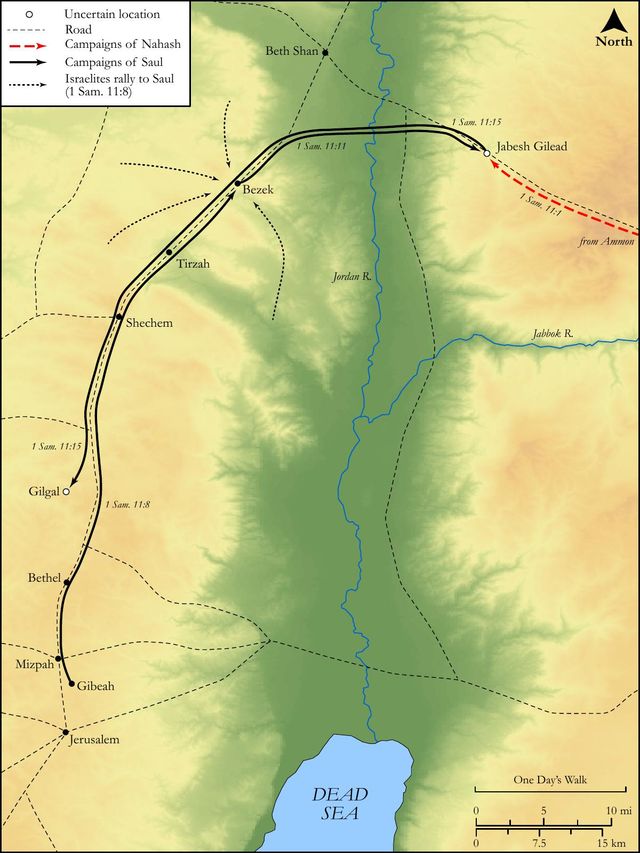
Jabesh-Gilead was a city located east of the Jordan River, maintaining a significant historical and tribal connection to Benjamin, as vividly recounted in Judges 21. Its strategic location made it particularly vulnerable to incursions from the Ammonites, a long-standing and often hostile neighbor of Israel. Nahash's demand to gouge out the right eyes of the men was a common, albeit horrific, tactic in the warfare of the nations round about, designed not merely to incapacitate but primarily to inflict profound humiliation and disgrace upon the conquered, rendering them unfit for battle and a permanent, visible symbol of their subjugation. The elders' desperate plan to send messengers "unto all the coasts of Israel" reflects the prevailing reality of Israel as a loose tribal confederacy, even with the recent anointing of Saul as king. There was no established standing army or immediate central authority to appeal to, necessitating a desperate plea for tribal solidarity and a deliverer from within the scattered communities.
Key Themes
ShowHideThe verse powerfully encapsulates several key themes prevalent in the book of 1 Samuel. Foremost is the theme of desperation and the urgent need for a deliverer. The city's dire plight highlights Israel's vulnerability without strong, unified leadership, a primary reason for their earlier request for a king in 1 Samuel 8. The elders' appeal to "all the coasts of Israel" underscores the crucial theme of national unity and tribal solidarity, a concept frequently tested but vital for Israel's survival and identity as God's covenant people. It also subtly introduces the theme of divine providence working through human agency, as their desperate plea ultimately provides the precise opportunity for Saul, whom God had already chosen, to demonstrate his leadership and secure his position as the divinely appointed king. The grim alternative of "no man to save us" emphasizes the profound stakes of the covenant community's faithfulness and God's sovereign intervention in their history, often in response to their cries for help, as seen throughout the period of the Judges (e.g., Judges 2:16).
Exposition and Analysis
ShowHideKey Word Analysis
ShowHideThis term refers to "old" or "aged" individuals, often implying wisdom, authority, and leadership within a community. In this context, the "elders of Jabesh" are the recognized leaders and representatives of the city, whose collective voice carries weight and whose decision-making reflects the will and desperation of the entire populace. Their role underscores the formal and grave nature of the plea being made to Nahash.
This word literally means "boundary" or "territory." When the elders propose to send messengers "unto all the coasts of Israel," they are referring to the entire geographical extent of the Israelite tribal territories, from Dan to Beersheba. This signifies their comprehensive and desperate attempt to reach every corner of the nation, appealing to a deep-seated sense of shared identity and responsibility that transcended immediate tribal loyalties, in the hope of finding a collective and national response to their crisis.
This primitive root means "to be open, wide or free," and by implication, "to be safe." Causatively, it means "to free or succor." The elders' desperate cry for "no man to save us" highlights their utter helplessness and their profound need for deliverance from the Ammonite threat. This word carries significant theological weight, as "salvation" (derived from this root) is a core concept throughout the Old Testament, pointing ultimately to God as the ultimate Deliverer.
Verse Breakdown
ShowHide"And the elders of Jabesh said unto him"
This phrase identifies the authoritative voice of the besieged city, its leaders, who formally address Nahash the Ammonite. This direct communication establishes the immediate context of a desperate plea from the vulnerable to the powerful aggressor.
"Give us seven days' respite"
This is the core request, a specific and limited period of delay. The duration of "seven days" is both practical—allowing time for messengers to travel and for a response to be organized across a dispersed nation—and symbolic, perhaps implying a complete or final chance. It is a plea for time, not for mercy or a renegotiation of the brutal terms.
"that we may send messengers unto all the coasts of Israel"
This clause reveals the strategic purpose behind the requested delay. The elders' plan is to appeal to a broader national consciousness and tribal solidarity, hoping that the collective identity and shared vulnerability of Israel would compel other tribes to come to their aid. It demonstrates their understanding that their local crisis was, in fact, a national affront and required a national response.
"and then, if [there be] no man to save us, we will come out to thee"
This concluding clause starkly presents the grim alternative and underscores the profound desperation of Jabesh-Gilead. It is a conditional surrender, openly admitting their utter helplessness and willingness to submit to the horrific terms if no external aid materializes. The phrase "no man to save us" emphasizes their complete dependence on a deliverer, highlighting the vacuum of strong, unified leadership and the dire need for someone to rise to the occasion.
Literary Devices
ShowHideThe verse employs several potent literary devices. Foreshadowing is prominently featured, as the elders' desperate plea for a "man to save us" directly sets the stage for the emergence of Saul, who, empowered by the Spirit of God, will indeed rise as that deliverer in the very next verses. There is a strong element of dramatic irony, as the elders of Jabesh-Gilead are unaware that the very king who will save them has already been anointed, though his authority is not yet fully established or recognized by all. Their plea is made in ignorance of the divine plan already in motion. The narrative also utilizes contrast by juxtaposing the extreme vulnerability and desperation of Jabesh-Gilead with the potential power and unity of "all the coasts of Israel," thereby magnifying the stakes and highlighting the urgent need for a unifying leader. This stark contrast underscores the precarious state of Israel during this transitional period from a loose tribal confederacy to a monarchy.
Theological and Thematic Connections
ShowHideThe desperate plea of Jabesh-Gilead in 1 Samuel 11:3 profoundly illustrates the human condition when faced with overwhelming odds and the apparent absence of immediate help. It speaks to the theological truth that while God often allows His people to reach points of utter helplessness, it is precisely in these moments that His power is most clearly demonstrated, often through unexpected means and human instruments. The elders' act of sending messengers, though seemingly a human strategy, reflects a deep-seated, albeit perhaps unarticulated, hope that God would raise up a deliverer, even if they didn't know who or how. This reliance on a broader community for rescue, and ultimately on God's intervention, mirrors the biblical pattern of God's people crying out in distress and God responding, often through chosen leaders or unexpected events. It highlights God's sovereignty over human affairs, working through the natural consequences of human choices (like the demand for a king) to fulfill His redemptive purposes and demonstrate His faithfulness to His covenant people.
Reflection and Application
ShowHideThe plight of Jabesh-Gilead and its elders in 1 Samuel 11:3 offers a powerful mirror for our own experiences of desperation and the search for rescue. When confronted with overwhelming challenges, impossible deadlines, or seemingly insurmountable threats, it is natural to feel a profound sense of helplessness and fear. This verse encourages us not to succumb to despair immediately but to exhaust all avenues, even if they seem like a "last resort." The elders' decision to send messengers throughout Israel, despite the slim odds, speaks to the importance of seeking help from our community, from those who share our faith and values, and from those whom God might use as instruments of His grace. It reminds us that even a small window of opportunity, a "seven days' respite," can be precisely what God uses to orchestrate a miraculous intervention. Our responsibility is to cry out, to seek help, and to trust that God is able to raise up a deliverer, often from unexpected places, to meet our deepest needs. This narrative invites us to cultivate a posture of hopeful dependence, recognizing that our ultimate salvation comes from a source greater than ourselves, and that even in our darkest moments, God is at work, preparing a way.
Questions for Reflection
ShowHideFAQ
ShowHideWhy did Nahash demand the right eye specifically, and what was the significance of this act?
ShowHideNahash's demand to gouge out the right eye of every man of Jabesh-Gilead, as mentioned in 1 Samuel 11:2, was a deliberate act of profound humiliation and strategic incapacitation. In ancient warfare, warriors typically held a shield in their left hand, protecting their left side and allowing their right eye to observe and aim. By removing the right eye, Nahash would effectively render the men of Jabesh-Gilead useless in battle, unable to fight effectively or defend themselves. Beyond the practical military disadvantage, it was a public display of utter subjugation and a lasting mark of disgrace, intended to break the spirit of the people and serve as a warning to all of Israel about the consequences of resisting Ammonite power. It was a more humiliating fate than death, as it would force them to live as a perpetual symbol of their defeat and a constant reminder of Ammonite dominance.
Why did the elders request exactly "seven days' respite"?
ShowHideThe request for "seven days' respite" was likely a combination of practical necessity and symbolic significance. Practically, seven days would have been a reasonable amount of time for messengers to travel throughout the scattered territories of Israel, deliver their urgent plea, and for a response to be organized and mobilized. Given the geographical spread of the tribes and the lack of modern communication, a shorter period would have been insufficient for a national appeal. Symbolically, the number seven often represents completeness, perfection, or a divinely appointed period in biblical contexts. In this desperate plea, it might signify that they were asking for a full, complete, and final opportunity to seek help before facing their inevitable doom. It was a last-ditch, comprehensive effort to appeal to the entire nation, trusting that within that "perfect" window, God might act.
Christ-Centered Fulfillment
ShowHideThe desperate cry of Jabesh-Gilead for "no man to save us" profoundly foreshadows humanity's ultimate spiritual predicament and the glorious intervention of Jesus Christ. Just as Jabesh-Gilead faced an insurmountable enemy and a horrific physical fate, humanity, in its fallen state, is besieged by sin and death, facing eternal spiritual mutilation and separation from God. The elders' plea for a deliverer, a "man to save us," finds its perfect and ultimate fulfillment in the person of Jesus Christ. While Saul, empowered by the Spirit, temporarily delivered Israel from a physical enemy, he was an imperfect king, a mere shadow of the true Deliverer. Jesus is the ultimate Lamb of God, who takes away the sin of the world, the one true "man" (fully human) who is also fully God, uniquely qualified to rescue us from a far greater enemy than Nahash. His sacrifice on the cross provides not just a "respite" but eternal salvation, a complete and final deliverance from the power of sin and death, as celebrated in passages like Romans 5:8 and Hebrews 2:14-15. The collective appeal of Jabesh-Gilead for help from "all the coasts of Israel" can be seen as a type of the Church, the body of Christ, which continually looks to its Head, Jesus, for salvation and strength, knowing that He is able to save completely those who come to God through Him, and that there is salvation in no one else.