


2 Samuel 8:4
- וַיִּלְכֹּדvai·yil·Kodand he capturedH3920Conj-w ¦ V-Qal-ConsecImperf-3msVerb Qal Consecutive Imperfect 3rd Singular Masculineוַandיִּלְכֹּדhe captured
- דָּוִדda·VidDavidH1732N-proper-mNoun Proper Masculine
- מִמֶּנּוּmi·Me·nufrom himH4480Prep ¦ 3msPreposition Definiteמִמֶּfromנּוּhim
- אֶלֶף'E·lefone thousandH505N-csNoun Singular common gender Absolute
- וּשְׁבַעu·she·va'and sevenH7651Conj-w ¦ N-cscNoun Singular common gender Constructוּandשְׁבַעseven
- מֵאוֹתme·'Othundred<s>H3967N-fpNoun Plural Feminine Absolute
- פָּרָשִׁיםpa·ra·ShimhorsemenH6571N-mpNoun Plural Masculine Absolute
- וְעֶשְׂרִיםve·'es·Rimand twentyH6242Conj-w ¦ N-mpNoun Plural Masculine Absoluteוְandעֶשְׂרִיםtwenty
- אֶלֶף'E·lefthousandH505N-csNoun Singular common gender Absolute
- אִישׁ'ishmanH376N-msNoun Singular Masculine Absolute
- רַגְלִיrag·Lion footH7273Adj-msAdjective Singular Masculine Absolute
- וַיְעַקֵּרvay·'a·Kerand he hamstrungH6131Conj-w ¦ V-Piel-ConsecImperf-3msVerb Piel Consecutive Imperfect 3rd Singular Masculineוַandיְעַקֵּרhe hamstrung
- דָּוִדda·VidDavidH1732N-proper-mNoun Proper Masculine
- אֶת'et<obj.>H853DirObjMParticle Object Indicator
- כָּלkolallH3605N-mscNoun Singular Masculine Construct
- הָרֶכֶבha·Re·khevthe chariotryH7393Art ¦ N-msNoun Singular Masculine Absoluteהָtheרֶכֶבchariotry
- וַיּוֹתֵרvai·yo·Terand he leftH3498Conj-w ¦ V-Hiphil-ConsecImperf-3msVerb Hiphil Consecutive Imperfect 3rd Singular Masculineוַandיּוֹתֵרhe left
- מִמֶּנּוּmi·Me·nuof itH4480Prep ¦ 3msPreposition Definiteמִמֶּofנּוּit
- מֵאָהMe·'ahone hundredH3967N-fsNoun Singular Feminine Absolute
- רָכֶבRa·khevchariot[s]H7393N-msNoun Singular Masculine Absolute
English is a literal word-by-word gloss of the Hebrew, not the KJV's wording. Why?
This is the original text the KJV's translators worked from — each Hebrew word with its own literal English meaning in this verse, prepared by scholars at Tyndale House, Cambridge. The KJV translates whole sentences, not word by word, so its wording differs: one Hebrew word can become several English words, and the KJV may choose “the LORD” where the gloss reads “Yahweh”. Both are faithful — they answer different questions. For the KJV's own rendering, switch to the KJV text.
Details
See on the biblical-era map
Study this verse
Public-domain commentary
Matthew Henry
From his Commentary on the Whole Bible. Henry comments on passages, not single verses — this entry covers 2 Samuel 8:1–8. His two-level outline is real structure in the source text, so it is rendered as structure.
God had given David rest from all his enemies that opposed him and made head against him; and he having made a good use of that rest, has now commission given him to make war upon them, and to act offensively for the avenging of Israel's quarrels and the recovery of their rights; for as yet they were not in full possession of that country to which by the promise of God they were entitled.
I.He quite subdued the Philistines, Sa2 8:1.
They had attacked him when they thought him weak (Sa2 5:17), and went by the worst then; but, when he found himself strong, he attacked them, and made himself master of their country. They had long been vexatious and oppressive to Israel. Saul got no ground against them; but David completed Israel's deliverance out of their hands, which Samson had begun long before, Jdg 13:5. Metheg-ammah was Gath (the chief and royal city of the Philistines) and the towns belonging to it, among which there was a constant garrison kept by the Philistines on the hill Ammah (Sa2 2:24), which was Metheg, a bridle (so it signifies) or curb upon the people of Israel; this David took out of their hand and used it as a curb upon them. Thus, when the strong man is disarmed, the armour wherein he trusted is taken from him, and used against him, Luk 11:22. And after the long and frequent struggles which the saints have had with the powers of darkness, like Israel with the Philistines, the Son of David shall tread them all under their feet and make the saints more than conquerors.
II.He smote the Moabites, and made them tributaries to Israel, Sa2 8:2.
He divided the country into three parts, two of which he destroyed, casting down the strong-holds, and putting all to the sword; the third part he spared, to till the ground and be servants to Israel. Dr. Lightfoot says, "He laid them on the ground and measured them with a cord, who should be slain and who should live;" and this is called meting out the valley of Succoth, Psa 60:6. The Jews say he used this severity with the Moabites because they had slain his parents and brethren, whom he put under the protection of the king of Moab during his exile, Sa1 22:3, Sa1 22:4. He did it in justice, because they had been dangerous enemies to the Israel of God; and in policy, because, if left in their strength, they still would have been so. But observe, Though it was necessary that two-thirds should be cut off, yet the line that was to keep alive, though it was but one, is ordered to be a full line. Be sure to give that length enough; let the line of mercy be stretched to the utmost in favorem vitae - so as to favour life. Acts of indemnity must be construed so as to enlarge the favour. Now Balaam's prophecy was fulfilled, A sceptre shall arise out of Israel, and shall smite the corners of Moab, to the utmost of which the fatal line extended, Num 24:17. The Moabites continued tributaries to Israel till after the death of Ahab, Kg2 3:4, Kg2 3:5. Then they rebelled and were never reduced.
III.He smote the Syrians or Aramites.
Of them there were two distinct kingdoms, as we find them spoken of in the title of the 60th Psalm: Aram Naharaim, - Syria of the rivers, whose head city was Damascus (famed for its rivers, Kg2 5:12), and Aram Zobah, which joined to it, but extended to Euphrates. These were the two northern crowns.
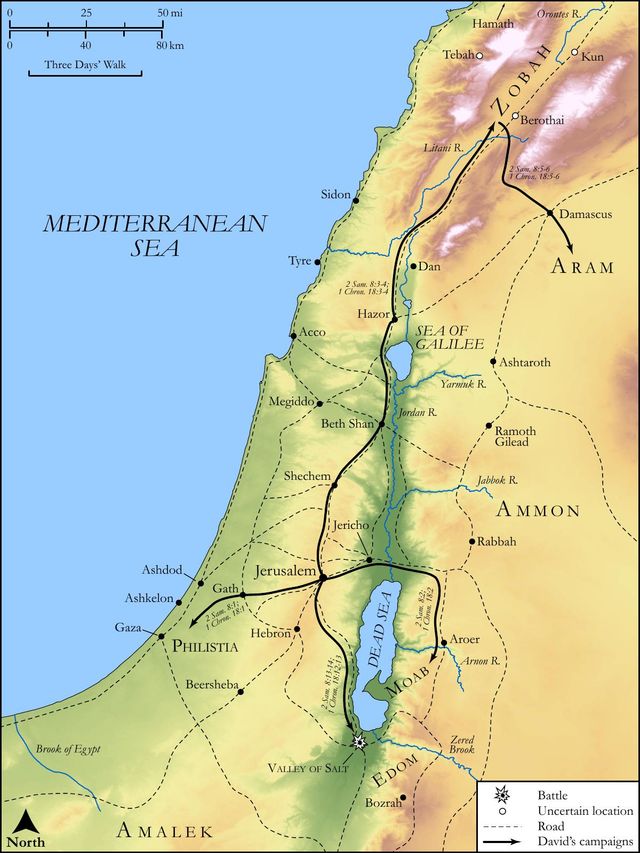
1.David began with the Syrians of Zobah, Sa2 8:3, Sa2 8:4. As he went to settle his border at the river Euphrates (for so far the land conveyed by the divine grant to Abraham and his seed did extend, Gen 15:18), the king of Zobah opposed him, being himself possessed of those countries which belonged to Israel; but David routed his forces, and took his chariots and horsemen. The horsemen are here said to be 700, but Ch1 18:4 they are said to be 7000. If they divided their horse by ten in a company, as it is probable they did, the captains and companies were 700, but the horsemen were 7000. David houghed the horses, cut the sinews of their hams, and so lamed them, and made them unserviceable, at least in war, God having forbidden them to multiply horses, Deu 17:16. David reserved only 100 chariots out of 1000 for his own use: for he placed his strength not in chariots nor horses, but in the living God (Psa 20:7), and wrote it from his own observation that a horse is a vain thing for safety, Psa 33:16, Psa 33:17.
2.The Syrians of Damascus coming in to the relief of the king of Zobah fell with him. 22,000 were slain in the field, Sa2 8:5. So that it was easy for David to make himself master of the country, and garrison it for himself, Sa2 8:6. The enemies of God's church, that think to secure themselves, will prove, in the end, to ruin themselves, by their confederacies with each other. Associate yourselves, and you shall be broken in pieces, Isa 8:9.
IV.In all these wars,
1.David was protected: The Lord preserved him whithersoever he went. It seems, he went in person, and, in the cause of God and Israel, jeoparded his own life in the high places of the field; but God covered his head in the day of battle, which he often speaks of, in his psalms, to the glory of God.
2.He was enriched. He took the shields of gold which the servants of Hadadezer had in their custody (Sa2 8:7) and much brass from several cities of Syria (Sa2 8:8), which he was entitled to, not only jure belli - by the uncontrollable right of the longest sword ("Get it, and take it"); but by commission from heaven, and the ancient entail of these countries on the seed of Abraham.
Historical interpretation
Two Centuries of Reception
2 surviving comments on this verse. Each one is dated, so this reads as a timeline rather than a list.
Select a marker to jump to its quote. Markers stagger vertically where authors wrote within a few decades of each other.
In the second book of Kings [Samuel], where David defeated the Moabites, Scripture records the measuring out of two separate lines for life and two for death. The significance of setting aside some Moabites for life and others for death is made clear by the story of Orpah and Ruth. Orpah, who turned back to idolatry and her ancient country, was destined for death; Ruth, following her mother-in-law, whose name means “pleasant,” says, “Your people shall be my people, and your God my God.”
The history of the Kings [Samuel] recounts that David won these victories after he succeeded Saul in the kingship, and it seems inappropriate to introduce them into our ordered arrangement here since they are known to be recounted extensively there. But we must realize that these wars are a description in figure of the Lord Savior’s victories which he wins throughout the whole world over pagans and the faithless. It is their words which this psalm will utter, so that when truly dislodged from their old superstition they may deserve to be changed through the grace of the new man.
Continue studying 2 Samuel 8:4 across the web’s major study libraries — every link below opens this exact verse, chapter, or book on the destination site.
Read & Compare
 BibleGatewayThis verse in more than 200 translations and 70 languages.
 Bible.comThe YouVersion reader — hundreds of translations, reading plans, and highlights.
 ESV.orgCrossway's official English Standard Version reader.
 NET BibleThe NET translation with 60,000+ translators' notes on every rendering decision.
 STEP BibleTyndale House's free study tool — original text, vocabulary, and scholarly resources.
 BibliaLogos Bible Software's free web reader.
 USCCBThe New American Bible (Revised Edition) with the U.S. bishops' study notes.
Commentaries
 BibleHub CommentariesDozens of classic commentaries on this verse, gathered on one page.
 StudyLightMore than 100 commentary sets — the largest collection on the web.
 BibleRefPlain-English commentary on what this verse means, verse by verse.
 Enduring WordDavid Guzik's free commentary on this chapter, widely used by Bible teachers.
 Bible Study ToolsVerse commentary alongside Greek and Hebrew study aids.
Original Language & Research
- BibleHub InterlinearThe verse word by word — original language, transliteration, and English.
- BibleHub LexiconEvery word's original-language definition and Strong's entry.
 Blue Letter BibleDeep-study tools — Strong's numbers, concordance, and word studies.
 SefariaThe Hebrew text with Rashi and centuries of Jewish commentary.
Sermons, Hymns & Audio


TrulyRandomVerse is not affiliated with these sites and doesn’t control their content. They’re linked because they’re genuinely useful.
Summary
Second Samuel 8:4 meticulously records King David's decisive actions following his significant victory over Hadadezer, king of Zobah. After capturing a formidable array of military assets—specifically, a thousand chariots, seven hundred horsemen, and twenty thousand footmen—David made a remarkable and counter-cultural strategic choice: he intentionally "houghed" (hamstrung) the vast majority of the captured chariot horses, reserving only a hundred. This act was not merely a pragmatic disarmament but a profound theological statement, signifying David's unwavering reliance on God for Israel's security and success, rather than on the conventional military might so prized in the ancient world.
Context
ShowHideLiterary Context
This verse is strategically placed within 2 Samuel 8, a pivotal chapter that summarizes David's extensive military campaigns and the subsequent consolidation of his kingdom. It follows the momentous establishment of Jerusalem as Israel's capital and, more significantly, the reception of God's unconditional covenant promises to David in 2 Samuel 7, which guaranteed an enduring dynasty and divine presence. Chapter 8 opens with David's initial victories over the Philistines (2 Samuel 8:1) and Moab (2 Samuel 8:2), setting a pattern of divine enablement in his conquests. Verse 3 then introduces the specific conflict with Hadadezer of Zobah, a powerful Aramean kingdom, as David moved to reassert Israel's influence and control over the strategic Euphrates region. Verse 4, therefore, serves as the detailed outcome of this crucial engagement, highlighting not only the spoils of war but, more importantly, David's unique and theologically significant disposition of the captured military assets, which undergirds the subsequent accounts of his expanding dominion and the establishment of garrisons.
Historical & Cultural Context
In the ancient Near East, chariots represented the pinnacle of military technology and power, akin to modern armored divisions. A large chariot force was a clear indicator of a kingdom's wealth, prestige, and offensive capability. Kings typically sought to accumulate as many chariots and horses as possible, viewing them as indispensable for both defense and territorial expansion. The act of "houghing" (also spelled "hobbling" or "hamstringing") horses was a brutal yet highly effective military tactic. It involved cutting the tendons in the horses' hind legs (specifically the hock or Achilles tendon), permanently incapacitating them for warfare. This prevented their re-use by the defeated enemy and also alleviated the immense logistical burden of maintaining, feeding, and training a vast number of captured warhorses. David's campaign against Hadadezer, whose kingdom of Zobah was a dominant force in Aram (modern Syria), was critical for securing Israel's northern and eastern borders and controlling vital trade routes that extended towards the Euphrates River, an area often considered part of the ideal boundaries of the land promised to Abraham.
Key Themes
ShowHideThis verse serves as a profound illustration of several core themes that permeate David's reign and the broader biblical narrative. Foremost is the theme of Divine Sovereignty and Victory. David's military successes are consistently portrayed as the direct result of God's presence and favor, fulfilling the divine promise to be with him wherever he went (2 Samuel 7:9). Secondly, and most strikingly, it underscores the theme of Trust in God over Military Might. David's deliberate decision to disable the vast majority of captured chariot horses, rather than integrating them into his own army, stands in stark contrast to the prevailing military doctrines of the era. This action directly echoes the Mosaic law's warning against Israelite kings accumulating excessive horses, lest they be tempted to rely on their own strength instead of the Lord (Deuteronomy 17:16). David's choice demonstrates a profound and active reliance on God for national security, aligning perfectly with the declaration in Psalm 20:7: "Some trust in chariots and some in horses, but we trust in the name of the LORD our God." Finally, the verse speaks to Strategic Disarmament and Kingdom Consolidation, as David's actions were not merely symbolic but also pragmatic, effectively neutralizing a significant threat and ensuring the stability and security of his rapidly expanding kingdom.
Exposition and Analysis
ShowHideKey Word Analysis
ShowHideThis verb (לָכַד, H3920) is a primitive root meaning "to catch (in a net, trap or pit)," and more generally, "to capture or occupy." In this context, it signifies David's decisive capture of Hadadezer's formidable military assets. It emphasizes the complete and overwhelming nature of David's victory, where the enemy's most potent forces were not merely defeated but seized and brought under his control. The use of this word highlights the tangible spoils of war that David acquired.
This verb (עָקַר, H6131) is a primitive root meaning "to pluck up (especially by the roots)," and specifically, "to hamstring." It describes the act of cutting the tendons in the horses' legs, typically the hock or Achilles tendon, rendering them permanently lame and unfit for pulling chariots or for cavalry use. David's application of this severe military tactic underscores the thoroughness and permanence of his disarmament strategy against Hadadezer's formidable forces, ensuring they could not be re-used by any enemy.
This noun (רֶכֶב, H7393) refers to a "vehicle," specifically a war chariot, and by extension, "cavalry." In the ancient world, war chariots were the elite fighting vehicles, typically drawn by two or more horses and carrying a driver and a warrior (archer or spearman). The mention of "a thousand chariots" indicates the immense power and wealth of Hadadezer's army, making David's victory exceptionally significant. David's decision to hamstring the horses of these chariots, rather than integrating them into his own army, stands in stark contrast to the typical military expansion strategies of the time and underscores a theological principle of reliance on God, not on conventional military might.
Verse Breakdown
ShowHide"And David took from him a thousand [chariots], and seven hundred horsemen, and twenty thousand footmen"
This opening clause vividly details the immense spoils of war captured from Hadadezer, king of Zobah. The specific numbers—a thousand chariots, seven hundred horsemen, and twenty thousand footmen—are staggering, conveying the formidable nature of Hadadezer's army and, by extension, the sheer magnitude of David's victory. This was not a minor skirmish but a decisive defeat of a major regional power, unequivocally demonstrating God's powerful hand in empowering David's kingdom and fulfilling His promises.
"and David houghed all the chariot [horses]"
This is the pivotal action of the verse, revealing David's extraordinary and counter-cultural strategic choice. David's command to "hough" (hamstring) the horses of the captured chariots was both a pragmatic military decision and a profound symbolic act. It permanently incapacitated the vast majority of this powerful military asset, preventing Hadadezer from rebuilding his chariot force and significantly reducing the logistical burden of maintaining such a large number of horses. More profoundly, it demonstrated David's intentional choice not to rely on an overwhelming conventional military force, but rather on divine assistance and the Lord's power for Israel's security.
"but reserved of them [for] an hundred chariots."
This final clause provides a crucial exception to David's general policy of hamstringing. He retained enough horses for one hundred chariots. This reservation was likely for practical purposes, such as rapid transport, pursuit of fleeing enemies, or for ceremonial duties, without allowing Israel to become dependent on them as the primary offensive weapon. It showcases a wise balance of strategic pragmatism with a deep-seated theological principle, acknowledging the utility of some military assets while firmly rejecting an excessive or ultimate reliance on them.
Literary Devices
ShowHideThe verse employs several significant literary devices to convey its powerful message. Contrast is prominently featured, highlighting the stark difference between the immense military might captured (thousands of chariots and men) and David's deliberate act of neutralizing most of it. This action creates potent Symbolism, where chariots and horses, universally recognized as emblems of earthly power, human strength, and military might, are rendered impotent by David's command, thereby emphasizing Israel's reliance on divine power rather than conventional weaponry. The sheer, large numbers mentioned also contribute to a sense of Hyperbole (or at least a grand scale), underscoring the overwhelming nature of the victory and the radicalness of David's disarmament strategy. This narrative choice serves to magnify God's role in David's successes and to reinforce the overarching theological message that true security and lasting victory for God's people come from the Lord alone, not from accumulated military might or human prowess.
Theological and Thematic Connections
ShowHideThis passage profoundly illustrates the biblical theme of divine reliance over human strength, a principle consistently upheld throughout Scripture. David's decision to hamstring the horses, rather than integrating them into his already formidable army, directly challenges the conventional wisdom of ancient warfare, where accumulating military assets was paramount. This act serves as a tangible expression of David's deep faith, demonstrating that he understood his victories were not due to superior weaponry or numerical advantage, but to the Lord's active hand and favor. It powerfully foreshadows the New Testament emphasis on spiritual warfare and the kingdom of God operating by divine power rather than worldly means, reminding believers that our ultimate security and triumph are found in God alone.
Reflection and Application
ShowHideDavid's radical act of disarming his captured enemy's most potent military asset, even at the cost of increasing his own conventional power, offers a profound and timeless lesson for believers today. In a world that often equates security, success, and influence with accumulation—whether of wealth, professional status, social connections, intellectual prowess, or physical strength—this verse calls us to a critical self-evaluation: where does our ultimate trust truly lie? What are the "chariots and horses" in our contemporary lives that we are tempted to rely on more than God? Is it our career achievements, our financial portfolio, our social media presence, our intellectual capabilities, our physical health, or even our meticulously planned retirement? The call to "hough" these metaphorical assets is a spiritual imperative to intentionally divest ourselves of false securities, to dismantle anything that subtly or overtly competes with our absolute and unwavering dependence on God. This does not imply abandoning responsibility or neglecting wise stewardship, but rather a profound reorientation of our hearts to recognize that true strength, enduring peace, and lasting victory flow exclusively from God. Such a posture enables us to live lives of courageous faith, unburdened by anxious self-reliance, and fully confident in the Lord's provision and protection.
Questions for Reflection
ShowHideFAQ
ShowHideWhy did David hamstring the horses instead of keeping them for his own army?
ShowHideDavid's decision to hamstring the vast majority of the captured chariot horses was a deeply significant act with both pragmatic and profound theological dimensions. From a pragmatic military standpoint, it permanently neutralized a powerful enemy asset, preventing Hadadezer or any future foe from rebuilding a formidable chariot force. Furthermore, maintaining and feeding thousands of horses would have imposed an immense logistical and financial burden on David's kingdom. More importantly, however, it was a profound theological statement. The Mosaic Law in Deuteronomy 17:16 explicitly warned future kings of Israel against multiplying horses for themselves, lest they be tempted to rely on military might and alliances rather than on God. David, described as "a man after God's own heart," understood that Israel's true strength and security lay in the Lord, not in conventional weaponry or a large standing army. By disarming the horses, he demonstrated his unwavering reliance on God's power for victory and security, aligning his actions with divine principles rather than the common military practices of the ancient world. This act powerfully echoed the sentiment expressed in Psalm 20:7, which declares, "Some trust in chariots, and some in horses: but we will remember the name of the LORD our God."
Christ-Centered Fulfillment
ShowHideDavid's remarkable act of hamstringing the chariot horses in 2 Samuel 8:4, rather than accumulating them for his own army, serves as a powerful and prophetic foreshadowing of the Christ-centered nature of God's ultimate kingdom. Unlike earthly kings who build their empires on military might, conventional power, and overwhelming force, Jesus Christ establishes His eternal kingdom not by the sword or by human strength, but through humility, self-sacrifice, and spiritual authority. The prophet Zechariah beautifully foretold that the King would come to Zion "riding on a donkey, on a colt, the foal of a donkey" (Zechariah 9:9), a stark and deliberate contrast to the chariots and warhorses that symbolized the power of earthly rulers. Jesus's triumphal entry into Jerusalem (Matthew 21:5) perfectly fulfilled this prophecy, demonstrating that His kingdom is "not of this world" (John 18:36). He disarmed the principalities and powers, not through physical combat, but through His sacrificial death on the cross, triumphing over them in it (Colossians 2:15). Just as David chose to rely on God over the might of chariots, so too does the New Covenant call believers to trust in the spiritual power of Christ's finished work, rather than in the fleeting strengths and securities of this world. Our true victory and eternal security are found in the Lamb who was slain, not in the might of horses and chariots, for He alone is worthy of all power and dominion (Revelation 5:12).