


Joshua 11:7
- וַיָּבֹאvai·ya·Vo'and he cameH935Conj-w ¦ V-Qal-ConsecImperf-3msVerb Qal Consecutive Imperfect 3rd Singular Masculineוַandיָּבֹאhe came
- יְהוֹשֻׁעַye·ho·Shu·a'JoshuaH3091N-proper-mNoun Proper Masculine
- וְכָלve·kholand allH3605Conj-w ¦ N-mscNoun Singular Masculine Constructוְandכָלall
- עַם'am[the] people ofH5971N-mscNoun Singular Masculine Construct
- הַמִּלְחָמָהha·mil·cha·Mah<the> warH4421Art ¦ N-fsNoun Singular Feminine Absoluteהַ<the>מִּלְחָמָהwar
- עִמּוֹi·Mowith himH5973Prep ¦ 3msPreposition Definiteעִמּwithוֹhim
- עֲלֵיהֶם'a·lei·Hemon themH5921Prep ¦ 3mpPreposition Definiteעֲלֵיonהֶםthem
- עַל'alatH5921PrepPreposition
- מֵיmei[the] waters ofH4325N-mpcNoun Plural Masculine Construct
- מֵרוֹםme·RomMeromH4792N-properNoun Proper Location
- פִּתְאֹםpit·'OmsuddenlyH6597AdvAdverb
- וַיִּפְּלוּvai·yi·pe·Luand they fellH5307Conj-w ¦ V-Qal-ConsecImperf-3mpVerb Qal Consecutive Imperfect 3rd Plural Masculineוַandיִּפְּלוּthey fell
- בָּהֶםba·Hemon <the> themPrep-b ¦ 3mpSuffix Personal 3rd Plural Masculineבָּon <the>הֶםthem
English is a literal word-by-word gloss of the Hebrew, not the KJV's wording. Why?
This is the original text the KJV's translators worked from — each Hebrew word with its own literal English meaning in this verse, prepared by scholars at Tyndale House, Cambridge. The KJV translates whole sentences, not word by word, so its wording differs: one Hebrew word can become several English words, and the KJV may choose “the LORD” where the gloss reads “Yahweh”. Both are faithful — they answer different questions. For the KJV's own rendering, switch to the KJV text.
Details
See on the biblical-era map
Study this verse
Public-domain commentary
Matthew Henry
From his Commentary on the Whole Bible. Henry comments on passages, not single verses — this entry covers Joshua 11:1–9. His three-level outline is real structure in the source text, so it is rendered as structure.
We are here entering upon the story of another campaign that Joshua made, and it was a glorious one, no less illustrious than the former in the success of it, though in respect of miracles it was inferior to it in glory. The wonders God then wrought for them were to animate and encourage them to act vigorously themselves. Thus the war carried on by the preaching of the gospel against Satan's kingdom was at first forwarded by miracles; but, the war being by them sufficiently proved to be of God, the managers of it are now left to the ordinary assistance of divine grace in the use of the sword of the Spirit, and must not expect hail-stones nor the standing still of the sun. In this story we have,
I.The Canaanites taking the field against Israel.
They were the aggressors, God hardening their hearts to begin the war, that Israel might be justified beyond exception in destroying them. Joshua and all Israel had returned to the camp at Gilgal, and perhaps these kings knew no other than that they intended to sit down content with the conquest they had already made, and yet they prepare war against them. Note, Sinners bring ruin upon their own heads, so that God will be justified when he speaks, and they alone shall bear the blame for ever. Judah had now couched as a lion gone up from the prey; if the northern kings rouse him up, it is at their peril, Gen 49:9. Now,
1.Several nations joined in this confederacy, some in the mountains and some in the plains, Jos 11:2. Canaanites from east and west, Amorites, Hittites, Perizzites, etc. (Jos 11:3), of different constitutions and divided interests among themselves, and yet they here unite against Israel as against a common enemy. Thus are the children of this world more unanimous, and therein wiser, than the children of light. The oneness of the church's enemies should shame the church's friends out of their discords and divisions, and engage them to be one.
2.The head of this confederacy was Jabin king of Hazor (Jos 11:1), as Adoni-zedec was of the former; it is said (Jos 11:10) Hazor had been the head of all those kingdoms, which could not have revolted without occasioning ill-will; but this was forgotten and laid aside upon this occasion, by consent of parties, Luk 23:12. When they had all drawn up their forces together, every kingdom bringing in its quota, they were a very great army, much greater than the former, as the sand on the sea shore in multitude, and upon this account much stronger and more formidable, that they had horses and chariots very many, which we do not find the southern kings had; hereby they had a great advantage against Israel, for their army consisted only of foot, and they never brought horses nor chariots into the field. Josephus tells us that the army of the Canaanites consisted of 300,000 foot, 10,000 horses, and 20,000 chariots. Many there be that rise up against God's Israel; doubtless their numbers made them very confident of success, but it proved that so much the greater slaughter was made of them.
II.The encouragement God gave to Joshua to give them the meeting, even upon the ground of their own choosing (Jos 11:6):
Be not afraid because of them. Joshua was remarkable for his courage - it was his master grace, and yet it seems he had need to be again and again cautioned not to be afraid. Fresh dangers and difficulties make it necessary to fetch in fresh supports and comforts from the word of God, which we have always nigh unto us, to be made use of in every time of need. Those that have God on their side need not be disturbed at the number and power of their enemies; more are those that are with us than those that are against us; those have the hosts of the Lord that have the Lord of hosts engaged for them. For his encouragement,
1.God assures him of success, and fixes the hour: Tomorrow about this time, when an engagement (it is probable) was expected and designed on both sides, I will deliver them up slain. Though they were to be slain by the sword of Israel, yet it is spoken of as God's work, that he would deliver them up.
2.He appoints him to hough their horses, hamstring them, lame them, and burn their chariots, not only that Israel might not use them hereafter, but that they might not fear them now, their God designing this contempt to be put upon them. Let Israel look upon their chariots but as rotten wood designed for the fire, and their horses of war as disabled things, scarcely good enough for the cart. This encouragement which God here gave to Joshua no doubt he communicated to the people, who perhaps were under some apprehensions of danger from this vast army, notwithstanding the experience they had had of God's power engaged for them. And the wisdom and goodness of God are to be observed,
(1.)In infatuating the counsels of the enemy, that all the kings of Canaan, who were not dispersed at such a distance from each other but that they might have got all together in a body, did not at first confederate against Israel, but were divided into the southern and northern combination, and so became the less formidable. And,
(2.)In preparing his people to encounter the greater force, by breaking the less. They first engage with five kings together, and now with many more. God proportions our trials to our strength and our strength to our trials.
III.Joshua's march against these confederate forces, Jos 11:7.
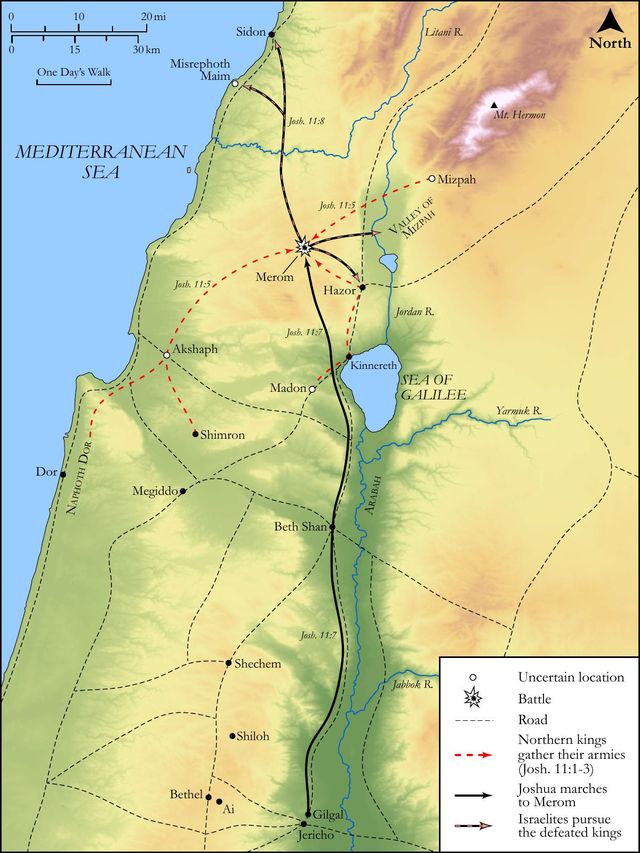
He came upon them suddenly, and surprised them in their quarters. He made this haste,
1.That he might put them into the greater confusion, by giving them an alarm, when they little thought he was near them.
2.That he might be sure not to come short of the honour God had fixed, to give him the meeting at the enemies' camp, tomorrow about this time. It is fit we should keep time with God.
IV.His success, Jos 11:8.
He obtained the honour and advantage of a complete victory; he smote them and chased them, in the several ways they took in their flight; some fled towards Zidon, which lay to the northwest, others towards Mizpeh, eastward, but the parties Joshua sent out pursued them each way. So the Lord delivered them into the hand of Israel; they would not deliver themselves into the hands of Israel to be made proselytes and tributaries, and so offered up to God's grace (Rom 15:16), and therefore God delivered them into their hands to be made sacrifices to his justice; for God will be honoured by us or upon us.
V.His obedience to the orders given him, in destroying the horses and chariots (Jos 11:9), which was an instance,
1.Of his subjection to the divine will, as one under authority, that must do as he is bidden.
2.Of his self-denial, and crossing his own genius and inclination in compliance with God's command.
3.Of his confidence in the power of God engaged for Israel, which enabled them to despise the chariots and horses which others trusted in, Psa 20:7; Psa 33:17.
4.Of his care to keep up in the people the like confidence in God, by taking that from them which they would be tempted to trust too much to. This was cutting of a right hand.
Continue studying Joshua 11:7 across the web’s major study libraries — every link below opens this exact verse, chapter, or book on the destination site.
Read & Compare
 BibleGatewayThis verse in more than 200 translations and 70 languages.
 Bible.comThe YouVersion reader — hundreds of translations, reading plans, and highlights.
 ESV.orgCrossway's official English Standard Version reader.
 NET BibleThe NET translation with 60,000+ translators' notes on every rendering decision.
 STEP BibleTyndale House's free study tool — original text, vocabulary, and scholarly resources.
 BibliaLogos Bible Software's free web reader.
 USCCBThe New American Bible (Revised Edition) with the U.S. bishops' study notes.
Commentaries
 BibleHub CommentariesDozens of classic commentaries on this verse, gathered on one page.
 StudyLightMore than 100 commentary sets — the largest collection on the web.
 BibleRefPlain-English commentary on what this verse means, verse by verse.
 Enduring WordDavid Guzik's free commentary on this chapter, widely used by Bible teachers.
 Bible Study ToolsVerse commentary alongside Greek and Hebrew study aids.
Original Language & Research
- BibleHub InterlinearThe verse word by word — original language, transliteration, and English.
- BibleHub LexiconEvery word's original-language definition and Strong's entry.
 Blue Letter BibleDeep-study tools — Strong's numbers, concordance, and word studies.
 SefariaThe Hebrew text with Rashi and centuries of Jewish commentary.
Sermons, Hymns & Audio


TrulyRandomVerse is not affiliated with these sites and doesn’t control their content. They’re linked because they’re genuinely useful.
Summary
Joshua 11:7 captures a pivotal moment in the Israelite conquest of Canaan, detailing Joshua's swift and decisive surprise attack against a formidable northern coalition at the Waters of Merom. This verse encapsulates the immediate and overwhelming execution of God's strategic command, resulting in a rapid and devastating defeat of Israel's most powerful adversaries in the north, thereby highlighting the critical interplay of divine strategy and human obedience in the unfolding of God's redemptive plan.
Context
ShowHideLiterary Context
This verse is strategically placed within the narrative of Joshua's northern campaign, immediately following the successful subjugation of the southern Canaanite kings. Joshua 11:1-5 sets the stage by introducing a massive and unprecedented confederation of northern kings, led by Jabin of Hazor, who gathered an enormous army, including a significant number of horses and chariots, to confront Israel. This overwhelming force presented a formidable challenge, seemingly superior in both numbers and military technology. Crucially, Joshua 11:6 records God's direct and specific instruction to Joshua not to fear this imposing enemy, promising to deliver them into Israel's hands and detailing the exact method of their defeat: hamstringing their horses and burning their chariots. Joshua's immediate and decisive action in verse 7 is a direct, faithful, and obedient response to this divine assurance, demonstrating his unwavering trust in God's word and setting the stage for the subsequent destruction of the northern cities and the ultimate subjugation of the region, as comprehensively detailed in Joshua 11:8-15.
Historical & Cultural Context
The "waters of Merom" are generally identified with the ancient Lake Hula or a nearby spring/marshy area in the upper Jordan Valley, a location of immense strategic importance. This region served as a vital crossroads, controlling key trade routes and providing access to the powerful northern Canaanite city-states, especially Hazor, which was a dominant regional power in the ancient Near East. Ancient warfare frequently involved large, often unwieldy armies, and the Canaanites possessed a significant technological advantage with their iron chariots, which were highly effective on open terrain. A surprise attack, especially against a large coalition that had gathered and was perhaps encamped, would have been a highly effective tactic to disrupt their formation, morale, and ability to deploy their chariots effectively. Joshua's strategy, therefore, was not merely a brilliant military maneuver but a divinely guided counter to a technologically and numerically superior force, demonstrating God's ability to overcome conventional military might through unconventional means. This engagement highlights the contrast between human military strength and divine intervention.
Key Themes
ShowHideJoshua 11:7 powerfully underscores several key themes pervasive throughout the book of Joshua and the broader Old Testament narrative. Firstly, it highlights Divine Sovereignty and Human Obedience, showcasing Joshua's prompt and unwavering obedience to God's specific command in Joshua 11:6, which directly led to the overwhelming victory. This obedience demonstrates Israel's role as God's instrument in the conquest. Secondly, the verse emphasizes God as the Divine Warrior, as the success of such a bold and sudden strike against a numerically and technologically superior enemy ultimately points to God's enabling power and active participation in the battle, fulfilling His promise to fight for Israel. This theme is foundational to Israel's understanding of their history, as seen in passages like Exodus 14:14. Thirdly, it illustrates the Fulfillment of God's Covenant Promises regarding the land of Canaan, as this decisive victory at Merom was a crucial step in Israel's complete subjugation of the northern territories, bringing them closer to possessing the land promised to their forefathers, a promise reiterated throughout the Pentateuch and foundational to the book of Joshua, as seen in Joshua 1:2-6.
Exposition and Analysis
ShowHideKey Word Analysis
ShowHideThis name (H3091) is derived from the Hebrew root meaning "Jehovah-saved" or "Yahweh is salvation." It signifies that Joshua himself is an instrument of God's saving power and a testament to God's faithfulness in delivering His people. His very name foreshadows the divine enablement behind his military successes, emphasizing that the victories are ultimately God's, achieved through His chosen leader.
This adverb (H6597) emphasizes the unexpected, abrupt, and instantaneous nature of Joshua's approach. In a military context, "suddenly" signifies a surprise attack, a crucial tactical advantage that prevents the enemy from organizing their defenses, preparing their chariots, or forming battle lines. It implies a swift, overwhelming, and unannounced assault, maximizing disruption and panic among the opposing forces. This element of surprise was likely key to neutralizing the Canaanites' numerical and technological superiority, particularly their chariots, which required time and space to deploy effectively.
The verb (H5307) "fell upon" is a primitive root meaning "to fall," but in this context, it carries the strong connotation of a violent, overwhelming, and decisive assault. When used in a military context, it often implies a rout or a devastating charge that causes the enemy to collapse or be completely overwhelmed. It suggests that the Israelite forces did not merely engage in a skirmish but launched a full-scale, impactful attack that immediately overwhelmed the enemy, leading to their swift and complete disarray. This phrase conveys the ferocity and effectiveness of the Israelite offensive, indicating a comprehensive and immediate victory.
Verse Breakdown
ShowHide"So Joshua came, and all the people of war with him,"
This opening clause establishes Joshua's decisive leadership and the unified, disciplined nature of the Israelite army. It underscores that the entire fighting force was mobilized and present, ready for the engagement, reflecting the obedience and commitment of the nation to God's directive through their appointed leader. This emphasizes the collective effort under divine guidance.
"against them by the waters of Merom suddenly;"
This specifies both the strategic location of the battle and the critical element of the attack. The "waters of Merom" served as the battleground, likely where the northern coalition had gathered or was encamped, making it a prime target. The adverb "suddenly" is paramount, indicating the surprise element of Joshua's strategy, which was instrumental in catching the enemy off guard and preventing them from utilizing their superior numbers and chariots effectively, thereby neutralizing their primary military advantage.
"and they fell upon them."
This final clause describes the immediate and devastating outcome of the surprise attack. "Fell upon them" signifies a swift, overwhelming, and decisive assault, indicating that the Israelite forces quickly gained the upper hand and routed the enemy. This concise phrase communicates a comprehensive and immediate victory, highlighting the effectiveness of the surprise maneuver and God's hand in empowering Israel to overcome their formidable adversaries.
Literary Devices
ShowHideThe verse employs several literary devices that enhance its impact and convey the swiftness and decisiveness of the battle. The most prominent is Pacing, specifically through the strategic use of the adverb "suddenly." This word dramatically accelerates the narrative, creating a sense of urgency and immediate action that mirrors the rapid nature of the attack itself. It emphasizes the complete lack of warning the enemy experienced, contributing significantly to their disarray and inability to mount an effective defense. There is also a strong element of Narrative Economy or conciseness; the verse is remarkably brief yet packed with intense action, conveying a massive military engagement and its immediate, devastating outcome in just a few impactful words. This brevity heightens the sense of suddenness and inevitability. Furthermore, the phrase "fell upon them" functions as a powerful Idiomatic Expression, succinctly conveying the overwhelming and devastating nature of the Israelite assault without needing lengthy description. This concise yet powerful language effectively communicates the swift and complete victory God granted to Israel, underscoring divine power at work.
Theological and Thematic Connections
ShowHideJoshua 11:7 serves as a powerful testament to God's unwavering faithfulness in fulfilling His covenant promises and His active, direct participation in the battles of His people. This decisive victory at Merom is not merely a military triumph achieved by human strategy alone, but a profound divine act, demonstrating that God fights for Israel, empowering them to overcome seemingly insurmountable odds. Joshua's swift and unwavering obedience to God's specific command in Joshua 11:6 underscores the vital principle that divine strategy, coupled with human faith and prompt action, leads to supernatural results. It powerfully reinforces the overarching theme that the conquest of Canaan was fundamentally God's work, with Israel serving as His obedient instrument, ensuring that all glory belonged solely to Him. This battle, like others recorded in the book of Joshua, vividly illustrates that when God's people walk in obedience and trust, He clears the path before them and grants them victory over their adversaries, thereby validating His covenant commitment to give them the promised land.
Reflection and Application
ShowHideJoshua 11:7 offers profound and enduring lessons for contemporary believers navigating the complexities and challenges of life. It serves as a powerful reminder that when God gives a clear command or provides a specific direction, even if the circumstances appear daunting or the opposition seems overwhelming, swift and decisive obedience, coupled with unwavering faith, can lead to unexpected and overwhelming victories. Just as Joshua did not hesitate but moved "suddenly" against a superior force, we are called to respond promptly and courageously to God's leading, trusting in His divine strategy rather than relying solely on our own limited strength, resources, or understanding. This verse encourages us to recognize that our spiritual battles, too, are ultimately fought and won by God, who empowers us to "fall upon" the challenges, strongholds, and spiritual adversaries in our lives. It challenges us to honestly assess where we might be hesitating in obedience, perhaps due to fear or doubt, and to step out in faith, confident that God will fight for us and grant us triumph when we align our actions with His divine will and purposes.
Questions for Reflection
ShowHideFAQ
ShowHideWhy was the "sudden" attack so crucial at Merom?
ShowHideThe "sudden" attack was absolutely crucial because it leveraged the element of surprise against a numerically and technologically superior enemy, particularly one with many chariots. As mentioned in Joshua 11:4, the northern coalition had "many horses and chariots, very many people." Chariots were powerful offensive weapons, but they required open, flat terrain and time to deploy effectively and maneuver. By striking suddenly, Joshua prevented the enemy from forming their battle lines, organizing their vast numbers, or deploying their chariots in a coordinated and effective manner. This disruption created chaos, panic, and disarray among the enemy forces, allowing the Israelite infantry to "fall upon them" with maximum impact, neutralizing the Canaanites' primary military advantage before it could even be utilized, thus securing a swift and decisive victory.
What was the significance of the Waters of Merom as a battleground?
ShowHideThe Waters of Merom (generally identified with ancient Lake Hula or a nearby marshy area) was a strategically significant location in the northern part of Canaan. It served as a natural gathering point for large armies due to the availability of water and relatively open space, making it an ideal staging ground for the northern coalition to assemble their vast forces. Control of this area was vital for dominating the northern trade routes and access to key cities like Hazor, the most powerful city-state in the region. Furthermore, the terrain around the "waters," potentially marshy or uneven near the shore, might have presented challenges for the Canaanite chariots, making a sudden, close-quarters infantry assault even more effective and disruptive to their preferred mode of warfare.
How does this battle relate to God's promise to Joshua?
ShowHideThis battle is a direct and powerful fulfillment of God's explicit promise to Joshua in Joshua 11:6. Before the battle, God specifically instructed Joshua, "Do not be afraid because of them, for tomorrow at this time I will deliver all of them slain before Israel. You shall hamstring their horses and burn their chariots with fire." Joshua's swift and decisive action in verse 7, leading to the overwhelming defeat of the enemy, demonstrates God's unwavering faithfulness to His word. The subsequent actions of hamstringing horses and burning chariots (explicitly mentioned in Joshua 11:9) further confirm Joshua's complete obedience to God's command and God's complete victory over Israel's adversaries, proving His active presence and power in the conquest.
Christ-Centered Fulfillment
ShowHideJoshua 11:7, with its vivid depiction of Joshua's decisive leadership and God's overwhelming victory over formidable foes, serves as a powerful Old Testament foreshadowing of Christ's ultimate triumph. Just as Joshua, whose name means "Yahweh saves," led Israel against seemingly insurmountable odds to conquer the promised land, the Lord Jesus Christ, our greater Joshua, leads His people in a spiritual conquest far grander than any earthly battle. The "sudden" and decisive blow struck at Merom prefigures Christ's ultimate and decisive victory over sin, death, and the powers of darkness, which was accomplished not through military might but through His sacrificial death and glorious resurrection. The New Testament reveals that Christ has already "disarmed the rulers and authorities and put them to open shame, by triumphing over them in Him" (Colossians 2:15). He is the true Divine Warrior who has overcome the world (John 16:33), providing a true and eternal rest that Joshua's conquest could only partially prefigure (Hebrews 4:8-10). Furthermore, Christ's return will be equally "sudden" and decisive, as He comes to execute final judgment and establish His eternal reign, depicted as a victorious warrior on a white horse leading the armies of heaven (Revelation 19:11-16). Thus, Joshua 11:7 points us to the ultimate and complete victory secured by Christ, who leads His church in an ongoing spiritual battle, assuring us of final triumph through Him and His finished work.