


Judges 7:18
Bible text: King James Version (1769 Blayney text) · Public domain
Bible text: King James Version with Strong's numbers · Public domain
Bible text: Berean Standard Bible · Public domain
Bible text: American Standard Version (1901) · Public domain
Bible text: World English Bible, Messianic edition · Public domain
Bible text: Geneva Bible (1599) · Public domain
Bible text: Young's Literal Translation · Public domain
- וְתָקַעְתִּיve·ta·ka'·Tiand I will give a blastH8628Conj-w ¦ V-Qal-ConsecPerf-1csVerb Qal Consecutive Perfect 1st Singular common genderוְandתָקַעְתִּיI will give a blast
- בַּשּׁוֹפָרba·sho·Faron the trumpetH7782Prep-b ¦ N-msNoun Singular Masculine Absoluteבַּon theשּׁוֹפָרtrumpet
- אָנֹכִי'a·no·KhiIH595Pro-1csPronoun Personal 1st Singular common gender
- וְכָלve·kholand allH3605Conj-w ¦ N-msNoun Singular Masculine Absoluteוְandכָלall
- אֲשֶׁר'a·SherwhoH834RelParticle Relative
- אִתִּי'i·Ti[are] with meH854Prep ¦ 1csPreposition Definiteאִתִּ[are] withיme
- וּתְקַעְתֶּםu·te·ka'·Temand you will give a blastH8628Conj-w ¦ V-Qal-ConsecPerf-2mpVerb Qal Consecutive Perfect 2nd Plural Masculineוּandתְקַעְתֶּםyou will give a blast
- בַּשּׁוֹפָרוֹתba·sho·fa·Roton the trumpetsH7782Prep-b ¦ N-fpNoun Plural Feminine Absoluteבַּon theשּׁוֹפָרוֹתtrumpets
- גַּםgamalsoH1571AdvAdverb
- אַתֶּם'a·TemyouH859Pro-2mpPronoun Personal 2nd Plural Masculine
- סְבִיבוֹתse·vi·Votall aroundH5439N-cpcNoun Plural common gender Construct
- כָּלkolallH3605N-mscNoun Singular Masculine Construct
- הַמַּחֲנֶהha·ma·cha·Nehthe campH4264Art ¦ N-fsNoun Singular Feminine Absoluteהַtheמַּחֲנֶהcamp
- וַאֲמַרְתֶּםva·'a·mar·Temand you will sayH559Conj-w ¦ V-Qal-ConsecPerf-2mpVerb Qal Consecutive Perfect 2nd Plural Masculineוַandאֲמַרְתֶּםyou will say
- לַיהוָהla·Yah·wehfor YahwehH3068Prep-l ¦ N-properNoun Proper TitleלַforיהוָהYahweh
- וּלְגִדְעוֹןu·le·gid·'onand for GideonH1439Conj-w ¦ Prep-l ¦ N-proper-mNoun Proper MasculineוּandלְforגִדְעוֹןGideon
English is a literal word-by-word gloss of the Hebrew, not the KJV's wording. Why?
This is the original text the KJV's translators worked from — each Hebrew word with its own literal English meaning in this verse, prepared by scholars at Tyndale House, Cambridge. The KJV translates whole sentences, not word by word, so its wording differs: one Hebrew word can become several English words, and the KJV may choose “the LORD” where the gloss reads “Yahweh”. Both are faithful — they answer different questions. For the KJV's own rendering, switch to the KJV text.
Details
See on the biblical-era maps
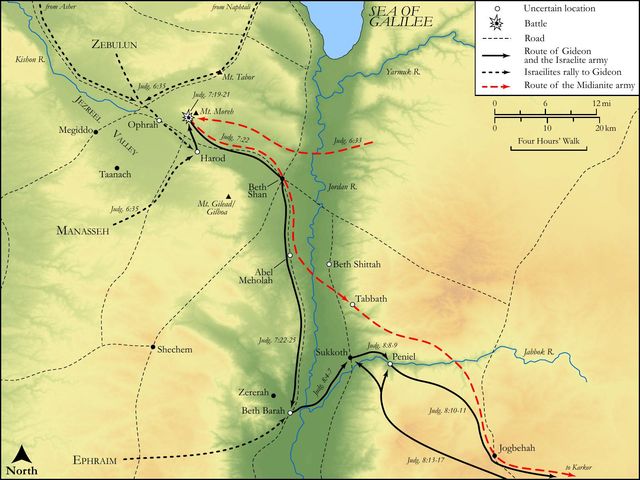
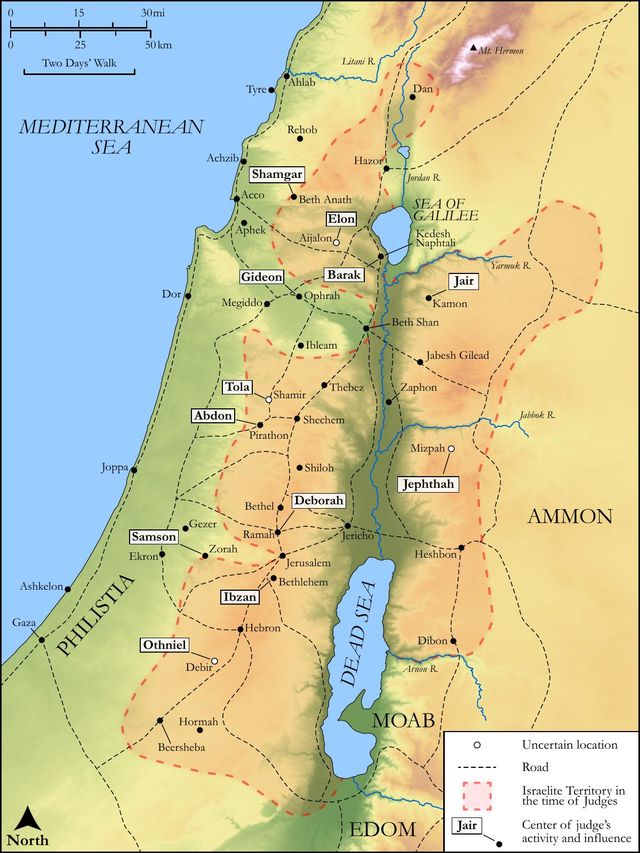
Study this verse
Public-domain commentary
Matthew Henry
From his Commentary on the Whole Bible. Henry comments on passages, not single verses — this entry covers Judges 7:16–22. His four-level outline is real structure in the source text, so it is rendered as structure.
Here is, I. The alarm which Gideon gave to the hosts of Midian in the dead time of the night; for it was intended that those who had so long been a terror to Israel, and had so often frightened them, should themselves be routed and ruined purely by terror.
1.The attack here made was, in many circumstances, like that which Abraham made upon the army that had taken Lot captive. The number of men was much the same: Abraham had 318, Gideon 300; they both divided their forces, both made their attack by night, and were both victorious under great disadvantages (Gen 14:14, Gen 14:15); and Gideon is not only a son of Abraham (so were the Midianites by Keturah) but an heir of his faith. Gideon,
(1.)Divided his army, small as it was, into three battalions (Jdg 7:16), one of which he himself commanded (Jdg 7:19), because great armies (and such a one he would make a show of) were usually divided into the right wing, and left wing, and the body of the army.
(2.)He ordered them all to do as he did, Jdg 7:17. He told them now, it is very likely, what they must do, else the thing was so strange that they would scarcely have done it of a sudden, but he would, by doing it first, give notice to them when to do it, as officers exercise their soldiers with the word of command or by beat of drum: Look on me, and do likewise. Such is the word of command which our Lord Jesus, the captain of our salvation, gives his soldiers; for he has left us an example, with a charge to follow it: As I do, so shall you do.
(3.)He made his descent in the night, when they were secure and least expected it, which would put them into great consternation, and when the smallness of his army would not be discovered. In the night all frights are most frightful, especially in the dead of the night, as this was, a little after midnight, when the middle watch began, and the alarm would wake them out of their sleep. We read of terror by night as very terrible (Psa 91:5), and fear in the night, Sol 3:8.
(4.)That which Gideon aimed at was to frighten this huge host, to give them not only a fatal rout, but a very shameful one. He accoutred his army with every man a trumpet in his right hand, and an earthen pitcher, with a torch in it, in his left, and he himself thought it no disparagement to him to march before them thus armed. He would make but a jest of conquering this army, and goes out against them rather as against a company of children than against a host of soldiers. The virgin, the daughter of Zion, hath despised thee, and laughed thee to scorn, Isa 37:22. The fewness of his men favoured his design; for, being so few, they marched to the camp with the greater secresy and expedition, so that they were not discovered till they were close by the camp; and he contrived to give the alarm when they had just mounted the guards (Jdg 7:19), that the sentinels, being then wakeful, might the sooner disperse the alarm through the camp, which was the best service they could do him. Three ways Gideon contrived to strike a terror upon this army, and so put them into confusion.
[1.]With a great noise. Every man must blow his trumpet in the most terrible manner he could and clatter an earthen pitcher to pieces at the same time; probably each dashed his pitcher to his next man's, and so they were broken both together, which would not only make a great crash, but was a figure of what would be the effects of the fright, even the Midianites' killing one another.
[2.]With a great blaze. The lighted torches were hid in the pitchers, like a candle under a bushel, until they came to the camp, and then, being taken out all together of a sudden, would make a glaring show, and run through the camp like a flash of lightning. Perhaps with these they set some of the tents on the outside of the camp on fire, which would very much increase the confusion.
[3.]With a great shout. Every man must cry, For the Lord, and for Gideon, so some think it should be read in Jdg 7:18, for there the sword is not in the original, but it is in Jdg 7:20, The sword of the Lord, and of Gideon. It should seem, he borrowed the word from the Midianite's dream (Jdg 7:14): it is the sword of Gideon. Finding his name was a terror to them, he thus improves it against them, but prefixes the name of Jehovah, as the figure without which his own was but an insignificant cypher. This would put life into his own men, who might well take courage when they had such a God as Jehovah, and such a man as Gideon, both to fight for, and to fight for them; well might those follow who had such leaders. It would likewise put their enemies into a fright, who had of old heard of Jehovah's great name, and of late of Gideon's. The sword of the Lord is all in all to the success of the sword of Gideon, yet the sword of Gideon must be employed. Men the instruments, and God the principal agent, must both be considered in their places, but men, the greatest and best, always in subserviency and subordination to God. This army was to be defeated purely by terrors, and these are especially the sword of the Lord. These soldiers, if they had swords by their sides, that was all, they had none in their hands, but they gained the victory by shouting "The sword." So the church's enemies are routed by a sword out of the mouth, Rev 19:21.
2.These soldiers, if they had swords by their sides, that was all, they had none in their hands, but they gained the victory by shouting "The sword." So the church's enemies are routed by a sword out of the mouth, Rev 19:21.
2.This method here taken of defeating the Midianites may be alluded to,
(1.)As typifying the destruction of the devil's kingdom in the world by the preaching of the everlasting gospel, the sounding of that trumpet, and the holding forth of that light out of earthen vessels, for such the ministers of the gospel are, in whom the treasure of that light is deposited, Co2 4:6, Co2 4:7. Thus God chose the foolish things of the world to confound the wise, a barley-cake to overthrow the tents of Midian, that the excellency of the power might be of God only; the gospel is a sword, not in the hand, but in the mouth, the sword of the Lord and of Gideon, of God and Jesus Christ, him that sits on the throne and the Lamb.
(2.)As representing the terrors of the great day. So the excellent bishop Hall applies it; if these pitchers, trumpets, and firebrands, did so daunt and dismay the proud troops of Midian and Amalek, who shall be able to stand before the last terror, when the trumpet of the archangel shall sound, the elements shall be on a flame, the heavens pass away with a great noise, and the Lord himself shall descend with a shout!
II.The wonderful success of this alarm.
The Midianites were shouted out of their lives, as the walls of Jericho were shouted down, that Gideon might see what he lately despaired of ever seeing, the wonders that their fathers told them of. Gideon's soldiers observed their orders, and stood every man in his place round about the camp (Jdg 7:21), sounding his trumpet to excite them to fight one another, and holding out his torch to light them to their ruin. They did not rush into the host of Midian, as greedy either of blood or spoil, but patiently stood still to see the salvation of the Lord, a salvation purely of his own working. Observe how the design took effect.
1.They feared the Israelites. All the host immediately took the alarm; it flew like lightning through all their lines, and they ran, and cried, and fled, Jdg 7:21. There was something natural in this fright. We may suppose they had not had intelligence of the great diminution of Gideon's army, but rather concluded that since their last advices it had been growing greater and greater; and therefore they had reason to suspect, knowing how odious and grievous they had made themselves and what bold steps had been taken towards the throwing off of their yoke, that it was a very great army which was to be ushered in with all those trumpeters and torch-bearers. But there was more of a supernatural power impressing this terror upon them. God himself gave it the setting on, to show how that promise should have been fulfilled if they had not forfeited it, One of you shall chase a thousand. See the power of imagination, and how much it may become a terror at some times, as at other times it is a pleasure.
2.They fell foul upon one another: The Lord set every man's sword against his fellow, Jdg 7:22. In this confusion, observing the trumpeters and torch-bearers to stand still without their camp, they concluded the body of the army had already entered and was in the midst of them, and therefore every one ran at the next he met, though a friend, supposing him an enemy, and one such mistake as this would occasion many, for then he that slew him would certainly be taken for an enemy, and would be dispatched immediately. It is our interest to preserve such a command of our own spirits as never to be afraid with any amazement, for we cannot conceive what mischiefs we thereby plunge ourselves into. See also how God often makes the enemies of his church instruments to destroy one another; it is a pity the church's friends should ever be thus infatuated.
3.They fled for their lives. Perhaps when day-light came they were sensible of their mistake in fighting with one another, and concluded that by this fatal error they had so weakened themselves that now it was impossible to make any head against Israel, and therefore made the best of their way towards their own country, though, for aught that appears, the 300 men kept their ground. The wicked flee when none pursueth, Pro 28:1. Terrors make him afraid on every side, and drive him to his feet, Job 18:11.
Continue studying Judges 7:18 across the web’s major study libraries — every link below opens this exact verse, chapter, or book on the destination site.
Read & Compare
 BibleGatewayThis verse in more than 200 translations and 70 languages.
 Bible.comThe YouVersion reader — hundreds of translations, reading plans, and highlights.
 ESV.orgCrossway's official English Standard Version reader.
 NET BibleThe NET translation with 60,000+ translators' notes on every rendering decision.
 STEP BibleTyndale House's free study tool — original text, vocabulary, and scholarly resources.
 BibliaLogos Bible Software's free web reader.
 USCCBThe New American Bible (Revised Edition) with the U.S. bishops' study notes.
Commentaries
 BibleHub CommentariesDozens of classic commentaries on this verse, gathered on one page.
 StudyLightMore than 100 commentary sets — the largest collection on the web.
 BibleRefPlain-English commentary on what this verse means, verse by verse.
 Enduring WordDavid Guzik's free commentary on this chapter, widely used by Bible teachers.
 Bible Study ToolsVerse commentary alongside Greek and Hebrew study aids.
Original Language & Research
- BibleHub InterlinearThe verse word by word — original language, transliteration, and English.
- BibleHub LexiconEvery word's original-language definition and Strong's entry.
 Blue Letter BibleDeep-study tools — Strong's numbers, concordance, and word studies.
 SefariaThe Hebrew text with Rashi and centuries of Jewish commentary.
Sermons, Hymns & Audio


TrulyRandomVerse is not affiliated with these sites and doesn’t control their content. They’re linked because they’re genuinely useful.
Summary
Judges 7:18 encapsulates Gideon's pivotal command to his 300 chosen warriors, outlining the precise, synchronized actions for their unconventional assault on the formidable Midianite encampment. This instruction details the simultaneous blowing of trumpets and the unified, powerful declaration, "The sword of the LORD, and of Gideon," a divinely inspired strategy designed to sow profound panic and confusion among the enemy, thereby ensuring that the ensuing miraculous victory would be unequivocally attributed to God's sovereign power rather than to human strength or conventional military might.
Context
ShowHideLiterary Context
Judges 7:18 is strategically positioned at the culmination of Gideon's meticulously orchestrated preparations for battle against the Midianites. This verse immediately follows God's dramatic reduction of Gideon's army, first from 32,000 to 10,000 by dismissing the fearful, and then to a mere 300 based on their distinctive method of drinking water Judges 7:2-7. This radical numerical disadvantage was divinely designed to preclude any possibility of Israel claiming victory by their own strength, guaranteeing that God alone would receive the glory. Furthermore, just prior to this command, Gideon, at God's prompting, infiltrated the Midianite camp and overheard a soldier's dream about a barley loaf overturning their tent, interpreted by his comrade as a clear sign of God delivering Midian into Gideon's hand Judges 7:9-15. This direct divine confirmation profoundly emboldened Gideon, leading directly to the specific battle instructions articulated in verse 18, which sets the stage for the astonishing, divinely empowered rout of the Midianites described in Judges 7:19-22.
Historical & Cultural Context
The era of the Judges was a tumultuous period in Israelite history, characterized by a recurring cycle of apostasy, divine judgment through foreign oppression, Israel's cry for deliverance, and God raising up a deliverer. For seven years, the Midianites, Amalekites, and other "people of the East" had subjected Israel to severe oppression, devastating their crops and livestock, leading to widespread famine and impoverishment Judges 6:1-6. In ancient warfare, psychological tactics were often as crucial as physical combat. Trumpets, specifically the shofar (ram's horn), held significant cultural and religious importance in Israel, used for signaling assembly, announcing feasts, and, critically, for warfare (e.g., the fall of Jericho in Joshua 6:4-5). The coordinated, sudden blast of 300 trumpets, coupled with the shattering of pitchers to reveal torches and the simultaneous unified shout, was a sophisticated psychological operation. It was meticulously designed to create maximum terror and confusion within the enemy camp, leading them to believe they were surrounded by an overwhelmingly vast army. The declaration "The sword of the LORD" resonated deeply within Israelite theology, where Yahweh was consistently understood as the divine warrior who actively fought on behalf of His people, a concept powerfully articulated in Deuteronomy 20:4.
Key Themes
ShowHideThis verse serves as a powerful conduit for several profound theological and narrative themes central to the Book of Judges and the broader biblical narrative. Firstly, it emphatically highlights Divine Sovereignty and Deliverance, underscoring that God's power is utterly unconstrained by human limitations, numerical inferiority, or conventional military logic. The victory is unequivocally God's work, not a testament to Gideon's or Israel's strength. Secondly, it powerfully illustrates the theme of Obedience and Faith, as Gideon and his men commit to an utterly unconventional and seemingly irrational strategy, thereby demonstrating their radical trust in God's specific, counter-intuitive instructions. This stands in stark contrast to Israel's pervasive disobedience throughout the Judges period. Thirdly, the passage vividly portrays God Using the Weak and Unlikely, a recurring biblical motif where God deliberately chooses humble, seemingly insignificant instruments to accomplish His mighty purposes, ensuring that His glory is supremely magnified. This is profoundly evident in God's selection of Gideon, a man from the weakest clan in Manasseh Judges 6:15, and His subsequent radical reduction of Gideon's fighting force. Finally, it powerfully demonstrates the Power of Declaration and Psychological Warfare, where a spoken word and a symbolic act become potent, divinely wielded weapons.
Exposition and Analysis
ShowHideKey Word Analysis
ShowHideThe Hebrew term שׁוֹפָר (shôwphâr) refers to a cornet or curved horn, typically made from a ram's horn, known for producing a clear, piercing sound. In ancient Israel, the shôwphâr served a multifaceted role: it was used for signaling assembly or battle (as seen in Numbers 10:9), announcing new moons and feasts, accompanying worship, and even symbolically representing the voice of God (e.g., Exodus 19:16). In this specific military context, the shôwphâr was not merely a tactical signal but carried profound spiritual connotations, imbuing the act with a sense of divine presence and authority, transforming a simple sound into a declaration of spiritual warfare.
The use of the divine name יְהוָה (Yᵉhôvâh), commonly rendered as "LORD" in English translations, is profoundly significant. It is the covenant name of God, signifying "the self-Existent or Eternal," revealing His personal, active, and redemptive presence with His people. In the context of "The sword of the LORD," it underscores that the victory is not a result of chance or human ingenuity, but a direct, deliberate act of the sovereign, covenant-keeping God who actively fights on behalf of Israel. It emphasizes His unwavering faithfulness to His promises and His ultimate authority over all earthly powers and circumstances.
The name גִּדְעוֹן (Gidʻôwn), derived from a root meaning "to fell" or "to cut down," signifies "feller" or "warrior." While the phrase "The sword of the LORD, and of Gideon" explicitly attributes primary power to God, the inclusion of Gideon's name acknowledges his crucial, divinely appointed role as the human instrument and leader in this deliverance. It signifies a partnership where God works through a chosen individual, yet it clearly subordinates human agency to divine sovereignty, ensuring that Gideon receives credit for his obedience and leadership but not for the ultimate power that secured the victory.
Verse Breakdown
ShowHide"When I blow with a trumpet, I and all that [are] with me"
This clause establishes Gideon's role as the central figure and the precise initiator of the coordinated attack. His personal trumpet blast serves as the definitive signal for the entire 300-man force to act simultaneously. This emphasizes the critical need for unified, disciplined response to a single command, which was paramount for the success of their highly unconventional and psychologically driven strategy.
"then blow ye the trumpets also on every side of all the camp"
This is the core instruction for Gideon's 300 men. They were to strategically position themselves around the vast Midianite encampment, each man equipped with a trumpet. The synchronized blowing of 300 trumpets, coupled with the shattering of pitchers and the sudden revelation of torches, was designed to create an overwhelming cacophony and visual spectacle. This would generate the illusion of a massive, encircling army, thereby inducing profound panic, disorientation, and self-destructive chaos among the sleeping Midianite forces.
"and say, [The sword] of the LORD, and of Gideon."
This is the climactic verbal declaration intended to accompany the trumpet blasts and the shattering of the pitchers. The shout primarily attributes the impending victory and the power behind the assault to "the LORD," unequivocally acknowledging His supreme power and active involvement as the divine warrior. By appending "and of Gideon," it recognizes Gideon's instrumental role as God's chosen leader and agent, but clearly subordinates his agency to God's. This declaration was strategically crafted to demoralize the Midianites by proclaiming the divine nature of the assault, while simultaneously emboldening the Israelites by reminding them that the sovereign God was fighting powerfully on their behalf.
Literary Devices
ShowHideJudges 7:18 masterfully employs several literary devices to heighten the dramatic tension and convey its profound theological message. Symbolism is powerfully at play, with the trumpet (shofar) symbolizing not merely a military signal but also divine presence, a call to spiritual warfare, and an instrument of God's power. The "sword" in the declaration represents God's active power and judgment, transcending its literal meaning to signify divine intervention. The entire unconventional strategy—the small number of men, the trumpets, the torches, and the shout—functions as a potent symbol of God's ability to achieve victory through apparent weakness and unconventional means. There is a strong element of Irony in God's chosen method: a minuscule, seemingly ill-equipped army achieves a decisive victory not through conventional military might but through noise and light, demonstrating God's power perfected in human weakness. The phrase "The sword of the LORD, and of Gideon" can be understood as a form of Hendiadys, where two nouns connected by "and" express a single, complex idea—that God's power is the ultimate force, working through His chosen human instrument, Gideon. The Repetition of this command and shout in the actual execution of the plan in Judges 7:20 reinforces its significance and psychological impact.
Theological and Thematic Connections
ShowHideJudges 7:18 stands as a profound theological statement, asserting God's absolute sovereignty over human affairs and His unique, often counter-intuitive, methods of deliverance. It powerfully teaches that God is not constrained by human strength, numerical advantage, or conventional wisdom; indeed, He frequently chooses the weak and seemingly foolish things of the world to confound the strong, ensuring that all glory redounds solely to Him. This passage vividly illustrates the timeless principle that "the battle is the Lord's," and that true, lasting victory emerges from radical obedience to His specific, sometimes illogical, commands, rather than from reliance on human might or strategic brilliance. It challenges believers across generations to trust God's ways even when they defy logical explanation, reminding us that His power is perfected in our weakness, and His divine plans are always infinitely superior to our own.
Reflection and Application
ShowHideJudges 7:18 offers enduring lessons for believers navigating the myriad challenges of contemporary life. It compels us to critically examine the locus of our trust: are we relying on our own abilities, accumulated resources, or conventional, human-derived solutions, or are we placing our unwavering faith in God's unconventional wisdom and omnipotent power? When confronted with seemingly overwhelming odds—be they personal struggles, daunting ministry endeavors, or complex societal challenges—this passage serves as a powerful reminder that God delights in working through apparent weakness to magnificently display His strength. Our radical obedience to His specific, sometimes seemingly illogical, instructions is paramount, for it is precisely in stepping out in faith that we create the necessary space for His miraculous intervention. Like Gideon's valiant men, we are called to be faithful instruments in God's sovereign hands, diligently executing His divine plan and boldly declaring His absolute sovereignty, secure in the knowledge that the ultimate victory belongs entirely to Him. This verse profoundly compels us to transcend mere human reasoning and embrace a radical, unwavering trust in the God who possesses the power to save by many or by few.
Questions for Reflection
ShowHideFAQ
ShowHideWhy did God reduce Gideon's army so drastically before the battle?
ShowHideGod reduced Gideon's army from an initial 32,000 to a mere 300 men—a staggering reduction of over 99%—primarily to ensure that the impending victory would be undeniably and unequivocally attributed to His divine power alone, rather than to Israel's military strength or numerical superiority. As explicitly stated in Judges 7:2, God told Gideon, "The people who are with you are too many for Me to give the Midianites into their hands, lest Israel claim glory for itself against Me, saying, 'My own hand has saved me.'" This drastic act served as a profound theological lesson, preventing human boasting and instilling in Israel the foundational understanding that their deliverance came solely from Yahweh. It powerfully reinforced the biblical principle that God often chooses the weak and the few to accomplish His mighty purposes, thereby magnifying His glory and ensuring that He receives all due praise, as also seen in Deuteronomy 8:17-18.
What is the significance of the shout "The sword of the LORD, and of Gideon"?
ShowHideThe phrase "The sword of the LORD, and of Gideon" carries profound significance for several critical reasons. Firstly, it explicitly attributes the primary power and ultimate victory to "the LORD" (Yahweh), affirming His supreme role as the divine warrior who actively fights for His people. This bold declaration would have instilled immediate and profound terror in the Midianites, who would have recognized the formidable name of Israel's God. Secondly, by including "and of Gideon," it acknowledges Gideon's crucial instrumental role as God's chosen leader and obedient agent. It represents a powerful declaration of divine partnership, where God sovereignly works through human obedience. It was not merely "Gideon's sword" acting independently, nor was it solely "the LORD's sword" without a human instrument. This combined shout served as a potent psychological weapon, a bold proclamation of God's active presence and leadership in the battle, meticulously designed to demoralize the enemy and simultaneously embolden the Israelites by reminding them that they were fighting under divine command and with divine power.
Christ-Centered Fulfillment
ShowHideJudges 7:18, with its profound emphasis on divine power operating through apparent weakness, unconventional means, and a powerful declaration, finds its ultimate and glorious fulfillment in the person and work of Jesus Christ. Gideon's astonishing victory, achieved not through conventional military might but through a divinely orchestrated strategy of noise, light, and a unified shout, powerfully foreshadows Christ's ultimate triumph over the forces of sin, death, and spiritual darkness. Jesus, the true and ultimate "Sword of the LORD," did not conquer through worldly power, military prowess, or conventional warfare. Instead, He achieved victory through His sacrificial death on the cross—an act that appeared to be the epitome of weakness and utter foolishness to the world 1 Corinthians 1:23-25. Yet, it was precisely through this apparent "weakness" that He decisively disarmed the spiritual rulers and authorities, making a public spectacle of them and triumphing over them in the cross Colossians 2:15. The "shout" of the gospel, seemingly foolish to the wisdom of the world, is, in fact, the very power of God for salvation to everyone who believes Romans 1:16. Just as Gideon's 300 men were humble instruments in God's hand, so too are believers called to be Christ's witnesses, empowered not by their own strength but by the Holy Spirit, to boldly proclaim His victory and extend His kingdom throughout the earth Acts 1:8. The battle against spiritual darkness remains the Lord's, and He calls His church to participate through faith-filled obedience, declaring the triumph of the Lamb of God, who is the true "Sword of the LORD" that brings ultimate and eternal deliverance Revelation 19:15.