


Judges 7:17
Bible text: King James Version (1769 Blayney text) · Public domain
Bible text: Berean Standard Bible · Public domain
Bible text: American Standard Version (1901) · Public domain
Bible text: World English Bible, Messianic edition · Public domain
Bible text: Geneva Bible (1599) · Public domain
Bible text: Young's Literal Translation · Public domain
- וַיֹּאמֶרvai·Yo·merand he saidH559Conj-w ¦ V-Qal-ConsecImperf-3msVerb Qal Consecutive Imperfect 3rd Singular Masculineוַandיֹּאמֶרhe said
- אֲלֵיהֶם'a·lei·Hemto themH413Prep ¦ 3mpPreposition Definiteאֲלֵיtoהֶםthem
- מִמֶּנִּיmi·Me·nifrom meH4480Prep ¦ 1csPreposition Definiteמִמֶּfromנִּיme
- תִרְאוּtir·'Uyou will seeH7200V-Qal-Imperf-2mpVerb Qal Imperfect 2nd Plural Masculine
- וְכֵןve·Khenand thusH3651Conj-w ¦ AdvAdverbוְandכֵןthus
- תַּעֲשׂוּta·'a·Suyou will doH6213V-Qal-Imperf-2mpVerb Qal Imperfect 2nd Plural Masculine
- וְהִנֵּהve·hi·Nehand here!H2009Conj-w ¦ PrtParticle Interjectionוְandהִנֵּהhere!
- אָנֹכִי'a·no·KhiIH595Pro-1csPronoun Personal 1st Singular common gender
- בָאva'[will be] comingH935V-Qal-Prtcpl-msVerb Qal Participle Singular Masculine Absolute
- בִּקְצֵהbik·Tzehin [the] edge ofH7097Prep-b ¦ N-mscNoun Singular Masculine Constructבִּinקְצֵה[the] edge of
- הַמַּחֲנֶהha·ma·cha·Nehthe campH4264Art ¦ N-fsNoun Singular Feminine Absoluteהַtheמַּחֲנֶהcamp
- וְהָיָהve·ha·Yahand it will beH1961Conj-w ¦ V-Qal-ConsecPerf-3msVerb Qal Consecutive Perfect 3rd Singular Masculineוְandהָיָהit will be
- כַאֲשֶׁרkha·'a·Sherjust asH834Prep-k ¦ RelParticle Relativeכַjustאֲשֶׁרas
- אֶעֱשֶׂה'e·'e·SehI will doH6213V-Qal-Imperf-1csVerb Qal Imperfect 1st Singular common gender
- כֵּןkensoH3651AdvAdverb
- תַּעֲשׂוּןta·'a·Sunyou will do !H6213V-Qal-Imperf-2mp ¦ SfxVerb Qal Imperfect 2nd Plural Masculineתַּעֲשׂוּyou will doן!
English is a literal word-by-word gloss of the Hebrew, not the KJV's wording. Why?
This is the original text the KJV's translators worked from — each Hebrew word with its own literal English meaning in this verse, prepared by scholars at Tyndale House, Cambridge. The KJV translates whole sentences, not word by word, so its wording differs: one Hebrew word can become several English words, and the KJV may choose “the LORD” where the gloss reads “Yahweh”. Both are faithful — they answer different questions. For the KJV's own rendering, switch to the KJV text.
Details
See on the biblical-era maps
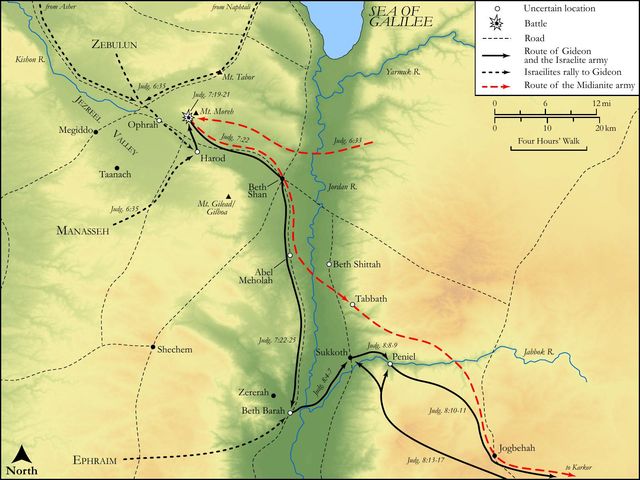
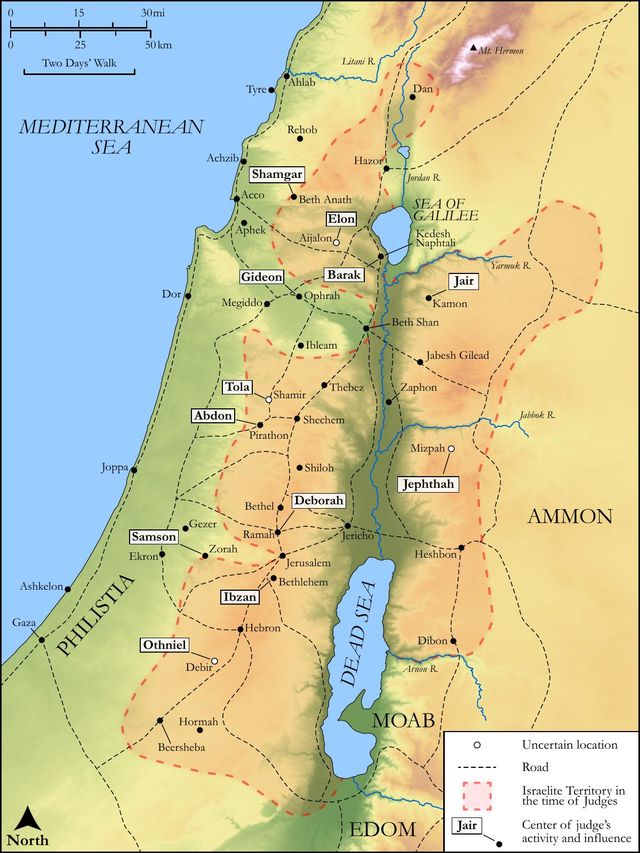
Study this verse
Public-domain commentary
Matthew Henry
From his Commentary on the Whole Bible. Henry comments on passages, not single verses — this entry covers Judges 7:16–22. His four-level outline is real structure in the source text, so it is rendered as structure.
Here is, I. The alarm which Gideon gave to the hosts of Midian in the dead time of the night; for it was intended that those who had so long been a terror to Israel, and had so often frightened them, should themselves be routed and ruined purely by terror.
1.The attack here made was, in many circumstances, like that which Abraham made upon the army that had taken Lot captive. The number of men was much the same: Abraham had 318, Gideon 300; they both divided their forces, both made their attack by night, and were both victorious under great disadvantages (Gen 14:14, Gen 14:15); and Gideon is not only a son of Abraham (so were the Midianites by Keturah) but an heir of his faith. Gideon,
(1.)Divided his army, small as it was, into three battalions (Jdg 7:16), one of which he himself commanded (Jdg 7:19), because great armies (and such a one he would make a show of) were usually divided into the right wing, and left wing, and the body of the army.
(2.)He ordered them all to do as he did, Jdg 7:17. He told them now, it is very likely, what they must do, else the thing was so strange that they would scarcely have done it of a sudden, but he would, by doing it first, give notice to them when to do it, as officers exercise their soldiers with the word of command or by beat of drum: Look on me, and do likewise. Such is the word of command which our Lord Jesus, the captain of our salvation, gives his soldiers; for he has left us an example, with a charge to follow it: As I do, so shall you do.
(3.)He made his descent in the night, when they were secure and least expected it, which would put them into great consternation, and when the smallness of his army would not be discovered. In the night all frights are most frightful, especially in the dead of the night, as this was, a little after midnight, when the middle watch began, and the alarm would wake them out of their sleep. We read of terror by night as very terrible (Psa 91:5), and fear in the night, Sol 3:8.
(4.)That which Gideon aimed at was to frighten this huge host, to give them not only a fatal rout, but a very shameful one. He accoutred his army with every man a trumpet in his right hand, and an earthen pitcher, with a torch in it, in his left, and he himself thought it no disparagement to him to march before them thus armed. He would make but a jest of conquering this army, and goes out against them rather as against a company of children than against a host of soldiers. The virgin, the daughter of Zion, hath despised thee, and laughed thee to scorn, Isa 37:22. The fewness of his men favoured his design; for, being so few, they marched to the camp with the greater secresy and expedition, so that they were not discovered till they were close by the camp; and he contrived to give the alarm when they had just mounted the guards (Jdg 7:19), that the sentinels, being then wakeful, might the sooner disperse the alarm through the camp, which was the best service they could do him. Three ways Gideon contrived to strike a terror upon this army, and so put them into confusion.
[1.]With a great noise. Every man must blow his trumpet in the most terrible manner he could and clatter an earthen pitcher to pieces at the same time; probably each dashed his pitcher to his next man's, and so they were broken both together, which would not only make a great crash, but was a figure of what would be the effects of the fright, even the Midianites' killing one another.
[2.]With a great blaze. The lighted torches were hid in the pitchers, like a candle under a bushel, until they came to the camp, and then, being taken out all together of a sudden, would make a glaring show, and run through the camp like a flash of lightning. Perhaps with these they set some of the tents on the outside of the camp on fire, which would very much increase the confusion.
[3.]With a great shout. Every man must cry, For the Lord, and for Gideon, so some think it should be read in Jdg 7:18, for there the sword is not in the original, but it is in Jdg 7:20, The sword of the Lord, and of Gideon. It should seem, he borrowed the word from the Midianite's dream (Jdg 7:14): it is the sword of Gideon. Finding his name was a terror to them, he thus improves it against them, but prefixes the name of Jehovah, as the figure without which his own was but an insignificant cypher. This would put life into his own men, who might well take courage when they had such a God as Jehovah, and such a man as Gideon, both to fight for, and to fight for them; well might those follow who had such leaders. It would likewise put their enemies into a fright, who had of old heard of Jehovah's great name, and of late of Gideon's. The sword of the Lord is all in all to the success of the sword of Gideon, yet the sword of Gideon must be employed. Men the instruments, and God the principal agent, must both be considered in their places, but men, the greatest and best, always in subserviency and subordination to God. This army was to be defeated purely by terrors, and these are especially the sword of the Lord. These soldiers, if they had swords by their sides, that was all, they had none in their hands, but they gained the victory by shouting "The sword." So the church's enemies are routed by a sword out of the mouth, Rev 19:21.
2.These soldiers, if they had swords by their sides, that was all, they had none in their hands, but they gained the victory by shouting "The sword." So the church's enemies are routed by a sword out of the mouth, Rev 19:21.
2.This method here taken of defeating the Midianites may be alluded to,
(1.)As typifying the destruction of the devil's kingdom in the world by the preaching of the everlasting gospel, the sounding of that trumpet, and the holding forth of that light out of earthen vessels, for such the ministers of the gospel are, in whom the treasure of that light is deposited, Co2 4:6, Co2 4:7. Thus God chose the foolish things of the world to confound the wise, a barley-cake to overthrow the tents of Midian, that the excellency of the power might be of God only; the gospel is a sword, not in the hand, but in the mouth, the sword of the Lord and of Gideon, of God and Jesus Christ, him that sits on the throne and the Lamb.
(2.)As representing the terrors of the great day. So the excellent bishop Hall applies it; if these pitchers, trumpets, and firebrands, did so daunt and dismay the proud troops of Midian and Amalek, who shall be able to stand before the last terror, when the trumpet of the archangel shall sound, the elements shall be on a flame, the heavens pass away with a great noise, and the Lord himself shall descend with a shout!
II.The wonderful success of this alarm.
The Midianites were shouted out of their lives, as the walls of Jericho were shouted down, that Gideon might see what he lately despaired of ever seeing, the wonders that their fathers told them of. Gideon's soldiers observed their orders, and stood every man in his place round about the camp (Jdg 7:21), sounding his trumpet to excite them to fight one another, and holding out his torch to light them to their ruin. They did not rush into the host of Midian, as greedy either of blood or spoil, but patiently stood still to see the salvation of the Lord, a salvation purely of his own working. Observe how the design took effect.
1.They feared the Israelites. All the host immediately took the alarm; it flew like lightning through all their lines, and they ran, and cried, and fled, Jdg 7:21. There was something natural in this fright. We may suppose they had not had intelligence of the great diminution of Gideon's army, but rather concluded that since their last advices it had been growing greater and greater; and therefore they had reason to suspect, knowing how odious and grievous they had made themselves and what bold steps had been taken towards the throwing off of their yoke, that it was a very great army which was to be ushered in with all those trumpeters and torch-bearers. But there was more of a supernatural power impressing this terror upon them. God himself gave it the setting on, to show how that promise should have been fulfilled if they had not forfeited it, One of you shall chase a thousand. See the power of imagination, and how much it may become a terror at some times, as at other times it is a pleasure.
2.They fell foul upon one another: The Lord set every man's sword against his fellow, Jdg 7:22. In this confusion, observing the trumpeters and torch-bearers to stand still without their camp, they concluded the body of the army had already entered and was in the midst of them, and therefore every one ran at the next he met, though a friend, supposing him an enemy, and one such mistake as this would occasion many, for then he that slew him would certainly be taken for an enemy, and would be dispatched immediately. It is our interest to preserve such a command of our own spirits as never to be afraid with any amazement, for we cannot conceive what mischiefs we thereby plunge ourselves into. See also how God often makes the enemies of his church instruments to destroy one another; it is a pity the church's friends should ever be thus infatuated.
3.They fled for their lives. Perhaps when day-light came they were sensible of their mistake in fighting with one another, and concluded that by this fatal error they had so weakened themselves that now it was impossible to make any head against Israel, and therefore made the best of their way towards their own country, though, for aught that appears, the 300 men kept their ground. The wicked flee when none pursueth, Pro 28:1. Terrors make him afraid on every side, and drive him to his feet, Job 18:11.
Continue studying Judges 7:17 across the web’s major study libraries — every link below opens this exact verse, chapter, or book on the destination site.
Read & Compare
 BibleGatewayThis verse in more than 200 translations and 70 languages.
 Bible.comThe YouVersion reader — hundreds of translations, reading plans, and highlights.
 ESV.orgCrossway's official English Standard Version reader.
 NET BibleThe NET translation with 60,000+ translators' notes on every rendering decision.
 STEP BibleTyndale House's free study tool — original text, vocabulary, and scholarly resources.
 BibliaLogos Bible Software's free web reader.
 USCCBThe New American Bible (Revised Edition) with the U.S. bishops' study notes.
Commentaries
 BibleHub CommentariesDozens of classic commentaries on this verse, gathered on one page.
 StudyLightMore than 100 commentary sets — the largest collection on the web.
 BibleRefPlain-English commentary on what this verse means, verse by verse.
 Enduring WordDavid Guzik's free commentary on this chapter, widely used by Bible teachers.
 Bible Study ToolsVerse commentary alongside Greek and Hebrew study aids.
Original Language & Research
- BibleHub InterlinearThe verse word by word — original language, transliteration, and English.
- BibleHub LexiconEvery word's original-language definition and Strong's entry.
 Blue Letter BibleDeep-study tools — Strong's numbers, concordance, and word studies.
 SefariaThe Hebrew text with Rashi and centuries of Jewish commentary.
Sermons, Hymns & Audio


TrulyRandomVerse is not affiliated with these sites and doesn’t control their content. They’re linked because they’re genuinely useful.
Summary
Judges 7:17 presents Gideon's crucial command to his select 300 men, instructing them to observe his actions meticulously and replicate them precisely as they approach the Midianite encampment. This pivotal directive highlights Gideon's exemplary leadership and the absolute necessity of synchronized obedience, which was foundational to the success of God's divinely orchestrated, unconventional strategy against a vastly superior enemy force. The verse sets the stage for a miraculous victory that would unequivocally demonstrate the Lord's power and faithfulness over human might and conventional warfare.
Context
ShowHideLiterary Context
Judges 7:17 is strategically placed at a critical juncture in the narrative of Gideon's campaign against the Midianites. Prior to this verse, God has dramatically reduced Gideon's army from an initial 32,000 to a mere 300 men, explicitly stating His purpose: to prevent Israel from claiming credit for their own deliverance and to ensure that the impending victory would be solely attributed to the Lord (Judges 7:2-7). This divine pruning underscores the theological message that salvation comes from God alone. Immediately preceding Gideon's command, he receives a profound and personal assurance of victory by secretly infiltrating the Midianite camp and overhearing a soldier recount a dream interpreted as God delivering the Midianites into Gideon's hand (Judges 7:13-15). Emboldened by this divine confirmation, Gideon swiftly divides his small force into three companies, equipping each man with a trumpet, an empty pitcher, and a torch concealed within the pitcher (Judges 7:16). Verse 17 then serves as the precise, direct instruction for the synchronized execution of this extraordinary and counter-intuitive battle plan.
Historical & Cultural Context
The book of Judges chronicles a tumultuous period in Israel's history marked by a recurring cycle of spiritual apostasy, subsequent oppression by foreign powers, cries for divine deliverance, and God raising up a "judge" to rescue His people. For seven oppressive years, the Midianites, in alliance with the Amalekites and other "people of the East," had relentlessly raided Israel's land, destroying their crops and livestock, leaving the Israelites impoverished, terrified, and forced to hide in caves and strongholds (Judges 6:1-6). This prolonged harassment highlights a deep state of national despair and military weakness. In this dire context, Gideon's minuscule, seemingly ill-equipped force stands in stark contrast to the vast, experienced Midianite army. The battle strategy outlined—involving the sudden combination of overwhelming noise (trumpets), blinding light (torches), and abrupt action (breaking pitchers)—was not a conventional military maneuver. Instead, it was a divinely inspired tactic of psychological warfare, designed to create maximum confusion, panic, and self-destruction within the enemy camp, leveraging the darkness of night and the element of surprise rather than direct combat.
Key Themes
ShowHideJudges 7:17 powerfully encapsulates several overarching themes prevalent in the book of Judges and the broader biblical narrative. Firstly, it prominently features Leadership by Example, as Gideon does not merely issue commands but explicitly states he will be the first to act, setting the precise standard for his men to follow. This approach fosters immediate trust and ensures unified action in a high-stakes, unconventional operation. Secondly, the verse underscores Absolute Obedience to divine instruction; the success of God's unique strategy hinged entirely on the precise and simultaneous execution of every man's actions, leaving no room for individual interpretation or deviation. This resonates deeply with the biblical principle that obedience is better than sacrifice and that God honors those who follow His commands without question. Thirdly, it vividly illustrates Divine Strategy and Reliance on God's Power, demonstrating that true victory comes not from human might, overwhelming numbers, or conventional warfare, but solely from God's supernatural intervention. This aligns perfectly with the prophetic declaration, "Not by might, nor by power, but by my Spirit, says the Lord of hosts". Finally, the men's willingness to follow such an unusual and seemingly illogical plan showcases Faith in Action, a profound trust in Gideon's leadership and, more importantly, in God's ability to deliver, even through the most unconventional means. This act of faith is implicitly celebrated among the heroes of faith in Hebrews 11:32.
Exposition and Analysis
ShowHideKey Word Analysis
ShowHideThis is an imperative verb, plural, derived from the primitive root ראה (ra'ah), meaning "to see," "to perceive," or "to observe." In this context, it carries the strong force of a direct command for active, focused attention. It implies not just casual observation but an intense, visual fixation on Gideon's actions, crucial for the precise imitation that is immediately commanded.
A primitive root meaning "to do or make, in the broadest sense and widest application." In Judges 7:17, this verb is repeated multiple times, emphasizing the active, performative nature of the command. It signifies the execution of a task, the performance of an action, and highlights the requirement for the men to physically replicate Gideon's movements and sounds. The repetition underscores the demand for exact and complete conformity.
Derived from חָנָה (chanah), meaning "an encampment (of travelers or troops)." Here, it refers specifically to the Midianite military encampment. The "outside of the camp" (H7097 qâtseh) marks the precise geographical boundary and the critical moment for the synchronized attack. The term evokes the image of a vast, formidable enemy host, against which Gideon's small band is about to unleash God's unconventional strategy.
Verse Breakdown
ShowHide"And he said unto them"
This opening phrase establishes Gideon's direct and authoritative communication with his 300 chosen men. It signals a moment of critical instruction, highlighting the personal nature of his leadership and the direct transmission of his precise orders.
"Look on me, and do likewise"
This is the core imperative of the verse, a command for visual observation followed by exact replication. "Look on me" demands focused attention on Gideon as the model, while "do likewise" (literally, "do thus") requires precise mirroring of his actions. This instruction establishes Gideon as the immediate, visible leader, ensuring uniformity in a high-stakes, synchronized maneuver.
"and, behold, when I come to the outside of the camp"
This clause specifies the crucial timing and location for the commencement of their coordinated actions. "Behold" (וְהִנֵּה, v'hineh) serves as an interjection to draw immediate attention to the imminent and significant event. "The outside of the camp" refers to the perimeter of the Midianite encampment, indicating the precise moment and place where the surprise attack will be initiated, maximizing the element of disorientation.
"it shall be [that], as I do, so shall ye do"
This concluding phrase powerfully reiterates and reinforces the previous command with emphatic certainty and absolute clarity. The repetition of "as I do, so shall ye do" leaves no room for individual interpretation, hesitation, or deviation. It underscores the absolute necessity of precise, simultaneous action, emphasizing the unified and disciplined execution required for the success of God's unconventional and miraculous strategy.
Literary Devices
ShowHideJudges 7:17 is rich with several literary devices that enhance its impact and convey its powerful message. Repetition is prominently employed through the echoing of the command "as I do, so shall ye do," which reinforces the initial instruction "Look on me, and do likewise." This repetition serves to emphasize the absolute precision, synchronization, and unwavering obedience required from Gideon's men, underscoring the critical nature of the instruction for the success of the divine strategy. The verse is delivered as Direct Address and utilizes the Imperative Mood ("Look," "do"), which creates a strong sense of urgency, authority, and immediate command from Gideon to his soldiers. This directness highlights Gideon's decisive leadership in a moment of extreme tension and strategic importance. Furthermore, the instruction itself embodies Symbolism within the broader narrative; Gideon's actions (breaking pitchers, blowing trumpets, shouting) are not merely physical acts but are symbolic of God's unconventional power overturning human strength and conventional warfare. The verse, as a command for precise imitation, also functions as a form of Foreshadowing, subtly hinting at the chaotic and disorienting effect their perfectly synchronized actions will have on the Midianites, leading directly to their ultimate defeat and God's miraculous deliverance.
Theological and Thematic Connections
ShowHideJudges 7:17 serves as a profound theological statement regarding God's methods, the nature of faith, and the indispensable role of obedience. It vividly illustrates that God frequently chooses to work through means that defy human logic, conventional wisdom, and military might, thereby ensuring that the glory for victory belongs solely to Him. Gideon's command for precise imitation underscores the principle that divine strategies, regardless of how unconventional or counter-intuitive they may appear, demand absolute and unified obedience from those who desire to be used by God. This narrative powerfully reinforces the idea that true strength and effectiveness lie not in numbers, human prowess, or elaborate planning, but in humble reliance on God's omnipotence and a willingness to follow His specific instructions, even when they seem illogical. The men's obedience, though seemingly simple, was an act of profound faith that unlocked God's miraculous intervention and demonstrated His power through their weakness.
Reflection and Application
ShowHideGideon's instruction in Judges 7:17 offers profound and timeless lessons for contemporary believers navigating a world that often prioritizes self-reliance, strategic planning, and overwhelming resources. This passage serves as a powerful reminder that God's ways are frequently counter-cultural and counter-intuitive to human wisdom. We are called to cultivate a spirit of radical obedience and unwavering trust in His unconventional methods, even when they challenge our understanding or seem to defy logical reasoning. Just as Gideon's men had to set aside their conventional military training and simply "look and do likewise," so too are we invited to lay down our own plans, wisdom, and perceived strengths, trusting that God's seemingly weak or foolish strategies are ultimately wiser and stronger than any human endeavor. This verse also speaks powerfully to the transformative impact of leadership by example within the church, families, and our daily lives. When those in positions of influence model faithful obedience and humble reliance on God, it inspires and empowers others to follow suit, fostering unity, effectiveness, and spiritual growth in God's mission. Our greatest victories, both personal and corporate, will often emerge not from our own strength or cleverness, but from our simple, precise, and unified obedience to the Lord's specific leading.
Questions for Reflection
ShowHideFAQ
ShowHideWhy was Gideon's army reduced to only 300 men before this command?
ShowHideGod deliberately reduced Gideon's army from an initial 32,000 to a mere 300 men to ensure that the impending victory over the Midianites would be undeniably attributed solely to divine power and not to Israel's military strength or numerical superiority. As explicitly stated in Judges 7:2, the Lord declared, "The people with you are too many for Me to give the Midianites into their hands, lest Israel claim glory for itself against Me, saying, 'My own hand has saved me.'" This strategic and dramatic reduction was a profound theological statement, highlighting God's absolute sovereignty and His ability to deliver His people through seemingly impossible odds, thereby preventing any human boasting or self-glory.
What was the significance of Gideon's specific instructions for his men to "look on me, and do likewise"?
ShowHideGideon's instruction was paramount for emphasizing absolute precision, perfect synchronization, and the power of leadership by example. In a night attack designed to create maximum chaos and panic within the enemy camp, every single man's action had to be perfectly coordinated and simultaneous. By commanding them to "look on me, and do likewise," Gideon ensured that his men would precisely mirror his actions—blowing the trumpet, breaking the pitcher, and shouting—at the exact same moment. This unified, sudden, and overwhelming sensory assault (combining sound and light) was crucial for the psychological impact on the Midianite camp, making it seem as if they were surrounded by a vast, unseen army, leading to internal confusion, terror, and ultimately, self-destruction. Furthermore, this direct, personal command built immense trust and confidence among Gideon's men, as their leader was not merely giving orders from a distance but was actively leading the charge, setting the standard for their courageous obedience.
Christ-Centered Fulfillment
ShowHideGideon's command, "Look on me, and do likewise," finds its ultimate and most profound fulfillment in the person and redemptive work of Jesus Christ. While Gideon was a fallible human leader, called by God to deliver Israel from physical oppression, Jesus is the perfect, divine Leader who came to deliver all humanity from the bondage of sin and eternal death. Christ Himself stands as the supreme example, not merely of military strategy, but of righteous living, boundless sacrificial love, and perfect, unwavering obedience to the Father's will. He calls His disciples not simply to adhere to a set of rules, but to intimately "take My yoke upon you and learn from Me, for I am gentle and lowly in heart." Jesus explicitly stated, "I have given you an example, that you also should do just as I have done to you," particularly in acts of humble service and self-giving love. The call to imitate Christ is central to genuine Christian discipleship, urging believers to "let this mind be in you which was also in Christ Jesus," who supremely humbled Himself and became obedient to the point of death, even death on a cross. Our victory over spiritual enemies, the temptations of the world, and the challenges of life comes not from our own strength or cleverness, but by precisely mirroring Christ's life of faith, His perfect obedience, and His absolute reliance on God, knowing that "He who is in you is greater than he who is in the world". Just as Gideon's men found miraculous victory by faithfully following their leader, believers find ultimate triumph, profound spiritual fulfillment, and eternal life by fixing their eyes on Jesus, the "author and perfecter of our faith," and diligently doing likewise.