


Isaiah 21:14
Bible text: King James Version (1769 Blayney text) · Public domain
Bible text: Berean Standard Bible · Public domain
Bible text: American Standard Version (1901) · Public domain
Bible text: World English Bible, Messianic edition · Public domain
Bible text: Geneva Bible (1599) · Public domain
Bible text: Young's Literal Translation · Public domain
- לִקְרַאתlik·Ratto meetH7122Prep-l ¦ V-Qal-InfVerb Qal Infinitive Constructלִtoקְרַאתmeet
- צָמֵאtza·Me'[the] thirstyH6771Adj-msAdjective Singular Masculine Absolute
- הֵתָיוּhe·Ta·yubringH857V-Hiphil-Imp-2mpVerb Hiphil Imperative 2nd Plural Masculine
- מָיִםMa·yimwaterH4325N-mpNoun Plural Masculine Absolute
- יֹשְׁבֵיyo·she·VeiO inhabitants ofH3427V-Qal-Prtcpl-mpVerb Qal Participle Plural Masculine Construct
- אֶרֶץ'E·retz[the] land ofH776N-fscNoun Singular Feminine Construct
- תֵּימָאtei·Ma'TemaH8485N-properNoun Proper Location
- בְּלַחְמוֹbe·lach·Mowith his breadH3899Prep-b ¦ N-msc ¦ 3msNoun Singular Masculine Constructבְּwithלַחְמbreadוֹhis
- קִדְּמוּki·de·Muthey metH6923V-Piel-Perf-3cpVerb Piel Perfect 3rd Plural common gender
- נֹדֵדno·Dedfugitive[s]H5074V-Qal-Prtcpl-msVerb Qal Participle Singular Masculine Absolute
English is a literal word-by-word gloss of the Hebrew, not the KJV's wording. Why?
This is the original text the KJV's translators worked from — each Hebrew word with its own literal English meaning in this verse, prepared by scholars at Tyndale House, Cambridge. The KJV translates whole sentences, not word by word, so its wording differs: one Hebrew word can become several English words, and the KJV may choose “the LORD” where the gloss reads “Yahweh”. Both are faithful — they answer different questions. For the KJV's own rendering, switch to the KJV text.
Details
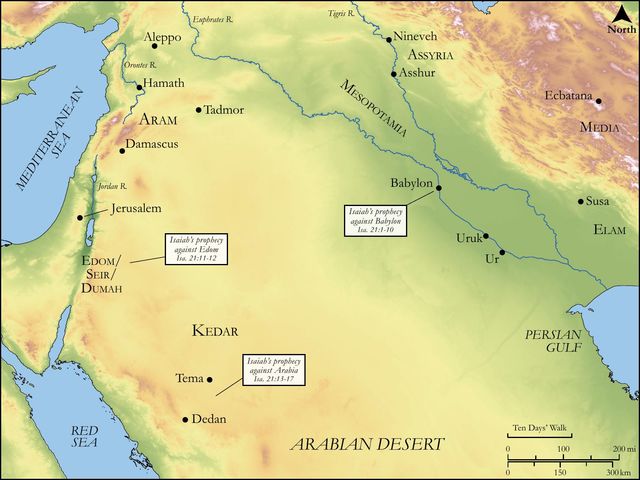
See on the biblical-era map
Study this verse
Public-domain commentary
Matthew Henry
From his Commentary on the Whole Bible. Henry comments on passages, not single verses — this entry covers Isaiah 21:13–17. His two-level outline is real structure in the source text, so it is rendered as structure.
Arabia was a large country, that lay eastward and southward of the land of Canaan. Much of it was possessed by the posterity of Abraham. The Dedanim, here mentioned (Isa 21:13), descended from Dedan, Abraham's son by Keturah; the inhabitants of Tema and Kedar descended from Ishmael, Gen 25:3, Gen 25:13, Gen 25:15. The Arabians generally lived in tents, and kept cattle, were a hardy people, inured to labour; probably the Jews depended upon them as a sort of a wall between them and the more warlike eastern nations; and therefore, to alarm them, they shall hear the burden of Arabia, and see it sinking under its own burden.
I.A destroying army shall be brought upon them, with a sword, with a drawn sword, with a bow ready bent, and with all the grievousness of war, Isa 21:15. It is probable that the king of Assyria, in some of the marches of his formidable and victorious army, took Arabia in his way, and, meeting with little resistance, made an easy prey of them. The consideration of the grievousness of war should make us thankful for the blessings of peace.
II.The poor country people will hereby be forced to flee for shelter wherever they can find a place; so that the travelling companies of Dedanium, which used to keep the high roads with their caravans, shall be obliged to quit them and lodge in the forest in Arabia (Isa 21:13), and shall not have the wonted convenience of their own tents, poor and weather-beaten as they are.
III.They shall stand in need of refreshment, being ready to perish for want of it, in their flight from the invading army:
"O you inhabitants of the land of Tema!" (who probably were next neighbours to the companies of Dedanim) "bring you water" (so the margin reads it) "to him that is thirsty, and prevent with your bread those that flee, for they are objects of your compassion; they do not wander for wandering sake, nor are they reduced to straits by any extravagance of their own, but they flee from the sword." Tema was a country where water was sometimes a scarce commodity (as we find, Job 6:19), and we may conclude it would be in a particular manner acceptable to these poor distressed refugees. Let us learn hence.
1.To look for distress ourselves. We know not what straits we may be brought into before we die. Those that live in cities may be forced to lodge in forests; and those may know the want of necessary food who now eat bread to the full. Our mountain stands not so strong but that it may be moved, rises not so high but that it may be scaled. These Arabians would the better bear these calamities because in their way of living they had used themselves to hardships.
2.To look with compassion upon those that are in distress, and with all cheerfulness to relieve them, not knowing how soon their case may be ours: "Bring water to those that are thirsty, and not only give bread to those that need and ask it, but prevent those with it that have need; give it to them unasked." Those that do so shall find it remembered to their praise, as (according to our reading) it is here remembered to the praise of the land of Tema that they did bring water to the thirsty and relieved even those that were on the falling side.
IV.All that which is the glory of Kedar shall vanish away and fail.
Did they glory in their numerous herds and flocks? They shall all be driven away by the enemy. It seems they were famous about other nations for the use of the bow in battle; but their archers, instead of foiling the enemy, shall fall themselves; and the residue of their number, when they are reduced to a small number, shall be diminished (Isa 21:17); their mighty able-bodied men, and men of spirit too, shall become very few; for they, being most forward in the defence of their country, were most exposed, and fell first, either by the enemies' sword or into the enemies' hand. Note, Neither the skill of archers (though they be ever so good marksmen) nor the courage of mighty men can protect a people from the judgments of God, when they come with commission; they rather expose the undertakers. That is poor glory which will thus quickly come to nothing.
V.All this shall be done in a little time:
"Within one year according to the years of a hireling (within one year precisely reckoned) this judgment shall come upon Kedar." If this fixing of the time be of no great use to us now (because we find not either when the prophecy was delivered or when it was accomplished), yet it might be of great use to the Arabians then, to awaken them to repentance, that, like the men of Nineveh, they might prevent the judgment when they were thus told it was just at the door. Or, when it begins to be fulfilled, the business shall be done, be begun and ended in one year's time. God, when he please, can do a great work in a little time.
VI.It is all ratified by the truth of God (Isa 21:16); "Thus hath the Lord said to me; you may take my word for it that it is his word;" and we may be sure no word of his shall fall to the ground. And again (Isa 21:17): The Lord God of Israel hath spoken it, as the God of Israel, in pursuance of his gracious designs concerning them; and we may be sure the strength of Israel will not lie.
Historical interpretation
Two Centuries of Reception
3 surviving comments on this verse. Each one is dated, so this reads as a timeline rather than a list.
Select a marker to jump to its quote. Markers stagger vertically where authors wrote within a few decades of each other.
(Verse 14, 15.) Bring water to the thirsty, O inhabitants of the land of the South; meet the one fleeing with bread. For they fled from the swords, from the drawn sword, from the bent bow, and from the severity of battle. LXX: Bring water to the thirsty, O inhabitants of the region of Theman; meet the fleeing ones with bread because of the multitude of the slain, because of the multitude of the wanderers, because of the multitude of the sword, and because of the multitude of the bows drawn, and because of the multitude of those falling in battle. You who are in Theman, which is interpreted as Auster and perfection, and you turn in that place of which it is written: God will come from the south wind (Habakkuk III, 4), and you who are consummated and perfected, and have within you the light of the knowledge of the Scriptures, when those fleeing from Arabia and the thicket come to you, meet them with water and bread, and do not wait until they come to you; but imitate the father in the Gospel parable, who reached out to his returning son. And indeed he gave a robe, and presented a ring (Luke XV): but you offer water and bread to the fleeing, so that those who are weary and exhausted may be sustained by your mercy, and quickly reach your seats. For they have fled the swords of heretics, the doctrine of the pagans, and the blasphemies of the Jews. And because they have seen many of them killed by spears and many fallen in battle, they themselves desire to be freed by your help. This place can properly be understood as being against those who surrender themselves to idleness and laziness, content with their own well-being, and do not reach out a helping hand to those who are repentant and converted.
(Verse 13 onwards) Burden in Arabia. In the evening you will sleep in the thicket, in the paths of Dodanim. Bring water to the thirsty ones you encounter: you who live in the land of the South, offer bread to the ones fleeing. Because they have fled from the swords, from the menacing sword, from the drawn bow, from the severity of battle. For this is what the Lord says to me: In yet one year, like the years of a hired worker, all the glory of Kedar will come to an end, and the remaining number of archers, the mighty men of the sons of Kedar, will be few. For the Lord, the God of Israel, has spoken. To me, who was searching and pondering for a long time about what Arabia was, to which the prophetic speech is directed, whether it should be understood as the Moabites, or the Ammonites, and the Edomites, and all the other regions which are now called Arabia, an opportunity is given in this Vision that follows: All the glory of Cedar will be taken away, and the remaining number of mighty archers from the sons of Cedar will be diminished (Isaiah 21:16, 17), to be understood as the Ishmaelites. The book of Genesis teaches that Ishmael, Cedar, and the Hagarites, who are called Saracens by a perverse name, were born. They inhabit the whole wilderness, about whom I think even the poet says: 'And the wandering Barcaeans far and wide' (Virg. Aeneid. IV); and the aforementioned volume, 'He shall dwell against the face of all his brothers' (Gen. XVI, 12): because the very wide desert stretches from India to Mauritania, and the Atlantic Ocean, which I believe sounds the title of Jeremiah: 'Against Cedar and against the kingdoms of Hazor, which Nebuchadnezzar king of Babylon struck' (Jer. XLIX, 28); and immediately follows: 'Thus says the Lord, Arise, and ascend to Cedar, and devastate the sons of the East: their tents, and their flocks shall they take, their skins and all their vessels, and they shall take camels for themselves' (Ibid., 29); and again: 'For Nebuchadnezzar king of Babylon has thought a thought against you, and has deliberated against you.' Arise and go up to a quiet and confidently dwelling nation, says the Lord: there are no gates, no bars for them: they dwell alone. And their camels shall be a booty, and the multitude of their cattle a spoil. And I will scatter them to every wind, them that are clipped on the sides: and I will bring destruction upon them from all their borders, says the Lord: and Achor shall be a habitation of dragons, desolate for ever: there shall no man abide there, nor son of man inhabit it. I have placed the entire prophecy and testimony of Jeremiah so that you may understand clearly what Cedar is. And consider how he specifically describes the people of the Ishmaelites, that they dwell in tents: they occupy the dwellings that night brings, they possess herds and flocks of camels: they do not have doors or bolts: for they do not live in cities, but dwell in the wilderness. And so, they were destroyed by the Babylonians, because they completely destroyed the city of Hazor, which was the metropolis of their people, even down to the ground: and yet, their herds of camels and flocks of sheep were captured, and their skins and tents were divided by lot: not all of their people were annihilated, for dromedary camels, numbering over a hundred thousand, are accustomed to flee through the vast wilderness in a single day. The glory of Cedar will be taken away, it says, and with the number of archers diminished, as they excel greatly in the art of war: the rest who have fled will remain. Because we have understood what Cedar is, and what Arabia is, and what Asor is, let us see what the prophet Isaiah says: 'You will sleep in the forest, at evening, on the paths of Dodanim.' The word Arab (), as we have often said, is used for evening, and Arabia, and raven, and plain, and the West. And because we translated it according to the LXX, 'you will sleep,' it can be interpreted as 'you will stay' or 'you will dwell,' which is called αὐλιθήσεσθε in Greek, and in Hebrew it is said 'Thalinu'. Moreover, he also turns to his close relatives and kinsmen. Thus, it is prophesied that now to the Jews, who were able to escape the siege of Babylon, they will cross over to the neighboring wilderness and settle in the solitude of Arabia on the journey that leads to their brothers. And again the conversation turns to the Ishmaelites, and he exhorts them to mercy: run, and bring water to your tired and endangered brothers, for they are thirsty with great fervor of the sun, and unless you help them, they will perish in the wilderness. And not only water, but also bring bread to the fugitives, so that your kindness may relieve those whom the siege has exhausted. At the same time, he explains the reason why he is giving these orders, saying: the Babylonians have fled, the bows of the Elamites have fled, a fierce battle has fled. Do not despise the unfortunate: your captivity will come quickly. For just as the year of a hired worker is swift and considers all labor to be short until he receives the desired wage, so all the glory of the sons of Cedar will be taken from you, and your arrows will be worn out, and only a small number of warriors will remain. Some people want to be taken from what is said, that even in one year, and every glory of Cedar will be taken away, not Babylonian captivity being proclaimed, about which Jeremiah also speaks, but of the Assyrians, who after one year of the devastation of Judah, have widely persecuted the Saracens. Moreover, that place which we have transferred: You who inhabit the land of the South, meet the fugitive with bread: and as if we read in the imperative mode on behalf of the Lord, they affirm that in Hebrew it can be read like this: You who inhabit the land of the South, met the fugitive with bread; just as when God said to them, when they met the thirsty, bring water, they would take away the bread with a hostile mind without water, in order to increase their thirst with food.
Again, by bread is set forth the instruction of heavenly doctrine, as is said by the prophet, “You who dwell in the land of the south, meet with bread him that is flying away.” For they dwell in the land of the south who, placed within [the] holy church, are breathed upon by the love of the Spirit from on high. But he is flying who is wishing to escape from the evils of this world. He then who dwells in the land of the south should meet with bread him that is flying; that is, he who is already full of the Holy Spirit within the church should console with words of instruction the one who is endeavoring to escape from his evil ways.
Continue studying Isaiah 21:14 across the web’s major study libraries — every link below opens this exact verse, chapter, or book on the destination site.
Read & Compare
 BibleGatewayThis verse in more than 200 translations and 70 languages.
 Bible.comThe YouVersion reader — hundreds of translations, reading plans, and highlights.
 ESV.orgCrossway's official English Standard Version reader.
 NET BibleThe NET translation with 60,000+ translators' notes on every rendering decision.
 STEP BibleTyndale House's free study tool — original text, vocabulary, and scholarly resources.
 BibliaLogos Bible Software's free web reader.
 USCCBThe New American Bible (Revised Edition) with the U.S. bishops' study notes.
Commentaries
 BibleHub CommentariesDozens of classic commentaries on this verse, gathered on one page.
 StudyLightMore than 100 commentary sets — the largest collection on the web.
 BibleRefPlain-English commentary on what this verse means, verse by verse.
 Enduring WordDavid Guzik's free commentary on this chapter, widely used by Bible teachers.
 Bible Study ToolsVerse commentary alongside Greek and Hebrew study aids.
Original Language & Research
- BibleHub InterlinearThe verse word by word — original language, transliteration, and English.
- BibleHub LexiconEvery word's original-language definition and Strong's entry.
 Blue Letter BibleDeep-study tools — Strong's numbers, concordance, and word studies.
 SefariaThe Hebrew text with Rashi and centuries of Jewish commentary.
Sermons, Hymns & Audio


TrulyRandomVerse is not affiliated with these sites and doesn’t control their content. They’re linked because they’re genuinely useful.
Summary
Isaiah 21:14 offers a striking depiction of unexpected compassion amidst a series of dire prophetic judgments. Within the "burden upon Arabia," the verse portrays the inhabitants of Tema proactively extending vital humanitarian aid—water and bread—to those fleeing a devastating conflict. This poignant scene stands as a powerful testament to selfless provision and human kindness in a time of extreme crisis, highlighting a remarkable moment of grace and ethical conduct within a broader narrative of divine judgment and societal upheaval.
Context
ShowHideLiterary Context
Isaiah 21 is a composite chapter, presenting a sequence of "burdens" or prophetic oracles against various foreign nations. These include Babylon (verses 1-10), Edom (verses 11-12), and Arabia (verses 13-17). Verse 14 is situated within the "burden upon Arabia," specifically addressing the Dedanites, Tema, and Kedar. The preceding verses (verses 13-13) vividly describe the harsh desert environment and the desperate plight of travelers forced to seek refuge in the thickets, emphasizing the scarcity of resources and the imminent danger. This immediate narrative context establishes the dire circumstances of those fleeing an impending invasion, most likely by the formidable Neo-Assyrian Empire, which dominated the geopolitical landscape during Isaiah's prophetic ministry. Thus, verse 14's portrayal of proactive aid underscores the profound vulnerability of those caught in the path of war, where basic necessities become matters of life and death.
Historical & Cultural Context
The 8th century BCE, the era of Isaiah's prophecy, was characterized by the relentless expansion of the Neo-Assyrian Empire. Assyrian military campaigns frequently extended into the Arabian peninsula, aiming to control vital trade routes and secure resources. Tema (modern Tayma) was a significant oasis town in northern Arabia, strategically positioned on major caravan routes, renowned for its abundant wells and relative prosperity. The "him that fled" likely refers to refugees from Dedanite or other Arabian tribes, displaced by Assyrian incursions or inter-tribal conflicts. In the arid desert environment, hospitality and the provision of water and food were not merely acts of kindness but were essential for survival, deeply ingrained in the cultural norms of the region. To "prevent" (in its archaic sense, to meet or anticipate) someone with provisions was a proactive and vital act of mercy, particularly towards those in distress, reflecting a profound understanding of desert ethics.
Key Themes
ShowHideThis verse contributes significantly to several overarching themes found within the book of Isaiah and broader prophetic literature. It powerfully illustrates the theme of human vulnerability in the face of conflict and displacement, vividly portraying the desperate need for basic provisions like water and food. Simultaneously, it highlights the theme of unexpected compassion and humanitarian aid, as the inhabitants of Tema, despite potentially facing their own threats, extended vital assistance. This act of mercy stands in stark contrast to the general tone of judgment and destruction prevalent in the surrounding prophecies, subtly introducing a note of hope and ethical conduct. Furthermore, it touches upon the theme of divine observation of human actions, suggesting that even amidst prophecies of judgment against nations, acts of charity and care for the needy are noted and valued. This aligns with broader biblical principles of justice and mercy, such as the repeated call to care for the sojourner and the poor found throughout the Law and Prophets, as exemplified in passages like Deuteronomy 10:18-19 and Leviticus 19:33-34.
Exposition and Analysis
ShowHideKey Word Analysis
ShowHideThis primitive root properly means "to sit down," but by implication, it extends to "to dwell," "to remain," or "to settle." In this context, it refers to the settled population of Tema, emphasizing their established presence and resources, which enabled them to provide aid. Their act of "bringing" water and bread is significant because they are not themselves fleeing, but are rooted in their land, making their proactive compassion all the more notable.
This adjective describes a state of intense physical need for water. It can be used literally, as here, to describe someone parched in the desert, or figuratively, to describe a spiritual longing. In Isaiah 21:14, it powerfully conveys the desperate condition of the refugees, making the provision of water an act of life-saving mercy, highlighting the urgency and severity of their need.
This primitive root means "to project (oneself)," "to precede," or "to anticipate." In this specific context, it means "to meet" or "to come to meet," often with the nuance of doing so proactively or quickly. The KJV translation "prevented" uses an older sense of the word meaning "to go before" or "to anticipate." This highlights that the people of Tema did not wait for the refugees to beg, but actively went out to provide bread, underscoring their initiative and timely compassion.
Verse Breakdown
ShowHide"The inhabitants of the land of Tema brought water to him that was thirsty"
This clause introduces the compassionate agents, the settled people of Tema, an oasis town renowned for its water supply. Their action is direct and purposeful: they "brought water," indicating a deliberate and active response to need. The recipient is "him that was thirsty," a vivid portrayal of the desperate condition of the refugees, emphasizing their parched state in the arid desert. This act of providing water is a fundamental and life-giving expression of hospitality in such an environment.
"they prevented with their bread him that fled."
This second clause reinforces the proactive and generous nature of Tema's inhabitants. The verb "prevented" (in its archaic sense of "met ahead of time" or "anticipated") powerfully emphasizes their initiative; they did not wait for the fugitives to arrive begging, but went out to meet them. They brought "their bread," signifying a willing and timely provision of essential sustenance from their own resources to those who were not only thirsty but also "fled," indicating their displacement, vulnerability, and urgent need for nourishment and security.
Literary Devices
ShowHideIsaiah 21:14 skillfully employs several literary devices to amplify its message and emotional impact. The most striking is Contrast, as the verse presents an act of profound human compassion and aid within a chapter largely dedicated to prophecies of judgment, destruction, and despair against various nations. This juxtaposition highlights the unexpected and remarkable nature of Tema's generosity, serving as a beacon of light amidst the impending darkness. There is also powerful Imagery at play, painting a vivid and visceral picture of the parched desert, the desperate flight of refugees, and the life-saving provision of water and bread. The simple yet potent actions described evoke a strong sense of immediate human need and the tangible, compassionate response to it. Furthermore, the phrase "prevented with their bread" utilizes a subtle form of Anticipation or proactive action, emphasizing the initiative taken by the people of Tema, rather than a passive or reactive response to a plea for help.
Theological and Thematic Connections
ShowHideThis verse, though concise, carries significant theological weight, serving as a powerful illustration of practical compassion and hospitality in the face of immense suffering. It implicitly affirms the divine value placed on caring for the vulnerable and displaced, even when such acts occur outside the immediate covenant community of Israel. The provision of water and bread, fundamental necessities for life, reflects a universal ethic of mercy that transcends national boundaries and prophetic judgments. It reminds us that God observes and values acts of kindness and provision for those in dire need, echoing the broader biblical mandate to love one's neighbor and extend hospitality to strangers, recognizing the inherent dignity of all people.
Reflection and Application
ShowHideIsaiah 21:14 serves as a timeless call to compassion and proactive humanitarianism. In a world continually marked by conflict, natural disasters, and forced displacement, the actions of the Tema inhabitants stand as a powerful example of selfless love and practical aid. They did not wait for the desperate to beg; they anticipated the need and met it with their own resources, demonstrating a profound sense of human solidarity. This challenges believers today to move beyond passive sympathy to active engagement in alleviating suffering. Whether it's supporting organizations that provide relief to refugees, offering hospitality to newcomers, or simply being attentive to the needs of the lowly in our own communities, the verse compels us to be instruments of God's provision and compassion. It reminds us that true faith is demonstrated not just in words, but in tangible acts of love, especially towards those who are most vulnerable and in need, reflecting the very heart of God.
Questions for Reflection
ShowHideFAQ
ShowHideWhat is the significance of Tema in this verse?
ShowHideTema (modern Tayma) was a significant oasis town in ancient northern Arabia, strategically located on major trade routes. Its importance lay in its reliable water sources, which made it a vital stop for travelers and caravans in the arid desert. In Isaiah 21:14, Tema's significance is twofold: first, its ability to provide water and bread highlights its relative prosperity and resources, indicating a capacity for generosity; second, the inhabitants' willingness to share these vital supplies with fleeing refugees demonstrates an unexpected and profound act of compassion in a harsh environment, contrasting sharply with the general tone of judgment in the surrounding prophecies and underscoring a universal ethic of care.
Does "prevented" mean they stopped the fleeing people?
ShowHideNo, in the context of the King James Version (KJV) and the original Hebrew, "prevented" (from the Hebrew qâdam) does not mean to hinder or stop. Rather, it carries an older English meaning of "to go before," "to anticipate," or "to meet." So, when the verse says "they prevented with their bread him that fled," it means the inhabitants of Tema proactively went out to meet the fleeing people, bringing them bread. This emphasizes their initiative and timely provision of aid, rather than any obstruction, highlighting their extraordinary compassion and foresight in meeting urgent needs.
Christ-Centered Fulfillment
ShowHideWhile Isaiah 21:14 describes a remarkable act of human compassion and material provision, it also subtly points forward to the ultimate provision and compassion found in Jesus Christ. The physical water and bread offered by Tema's inhabitants, meeting immediate bodily needs, foreshadow the spiritual sustenance that Christ provides to a world parched by sin and spiritual hunger. Jesus declared Himself to be the Living Water for the spiritually thirsty, promising that whoever drinks of Him will never thirst again (John 4:14). Similarly, He is the Bread of Life, who came down from heaven to give life to the world, offering Himself as the true nourishment for those spiritually hungry (John 6:51). Just as Tema proactively met the urgent physical needs of the fleeing, Christ meets the deepest spiritual needs of humanity, offering eternal life and true satisfaction to all who come to Him. His entire earthly ministry was characterized by profound compassion for the hungry, the sick, and the lowly, culminating in His ultimate sacrifice on the cross, providing the spiritual "water" and "bread" that truly saves, sustains, and satisfies for all eternity.