


Job 6:19
Bible text: King James Version (1769 Blayney text) · Public domain
Bible text: Berean Standard Bible · Public domain
Bible text: American Standard Version (1901) · Public domain
Bible text: World English Bible, Messianic edition · Public domain
Bible text: Geneva Bible (1599) · Public domain
Bible text: Young's Literal Translation · Public domain
- הִבִּיטוּHi·bi·tuthey lookH5027V-Hiphil-Perf-3cpVerb Hiphil Perfect 3rd Plural common gender
- אָרְחוֹת'a·re·Chot[the] caravans ofH734N-fpcNoun Plural Feminine Construct
- תֵּמָאte·Ma'TemaH8485N-properNoun Proper Location
- הֲלִיכֹתha·li·Khot[the] travelers ofH1979N-fpcNoun Plural Feminine Construct
- שְׁבָאShe·Va'ShebaH7614N-properNoun Proper Location
- קִוּוּki·vuthey look eagerlyH6960V-Piel-Perf-3cpVerb Piel Perfect 3rd Plural common gender
- לָמוֹla·mofor themPrep-l ¦ 3mpSuffix Personal 3rd Plural Masculineלָforמוֹthem
English is a literal word-by-word gloss of the Hebrew, not the KJV's wording. Why?
This is the original text the KJV's translators worked from — each Hebrew word with its own literal English meaning in this verse, prepared by scholars at Tyndale House, Cambridge. The KJV translates whole sentences, not word by word, so its wording differs: one Hebrew word can become several English words, and the KJV may choose “the LORD” where the gloss reads “Yahweh”. Both are faithful — they answer different questions. For the KJV's own rendering, switch to the KJV text.
Details
See on the biblical-era map
Study this verse
Public-domain commentary
Matthew Henry
From his Commentary on the Whole Bible. Henry comments on passages, not single verses — this entry covers Job 6:14–21. His three-level outline is real structure in the source text, so it is rendered as structure.
Eliphaz had been very severe in his censures of Job; and his companions, though as yet they had said little, yet had intimated their concurrence with him. Their unkindness therein poor Job here complains of, as an aggravation of his calamity and a further excuse of his desire to die; for what satisfaction could he ever expect in this world when those that should have been his comforters thus proved his tormentors?
I.He shows what reason he had to expect kindness from them.
His expectation was grounded upon the common principles of humanity (Job 6:14): "To him that is afflicted, and that is wasting and melting under his affliction, pity should be shown from his friend; and he that does not show that pity forsakes the fear of the Almighty." Note,
1.Compassion is a debt owing to those that are in affliction. The least which those that are at ease can do for those that are pained and in anguish is to pity them, - to manifest the sincerity of a tender concern for them, and to sympathize with them, - to take cognizance of their case, enquire into their grievances, hear their complaints, and mingle their tears with theirs, - to comfort them, and to do all they can to help and relieve them: this well becomes the members of the same body, who should feel for the grievances of their fellow-members, not knowing how soon the same may be their own.
2.Inhumanity is impiety and irreligion. He that withholds compassion from his friend forsakes the fear of the Almighty. So the Chaldee. How dwells the love of God in that man? Jo1 3:17. Surely those have no fear of the rod of God upon themselves who have no compassion for those that feel the smart of it. See Jam 1:27.
3.Troubles are the trials of friendship. When a man is afflicted he will see who are his friends indeed and who are but pretenders; for a brother is born for adversity, Pro 17:17; Pro 18:24.
II.He shows how wretchedly he was disappointed in his expectations from them (Job 6:15):
"My brethren, who should have helped me, have dealt deceitfully as a brook." They came by appointment, with a great deal of ceremony, to mourn with him and to comfort him (Job 2:11); and some extraordinary things were expected from such wise, learned, knowing men, and Job's particular friends. None questioned but that the drift of their discourses would be to comfort Job with the remembrance of his former piety, the assurance of God's favour to him, and the prospect of a glorious issue; but, instead of this, they most barbarously fall upon him with their reproaches and censures, condemn him as a hypocrite, insult over his calamities, and pour vinegar, instead of oil, into his wounds, and thus they deal deceitfully with him. Note, It is fraud and deceit not only to violate our engagements to our friends, but to frustrate their just expectations from us, especially the expectations we have raised. Note, further, It is our wisdom to cease from man. We cannot expect too little from the creature nor too much from the Creator. It is no new thing even for brethren to deal deceitfully (Jer 9:4, Jer 9:5; Mic 7:5); let us therefore put our confidence in the rock of ages, not in broken reeds - in the fountain of life, not in broken cisterns. God will out-do our hopes as much as men come short of them. This disappointment which Job met with he here illustrates by the failing of brooks in summer.
1.The similitude is very elegant, Job 6:15-20.
(1.)Their pretensions are fitly compared to the great show which the brooks make when they are swollen with the waters of a land flood, by the melting of the ice and snow, which make them blackish or muddy, Job 6:16.
(2.)His expectations from them, which their coming so solemnly to comfort him had raised, he compares to the expectation which the weary thirsty travellers have of finding water in the summer where they have often seen it in great abundance in the winter, Job 6:19. The troops of Tema and Sheba, the caravans of the merchants of those countries, whose road lay through the deserts of Arabia, looked and waited for supply of water from those brooks. "Hard by here," says one, "A little further," says another, "when I last travelled this way, there was water enough; we shall have that to refresh us." Where we have met with relief or comfort we are apt to expect it again; and yet it does not follow; for,
(3.)The disappointment of his expectation is here compared to the confusion which seizes the poor travellers when they find heaps of sand where they expected floods of water. In the winter, when they were not thirsty, there was water enough. Every one will applaud and admire those that are full and in prosperity. But in the heat of summer, when they needed water, then it failed them; it was consumed (Job 6:17); it was turned aside, Job 6:18. When those who are rich and high are sunk and impoverished, and stand in need of comfort, then those who before gathered about them stand aloof from them, those who before commended them are forward to run them down. Thus those who raise their expectations high from the creature will find it fail them when it should help them; whereas those who make God their confidence have help in the time of need, Heb 4:16. Those who make gold their hope will sooner or later be ashamed of it, and of their confidence in it (Eze 7:19); and the greater their confidence was the greater their shame will be: They were confounded because they had hoped, Job 6:20. We prepare confusion for ourselves by our vain hopes: the reeds break under us because we lean upon them. If we build a house upon the sand, we shall certainly be confounded, for it will fall in the storm, and we must thank ourselves for being such fools as to expect it would stand. We are not deceived unless we deceive ourselves.
2.The application is very close (Job 6:21): For now you are nothing. They seemed to be somewhat, but in conference they added nothing to him. Allude to Gal 2:6. He was never the wiser, never the better, for the visit they made him. Note, Whatever complacency we may take, or whatever confidence we may put, in creatures, how great soever they may seem and how dear soever they may be to us, one time or other we shall say of them, Now you are nothing. When Job was in prosperity his friends were something to him, he took complacency in them and their society; but "Now you are nothing, now I can find no comfort but in God." It were well for us if we had always such convictions of the vanity of the creature, and its insufficiency to make us happy, as we have sometimes had, or shall have on a sick-bed, a death-bed, or in trouble of conscience: "Now you are nothing. You are not what you have been, what you should be, what you pretend to be, what I thought you would have been; for you see my casting down and are afraid. When you saw me in my elevation you caressed me; but now that you see me in my dejection you are shy of me, are afraid of showing yourselves kind, lest I should thereby be emboldened to beg something of you, or to borrow" (compare Job 6:22); "you are afraid lest, if you own me, you should be obliged to keep me." Perhaps they were afraid of catching his distemper or of coming within smell of the noisomeness of it. It is not good, either out of pride or niceness, for love of our purses or of our bodies, to be shy of those who are in distress and afraid of coming near them. Their case may soon be our own.
Historical interpretation
Historical reception
2 surviving comments on this verse. Each one is dated, so this reads as a timeline rather than a list.
“They are confounded, because I have hoped.” When the wicked inflict evils upon the good, they are overjoyed at the success of their deceptions, if they see the good shaken from interior hope. For the wicked reckon the spread of their error to be the greatest gain, for they rejoice to have companions in perdition. But when the good person’s hope is rooted within, never bent to the ground by outward evils, confusion seizes the soul of the wicked. Their inability to get at the innermost parts of the distressed results in shame for the wicked. Their cruelty has not produced the effect they expected.… “They came even to me and were ashamed.” For lost sinners “come even to holy church” on the day of judgment, in that they are brought even then to behold its glory. For the punishment of their guilt is even greater when they see what they have lost as they are rejected. Then shame covers the wicked, when the conscience bears witness and convicts them in the sight of the Judge. At that time the Judge is beheld without and the accuser is convicted within. Every sin is called up before the eyes and the soul. The soul is tortured by its own fire, over and above the burnings of hell.
39. For Tema is rendered ‘the south wind,’ and Sheba ‘a net.’ What is here set forth by ‘the south wind,’ which dissolves the limbs it blows on with its warm breath, saving dissolute laxity of life? and what by ‘the net,’ save the fettering of practice? For they that aim at the things that are eternal with a dissolute mind, of their own free will fetter themselves by the irregularity of their efforts, that they should never advance towards God with a free step, and while they entangle themselves with the loose practices of their behaviour, they as it were set their feet to be held in the meshes [maculis] of a net. For as we said a little way above, that there are persons who are drawn back into bad habits, already got the better of, by means of other open evil habits not yet overcome, so there are some that fall back into those which they had abandoned by means of others, which are cloked with the title of respectability, or the honourableness of praise. Thus there are very many, who now no longer aim at the things of another, and who with the love of tranquillity begun are parted from the jarrings of this world, thirst to be instructed in Holy Writ, long to give themselves to heavenly contemplations, yet they do not abandon with a perfect freedom of soul all concern about their domestic affairs, and often while they are employed in the service of the same in a lawful way, they are involved in the unlawful jarrings of this world at the same time; and while they are eager to protect their earthly interests with anxious care, they quit that repose of the heart, which they sought for; and whilst their substance, that is escaping from them, is guarded with continual caution, the word of divine knowledge which has been conceived in the heart is let loose; in that, according to the declaration of ‘Truth,’ the thorns choke the seed that has sprung up, when the importunate cares of earthly things put out the word of God from the recollection [Matt. 13, 22]. Therefore they are walking in a net with their steps all abroad, who, while they do not perfectly forsake the world, fetter themselves in their steppings, that they cannot step.
40. And there are very many, who not only do not covet what belongs to another, but even abandon all that they possessed in the world, who despise themselves, do not aim at any glory of the present life, sever themselves from this world's courses of action, and whatever prosperity may smile upon them, they well nigh tread it under their feet; yet being tied with the chain of earthly relationship, while they imprudently obey the dictates of the love of kindred, it often happens that by the instrumentality of relations they turn back to those habits which they had even together with self-contempt already subdued; and whereas they love their fleshly kin beyond what needs, being drawn back without, they are separated from the Parent of the heart. For we often see men, who, as far as concerns their own interest, henceforth no longer entertain any desires of the present life, who have quitted the world both in practice and in profession, yet for their inordinate affection for relations, burst into the courts of justice, busy themselves with the discord of earthly things, part with the freedom of interior repose, and restore in their hearts the interests of the world that were long undone. Whither then are those walking but into a net, whom perfection of life commenced had already set free from the present world, but whom the excessive love of earthly kin still binds?
41. For they that fol1ow after the reward of the eternal espousals with close pursuits, and not with loose steps, as they disregard themselves for the love of God, so they lay aside every thing whereby they see they are hindered; and since it is necessary for God's sake that they should render service to all that they are able, for God's sake they refuse their private services even to their relations. Hence it is that when one said, Suffer me first to go and bury my father, he thereupon heard from the lips of ‘Truth,’ Follow Me, and let the dead bury their dead, but go thou and preach the kingdom of God. [Luke 9, 59. 60.] Wherein it is to be observed, that whereas the chosen disciple is withheld from the burial of his father, for the sake of God it is not permitted a devout person to do for a dead father, from carnal affection, that which, for God's sake, he ought to do for strangers likewise. Hence again ‘Truth’ saith, If any man come to Me, and hate not his father, and mother, and wife, and children, and brethren, and sisters, yea, and his own life also, he cannot be My disciple. [Luke 14, 26] In which same place, forasmuch, as after the hatred of our kindred we have the hatred of our own life brought in, it is plainly shown that we are bidden to hold our relations in hatred in such sort as ourselves, that urging them [A.B.E. ourselves] away to the interests of eternity, and putting aside carnal favour towards them, when it is a hindrance in the way, we might learn by a proportioned skill of discrimination, at once to love them suitably, and to hate them savingly, so that in love hatred might be so taught to arise, that we might be able to love more really in hatred. Hence again it is said by Moses, Who said unto his father and to his mother, I know you not, and to his brethren, I recognize you not, nor knew they their own children; these have observed Thy word and Thy covenant, and kept Thy judgments. [Deut. 33, 9] For he longs to know God more familiarly who, from love of religion, desires to know no longer those whom he has known after the flesh. For the knowledge of God is lessened by a grievous curtailment, if it be shared with acquaintance with the flesh. Everyone then must be put without the pale of kindred and acquaintance, if he would be more genuinely united to the Parent of all, that those same ones, whom for the sake of God he makes light of for a good end, he may the more substantially love, in proportion as he renounces in them the destructible affection of carnal attachment.
42. We ought indeed, even in a temporal way, to benefit more than the rest those to whom we are more nearly united; for a flame too extends its burning to things put by it, but that particular thing, wherein it originates, it first sets burning. We ought to acknowledge the tie of earthly relationship, and yet to disown it, when it obstructs the progress of the mind, that the faithful soul, being inflamed in devotion to divine things, may at once not look with contempt on the things which are joined to it below, and that by regulating these aright in itself, it may mount above them in the love of things on high. Therefore with wise caution we must be on our guard, that no favouring of the flesh steal upon us, and divert the step of the heart from the right path, lest it hinder the efficacy of heavenly love, and sink the soaring mind; downwards under a superincumbent weight. For everyone ought so to sympathize in the wants of his kindred, that yet by such sympathy he never let the force of his purpose be impeded, so that affection indeed should fill the bowels of the heart, yet not divert it from its spiritual resolve. For it is not that holy men do not love their fleshly kin, to give them all things necessary, but they subdue this very fondness within themselves from love of spiritual things, in order so to temper it by the control of discretion, that they may be never led by it, yea in a small measure, and in the very least degree, to deviate from the straight path. And these are well conveyed to us by the representation of the kine, which going along towards the hilly lands under the Ark of the Lord, proceed at one and the same time with fondness and with hardened feeling; as it is written, And the men did so: and took two milch kine, and tied them to the cart, and shut up their calves at home: and they laid the Ark of the Lord upon the cart. [1 Sam. 6, 10] And soon after; And the kine took the straight way to the way of Beth-shemesh, and they went along by one way, lowing as they went, and turned not aside to the right hand or to the left. [ver. 12] For observe, when the calves were shut up at home, the kine which are fastened to the waggon bearing the Ark of the Lord, moan and go their way, they give forth lowings from deep within, and yet never alter their steps from following the path. They feel love indeed shown by compassion, but never bend their necks behind. Thus, thus must they needs go on their way, who being placed under the yoke of the sacred Law, henceforth carry the Lord's Ark in inward knowledge, so as never for this, that they take compassion on the necessities of relations, to deviate from the course of righteousness which they have entered upon. For ‘Beth-shemesh’ is rendered ‘the house of the sun.’ Thus to go to Beth-shemesh with the Ark of the Lord placed on them, is in company with heavenly knowledge to draw near to the seat of light eternal. But we are then really going on towards Beth-shemesh, when in going the path of righteousness, we never turn aside into the adjoining side-paths of error, not even for the sake of the affection we bear to our offspring; kindness to whom ought indeed to have a place in our mind, but never to turn it back, lest that mind, if it be not touched by a feeling of affection, be hard, or being too much touched, if it is turned aside, be slack.
43. It is well to look at blessed Job, in whom the yoke of God's fear had worn the neck of the heart, and see under what controlling influence of discretion he bears the Ark of the Lord's sentence. For when the calves are gone he lows, in that, when tidings of his children's death were brought 'him, ‘he fell upon the ground with his head shaven,’ yet he goes by the right way whilst lowing, in that his lips in groaning are opened to utter the praises of God, whereas, he exclaims without delay, The Lord gave, and the Lord hath taken away; blessed be the name of the Lord. [Job 1, 21] But minds that are not gifted with discretion know nothing of this rule of life, and in the degree that they seek the ways of the Lord negligently, they are turned back foolishly to the paths of the world.
44. Rightly then does the holy man after ‘the paths of Theman’ make mention of ‘the ways of Saba.’ For they whom the south wind of a mischievous warmth has relaxed, are verily held bound in the net of entanglement. But in describing the deeds of the wicked, he rightly admonishes them to ‘consider’ these things; for we delight in froward practices in doing them, but when seen in others we pass sentence upon them, and the actions, which in our own case we think to be little deserving of sentence, we learn to be as base as they really are by the conduct of others; and so it comes to pass that the mind is brought back to itself, and takes shame to do the thing that it censures. For it is as though an ugly face in a mirror caused disgust, as often as the mind sees in a similar life, what to feel abhorrence for in itself. Therefore he says, Consider the paths of Teman, the ways of Sheba, and wait a little. As if it were in plain words; ‘Look to the harms of another's luke-warmness, and then you will the more surely take hope in relation to eternal things, if with the eye of the heart rightly directed you look at that which may disgust you in others.’
45. And it is well said, wait a little; for it often happens, that whereas the short period of the present life is loved as if it were to last for long, the soul is dashed from its eternal hope, and being beguiled with present objects, is thrown back by the blackness of self-despair. And when it imagines that the period is long which remains for it to live, at once upon quitting life it meets that eternity, which it may not avoid. Hence it is that it was spoken by one that was wise, Woe unto you that have lost patience. For truly they ‘lose patience,’ who, whilst they reckon to tarry long amongst visible things, part with the hope of the invisible. And while the mind is rivetted to present objects, life is ended, and they are suddenly brought to unlooked-for punishments, which, being deceived by their presumptuous expectations, they flattered themselves they would either never meet with, or not till late. Hence ‘Truth’ says, Watch therefore, for ye know neither the day nor the hour. [Matt. 25, 13] Hence again it is written, The Day of the Lord so cometh as a thief in the night [1 Thess. 5, 2]; for because it is never seen drawing near to seize upon the soul, it is likened to a thief in the night. Therefore it ought to be the more apprehended as always coming, in proportion as it cannot be foreknown by us when it is about to come. Whence holy men too, in that they have their eyes incessantly fixed on the shortness of life, do as it were pass through life daily undergoing death; and prepare themselves on a more solid basis for the things that shall last, in proportion as they are ever reflecting by the end that transitory things are nought. For hence the Psalmist, seeing that the life of the sinner fleeth at a quick pace, exclaims, For yet a little while and the sinner shall not be. [Ps. 37, 10] Hence again he saith, As for man, his days are as grass. [Ps. 103, 15] Hence Isaiah saith, All flesh is grass, and all the goodliness thereof is as the flower of the field. [Is. 40, 6] Hence James rebukes the spirit of the presumptuous, saying, For what is your life? it is even a vapour that appeareth for a little time. [James 4, 14] Therefore it is rightly said, wait a little, in that both that is unmeasurable which follows after without limit, and all but little that is closed by an end. For that ought not to seem long to us, which by the course of its allotted period is tending not to be; which while it is carried on by moments, its very own moments, whilst they delay, are themselves urging forwards; and from the very same cause, from which it is seen to be in our possession, it results that it ceases to be in our possession. But blessed Job, after he had brought in the shortness of the present life in terms of contempt, therefore in the voice of all the Elect rises up justly against the wicked.
Continue studying Job 6:19 across the web’s major study libraries — every link below opens this exact verse, chapter, or book on the destination site.
Read & Compare
 BibleGatewayThis verse in more than 200 translations and 70 languages.
 Bible.comThe YouVersion reader — hundreds of translations, reading plans, and highlights.
 ESV.orgCrossway's official English Standard Version reader.
 NET BibleThe NET translation with 60,000+ translators' notes on every rendering decision.
 STEP BibleTyndale House's free study tool — original text, vocabulary, and scholarly resources.
 BibliaLogos Bible Software's free web reader.
 USCCBThe New American Bible (Revised Edition) with the U.S. bishops' study notes.
Commentaries
 BibleHub CommentariesDozens of classic commentaries on this verse, gathered on one page.
 StudyLightMore than 100 commentary sets — the largest collection on the web.
 BibleRefPlain-English commentary on what this verse means, verse by verse.
 Enduring WordDavid Guzik's free commentary on this chapter, widely used by Bible teachers.
 Bible Study ToolsVerse commentary alongside Greek and Hebrew study aids.
Original Language & Research
- BibleHub InterlinearThe verse word by word — original language, transliteration, and English.
- BibleHub LexiconEvery word's original-language definition and Strong's entry.
 Blue Letter BibleDeep-study tools — Strong's numbers, concordance, and word studies.
 SefariaThe Hebrew text with Rashi and centuries of Jewish commentary.
Sermons, Hymns & Audio


TrulyRandomVerse is not affiliated with these sites and doesn’t control their content. They’re linked because they’re genuinely useful.
Summary
Job 6:19 profoundly articulates Job's crushing disillusionment as he recounts the failure of anticipated sources of comfort and aid. In this poignant lament, he describes how famed caravans from distant, wealthy lands—Tema and Sheba—passed by, offering neither the solace, understanding, nor practical help he desperately sought in his immense suffering, thereby deepening his profound sense of isolation and abandonment.
Context
ShowHideLiterary Context
Job 6 opens with Job's impassioned and deeply personal response to Eliphaz's well-intentioned but ultimately misguided counsel. Eliphaz had suggested that Job's suffering was a direct consequence of sin, urging him to repent and find relief. Job, however, vehemently rejects this premise, asserting his innocence and expressing the overwhelming, almost unbearable, weight of his grief. He longs for death as an escape from his agony, comparing his suffering to a raging torrent that would overwhelm even the most steadfast heart. Job 6:19 is embedded within this extended lament, where Job articulates the depth of his despair and the utter failure of all human sources—friends, external aid, or even the hope of relief—to alleviate his pain. It highlights his profound isolation and the stark inadequacy of worldly resources in the face of divinely permitted affliction, further emphasizing the unique nature of his trial.
Historical & Cultural Context
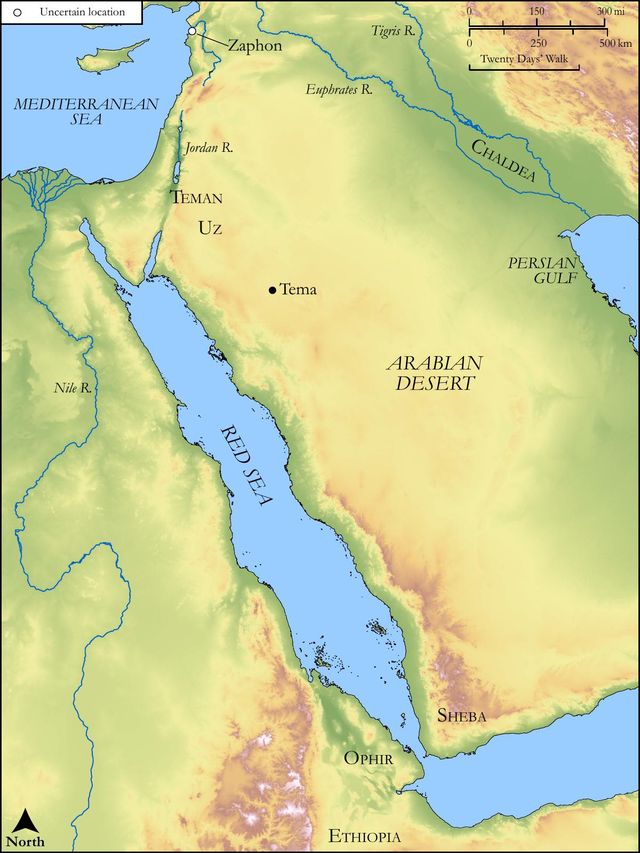
Tema and Sheba were prominent regions in ancient Arabia, renowned for their strategic locations along major trade routes, particularly the lucrative incense and spice trade. Tema (modern Tayma in Saudi Arabia) was a significant oasis city and a vital caravan stop, known for its wealth, influence, and access to resources. Sheba (likely in modern Yemen, associated with the powerful Sabaean kingdom) was a wealthy and influential kingdom, famously visited by the Queen of Sheba who sought Solomon's wisdom. The mention of "troops" or "companies" from these places evokes images of well-equipped, resourceful, and potentially knowledgeable travelers. For Job to expect aid or wisdom from such esteemed and distant sources, only to be met with their indifferent passing, underscores the exceptional nature of his suffering. It implies that even the most well-resourced and respected human avenues of help were utterly incapable of addressing his profound spiritual and physical anguish, intensifying his sense of abandonment.
Key Themes
ShowHideThis verse powerfully contributes to several overarching themes in the Book of Job. Firstly, it amplifies the theme of Failed Expectations, vividly portraying the crushing disappointment of anticipating comfort or relief from specific sources, only to find them utterly wanting. Job's hope, like the desert traveler's expectation of water from a seasonal wadi (as described in Job 6:15-18), is dashed, leaving him more desolate than before. Secondly, it underscores Job's profound Isolation, emphasizing his feeling of being utterly alone in his suffering, with even distant, potentially helpful groups passing by without offering aid or understanding. This sense of abandonment is a recurring motif throughout his laments, echoing the sentiment of Psalm 69:20. Finally, the verse highlights the Insufficiency of Human Wisdom and Resources. Job is learning that human wisdom and material wealth, even from respected or wealthy areas like Tema and Sheba, are utterly inadequate in the face of such profound, divinely ordained trials, pointing to a higher, divine source of ultimate comfort and vindication.
Exposition and Analysis
ShowHideKey Word Analysis
ShowHideWhile often translated "troops" (KJV) or "caravans" (NIV, ESV), the Hebrew term H734 primarily refers to "a well-trodden road (literally or figuratively); also a caravan; manner, path, race, rank, traveller, troop, (by-, high-) way." In this context, it signifies a traveling company or caravan, emphasizing the transient nature of these groups and their journeying through the desert. It suggests an expectation of passing travelers who might offer a moment of respite, news, or even supplies, making their failure to do so all the more poignant for Job.
The Hebrew root H5027 means "to scan, i.e. look intently at; by implication, to regard with pleasure, favor or care; (cause to) behold, consider, look (down), regard, have respect, see." This verb implies an intense, expectant gaze, a hopeful searching. It's not a casual glance but a deliberate act of looking towards a source from which help or relief is anticipated. The disappointment is magnified because the "looking" was filled with a desperate hope that was ultimately unfulfilled, highlighting the stark reality of Job's abandonment.
The Hebrew root H6960 means "to bind together (perhaps by twisting), i.e. collect; (figuratively) to expect; gather (together), look, patiently, tarry, wait (for, on, upon)." This word conveys a sense of patient, enduring expectation, a lingering hope. It suggests a prolonged period of anticipation for something to materialize. The combination of "looked" and "waited" paints a picture of Job's deep, sustained longing for relief, only to be met with emptiness, amplifying his despair and the bitter irony of his situation.
Verse Breakdown
ShowHide"The troops of Tema looked"
This clause introduces the first group, the caravans from Tema, a significant oasis and trading hub. "Looked" (from nâbaṭ) implies an intense, hopeful gaze, suggesting that these travelers, perhaps thirsty and weary from their journey, were themselves looking for something—water, shelter, or perhaps a sign of their destination. The profound irony is that Job, the one in dire need, is observing them looking, perhaps for what he could not provide, or perhaps they are looking for a sign of their own relief, passing by Job's suffering unnoticed and unaddressed.
"the companies of Sheba waited for them"
This second clause introduces the caravans from Sheba, another wealthy and powerful trading kingdom. The "companies" (from hălîykâh, meaning "a walking; by implication, a procession or march, a caravan") also denote traveling groups or convoys. "Waited for them" (from qâvâh) suggests a patient, enduring expectation. This could mean they waited for the Tema caravans to arrive, perhaps for a rendezvous or shared journey, or it could be a parallel statement to the first clause, implying that these companies, too, were waiting for something—relief, sustenance, or a sign of hope in the desolate landscape. In either interpretation, they are self-absorbed in their own expectations and pursuits, oblivious or indifferent to Job's profound need, further cementing his isolation and the utter failure of human compassion or aid.
Literary Devices
ShowHideThe verse employs striking Parallelism, a common feature of Hebrew poetry, where the two clauses ("The troops of Tema looked, the companies of Sheba waited for them") mirror each other in structure and meaning, reinforcing the central idea of unfulfilled expectation. This is specifically Synonymous Parallelism, as both lines convey the same core message of distant, potentially resourceful groups failing to deliver aid or solace. The imagery of "troops" and "companies" from renowned trading centers passing by without intervention serves as a powerful Metaphor for the failure of all human and worldly sources to provide comfort or understanding in Job's unique suffering. The Irony is palpable: those who are themselves on a journey, perhaps seeking their own relief or commerce, are depicted as the very ones from whom Job might have expected help, yet they offer none, highlighting the profound and unexpected nature of his abandonment.
Theological and Thematic Connections
ShowHideJob 6:19 serves as a poignant illustration of the inherent limitations of human resources and wisdom when confronted with profound suffering and divine trial. It underscores the theological truth that while we often look to worldly sources—friends, wealth, status, or even distant, renowned wisdom—for comfort and solutions, these are ultimately insufficient when confronted with the deeper spiritual and existential crises of life. Job's experience teaches that true solace and understanding must come from a source beyond human capacity, driving him toward a recognition of God's sovereignty even in suffering. This verse sets the stage for Job's eventual realization that his vindication and ultimate hope lie not in human intervention, but in his Redeemer.
Reflection and Application
ShowHideJob's bitter disappointment in this verse resonates deeply with the universal human experience of unmet expectations and the sting of abandonment. We, like Job, often place our hope and trust in various human sources—friends, family, institutions, or even our own efforts and achievements—to deliver us from distress. Yet, there are moments in life when these wellsprings run dry, when the "caravans" we expect to bring comfort pass by, leaving us more isolated and vulnerable than before. This verse serves as a powerful reminder of the inherent limitations of all human aid and wisdom. It challenges us to examine where we truly place our ultimate hope and reliance. When earthly sources fail, as they inevitably will, it is an invitation, however painful, to turn our gaze upward, to recognize that true, unwavering comfort and strength can only be found in God alone. This realization, though often born of suffering, can lead to a more profound and resilient faith, rooted in the steadfast presence and unfailing promises of the Almighty, rather than the fleeting provisions of the world.
Questions for Reflection
ShowHideFAQ
ShowHideWhy would Job expect help from "troops" or "companies" from distant lands like Tema and Sheba?
ShowHideJob's expectation stems from the custom of the land, where caravans, especially from wealthy and influential regions like Tema and Sheba, were not merely commercial ventures but also conduits of information, wisdom, and resources. These groups traveled vast distances, connecting different cultures and often carrying not just goods but also news, remedies, and even philosophical insights. For someone in Job's desperate state, isolated and suffering, the passing of such groups would naturally represent a potential lifeline—a source of news from the outside world, a wise traveler who might offer counsel, or even practical aid. His profound disappointment highlights that even these seemingly resourceful and worldly avenues proved utterly incapable of addressing his unique and profound suffering, emphasizing the depth of his abandonment and the ultimate inadequacy of human solutions. It serves as a powerful metaphor for the failure of all external, human-derived comfort to truly alleviate the deepest pains of the soul.
Christ-Centered Fulfillment
ShowHideJob's bitter lament in Job 6:19, where earthly "caravans" fail to bring comfort, finds its ultimate fulfillment and reversal in the person of Jesus Christ. While Job experienced the profound disappointment of human insufficiency, Christ embodies divine sufficiency and unwavering faithfulness. He is the true "caravan" of salvation, bringing not fleeting relief but eternal life and perfect comfort to all who believe. Unlike the passing companies of Tema and Sheba who offered no aid, Jesus actively sought out the suffering, offering healing, hope, and forgiveness. He is the Lamb of God who takes away the sin of the world, the one who bore our infirmities and carried our sorrows (Isaiah 53:4), and through His suffering, secured our ultimate peace. Where Job found only isolation, believers find ultimate fellowship and an empathetic High Priest in Christ, who was tempted in every respect as we are, yet without sin. His suffering on the cross, far from being a failure of aid, was the supreme act of divine intervention, ensuring that those who trust in Him will never be abandoned but will receive the comfort with which we ourselves are comforted by God. He is the steadfast hope that will never disappoint, the source of living water in the spiritual desert, unlike the empty wells Job encountered.