


2 Samuel 15:27
Bible text: King James Version (1769 Blayney text) · Public domain
Bible text: King James Version with Strong's numbers · Public domain
Bible text: Berean Standard Bible · Public domain
Bible text: American Standard Version (1901) · Public domain
Bible text: World English Bible, Messianic edition · Public domain
Bible text: Geneva Bible (1599) · Public domain
Bible text: Young's Literal Translation · Public domain
- וַיֹּאמֶרvai·Yo·merand he saidH559Conj-w ¦ V-Qal-ConsecImperf-3msVerb Qal Consecutive Imperfect 3rd Singular Masculineוַandיֹּאמֶרhe said
- הַמֶּלֶךְha·Me·lekhthe kingH4428Art ¦ N-msNoun Singular Masculine Absoluteהַtheמֶּלֶךְking
- אֶל'eltoH413PrepPreposition
- צָדוֹקtza·DokZadokH6659N-proper-mNoun Proper Masculine
- הַכֹּהֵןha·ko·Henthe priestH3548Art ¦ N-msNoun Singular Masculine Absoluteהַtheכֹּהֵןpriest
- הֲרוֹאֶהha·ro·'Eh¿ a seerH7200Interrog ¦ N-msNoun Singular Masculine Absoluteהֲ¿רוֹאֶהa seer
- אַתָּה'a·Tah[are] youH859Pro-2msPronoun Personal 2nd Singular Masculine
- שֻׁבָהShu·vahreturn !H7725V-Qal-Imp-2ms ¦ SfxVerb Qal Imperative 2nd Singular Masculineשֻׁבָreturnה!
- הָעִירha·'Irthe cityH5892Art ¦ N-fsNoun Singular Feminine Absoluteהָtheעִירcity
- בְּשָׁלוֹםbe·sha·Lomin peaceH7965Prep-b ¦ N-msNoun Singular Masculine Absoluteבְּinשָׁלוֹםpeace
- וַאֲחִימַעַץva·'a·chi·Ma·'atzand AhimaazH290Conj-w ¦ N-proper-mNoun Proper MasculineוַandאֲחִימַעַץAhimaaz
- בִּנְךָbin·Khayour sonH1121N-msc ¦ 2msNoun Singular Masculine Constructבִּנְsonךָyour
- וִיהוֹנָתָןvi·ho·na·Tanand JonathanH3083Conj-w ¦ N-proper-mNoun Proper MasculineוִandיהוֹנָתָןJonathan
- בֶּןben[the] son ofH1121N-mscNoun Singular Masculine Construct
- אֶבְיָתָר'ev·ya·TarAbiatharH54N-proper-mNoun Proper Masculine
- שְׁנֵיshe·Nei[the] twoH8147N-cdcNoun Dual common gender Construct
- בְנֵיכֶםve·nei·Khemyour sonsH1121N-mpc ¦ 2mpNoun Plural Masculine Constructבְנֵיsonsכֶםyour
- אִתְּכֶם'i·te·Khemwith youH854Prep ¦ 2mpPreposition Definiteאִתְּwithכֶםyou
English is a literal word-by-word gloss of the Hebrew, not the KJV's wording. Why?
This is the original text the KJV's translators worked from — each Hebrew word with its own literal English meaning in this verse, prepared by scholars at Tyndale House, Cambridge. The KJV translates whole sentences, not word by word, so its wording differs: one Hebrew word can become several English words, and the KJV may choose “the LORD” where the gloss reads “Yahweh”. Both are faithful — they answer different questions. For the KJV's own rendering, switch to the KJV text.
Details
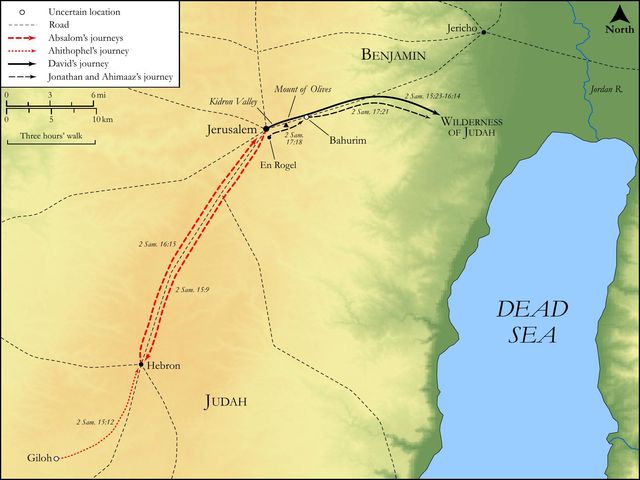
See on the biblical-era maps

Study this verse
Public-domain commentary
Matthew Henry
From his Commentary on the Whole Bible. Henry comments on passages, not single verses — this entry covers 2 Samuel 15:24–30. His three-level outline is real structure in the source text, so it is rendered as structure.
Here we have, I. The fidelity of the priests and Levites and their firm adherence to David and his interest. They knew David's great affection to them and their office, notwithstanding his failings. The method Absalom took to gain people's affections made no impression upon them; he had little religion in him, and therefore they steadily adhered to David. Zadok and Abiathar, and all the Levites, if he go, will accompany him, and take the ark with them, that, by it, they may ask counsel of God for him, Sa2 15:24. Note, Those that are friends to the ark in their prosperity will find it a friend to them in their adversity. Formerly David would not rest till he had found a resting-place for the ark; and now, if the priests may have their mind, the ark shall not rest till David return to his rest.
II.David's dismission of them back into the city, Sa2 15:25, Sa2 15:26.
Abiathar was high priest (Kg1 2:35), but Zadok was his assistant, and attended the ark most closely, while Abiathar was active in public business, Sa2 15:24. Therefore David directs his speech to Zadok, and an excellent speech it is, and shows him to be in a very good frame under his affliction, and that still he holds fast his integrity.
1.He is very solicitous for the safety of the ark: "By all means carry the ark back into the city, let not that be unsettled and exposed with me, lodge that again in the tent pitched for it; surely Absalom, bad as he is, will do that no harm." David's heart, like Eli's trembles for the ark of God. Note, It argues a good principle to be more concerned for the church's prosperity than for our own, to prefer Jerusalem before our chief joy (Psa 137:6), the success of the gospel, and the flourishing of the church, above our own wealth, credit, ease, and safety, even when they are most in hazard.
2.He is very desirous to return to the enjoyment of the privileges of God's house. He will reckon it the greatest instance of God's favour to him if he may but once more be brought back to see it and his habitation. This will be more his joy than to be brought back to his own palace and throne again. Note, Gracious souls measure their comforts and conveniences in this world by the opportunity they give them of communion with God. Hezekiah wished for the recovery of his health for this reason, that he might go up to the house of the Lord, Isa 38:22.
3.He is very submissive to the holy will of God concerning the issue of this dark dispensation. He hopes the best (Sa2 15:25), and hopes for it from the favour of God, which he looks upon to be the fountain of all good: "If God favour me so far, I shall be settled again as formerly." But he provides for the worst: "If he deny me this favour - if he thus say, I have no delight in thee - I know I deserve the continuance of his displeasure; his holy will be done." See him here patiently awaiting the event: "Behold, here am I, as a servant expecting orders;" and see him willing to commit himself to God concerning it: "Let him do to me as seemeth good to him. I have nothing to object. All is well that God does." Observe with what satisfaction and holy complacency he speaks of the divine disposal: not only, "He can do what he will," subscribing to his power (Job 9:12), or, "He has a right to do what he will," subscribing to his sovereignty (Job 33:13), or, "He will do what he will," subscribing to his unchangeableness (Job 23:13, Job 23:15), but, "Let him to what he will," subscribing to his wisdom and goodness. Note, It is our interest, as well as duty, cheerfully to acquiesce in the will of God, whatever befals us. That we may not complain of what is, let us see God's hand in all events; and, that we may not be afraid of what shall be, let us see all events in God's hand.
III.The confidence David put in the priests that they would serve his interest to the utmost of their power in his absence.
He calls Zadok a seer (Sa2 15:27), that is, a wise man, a man that can see into business and discern time and judgment: "Thou hast thy eyes in thy head (Ecc 2:14), and therefore art capable of doing me service, especially by sending me intelligence of the enemy's motions and resolutions." One friend that is a seer, in such an exigency as this, was worth twenty that were not so quick-sighted. For the settling of a private correspondence with the priests in his absence, he appoints,
1.Whom they should send to him - their two sons, Ahimaaz and Jonathan, whose coat, it might be hoped, would be their protection, and of whose prudence and faithfulness he had probably had experience.
2.Whither they should send. He would encamp in the plain of the wilderness till he heard from them (Sa2 15:28), and then would move according to the information and advice they should send him. Hereupon they returned to the city, to await the event. It was a pity that any disturbance should be given to a state so happy as this was, when the prince and the priests had such an entire affection for the confidence in each other.
IV.The melancholy posture that David and his men put themselves into, when, at the beginning of their march, they went up the mount of Olives, Sa2 15:30.
1.David himself, as a deep mourner, covered his head and face for shame and blushing, went bare-foot, as a prisoner or a slave, for mortification, and went weeping. Did it become a man of his reputation for courage and greatness of spirit thus to cry like a child, only for fear of an enemy at a distance, against whom he might easily have made head, and perhaps with one bold stroke have routed him? Yes, it did not ill become him, considering how much there was in this trouble,
(1.)Of the unkindness of his son. He could not but weep to think that one who came out of his bowels, and had so often lain in his arms, should thus lift up the heel against him. God himself is said to be grieved with the rebellions of his own children (Psa 95:10) and even broken with their whorish heart, Eze 6:9.
(2.)There was much of the displeasure of his God in it. This infused the wormwood and gall into the affliction and misery, Lam 3:19. His sin was ever before him (Psa 51:3), but never so plain nor ever appearing so black as now. He never wept thus when Saul hunted him: but a wounded conscience makes troubles lie heavily, Psa 38:4.
2.When David wept all his company wept likewise, being much affected with his grief and willing to share in it. It is our duty to weep with those that weep, especially our superiors, and those that are better than we; for, if this be done in the green tree, what will be done in the dry? We must weep with those that weep for sin. When Hezekiah humbled himself for his sin all Jerusalem joined with him, Ch2 32:26. To prevent suffering with sinners, let us sorrow with them.
Continue studying 2 Samuel 15:27 across the web’s major study libraries — every link below opens this exact verse, chapter, or book on the destination site.
Read & Compare
 BibleGatewayThis verse in more than 200 translations and 70 languages.
 Bible.comThe YouVersion reader — hundreds of translations, reading plans, and highlights.
 ESV.orgCrossway's official English Standard Version reader.
 NET BibleThe NET translation with 60,000+ translators' notes on every rendering decision.
 STEP BibleTyndale House's free study tool — original text, vocabulary, and scholarly resources.
 BibliaLogos Bible Software's free web reader.
 USCCBThe New American Bible (Revised Edition) with the U.S. bishops' study notes.
Commentaries
 BibleHub CommentariesDozens of classic commentaries on this verse, gathered on one page.
 StudyLightMore than 100 commentary sets — the largest collection on the web.
 BibleRefPlain-English commentary on what this verse means, verse by verse.
 Enduring WordDavid Guzik's free commentary on this chapter, widely used by Bible teachers.
 Bible Study ToolsVerse commentary alongside Greek and Hebrew study aids.
Original Language & Research
- BibleHub InterlinearThe verse word by word — original language, transliteration, and English.
- BibleHub LexiconEvery word's original-language definition and Strong's entry.
 Blue Letter BibleDeep-study tools — Strong's numbers, concordance, and word studies.
 SefariaThe Hebrew text with Rashi and centuries of Jewish commentary.
Sermons, Hymns & Audio


TrulyRandomVerse is not affiliated with these sites and doesn’t control their content. They’re linked because they’re genuinely useful.
Summary
2 Samuel 15:27 captures a pivotal moment in King David's flight from Absalom's rebellion, showcasing his profound faith and strategic genius. As Jerusalem falls to his rebellious son, David instructs Zadok the priest, whom he affirms as a "seer" or one possessing divine insight, to return to the city. This command is not a simple dismissal but a critical strategic maneuver, entrusting Zadok and his two sons, Ahimaaz and Jonathan, with the vital and dangerous mission of intelligence gathering within the rebel-held capital, thereby demonstrating David's unwavering reliance on God's sovereignty and his shrewd leadership in crisis.
Context
ShowHideLiterary Context
This verse is deeply embedded within the dramatic and sorrowful narrative of Absalom's usurpation of the throne and King David's hurried departure from Jerusalem. The immediate preceding verses (2 Samuel 15:13-17) describe David's exodus, accompanied by his loyal household and military. Significantly, Zadok and Abiathar, the chief priests, appear with the Ark of the Covenant, intending to accompany the king (2 Samuel 15:24). David's response is a profound act of faith: he commands the Ark to be returned to Jerusalem, declaring, "If I find favor in the eyes of the Lord, he will bring me back and let me see it and his dwelling place again. But if he says, 'I have no pleasure in you,' then let him do to me what seems good to him" (2 Samuel 15:25-26). Verse 27 immediately follows this declaration, detailing David's specific charge to Zadok, highlighting his spiritual capacity and the crucial strategic role he and his sons are to play in the unfolding crisis. This sequence underscores David's reliance on divine providence even as he enacts practical, human measures for his survival and eventual restoration.
Historical & Cultural Context
The backdrop is a full-scale, deeply painful rebellion led by David's own son, Absalom. David's flight from Jerusalem signifies a temporary loss of his throne and capital, forcing him into a vulnerable and precarious position. In ancient Israel, priests like Zadok held significant spiritual authority and often served as key advisors to the king, mediating between God and the people. The term "seer" (Hebrew: ro'eh) was an early designation for a prophet, indicating one who receives divine revelation or possesses spiritual insight, predating the more common term navi. David's acknowledgment of Zadok as a "seer" highlights Zadok's recognized spiritual discernment and trustworthiness, making him uniquely qualified for a covert intelligence mission. The inclusion of the sons, Ahimaaz and Jonathan, reflects the common practice of family involvement in critical tasks and their specific role as swift and reliable messengers, a role that becomes vital later in the narrative (e.g., 2 Samuel 17:17-21).
Key Themes
ShowHideSeveral major themes converge powerfully in this verse. Firstly, Divine Sovereignty and Trust are paramount; David's decision to send the Ark back to Jerusalem, rather than treating it as a protective talisman, demonstrates his profound trust in God's ultimate control over his destiny and the outcome of the rebellion. He relies on God's favor, not on a physical object, to restore him, echoing his faith in earlier trials (e.g., 1 Samuel 17:45-47). Secondly, Strategic Leadership in Crisis is vividly displayed; despite his personal distress and the chaos of flight, David remains a shrewd and proactive leader. He recognizes the critical need for intelligence from within the city and leverages the unique position and loyalty of Zadok and his sons to establish a vital communication channel, a strategy that proves instrumental in thwarting Absalom's plans (as seen in 2 Samuel 17:1-14). Thirdly, the Prophetic and Discerning Role of the Priesthood is emphasized; David's rhetorical question, "Art not thou a seer?", affirms Zadok's spiritual insight, elevating his role beyond mere ritualistic duties to one of active discernment and perception of God's will, crucial for understanding the true state of affairs in Jerusalem. Finally, Loyalty and Trust are foundational, as Zadok, Abiathar, and their sons demonstrate unwavering faithfulness to David, willingly undertaking a dangerous mission that could cost them their lives, underscoring the deep bonds of allegiance that persisted even in the face of widespread defection.
Exposition and Analysis
ShowHideKey Word Analysis
ShowHideThis term (H7200), derived from the primitive root meaning "to see," refers to one who perceives, discerns, or has insight, often implying prophetic ability or the capacity to understand God's will. In ancient Israel, ro'eh was an early title for a prophet (e.g., 1 Samuel 9:9). David's rhetorical question, "Art not thou a seer?", is not a genuine inquiry but a powerful affirmation of Zadok's recognized spiritual capacity and discerning wisdom, making him uniquely suited for a mission requiring keen observation and interpretation of events.
While commonly translated as "peace," shalom (H7965) encompasses a much broader concept of wholeness, well-being, prosperity, completeness, and safety. When David tells Zadok to "return into the city in peace," it signifies not only a hope for his physical safety but also for the successful and unhindered execution of his mission. It implies that Zadok's return is part of God's plan for David's restoration and the eventual re-establishment of order, suggesting a divinely favored outcome for his dangerous task.
Verse Breakdown
ShowHide"The king said also unto Zadok the priest"
This phrase establishes David's direct and authoritative command to Zadok, highlighting the personal nature and profound importance of this crucial instruction. It underscores Zadok's prominence and David's reliance on him as a trusted spiritual and strategic advisor, distinguishing him from the general populace fleeing with the king.
"[Art not] thou a seer?"
This is a powerful rhetorical question, functioning as a strong affirmation rather than a genuine inquiry. David is essentially stating, "Surely you are a seer!" This acknowledges Zadok's recognized spiritual discernment and prophetic insight, which David deems essential for the sensitive intelligence-gathering mission he is about to entrust to him. It implies that Zadok possesses the spiritual acumen to perceive God's hand in the unfolding events and to interpret the political landscape accurately, beyond mere physical observation.
"return into the city in peace"
This is the core instruction, a command for Zadok to go back to Jerusalem, the very heart of the rebellion and a place of immense danger for David's loyalists. The phrase "in peace" conveys David's desire for Zadok's physical safety and the successful completion of his mission, implying that his return is part of a divinely ordained plan for David's ultimate restoration. It also subtly suggests a covert operation, where Zadok must maintain a facade of normalcy to effectively gather information without arousing suspicion.
"and your two sons with you, Ahimaaz thy son, and Jonathan the son of Abiathar"
David explicitly includes the sons of both Zadok and Abiathar in this perilous mission. This detail is crucial, as these young men will later serve as vital, swift, and reliable messengers, risking their lives to relay critical intelligence from Jerusalem back to David (e.g., 2 Samuel 17:17-21). Their inclusion underscores the paramount importance of secure and timely communication in times of crisis and highlights the intergenerational loyalty within these priestly families to David.
Literary Devices
ShowHideThe passage effectively employs several literary devices to enhance its meaning and impact. A prominent device is the Rhetorical Question ("Art not thou a seer?"), which David uses not to elicit information but to make a forceful affirmation of Zadok's known spiritual capacity and discerning wisdom. This device underscores David's profound trust and the strategic value he places on Zadok's unique abilities. There is also a strong element of Foreshadowing, as the explicit mention of Zadok's and Abiathar's sons, Ahimaaz and Jonathan, subtly hints at their future, active, and crucial role as messengers in relaying intelligence back to David, which becomes vital for his survival in later chapters. The entire scene is imbued with Dramatic Irony, as David, the fleeing king in a moment of apparent weakness and vulnerability, is in fact orchestrating a sophisticated counter-intelligence operation from afar, demonstrating his enduring strategic brilliance and reliance on divine aid even in the face of profound personal and political upheaval.
Theological and Thematic Connections
ShowHideDavid's instruction to Zadok in 2 Samuel 15:27 is deeply rooted in his profound trust in God's sovereign plan, even amidst the chaos of rebellion. By sending the Ark back to Jerusalem (as seen in the preceding verses) and entrusting Zadok with a mission of spiritual discernment and intelligence, David demonstrates that his hope is not in physical symbols or human might, but in the Lord's ultimate control over his destiny. This act of faith, combined with strategic action, illustrates a mature understanding of divine providence—God works through human means, but His will is supreme. David's recognition of Zadok as a "seer" also highlights the value of spiritual insight and discernment in leadership, particularly during times of crisis. It underscores that God often uses those with spiritual gifts to guide and inform, even in seemingly secular or strategic matters, affirming that true wisdom comes from above.
Reflection and Application
ShowHideDavid's actions in 2 Samuel 15:27 offer profound lessons for believers navigating personal and collective crises. His decision to send the Ark back to Jerusalem, rather than clinging to it as a good luck charm, exemplifies a robust faith that trusts God's sovereignty above all else. This challenges us to examine where we place our ultimate reliance: on our own resources, clever strategies, or even spiritual symbols, rather than on the living God who orchestrates all things for His purposes. In moments of great uncertainty, like David, we are called to combine unwavering faith with wise, strategic action, utilizing the gifts and loyalties of those around us. Furthermore, David's valuing of Zadok's spiritual discernment reminds us of the importance of recognizing and heeding those within our communities who possess spiritual insight and wisdom, especially when facing difficult decisions. True leadership, whether in the church, family, or workplace, involves humility to seek and appreciate such counsel, understanding that God often speaks through His anointed ones, guiding us toward His "shalom" even in the midst of turmoil.
Questions for Reflection
ShowHideFAQ
ShowHideWhy did David send the Ark of the Covenant back to Jerusalem instead of keeping it with him?
ShowHideDavid sent the Ark back to Jerusalem (as detailed in 2 Samuel 15:25) as an act of profound faith and trust in God's sovereignty. He did not want to treat the Ark as a magical charm or a good luck token that would guarantee his victory or safety. Instead, he believed that if he found favor in the eyes of the Lord, God Himself would bring him back to Jerusalem and allow him to see the Ark again. This decision underscored his reliance on God's will and presence, rather than on the physical symbol of the Ark, demonstrating a mature theological understanding that God is not manipulated by objects but acts according to His divine purpose.
What was Zadok's specific mission when David sent him back to Jerusalem?
ShowHideZadok's mission was primarily one of intelligence gathering and covert support for David. By asking, "Art not thou a seer?", David affirmed Zadok's spiritual discernment, implying that Zadok could perceive the true state of affairs within Absalom's camp and God's hand in them. Zadok, along with Abiathar and their sons, were to remain in Jerusalem and act as David's eyes and ears, relaying crucial information about Absalom's plans and movements back to David through their sons, Ahimaaz and Jonathan. This strategic intelligence proved vital for David's survival and eventual return to power, as seen in 2 Samuel 17:15-22.
Why were Zadok's and Abiathar's sons included in this dangerous mission?
ShowHideThe sons, Ahimaaz and Jonathan, were included because they were swift and reliable messengers, crucial for relaying sensitive information between Zadok and Abiathar in Jerusalem and David, who was in exile. In an era without modern communication, trusted human messengers were indispensable for maintaining contact and sharing intelligence. Their youth, agility, and loyalty made them ideal for traversing the dangerous routes between Jerusalem and David's location, often at great personal risk, as vividly depicted in their perilous journey to warn David in 2 Samuel 17:17-21. Their inclusion highlights the critical role of secure and timely communication in times of political upheaval and the intergenerational commitment to the king.
Christ-Centered Fulfillment
ShowHideThe narrative of David's flight and his trust in God's sovereignty, as encapsulated in 2 Samuel 15:27, powerfully foreshadows the ultimate journey and kingship of Jesus Christ. David, the anointed king, is forced to flee his capital, relying on divine favor and the loyalty of a faithful few. This prefigures Christ, the true King of Israel, who also experienced rejection and flight, ultimately laying down His life in perfect submission to His Father's will, even praying, "not my will, but yours be done". David's recognition of Zadok as a "seer" points to Christ as the ultimate Prophet, who perfectly discerns and reveals the will of God, being the very Word made flesh who "no one has seen God; the only God, who is at the Father's side, he has made him known". Furthermore, Zadok's priestly role, combined with his discerning wisdom, points to Jesus as our Great High Priest, who "sympathizes with our weaknesses" and perfectly intercedes for us from the heavenly sanctuary. David's strategic leadership in preserving his kingdom, even in exile, finds its ultimate fulfillment in Christ's victory over sin and death, establishing an eternal kingdom that "will never be destroyed" and whose King reigns forever. The unwavering loyalty of Zadok and his sons, risking their lives for their king, mirrors the call to radical loyalty to Christ, who teaches, "Greater love has no one than this, that someone lay down his life for his friends", a love He Himself exemplified on the cross. Thus, David's crisis and his faith-filled response serve as a profound Old Testament type, pointing to the greater King and His redemptive work.