


2 Samuel 17:18
- וַיַּרְאvai·Yar'and he sawH7200Conj-w ¦ V-Qal-ConsecImperf-3msVerb Qal Consecutive Imperfect 3rd Singular Masculineוַandיַּרְאhe saw
- אֹתָם'o·Tam<obj.> themH853DirObjM ¦ 3mpParticle Object Indicatorאֹתָ<obj.>םthem
- נַעַרNa·'ara young manH5288N-msNoun Singular Masculine Absolute
- וַיַּגֵּדvai·ya·Gedand he toldH5046Conj-w ¦ V-Hiphil-ConsecImperf-3msVerb Hiphil Consecutive Imperfect 3rd Singular Masculineוַandיַּגֵּדhe told
- לְאַבְשָׁלֹםle·'av·sha·Lomto AbsalomH53Prep-l ¦ N-proper-mNoun Proper MasculineלְtoאַבְשָׁלֹםAbsalom
- וַיֵּלְכוּvai·ye·le·Khuand they wentH1980Conj-w ¦ V-Qal-ConsecImperf-3mpVerb Qal Consecutive Imperfect 3rd Plural Masculineוַandיֵּלְכוּthey went
- שְׁנֵיהֶםshe·nei·Hem[the] two of themH8147N-cdc ¦ 3mpNoun Dual common gender Constructשְׁנֵי[the] two ofהֶםthem
- מְהֵרָהme·he·RahquicklyH4120AdvAdverb
- וַיָּבֹאוּvai·ya·Vo·'uand they cameH935Conj-w ¦ V-Qal-ConsecImperf-3mpVerb Qal Consecutive Imperfect 3rd Plural Masculineוַandיָּבֹאוּthey came
- אֶל'eltoH413PrepPreposition
- בֵּיתbeit[the] house ofH1004N-mscNoun Singular Masculine Construct
- אִישׁ'isha manH376N-msNoun Singular Masculine Absolute
- בְּבַחוּרִיםbe·va·chu·Rimin BahurimH980Prep-b ¦ N-properNoun Proper LocationבְּinבַחוּרִיםBahurim
- וְלוֹve·Loand [belonged] to <the> himConj-w ¦ Prep-l ¦ 3msSuffix Personal 3rd Singular Masculineוְandל[belonged] to <the>וֹhim
- בְאֵרve·'Era wellH875N-fsNoun Singular Feminine Absolute
- בַּחֲצֵרוֹba·cha·tze·Roin his courtyardH2691Prep-b ¦ N-csc ¦ 3msNoun Singular common gender Constructבַּinחֲצֵרcourtyardוֹhis
- וַיֵּרְדוּvai·Ye·re·duand they went downH3381Conj-w ¦ V-Qal-ConsecImperf-3mpVerb Qal Consecutive Imperfect 3rd Plural Masculineוַandיֵּרְדוּthey went down
- שָׁםShamthereH8033AdvAdverb
English is a literal word-by-word gloss of the Hebrew, not the KJV's wording. Why?
This is the original text the KJV's translators worked from — each Hebrew word with its own literal English meaning in this verse, prepared by scholars at Tyndale House, Cambridge. The KJV translates whole sentences, not word by word, so its wording differs: one Hebrew word can become several English words, and the KJV may choose “the LORD” where the gloss reads “Yahweh”. Both are faithful — they answer different questions. For the KJV's own rendering, switch to the KJV text.
Details
See on the biblical-era map
Study this verse
Public-domain commentary
Matthew Henry
From his Commentary on the Whole Bible. Henry comments on passages, not single verses — this entry covers 2 Samuel 17:15–21.
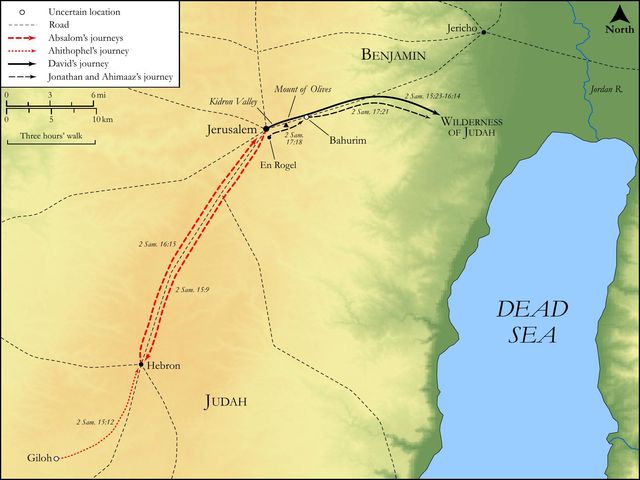
We must now leave David's enemies pleasing themselves with the thoughts of a sure victory by following Hushai's counsel, and sending a summons, no doubt, to all the tribes of Israel, to come to the general rendezvous at a place appointed, pursuant to that counsel; and we next find David's friends consulting how to get him notice of all this, that he might steer his course accordingly. Hushai tells the priests what had passed in council, Sa2 17:15. But, it should seem, he was not sure but that yet Ahithophel's counsel might be followed, and was therefore jealous lest, if he made not the best of his way, the king would be swallowed up, and all the people that were with him, Sa2 17:16. Perhaps, as he was called in to give advice (Sa2 17:5), so he was dismissed before they came to that resolve (Sa2 17:14) in favour of his advice, or he feared they might afterwards change their mind. However, it was good to provide against the worst, and therefore to hasten those valuable lives out of the reach of these destroyers. Such strict guards did Absalom set upon all the avenues to Jerusalem that they had much ado to get this necessary intelligence to David. 1. The young priests that were to be the messengers were forced to retire secretly out of the city, by En-rogel, which signifies, as some say, the fountain of a spy. Surely it went ill with Jerusalem when two such faithful priests as they were might not be seen to come into the city. 2. Instructions were sent to them by a poor simple young woman, who probably went to that well under pretence of fetching water, Sa2 17:17. If she carried the message by word of mouth, there was danger of her making some mistake or blunder in it; but Providence can make an ignorant girl a trusty messenger, and serve its wise counsels by the foolish things of the world. 3. Yet, by the vigilance of Absalom's spies, they were discovered, and information was brought to Absalom of their motions: A lad saw them and told him, Sa2 17:18. 4. They, being aware that they were discovered, sheltered themselves in a friend's house in Bahurim, where David had refreshed himself but just before, Sa2 16:14. There they were happily hidden in a well, which now, in summer time, perhaps was dry, Sa2 17:18. The woman of the house very ingeniously covered the mouth of the well with a cloth, on which she spread corn to dry, so that the pursuers were not aware that there was a well; else they would have searched it, Sa2 17:19. Thus far the woman did well; but we know not how to justify her further concealing them with a lie, Sa2 17:20. We must not do evil that good may come of it. However, hereby the messengers were protected, and the pursuers were defeated and returned to Absalom without their prey. It was well that Absalom did not hereupon fall upon their two fathers, Zadok and Abiathar, as Saul on Ahimelech for his kindness to David: but God restrained him. Being thus preserved, they brought their intelligence very faithfully to David (Sa2 17:21), with this advice of his friends, that he should not delay to pass over Jordan, near to which, it seems, he now was. There, as some think, he penned the 42nd and 43rd Psalms, looking back upon Jerusalem from the land of Jordan, Psa 42:6.
Continue studying 2 Samuel 17:18 across the web’s major study libraries — every link below opens this exact verse, chapter, or book on the destination site.
Read & Compare
 BibleGatewayThis verse in more than 200 translations and 70 languages.
 Bible.comThe YouVersion reader — hundreds of translations, reading plans, and highlights.
 ESV.orgCrossway's official English Standard Version reader.
 NET BibleThe NET translation with 60,000+ translators' notes on every rendering decision.
 STEP BibleTyndale House's free study tool — original text, vocabulary, and scholarly resources.
 BibliaLogos Bible Software's free web reader.
 USCCBThe New American Bible (Revised Edition) with the U.S. bishops' study notes.
Commentaries
 BibleHub CommentariesDozens of classic commentaries on this verse, gathered on one page.
 StudyLightMore than 100 commentary sets — the largest collection on the web.
 BibleRefPlain-English commentary on what this verse means, verse by verse.
 Enduring WordDavid Guzik's free commentary on this chapter, widely used by Bible teachers.
 Bible Study ToolsVerse commentary alongside Greek and Hebrew study aids.
Original Language & Research
- BibleHub InterlinearThe verse word by word — original language, transliteration, and English.
- BibleHub LexiconEvery word's original-language definition and Strong's entry.
 Blue Letter BibleDeep-study tools — Strong's numbers, concordance, and word studies.
 SefariaThe Hebrew text with Rashi and centuries of Jewish commentary.
Sermons, Hymns & Audio


TrulyRandomVerse is not affiliated with these sites and doesn’t control their content. They’re linked because they’re genuinely useful.
Summary
This verse encapsulates a critical moment in Absalom's rebellion against King David, describing the narrow escape of David's loyal messengers, Ahimaaz and Jonathan. After receiving vital intelligence from Hushai, their mission to warn David was imperiled when a young boy spotted them and reported their presence to Absalom. The narrative swiftly details their resourceful evasion, finding an unexpected and providential hiding place in a well located within a man's courtyard in Bahurim, thereby underscoring the extreme danger, the evident hand of divine providence, and the unwavering loyalty of those committed to David's cause.
Context
ShowHideLiterary Context
2 Samuel 17:18 is positioned at a pivotal point in the unfolding drama of Absalom's rebellion. Immediately preceding this, David's loyal advisor, Hushai the Archite, has masterfully countered the astute counsel of Ahithophel, persuading Absalom to delay his pursuit of David (2 Samuel 17:7-14). This strategic delay was absolutely vital for David's survival. Hushai then dispatches a warning to David via the sons of the priests Zadok and Abiathar, Ahimaaz and Jonathan, urging the king to cross the Jordan River without delay. Verse 18 vividly portrays the perilous journey of these messengers, their discovery by a "lad," and their desperate, yet divinely assisted, escape to deliver the life-saving message. The subsequent verses confirm their successful delivery of the message and David's immediate crossing of the Jordan, securing his temporary safety (2 Samuel 17:21-22). This specific incident highlights the high stakes, intricate espionage, and profound loyalty at play within the larger narrative of David's flight and eventual restoration.
Historical & Cultural Context
The period of Absalom's rebellion represents a profound crisis of political legitimacy and civil war within the nascent Israelite kingdom. Absalom's coup was a direct challenge to David's divinely established kingship, forcing the legitimate monarch to flee Jerusalem (2 Samuel 15:13-14). In the context of ancient Near Eastern warfare and political intrigue, the gathering and transmission of intelligence were paramount. Messengers, especially those carrying sensitive information, faced extreme danger, as their capture could compromise vital plans or lead to their immediate execution. Wells or cisterns, common features in courtyards or fields for water storage, were frequently utilized as hiding places during times of conflict or pursuit, a practice attested in various biblical narratives. Bahurim itself was a village situated east of Jerusalem, notably remembered as the location where Shimei, a Benjaminite, publicly cursed David during his initial flight (2 Samuel 16:5-8). Its role here as a place of refuge for David's loyalists adds a layer of historical irony, perhaps subtly pointing to God's sovereign hand in turning former places of adversity into havens of deliverance.
Key Themes
ShowHideThis verse powerfully illustrates several enduring themes prevalent throughout the Books of Samuel. Foremost among them is Divine Protection and Providence; despite being discovered by a seemingly insignificant "lad" and reported to Absalom, the messengers' swift escape and the timely provision of a hiding place in the well clearly point to God's active involvement in preserving David and his kingdom. This aligns seamlessly with the broader theme of God's unwavering faithfulness to His covenant with David, even amidst human rebellion and failure (2 Samuel 7:12-16). The Urgency and Danger of their mission are palpable, emphasizing the life-or-death stakes involved in relaying Hushai's critical intelligence. Furthermore, the Loyalty and Resourcefulness of David's supporters—both the messengers themselves and the unnamed man and his wife in Bahurim—shine brightly, standing in stark contrast to the treachery of Absalom and Ahithophel. This highlights the profound importance of faithfulness to God's anointed, even when circumstances are dire and the king is in exile.
Exposition and Analysis
ShowHideKey Word Analysis
ShowHideThis Hebrew term (H5288) is quite broad, encompassing a range from an infant to a young boy, a youth, or even a servant. In this specific context, it emphasizes the unexpected and seemingly innocuous source of the threat. It was not a seasoned soldier or a known spy who spotted them, but a seemingly ordinary youth, highlighting the omnipresent danger and the pervasive nature of Absalom's surveillance. The fact that a "lad" saw them underscores the providential nature of their escape, as it was a small detail that could have had catastrophic consequences for David's cause.
This adverb (H4120) signifies a sense of urgency, promptness, and swiftness. It highlights the immediate and decisive action taken by Ahimaaz and Jonathan upon their discovery. Their rapid movement was absolutely crucial for their survival and the ultimate success of their mission. It conveys the high stakes involved and demonstrates their acute awareness of the gravity of the intelligence they carried, prompting an instantaneous and effective response.
This term (H875) refers to a pit, specifically a well, a common feature in ancient Israelite courtyards or fields, primarily used for water collection. However, in times of war or pursuit, cisterns or dry wells could also serve as effective, albeit temporary, hiding places. Here, it signifies an unexpected and providential refuge. The "well in his court" implies a private, domestic setting, strongly suggesting that the unnamed man who owned the house was complicit in their escape, risking his own safety for the sake of David and his loyalists.
This primitive root (H3381) means to descend, to go downwards, or to fall. In this context, it precisely describes the physical act of Ahimaaz and Jonathan entering the well. This action signifies their desperate need for concealment and the immediate, physical means of their deliverance from Absalom's pursuing forces. It sets the stage for the next phase of their escape, where the man's wife further aids them by covering the well.
Verse Breakdown
ShowHide"Nevertheless a lad saw them, and told Absalom:"
This opening clause immediately introduces the crisis, marking a sudden and unexpected turn of events. The "nevertheless" (implied by the conjunction and narrative flow) indicates a moment of exposure despite the messengers' presumed caution. The detail that a "lad" (a young, perhaps unnoticed observer) was the one to spot them adds to the narrative tension, demonstrating how easily a critical mission could be compromised by seemingly minor factors. The direct report to Absalom underscores the efficiency of Absalom's intelligence network and the immediate, mortal danger the messengers faced.
"but they went both of them away quickly,"
This clause vividly describes the messengers' immediate, decisive, and resourceful response to being discovered. The phrase "went both of them away quickly" emphasizes their urgency and their understanding of the mortal peril. They did not hesitate or panic but reacted with remarkable speed, a crucial factor in their evasion of Absalom's pursuing forces. This swift action was vital for their survival and the continuation of their mission.
"and came to a man's house in Bahurim, which had a well in his court;"
This part of the verse reveals their destination and the nature of their unexpected refuge. Bahurim, a village with previous, less favorable associations with David's flight (where he was cursed by Shimei), now becomes a place of unexpected aid. The specific detail of "a man's house... which had a well in his court" is crucial. It signifies a pre-existing, domestic feature that became their means of escape, suggesting either prior knowledge of the location or, more profoundly, divine guidance to it. The presence of the man and his house implies a safe haven provided by a loyal, albeit unnamed, supporter of David.
"whither they went down."
This final, concise clause describes the climactic act of hiding. "Went down" clearly indicates their descent into the well, a common and effective method of concealment in such situations. This act signifies their desperate need for refuge and the immediate, physical means of their deliverance from Absalom's pursuit, setting the stage for the next phase of their escape, where the man's wife further aids them by covering the well.
Literary Devices
ShowHideThe narrative of 2 Samuel 17:18 is rich with Narrative Tension, created by the sudden and unexpected shift from the messengers' covert operation to their immediate exposure by a "lad." This generates palpable Suspense, as the reader is left to wonder if they will be captured and if King David will receive his critical warning. There is a subtle Irony in a seemingly insignificant "lad" becoming the catalyst for such a high-stakes pursuit, highlighting how even minor figures can play pivotal roles in divine providence. The well itself functions as potent Symbolism, representing refuge, concealment, and divine provision in a time of extreme peril. The swift, almost breathless Pacing of the verse, moving rapidly from discovery to immediate action and descent, effectively heightens the drama and urgency of the situation. This dramatic episode ultimately serves as Foreshadowing of God's continued protection over David and the eventual failure of Absalom's rebellion, despite moments of intense danger and human vulnerability.
Theological and Thematic Connections
ShowHideThis incident in Bahurim serves as a powerful testament to God's sovereign providence and His unwavering commitment to His chosen king, David, even amidst the chaos of rebellion and human treachery. Despite the meticulous plans of Absalom and the unexpected discovery by a young boy, God's protective hand is unmistakably evident in the swift escape of the messengers and the timely provision of a hidden refuge. This narrative beautifully illustrates that God often works through ordinary people and seemingly mundane circumstances—a loyal homeowner, a common well—to accomplish His extraordinary purposes. It reassures us that even when we feel exposed or vulnerable in our service to God, His divine oversight can provide unexpected avenues of deliverance and ensure the fulfillment of His will. The faithfulness of Ahimaaz and Jonathan, risking their lives for David, also echoes the call for unwavering loyalty to God's purposes, trusting that He will provide the means for their completion and that no human scheme can ultimately thwart His divine plan.
Reflection and Application
ShowHideThe perilous escape of Ahimaaz and Jonathan in 2 Samuel 17:18 offers profound and enduring lessons for contemporary believers. It reminds us that faithfulness in God's service often involves significant risks, unexpected challenges, and moments of intense vulnerability. Just as a seemingly insignificant "lad" could jeopardize a vital mission, so too can small, unforeseen obstacles or seemingly minor betrayals arise in our spiritual journeys or ministries, threatening to derail our efforts. Yet, this narrative powerfully demonstrates God's remarkable capacity to provide refuge and deliverance in the most unlikely places—a well in a private courtyard. It encourages us to cultivate a deep and abiding trust in God's sovereign hand, even when circumstances appear dire, when we feel exposed, or when human plans seem to unravel. Our primary task is to remain faithful to the mission God has entrusted to us, acting with urgency, resourcefulness, and prayerful dependence, while resting in the assurance that He will open doors of escape or provide hidden havens when needed. This story calls us to recognize that God's protection is not always a dramatic, overt miracle, but often works subtly through the ordinary, through the loyalty of fellow believers, and through the available resources He has placed around us, reminding us that His presence is our ultimate refuge.
Questions for Reflection
ShowHideFAQ
ShowHideWho were Ahimaaz and Jonathan, and why were they so important to David?
ShowHideAhimaaz and Jonathan were the sons of Zadok and Abiathar, respectively, who served as the chief priests loyal to King David. They functioned as critical intelligence couriers for David during Absalom's rebellion. Their importance stemmed from their unwavering loyalty to David and their unique position as sons of priests, which allowed them access to sensitive information from within Jerusalem, where their fathers remained. They were instrumental in relaying Hushai's vital counter-counsel to David, which warned him of Absalom's imminent attack and bought him precious time to escape across the Jordan River. Their mission, as detailed in 2 Samuel 17:15-22, was literally life-saving for David and crucial for the eventual suppression of the rebellion, demonstrating their pivotal role in preserving the legitimate kingship.
What is the significance of Bahurim in this narrative?
ShowHideBahurim was a village located east of Jerusalem, along the route David took when fleeing Absalom. It holds particular significance in David's story as the very place where Shimei, a relative of Saul, publicly cursed David and threw stones at him as he fled Jerusalem (2 Samuel 16:5-13). The fact that Ahimaaz and Jonathan found refuge in Bahurim, a place previously associated with hostility, humiliation, and a curse for David, adds a profound layer of divine irony or sovereignty to the narrative. It powerfully suggests that God can transform places of past adversity and shame into havens of deliverance and protection. The unnamed man in Bahurim who harbored them also demonstrates that despite the widespread support for Absalom, pockets of deep loyalty to David remained, even in unexpected and historically problematic locations.
Christ-Centered Fulfillment
ShowHideThe narrative of 2 Samuel 17:18, with its themes of a hidden king, loyal messengers, and providential escape from mortal danger, finds profound Christ-centered fulfillment. Just as David, God's anointed king, was forced to flee and rely on hidden loyalists and unexpected refuges for his preservation, so too was Jesus, the ultimate King and Anointed One, often "hidden" or protected by divine providence until His appointed time. From His infancy, when God supernaturally preserved Him from Herod's wrath through the flight to Egypt (Matthew 2:13-15), to moments in His public ministry when He "slipped away" from those who sought to harm Him before His hour had come (John 8:59), Jesus' life was marked by divine protection amidst constant threats. He is the ultimate Messenger, sent by the Father to deliver the life-saving message of salvation and good news to the poor (Luke 4:18-19). The "well" in Bahurim, a place of physical refuge and a source of life-sustaining water, points to Christ as our ultimate spiritual refuge and the inexhaustible source of living water, satisfying the deepest thirst of the human soul (John 4:14). Ultimately, Jesus' "escape" from death was not a mere evasion but a triumphant resurrection, securing eternal deliverance and victory over sin and death for all who trust in Him, thereby fulfilling God's ultimate plan to destroy the power of the devil and set humanity free (Hebrews 2:14-15).