


2 Samuel 16:20
Bible text: King James Version (1769 Blayney text) · Public domain
Bible text: Berean Standard Bible · Public domain
Bible text: American Standard Version (1901) · Public domain
Bible text: World English Bible, Messianic edition · Public domain
Bible text: Geneva Bible (1599) · Public domain
Bible text: Young's Literal Translation · Public domain
- וַיֹּאמֶרvai·Yo·merand he saidH559Conj-w ¦ V-Qal-ConsecImperf-3msVerb Qal Consecutive Imperfect 3rd Singular Masculineוַandיֹּאמֶרhe said
- אַבְשָׁלוֹם'av·sha·LomAbsalomH53N-proper-mNoun Proper Masculine
- אֶל'eltoH413PrepPreposition
- אֲחִיתֹפֶל'a·chi·To·felAhithophelH302N-proper-mNoun Proper Masculine
- הָבוּha·VugiveH3051V-Qal-Imp-2mpVerb Qal Imperative 2nd Plural Masculine
- לָכֶםla·Khemfor <the> yourselvesPrep-l ¦ 2mpSuffix Personal 2nd Plural Masculineלָfor <the>כֶםyourselves
- עֵצָה'e·TzahcounselH6098N-fsNoun Singular Feminine Absolute
- מַהmahwhat?H4100InterrogPronoun Interrogative
- נַּעֲשֶׂהna·'a·Sehwill we doH6213V-Qal-Imperf-1cpVerb Qal Imperfect 1st Plural common gender
English is a literal word-by-word gloss of the Hebrew, not the KJV's wording. Why?
This is the original text the KJV's translators worked from — each Hebrew word with its own literal English meaning in this verse, prepared by scholars at Tyndale House, Cambridge. The KJV translates whole sentences, not word by word, so its wording differs: one Hebrew word can become several English words, and the KJV may choose “the LORD” where the gloss reads “Yahweh”. Both are faithful — they answer different questions. For the KJV's own rendering, switch to the KJV text.
Details
See on the biblical-era maps

Study this verse
Public-domain commentary
Matthew Henry
From his Commentary on the Whole Bible. Henry comments on passages, not single verses — this entry covers 2 Samuel 16:15–23. His four-level outline is real structure in the source text, so it is rendered as structure.
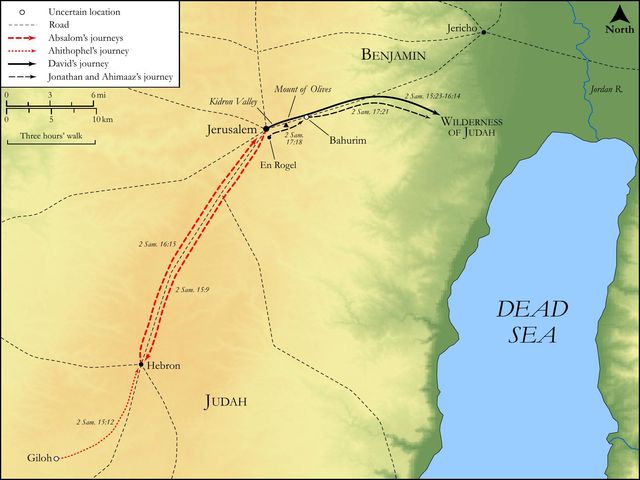
Absalom had notice sent him speedily by some of his friends at Jerusalem that David had withdrawn, and with what a small retinue he had gone; so that the coasts were clear, Absalom might take possession of Jerusalem when he pleased. The gates were open, and there was none to oppose him. Accordingly he came without delay (Sa2 16:15), extremely elevated, no doubt, with this success at first, and that that in which, when he formed his design, he probably apprehended the greatest difficulty, was so easily and effectually done. Now that he is master of Jerusalem he concludes all his own, the country will follow of course. God suffers wicked men to prosper awhile in their wicked plots, even beyond their expectation, that their disappointment may be the more grievous and disgraceful. The most celebrated politicians of that age were Ahithophel and Hushai. The former Absalom brings with him to Jerusalem (Sa2 16:15), the other meets him there (Sa2 16:16), so that he cannot but think himself sure of success, when he has both these to be his counsellors; on them he relies, and consults not the ark, though he has that with him. But miserable counsellors were they both; for,
I.Hushai would never counsel him to do wisely.
He was really his enemy, and designed to betray him, while he pretended to be in his interest; so that Absalom could not have a more dangerous man about him.
1.Hushai complimented him upon his accession to the throne, as if he had been abundantly satisfied in this title, and well pleased that he had come to the possession, Sa2 16:16. What arts of dissimulation are those tempted to use who govern themselves by fleshly wisdom! and how happy are those who have not known these depths of Satan, but have their conversation in the world with simplicity and godly sincerity!
2.Absalom was surprised to find him for him who was known to be David's intimate friend and confidant. He asks him, Is this thy kindness to thy friend? (Sa2 16:17), pleasing himself with this thought, that all would be his, since Hushai was. He doubts not of his sincerity, but easily believes what he wishes to be true, that David's best friends are so in love with himself as to take the first opportunity to declare for him, though the pride of his heart deceived him, Oba 1:3. Hushai confirmed him in the belief that he was hearty for him. For, though David is his friend, yet he is for the king in possession, Sa2 16:18. Whom the people choose, and Providence smiles upon, he will be faithful to; and he is for the king in succession (Sa2 16:19), the rising sun. It was true, he loved his father; but he had had his day, and it was over; and why should he not love his successor as well? Thus he pretended to give reasons for a resolution he abhorred the thought of.
II.Ahithophel counselled him to do wickedly, and so did as effectually betray him as he did who was designedly false to him; for those that advise men to sin certainly advise them to their hurt; and that government which is founded in sin is founded in the sand.
1.It seems, Ahithophel was noted as a deep politician; his counsel was as if a man had enquired at the oracle of God, Sa2 16:23. Such reputation was he in for subtlety and sagacity in public affairs, such reaches had he beyond other privy-counselors, such reasons would he give for his advice, and such success generally his projects had, that all people, good and bad, both David and Absalom, had a profound regard for his sentiments, too much by far, when they regarded him as an oracle of God; shall the prudence of any mortal compare with him who only is wise? Let us observe from this account of Ahithophel's fame for policy,
(1.)That many excel in worldly wisdom who are utterly destitute of heavenly grace, because those who set up for oracles themselves are apt to despise the oracles of God. God has chosen the foolish things of the world; and the greatest statesmen are seldom the greatest saints.
(2.)That frequently the greatest politicians act most foolishly for themselves. Ahithophel was cried up for an oracle, and yet very unwisely took part with Absalom, who was not only a usurper, but a rash youth, never likely to come to good, whose fall, and the fall of all that adhered to him, any one, with the tenth part of the policy that Ahithophel pretended to, might foresee. Well, after all, honesty is the best policy, and will be found so in the long run. But,
2.His policy in this case defeated its own aim. Observe,
(1.)The wicked counsel Ahithophel gave to Absalom. Finding that David had left his concubines to keep the house, he advised him to lie with them (Sa2 16:21), a very wicked thing. The divine law had made it a capital crime, Lev 20:11. The apostle speaks of it as a piece of villany not so much as named among the Gentiles, Co1 5:1. Reuben lost his birthright for it. But Ahithophel advised Absalom to it as a public thing, because it would give assurance to all Israel,
[1.]That he was in good earnest in his pretensions. No doubt he resolved to make himself master of all that belonged to his predecessor when he began with his concubines.
[2.]That he was resolved never to make peace with his father upon any terms; for by this he would render himself so odious to his father that he would never be reconciled to him, which perhaps the people were jealous of and that they must be sacrificed to the reconciliation. Having drawn the sword, he did, by this provocation, throw away the scabbard, which would strengthen the hands of his party and keep them firmly to him. This was Ahithophel's cursed policy, which bespoke him rather an oracle of devil than of God.
(2.)Absalom's compliance with this counsel. It entirely suited his lewd and wicked mind, and he delayed not to put it in execution, Sa2 16:22. When an unnatural rebellion was the opera, what fitter prologue could there be to it than such unnatural lust? Thus was his wickedness all of a piece, and such as a conscience not quite seared could not entertain the thoughts of without the utmost horror. Nay, the client outdoes what his counsel advises. Ahithophel advised him to do it, that all Israel shall see it. A tent is accordingly spread on the top of the house for the purpose; so impudently does he declare his sin as Sodom. Yet, in this, the word of God was fulfilled in the letter of it: God had threatened, by Nathan, that, for defiling Bath-sheba, David should have his own wives publicly debauched (Sa2 12:11, Sa2 12:12), and some think that Ahithophel, in advising it, designed to be revenged on David for the injury done to Bath-sheba, who was his grand-daughter: for she was the daughter of Eliam (Sa2 11:3), who was the son of Ahithophel, Sa2 23:34. Job speaks of this as the just punishment of adultery (Let my wife grind to another, Job 31:9, Job 31:10), and the prophet, Hos 4:13, Hos 4:14. What to think of these concubines, who submitted to this wickedness, I know not; but how unrighteous soever Absalom and they were, we must say, The Lord is righteous: nor shall any word of his fall to the ground.
Continue studying 2 Samuel 16:20 across the web’s major study libraries — every link below opens this exact verse, chapter, or book on the destination site.
Read & Compare
 BibleGatewayThis verse in more than 200 translations and 70 languages.
 Bible.comThe YouVersion reader — hundreds of translations, reading plans, and highlights.
 ESV.orgCrossway's official English Standard Version reader.
 NET BibleThe NET translation with 60,000+ translators' notes on every rendering decision.
 STEP BibleTyndale House's free study tool — original text, vocabulary, and scholarly resources.
 BibliaLogos Bible Software's free web reader.
 USCCBThe New American Bible (Revised Edition) with the U.S. bishops' study notes.
Commentaries
 BibleHub CommentariesDozens of classic commentaries on this verse, gathered on one page.
 StudyLightMore than 100 commentary sets — the largest collection on the web.
 BibleRefPlain-English commentary on what this verse means, verse by verse.
 Enduring WordDavid Guzik's free commentary on this chapter, widely used by Bible teachers.
 Bible Study ToolsVerse commentary alongside Greek and Hebrew study aids.
Original Language & Research
- BibleHub InterlinearThe verse word by word — original language, transliteration, and English.
- BibleHub LexiconEvery word's original-language definition and Strong's entry.
 Blue Letter BibleDeep-study tools — Strong's numbers, concordance, and word studies.
 SefariaThe Hebrew text with Rashi and centuries of Jewish commentary.
Sermons, Hymns & Audio


TrulyRandomVerse is not affiliated with these sites and doesn’t control their content. They’re linked because they’re genuinely useful.
Summary
Absalom, having successfully entered Jerusalem and effectively seized control of the capital in his rebellion against King David, immediately seeks strategic counsel from Ahithophel. This pivotal moment reveals Absalom's urgent need for a concrete plan to consolidate his illegitimate claim to the throne and determine the next decisive steps in his usurpation, setting the stage for Ahithophel's infamous and ultimately frustrated advice.
Context
ShowHideLiterary Context
This verse marks a critical turning point in the unfolding drama of Absalom's rebellion, immediately following King David's hurried and sorrowful flight from Jerusalem, detailed in 2 Samuel 15:13-17. Absalom has just made a triumphant entry into the capital, taking control without military engagement. His very first act as the de facto ruler is to consult Ahithophel, David's former trusted advisor who has now defected to Absalom's side. This consultation in 2 Samuel 16:20 directly precedes Ahithophel's shocking counsel in 2 Samuel 16:21-23, which advises a public and irreversible act of defiance against David, designed to alienate the people from their rightful king and solidify Absalom's new reign. The immediate seeking of counsel underscores the urgency and strategic importance of the moment.
Historical & Cultural Context
Among the kings of that day, the seizure of a capital city was a crucial, though not always sufficient, step in establishing a new reign, especially one founded on usurpation. A new ruler needed to quickly demonstrate authority, legitimacy (even if self-proclaimed), and deter any potential counter-rebellion. Seeking counsel from a renowned and respected advisor like Ahithophel, whose wisdom was legendary and considered "as if one had inquired at the oracle of God" (2 Samuel 16:23), was a customary and expected action for any leader, legitimate or otherwise, seeking to navigate complex political and military landscapes. The subsequent advice to publicly take David's concubines was a symbolic act of ultimate usurpation, asserting full dominion over the previous king's household and, by extension, his kingdom, a practice seen also when Abner went in unto Rizpah, Saul's concubine, which Ish-bosheth took as a challenge to his throne.
Key Themes
ShowHideThis verse powerfully contributes to several overarching themes within 2 Samuel and the broader Deuteronomistic History. It highlights the theme of usurpation and rebellion, as Absalom actively seeks to consolidate his illegitimate claim to the throne, not through divine appointment, but through human cunning and force. The presence of Ahithophel, David's former confidant, underscores the profound theme of betrayal, illustrating the deep personal and political fractures within David's kingdom and the devastating consequences of disloyalty. Furthermore, the very act of seeking counsel, even for a wicked purpose, subtly introduces the theme of divine sovereignty; though human schemes are meticulously planned, the broader narrative of 2 Samuel, particularly in 2 Samuel 17:14, reveals that God ultimately frustrates Ahithophel's "wise" counsel, demonstrating that even the most astute human plans are subject to God's overarching purpose and His protection of His anointed.
Exposition and Analysis
ShowHideKey Word Analysis
ShowHideFrom אָח and תָּפֵל, meaning "brother of folly." While his name ironically suggests "folly," Ahithophel was renowned for his extraordinary wisdom and strategic acumen, so much so that his counsel was considered "as if one had inquired at the oracle of God" (2 Samuel 16:23). His presence here signifies the gravity of Absalom's situation, as he seeks the highest level of strategic guidance available, and the depth of David's betrayal.
A primitive root meaning "to give," "to put," or "to grant." In this imperative form, "Give counsel," it functions as a direct command for Ahithophel to provide his strategic advice. Absalom is not merely asking for an opinion but demanding a concrete, actionable plan from his chief strategist, emphasizing the urgency and decisiveness he expects.
From יָעַץ, meaning "advice," "plan," or "purpose." This word denotes strategic guidance, particularly in matters of state, warfare, or significant policy. Absalom is not seeking general suggestions but a well-thought-out, decisive strategy for how to secure his newly seized power and proceed with his rebellion against his father. The term highlights the political and military implications of the advice sought.
A primitive root meaning "to do," "to make," "to act," or "to perform" in the broadest sense. Here, it signifies Absalom's desire for a concrete course of action. He is not merely seeking theoretical discussion but practical, executable steps to implement his usurpation and solidify his position. The combination of "counsel" and "do" indicates Absalom's intent to move swiftly and decisively based on Ahithophel's strategic advice.
Verse Breakdown
ShowHide"Then said Absalom to Ahithophel,"
This opening clause immediately establishes the direct and significant interaction between Absalom, the rebellious son who has just taken the capital, and Ahithophel, David's former trusted counselor. It highlights Absalom's immediate recognition of his need for strategic guidance to legitimize his power grab, and simultaneously underscores the profound betrayal of Ahithophel, who now stands ready to advise against his former king.
"Give counsel among you what we shall do."
This is Absalom's direct command and urgent inquiry. The phrase "among you" (or "for yourselves/for us") implies a collective deliberation, though Ahithophel is clearly the primary recipient and expected source of wisdom. Absalom is asking for a clear, actionable plan for consolidating his power and prosecuting the rebellion. The urgency of "what we shall do" underscores the critical juncture: Absalom has seized the city but now needs to solidify his position and prevent David's potential counter-attack or a popular uprising.
Literary Devices
ShowHideThe verse effectively employs several significant literary devices. Dramatic Irony is palpable, as the reader is acutely aware of God's overarching plan for David and his kingdom, even as Absalom and Ahithophel meticulously scheme. The audience knows that Ahithophel's "wise" counsel, though seemingly brilliant and strategically sound, will ultimately be frustrated by divine intervention, as explicitly stated in 2 Samuel 17:14. There is also a subtle Foreshadowing of the tragic end of Ahithophel, whose counsel, though initially accepted by Absalom, will ultimately lead to his downfall when it is rejected in favor of Hushai's advice. The scene itself serves as a powerful Symbolism, representing the complete rupture between Absalom and David, as Absalom seeks to establish his own authority by turning to David's former confidant for advice on how to dismantle David's legitimate rule.
Theological and Thematic Connections
ShowHideThis brief verse is rich in theological implications, serving as a stark reminder of the profound danger inherent in seeking counsel for wicked purposes, even from those renowned for their wisdom. Absalom's rebellion is a direct affront to God's anointed king, and his consultation with Ahithophel, a man whose counsel was considered "as if one had inquired at the oracle of God" (2 Samuel 16:23), demonstrates the perversion of wisdom when it is applied to ungodly ends. The narrative implicitly contrasts human wisdom, however astute and highly regarded, with divine sovereignty. While Absalom and Ahithophel meticulously plot their rebellion, God is ultimately in control, orchestrating events to protect His chosen king and frustrate the plans of the wicked. This serves as a powerful reminder that true wisdom begins with the fear of the Lord, and any counsel that deviates from God's righteous path, no matter how clever or strategically sound, is ultimately folly in His sight and destined to fail against His purposes.
Reflection and Application
ShowHideThe scene in 2 Samuel 16:20 serves as a potent and timeless reminder that the source, nature, and ultimate purpose of the counsel we seek and give are of paramount importance. Absalom, in his vaulting ambition and desire for an earthly throne, sought the most esteemed human wisdom available, but he sought it for a rebellious, self-serving, and ungodly end. This path led not to lasting success or peace, but to his eventual downfall and the tragic suicide of his advisor. For us, this narrative highlights the critical importance of discerning the counsel we receive and the counsel we offer. Are we seeking wisdom that aligns with God's revealed will and righteous character, or are we merely looking for shrewd strategies to achieve our own desires, even if they contradict divine principles or harm others? True wisdom is not merely intellectual shrewdness or strategic brilliance; it is fundamentally a moral and spiritual orientation towards God's truth and His ways. We are called to seek counsel from those who fear the Lord and whose advice is rooted in His Word, ensuring that our plans and actions are built on a foundation that will endure and bring glory to God, rather than fleeting human success.
Questions for Reflection
ShowHideFAQ
ShowHideWhy was Ahithophel's counsel so highly regarded?
ShowHideAhithophel was renowned for his extraordinary wisdom and strategic acumen. 2 Samuel 16:23 explicitly states that "the counsel of Ahithophel, which he counselled in those days, was as if a man had inquired at the oracle of God." This indicates that his advice was considered virtually infallible and divinely inspired by those who heard it, making his defection to Absalom a significant blow to David and a major asset to the rebellion. His counsel was practical, decisive, and often ruthless, designed to achieve immediate and complete victory.
What was Ahithophel's famous counsel to Absalom immediately after this verse?
ShowHideImmediately following Absalom's request for counsel, Ahithophel advised Absalom to publicly lie with David's concubines on the roof of the palace (2 Samuel 16:21-22). This act was designed to be an irreversible and public declaration of Absalom's complete break with his father and his full usurpation of David's authority and kingdom. It would signal to all of Israel that Absalom was the new king and that reconciliation with David was impossible, thereby solidifying support for his rebellion.
How does God frustrate Ahithophel's counsel later in the narrative?
ShowHideAlthough Ahithophel's initial counsel to Absalom was accepted, his subsequent, even more strategic advice to pursue David immediately was ultimately frustrated by God. David, through his loyal servant Hushai, prayed that God would "turn the counsel of Ahithophel into foolishness" (2 Samuel 15:31). God answered this prayer by enabling Hushai to offer alternative counsel to Absalom, which, though seemingly less decisive, appealed to Absalom's vanity and was ultimately accepted over Ahithophel's. As a result, 2 Samuel 17:14 explicitly states, "For the Lord had appointed to defeat the good counsel of Ahithophel, to the intent that the Lord might bring evil upon Absalom." This divine intervention allowed David time to regroup and ultimately led to Absalom's defeat and Ahithophel's suicide.
Christ-Centered Fulfillment
ShowHideThe tragic narrative of Absalom's rebellion, culminating in his seeking counsel for usurpation, finds profound Christ-centered fulfillment in the person and work of Jesus. Unlike Absalom, who sought to seize an earthly throne through treachery and human cunning, Jesus is the true and rightful King, whose kingdom "is not of this world" (John 18:36). While Absalom relied on Ahithophel's flawed human wisdom, even that which was considered "as if one had inquired at the oracle of God," Jesus embodies divine wisdom itself, being "the power of God, and the wisdom of God" (1 Corinthians 1:24). The profound betrayal David experienced at the hands of Ahithophel, his trusted counselor, foreshadows the ultimate betrayal of Jesus by Judas Iscariot (Matthew 26:47-50), yet this betrayal, unlike Absalom's, was not a disruption of God's plan but an integral part of His perfect redemptive purpose. Ultimately, all human schemes and rebellions against God's anointed King, whether David or Christ, are destined to fail, as powerfully illustrated by the divine frustration of Ahithophel's seemingly brilliant counsel. Jesus' reign is eternal, established not by human might or cunning, but by God's sovereign power and His sacrificial love on the cross, ensuring that "of the increase of his government and peace there shall be no end" (Isaiah 9:7).