


2 Samuel 21:15
- וַתְּהִיva·te·hiand it belongedH1961Conj-w ¦ V-Qal-ConsecImperf-3fsVerb Qal Consecutive Imperfect 3rd Singular Feminineוַandתְּהִיit belonged
- עוֹדodagainH5750Adj-msAdjective Numerical Singular Masculine Absolute
- מִלְחָמָהmil·cha·MahwarH4421N-fsNoun Singular Feminine Absolute
- לַפְּלִשְׁתִּיםla·pe·lish·Timto the PhilistinesH6430Prep-l ¦ N-mpNoun Gentilic Plural Masculine Absoluteלַto theפְּלִשְׁתִּיםPhilistines
- אֶת'etwithH854PrepPreposition
- יִשְׂרָאֵלYis·ra·'ElIsraelH3478N-properNoun Proper Location
- וַיֵּרֶדvai·Ye·redand he went downH3381Conj-w ¦ V-Qal-ConsecImperf-3msVerb Qal Consecutive Imperfect 3rd Singular Masculineוַandיֵּרֶדhe went down
- דָּוִדda·VidDavidH1732N-proper-mNoun Proper Masculine
- וַעֲבָדָיוva·'a·va·Davand his servantsH5650Conj-w ¦ N-mpc ¦ 3msNoun Plural Masculine Constructוַandעֲבָדָיservantsוhis
- עִמּוֹi·Mowith himH5973Prep ¦ 3msPreposition Definiteעִמּwithוֹhim
- וַיִּלָּחֲמוּvai·yi·la·cha·Muand they foughtH3898Conj-w ¦ V-Niphal-ConsecImperf-3mpVerb Niphal Consecutive Imperfect 3rd Plural Masculineוַandיִּלָּחֲמוּthey fought
- אֶת'etwithH854PrepPreposition
- פְּלִשְׁתִּיםpe·lish·Tim[the] PhilistinesH6430N-mpNoun Gentilic Plural Masculine Absolute
- וַיָּעַףvai·Ya·'afand he was wearyH5888Conj-w ¦ V-Qal-ConsecImperf-3msVerb Qal Consecutive Imperfect 3rd Singular Masculineוַandיָּעַףhe was weary
- דָּוִדda·VidDavidH1732N-proper-mNoun Proper Masculine
English is a literal word-by-word gloss of the Hebrew, not the KJV's wording. Why?
This is the original text the KJV's translators worked from — each Hebrew word with its own literal English meaning in this verse, prepared by scholars at Tyndale House, Cambridge. The KJV translates whole sentences, not word by word, so its wording differs: one Hebrew word can become several English words, and the KJV may choose “the LORD” where the gloss reads “Yahweh”. Both are faithful — they answer different questions. For the KJV's own rendering, switch to the KJV text.
Details
See on the biblical-era map

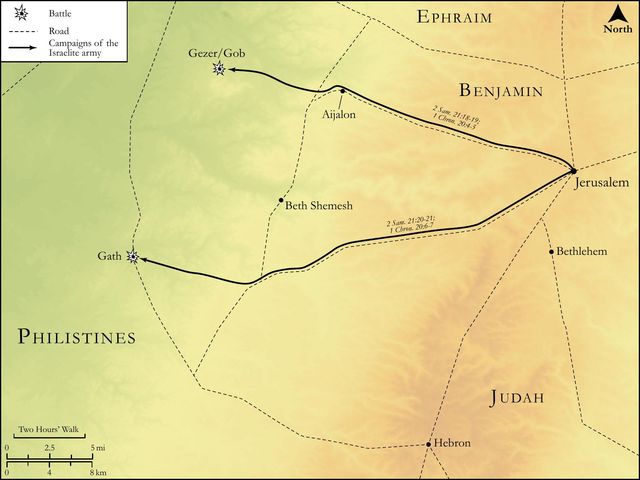
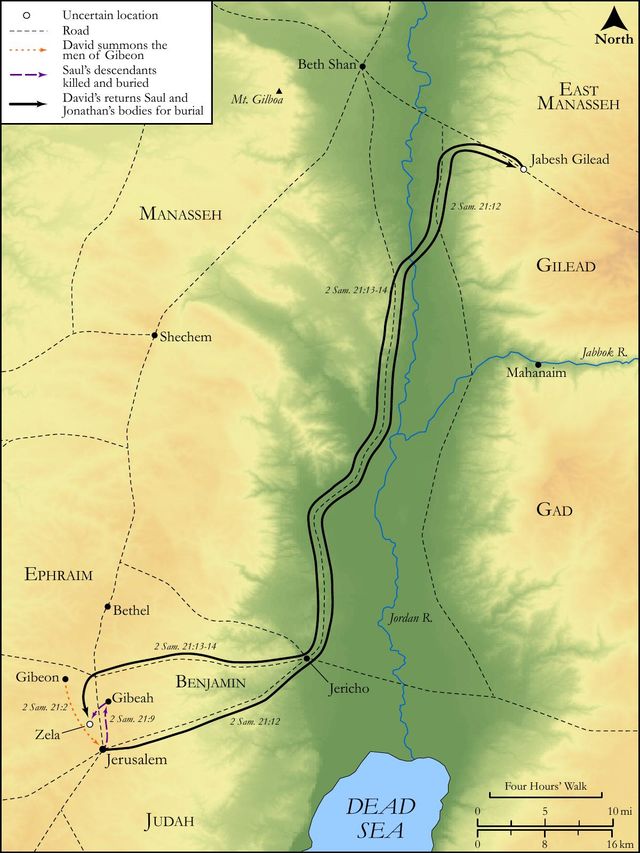
Study this verse
Public-domain commentary
Matthew Henry
From his Commentary on the Whole Bible. Henry comments on passages, not single verses — this entry covers 2 Samuel 21:15–22. His three-level outline is real structure in the source text, so it is rendered as structure.
We have here the story of some conflicts with the Philistines, which happened, as it should seem, in the latter end of David's reign. Though he had so subdued them that they could not bring any great numbers into the field, yet as long as they had any giants among them to be their champions, they would never be quiet, but took all occasions to disturb the peace of Israel, to challenge them, or make incursions upon them.
I.David himself was engaged with one of the giants.
The Philistines began the war yet again, Sa2 21:15. The enemies of God's Israel are restless in their attempts against them. David, though old, desired not a writ of ease from the public service, but he went down in person to fight against the Philistines (Senescit, non segnescit - He grows old, but not indolent), a sign that he fought not for his own glory (at this age he was loaded with glory, and needed no more), but for the good of his kingdom. But in this engagement we find him,
1.In distress and danger. He thought he could bear the fatigues of war as well as he had done formerly; his will was good, and he hoped he could do as at other times. But he found himself deceived; age had cut his hair, and, after a little toil, he waxed faint. His body could not keep pace with his mind. The champion of the Philistines was soon aware of his advantage, perceived that David's strength failed him, and, being himself strong and well-armed, he thought to slay David; but God was not in his thoughts, and therefore in that very day they all perished. The enemies of God's people are often very strong, very subtle, and very sure of success, like Isbi-benob, but there is no strength, nor counsel, nor confidence against the Lord.
2.Wonderfully rescued by Abishai, who came seasonably in to his relief, Sa2 21:17. Herein we must own Abishai's courage and fidelity to his prince (to save whose life he bravely ventured his own), but much more the good providence of God, which brought him in to David's succour in the moment of his extremity. Such a cause and such a champion, though distressed, shall not be deserted. When Abishai succoured him, gave him a cordial, it may be, to relieve his fainting spirits, or appeared as his second, he (namely, David, so I understand it) smote the Philistine and killed him; for it is said (Sa2 21:22) that David had himself a hand in slaying the giants. David fainted, but he did not flee; though his strength failed him, he bravely kept his ground, and then God sent him this help in the time of need, which, though brought him by his junior and inferior, he thankfully accepted, and, with a little recruiting, gained his point, and came off a conqueror. Christ, in his agonies, was strengthened by an angel. In spiritual conflicts, even strong saints sometimes wax faint; then Satan attacks them furiously; but those that stand their ground and resist him shall be relieved, and made more than conquerors.
3.David's servants hereupon resolved that he should never expose himself thus any more. They had easily persuaded him not to fight against Absalom (Sa2 18:3), but against the Philistines he would go, till, having had this narrow escape, it was resolved in council, and confirmed with an oath, that the light of Israel (its guide and glory, so David was) should never be put again into such hazard of being blown out. The lives of those who are as valuable to their country as David was ought to be preserved with a double care, both by themselves and others.
II.The rest of the giants fell by the hand of David's servants.
1.Saph was slain by Sibbechai, one of David's worthies, Sa2 21:18; Ch1 11:29.
2.Another, who was brother to Goliath, was slain by Elhanan, who is mentioned Sa2 23:24.
3.Another, who was of very unusual bulk, who had more fingers and toes than other people (Sa2 21:20), and such an unparalleled insolence that, though he had seen the fall of other giants, yet he defied Israel, was slain by Jonathan the son of Shimea. Shimea had one son named Jonadab (Sa2 13:3), whom I should have taken for the same with this Jonathan, but that the former was noted for subtlety, the latter for bravery. These giants were probably the remains of the sons of Anak, who, though long feared, fell at last. Now observe,
(1.)It is folly for the strong man to glory in his strength. David's servants were no bigger nor stronger than other men; yet thus, by divine assistance, they mastered one giant after another. God chooses by the weak things to confound the mighty.
(2.)It is common for those to go down slain to the pit who have been the terror of the mighty in the land of the living, Eze 32:27.
(3.)The most powerful enemies are often reserved for the last conflict. David began his glory with the conquest of one giant, and here concludes it with the conquest of four. Death is a Christian's last enemy, and a son of Anak; but, through him that triumphed for us, we hope to be more than conquerors at last, even over that enemy.
Continue studying 2 Samuel 21:15 across the web’s major study libraries — every link below opens this exact verse, chapter, or book on the destination site.
Read & Compare
 BibleGatewayThis verse in more than 200 translations and 70 languages.
 Bible.comThe YouVersion reader — hundreds of translations, reading plans, and highlights.
 ESV.orgCrossway's official English Standard Version reader.
 NET BibleThe NET translation with 60,000+ translators' notes on every rendering decision.
 STEP BibleTyndale House's free study tool — original text, vocabulary, and scholarly resources.
 BibliaLogos Bible Software's free web reader.
 USCCBThe New American Bible (Revised Edition) with the U.S. bishops' study notes.
Commentaries
 BibleHub CommentariesDozens of classic commentaries on this verse, gathered on one page.
 StudyLightMore than 100 commentary sets — the largest collection on the web.
 BibleRefPlain-English commentary on what this verse means, verse by verse.
 Enduring WordDavid Guzik's free commentary on this chapter, widely used by Bible teachers.
 Bible Study ToolsVerse commentary alongside Greek and Hebrew study aids.
Original Language & Research
- BibleHub InterlinearThe verse word by word — original language, transliteration, and English.
- BibleHub LexiconEvery word's original-language definition and Strong's entry.
 Blue Letter BibleDeep-study tools — Strong's numbers, concordance, and word studies.
 SefariaThe Hebrew text with Rashi and centuries of Jewish commentary.
Sermons, Hymns & Audio


TrulyRandomVerse is not affiliated with these sites and doesn’t control their content. They’re linked because they’re genuinely useful.
Summary
Second Samuel 21:15 introduces a pivotal and poignant moment in the latter part of King David's reign, marking a renewed conflict with the Philistines that unexpectedly reveals the aging monarch's profound physical vulnerability. This verse sets the stage for a series of encounters that not only highlight the persistent external threats to Israel but also underscore the shifting dynamics of leadership, as David's reliance on his loyal "mighty men" becomes increasingly evident. It subtly emphasizes the human limitations even of God's chosen leaders, preparing the reader for a narrative where divine providence works through the faithfulness and communal support of David's devoted followers.
Context
ShowHideLiterary Context
This verse initiates a distinct literary unit (2 Samuel 21:15-22) that serves as an appendix to the main narrative of David's reign, following the detailed accounts of his triumphs, failures, and the succession struggles within his family. While chapters 9-20 focus on internal turmoil and political intrigue, this section shifts back to external conflicts, specifically with the Philistines. It provides a series of vignettes detailing the exploits of David's mighty men, effectively showcasing their valor and loyalty, particularly in light of David's declining physical prowess. The placement of this appendix, after the resolution of Absalom's rebellion and before David's final words and the account of his mighty men in 2 Samuel 23, subtly prepares the reader for the transition of power and the eventual end of David's reign. It underscores that even in his twilight years, the struggle for Israel's security remained, and David, though still leading, was no longer the invincible warrior of his youth, as seen in his early victory over Goliath.
Historical & Cultural Context
The Philistines were a formidable "Sea Peoples" group who settled along the southwestern coast of Canaan (e.g., Gaza, Ashkelon, Ashdod, Gath, Ekron) around the 12th century BCE. They were technologically advanced, possessing iron weaponry, which gave them a significant military advantage over the Israelites, who were still largely in the Bronze Age. Their presence represented a constant threat to Israelite expansion and security, particularly in the fertile Shephelah region. Throughout the period of the Judges and the early monarchy, the Philistines were Israel's primary adversaries, often oppressing them and even capturing the Ark of the Covenant (as detailed in 1 Samuel 4). David's reign saw significant victories against them, establishing Israel's dominance (e.g., 2 Samuel 5:17-25). However, this verse indicates that despite past victories, the Philistine threat was not entirely eradicated, necessitating ongoing vigilance. Culturally, kings were expected to lead their armies into battle, a role David consistently fulfilled, making his physical weakening in this context particularly poignant and a potential source of vulnerability for the nation.
Key Themes
ShowHideThis verse introduces and reinforces several key themes within the broader narrative of 2 Samuel and the Deuteronomistic History. Firstly, it highlights the persistence of conflict and the ongoing struggle for the Promised Land. Even under a divinely appointed king like David, peace was not absolute, and vigilance against external threats remained crucial. Secondly, it powerfully illustrates David's aging and human vulnerability. The mighty warrior, renowned for his strength and courage, is shown to be susceptible to the physical toll of age and warfare, challenging the idealized image of the heroic king. This theme subtly prepares the reader for the eventual need for succession and the transition of leadership. Thirdly, the verse subtly introduces the importance of communal support and loyalty. David's "servants" are present with him, foreshadowing their crucial role in protecting him, emphasizing that even the greatest leaders are reliant on the strength and faithfulness of their community. This reliance on others, rather than solely on individual might, points to God's work through His people.
Exposition and Analysis
ShowHideKey Word Analysis
ShowHideThis term signifies not just a single battle but often an ongoing state of armed conflict or campaigning. The repetition "had yet war again" (literally "there was again war") emphasizes the persistent, cyclical nature of the Philistine threat, suggesting that despite previous victories, the conflict was never fully resolved and continued to plague Israel. It underscores the reality that peace in the ancient Near East was often tenuous and hard-won, requiring continuous engagement.
This verb conveys a profound sense of weariness, exhaustion, or being utterly spent. It's more than just being tired; it implies a deep physical fatigue that borders on collapse or fainting, stemming from the darkness of swooning. This word choice is critical, as it starkly contrasts with David's earlier portrayals as a vigorous, indefatigable warrior (e.g., 1 Samuel 17). It signals a significant shift in David's physical capabilities, highlighting the toll of age and years of relentless warfare, and setting the stage for his men to intervene.
Verse Breakdown
ShowHide"Moreover the Philistines had yet war again with Israel;"
This opening clause immediately re-establishes the long-standing enmity between Israel and the Philistines, signaling a renewed phase of conflict. The adverb "again" emphasizes the recurring nature of this threat, reminding the reader that despite David's past victories, the Philistines remained a formidable and persistent adversary, necessitating continued vigilance and military engagement.
"and David went down, and his servants with him, and fought against the Philistines:"
This describes David's continued leadership in battle, even in his later years. The phrase "went down" often implies descending from the central highlands of Israel to the lower plains where the Philistines resided. The inclusion of "his servants with him" is crucial, indicating that David was not alone but accompanied by his loyal retinue, foreshadowing their vital role in the ensuing events. This detail highlights both David's enduring commitment to his people's defense and his increasing reliance on his trusted companions.
"and David waxed faint."
This is the climactic and most significant part of the verse. It reveals David's unexpected physical weakness in the midst of battle. The KJV's "waxed faint" vividly portrays a sudden and profound exhaustion, a near collapse. This detail is a stark departure from the invincible warrior image of David's youth and serves as a poignant reminder of human mortality and the physical toll of a life dedicated to warfare. It directly sets up the subsequent narrative where David's life is saved by one of his mighty men, underscoring his vulnerability and the critical need for his loyal support system.
Literary Devices
ShowHideThe verse employs several significant literary devices. Juxtaposition is evident in the stark contrast between David's past reputation as an invincible warrior (e.g., his defeat of Goliath in 1 Samuel 17) and his present moment of physical weakness. This creates a sense of Realism, portraying the aging process and the cumulative effects of a life of warfare, making David a more relatable and human figure. The phrase "David waxed faint" serves as Foreshadowing, hinting at the subsequent events in 2 Samuel 21:16-17, where his life is endangered and he must be rescued, thereby emphasizing the growing importance of his "mighty men" and the eventual need for a successor. There is also a subtle Irony in the great king, who once single-handedly faced giants, now being overcome by mere exhaustion, highlighting the limits of even the most powerful human strength.
Theological and Thematic Connections
ShowHideThis verse powerfully illustrates the theological truth that even the most divinely appointed and gifted leaders are ultimately human and subject to limitations. David, God's chosen king, experiences the debilitating effects of age and sustained conflict, reminding us that no human being, regardless of their past triumphs or anointing, is exempt from physical vulnerability. This vulnerability, however, is not a sign of God's abandonment but rather an opportunity for His faithfulness to be demonstrated through the community. It underscores the biblical theme of reliance, not on human strength alone, but on God's provision, often mediated through the support and loyalty of others. The persistent Philistine threat also speaks to the ongoing spiritual warfare faced by God's people, where victories are often followed by new challenges, necessitating continuous dependence on divine strength and communal solidarity.
Reflection and Application
ShowHide2 Samuel 21:15 offers a profound lesson on the reality of human limitations, even for those whom God has mightily used. David, the legendary warrior, finds himself physically diminished, a poignant reminder that strength and vigor are temporal. This should encourage us to cultivate humility, recognizing that our own abilities and energy are finite. It calls us to acknowledge our vulnerabilities and to understand that true strength often lies not in self-sufficiency, but in a willingness to rely on God and to accept the support of our community. Just as David's servants stepped in to protect him, we are called both to offer support to those who are weary and to graciously receive help when we ourselves "wax faint." In a world that often glorifies unceasing productivity and self-reliance, this verse provides a vital counter-narrative, affirming the value of rest, the necessity of interdependence, and the enduring presence of God even in our moments of weakness. It reminds us that our perseverance in the face of ongoing challenges is not solely dependent on our individual might, but on the collective strength of the body of Christ and the sustaining power of God.
Questions for Reflection
ShowHideFAQ
ShowHideWhy was David, an aging king, still leading in battle?
ShowHideIn ancient Near Eastern cultures, it was customary and expected for kings to lead their armies into battle. This was a demonstration of their courage, their commitment to their people, and their divine anointing. David, throughout his reign, consistently fulfilled this role, from his early days as a warrior (e.g., 1 Samuel 17) to his later years. Even as he aged, his sense of duty and his personal bravery compelled him to continue to fight for Israel's security. However, this verse marks a turning point, as his physical decline during this battle leads his men to insist that he no longer go out with them to war (as seen in 2 Samuel 21:17), recognizing the risk to the kingdom if their king were to fall.
Who were these Philistines, and why were they still a threat?
ShowHideThe Philistines were a powerful, non-Semitic people who had settled along the southwestern coast of Canaan (modern-day Gaza Strip and surrounding areas) around the 12th century BCE. They were a formidable military power, known for their iron weaponry, which gave them an advantage over the Israelites. They had been Israel's primary adversaries since the time of the Judges (e.g., Samson in Judges 16) and the early monarchy (e.g., Saul's death in 1 Samuel 31). While David had achieved significant victories against them earlier in his reign, breaking their dominance (e.g., 2 Samuel 5:17-25), this verse indicates that the threat was not entirely eradicated. Pockets of Philistine resistance and ongoing border skirmishes continued, demonstrating that even after major military successes, securing the land of Israel required persistent vigilance and ongoing conflict.
Christ-Centered Fulfillment
ShowHideDavid's sudden weakness in battle, "waxing faint," serves as a poignant reminder of the ultimate limitations of even the greatest human king. While David was God's anointed, a man after God's own heart, his physical vulnerability underscores the need for a perfect, eternal King who would never grow weary or faint. This foreshadows Jesus Christ, the true Son of David, who is not merely a human warrior but the divine Son of God. Unlike David, who eventually succumbed to the effects of age and physical exhaustion, Jesus, though he experienced human weakness and fatigue (e.g., John 4:6), ultimately conquered death and weakness through his resurrection. He is the King who went to battle against sin and death, not with a sword, but through self-sacrifice on the cross, triumphing definitively (as described in Colossians 2:15). His strength is inexhaustible, and his reign is eternal, ensuring that his people will never be left vulnerable by a fading monarch. He is the one who "does not faint or grow weary" (Isaiah 40:28), and through whom we, too, can find strength when we are weak (2 Corinthians 12:9).