


1 Chronicles 20:4
Bible text: King James Version (1769 Blayney text) · Public domain
Bible text: King James Version with Strong's numbers · Public domain
Bible text: Berean Standard Bible · Public domain
Bible text: American Standard Version (1901) · Public domain
Bible text: World English Bible, Messianic edition · Public domain
Bible text: Geneva Bible (1599) · Public domain
Bible text: Young's Literal Translation · Public domain
- וַיְהִיvay·Hiand it wasH1961Conj-w ¦ V-Qal-ConsecImperf-3msVerb Qal Consecutive Imperfect 3rd Singular Masculineוַandיְהִיit was
- אַחֲרֵיכֵן'a·cha·rei·Khenafter thisH310Adj-mpc ¦ AdvAdjective Numerical Plural Masculine Constructאַחֲרֵיafterכֵןthis
- וַתַּעֲמֹדva·ta·'a·Modand it aroseH5975Conj-w ¦ V-Qal-ConsecImperf-3fsVerb Qal Consecutive Imperfect 3rd Singular Feminineוַandתַּעֲמֹדit arose
- מִלְחָמָהmil·cha·Maha battleH4421N-fsNoun Singular Feminine Absolute
- בְּגֶזֶרbe·Ge·zerat GezerH1507Prep-b ¦ N-properNoun Proper LocationבְּatגֶזֶרGezer
- עִם'imwithH5973PrepPreposition
- פְּלִשְׁתִּיםpe·lish·Tim[the] PhilistinesH6430N-mpNoun Gentilic Plural Masculine Absolute
- אָז'azthenH227AdvAdverb
- הִכָּהhi·Kahhe struck downH5221V-Hiphil-Perf-3msVerb Hiphil Perfect 3rd Singular Masculine
- סִבְּכַיsi·be·KhaiSibbecaiH5444N-proper-mNoun Proper Masculine
- הַחֻשָׁתִיha·chu·sha·Tithe HushathiteH2843Art ¦ N-msNoun Gentilic Singular Masculine AbsoluteהַtheחֻשָׁתִיHushathite
- אֶת'et<obj.>H853DirObjMParticle Object Indicator
- סִפַּיsi·PaiSippaiH5598N-proper-mNoun Proper Masculine
- מִילִדֵיmi·li·Deione of those born ofH3211Prep-m ¦ N-mpcNoun Plural Masculine Constructמִone ofילִדֵיthose born of
- הָרְפָאִיםha·re·fa·'Imthe RephaitesH7497Art ¦ N-mpNoun Gentilic Plural Masculine AbsoluteהָtheרְפָאִיםRephaites
- וַיִּכָּנֵעוּvai·yi·ka·Ne·'uand they were subduedH3665Conj-w ¦ V-Niphal-ConsecImperf-3mpVerb Niphal Consecutive Imperfect 3rd Plural Masculineוַandיִּכָּנֵעוּthey were subdued
English is a literal word-by-word gloss of the Hebrew, not the KJV's wording. Why?
This is the original text the KJV's translators worked from — each Hebrew word with its own literal English meaning in this verse, prepared by scholars at Tyndale House, Cambridge. The KJV translates whole sentences, not word by word, so its wording differs: one Hebrew word can become several English words, and the KJV may choose “the LORD” where the gloss reads “Yahweh”. Both are faithful — they answer different questions. For the KJV's own rendering, switch to the KJV text.
Details
See on the biblical-era maps
Study this verse
Public-domain commentary
Matthew Henry
From his Commentary on the Whole Bible. Henry comments on passages, not single verses — this entry covers 1 Chronicles 20:4–8.
The Philistines were nearly subdued (Ch1 18:1); but, as in the destruction of the Canaanites by Joshua the sons of Anak were last subdued (Jos 11:21), so here in the conquest of the Philistines the giants of Gath were last brought down. In the conflicts between grace and corruption there are some sins which, like these giants, keep their ground a great while and are not mastered without much difficulty and a long struggle: but judgment will be brought forth unto victory at last. Observe, 1. We never read of giants among the Israelites as we do of the giants among the Philistines - giants of Gath, but not giants of Jerusalem. The growth of God's plants is in usefulness, not in bulk. Those who covet to have cubits added to their stature do not consider that it will but make then more unwieldy. In the balance of the sanctuary David far outweighs Goliath. 2. The servants of David, though men of ordinary stature, were too hard for the giants of Gath in every encounter, because they had God on their side, who takes pleasure in abasing lofty looks, and mortifying the giants that are in the earth, as he did of old by the deluge, though they were men of renown. Never let the church's friends be disheartened by the power and pride of the church's enemies. We need not fear great men against us while we have the great God for us. What will a finger more on each hand do, or a toe more on each foot, in contest with Omnipotence? 3. These giants defied Israel (Ch1 20:7) and were thus made to pay for their insolence. None are more visibly marked for ruin that those who reproach God and his Israel. God will do great things rather than suffer the enemy to behave themselves proudly, Deu 32:27. The victories of the Son of David, like those of David himself, are gradual. We see not yet all things put under him; but it will be seen shortly: and death itself, the last enemy, like these giants, will be triumphed over.
Continue studying 1 Chronicles 20:4 across the web’s major study libraries — every link below opens this exact verse, chapter, or book on the destination site.
Read & Compare
 BibleGatewayThis verse in more than 200 translations and 70 languages.
 Bible.comThe YouVersion reader — hundreds of translations, reading plans, and highlights.
 ESV.orgCrossway's official English Standard Version reader.
 NET BibleThe NET translation with 60,000+ translators' notes on every rendering decision.
 STEP BibleTyndale House's free study tool — original text, vocabulary, and scholarly resources.
 BibliaLogos Bible Software's free web reader.
 USCCBThe New American Bible (Revised Edition) with the U.S. bishops' study notes.
Commentaries
 BibleHub CommentariesDozens of classic commentaries on this verse, gathered on one page.
 StudyLightMore than 100 commentary sets — the largest collection on the web.
 BibleRefPlain-English commentary on what this verse means, verse by verse.
 Enduring WordDavid Guzik's free commentary on this chapter, widely used by Bible teachers.
 Bible Study ToolsVerse commentary alongside Greek and Hebrew study aids.
Original Language & Research
- BibleHub InterlinearThe verse word by word — original language, transliteration, and English.
- BibleHub LexiconEvery word's original-language definition and Strong's entry.
 Blue Letter BibleDeep-study tools — Strong's numbers, concordance, and word studies.
 SefariaThe Hebrew text with Rashi and centuries of Jewish commentary.
Sermons, Hymns & Audio


TrulyRandomVerse is not affiliated with these sites and doesn’t control their content. They’re linked because they’re genuinely useful.
Summary
1 Chronicles 20:4 meticulously records a significant military engagement during King David's reign, highlighting the valor of Sibbechai the Hushathite, who decisively slew Sippai, one of the formidable "children of the giant," at the strategic city of Gezer. This account serves to underscore God's consistent faithfulness in delivering His people, demonstrating His sovereign power over all adversaries, and illustrating the ongoing subjugation of Israel's enemies through the courageous acts of His chosen warriors.
Context
ShowHideLiterary Context
This verse is strategically placed within a broader section of 1 Chronicles (chapters 18-20) that meticulously chronicles King David's significant military campaigns and the heroic exploits of his elite warriors, often referred to as "David's Mighty Men." Chapter 20, in particular, consolidates four distinct encounters with Philistine giants, serving as a theological and historical parallel to the accounts found in 2 Samuel 21:18-22. The Chronicler's emphasis here is not merely on military history but on God's active involvement in securing Israel's borders and establishing David's kingdom. The specific battle at Gezer, detailed in this verse, is presented as one of these crucial confrontations, highlighting the individual bravery that contributed to the larger national narrative of divine protection and victory, reinforcing the Chronicler's overarching theme of God's covenant faithfulness to the Davidic line.
Historical & Cultural Context
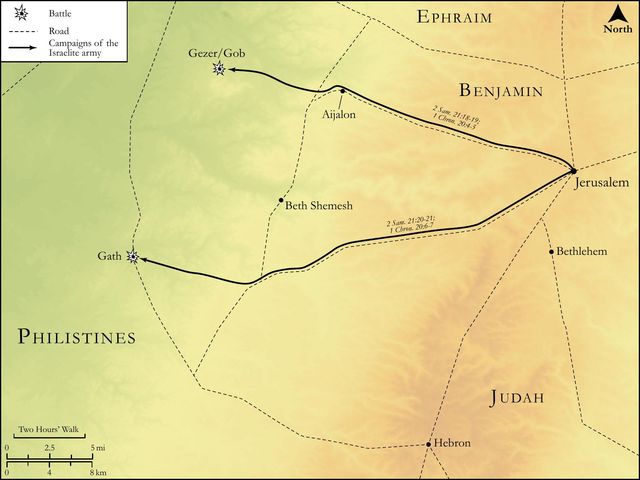
Gezer was a strategically vital Canaanite city, later incorporated into Israelite territory, located in the Shephelah, the low-lying foothills between the central highlands of Judah and the Philistine plain. Its geographical position made it a frequent flashpoint for conflict between Israel and the Philistines, a powerful and long-standing adversary known for their advanced iron weaponry and formidable warriors. The mention of "children of the giant" (KJV) or "descendants of Rapha" (ESV/NIV) refers to the Rephaim, an ancient, often exceptionally large and powerful people group, remnants of whom are mentioned throughout the Old Testament (e.g., Deuteronomy 2:11). Their presence here underscores the formidable nature of the Philistine threat and the extraordinary challenges faced by Israel's warriors. David's reign marked a period of consolidation and expansion for Israel, and these military accounts serve to validate his kingship and God's covenant faithfulness in securing the promised land.
Key Themes
ShowHideSeveral significant themes emerge from 1 Chronicles 20:4 and its broader context, reflecting the Chronicler's theological agenda. Firstly, the theme of Divine Victory through Human Agents is prominent; while Sibbechai's prowess is evident, the ultimate subjugation of the enemy is presented as God's work, empowering His people to overcome seemingly insurmountable odds. This aligns with the Chronicler's emphasis on God's direct involvement in Israel's history, particularly in the establishment and security of the Davidic kingdom. Secondly, the Persistent Threat of the Philistines is highlighted, demonstrating that even under David's strong leadership, the struggle against this formidable enemy was ongoing, requiring continuous vigilance and divine intervention. The "children of the giant" symbolize the enduring and imposing nature of these adversaries, whose defeat consistently points to God's superior power. Lastly, the Valor of David's Mighty Men is celebrated. Sibbechai, listed among David's elite warriors in 1 Chronicles 11:29, represents the individual acts of bravery and faithfulness that collectively contributed to Israel's security and dominance, all undergirded by God's sovereign hand, showcasing the importance of loyal and courageous service within God's plan.
Exposition and Analysis
ShowHideKey Word Analysis
ShowHideThis city, identified as H1507, was a strategically crucial location in Palestine, controlling major trade routes and serving as a gateway to the coastal plain. The fact that "war arose at Gezer with the Philistines" indicates a significant, targeted engagement in a contested and vital region, highlighting the ongoing struggle for control over key territories between Israel and its perennial enemies.
Identified as H5598, Sippai is the specific formidable Philistine warrior slain by Sibbechai. His name, derived from a word meaning "bason-like," might allude to his large stature or appearance. The parallel account in 2 Samuel 21:18 names him Saph, a common variation in ancient texts that does not diminish the historical veracity of the event. His lineage connects him to the Rephaim, emphasizing his extraordinary size and strength, making Sibbechai's victory all the more remarkable and a testament to divine empowerment.
This term, H7497, refers to a "giant" or "Rapha," specifically denoting a remnant of the Rephaim, an ancient race known for their imposing stature and formidable fighting ability. The phrase "children of the giant" (KJV) or "descendants of Rapha" (ESV) explicitly identifies Sippai as belonging to this fearsome lineage. Their presence among the Philistines underscored the military might and the significant challenge they posed to Israel, making their defeat a clear demonstration of God's power to overcome seemingly insurmountable foes.
Verse Breakdown
ShowHide"And it came to pass after this, that there arose war at Gezer with the Philistines;"
This opening clause provides a chronological marker, indicating that this event occurred subsequent to previously recounted military campaigns, maintaining the narrative flow of David's reign. The specific mention of "Gezer" precisely locates the conflict, emphasizing its strategic importance as a flashpoint between Israel and "the Philistines," who are consistently portrayed as Israel's formidable and enduring adversaries, setting the stage for a significant engagement.
"at which time Sibbechai the Hushathite slew Sippai, [that was] of the children of the giant:"
This clause introduces the specific hero, Sibbechai from Hushah (a town in Judah, identified as one of David's mighty men), and his singular act of valor. His opponent, Sippai, is explicitly identified as one of the "children of the giant," immediately elevating the significance of Sibbechai's victory by highlighting the extraordinary nature of the enemy. This confrontation echoes David's earlier triumph over Goliath, establishing a pattern of God empowering His chosen ones against overwhelming odds and demonstrating that even the most imposing threats can be overcome through divine enablement.
"and they were subdued."
This concise concluding phrase signifies the complete and decisive outcome of the battle. The plural "they" refers to the Philistines, indicating that Sippai's defeat was not an isolated incident but part of a larger subjugation of the enemy force. This outcome is attributed not merely to human strength but implies divine assistance, underscoring God's role in granting victory and ensuring Israel's security and dominance over its adversaries. The Hebrew word for "subdued" (H3665, kânaʻ) means "to bend the knee" or "to humiliate," emphasizing the complete vanquishing of the enemy.
Literary Devices
ShowHideThe Chronicler employs several literary devices in 1 Chronicles 20:4 to enhance its impact and convey its profound theological message. Parallelism is evident through the direct comparison with the account in 2 Samuel 21:18, demonstrating how the Chronicler re-presents historical events, often with a specific theological lens that emphasizes God's hand in Israel's victories. The repetition of the theme of "giants" throughout chapter 20 (and in the broader biblical narrative) serves to emphasize the formidable nature of Israel's adversaries and, by contrast, the extraordinary power of God who enables their defeat. This creates a sense of an ongoing, epic struggle that requires divine intervention. The verse also functions as a heroic narrative, albeit a concise one, focusing on the individual valor of Sibbechai. This highlights the importance of specific individuals in God's plan and their contribution to national security and the fulfillment of divine purposes. Finally, the concluding phrase "and they were subdued" acts as a form of understatement or conciseness, summarizing a decisive victory with brevity, allowing the reader to infer the full extent of the Philistine defeat and the profound divine power behind it.
Theological and Thematic Connections
ShowHide1 Chronicles 20:4 profoundly illustrates God's unwavering faithfulness to His covenant people, demonstrating His active involvement in their battles and His power to empower ordinary individuals to overcome extraordinary foes. The defeat of Sippai, a descendant of the formidable Rephaim, serves as a powerful reminder that no adversary, no matter how imposing or "giant-like," can ultimately stand against the Lord and those He empowers. This victory is not merely a testament to Sibbechai's physical prowess but primarily to God's enabling strength, ensuring the security and establishment of David's kingdom. It reinforces the theological principle that true victory comes from God, who equips His servants for the challenges they face, whether physical or spiritual, and that His might is made perfect in human weakness.
Reflection and Application
ShowHideThe account of Sibbechai's victory over Sippai in 1 Chronicles 20:4 offers profound encouragement and practical application for believers today. Just as ancient Israel faced formidable "giants" in the form of physical adversaries, we too encounter "giants" in our lives—whether they are spiritual strongholds, overwhelming circumstances, persistent temptations, daunting emotional struggles, or societal pressures. This verse reminds us that God is still in the business of empowering His people to overcome seemingly insurmountable odds. Sibbechai, one of David's mighty men, was an ordinary individual whom God used for an extraordinary feat, demonstrating that divine power can flow through available and obedient vessels. This truth liberates us from relying solely on our own limited strength, wisdom, or resources. Instead, it calls us to cultivate a deep reliance on God's divine strength, courage, and wisdom, knowing that when we stand firm in faith, trusting in His power, even the most imposing "giants" in our lives can be subdued. Our victory is not earned by our might but received through His enablement, transforming our weaknesses into opportunities for His glory.
Questions for Reflection
ShowHideFAQ
ShowHideIs this the same account as 2 Samuel 21:18?
ShowHideYes, 1 Chronicles 20:4 is a parallel account to 2 Samuel 21:18. While the core event—a battle at Gezer (or Gob, a related location) where a Philistine giant is slain by one of David's mighty men—is the same, there are minor variations in the names. In 1 Chronicles, the giant is named Sippai and the hero Sibbechai the Hushathite. In 2 Samuel, the giant is Saph and the hero Sibbechai. Such variations are common in ancient texts and do not undermine the historical veracity but rather highlight the Chronicler's specific theological and genealogical interests, often emphasizing the lineage and valor of David's elite warriors and God's consistent deliverance.
Who were the "children of the giant" or Rephaim?
ShowHideThe "children of the giant" is the King James Version's translation of the Hebrew phrase yelîdê hārāp̄â, which literally means "descendants of Rapha." The Rephaim (from Rapha) were an ancient people group, often described as possessing extraordinary size and strength, who dwelt in various lands round about, particularly Transjordan and the coastal regions. They are mentioned in several biblical contexts, including Genesis 14:5, Deuteronomy 2:11, and Joshua 12:4. They represent a formidable, often feared, enemy of Israel, symbolizing overwhelming power and physical threat. The fact that the Philistines had these "descendants of Rapha" among them underscored their military might and the significant challenge they posed to Israel, making their defeat a clear demonstration of God's power.
Christ-Centered Fulfillment
ShowHideThe victory of Sibbechai over Sippai, one of the formidable "children of the giant," serves as a powerful Old Testament foreshadowing of Christ's ultimate and decisive triumph over the true "giants" that plague humanity: sin, death, and the devil. Just as Sibbechai, a mighty man of David, subdued a physical enemy who symbolized an overwhelming threat to Israel, so too Jesus Christ, the greater Son of David, came to utterly disarm and defeat the spiritual powers that held humanity captive. The physical victory at Gezer, achieved through God's empowerment of a human agent, points forward to the cross, where Christ, through His own sacrifice, "disarmed the rulers and authorities and put them to open shame, by triumphing over them in Him" (Colossians 2:15). He "destroyed the one who has the power of death, that is, the devil" (Hebrews 2:14), thereby liberating those who were held in slavery by the fear of death. This account, therefore, is not merely a historical record of military success but a narrative thread woven into the larger tapestry of God's redemptive plan, culminating in the complete subjugation of all spiritual enemies by the Lamb of God, whose victory ensures that believers are "more than conquerors through him who loved us" (Romans 8:37). Through Christ, the seemingly insurmountable "giants" of our spiritual existence have been decisively defeated, offering us true freedom and eternal victory.