


1 Chronicles 11:29
Bible text: King James Version (1769 Blayney text) · Public domain
Bible text: King James Version with Strong's numbers · Public domain
Bible text: Berean Standard Bible · Public domain
Bible text: American Standard Version (1901) · Public domain
Bible text: World English Bible, Messianic edition · Public domain
Bible text: Geneva Bible (1599) · Public domain
Bible text: Young's Literal Translation · Public domain
- סִבְּכַיsi·be·KhaiSibbecaiH5444N-proper-mNoun Proper Masculine
- הַחֻשָׁתִיha·Chu·sha·Tithe HushathiteH2843Art ¦ N-msNoun Gentilic Singular Masculine AbsoluteהַtheחֻשָׁתִיHushathite
- עִילַי'i·LaiIlaiH5866N-proper-mNoun Proper Masculine
- הָאֲחוֹחִיha·'a·cho·Chithe AhohiteH266Art ¦ N-msNoun Gentilic Singular Masculine AbsoluteהָtheאֲחוֹחִיAhohite
English is a literal word-by-word gloss of the Hebrew, not the KJV's wording. Why?
This is the original text the KJV's translators worked from — each Hebrew word with its own literal English meaning in this verse, prepared by scholars at Tyndale House, Cambridge. The KJV translates whole sentences, not word by word, so its wording differs: one Hebrew word can become several English words, and the KJV may choose “the LORD” where the gloss reads “Yahweh”. Both are faithful — they answer different questions. For the KJV's own rendering, switch to the KJV text.
Details
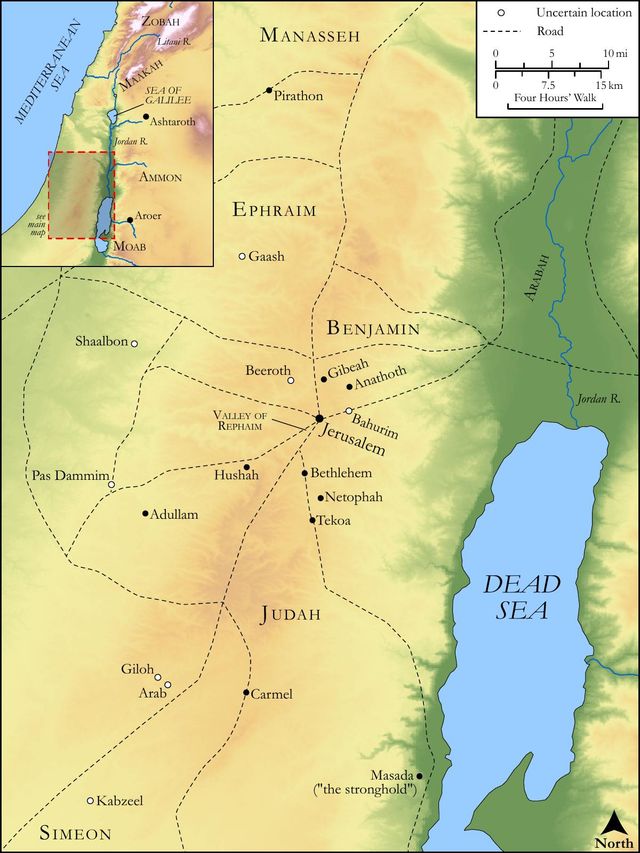
See on the biblical-era map
Study this verse
Public-domain commentary
Matthew Henry
From his Commentary on the Whole Bible. Henry comments on passages, not single verses — this entry covers 1 Chronicles 11:10–47. His two-level outline is real structure in the source text, so it is rendered as structure.
We have here an account of David's worthies, the great men of his time that served him and were preferred by him. The first edition of this catalogue we had, Sa2 23:8, etc. This is much the same, only that those named here from Ch1 11:41 to the end are added. Observe,
I.The connexion of this catalogue with that which is said concerning David, Ch1 11:9.
1.David waxed greater and greater, and these were his mighty men. Much of the strength and honour of great men is borrowed from their servants and depends upon them, which cannot but somewhat diminish pomp and power in the opinion of those that are wise. David is great because he has great men about him; take these away, and he is where he was.
2.The Lord of hosts was with him, and these were the mighty men which he had. God was with him and wrought for him, but by men and means and the use of second causes. By this it appeared that God was with him, that he inclined the hearts of those to come over to him that were able to serve his interest. As, if God be for us none can be against us, so, if God be for us, all shall be for us that we have occasion for. Yet David ascribed his success and increase, not to the hosts he had, but to the Lord of hosts, not to the mighty men that were with him, but to the mighty God whose presence with us is all in all.
II.The title of this catalogue (Ch1 11:10):
These are the men who strengthened themselves with him. In strengthening him they strengthened themselves and their own interest; for his advancement was theirs. What we do in our places for the support of the kingdom of the Son of David we shall be gainers by. In strengthening it we strengthen ourselves. It may be read, They held strongly with him and with all Israel. Note, When God has work to do he will not want fit instruments to do it with. If it be work that requires mighty men, mighty men shall either be found or made to effect it, according to the word of the Lord.
III.That which made all these men honourable was the good service that they did to their king and country; they helped to make David king (Ch1 11:10) - a good work. They slew the Philistines, and other public enemies, and were instrumental to save Israel. Note, The way to be great is to do good. Nor did they gain this honour without labour and the hazard of their lives. The honours of Christ's kingdom are prepared for those that fight the good fight of faith, that labour and suffer, and are willing to venture all, even life itself, for Christ and a good conscience. It is by a patient continuance in well-doing that we must seek for glory, and honour, and immortality; and those that are faithful to the Son of David shall find their names registered and enrolled much more to their honour than these are in the records of fame.
IV.Among all the great exploits of David's mighty men, here is nothing great mentioned concerning David himself but his pouring out water before the Lord which he had longed for, Ch1 11:18, Ch1 11:19. Four very honourable dispositions of David appeared in that action, which, for aught I know, made it as great as any of the achievements of those worthies.
1.Repentance for his own weakness. It is really an honour to a man, when he is made sensible that he has said or done any thing unadvisedly, to unsay it and undo it again by repentance, as it is a shame to a man when he has said or done amiss to stand to it.
2.Denial of his own appetite. He longed for the water of the well of Bethlehem; but, when he had it, he would not drink it, because he would not so far humour himself and gratify a foolish fancy. He that has such a rule as this over his own spirit is better than the mighty. It is an honour to a man to have the command of himself; but he that will command himself must sometimes cross himself.
3.Devotion towards God. That water which he thought too good, too precious, for his own drinking, he poured out to the Lord for a drink offering. If we have any thing better than another, let God be honoured with it, who is the best, and should have the best.
4.Tenderness of his servants. It put him into the greatest confusion imaginable to think that three brave men should hazard their lives to fetch water for him. In his account it turns the water into blood. It is the honour of great men not to be prodigal of the blood of those they employ, but, in all the commands they give them, to put their own souls into their souls' stead.
V.In the wonderful achievements of these heroes the power of God must be acknowledged.
How could one slay 300 and another the same number (Ch1 11:11, Ch1 11:20), another two lion-like men (Ch1 11:22), and another an Egyptian giant (Ch1 11:23), if they had not had the extraordinary presence of God with them, according to that promise, Jos 23:10, One man of you shall chase a thousand, for the Lord your God fighteth for you?
VI.One of these worthies is said to be an Ammonite (Ch1 11:39), another a Moabite (Ch1 11:46), and yet the law was that an Ammonite and a Moabite should not enter into the congregation of the Lord, Deu 23:3. These, it is likely, had approved themselves so hearty for the interest of Israel that in their case it was thought fit to dispense with that law, and the rather because it was an indication that the Son of David would have worthies among the Gentiles: with him there is neither Greek nor Jew.
Continue studying 1 Chronicles 11:29 across the web’s major study libraries — every link below opens this exact verse, chapter, or book on the destination site.
Read & Compare
 BibleGatewayThis verse in more than 200 translations and 70 languages.
 Bible.comThe YouVersion reader — hundreds of translations, reading plans, and highlights.
 ESV.orgCrossway's official English Standard Version reader.
 NET BibleThe NET translation with 60,000+ translators' notes on every rendering decision.
 STEP BibleTyndale House's free study tool — original text, vocabulary, and scholarly resources.
 BibliaLogos Bible Software's free web reader.
 USCCBThe New American Bible (Revised Edition) with the U.S. bishops' study notes.
Commentaries
 BibleHub CommentariesDozens of classic commentaries on this verse, gathered on one page.
 StudyLightMore than 100 commentary sets — the largest collection on the web.
 BibleRefPlain-English commentary on what this verse means, verse by verse.
 Enduring WordDavid Guzik's free commentary on this chapter, widely used by Bible teachers.
 Bible Study ToolsVerse commentary alongside Greek and Hebrew study aids.
Original Language & Research
- BibleHub InterlinearThe verse word by word — original language, transliteration, and English.
- BibleHub LexiconEvery word's original-language definition and Strong's entry.
 Blue Letter BibleDeep-study tools — Strong's numbers, concordance, and word studies.
 SefariaThe Hebrew text with Rashi and centuries of Jewish commentary.
Sermons, Hymns & Audio


TrulyRandomVerse is not affiliated with these sites and doesn’t control their content. They’re linked because they’re genuinely useful.
Summary
1 Chronicles 11:29 meticulously records the names of "Sibbecai the Hushathite" and "Ilai the Ahohite," two distinguished warriors among David's elite "mighty men." This verse is part of a comprehensive roster that honors the exceptional bravery, unwavering loyalty, and significant contributions of the individuals who formed the backbone of King David's military strength and supported his divinely appointed reign. It underscores the importance of communal effort and individual faithfulness in the establishment and flourishing of God's kingdom on earth.
Context
ShowHideLiterary Context
This verse is situated within 1 Chronicles 11:10-47, a detailed and significant list of David's most valiant warriors. The chapter begins with David's anointing as king over all Israel and his capture of Jerusalem, establishing it as his capital (1 Chronicles 11:1-9). Following this foundational narrative, the chronicler dedicates a substantial portion of the chapter to documenting the names and, in some cases, the heroic deeds of these "mighty men." This list serves not merely as a historical record but as a theological statement, emphasizing the divine blessing on David's reign, manifested through the loyalty and strength of his supporters. The inclusion of each name, even those without specific actions detailed, highlights the chronicler's intent to honor every individual who contributed to the stability and success of the Davidic monarchy, which was central to God's covenant purposes.
Historical & Cultural Context
Among the kings of that day, the strength and legitimacy of a king were often reflected in the caliber of his military. Elite fighting units, like David's "mighty men," were crucial for defense, expansion, and maintaining order. These warriors were not just soldiers but often close companions and trusted advisors, bound by personal loyalty to the king. The act of meticulously listing names, especially in genealogical or military rosters, was a common practice in Israel, serving to establish lineage, confer honor, and preserve a historical record. The Chronicler, writing centuries after David's time, likely during or after the Babylonian exile, would have used such lists to remind the post-exilic community of Israel's glorious past under a righteous king and to inspire faithfulness and hope for future restoration under a new Davidic leader.
Key Themes
ShowHideThe list of David's mighty men, including the individuals in 1 Chronicles 11:29, powerfully articulates several key themes. First, Loyalty and Service are paramount; these men dedicated their lives to David, recognizing his divine appointment and serving his cause, which was intrinsically linked to God's plan for Israel. Their unwavering commitment, often at great personal risk, exemplifies faithful service. Second, Recognition and Honor are central. The chronicler's deliberate inclusion of each name, even in a long list, underscores the biblical principle that every individual contribution, however seemingly small or unheralded, is valued and remembered by God. This echoes the sentiment found in passages like Hebrews 6:10. Third, the list highlights the Foundation of Leadership. David's extraordinary success as king was not a solitary achievement but was built upon the collective strength, courage, and dedication of these key supporters. This illustrates the vital role of a strong, unified, and committed team in achieving God-given objectives, a principle applicable to leadership in all spheres, including the church, as seen in the New Testament's emphasis on the body of Christ in 1 Corinthians 12.
Exposition and Analysis
ShowHideKey Word Analysis
ShowHideDerived from a root meaning "copse-like," Sibbecai was an Israelite from Hushah. He is prominently featured among David's elite warriors and is specifically credited with slaying the Philistine giant Saph (or Sippai), as recorded in 2 Samuel 21:18 and 1 Chronicles 20:4. His inclusion in this esteemed list underscores his significant military prowess and contribution to David's kingdom. In the parallel list in 2 Samuel 23:27, he is referred to as "Mebunnai," a variation often attributed to scribal differences or an alternative name for the same person.
This patronymic denotes a descendant of Chushah, indicating Sibbecai's place of origin or tribal affiliation. Hushah was likely a town in Judah. This designation serves to identify the warrior by his lineage and community, a common practice in biblical genealogies and military rosters, highlighting the importance of family and regional identity in ancient Israel.
Meaning "elevated," Ilai is identified as "the Ahohite." He is another esteemed member of David's mighty men, whose presence in this prestigious list testifies to his loyalty and military capability, even though no specific heroic deed is attributed to him in the biblical text. His name's meaning, "elevated," could subtly reflect his standing or character among his peers. In the parallel account in 2 Samuel 23:28, he is named "Zalmon the Ahohite," a common discrepancy in ancient texts, likely representing a variant spelling or an alternative name.
This patronymic indicates Ilai's descent from Achoach, a Benjamite clan, as seen in 1 Chronicles 8:4. Like "Hushathite," this designation provides crucial information about Ilai's tribal affiliation and lineage, reinforcing the chronicler's interest in the specific identities and origins of David's loyal supporters.
Verse Breakdown
ShowHide"Sibbecai the Hushathite"
This phrase introduces one of David's renowned warriors. "Sibbecai" is his personal name, and "the Hushathite" is an ethnicon, specifying his place of origin or tribal affiliation (Hushah, likely in Judah). This identification serves to distinguish him and connect him to his lineage and community. His inclusion in this list signifies his status as a key figure in David's military, known for his strength and bravery, particularly his victory over a Philistine giant.
"Ilai the Ahohite"
This second phrase introduces another distinguished member of David's mighty men. "Ilai" is his personal name, and "the Ahohite" indicates his descent from the family of Ahoah, a branch of the tribe of Benjamin. Like Sibbecai, his inclusion here, even without a specific deed mentioned, marks him as a loyal and capable warrior who contributed significantly to David's reign. The chronicler's purpose in listing him is to honor his service and ensure his remembrance among the heroes of Israel.
Literary Devices
ShowHideThe primary literary device at play in 1 Chronicles 11:29, and indeed throughout the entire list of David's mighty men (1 Chronicles 11:10-47), is Catalog/List. This device is used to systematically enumerate individuals, often with their affiliations or notable achievements, serving to organize information, provide a comprehensive record, and confer honor. The meticulous listing of names like Sibbecai and Ilai emphasizes the chronicler's interest in the individual contributions to the collective strength of David's kingdom. Another significant device is Parallelism, specifically with the account found in 2 Samuel 23. The Chronicler's list largely mirrors the one in Samuel, but with notable variations in names (e.g., Sibbecai/Mebunnai, Ilai/Zalmon). This highlights the textual transmission process and the potential for alternative names or scribal differences between ancient sources. Furthermore, there is an element of Emphasis through Repetition as the chronicler repeatedly lists names, reinforcing the importance of each warrior and the collective strength they represented for David's reign.
Theological and Thematic Connections
ShowHideThe careful enumeration of David's mighty men, including Sibbecai and Ilai, speaks volumes about God's valuing of individual contributions within His larger redemptive plan. While David was the chosen king, his success was intrinsically linked to the faithfulness and courage of his loyal supporters. This illustrates that God often works through a community of committed individuals, each playing a vital role, no matter how seemingly small or unheralded. The chronicler's dedication to preserving these names underscores a divine principle: God remembers and honors the service of His people. Their loyalty to David, God's anointed, serves as a model for our own faithfulness to God's appointed leaders and, ultimately, to Christ Himself.
Reflection and Application
ShowHideThe seemingly simple act of listing names in 1 Chronicles 11:29 offers profound lessons for contemporary believers. It reminds us that every individual, regardless of their public profile or the magnitude of their deeds, holds intrinsic value in God's eyes and plays a crucial part in His unfolding purposes. Just as Sibbecai and Ilai contributed to David's kingdom, we are called to faithfully steward our unique gifts and positions within the body of Christ. Our service, whether in prominent leadership or quiet support, is seen and honored by God. This passage encourages us to embrace our roles with dedication, knowing that our collective faithfulness strengthens the church and advances God's kingdom. It also serves as a powerful reminder of the importance of community and mutual support, as David's strength was multiplied by the loyalty of his mighty men, urging us to cultivate genuine fellowship and collaborative ministry within our own spiritual communities.
Questions for Reflection
ShowHideFAQ
ShowHideWhy are there discrepancies in the names of David's mighty men between 1 Chronicles and 2 Samuel?
ShowHideThe discrepancies in names, such as Sibbecai in 1 Chronicles 11:29 being called Mebunnai in 2 Samuel 23:27, and Ilai in 1 Chronicles being Zalmon in 2 Samuel 23:28, are common in ancient biblical texts. These variations can be attributed to several factors. Firstly, individuals in ancient Israel sometimes had multiple names (e.g., a birth name and a nickname, or a name adopted later in life). Secondly, scribal errors during the long process of copying manuscripts could lead to minor alterations in spelling or even the substitution of similar-sounding names. Thirdly, the Chronicler may have used a slightly different source tradition or had access to alternative records than the author of Samuel. Despite these variations, the core identity and role of the individuals as David's mighty men remain consistent across both accounts, affirming their historical reality and significance.
What is the theological significance of such a detailed list of names in the Bible?
ShowHideThe theological significance of detailed lists of names, like that of David's mighty men in 1 Chronicles 11, is profound. It underscores God's meticulous attention to individuals and His remembrance of their service. In a culture where honor and lineage were paramount, the chronicler's inclusion of these names serves to validate their contributions and ensure their legacy. Theologically, it highlights that God's kingdom is built not just by a single leader, but by the collective faithfulness and diverse gifts of many individuals. It also provides a historical record of God's faithfulness to His covenant with David, demonstrating how He raised up loyal and courageous people to support His chosen king. This echoes the New Testament concept of the body of Christ, where every member is vital (1 Corinthians 12:12-27).
Christ-Centered Fulfillment
ShowHideThe roster of David's mighty men, including Sibbecai and Ilai, serves as a powerful Old Testament type for the community of believers who serve the greater King, Jesus Christ. Just as these warriors pledged their unwavering loyalty and strength to David, so too are believers called to be "mighty men and women" in the spiritual army of Christ. Their dedication to David's earthly kingdom foreshadows the commitment required of those who follow the Lamb of God in His eternal kingdom. The chronicler's careful preservation of each name reflects God's own meticulous remembrance of His faithful servants, whose names are written in the Book of Life. While David's men fought with physical weapons against earthly foes, Christ's followers engage in a spiritual battle, equipped with the armor of God, striving for righteousness and the advancement of the Gospel (2 Corinthians 10:4). Ultimately, the valor and loyalty of David's mighty men point to the supreme loyalty and sacrifice of Christ Himself, who, as the true Son of David, established a kingdom that will never end, built upon the faithful service of His redeemed people (Revelation 1:5-6).