


2 Samuel 21:18
Bible text: King James Version (1769 Blayney text) · Public domain
Bible text: King James Version with Strong's numbers · Public domain
Bible text: Berean Standard Bible · Public domain
Bible text: American Standard Version (1901) · Public domain
Bible text: World English Bible, Messianic edition · Public domain
Bible text: Geneva Bible (1599) · Public domain
Bible text: Young's Literal Translation · Public domain
- וַיְהִיvay·Hiand it wasH1961Conj-w ¦ V-Qal-ConsecImperf-3msVerb Qal Consecutive Imperfect 3rd Singular Masculineוַandיְהִיit was
- אַחֲרֵי'a·cha·reiafterH310Adj-mpcAdjective Numerical Plural Masculine Construct
- כֵןKhenthusH3651AdvAdverb
- וַתְּהִיva·te·hiand it wasH1961Conj-w ¦ V-Qal-ConsecImperf-3fsVerb Qal Consecutive Imperfect 3rd Singular Feminineוַandתְּהִיit was
- עוֹדodagainH5750Adj-msAdjective Numerical Singular Masculine Absolute
- הַמִּלְחָמָהha·mil·cha·Mah<the> warH4421Art ¦ N-fsNoun Singular Feminine Absoluteהַ<the>מִּלְחָמָהwar
- בְּגוֹבbe·Govat GobH1359Prep-b ¦ N-properNoun Proper LocationבְּatגוֹבGob
- עִם'imwithH5973PrepPreposition
- פְּלִשְׁתִּיםpe·lish·Tim[the] PhilistinesH6430N-mpNoun Gentilic Plural Masculine Absolute
- אָז'azthenH227AdvAdverb
- הִכָּהhi·Kahhe struck downH5221V-Hiphil-Perf-3msVerb Hiphil Perfect 3rd Singular Masculine
- סִבְּכַיsi·be·KhaiSibbecaiH5444N-proper-mNoun Proper Masculine
- הַחֻשָׁתִיha·Chu·sha·Tithe HushathiteH2843Art ¦ N-msNoun Gentilic Singular Masculine AbsoluteהַtheחֻשָׁתִיHushathite
- אֶת'et<obj.>H853DirObjMParticle Object Indicator
- סַףsafSaphH5593N-proper-mNoun Proper Masculine
- אֲשֶׁר'a·SherwhoH834RelParticle Relative
- בִּילִדֵיbi·li·Dei[was] among those born ofH3211Prep-b ¦ N-mpcNoun Plural Masculine Constructבִּ[was] amongילִדֵיthose born of
- הָרָפָהha·ra·Fahthe RaphahH7497Art ¦ N-properNoun Proper TitleהָtheרָפָהRaphah
English is a literal word-by-word gloss of the Hebrew, not the KJV's wording. Why?
This is the original text the KJV's translators worked from — each Hebrew word with its own literal English meaning in this verse, prepared by scholars at Tyndale House, Cambridge. The KJV translates whole sentences, not word by word, so its wording differs: one Hebrew word can become several English words, and the KJV may choose “the LORD” where the gloss reads “Yahweh”. Both are faithful — they answer different questions. For the KJV's own rendering, switch to the KJV text.
Details
See on the biblical-era maps
Study this verse
Public-domain commentary
Matthew Henry
From his Commentary on the Whole Bible. Henry comments on passages, not single verses — this entry covers 2 Samuel 21:15–22. His three-level outline is real structure in the source text, so it is rendered as structure.
We have here the story of some conflicts with the Philistines, which happened, as it should seem, in the latter end of David's reign. Though he had so subdued them that they could not bring any great numbers into the field, yet as long as they had any giants among them to be their champions, they would never be quiet, but took all occasions to disturb the peace of Israel, to challenge them, or make incursions upon them.
I.David himself was engaged with one of the giants.
The Philistines began the war yet again, Sa2 21:15. The enemies of God's Israel are restless in their attempts against them. David, though old, desired not a writ of ease from the public service, but he went down in person to fight against the Philistines (Senescit, non segnescit - He grows old, but not indolent), a sign that he fought not for his own glory (at this age he was loaded with glory, and needed no more), but for the good of his kingdom. But in this engagement we find him,
1.In distress and danger. He thought he could bear the fatigues of war as well as he had done formerly; his will was good, and he hoped he could do as at other times. But he found himself deceived; age had cut his hair, and, after a little toil, he waxed faint. His body could not keep pace with his mind. The champion of the Philistines was soon aware of his advantage, perceived that David's strength failed him, and, being himself strong and well-armed, he thought to slay David; but God was not in his thoughts, and therefore in that very day they all perished. The enemies of God's people are often very strong, very subtle, and very sure of success, like Isbi-benob, but there is no strength, nor counsel, nor confidence against the Lord.
2.Wonderfully rescued by Abishai, who came seasonably in to his relief, Sa2 21:17. Herein we must own Abishai's courage and fidelity to his prince (to save whose life he bravely ventured his own), but much more the good providence of God, which brought him in to David's succour in the moment of his extremity. Such a cause and such a champion, though distressed, shall not be deserted. When Abishai succoured him, gave him a cordial, it may be, to relieve his fainting spirits, or appeared as his second, he (namely, David, so I understand it) smote the Philistine and killed him; for it is said (Sa2 21:22) that David had himself a hand in slaying the giants. David fainted, but he did not flee; though his strength failed him, he bravely kept his ground, and then God sent him this help in the time of need, which, though brought him by his junior and inferior, he thankfully accepted, and, with a little recruiting, gained his point, and came off a conqueror. Christ, in his agonies, was strengthened by an angel. In spiritual conflicts, even strong saints sometimes wax faint; then Satan attacks them furiously; but those that stand their ground and resist him shall be relieved, and made more than conquerors.
3.David's servants hereupon resolved that he should never expose himself thus any more. They had easily persuaded him not to fight against Absalom (Sa2 18:3), but against the Philistines he would go, till, having had this narrow escape, it was resolved in council, and confirmed with an oath, that the light of Israel (its guide and glory, so David was) should never be put again into such hazard of being blown out. The lives of those who are as valuable to their country as David was ought to be preserved with a double care, both by themselves and others.
II.The rest of the giants fell by the hand of David's servants.
1.Saph was slain by Sibbechai, one of David's worthies, Sa2 21:18; Ch1 11:29.
2.Another, who was brother to Goliath, was slain by Elhanan, who is mentioned Sa2 23:24.
3.Another, who was of very unusual bulk, who had more fingers and toes than other people (Sa2 21:20), and such an unparalleled insolence that, though he had seen the fall of other giants, yet he defied Israel, was slain by Jonathan the son of Shimea. Shimea had one son named Jonadab (Sa2 13:3), whom I should have taken for the same with this Jonathan, but that the former was noted for subtlety, the latter for bravery. These giants were probably the remains of the sons of Anak, who, though long feared, fell at last. Now observe,
(1.)It is folly for the strong man to glory in his strength. David's servants were no bigger nor stronger than other men; yet thus, by divine assistance, they mastered one giant after another. God chooses by the weak things to confound the mighty.
(2.)It is common for those to go down slain to the pit who have been the terror of the mighty in the land of the living, Eze 32:27.
(3.)The most powerful enemies are often reserved for the last conflict. David began his glory with the conquest of one giant, and here concludes it with the conquest of four. Death is a Christian's last enemy, and a son of Anak; but, through him that triumphed for us, we hope to be more than conquerors at last, even over that enemy.
Continue studying 2 Samuel 21:18 across the web’s major study libraries — every link below opens this exact verse, chapter, or book on the destination site.
Read & Compare
 BibleGatewayThis verse in more than 200 translations and 70 languages.
 Bible.comThe YouVersion reader — hundreds of translations, reading plans, and highlights.
 ESV.orgCrossway's official English Standard Version reader.
 NET BibleThe NET translation with 60,000+ translators' notes on every rendering decision.
 STEP BibleTyndale House's free study tool — original text, vocabulary, and scholarly resources.
 BibliaLogos Bible Software's free web reader.
 USCCBThe New American Bible (Revised Edition) with the U.S. bishops' study notes.
Commentaries
 BibleHub CommentariesDozens of classic commentaries on this verse, gathered on one page.
 StudyLightMore than 100 commentary sets — the largest collection on the web.
 BibleRefPlain-English commentary on what this verse means, verse by verse.
 Enduring WordDavid Guzik's free commentary on this chapter, widely used by Bible teachers.
 Bible Study ToolsVerse commentary alongside Greek and Hebrew study aids.
Original Language & Research
- BibleHub InterlinearThe verse word by word — original language, transliteration, and English.
- BibleHub LexiconEvery word's original-language definition and Strong's entry.
 Blue Letter BibleDeep-study tools — Strong's numbers, concordance, and word studies.
 SefariaThe Hebrew text with Rashi and centuries of Jewish commentary.
Sermons, Hymns & Audio


TrulyRandomVerse is not affiliated with these sites and doesn’t control their content. They’re linked because they’re genuinely useful.
Summary
Second Samuel 21:18 records a pivotal encounter during King David's reign, detailing how Sibbechai the Hushathite, one of David's esteemed mighty men, decisively defeated Saph, a formidable descendant of the Rephaim, or "sons of the giant," in a battle at Gob. This concise yet powerful narrative underscores the ongoing, divinely-assisted conflict between Israel and the Philistines, highlights the persistent threat posed by the giant lineage even after Goliath's defeat, and celebrates the valor of David's elite warriors who were instrumental in securing Israel's peace and demonstrating God's unwavering faithfulness in delivering His people from seemingly insurmountable foes.
Context
ShowHideLiterary Context
This verse is strategically placed within an appendix to the book of 2 Samuel, specifically encompassing chapters 2 Samuel 21-24. These chapters diverge from the strict chronological narrative of David's reign, instead serving as a thematic collection of significant events, lists, and heroic deeds that collectively highlight God's faithfulness, David's legacy, and the divine protection over Israel. The immediate context of 2 Samuel 21 opens with a three-year famine, revealed as divine judgment for King Saul's massacre of the Gibeonites. Following the resolution of this covenant breach, the narrative shifts to a series of four distinct accounts detailing battles against the Philistines, each featuring one of David's mighty men slaying a giant. Verse 18 is the inaugural account in this sequence, setting the stage for subsequent victories over other giant descendants and emphasizing both the persistent nature of the Philistine threat and the consistent divine aid provided through Israel's champions.
Historical & Cultural Context
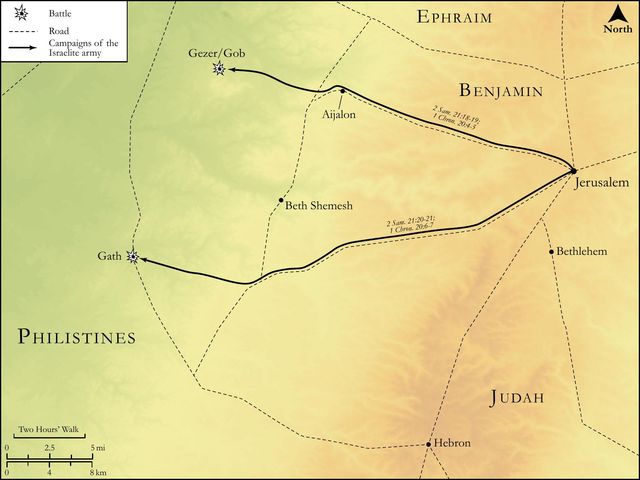
The Philistines constituted a formidable and enduring adversary for ancient Israel, occupying the fertile coastal plain and frequently engaging in territorial and military clashes with the Israelites. Their advanced military technology, notably their mastery of iron weaponry, often afforded them a significant advantage in warfare. The "giants" mentioned in the text, specifically "sons of the giant" (Hebrew: yelidey ha-rapha), refer to the Rephaim, an ancient, indigenous race renowned for their extraordinary stature and strength, remnants of whom were found in various parts of Canaan. Their continued presence in Philistine strongholds like Gath (the hometown of Goliath, as described in 1 Samuel 17:4) indicates a persistent lineage of formidable warriors. The battle at "Gob" (identified as Gezer in the parallel account of 1 Chronicles 20:4) pinpoints a specific geographical location for these conflicts, underscoring the tangible, life-threatening challenges Israel faced during David's reign. These narratives served to reinforce the cultural value placed on heroic deeds and the belief in divine intervention in warfare, which were crucial for the identity and security of the fledgling Israelite kingdom.
Key Themes
ShowHideSeveral profound themes resonate from 2 Samuel 21:18, offering significant theological insights.
Ongoing Conflict and Divine Aid
Despite David's earlier, decisive victories over the Philistines, the threat was never entirely eradicated. This verse, along with the other accounts in 2 Samuel 21, highlights the persistent nature of both physical and spiritual warfare. Crucially, it consistently demonstrates God's continued intervention and empowerment of His people, ensuring Israel's security and the fulfillment of His covenant promises through His chosen warriors.
The Legacy of Giants and Persistent Evil
The repeated mention of "sons of the giant" underscores that the challenge posed by Goliath was not an isolated incident but rather indicative of a formidable, almost supernatural, lineage that continued to emerge. Their defeat signifies the ongoing triumph of God's power over seemingly insurmountable evil and opposition, echoing earlier conquests of the land where giants were encountered (e.g., Numbers 13:33). This theme emphasizes that God's people will always face formidable opposition, but God provides the means for victory.
Valor of David's Mighty Men
Sibbechai the Hushathite is presented as a key figure within David's elite fighting force, whose bravery, skill, and strength were instrumental in securing Israel's borders and maintaining peace. These accounts, including the comprehensive list in 2 Samuel 23:8-39, serve to celebrate the human instruments God used, showcasing their loyalty, courage, and effectiveness as they participated in God's overarching plan for Israel.
Exposition and Analysis
ShowHideKey Word Analysis
ShowHideThis geographical location is specifically named as the site of the battle. While its precise identification is subject to scholarly debate (some suggesting it is an alternative name for Gezer, as seen in the parallel account in 1 Chronicles 20:4), its inclusion grounds the narrative in historical reality. The naming of the location emphasizes that these were real battles fought in real places, with tangible stakes for God's people, where they faced and overcame significant enemies.
This is the specific name of the Philistine giant slain by Sibbechai. The parallel account in 1 Chronicles 20:4 names him Sippai, suggesting a slight textual variation or alternative spelling, but the identity remains consistent. The naming of the giant personalizes the threat, transforming him from an anonymous foe into a distinct adversary. His explicit identification as one "of the sons of the giant" immediately links him to the formidable lineage of the Rephaim, underscoring the immense magnitude and significance of Sibbechai's achievement.
This term, found within the phrase "sons of the giant," refers to the Rephaim, an ancient race known for their extraordinary stature and strength. The word itself can denote a "giant" or be used as a proper noun for the Rephaim. Its presence here carries connotations of a powerful, often formidable, and even semi-mythical lineage that posed a significant and persistent threat to the Israelites. Their continued emergence and defeat, even after Goliath's demise, highlight the enduring nature of the challenges Israel faced. The "giant" here is not merely a physically large man but a representative of a lineage that defied God's people, making their defeat a profound theological victory as much as a military one.
Verse Breakdown
ShowHide"And it came to pass after this, that there was again a battle with the Philistines at Gob:"
This opening clause meticulously establishes the setting and the continuity of conflict. The phrase "after this" loosely connects the narrative to the preceding events of the famine, signaling a shift in focus to military engagements. The crucial phrase "again a battle" powerfully underscores the persistent and recurring nature of the Philistine threat, reminding the reader that the struggle for land, sovereignty, and security was an ongoing reality, not a singular event. The specific mention of "Gob" provides the precise geographical context for this particular engagement, rooting the heroic deed in a concrete location.
"then Sibbechai the Hushathite slew Saph,"
This concise and impactful clause introduces the central hero of the account, Sibbechai, who is further identified by his tribal affiliation "the Hushathite," marking him as a specific individual from King David's elite corps of warriors. The verb "slew" (Hebrew: וַיַּךְ, vayyak, from H5221 nâkâh) is direct and powerful, emphasizing the decisive and lethal action taken by Sibbechai. The object "Saph" immediately names the formidable foe, setting up the profound significance of his defeat. This clause serves as a direct and unambiguous declaration of a heroic and pivotal deed.
"which [was] of the sons of the giant."
This final, critical clause provides the essential identification of Saph, clarifying the extraordinary nature of the threat he represented. By explicitly stating that he was "of the sons of the giant," the text immediately elevates the significance of Sibbechai's victory. It unequivocally connects Saph to the lineage of the Rephaim, a race renowned throughout biblical history for their immense size, strength, and formidable presence, thereby placing Sibbechai's feat in the same heroic league as David's iconic victory over Goliath. This crucial detail amplifies the courage, skill, and divine empowerment required for such an act, underscoring the magnitude of the triumph.
Literary Devices
ShowHideThe narrative of 2 Samuel 21:18 masterfully employs several literary devices to enhance its impact and convey its theological message. Repetition is a prominent structural element within this chapter, as this account is the first of four similar narratives detailing David's mighty men slaying Philistine giants. This structural repetition emphasizes the ongoing nature of the conflict, the consistent valor of David's warriors, and ultimately reinforces the overarching theme of divine deliverance through human instruments. The use of Heroic Narrative is central, focusing on the individual prowess of Sibbechai who, much like David against Goliath, confronts and decisively defeats a seemingly overwhelming foe. This highlights the ideal of the warrior-hero within Israelite society and celebrates the individuals God uses. Furthermore, the mention of "sons of the giant" carries profound Symbolism. The giants represent not just physical adversaries but also formidable, persistent evil, overwhelming opposition, or any seemingly unconquerable force that threatens God's people and His purposes. Their defeat symbolizes God's power to overcome any obstacle, no matter how daunting, through His chosen agents. The concise and direct language also contributes to the Episodic nature of the appendix, presenting distinct, memorable vignettes of valor and divine intervention.
Theological and Thematic Connections
ShowHideThe account of Sibbechai slaying Saph in 2 Samuel 21:18 transcends a mere historical battle record; it functions as a profound theological statement on God's enduring sovereignty, His unwavering faithfulness, and His active presence in the lives of His people. It powerfully demonstrates that even after major, decisive victories, the forces of opposition do not simply vanish. The persistent threat of the "giants" symbolizes the ongoing spiritual and physical battles that God's people inevitably face throughout history. Yet, in the face of such challenges, God consistently raises up, equips, and empowers individuals to confront these adversaries, ensuring that His covenant promises are upheld and His people are protected. This narrative profoundly underscores that victory is not solely dependent on human strength, skill, or numbers, but fundamentally on divine enablement and intervention, reminding Israel that their ultimate security and triumph rested in God's faithfulness, manifested through the valor of His dedicated servants.
Reflection and Application
ShowHideThe brief yet potent account of Sibbechai's victory over Saph serves as a powerful and enduring reminder that the battles of faith are often ongoing, demanding persistent vigilance, unwavering courage, and an absolute reliance on divine strength. Just as the Philistine giants continually emerged as a threat, believers today face recurring "giants" in their lives—whether they manifest as persistent temptations, overwhelming circumstances, deep-seated societal injustices, or direct spiritual attacks. This verse profoundly encourages us not to grow weary or despair in the face of these formidable challenges, but to recognize that God continues to equip, empower, and enable His people for victory. It highlights the profound importance of courage and faithfulness when confronted with daunting odds, reminding us that even seemingly ordinary or lesser-known individuals can be powerfully used by God to accomplish extraordinary feats for His glory. Our true strength is not inherent in ourselves, but is a divine gift from the Lord, enabling us to confront and overcome the formidable obstacles that stand in the way of His kingdom and His purposes for our lives.
Questions for Reflection
ShowHideFAQ
ShowHideWhy are these stories of giant-slaying included in the appendix of 2 Samuel, rather than in chronological order?
ShowHideThe inclusion of these giant-slaying accounts in the appendix (chapters 2 Samuel 21-24) serves several crucial theological and literary purposes, transcending a strict chronological arrangement. First, they powerfully demonstrate God's continued faithfulness and unwavering power in delivering Israel from their enemies, even in the later, more challenging stages of David's reign. Second, they highlight the extraordinary valor, skill, and effectiveness of David's mighty men, showcasing the human instruments God strategically used to secure and protect the nascent kingdom. Third, by detailing the defeat of various "sons of the giant," these narratives reinforce the profound idea that the formidable threat represented by Goliath was not an isolated incident but part of a persistent and ancient lineage of formidable foes. Their repeated defeat underscores the complete subjugation of the land and the triumph of God's people over all opposition, ultimately ensuring the peace and security of Israel under David's leadership. These stories function as a powerful, thematic testament to the divine protection, strength, and ultimate victory that characterized David's reign, bringing the book to a compelling and spiritually significant conclusion.
Christ-Centered Fulfillment
ShowHideThe defeat of Saph by Sibbechai, much like David's earlier iconic victory over Goliath, serves as a powerful and profound foreshadowing of the ultimate triumph of Jesus Christ over all the "giants" that plague humanity. The physical giants of the Old Testament, representing overwhelming, seemingly unconquerable foes that defied God's people, find their ultimate spiritual fulfillment in the enemies of sin, death, and Satan. Just as Sibbechai, a mighty man of David, conquered a physical giant, Jesus Christ, the ultimate Son of David and the true champion of God, confronted and decisively defeated the spiritual giants that held all humanity captive. His sacrificial death on the cross and glorious resurrection represent the definitive and eternal victory over the power of sin, which once enslaved humanity (Romans 6:23), and the sting of death, which once held humanity in fear (1 Corinthians 15:54-57). Furthermore, Christ disarmed the spiritual rulers and authorities, triumphing over them publicly by the cross (Colossians 2:15). Through His singular and decisive victory, Christ empowers believers, who are now spiritually united with Him as part of His body, to overcome the persistent spiritual battles they face, equipping them with His strength, His authority, and His divine armor to stand firm against the schemes of the devil (Ephesians 6:10-11). Thus, Sibbechai's heroic act points forward to the greater, eternal victory secured by our Lord Jesus Christ, who enables His followers to live in the freedom and power of His triumph.