


1 Chronicles 20:8
Bible text: King James Version (1769 Blayney text) · Public domain
Bible text: Berean Standard Bible · Public domain
Bible text: American Standard Version (1901) · Public domain
Bible text: World English Bible, Messianic edition · Public domain
Bible text: Geneva Bible (1599) · Public domain
Bible text: Young's Literal Translation · Public domain
- אֵל'eltheseH411PrtParticle Demonstrative
- נוּלְּדוּnu·le·Duthey were bornH3205V-Niphal-Perf-3cpVerb Niphal Perfect 3rd Plural common gender
- לְהָרָפָאle·ha·ra·Fa'to <the> RaphaH7497Prep-l ¦ Art ¦ N-properNoun Proper Titleלְtoהָ<the>רָפָאRapha
- בְּגַתbe·Gatin GathH1661Prep-b ¦ N-properNoun Proper LocationבְּinגַתGath
- וַיִּפְּלוּvai·yi·pe·Luand they fellH5307Conj-w ¦ V-Qal-ConsecImperf-3mpVerb Qal Consecutive Imperfect 3rd Plural Masculineוַandיִּפְּלוּthey fell
- בְיַדve·yadby [the] hand ofH3027Prep-b ¦ N-cscNoun Singular common gender Constructבְbyיַד[the] hand of
- דָּוִידda·VidDavidH1732N-proper-mNoun Proper Masculine
- וּבְיַדu·ve·yadand by [the] hand ofH3027Conj-w ¦ Prep-b ¦ N-cscNoun Singular common gender Constructוּandבְbyיַד[the] hand of
- עֲבָדָיו'a·va·Davhis servantsH5650N-mpc ¦ 3msNoun Plural Masculine Constructעֲבָדָיservantsוhis
English is a literal word-by-word gloss of the Hebrew, not the KJV's wording. Why?
This is the original text the KJV's translators worked from — each Hebrew word with its own literal English meaning in this verse, prepared by scholars at Tyndale House, Cambridge. The KJV translates whole sentences, not word by word, so its wording differs: one Hebrew word can become several English words, and the KJV may choose “the LORD” where the gloss reads “Yahweh”. Both are faithful — they answer different questions. For the KJV's own rendering, switch to the KJV text.
Details
See on the biblical-era maps
Study this verse
Public-domain commentary
Matthew Henry
From his Commentary on the Whole Bible. Henry comments on passages, not single verses — this entry covers 1 Chronicles 20:4–8.
The Philistines were nearly subdued (Ch1 18:1); but, as in the destruction of the Canaanites by Joshua the sons of Anak were last subdued (Jos 11:21), so here in the conquest of the Philistines the giants of Gath were last brought down. In the conflicts between grace and corruption there are some sins which, like these giants, keep their ground a great while and are not mastered without much difficulty and a long struggle: but judgment will be brought forth unto victory at last. Observe, 1. We never read of giants among the Israelites as we do of the giants among the Philistines - giants of Gath, but not giants of Jerusalem. The growth of God's plants is in usefulness, not in bulk. Those who covet to have cubits added to their stature do not consider that it will but make then more unwieldy. In the balance of the sanctuary David far outweighs Goliath. 2. The servants of David, though men of ordinary stature, were too hard for the giants of Gath in every encounter, because they had God on their side, who takes pleasure in abasing lofty looks, and mortifying the giants that are in the earth, as he did of old by the deluge, though they were men of renown. Never let the church's friends be disheartened by the power and pride of the church's enemies. We need not fear great men against us while we have the great God for us. What will a finger more on each hand do, or a toe more on each foot, in contest with Omnipotence? 3. These giants defied Israel (Ch1 20:7) and were thus made to pay for their insolence. None are more visibly marked for ruin that those who reproach God and his Israel. God will do great things rather than suffer the enemy to behave themselves proudly, Deu 32:27. The victories of the Son of David, like those of David himself, are gradual. We see not yet all things put under him; but it will be seen shortly: and death itself, the last enemy, like these giants, will be triumphed over.
Continue studying 1 Chronicles 20:8 across the web’s major study libraries — every link below opens this exact verse, chapter, or book on the destination site.
Read & Compare
 BibleGatewayThis verse in more than 200 translations and 70 languages.
 Bible.comThe YouVersion reader — hundreds of translations, reading plans, and highlights.
 ESV.orgCrossway's official English Standard Version reader.
 NET BibleThe NET translation with 60,000+ translators' notes on every rendering decision.
 STEP BibleTyndale House's free study tool — original text, vocabulary, and scholarly resources.
 BibliaLogos Bible Software's free web reader.
 USCCBThe New American Bible (Revised Edition) with the U.S. bishops' study notes.
Commentaries
 BibleHub CommentariesDozens of classic commentaries on this verse, gathered on one page.
 StudyLightMore than 100 commentary sets — the largest collection on the web.
 BibleRefPlain-English commentary on what this verse means, verse by verse.
 Enduring WordDavid Guzik's free commentary on this chapter, widely used by Bible teachers.
 Bible Study ToolsVerse commentary alongside Greek and Hebrew study aids.
Original Language & Research
- BibleHub InterlinearThe verse word by word — original language, transliteration, and English.
- BibleHub LexiconEvery word's original-language definition and Strong's entry.
 Blue Letter BibleDeep-study tools — Strong's numbers, concordance, and word studies.
 SefariaThe Hebrew text with Rashi and centuries of Jewish commentary.
Sermons, Hymns & Audio


TrulyRandomVerse is not affiliated with these sites and doesn’t control their content. They’re linked because they’re genuinely useful.
Summary
1 Chronicles 20:8 serves as a concise yet profoundly significant concluding statement to the Chronicler's account of King David's decisive victories over the formidable Philistine giants. This verse underscores the complete subjugation of these powerful adversaries, specifically those descended from the giant in Gath, highlighting that their defeat was achieved through the combined might and courage of David and his valiant servants. It encapsulates a period of Israel's consolidation and security under divine favor, demonstrating God's faithfulness in empowering His chosen king and people against seemingly insurmountable foes, thereby solidifying the Davidic kingdom's dominion and reinforcing the theological truth that God grants victory to His covenant people.
Context
ShowHideLiterary Context
This verse functions as a summary and concluding statement to the preceding narrative in 1 Chronicles 20:4-7. These verses meticulously detail specific encounters where four individual Philistine giants were slain by David's mighty men—Sibbecai, Elhanan, Jonathan (David's nephew), and an unnamed individual. The Chronicler, writing for a post-exilic audience, recounts these victories not merely as historical records but as theological affirmations of God's enduring covenant with David and His people. By summarizing these conquests, the text emphasizes the completeness of the Philistine threat's neutralization and the divine hand in Israel's military success, reinforcing the legitimacy and strength of the Davidic dynasty. This account parallels 2 Samuel 21:15-22, indicating a shared tradition of these significant events within Israel's historical memory. The placement of this summary after the specific battles underscores their collective significance as a testament to God's ongoing support for David's reign.
Historical & Cultural Context
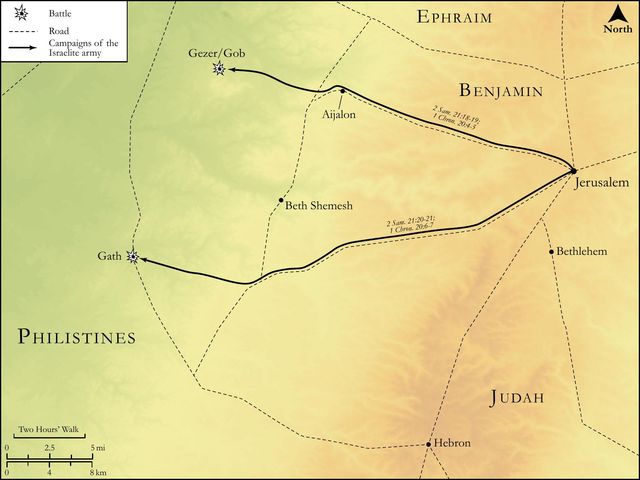
The Philistines were a formidable, technologically advanced, and well-organized enemy of Israel, posing a constant threat to their territorial integrity and national identity throughout the early monarchy. Their presence in major cities like Gath, one of the five Philistine city-states, symbolized their power and deep-rooted opposition. The mention of "giants" refers to the Rephaim, an ancient race of large, powerful individuals mentioned in various parts of the Old Testament (e.g., Deuteronomy 2:10-11). Their continued existence in Philistine territory, particularly Gath (the home of Goliath), represented a lingering, almost mythical, threat to Israelite sovereignty and security. The defeat of these giants was not just a military victory but a profound symbolic triumph, demonstrating Israel's God-given ascendancy over the most daunting of their enemies, echoing the earlier, foundational defeat of Goliath by David himself (1 Samuel 17).
Key Themes
ShowHideThe verse powerfully contributes to several overarching themes prevalent in the book of Chronicles. First, it highlights Divine Victory and Deliverance, emphasizing that Israel's triumphs against overwhelming odds were ultimately God's doing, working through His chosen instruments. No enemy, however imposing, could thwart the Lord's purposes for His covenant people, reinforcing the Chronicler's consistent message of God's active involvement in Israel's history. Second, it showcases The Prowess and Loyalty of David and His Servants, crediting David and his elite warriors (often referred to as his "mighty men," as seen in 1 Chronicles 11:10-47) with the physical execution of these giants. This theme celebrates their bravery, skill, and unwavering dedication, which were crucial in securing the kingdom and establishing David's reign. Finally, the defeat of these "giants" symbolizes Overcoming Formidable Opposition, serving as a powerful metaphor for the triumph of faith and courage over seemingly insurmountable challenges, whether military, spiritual, or personal, demonstrating God's power to enable His people to conquer what appears unconquerable.
Exposition and Analysis
ShowHideKey Word Analysis
ShowHideThis demonstrative particle, used in a plural sense, directly refers to the specific Philistine giants detailed in the preceding verses (1 Chronicles 20:4-7). Its use here emphasizes the collective nature of the victory, encompassing all the named and implied giant descendants who were defeated, rather than focusing on a single individual. It serves to draw a definitive conclusion to the series of battles against this particular lineage of formidable foes.
This term refers to a "giant" or, more broadly, a member of the Rephaim, an ancient race known for their large stature and formidable strength. In this context, it denotes individuals of extraordinary size and power, embodying the formidable nature of Israel's enemies. The phrase "born unto the giant in Gath" implies a lineage or family connection to a prominent, perhaps progenitor, giant from Gath, likely recalling the infamous Goliath whom David had previously defeated (1 Samuel 17). This connection underscores the ongoing struggle against this specific, powerful lineage of adversaries.
This is a common and potent biblical idiom used to describe defeat, death, or destruction in battle. It literally means "fell into the hand of" or "fell by means of the hand of," emphasizing the direct agency of the victor. The word yâd (hand) itself signifies power, means, and direction. In this verse, it clearly attributes the decisive defeat and death of the giants to the direct action of David and his servants, acknowledging their physical prowess and courage while implicitly recognizing God's empowering presence behind their actions, as His "hand" often works through human instruments.
Verse Breakdown
ShowHide"These were born unto the giant in Gath;"
This initial clause serves to identify and specify the lineage and origin of the defeated adversaries. It clarifies that these were not merely any Philistine warriors, but direct descendants, family members, or kin of the original "giant" (likely referring to the progenitor of the Rephaim in Gath, or even Goliath himself, given Gath's prominence as his hometown). This emphasis on their formidable lineage highlights their extraordinary nature and the profound symbolic significance of their defeat. Their connection to Gath further underscores the Philistine threat, as Gath was a major Philistine stronghold.
"and they fell by the hand of David, and by the hand of his servants."
This second clause states the decisive and final outcome of the encounters. The phrase "fell by the hand of" is an idiomatic expression signifying their death and defeat in battle. Crucially, it attributes the victory not solely to King David, but also to "his servants"—his elite warriors, often referred to as his "mighty men." This collective credit acknowledges the bravery, skill, and unwavering loyalty of David's followers, emphasizing the collaborative effort in securing Israel's dominion and the breadth of God's empowering presence among His people. It highlights that the triumph was a shared one, achieved through a unified and divinely-enabled force.
Literary Devices
ShowHide1 Chronicles 20:8 employs several literary devices to convey its message effectively and powerfully. Conciseness is paramount, as the verse functions as a summary statement, distilling the essence of multiple, detailed battles into a single, impactful declaration. This brevity enhances its declarative power, emphasizing the finality and completeness of the Philistine giants' defeat. Symbolism is also evident, where the "giants" represent not only literal formidable adversaries but also any overwhelming obstacle or enemy—whether military, spiritual, or personal—that stands against God's people and His purposes. Their defeat thus symbolizes the triumph of divine power working through human courage over seemingly insurmountable challenges. Furthermore, the Repetition of the idiom "by the hand of" (implied through the collective "David, and by the hand of his servants") underscores the direct agency involved in the victory, while also subtly hinting at the divine hand empowering these human agents, as God often works through His chosen instruments.
Theological and Thematic Connections
ShowHideThe defeat of the Philistine giants, concisely summarized in 1 Chronicles 20:8, is deeply significant for the Chronicler's theological agenda. It powerfully affirms God's unwavering commitment to His covenant with Israel and, specifically, to the Davidic dynasty. These victories demonstrate that no power, human or supernatural, can ultimately thwart God's plan for His people. Just as God empowered David to overcome Goliath in his youth, He continued to grant victory against the remaining giants, solidifying Israel's security and establishing David's reign as one profoundly blessed by divine favor. This narrative reinforces the pervasive theme in Chronicles that God fights for His people, and their success is a direct testament to His faithfulness and strength, even when human courage and skill are also prominently displayed. It underscores the principle that true victory comes from reliance on the Lord.
Reflection and Application
ShowHide1 Chronicles 20:8, though recounting ancient battles against literal giants, offers profound and enduring lessons for believers today. We, too, face "giants" in our lives—formidable spiritual battles against unseen forces, overwhelming personal struggles with sin or despair, deeply entrenched societal injustices, or seemingly insurmountable obstacles to faith and ministry. This verse reminds us that just as David and his servants faced literal giants and prevailed, we are called to confront our own "giants" with courage and unwavering faith. Our victories, however, are not solely by our own might or cleverness, but are achieved "by the hand" of God working powerfully through us. It encourages us to cultivate a courageous faith in the face of daunting challenges, to trust implicitly in God's empowering strength and provision, and to recognize the vital role of community and collaboration within the body of Christ. When we stand united, empowered by God's Spirit and supported by fellow believers, even the most imposing adversaries can be overcome, leading to God's glory and the advancement of His kingdom in our lives and in the world.
Questions for Reflection
ShowHideFAQ
ShowHideWho were these "giants" mentioned in Gath, and why were they so significant?
ShowHideThe "giants" mentioned in 1 Chronicles 20:8 were formidable Philistine warriors, described as descendants or kin of a "giant" in Gath. The Hebrew term used, rapha' or Rephaim, often refers to an ancient race of exceptionally large and powerful individuals who were remnants of pre-Israelite inhabitants of the land. Their significance lies in several aspects: they represented the most imposing and fearsome aspect of the Philistine threat, a lingering vestige of powerful, ancient adversaries. Their direct connection to Gath, the home of the infamous Goliath, underscored the deep-rooted and seemingly invincible nature of the Philistine opposition. Their defeat was not just a military victory but a profound symbolic triumph, demonstrating God's power to deliver His people from even the most overwhelming adversaries, thereby solidifying David's kingdom and Israel's security. This narrative reinforces the theme of God's people overcoming seemingly impossible odds through divine empowerment, echoing earlier accounts of giants being dispossessed by God's people (e.g., Deuteronomy 2:20-21).
Why does 1 Chronicles 20:8 summarize these events so briefly?
ShowHide1 Chronicles 20:8 serves as a concise summary statement, concluding the more detailed accounts of specific giant-slaying battles found in 1 Chronicles 20:4-7. The Chronicler's primary purpose is not to provide exhaustive battle details, which are partially found in the parallel account in 2 Samuel 21:15-22, but rather to emphasize the complete and decisive nature of the victory. By summarizing, the verse highlights the overall triumph, underscoring God's consistent empowerment of David and his men, and the final neutralization of this particular, formidable threat. It functions as a concluding theological declaration, affirming the security and divine favor upon the Davidic kingdom rather than a blow-by-blow military report, focusing on the ultimate outcome as a testament to God's faithfulness.
What is the significance of "David and his servants" in this verse?
ShowHideThe phrase "by the hand of David, and by the hand of his servants" is highly significant because it attributes the victory not solely to King David but also to his loyal and courageous elite warriors, often known as his "mighty men" (e.g., 1 Chronicles 11:10). This emphasis on collective effort highlights the bravery and skill of David's inner circle, showcasing their dedication and effectiveness as instruments of God's purposes. The Chronicler frequently celebrates the exploits of these men, not to diminish God's role, but to illustrate how God works through faithful human agents and a unified community to achieve His plans. While God is the ultimate source of victory, this verse acknowledges the human agency, courage, and collaboration required in the execution of God's plans, underscoring the importance of leadership working in concert with a faithful and capable team to achieve great things for God's glory and the security of His people.
Christ-Centered Fulfillment
ShowHideThe defeat of the Philistine giants by David and his servants in 1 Chronicles 20:8 powerfully foreshadows the ultimate, decisive victory achieved by Jesus Christ. Just as these literal giants represented formidable, seemingly insurmountable foes to Israel's peace and security, humanity faced far greater spiritual "giants" in the form of sin, death, and the oppressive power of Satan. David, as Israel's king and warrior, served as a type of the greater King and Warrior, Jesus, who would come to decisively conquer these ultimate spiritual adversaries. Christ, through His sacrificial death on the cross and His glorious resurrection, disarmed the spiritual powers and authorities, triumphing over them publicly (as powerfully declared in Colossians 2:15). He came specifically to destroy the works of the devil (1 John 3:8) and, by His death, rendered powerless him who had the power of death, that is, the devil (Hebrews 2:14-15). The victory of David and his men secured temporal peace and dominion for Israel; the victory of Christ secures eternal peace, salvation, and liberation for all who believe, enabling us to overcome our own spiritual giants through the power of the Lamb of God (Revelation 12:11) and the indwelling Spirit of Christ.