


2 Samuel 17:21
- וַיְהִיvay·Hiand it wasH1961Conj-w ¦ V-Qal-ConsecImperf-3msVerb Qal Consecutive Imperfect 3rd Singular Masculineוַandיְהִיit was
- אַחֲרֵי'a·cha·ReiafterH310Adj-mpcAdjective Numerical Plural Masculine Construct
- לֶכְתָּםlekh·Tamthey had goneH1980V-Qal-Inf ¦ 3mpVerb Qal Infinitive Constructלֶכְתָּhad goneםthey
- וַיַּעֲלוּvai·ya·'a·Luand they came upH5927Conj-w ¦ V-Qal-ConsecImperf-3mpVerb Qal Consecutive Imperfect 3rd Plural Masculineוַandיַּעֲלוּthey came up
- מֵהַבְּאֵרme·ha·be·'Erfrom the wellH875Prep-m ¦ Art ¦ N-fsNoun Singular Feminine Absoluteמֵfromהַtheבְּאֵרwell
- וַיֵּלְכוּvai·Ye·le·Khuand they wentH1980Conj-w ¦ V-Qal-ConsecImperf-3mpVerb Qal Consecutive Imperfect 3rd Plural Masculineוַandיֵּלְכוּthey went
- וַיַּגִּדוּvai·ya·Gi·duand they toldH5046Conj-w ¦ V-Hiphil-ConsecImperf-3mpVerb Hiphil Consecutive Imperfect 3rd Plural Masculineוַandיַּגִּדוּthey told
- לַמֶּלֶךְla·Me·lekhto the kingH4428Prep-l ¦ N-msNoun Singular Masculine Absoluteלַto theמֶּלֶךְking
- דָּוִדda·VidDavidH1732N-proper-mNoun Proper Masculine
- וַיֹּאמְרוּvai·yo·me·Ruand they saidH559Conj-w ¦ V-Qal-ConsecImperf-3mpVerb Qal Consecutive Imperfect 3rd Plural Masculineוַandיֹּאמְרוּthey said
- אֶל'eltoH413PrepPreposition
- דָּוִדda·VidDavidH1732N-proper-mNoun Proper Masculine
- קוּמוּKu·muariseH6965V-Qal-Imp-2mpVerb Qal Imperative 2nd Plural Masculine
- וְעִבְרוּve·'iv·Ruand pass overH5674Conj-w ¦ V-Qal-Imp-2mpVerb Qal Imperative 2nd Plural Masculineוְandעִבְרוּpass over
- מְהֵרָהme·he·RahquicklyH4120AdvAdverb
- אֶת'et<obj.>H853DirObjMParticle Object Indicator
- הַמַּיִםha·Ma·yimthe waterH4325Art ¦ N-mpNoun Plural Masculine Absoluteהַtheמַּיִםwater
- כִּיkiforH3588PrtParticle Conditional
- כָכָהKha·khahthusH3602AdvAdverb
- יָעַץya·'Atzhe has counseledH3289V-Qal-Perf-3msVerb Qal Perfect 3rd Singular Masculine
- עֲלֵיכֶם'a·lei·Khemon youH5921Prep ¦ 2mpPreposition Definiteעֲלֵיonכֶםyou
- אֲחִיתֹפֶל'a·chi·To·felAhithophelH302N-proper-mNoun Proper Masculine
English is a literal word-by-word gloss of the Hebrew, not the KJV's wording. Why?
This is the original text the KJV's translators worked from — each Hebrew word with its own literal English meaning in this verse, prepared by scholars at Tyndale House, Cambridge. The KJV translates whole sentences, not word by word, so its wording differs: one Hebrew word can become several English words, and the KJV may choose “the LORD” where the gloss reads “Yahweh”. Both are faithful — they answer different questions. For the KJV's own rendering, switch to the KJV text.
Details
See on the biblical-era map

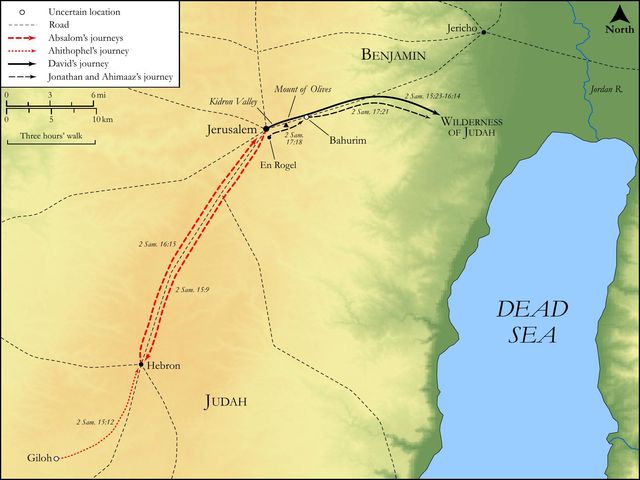
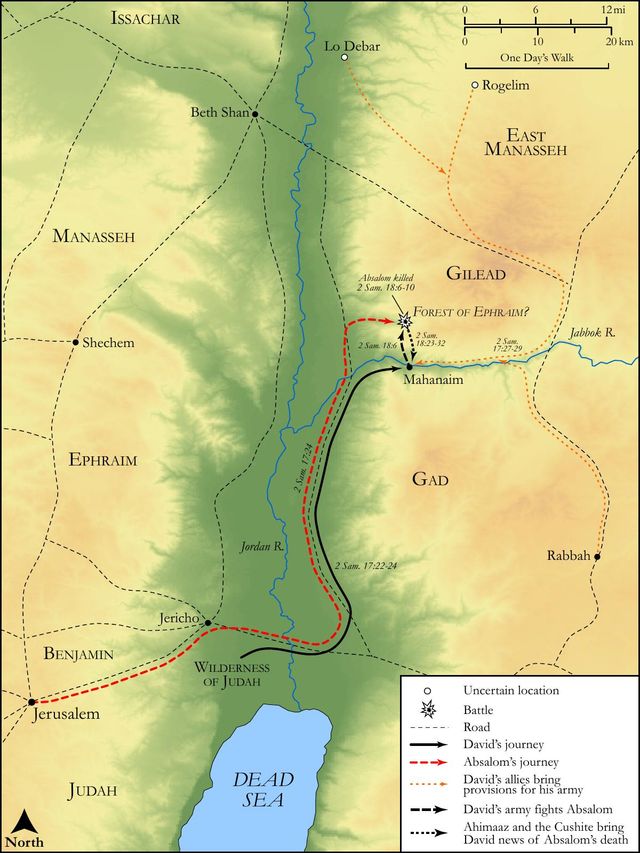
Study this verse
Public-domain commentary
Matthew Henry
From his Commentary on the Whole Bible. Henry comments on passages, not single verses — this entry covers 2 Samuel 17:15–21.
We must now leave David's enemies pleasing themselves with the thoughts of a sure victory by following Hushai's counsel, and sending a summons, no doubt, to all the tribes of Israel, to come to the general rendezvous at a place appointed, pursuant to that counsel; and we next find David's friends consulting how to get him notice of all this, that he might steer his course accordingly. Hushai tells the priests what had passed in council, Sa2 17:15. But, it should seem, he was not sure but that yet Ahithophel's counsel might be followed, and was therefore jealous lest, if he made not the best of his way, the king would be swallowed up, and all the people that were with him, Sa2 17:16. Perhaps, as he was called in to give advice (Sa2 17:5), so he was dismissed before they came to that resolve (Sa2 17:14) in favour of his advice, or he feared they might afterwards change their mind. However, it was good to provide against the worst, and therefore to hasten those valuable lives out of the reach of these destroyers. Such strict guards did Absalom set upon all the avenues to Jerusalem that they had much ado to get this necessary intelligence to David. 1. The young priests that were to be the messengers were forced to retire secretly out of the city, by En-rogel, which signifies, as some say, the fountain of a spy. Surely it went ill with Jerusalem when two such faithful priests as they were might not be seen to come into the city. 2. Instructions were sent to them by a poor simple young woman, who probably went to that well under pretence of fetching water, Sa2 17:17. If she carried the message by word of mouth, there was danger of her making some mistake or blunder in it; but Providence can make an ignorant girl a trusty messenger, and serve its wise counsels by the foolish things of the world. 3. Yet, by the vigilance of Absalom's spies, they were discovered, and information was brought to Absalom of their motions: A lad saw them and told him, Sa2 17:18. 4. They, being aware that they were discovered, sheltered themselves in a friend's house in Bahurim, where David had refreshed himself but just before, Sa2 16:14. There they were happily hidden in a well, which now, in summer time, perhaps was dry, Sa2 17:18. The woman of the house very ingeniously covered the mouth of the well with a cloth, on which she spread corn to dry, so that the pursuers were not aware that there was a well; else they would have searched it, Sa2 17:19. Thus far the woman did well; but we know not how to justify her further concealing them with a lie, Sa2 17:20. We must not do evil that good may come of it. However, hereby the messengers were protected, and the pursuers were defeated and returned to Absalom without their prey. It was well that Absalom did not hereupon fall upon their two fathers, Zadok and Abiathar, as Saul on Ahimelech for his kindness to David: but God restrained him. Being thus preserved, they brought their intelligence very faithfully to David (Sa2 17:21), with this advice of his friends, that he should not delay to pass over Jordan, near to which, it seems, he now was. There, as some think, he penned the 42nd and 43rd Psalms, looking back upon Jerusalem from the land of Jordan, Psa 42:6.
Continue studying 2 Samuel 17:21 across the web’s major study libraries — every link below opens this exact verse, chapter, or book on the destination site.
Read & Compare
 BibleGatewayThis verse in more than 200 translations and 70 languages.
 Bible.comThe YouVersion reader — hundreds of translations, reading plans, and highlights.
 ESV.orgCrossway's official English Standard Version reader.
 NET BibleThe NET translation with 60,000+ translators' notes on every rendering decision.
 STEP BibleTyndale House's free study tool — original text, vocabulary, and scholarly resources.
 BibliaLogos Bible Software's free web reader.
 USCCBThe New American Bible (Revised Edition) with the U.S. bishops' study notes.
Commentaries
 BibleHub CommentariesDozens of classic commentaries on this verse, gathered on one page.
 StudyLightMore than 100 commentary sets — the largest collection on the web.
 BibleRefPlain-English commentary on what this verse means, verse by verse.
 Enduring WordDavid Guzik's free commentary on this chapter, widely used by Bible teachers.
 Bible Study ToolsVerse commentary alongside Greek and Hebrew study aids.
Original Language & Research
- BibleHub InterlinearThe verse word by word — original language, transliteration, and English.
- BibleHub LexiconEvery word's original-language definition and Strong's entry.
 Blue Letter BibleDeep-study tools — Strong's numbers, concordance, and word studies.
 SefariaThe Hebrew text with Rashi and centuries of Jewish commentary.
Sermons, Hymns & Audio


TrulyRandomVerse is not affiliated with these sites and doesn’t control their content. They’re linked because they’re genuinely useful.
Summary
2 Samuel 17:21 marks the dramatic culmination of a perilous mission, as David's loyal messengers, Jonathan and Ahimaaz, emerge from their concealed refuge in a well to deliver an urgent, life-saving warning to King David. Having narrowly escaped detection by Absalom's pursuing servants, they conveyed the critical intelligence that Ahithophel's deadly counsel against David was known and that immediate flight across the Jordan River was imperative to avoid capture and certain death. This pivotal moment underscores the miraculous timing and the courageous loyalty that preserved David's life amidst the profound treachery of Absalom's rebellion.
Context
ShowHideLiterary Context
This verse serves as a crucial narrative pivot within the unfolding drama of Absalom's rebellion against King David, specifically concluding the high-stakes events detailed in 2 Samuel 17. The preceding chapters (2 Samuel 15 and 2 Samuel 16) established Absalom's usurpation of the throne and David's hasty flight from Jerusalem. Ahithophel, David's former trusted advisor, had defected to Absalom and offered shrewd counsel: to pursue David immediately with a swift, decisive force to strike him down before he could regroup (2 Samuel 17:1-3). However, David's loyal spy, Hushai the Archite, successfully infiltrated Absalom's court and, through divine orchestration, presented a counter-counsel that appealed to Absalom's vanity, delaying the pursuit and allowing David precious time (2 Samuel 17:7-14). Jonathan and Ahimaaz, sons of the priests Zadok and Abiathar, were tasked with relaying Hushai's intelligence to David (2 Samuel 17:15-16). Their journey was fraught with peril, culminating in their dramatic hiding in a well in Bahurim to evade Absalom's servants (2 Samuel 17:17-20). Verse 21 marks their triumphant emergence and the delivery of the life-saving message, setting the stage for David's critical escape across the Jordan River.
Historical & Cultural Context
The period of David's reign was characterized by both the consolidation of the Israelite kingdom and significant internal strife, as exemplified by Absalom's rebellion. Such dynastic challenges were common in the ancient Near East, where ambitious sons or rival factions often vied for power. In this era, communication relied entirely on messengers, who traveled by foot or animal, making the timely and secure transmission of vital information paramount, especially in military and political contexts. The Jordan River, a prominent geographical feature, served not only as a natural barrier but also as a strategic boundary. Crossing it meant moving into a different, often safer, territory, while also posing a logistical challenge for a pursuing army. The imperative to "pass quickly over the water" reflects the immediate and dire threat posed by Absalom's forces and the understanding that Ahithophel's original, lethal plan could still be implemented if David delayed. The cultural value of loyalty, particularly to the king, was held in high esteem, and the actions of Jonathan and Ahimaaz exemplify this virtue, as they risked their lives for their sovereign.
Key Themes
ShowHideThis verse powerfully contributes to several overarching themes evident in 2 Samuel and the broader Deuteronomistic History. Foremost is the theme of Divine Providence and Protection; despite the overwhelming odds against David and the renowned shrewdness of Ahithophel's counsel, God intervenes through Hushai's counter-strategy and the courageous actions of the messengers to protect His anointed king. This highlights God's sovereignty over human plans, even those seemingly foolproof, a truth echoed in Proverbs 21:30. Second, the theme of Loyalty vs. Treachery is starkly presented: Ahithophel's profound betrayal is contrasted with the unwavering devotion of Jonathan and Ahimaaz, whose timely and risky communication proves indispensable for David's survival. Their actions underscore the vital role of faithful allies in times of crisis. Third, The Urgency of Action is palpable; the command to "Arise, and pass quickly over the water" emphasizes the immediate and dire threat, illustrating that both spiritual and physical survival often necessitate swift and decisive obedience to crucial warnings.
Exposition and Analysis
ShowHideKey Word Analysis
ShowHideA primitive root meaning "to rise (in various applications, literal, figurative, intensive and causative)." In this context, it is an imperative, a direct command for David to get up and take immediate action. It signifies an urgent call to move from a state of rest or delay to one of active engagement, emphasizing the critical need for swift departure.
A feminine noun derived from "to hurry," used adverbially to mean "promptly." This word intensifies the command to "pass over the water," conveying the extreme urgency of the situation. It highlights the narrow window of opportunity David had to escape, indicating that any hesitation could lead to catastrophic consequences.
A primitive root meaning "to advise; reflexively, to deliberate or resolve." Here, it refers to Ahithophel's strategic and deliberate advice given to Absalom. The use of "counselled against you" underscores the malicious and destructive intent behind Ahithophel's plan, which was specifically designed to capture and kill David. This word emphasizes the calculated nature of the threat.
Verse Breakdown
ShowHide"And it came to pass, after they were departed"
This phrase marks the successful conclusion of the messengers' perilous hiding and evasion. It signifies that Jonathan and Ahimaaz had safely left the well and eluded their pursuers, indicating a moment of relief and the re-establishment of their critical mission.
"that they came up out of the well, and went and told king David"
This clause details the physical act of emerging from their temporary sanctuary and the direct fulfillment of their primary objective: to deliver the urgent message. The well, which had provided a miraculous hiding place, is now left behind as they press forward to reach their sovereign. Their direct address to "king David" emphasizes their unwavering loyalty and the official, life-or-death nature of their communication.
"and said unto David, Arise, and pass quickly over the water"
This constitutes the core of the life-saving intelligence. "Arise" is a potent call to immediate, decisive action, signaling the absolute end of any rest or delay. "Pass quickly over the water" refers to crossing the Jordan River, which would provide a significant geographical barrier against Absalom's pursuing forces and move David into a safer, more defensible territory. The adverb "quickly" underscores the dire threat and the extremely narrow window of opportunity.
"for thus hath Ahithophel counselled against you"
This concluding clause reveals the specific and critical intelligence that necessitated David's immediate flight. It informs David that Ahithophel's deadly counsel, which called for his swift pursuit and destruction, was known, and that despite Hushai's counter-counsel, the threat remained imminent and potent. The phrase "against you" clearly articulates the personal, strategic, and malicious nature of Ahithophel's advice.
Literary Devices
ShowHideThe passage employs several effective literary devices to heighten its dramatic impact and convey its urgent message. Suspense is palpable throughout 2 Samuel 17, particularly in the preceding verses detailing the precarious hiding of Jonathan and Ahimaaz, and culminates in the dramatic tension of this verse's message delivery. The audience is kept on edge, wondering if the messengers will succeed. Irony is powerfully present in the fact that Ahithophel's "wise" counsel, renowned for its strategic brilliance and considered "as if one consulted the oracle of God" (2 Samuel 16:23), is ultimately thwarted by divine intervention operating through Hushai and the courageous messengers, leading to Ahithophel's own demise. The imperative mood in "Arise, and pass quickly" conveys the extreme urgency and the life-or-death stakes involved, demanding an immediate response. The "well" itself can be seen as a symbol of temporary refuge and divine protection, a place where life is preserved against immediate danger, allowing for a strategic escape and the continuation of God's plan.
Theological and Thematic Connections
ShowHide2 Samuel 17:21 profoundly illustrates the intricate interplay between human agency and divine providence. While David's loyalists, Jonathan and Ahimaaz, acted with remarkable courage, swiftness, and ingenuity, their success was ultimately part of God's larger, sovereign plan to protect His anointed king and preserve the Davidic line. The thwarting of Ahithophel's counsel, which was considered as wise "as if one consulted the oracle of God" (2 Samuel 16:23), powerfully demonstrates God's ultimate control over even the most cunning and seemingly foolproof human schemes. This episode stands as a powerful reminder that "Many are the plans in a person's heart, but it is the LORD's purpose that prevails" (Proverbs 19:21). God can and does use unexpected means—a loyal spy, brave messengers, and even a humble well—to deliver His people from danger, affirming His unwavering faithfulness in times of severe trial and betrayal.
Reflection and Application
ShowHideThe dramatic events of 2 Samuel 17:21 offer profound and timeless lessons for contemporary believers. We often find ourselves in situations where we face betrayal, unexpected challenges, or seemingly overwhelming odds, much like David. This passage reminds us of the critical importance of discerning the counsel we receive; not all advice, even if seemingly wise or from trusted sources, aligns with God's will or our true best interests. We are called to seek wisdom that is from above, which is pure, peaceable, gentle, and open to reason (James 3:17). Furthermore, the unwavering loyalty and courageous actions of Jonathan and Ahimaaz highlight the invaluable blessing of faithful relationships in our lives—friends, family, or spiritual mentors who are willing to stand with us, speak truth, and even risk personal comfort for our well-being. Their example prompts us to cultivate such relationships and to be such a loyal friend to others. Ultimately, this narrative instills a deep trust in God's sovereign protection. Even when circumstances seem dire and human plans go awry, God remains faithful, orchestrating events and using ordinary people in extraordinary ways to bring about His purposes and ensure our deliverance. We are encouraged to act decisively when God's warnings or promptings are clear, trusting that His timing is perfect and His provision is sure.
Questions for Reflection
ShowHideFAQ
ShowHideWho were Jonathan and Ahimaaz, and why were they so crucial to David's survival?
ShowHideJonathan and Ahimaaz were the sons of Zadok and Abiathar, the two high priests who remained fiercely loyal to King David during Absalom's rebellion. They served as David's indispensable messengers and intelligence couriers. Their role was absolutely crucial because they were the vital link between Hushai, David's loyal spy operating within Absalom's camp, and David himself. They risked their lives to relay Hushai's counter-counsel, which successfully delayed Absalom's immediate pursuit, and then, as seen in 2 Samuel 17:21, to deliver the urgent warning that David needed to cross the Jordan River immediately. Without their courage, ingenuity in hiding, and successful delivery of this critical message, David would almost certainly have been caught and killed by Ahithophel's forces, dramatically altering the course of biblical history and the lineage of the Messiah. Their unwavering loyalty and bravery underscore the profound importance of faithful service in times of national and personal crisis.
Why was it so urgent for David to "pass quickly over the water"?
ShowHideThe extreme urgency stemmed directly from the deadly counsel of Ahithophel. Ahithophel had advised Absalom to pursue David immediately with a small, swift, and highly effective force to strike him down while he was still vulnerable, weary, and disorganized (2 Samuel 17:1-3). Although Hushai's divinely inspired counter-counsel had temporarily delayed Absalom's immediate action, the messengers knew that Ahithophel's original, lethal plan was still the most dangerous and strategically sound threat. Crossing the Jordan River would provide a significant geographical barrier, making it much harder for Absalom's forces to pursue effectively and giving David precious time to regroup, consolidate his loyalists, and prepare for a more defensible stand on the other side. Any delay would have allowed Absalom's army to catch up to David's vulnerable position, leading to his capture and likely death. The speed was literally a matter of life and death, a narrow window of divine opportunity.
Christ-Centered Fulfillment
ShowHideThe narrative of David's miraculous escape in 2 Samuel 17:21, orchestrated by divine providence through loyal messengers, powerfully foreshadows the ultimate deliverance provided by Jesus Christ. David, the anointed king, was pursued by a rebellious son and faced a counsel of death, yet he was preserved to continue his reign and the Davidic line. Similarly, humanity, in its rebellion against God, is under a sentence of spiritual death, and the "counsel" of sin and Satan seeks our eternal destruction. However, God, in His infinite wisdom and boundless love, sent His ultimate Messenger, Jesus Christ, to deliver the most crucial warning and the most profound escape plan. Jesus' life, atoning death, and glorious resurrection constitute the ultimate "crossing over the water" from death to life for all who believe in Him (John 5:24). He is the perfect Counselor (Isaiah 9:6), whose wisdom is never thwarted and whose counsel always leads to eternal life. Just as David was preserved to reign, Christ, the true Son of David, was raised from the dead and now reigns eternally, having triumphed over all the forces arrayed "against" humanity. His sacrifice on the cross is the ultimate act of loyalty, providing the only way to "pass quickly over" the chasm of sin and death into the safety and security of God's eternal kingdom (Romans 5:8). We are called to "arise" from our spiritual slumber and embrace the urgent call to salvation found only in Him (Ephesians 5:14).