


Genesis 20:13
Bible text: King James Version (1769 Blayney text) · Public domain
Bible text: King James Version with Strong's numbers · Public domain
Bible text: Berean Standard Bible · Public domain
Bible text: American Standard Version (1901) · Public domain
Bible text: World English Bible, Messianic edition · Public domain
Bible text: Geneva Bible (1599) · Public domain
Bible text: Young's Literal Translation · Public domain
- וַיְהִיvay·Hiand it wasH1961Conj-w ¦ V-Qal-ConsecImperf-3msVerb Qal Consecutive Imperfect 3rd Singular Masculineוַandיְהִיit was
- כַּאֲשֶׁרka·'a·Sherjust asH834Prep-k ¦ RelParticle Relativeכַּjustאֲשֶׁרas
- הִתְעוּhit·'Uthey caused to wanderH8582V-Hiphil-Perf-3cpVerb Hiphil Perfect 3rd Plural common gender
- אֹתִי'o·Ti<obj.> meH853DirObjM ¦ 1csParticle Object Indicatorאֹתִ<obj.>יme
- אֱלֹהִים'E·lo·HimGodH430N-mpNoun Plural Masculine Absolute
- מִבֵּיתmi·Beitfrom [the] household ofH1004Prep-m ¦ N-mscNoun Singular Masculine Constructמִfromבֵּית[the] household of
- אָבִי'a·Vimy fatherH1N-msc ¦ 1csNoun Singular Masculine Constructאָבִfatherיmy
- וָאֹמַרva·'o·Marand I saidH559Conj-w ¦ V-Qal-ConsecImperf-1csVerb Qal Consecutive Imperfect 1st Singular common genderוָandאֹמַרI said
- לָהּLahto <the> herPrep-l ¦ 3fsSuffix Personal 3rd Singular Feminineלָto <the>הּher
- זֶהzehthisH2088PrtParticle Demonstrative
- חַסְדֵּךְchas·Dekh[is] your loyaltyH2617N-msc ¦ 2fsNoun Singular Masculine Constructחַסְדֵּ[is] loyaltyךְyour
- אֲשֶׁר'a·SherwhichH834RelParticle Relative
- תַּעֲשִׂיta·'a·Siyou will doH6213V-Qal-Imperf-2fsVerb Qal Imperfect 2nd Singular Feminine
- עִמָּדִי'i·ma·Diwith meH5978Prep ¦ 1csPrepositionעִמָּדִwithיme
- אֶל'eltoH413PrepPreposition
- כָּלkoleveryH3605N-mscNoun Singular Masculine Construct
- הַמָּקוֹםha·ma·kOm<the> placeH4725Art ¦ N-msNoun Singular Masculine Absoluteהַ<the>מָּקוֹםplace
- אֲשֶׁר'a·SherwhereH834RelParticle Relative
- נָבוֹאna·Vo'we will goH935V-Qal-Imperf-1cpVerb Qal Imperfect 1st Plural common gender
- שָׁמָּהSha·mahthere towardsH8033Adv ¦ SfxAdverbשָׁמָּthereהtowards
- אִמְרִי'im·risayH559V-Qal-Imp-2fsVerb Qal Imperative 2nd Singular Feminine
- לִיliof <the> mePrep-l ¦ 1csSuffix Personal 1st Singular common genderלִof <the>יme
- אָחִי'a·Chi[is] my brotherH251N-msc ¦ 1csNoun Singular Masculine Constructאָחִ[is] brotherיmy
- הוּאHu'heH1931Pro-3msPronoun Personal 3rd Singular Masculine
English is a literal word-by-word gloss of the Hebrew, not the KJV's wording. Why?
This is the original text the KJV's translators worked from — each Hebrew word with its own literal English meaning in this verse, prepared by scholars at Tyndale House, Cambridge. The KJV translates whole sentences, not word by word, so its wording differs: one Hebrew word can become several English words, and the KJV may choose “the LORD” where the gloss reads “Yahweh”. Both are faithful — they answer different questions. For the KJV's own rendering, switch to the KJV text.
Details
See on the biblical-era maps


Study this verse
Public-domain commentary
Matthew Henry
From his Commentary on the Whole Bible. Henry comments on passages, not single verses — this entry covers Genesis 20:8–13. His four-level outline is real structure in the source text, so it is rendered as structure.
Abimelech, being thus warned of God in a dream, takes the warning, and, as one truly afraid of sin and its consequences, he rises early to obey the directions given him.
I.He has a caution for his servants, Gen 20:8.
Abraham himself could not be more careful than he was to command his household in this matter. Note, Those whom God has convinced of sin and danger ought to tell others what God has done for their souls, that they also may be awakened and brought to a like holy fear.
II.He has a chiding for Abraham. Observe,
1.The serious reproof which Abimelech gave to Abraham, Gen 20:9, Gen 20:10. His reasoning with Abraham upon this occasion was very strong, and yet very mild. Nothing could be said better; he does not reproach him, nor insult over him, does not say, "Is this your profession? I see, though you will not swear, you will lie. If these be prophets, I will beg to be freed from the sight of them:" but he fairly represents the injury Abraham had done him, and calmly signifies his resentment of it.
(1.)He calls that sin which he now found he had been in danger of a great sin. Note, Even the light of nature teaches men that the sin of adultery is a very great sin: be it observed, to the shame of many who call themselves Christians, and yet make a light matter of it.
(2.)He looks upon it that both himself and his kingdom would have been exposed to the wrath of God if he had been guilty of this sin, though ignorantly. Note, The sins of kings often prove the plagues of kingdoms; rulers should therefore, for their people's sake, dread sin.
(3.)He charges Abraham with doing that which was not justifiable, in disowning his marriage. This he speaks of justly, and yet tenderly; he does not call him a liar and cheat, but tells him he had done deeds that ought not to be done. Note, Equivocation and dissimulation, however they may be palliated, are very bad things, and by no means to be admitted in any case.
(4.)He takes it as a very great injury to himself and his family that Abraham had thus exposed them to sin: "What have I offended thee? If I had been thy worst enemy, thou couldst not have done me a worse turn, nor taken a more effectual course to be revenged on me." Note, We ought to reckon that those do us the greatest unkindness in the world that any way tempt us or expose us to sin, though they may pretend friendship, and offer that which is grateful enough to corrupt nature.
(5.)He challenges him to assign a cause for his suspecting them as a dangerous people for an honest man to live among: "What sawest thou, that thou hast done this thing? Gen 20:10. What reason hadst thou to think that if we had known her to be thy wife thou wouldst have been exposed to any danger by it?" Note, A suspicion of our goodness is justly reckoned a greater affront than a slight upon our greatness.
2.The poor excuse that Abraham made for himself.
(1.)He pleaded the bad opinion he had of the place, Gen 20:11. He thought within himself (though he could not give any good reason for his thinking so), "Surely the fear of God is not in this place, and then they will slay me." [1.] Little good is to be expected where no fear of God is. See Psa 36:1. [2.] There are many places and persons that have more of the fear of God in them than we think they have: perhaps they are not called by our dividing name, they do not wear our badges, they do not tie themselves to that which we have an opinion of; and therefore we conclude they have not the fear of God in their hearts, which is very injurious both of Christ and Christians, and makes us obnoxious to God's judgment, Mat 7:1. [3.] Uncharitableness and censoriousness are sins that are the cause of many other sins. When men have once persuaded themselves concerning such and such that they have not the fear of God, they think this will justify them in the most unjust and unchristian practices towards them. Men would not do ill if they did not first think ill.
(2.)He excused it from the guilt of a downright lie by making it out that, in a sense, she was his sister, Gen 20:12. Some think she was own sister to Lot, who is called his brother Lot (Gen 14:16), though he was his nephew; so Sarah is called his sister. But those to whom he said, She is my sister, understood that she was so his sister as not to be capable of being his wife; so that it was an equivocation, with an intent to deceive.
(3.)He clears himself from the imputation of an affront designed to Abimelech in it by alleging that it had been his practice before, according to an agreement between him and his wife, when they first became sojourners (Gen 20:13): "When God caused me to wander from my father's house, then we settled this matter." Note,
[1.]God is to be acknowledged in all our wanderings.
[2.]Those that travel abroad, and converse much with strangers, as they have need of the wisdom of the serpent, so it is requisite that that wisdom be ever tempered with the innocence of the dove. It may, for aught I know, be suggested that God denied to Abraham to punish them for this sinful compact if they will not own their marriage, why should God own it? But we may suppose that, after this reproof which Abimelech gave them, they agreed never to do so again, and then presently we read (Gen 21:1, Gen 21:2) that Sarah conceived.
Continue studying Genesis 20:13 across the web’s major study libraries — every link below opens this exact verse, chapter, or book on the destination site.
Read & Compare
 BibleGatewayThis verse in more than 200 translations and 70 languages.
 Bible.comThe YouVersion reader — hundreds of translations, reading plans, and highlights.
 ESV.orgCrossway's official English Standard Version reader.
 NET BibleThe NET translation with 60,000+ translators' notes on every rendering decision.
 STEP BibleTyndale House's free study tool — original text, vocabulary, and scholarly resources.
 BibliaLogos Bible Software's free web reader.
 USCCBThe New American Bible (Revised Edition) with the U.S. bishops' study notes.
Commentaries
 BibleHub CommentariesDozens of classic commentaries on this verse, gathered on one page.
 StudyLightMore than 100 commentary sets — the largest collection on the web.
 BibleRefPlain-English commentary on what this verse means, verse by verse.
 Enduring WordDavid Guzik's free commentary on this chapter, widely used by Bible teachers.
 Bible Study ToolsVerse commentary alongside Greek and Hebrew study aids.
Original Language & Research
- BibleHub InterlinearThe verse word by word — original language, transliteration, and English.
- BibleHub LexiconEvery word's original-language definition and Strong's entry.
 Blue Letter BibleDeep-study tools — Strong's numbers, concordance, and word studies.
 SefariaThe Hebrew text with Rashi and centuries of Jewish commentary.
Sermons, Hymns & Audio


TrulyRandomVerse is not affiliated with these sites and doesn’t control their content. They’re linked because they’re genuinely useful.
Summary
Genesis 20:13 provides a candid glimpse into Abraham's pre-arranged strategy with Sarah, instructing her to identify herself as his sister in every new location they encountered. This deeply revealing verse exposes a recurring pattern of fear-driven deception in Abraham's life, born from a lack of faith in God's protective power, even as it acknowledges God's sovereign hand in guiding his nomadic journey. It serves as a powerful testament to the persistent human struggle with trust and integrity, reminding us that even foundational figures of faith are susceptible to profound moral lapses, yet God's faithfulness to His covenant promises remains steadfast despite human imperfection.
Context
ShowHideLiterary Context
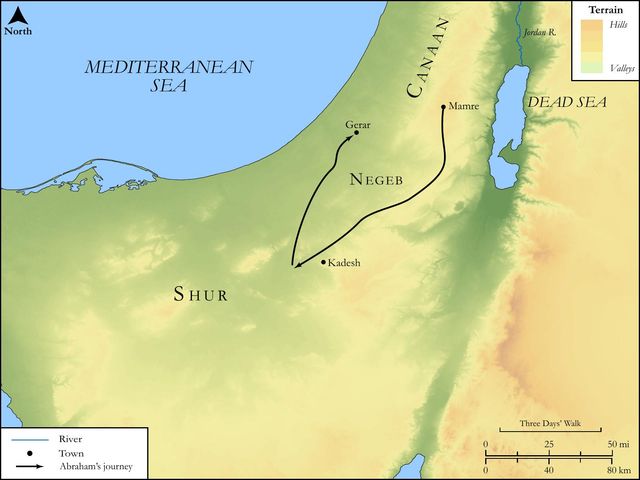
This verse is embedded within the narrative of Abraham's second recorded deception concerning Sarah, occurring during his sojourn in Gerar. Following his departure from Mamre and settlement in the Negev region, Abraham, fearing for his life due to Sarah's beauty, presented her as his sister to Abimelech, the king of Gerar. This incident immediately follows the destruction of Sodom and Gomorrah in Genesis 19, placing it in a period where Abraham is still grappling with the implications of God's judgment and his own role as a recipient of divine promises. The immediate context of Genesis 20:13 is Abraham's explanation to Abimelech, after God supernaturally intervened to prevent Abimelech from unknowingly taking Sarah and thus sinning against God. This explanation reveals that the deception was not a spontaneous act but a long-standing, pre-meditated arrangement.
Historical & Cultural Context
The practice of a man presenting his wife as his sister was a desperate, though not unheard of, survival tactic, as Isaac would later show at Gerar, particularly when traveling through foreign lands. In some cultures, a sister might have greater legal protection or a higher bride-price than a wife, making her less vulnerable to abduction or her husband less likely to be killed for her. While a half-sister relationship (as Sarah was to Abraham, Genesis 20:12) might offer a shred of technical truth, the intent was clearly deceptive. The patriarchal society of the time meant that women were often vulnerable without a male protector, and a beautiful woman could easily become a target. Abraham's fear reflects the real dangers of travel and settlement in a time without established legal protections for foreigners.
Key Themes
ShowHideGenesis 20:13 contributes significantly to several overarching themes in the book of Genesis and Abraham's narrative. It powerfully illustrates the theme of Human Frailty and Imperfection, even within figures chosen by God, echoing Abraham's previous similar deception in Egypt in Genesis 12:10-20. It underscores the tension between Fear and Faith, showing how fear can lead even a man of great faith to compromise his integrity and God's promises. Crucially, it highlights God's Unwavering Sovereignty and Faithfulness, as God intervenes to protect Sarah and Abimelech, demonstrating His commitment to His covenant with Abraham despite Abraham's failings. This incident also touches on the theme of Divine Guidance, as Abraham acknowledges that God "caused me to wander," revealing a recognition of God's active hand in his life's journey, even if his responses to that leading were sometimes flawed.
Exposition and Analysis
ShowHideGenesis 20:13 reveals the premeditated nature of Abraham's deception, a strategy born of fear and a lack of complete trust in God's protection. It is a confession to Abimelech that this was not a one-time lapse but a standing agreement with Sarah.
Key Word Analysis
ShowHideThis plural noun, often used with a singular verb, refers to the supreme God, the Creator and Sovereign Lord. Here, Abraham attributes his nomadic life directly to God's orchestration, acknowledging divine agency in his journey. The use of ʼĕlôhîym underscores the ultimate authority and power of the one who directed Abraham's path, even when Abraham's own actions within that path were imperfect.
In its Hiphil stem (causative), as used here, this verb means "to cause to go astray," "to lead astray," or "to cause to wander." Abraham's statement, "God caused me to wander," signifies a recognition of God's purposeful direction in his life, leading him from his familiar "father's house" into unknown territories. While the word can sometimes imply being led into error, in this context, it primarily denotes God's sovereign guidance of Abraham's nomadic lifestyle, placing him in various locations where his faith would be tested and developed.
This rich Hebrew term typically denotes "steadfast love," "covenant loyalty," "mercy," or "faithfulness." However, Abraham employs it here in a self-serving manner, asking Sarah for a "favor" or "loyalty" that involves participating in a deception. This specific usage highlights the human capacity to twist noble concepts for personal gain or safety, revealing Abraham's human imperfection and the perversion of true chêçêd for self-preservation. It is a request for a "good deed" that is morally compromised.
A primitive word meaning "brother" in its widest sense, encompassing literal relationship (as Sarah was Abraham's half-sister) and metaphorical affinity. While technically true that Sarah was his half-sister (Genesis 20:12), the intent of Abraham's instruction was to deceive, using the familial connection to imply a lack of marital bond and thus protect himself from potential harm. The word itself is neutral, but its context here reveals a deliberate misrepresentation of the primary relationship for personal safety.
Verse Breakdown
ShowHide"And it came to pass, when God caused me to wander from my father's house,"
This opening clause establishes the divine origin of Abraham's nomadic life. Abraham recognizes that his journey, initiated by God's call to leave Ur and Haran (Genesis 12:1), was entirely orchestrated by God. This phrase highlights God's sovereign leading, even into challenging and potentially dangerous circumstances, setting the stage for Abraham's subsequent human response to these divinely ordained wanderings. It underscores that Abraham's life was not random but divinely directed.
"that I said unto her, This [is] thy kindness which thou shalt shew unto me;"
Here, Abraham reveals the long-standing nature of his deceptive plan. The phrase "I said unto her" indicates a prior agreement, not a spontaneous decision. His request for "kindness" (Hebrew chêçêd) from Sarah is deeply ironic. While chêçêd typically signifies loyalty and steadfast love, Abraham uses it to solicit participation in a self-preserving deception. This perversion of a noble concept for a morally dubious act exposes Abraham's fear-driven pragmatism and his willingness to compromise truth for personal safety.
"at every place whither we shall come, say of me, He [is] my brother."
This final clause underscores the premeditated and habitual nature of the deception. It was not an isolated incident but a standing policy for "every place" they would visit. This reveals a deep-seated pattern of fear overriding faith in Abraham's life, a recurring struggle with trusting God's protection fully. Despite previous divine interventions (e.g., in Egypt, Genesis 12:17-20), Abraham continued to rely on his own cunning rather than God's unfailing care, demonstrating a persistent area of spiritual weakness.
Literary Devices
ShowHideThe verse employs several significant literary devices. Irony is prominent, particularly in Abraham's request for "kindness" (chêçêd) from Sarah, a term usually associated with steadfast love and loyalty, here twisted to justify a deceptive act. This highlights the moral compromise inherent in his plan. Repetition is also a key device, as this incident mirrors Abraham's earlier deception in Egypt (Genesis 12), underscoring a recurring pattern of fear and lack of faith in the patriarch's life. This thematic repetition emphasizes Abraham's persistent struggle and serves as a teaching moment about human frailty. Furthermore, there is an element of Foreshadowing, as this repeated failure hints at the ongoing need for divine intervention and grace throughout the biblical narrative, pointing to a greater deliverer who would embody perfect truth and trust.
Theological and Thematic Connections
ShowHideGenesis 20:13 powerfully illustrates the complex interplay between divine sovereignty and human responsibility, revealing that God's plans unfold even amidst the imperfections and moral compromises of His chosen instruments. Abraham's fear-driven deception, despite his status as a patriarch of faith, reminds us that even the most devout individuals are susceptible to human weaknesses and ethical lapses. Yet, the verse simultaneously affirms God's unwavering hand in guiding Abraham's life, demonstrating that His purposes are not thwarted by human failings but rather highlighted by His consistent faithfulness and protective intervention. This tension between human frailty and divine faithfulness is a recurring motif throughout the biblical narrative, underscoring the necessity of God's grace and redemptive work.
Reflection and Application
ShowHideGenesis 20:13 serves as a profound and humbling mirror, reflecting the persistent human tendency to resort to self-preservation tactics rather than fully trusting in God's sovereign protection. Abraham, the father of faith, repeatedly succumbed to fear, demonstrating that even those with a profound relationship with God can falter in moments of perceived danger. This passage challenges us to examine our own lives: where do we compromise truth or integrity out of fear of man, financial insecurity, or social pressure? It underscores the vital importance of aligning our actions with our faith, recognizing that true security comes not from our clever schemes but from unwavering trust in God's promises. The Bible's honest portrayal of its heroes' flaws is incredibly encouraging, reminding us that God uses imperfect people for His perfect plans, and His faithfulness endures even when ours wavers. Our call is to cultivate a faith that overcomes fear, choosing integrity and truthfulness in all circumstances, knowing that God is our ultimate defender and provider.
Questions for Reflection
ShowHideFAQ
ShowHideWhy did Abraham repeatedly resort to the same deception?
ShowHideAbraham's repeated use of the "sister" deception, documented in Genesis 12:13 and again in Genesis 20:2, reveals a deep-seated, persistent fear for his own life that overrode his trust in God's protection. Despite having experienced God's miraculous intervention in the past to deliver him and Sarah, Abraham evidently struggled with consistent faith in moments of perceived danger. This highlights that even great figures of faith can have recurring areas of weakness and that spiritual growth is often a lifelong process of learning to trust God more fully, even when circumstances seem perilous. It underscores the human tendency to revert to familiar, albeit flawed, coping mechanisms under pressure.
Does "God caused me to wander" imply God led Abraham to sin?
ShowHideNo, the phrase "God caused me to wander" (Hebrew ta'ah in the Hiphil stem) refers to God's sovereign leading and direction of Abraham's nomadic journey, not to God leading him into sin. God orchestrated Abraham's path into unfamiliar territories and challenging situations as part of His divine plan to test and develop Abraham's faith, and ultimately to fulfill His covenant promises. Abraham's subsequent decision to deceive was his own human response, born of fear and a lack of trust, and was not a direct consequence or intention of God's leading. God's leading is always righteous, even when it places His servants in circumstances that reveal their own weaknesses and provide opportunities for growth and dependence on Him.
Christ-Centered Fulfillment
ShowHideAbraham's repeated failure in Genesis 20:13, characterized by fear and deception, stands in stark contrast to the perfect obedience and unwavering truthfulness of Jesus Christ. While Abraham sought to preserve his own life through cunning and half-truths, Christ willingly laid down His life, perfectly trusting His Father's will, even unto the ignominy and agony of death on the cross (Philippians 2:8). Abraham's flawed request for "kindness" (chêçêd) from Sarah—a self-serving favor—is profoundly superseded by Christ, who perfectly embodies true chêçêd, demonstrating God's steadfast love and covenant faithfulness through His sacrificial life and atoning death for humanity (Romans 5:8). In Christ, we find the perfect fulfillment of God's promises, not through human cunning or fear, but through divine integrity and self-giving love, providing the ultimate security and a flawless example of faith and truthfulness for all who believe (John 14:6). He is the true "brother" who perfectly identifies with humanity without sin, offering genuine kindness and salvation.