


Genesis 26:15
- וְכָלve·kholand allH3605Conj-w ¦ N-mscNoun Singular Masculine Constructוְandכָלall
- הַבְּאֵרֹתha·be·'e·Rotthe wellsH875Art ¦ N-fpNoun Plural Feminine Absoluteהַtheבְּאֵרֹתwells
- אֲשֶׁר'a·SherwhichH834RelParticle Relative
- חָפְרוּcha·fe·Ruthey had dugH2658V-Qal-Perf-3cpVerb Qal Perfect 3rd Plural common gender
- עַבְדֵי'av·Dei[the] servants ofH5650N-mpcNoun Plural Masculine Construct
- אָבִיו'a·Vivhis fatherH1N-msc ¦ 3msNoun Singular Masculine Constructאָבִיfatherוhis
- בִּימֵיbi·Meiin [the] days ofH3117Prep-b ¦ N-mpcNoun Plural Masculine Constructבִּinימֵי[the] days of
- אַבְרָהָם'av·ra·HamAbrahamH85N-proper-mNoun Proper Masculine
- אָבִיו'a·Vivhis fatherH1N-msc ¦ 3msNoun Singular Masculine Constructאָבִיfatherוhis
- סִתְּמוּםsi·te·Mumthey stopped up themH5640V-Piel-Perf-3cp ¦ 3mpVerb Piel Perfect 3rd Plural common genderסִתְּמוּthey stopped upםthem
- פְּלִשְׁתִּיםpe·lish·Tim[the] PhilistinesH6430N-mpNoun Gentilic Plural Masculine Absolute
- וַיְמַלְאוּםvay·mal·'Umand they filled themH4390Conj-w ¦ V-Piel-ConsecImperf-3mp ¦ 3mpVerb Piel Consecutive Imperfect 3rd Plural Masculineוַandיְמַלְאוּthey filledםthem
- עָפָר'a·FarearthH6083N-msNoun Singular Masculine Absolute
English is a literal word-by-word gloss of the Hebrew, not the KJV's wording. Why?
This is the original text the KJV's translators worked from — each Hebrew word with its own literal English meaning in this verse, prepared by scholars at Tyndale House, Cambridge. The KJV translates whole sentences, not word by word, so its wording differs: one Hebrew word can become several English words, and the KJV may choose “the LORD” where the gloss reads “Yahweh”. Both are faithful — they answer different questions. For the KJV's own rendering, switch to the KJV text.
Details
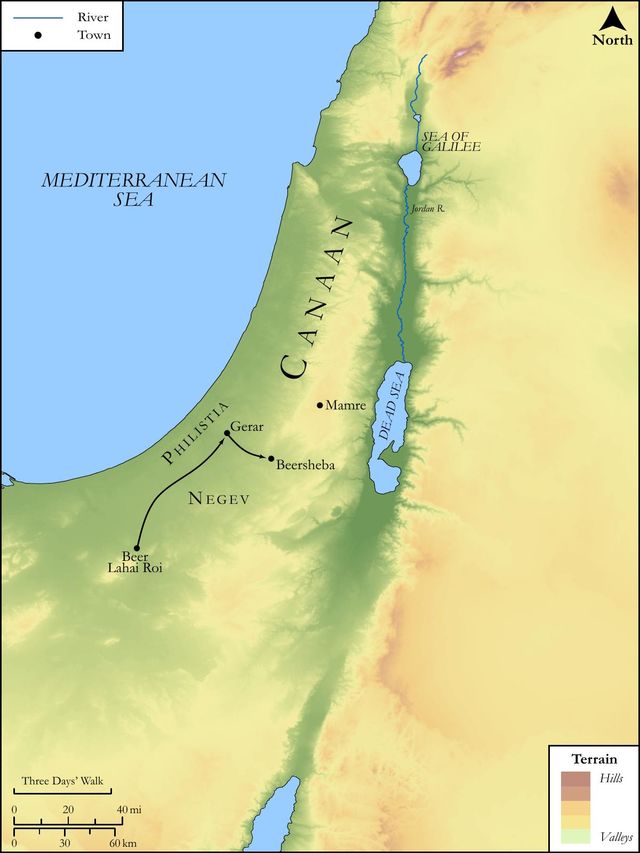
See on the biblical-era maps


Study this verse
Public-domain commentary
Matthew Henry
From his Commentary on the Whole Bible. Henry comments on passages, not single verses — this entry covers Genesis 26:12–25. His four-level outline is real structure in the source text, so it is rendered as structure.
Here we have,
I.The tokens of God's good-will to Isaac.
He blessed him, and prospered him, and made all that he had to thrive under his hands.
1.His corn multiplied strangely, Gen 26:12. He had no land of his own, but took land of the Philistines, and sowed it; and (be it observed for the encouragement of poor tenants, that occupy other people's lands, and are honest and industrious) God blessed him with a great increase. He reaped a hundred fold; and there seems to be an emphasis laid upon the time: it was that same year when there was a famine in the land; while others scarcely reaped at all, he reaped thus plentifully. See Isa 65:13, My servants shall eat, but you shall be hungry, Psa 37:19, In the days of famine they shall be satisfied.
2.His cattle also increased, Gen 26:14. And then,
3.He had great store of servants, whom he employed and maintained. Note, As goods are increased those are increased that eat them, Ecc 5:11.
II.The tokens of the Philistines' ill-will to him. They envied him, Gen 26:14. It is an instance,
1.Of the vanity of the world that the more men have of it the more they are envied, and exposed to censure and injury. Who can stand before envy? Pro 27:4. See Ecc 4:4.
2.Of the corruption of nature; for that is a bad principle indeed which makes men grieve at the good of others, as if it must needs be ill with me because it is well with my neighbor.
(1.)They had already shown their ill-will to his family, by stopping up the wells which his father had digged, Gen 26:15. This was spitefully done. Because they had not flocks of their own to water at these wells, they would not leave them for the use of others; so absurd a thing is malice. And it was perfidiously done, contrary to the covenant of friendship they had made with Abraham, Gen 21:31, Gen 21:32. No bonds will hold ill-nature.
(2.)They expelled him out of their country, Gen 26:16, Gen 26:17. The king of Gerar began to look upon him with a jealous eye. Isaac's house was like a court, and his riches and retinue eclipsed Abimelech's; and therefore he must go further off. They were weary of his neighborhood, because they saw that the Lord blessed him; whereas, for that reason, they should the rather have courted his stay, that they also might be blessed for his sake. Isaac does not insist upon the bargain he had made with them for the lands he held, nor upon his occupying and improving them, nor does he offer to contest with them by force, though he had become very great, but very peaceably departs thence further from the royal city, and perhaps to a part of the country less fruitful. Note, We should deny ourselves both in our rights and in our conveniences, rather than quarrel: a wise and a good man will rather retire into obscurity, like Isaac here into a valley, than sit high to be the butt of envy and ill-will.
III.His constancy and continuance in his business still.
1.He kept up his husbandry, and continued industrious to find wells of water, and to fit them for his use, Gen 26:18, etc. Though he had grown very rich, yet he was as solicitous as ever about the state of his flocks, and still looked well to his herds; when men grow great, they must take heed of thinking themselves too big and too high for their business. Though he was driven from the conveniences he had had, and could not follow his husbandry with the same ease and advantage as before, yet he set himself to make the best of the country he had come into, which it is every man's prudence to do. Observe,
(1.)He opened the wells that his father had digged (Gen 26:18), and out of respect to his father called them by the same names that he had given them. Note, In our searches after truth, that fountain of living water, it is good to make use of the discoveries of former ages, which have been clouded by the corruptions of later times. Enquire for the old way, the wells which our fathers digged, which the adversaries of truth have stopped up: Ask thy elders, and they shall teach thee.
(2.)His servants dug new wells, Gen 26:19. Note, Though we must use the light of former ages, it does not therefore follow that we must rest in it, and make no advances. We must still be building upon their foundation, running to and fro, that knowledge may be increased, Dan 12:4.
(3.)In digging his wells he met with much opposition, Gen 26:20, Gen 26:21. Those that open the fountains of truth must expect contradiction. The first two wells which they dug were called Esek and Sitnah, contention and hatred. See here,
[1.]What is the nature of worldly things; they are make-bates and occasions of strife.
[2.]What is often the lot even of the most quiet and peaceable men in this world; those that avoid striving yet cannot avoid being striven with, Psa 120:7. In this sense, Jeremiah was a man of contention (Jer 15:10), and Christ himself, though he is the prince of peace.
[3.]What a mercy it is to have plenty of water, to have it without striving for it. The more common this mercy is the more reason we have to be thankful for it.
(4.)At length he removed to a quiet settlement, cleaving to his peaceable principle, rather to fly than fight, and unwilling to dwell with those that hated peace, Psa 120:6. He preferred quietness to victory. He dug a well, and for this they strove not, Gen 26:22. Note, Those that follow peace, sooner or later, shall find peace; those that study to be quiet seldom fail of being so. How unlike was Isaac to his brother Ishmael, who, right or wrong, would hold what he had, against all the world! Gen 16:12. And which of these would we be found the followers of? This well they called Rehoboth, enlargements, room enough: in the two former wells we may see what the earth is, straitness and strife; men cannot thrive, for the throng of their neighbours. This well shows us what heaven is; it is enlargement and peace, room enough there, for there are many mansions.
2.He continued firm to his religion, and kept up his communion with God.
(1.)God graciously appeared to him, Gen 26:24. When the Philistines expelled him, forced him to remove from place to place, and gave him continual molestation, then God visited him, and gave him fresh assurances of his favour. Note, When men are found false and unkind, we may comfort ourselves that God is faithful and gracious; and his time to show himself so is when we are most disappointed in our expectations from men. When Isaac had come to Beer-sheba (Gen 26:23) it is probable that it troubled him to think of his unsettled condition, and that he could not be suffered to stay long in a place; and, in the multitude of these thoughts within him, that same night that he came weary and uneasy to Beer-sheba God brought him his comforts to delight his soul. Probably he was apprehensive that the Philistines would not let him rest there: Fear not, says God to him, I am with thee, and will bless thee. Those may remove with comfort that are sure of God's presence with them wherever they go.
(2.)He was not wanting in his returns of duty to God; for there he built an altar, and called upon the name of the Lord, Gen 26:25. Note,
[1.]Wherever we go, we must take our religion along with us. Probably Isaac's altars and his religious worship gave offence to the Philistines, and provoked them to be the more troublesome to him; yet he kept up his duty, whatever ill-will he might be exposed to by it.
[2.]The comforts and encouragements God gives us by his word should excite and quicken us to every exercise of devotion by which God may be honoured and our intercourse with heaven maintained.
Historical interpretation
Historical reception
2 surviving comments on this verse. Each one is dated, so this reads as a timeline rather than a list.
Isaac therefore digs also new wells; no, rather, Isaac’s servants dig them. Isaac’s servants are Matthew, Mark, Luke, John; his servants are Peter, James, Jude; the apostle Paul is Isaac’s servant. These all dig the wells of the New Testament. But those who “mind earthly things” nor permit new things to be established nor old things to be cleansed also quarrel for these wells. They oppose the gospel wells; they resist the apostolic wells. And since they oppose in all things, since they quarrel in all things, it is said to them, “Since you have made yourselves unworthy of God’s grace, henceforth now we go to the Gentiles.”
This Isaac, therefore, our Savior, when he has come into that valley of Gerar, first of all wishes to dig those wells that the servants of his father had dug; he wishes to renew the wells of the law, of course, and the prophets, which Philistines had filled with earth.Who are those who fill the wells with earth? Those, doubtless, who put an earthly and fleshly interpretation on the law and close up the spiritual and mystical interpretation so that neither do they themselves drink nor do they permit others to drink.
Hear our Isaac, the Lord Jesus, saying in the Gospels: “Woe to you, scribes and Pharisees, since you have taken away the key of knowledge, and you yourselves have not entered, nor have you permitted those who wish to enter.” Those therefore are the ones who have filled with earth the wells “which the servants of Abraham had dug;” those who teach the law carnally and defile the waters of the Holy Spirit; who hold the wells for this purpose, not that they might bring forth water but that they might put earth in them. Isaac therefore undertakes to dig these wells. And let us see how he digs them.
When the servants of Isaac, who are the apostles of our Lord, were passing through grain fields on the sabbath, Scripture says, “they plucked the ears and ate, rubbing them in their hands.” At that time, therefore, those who had filled his father’s wells with earth said to him, “Behold, your disciples are doing that which is not lawful on the sabbath day.” In order to dig out their earthly understanding, Jesus says to them, “Have you not read what David did when he was hungry, and those who were with him, how he went in to Abiathar the priest and ate the consecrated bread, he and his servants, which it was not lawful to eat but for the priests only?” And he adds these words: “If you knew what this means: ‘I desire mercy and not sacrifice,’ you would certainly never have condemned the innocent.” But what do those men reply to these words? They quarrel with his servants and say, “This man is not of God who does not keep the sabbath.” In this way, therefore, Isaac dug the wells “which the servants of his father had dug.”
Continue studying Genesis 26:15 across the web’s major study libraries — every link below opens this exact verse, chapter, or book on the destination site.
Read & Compare
 BibleGatewayThis verse in more than 200 translations and 70 languages.
 Bible.comThe YouVersion reader — hundreds of translations, reading plans, and highlights.
 ESV.orgCrossway's official English Standard Version reader.
 NET BibleThe NET translation with 60,000+ translators' notes on every rendering decision.
 STEP BibleTyndale House's free study tool — original text, vocabulary, and scholarly resources.
 BibliaLogos Bible Software's free web reader.
 USCCBThe New American Bible (Revised Edition) with the U.S. bishops' study notes.
Commentaries
 BibleHub CommentariesDozens of classic commentaries on this verse, gathered on one page.
 StudyLightMore than 100 commentary sets — the largest collection on the web.
 BibleRefPlain-English commentary on what this verse means, verse by verse.
 Enduring WordDavid Guzik's free commentary on this chapter, widely used by Bible teachers.
 Bible Study ToolsVerse commentary alongside Greek and Hebrew study aids.
Original Language & Research
- BibleHub InterlinearThe verse word by word — original language, transliteration, and English.
- BibleHub LexiconEvery word's original-language definition and Strong's entry.
 Blue Letter BibleDeep-study tools — Strong's numbers, concordance, and word studies.
 SefariaThe Hebrew text with Rashi and centuries of Jewish commentary.
Sermons, Hymns & Audio


TrulyRandomVerse is not affiliated with these sites and doesn’t control their content. They’re linked because they’re genuinely useful.
Summary
Genesis 26:15 recounts the malicious act of the Philistines, who, driven by envy of Isaac's extraordinary prosperity, deliberately stopped up and filled with earth the vital wells that his father Abraham's servants had dug. This hostile action was intended to deprive Isaac of essential water resources, undermine his established presence in the land, and erase the tangible legacy of his family's claim, thereby forcing his relocation and demonstrating the destructive power of human jealousy.
Context
ShowHideLiterary Context
This verse is situated within a narrative arc detailing Isaac's sojourn in Gerar during a severe famine. God had explicitly commanded Isaac to remain in the land, promising His blessing and presence (Genesis 26:2-3). In obedience, Isaac sowed in the land and reaped a hundredfold, becoming exceedingly prosperous, possessing vast flocks, herds, and many servants (Genesis 26:12-14). This immense wealth, a direct result of divine favor, provoked intense envy among the Philistines, particularly their king Abimelech's people. The stopping of the wells is the immediate consequence of this envy, a tangible act of aggression that directly challenges Isaac's ability to sustain his household and livestock in the arid region. It sets the stage for Isaac's subsequent movements and the redigging of wells, echoing the earlier conflicts over water during Abraham's time (Genesis 21:25-30).
Historical & Cultural Context
In the ancient Near East, especially in semi-arid regions like Gerar, water was the most critical and contested resource. Wells were not merely sources of hydration; they represented life, sustenance, and established presence. Digging a well was a significant investment of labor and signified a claim to the land and its resources. Control over wells was a source of power and a frequent cause of conflict between nomadic or semi-nomadic groups and settled populations. The Philistines, a settled people, viewed Isaac's growing prosperity and his access to water as a threat to their own resources and sovereignty. By stopping Abraham's wells, they were not only inconveniencing Isaac but also attempting to erase the historical markers of Abraham's prior presence and claim, thereby denying Isaac's ancestral right to the land and forcing him out. This act reflects common ancient land disputes and the strategic importance of water infrastructure.
Key Themes
ShowHideGenesis 26:15 contributes significantly to several overarching themes within the book of Genesis and the broader biblical narrative. Firstly, it powerfully illustrates the theme of Divine Blessing and Human Envy. Isaac's prosperity is explicitly attributed to God's blessing, yet this blessing elicits intense jealousy and hostility from the Philistines, demonstrating how God's favor can provoke opposition from those who resent divine partiality or perceive it as a threat. Secondly, the verse highlights the theme of Conflict Over Resources and Land. The wells symbolize vital resources, and the dispute over them underscores the enduring human struggle for control over necessities and territory, a recurring motif in the patriarchal narratives and beyond. Thirdly, it speaks to Inheritance and Legacy, as the wells were tangible links to Abraham's past presence and the covenant promise of land. The Philistines' act was an attempt to sever Isaac's connection to this heritage and undermine his claim to the land promised to his forefathers (Genesis 12:7). Finally, the verse implicitly sets up the theme of Perseverance in Adversity, foreshadowing Isaac's resilient response to this opposition by redigging the wells, demonstrating his reliance on God's provision despite human malice, a pattern seen throughout the lives of the patriarchs.
Exposition and Analysis
ShowHideKey Word Analysis
ShowHideMeaning "a pit; especially a well." This term emphasizes the critical importance of these water sources in an arid land. Wells were not mere puddles but significant excavations, often lined, representing substantial labor and investment. They were lifelines for people and livestock, making their obstruction an act of severe economic and existential sabotage.
Meaning "to stop up; by implication, to repair; figuratively, to keep secret; closed up, hidden, secret, shut out (up), stop." The use of "stopped" (H5640) signifies a deliberate and complete blockage, rendering the wells unusable. This was a willful act of destruction, not merely neglect, requiring considerable effort to reverse. It conveys malicious intent to cut off Isaac's vital supply.
Meaning "dust (as powdered or gray); hence, clay, earth, mud." The Philistines "filled them with earth," indicating a thorough and comprehensive obstruction. This was not a temporary measure but a destructive act designed to render the wells permanently unusable without significant and arduous labor to clear them. The act of filling with earth also symbolically buried Abraham's legacy in that place.
Verse Breakdown
ShowHide"For all the wells which his father's servants had digged in the days of Abraham his father"
This clause establishes the historical context and the ancestral claim to the wells. It emphasizes that these were not newly dug wells but established, inherited resources, linking Isaac directly to Abraham's legacy and presence in the land. The phrase "in the days of Abraham his father" underscores the long-standing nature of these water sources and their significance as markers of family heritage and prior occupation.
"the Philistines had stopped them, and filled them with earth"
This second clause describes the hostile action itself. It identifies the perpetrators ("the Philistines") and the specific, destructive nature of their act: "stopped them" (blocked them completely) and "filled them with earth" (rendering them useless and requiring immense effort to restore). This was a deliberate, laborious act of sabotage, driven by envy and a desire to dispossess Isaac.
Literary Devices
ShowHideGenesis 26:15 employs several literary devices to convey its meaning and impact. The most prominent is Symbolism: the wells themselves symbolize life, prosperity, and established presence in the land. By stopping them, the Philistines were attempting to cut off Isaac's life-source and undermine his very existence and claim to the territory. There is also a strong element of Conflict, not just physical but also a deeper ideological clash between God's blessing on Isaac and human envy and opposition. The act of "stopping" and "filling with earth" can be seen as a form of Metaphorical Burial, where the Philistines sought to bury not just the wells but Abraham's legacy and Isaac's future in that land. The narrative also uses Juxtaposition by placing Isaac's divine blessing immediately before the Philistines' malicious response, highlighting the stark contrast between God's provision and human hostility.
Theological and Thematic Connections
ShowHideGenesis 26:15 vividly illustrates the enduring tension between divine blessing and human opposition. Isaac's prosperity, a direct manifestation of God's covenant faithfulness, becomes the catalyst for the Philistines' destructive envy. This passage reveals that God's favor, while a source of life and abundance, can also provoke hostility from a world that often resents or misunderstands divine grace. The act of stopping the wells is a profound theological statement about humanity's fallen nature, where jealousy leads to acts of sabotage against those who are blessed. Yet, it also implicitly underscores God's unstoppable purpose; despite such human efforts to thwart His plan, God's provision for Isaac and His covenant promises would ultimately prevail. This narrative serves as a reminder that the path of faith often involves navigating opposition, but God's faithfulness remains constant.
Reflection and Application
ShowHideGenesis 26:15 offers profound insights for believers today, urging us to recognize and protect the "wells" of our spiritual lives. Just as the Philistines sought to cut off Isaac's physical lifelines, we face spiritual opposition that seeks to hinder our access to the living water of God's Word, prayer, fellowship, and the Holy Spirit's presence. We must be vigilant against anything that attempts to "stop up" or "fill with earth" these vital sources of spiritual nourishment and vitality. This passage also calls us to cultivate resilience in the face of adversity and envy. When others, motivated by jealousy or hostility, attempt to undermine God's blessings in our lives, our response should be one of perseverance and continued reliance on God's unfailing provision, rather than retaliation or despair. Furthermore, it reminds us of the importance of preserving our spiritual heritage—the foundational truths, teachings, and blessings passed down through generations of faith—ensuring they are not forgotten or rendered inaccessible by the "earth" of worldly distractions or spiritual apathy.
Questions for Reflection
ShowHideFAQ
ShowHideWhy were wells so important in ancient times?
ShowHideIn the arid and semi-arid regions of the ancient Near East, water was the single most critical resource for survival, far more valuable than gold or silver. Wells provided the essential water for human consumption, for sustaining vast flocks and herds (which were a primary measure of wealth, as seen in Genesis 26:14), and for limited agriculture. Beyond mere sustenance, wells also signified established presence and ownership of land. Digging a well was a significant investment of labor and capital, making it a tangible marker of a family's claim to a territory. Control over wells was therefore a source of immense power and frequently led to disputes and conflicts, as vividly illustrated in the interactions between Abraham, Isaac, and the Philistines throughout Genesis. To stop up a well was an act of economic warfare and a direct challenge to another's right to exist and prosper in a given area.
Christ-Centered Fulfillment
ShowHideThe Philistines' act of stopping up Isaac's wells in Genesis 26:15 serves as a powerful Old Testament shadow, implicitly pointing to humanity's greater spiritual need and Christ's ultimate provision. Just as the Philistines sought to cut off Isaac's vital physical water supply, humanity, through sin and rebellion against God, had effectively "stopped up" and "filled with earth" its own access to the living water of God's presence and eternal life. We had become like "broken cisterns that can hold no water" (Jeremiah 2:13). However, Jesus Christ, the true and eternal "well of salvation" (Isaiah 12:3), came to break down the barriers of sin and restore access to God. He declared Himself the source of "living water," promising that whoever drinks of it "will never be thirsty again" (John 4:10-14). On the last day of the feast, Jesus stood and cried out, "If anyone is thirsty, let him come to me and drink!" (John 7:37-38). Through His sacrifice on the cross, He opened an inexhaustible spring of grace, forgiveness, and eternal life, a spiritual blessing that no human envy, opposition, or earthly obstacle can ever stop up or fill with earth. He is the ultimate fulfillment of the thirst for life, offering a never-ending flow of spiritual sustenance that leads to everlasting life (Revelation 21:6).