


John 14:2
- ἐνenInG1722PREPPreposition
- τῇtēatheG3588T-DSFDefinite article Dative Singular Feminine
- οἰκίᾳoikiahouseG3614N-DSFNoun Dative Singular Feminine
- τοῦtouof theG3588T-GSMDefinite article Genitive Singular Masculine
- πατρόςpatrosFatherG3962N-GSM-TNoun Genitive Singular Masculine Title
- μουmouof MineG3165P-1GSPersonal pronoun Genitive 1st Singular
- μοναὶmonaimansionsG3438N-NPFNoun Nominative Plural Feminine
- πολλαίpollaimanyG4183A-NPFAdjective Nominative Plural Feminine
- εἰσιν·eisinthere are —G1510V-PAI-3PVerb Present Active Indicative 3rd Plural
- εἰeilestG1487CONDConjunction
- δὲdethenG1161CONJConjunction
- μήmēsurelyG3361PRT-NNegative Particle Negative
- εἶπονeiponI have toldG2036V-2AAI-1SVerb 2nd Aorist Active Indicative 1st Singular
- ἂνanthen wouldG302PRTParticle or Disjunctive
- ὑμῖν·huminyou —G4771P-2DPPersonal pronoun Dative 2nd Plural
- πορεύομαιporeuomaiI goG4198V-PNI-1SVerb Present Middle Or Passive Deponent Indicative 1st Singular
- ἑτοιμάσαιhetoimasaito prepareG2090V-AANVerb Aorist Active Infinitive
- τόπονtopona placeG5117N-ASMNoun Accusative Singular Masculine
- ὑμῖνhuminfor youG4771P-2DPPersonal pronoun Dative 2nd Plural
English is a literal word-by-word gloss of the Greek, not the KJV's wording. Why?
This is the original text the KJV's translators worked from — each Greek word with its own literal English meaning in this verse, prepared by scholars at Tyndale House, Cambridge. The KJV translates whole sentences, not word by word, so its wording differs: one Greek word can become several English words, and the KJV may choose “charity” where the gloss reads “love”. Both are faithful — they answer different questions. For the KJV's own rendering, switch to the KJV text.
Details
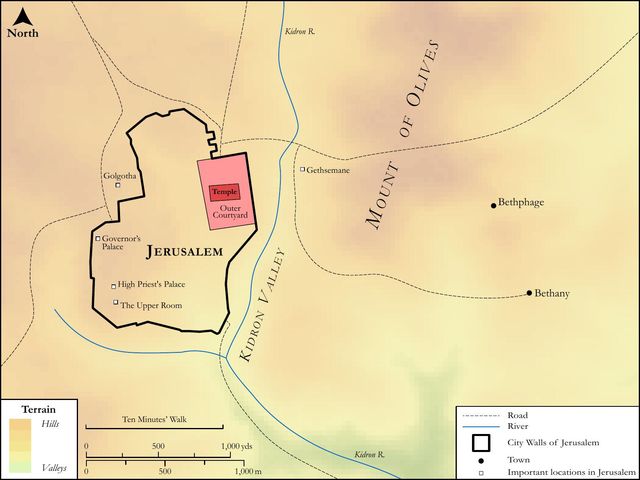
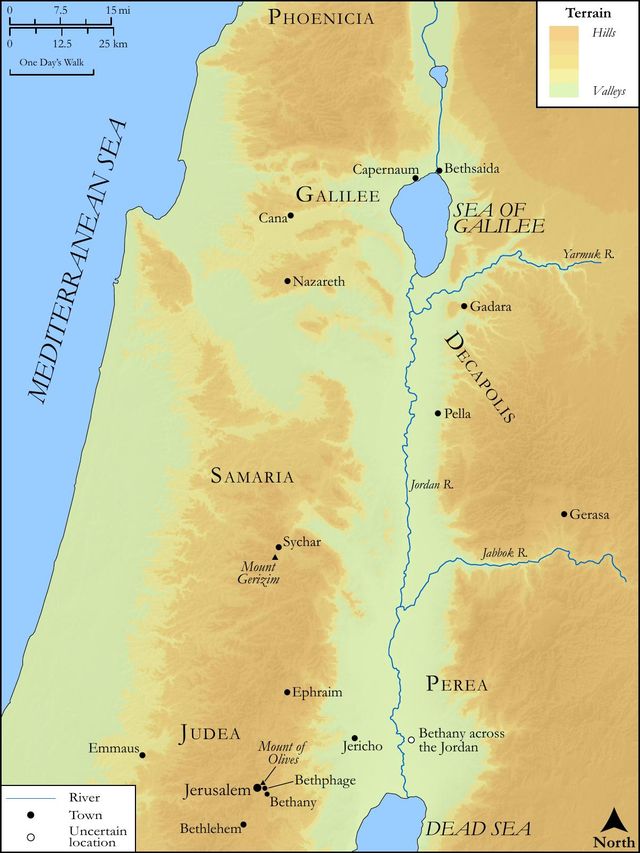
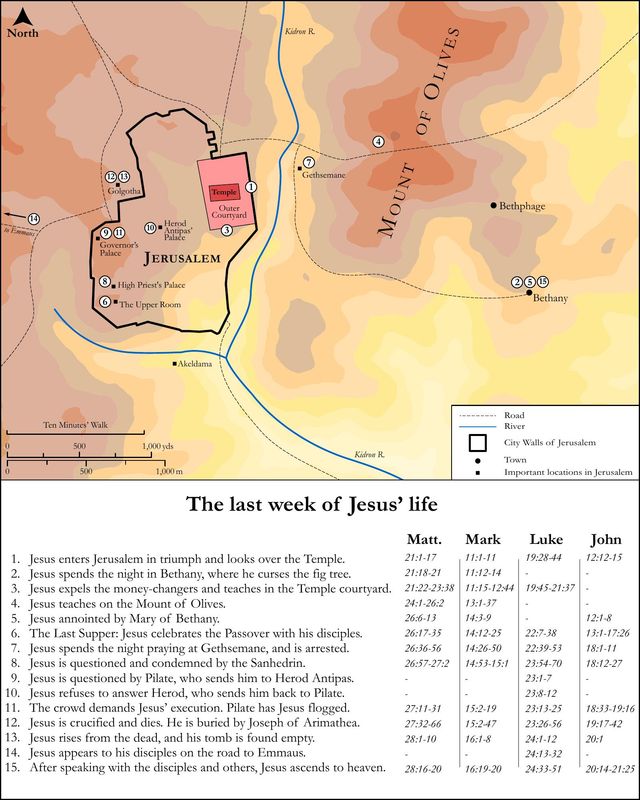
See on the biblical-era map
Study this verse
Public-domain commentary
Matthew Henry
From his Commentary on the Whole Bible. Henry comments on passages, not single verses — this entry covers John 14:1–3. His four-level outline is real structure in the source text, so it is rendered as structure.
In these verses we have,
I.A general caution which Christ gives to his disciples against trouble of heart (Joh 14:1):
Let not your heart be troubled. They now began to be troubled, were entering into this temptation. Now here see,
1.How Christ took notice of it. Perhaps it was apparent in their looks; it was said (Joh 13:22), They looked one upon another with anxiety and concern, and Christ looked upon them all, and observed it; at least, it was intelligible to the Lord Jesus, who is acquainted with all our secret undiscovered sorrows, with the wound that bleeds inwardly; he knows not only how we are afflicted, but how we stand affected under our afflictions, and how near they lie to our hearts; he takes cognizance of all the trouble which his people are at any time in danger of being overwhelmed with; he knows our souls in adversity. Many things concurred to trouble the disciples now.
(1.)Christ had just told them of the unkindness he should receive from some of them, and this troubled them all. Peter, no doubt, looked very sorrowful upon what Christ said to him, and all the rest were sorry for him and for themselves too, not knowing whose turn it should be to be told next of some ill thing or other they should do. As to this, Christ comforts them; though a godly jealousy over ourselves is of great use to keep us humble and watchful, yet it must not prevail to the disquieting of our spirits and the damping of our holy joy.
(2.)He had just told them of his own departure from them, that he should not only go away, but go away in a cloud of sufferings. They must shortly hear him loaded with reproaches, and these will be as a sword in their bones; they must see him barbarously abused and put to death, and this also will be a sword piercing through their own souls, for they had loved him, and chosen him, and left all to follow him. When we now look upon Christ pierced, we cannot but mourn and be in bitterness, though we see the glorious issue and fruit of it; much more grievous must the sight be to them, who could then look no further. If Christ depart from them [1.] They will think themselves shamefully disappointed; for they looked that this had been he that should have delivered Israel, and should have set upon his kingdom in secular power and glory, and, in expectation of this, had lost all to follow him. Now, if he leave the world in the same circumstances of meanness and poverty in which he had lived, and worse, they are quite defeated. [2.] They will think themselves sadly deserted and exposed. They knew by experience what little presence of mind they had in difficult emergencies, that they could count upon nothing but being ruined and run down if they part with their Master. Now, in reference to all these, Let not your heart be troubled. Here are three words, upon any of which the emphasis may significantly be laid. First, Upon the word troubled, mē tarassesthō. Be not so troubled as to be put into a hurry and confusion, like the troubled sea when it cannot rest. He does not say, "Let not your hearts be sensible of the griefs, or sad because of them" but, "Be not ruffled and discomposed, be not cast down and disquieted," Psa 42:5. Secondly, Upon the word heart: "Though the nation and city be troubled, though your little family and flock be troubled, yet let not your heart be troubled. Keep possession of your own souls when you can keep possession of nothing else." The heart is the main fort; whatever you do, keep trouble from this, keep this with all diligence. The spirit must sustain the infirmity, therefore, see that this be not wounded. Thirdly, Upon the word your: "You that are my disciples and followers, my redeemed, chosen, sanctified ones, however others are overwhelmed with the sorrows of this present time, be not you so, for you know better; let the sinners in Zion tremble, but let the sons of Zion be joyful in their king." Herein Christ's disciples should do more than others, should keep their minds quiet, when every thing else is unquiet.
2.The remedy he prescribes against this trouble of mind, which he saw ready to prevail over them; in general, believe - pisteuete.
(1.)Some read it in both parts imperatively, "Believe in God, and his perfections and providence, believe also in me, and my mediation. Build with confidence upon the great acknowledged principles of natural religion: that there is a God, that he is most holy, wise, powerful, and good; that he is the governor of the world, and has the sovereign disposal of all events; and comfort yourselves likewise with the peculiar doctrines of that holy religion which I have taught you." But,
(2.)We read the former as an acknowledgment that they did believe in God, for which he commends them: "But, if you would effectually provide against a stormy day, believe also in me." Through Christ we are brought into covenant with God, and become interested in his favour and promise, which otherwise as sinners we must despair of, and the remembrance of God would have been our trouble; but, by believing in Christ as the Mediator between God and man, our belief in God becomes comfortable; and this is the will of God, that all men should honour the Son as they honour the Father, by believing in the Son as they believe in the Father. Those that rightly believe in God will believe in Jesus Christ, whom he has made known to them; and believing in God through Jesus Christ is an excellent means of keeping trouble from the heart. The joy of faith is the best remedy against the griefs of sense; it is a remedy with a promise annexed to it; the just shall live by faith; a remedy with a probatum est annexed to it. I had fainted unless I had believed.
II.Here is a particular direction to act faith upon the promise of eternal life, Joh 14:2, Joh 14:3.
He had directed them to trust to God, and to trust in him; but what must they trust God and Christ for? Trust them for a happiness to come when this body and this world shall be no more, and for a happiness to last as long as the immortal soul and the eternal world shall last. Now this is proposed as a sovereign cordial under all the troubles of this present time, to which there is that in the happiness of heaven which is admirably adapted and accommodated. The saints have encouraged themselves with this in their greatest extremities, That heaven would make amends for all. Let us see how this is suggested here.
1.Believe and consider that really there is such a happiness: In my Father's house there are many mansions; if it were not so, I would have told you, Joh 14:2.
(1.)See under what notion the happiness of heaven is here represented: as mansions, many mansions in Christ's Father's house.
[1.]Heaven is a house, not a tent or tabernacle; it is a house not made with hands, eternal in the heavens.
[2.]It is a Father's house: my Father's house; and his Father is our Father, to whom he was now ascending; so that in right of their elder brother all true believers shall be welcome to that happiness as to their home. It is his house who is King of kings and Lord of lords, dwells in light, and inhabits eternity.
[3.]There are mansions there; that is, First, Distinct dwellings, an apartment for each. Perhaps there is an allusion to the priests' chambers that were about the temple. In heaven there are accommodations for particular saints; though all shall be swallowed up in God, yet our individuality shall not be lost there; every Israelite had his lot in Canaan, and every elder a seat, Rev 4:4. Secondly, Durable dwellings. Monai, from mneiō, maneo, abiding places. The house itself is lasting; our estate in it is not for a term of years, but a perpetuity. Here we are as in an inn; in heaven we shall gain a settlement. The disciples had quitted their houses to attend Christ, who had not where to lay his head, but the mansions in heaven will make them amends.
[4.]There are many mansions, for there are many sons to be brought to glory, and Christ exactly knows their number, nor will be straitened for room by the coming of more company than he expects. He had told Peter that he should follow him (Joh 13:36), but let not the rest be discouraged, in heaven there are mansions for them all. Rehoboth, Gen 26:22.
(2.)See what assurance we have of the reality of the happiness itself, and the sincerity of the proposal of it to us: "If it were not so, I would have told you. If you had deceived yourselves, when you quitted your livelihoods, and ventured your lives for me, in prospect of a happiness future and unseen, I would soon have undeceived you." The assurance is built, [1.] Upon the veracity of his word. It is implied, "If there were not such a happiness, valuable and attainable, I would not have told you that there was." [2.] Upon the sincerity of his affection to them. As he is true, and would not impose upon them himself, so he is kind, and would not suffer them to be imposed upon. If either there were no such mansions, or none designed for them, who had left all to follow him, he would have given them timely notice of the mistake, that they might have made an honourable retreat to the world again, and have made the best they could of it. Note, Christ's good-will to us is a great encouragement to our hope in him. He loves us too well, and means us too well, to disappoint the expectations of his own raising, or to leave those to be of all men most miserable who have been of him most observant.
2.Believe and consider that the design of Christ's going away was to prepare a place in heaven for his disciples. "You are grieved to think of my going away, whereas I go on your errand, as the forerunner; I am to enter for you." He went to prepare a place for us; that is,
(1.)To take possession for us, as our advocate or attorney, and so to secure our title as indefeasible. Livery of seisin was given to Christ, for the use and behoof of all that should believe on him.
(2.)To make provision for us as our friend and father. The happiness of heaven, though prepared before the foundation of the world, yet must be further fitted up for man in his fallen state. It consisting much in the presence of Christ there, it was therefore necessary that he should go before, to enter into that glory which his disciples were to share in. Heaven would be an unready place for a Christian if Christ were not there. He went to prepare a table for them, to prepare thrones for them, Luk 22:30. Thus Christ declares the fitness of heaven's happiness for the saints, for whom it is prepared.
3.Believe and consider that therefore he would certainly come again in due time, to fetch them to that blessed place which he was now going to possess for himself and prepare for them (Joh 14:3): "If I go and prepare a place for you, if this be the errand of my journey, you may be sure, when every thing is ready, I will come again, and receive you to myself, so that you shall follow me hereafter, that where I am there you may be also." Now these are comfortable words indeed.
(1.)That Jesus Christ will come again; erchomai - I do come, intimating the certainty of it, that he will come and that he is daily coming. We say, We are coming, when we are busy in preparing for our coming, and so he is; all he does has a reference and tendency to his second coming. Note, The belief of Christ's second coming, of which he has given us the assurance, is an excellent preservative against trouble of heart, Phi 4:5; Jam 5:8.
(2.)That he will come again to receive all his faithful followers to himself. He sends for them privately at death, and gathers them one by one; but they are to make their public entry in solemn state all together at the last day, and then Christ himself will come to receive them, to conduct them in the abundance of his grace, and to welcome them in the abundance of his love. He will hereby testify the utmost respect and endearment imaginable. The coming of Christ is in order to our gathering together unto him, Th2 2:1.
(3.)That where he is there they shall be also. This intimates, what many other scriptures declare, that the quintessence of heaven's happiness is being with Christ there, Joh 17:24; Phi 1:23; Th1 4:17. Christ speaks of his being there as now present, that where I am; where I am to be shortly, where I am to be eternally; there you shall be shortly, there you shall be eternally: not only there, in the same place; but here, in the same state: not only spectators of his glory, as the three disciples on the mount, but sharers in it.
(4.)That this may be inferred from his going to prepare a place for us, for his preparations shall not be in vain. He will not build and furnish lodgings, and let them stand empty. He will be the finisher of that of which he is the author. If he has prepared the place for us, he will prepare us for it, and in due time put us in possession of it. As the resurrection of Christ is the assurance of our resurrection, so his ascension, victory, and glory, are an assurance of ours.
Historical interpretation
Ten Centuries of Reception
17 surviving comments on this verse. Each one is dated, so this reads as a timeline rather than a list.
Select a marker to jump to its quote. Markers stagger vertically where authors wrote within a few decades of each other.
As the presbyters say, then those who are deemed worthy of an abode in heaven shall go there, others shall enjoy the delights of Paradise, and others shall possess the splendour of the city; for everywhere the Saviour will be seen, according as they shall be worthy who see Him. But that there is this distinction between the habitation of those who produce an hundred-fold, and that of those who produce sixty-fold, and that of those who produce thirty-fold; for the first will be taken up into the heavens, the second class will dwell in Paradise, and the last will inhabit the city; and that on this account the Lord said, "In my Father's house are many mansions:" for all things belong to God, who supplies all with a suitable dwelling-place, even as His word says, that a share is given to all by the Father, according as each one is or shall be worthy. And this is the couch in which they shall recline who feast, being invited to the wedding. The presbyters, the disciples of the apostles, say that this is the gradation and arrangement of those who are saved, and that they advance through steps of this nature; and that, moreover, they ascend through the Spirit to the Son, and through the Son to the Father; and that in due time the Son will yield up His work to the Father, even as it is said by the apostle, "For He must reign till He hath put all enemies under His feet. The last enemy that shall be destroyed is death."
All things belong to God, who supplies all with a suitable dwelling place, even as his Word says that a share is allotted to all by the Father, according as each person is or shall be worthy. And this is the couch on which the guests shall recline, having been invited to the wedding.
As the Head rose from the dead, so also the remaining part of the body—[namely, the body] of every man who is found in life—when the time is fulfilled of that condemnation which existed by reason of disobedience, may arise, blended together and strengthened through means of joints and bands by the increase of God, each of the members having its own proper and fit position in the body. For there are many mansions in the Father's house, inasmuch as there are also many members in the body.
How will there be many mansions in our Father’s house, if not to match the diversity of what each deserves? How will one star also differ from another star in glory, unless in virtue of disparity in their rays?
Else how shall we sing thanks to God to eternity, if there shall remain in us no sense and memory of this debt; if we shall be reformed in substance, not in consciousness? Consequently, we who shall be with God shall be together; since we shall all be with the one God-albeit the wages be various, albeit there be "many mansions", in the house of the same Father having laboured for the "one penny " of the self-same hire, that is, of eternal life; in which (eternal life) God will still less separate them whom He has conjoined, than in this lesser life He forbids them to be separated.
Owing to the fact that our flesh is undergoing dissolution through its sufferings, we shall be provided with a home in heaven.… Because he had called the flesh a house, he wanted to use the same term elegantly in his comparison of the ultimate reward, promising to the very house that undergoes dissolution through suffering a better house through the resurrection, just as the Lord also promises us many mansions like that of a house in his Father’s home.
Because, however, he had called the flesh a house, he wished elegantly to use the same term in his comparison of the ultimate reward; promising to the very house, which undergoes dissolution through suffering, a better house through the resurrection. Just as the Lore also promises us many mansions as of a house in His Father's home; although this may possibly be understood of the domicile of this world, on the dissolution of whose fabric an eternal abode is promised in heaven, inasmuch as the following context, having a manifest reference to the flesh, seems to show that these preceding words have no such reference.
And Callistus, who was in the habit of always associating with Zephyrinus, and, as I have previously stated, of paying him hypocritical service, disclosed, by force of contrast, Zephyrinus to be a person able neither to form a judgment of things said, nor discerning the design of Callistus, who was accustomed to converse with Zephyrinus on topics which yielded satisfaction to the latter. Thus, after the death of Zephyrinus, supposing that he had obtained (the position) after which he so eagerly pursued, he excommunicated Sabellius, as not entertaining orthodox opinions. He acted thus from apprehension of me, and imagining that he could in this manner obliterate the charge against him among the churches, as if he did not entertain strange opinions. He was then an impostor and knave, and in process of time hurried away many with him. And having even venom imbedded in his heart, and forming no correct opinion on any subject, and yet withal being ashamed to speak the truth, this Callistus, not only on account of his publicly saying in the way of reproach to us, "Ye are Ditheists," but also on account of his being frequently accused by Sabellius, as one that had transgressed his first faith, devised some such heresy as the following. Callistus alleges that the Logos Himself is Son, and that Himself is Father; and that though denominated by a different title, yet that in reality He is one indivisible spirit. And he maintains that the Father is not one person and the Son another, but that they are one and the same; and that all things are full of the Divine Spirit, both those above and those below. And he affirms that the Spirit, which became incarnate in the virgin, is not different from the Father, but one and the same. And he adds, that this is what has been declared by the Saviour: "Believest thou not that I am in the Father, and the Father in me? " For that which is seen, which is man, he considers to be the Son; whereas the Spirit, which was contained in the Son, to be the Father. "For," says (Callistus), "I will not profess belief in two Gods, Father and Son, but in one. For the Father, who subsisted in the Son Himself, after He had taken unto Himself our flesh, raised it to the nature of Deity, by bringing it into union with Himself, and made it one; so that Father and Son must be styled one God, and that this Person being one, cannot be two." And in this way Callistus contends that the Father suffered along with the Son; for he does not wish to assert that the Father suffered, and is one Person, being careful to avoid blasphemy against the Father. (How careful he is!) senseless and knavish fellow, who improvises blasphemies in every direction, only that he may not seem to speak in violation of the truth, and is not abashed at being at one time betrayed into the tenet of Sabellius, whereas at another into the doctrine of Theodotus.
Are there many mansions in God’s house, as you have heard, or only one? Of course you will admit that there are many, and not just one. Now, are they all to be filled, or only some, and others not, so that some will be left empty and will have been prepared to no purpose? Of course all will be filled, for nothing can be in vain that has been done by God.
(Hom. lxxiii. 1) Or thus: Our Lord having said above to Peter, Whither I go, thou canst not follow Me now, but thou shalt follow Me afterwards, that they might not think that this promise was made to Peter only, He says, In My Father's house are many mansions; i. e. You shall be admitted into that place, as well as Peter, for it contains abundance of mansions, which are ever ready to receive you: If it were not so, I would have told you: I go to prepare a place for you.
With my Father there is such an abundance that he can give everyone the delights of eternal happiness.… He tells us that here since the custom among us, when space is scarce, is to reserve a place to stay in advance due to lack of available rooms.
(Tr. lxvii. 2) And as the disciples were afraid for themselves, when Peter, the boldest and most zealous of them, had been told, The cock shall not crow, till thou hast denied Me thrice, He adds, In My Father's house are many mansions, by way of an assurance to them in their trouble, that they might with confidence and certainty look forward, after all their trials, to dwelling together with Christ in the presence of God. For though one man is bolder, wiser, juster, holier than another, yet no one shall be removed from that house of God, but each receive a mansion suited to his deserts. The penny indeed which the householder paid to the labourers who worked in his vineyard, was the same to all; for life eternal, which this penny signifies, is of the same duration to all. But there may be many mansions, many degrees of dignity, in that life, corresponding to people's deserts.
(Tr. lxvii. 2) And thus God will be all in all; that is, since God is love, love will bring it to pass, that what each has, will be common to all. That which one loves in another is one's own, though one have it not one's self. And then there will be no envy at superior grace, for in all hearts will reign the unity of love.
(Tr. lxvii. 3) But they are rejected by the Christians, who infer from there being many mansions that there is a place outside the kingdom of heaven, where innocent souls, that have departed this life without baptism, and could not there enter into the kingdom of heaven, remain happy. But God forbid, that when every house of every heir of the kingdom is in the kingdom, there should be a part of the regal house itself not in the kingdom. Our Lord does not say, In eternal bliss are many mansions, but they are in My Father's house.
He means evidently that there are already many mansions, and that there is no need of His preparing one.
(Tract. lxviii. 1) But why does He go and prepare a place, if there are many mansions already? Because these are not as yet so prepared as they will be. The same mansions that He hath prepared by predestination, He prepares by operation. They are prepared already in respect of predestination; if they were not, He would have said, I will go and prepare, i. e. predestinate, a place for you; but inasmuch as they are not yet prepared in respect of operation, He says, And if I go and prepare a place for you. And now He is preparing mansions, by preparing occupants for them. Indeed, when He says, In My Father's house are many mansions, what think we the house of God to be but the temple of God, of which the Apostle saith, The temple of God is holy, which temple ye are. (1 Cor. 3:17) This house of God then is now being built, now being prepared. (c. 3.). But why has He gone away to prepare it, if it is ourselves that He prepares: if He leaves us, how can He prepare us? The meaning is, that, in order that those mansions may be prepared, the just must live by faith: and if thou seest, there is no faith. Let Him go away then, that He be not seen; let Him be hid, that He be believed. Then a place is prepared, if thou live by faith: let faith desire, that desire may enjoy. If thou rightly understandest Him, He never leaves either the place He came from, or that He goes from. He goes, when He withdraws from sight, He comes, when He appears. But except He remain in power, that we may grow in goodness, no place of happiness will be prepared for us.
We acknowledge, beloved brethren, that we are owing you, and ought now to repay, what was left over for consideration, how we can understand that there is no real mutual contrariety between these two statements, namely, that after saying, "In my Father's house are many mansions: if it were not so, I would have told you, that I go to prepare a place for you;"-where He makes it clear enough that He said so to them for the very reason that there are many mansions there already, and there is no need of preparing any; -the Lord again says: "And if I go and prepare a place for you, I will come again and receive you unto myself; that where I am, there ye may be also." How is it that He goes and prepares a place, if there are many mansions already? If there were not such, He would have said, "I go to prepare." Or if the place has still to be prepared, would He not then also properly have said, "I go to prepare"? Are these mansions in existence already, and yet needing still to be prepared? For if they were not in existence, He would have said, "I go to prepare." And yet, because their present state of existence is such as still to stand in need of preparation, He does not go to prepare them in the same sense as they already exist; but if He go and prepare them as they shall be hereafter, He will come again and receive His own to Himself: that where He is, there they may be also.
How then are there mansions in the Father's house, and these not different ones but the same, which already exist in a sense in which they can admit of no preparation, and yet do not exist, inasmuch as they are still to be prepared? How are we to think of this, but in the same way as the prophet, who also declares of God, that He has [already] made that which is yet to be. For he says not, Who will make what is yet to be, but, "Who has made what is yet to be." Therefore He has both made such things and is yet to make them. For they have not been made at all if He has not made them; nor will they ever be if He make them not Himself. He has made them therefore in the way of fore-ordaining them; He has yet to make them in the way of actual elaboration. Just as the Gospel plainly intimates when He chose His disciples, that is to say, at the time of His calling them; and yet the apostle says, "He chose us before the foundation of the world," to wit, by predestination, not by actual calling. "And whom He did predestinate, them He also called;" He hath chosen by predestination before the foundation of the world, He chooses by calling before its close. And so also has He prepared those mansions, and is still preparing them and He who has already made the things which are yet to be, is now preparing, not different ones, but the very mansions He has already prepared: what He has prepared in predestination, He is preparing by actual working. Already, therefore, they are, as respects predestination; if it were not so, He would have said, I will go and prepare, that is, I will predestinate. But because they are not yet in a state of practical preparedness He says, "And if I go and prepare a place for you, I will come again, and receive you unto myself."
But He is in a certain sense preparing the dwellings by preparing for them the dwellers. As, for instance, when He said, "In my Father's house are many dwellings," what else can we suppose the house of God to mean but the temple of God? And what that is, ask the apostle, and he will reply, "For the temple of God is holy, which [temple] ye are." This is also the kingdom of God, which the Son is yet to deliver up to the Father; and hence the same apostle says, "Christ, the beginning, and then they that are Christ's in His presence; then [cometh] the end, when He shall have delivered up the kingdom to God, even the Father;" that is, those whom He has redeemed by His blood, He shall then have delivered up to stand before His Father's face. This is that kingdom of heaven whereof it is said, "The kingdom of heaven is likened unto a man who sowed good seed in his field. But the good seed are the children of the kingdom;" and although now they are mingled with tares, at the end the King Himself shall send forth His angels, "and they shall gather out of His kingdom all things that offend. Then shall the righteous shine forth as the sun in the kingdom of their Father."
But why is it that He went away to make such preparation, when, as it is certainly we ourselves that are the subjects in need of preparation, His doing so will be hindered by leaving us behind? I explain it, Lord, as I can: it was surely this Thou didst signify by the preparation of those mansions, that the just ought to live by faith. For he who is sojourning at a distance from the Lord has need to be living by faith, because by this we are prepared for beholding His countenance. For "blessed are the pure in heart, for they shall see God;" and "He purifieth their hearts by faith." The former we find in the Gospel, the latter in the Acts of the Apostles. But the faith by which those who are yet to see God have their hearts purified, while sojourning at a distance here, believeth what it doth not see; for if there is sight, there is no longer faith. Merit is accumulating now to the believer, and then the reward is paid into the hand of the beholder. Let the Lord then go and prepare us a place; let Him go, that He may not be seen; and let Him remain concealed, that faith may be exercised. For then is the place preparing, if it is by faith we are living. Let the believing in that place be desired, that the place desired may itself be possessed; the longing of love is the preparation of the mansion. Prepare thus, Lord, what Thou art preparing; for Thou art preparing us for Thyself, and Thyself for us, inasmuch as Thou art preparing a place both for Thyself in us, and for us in Thee. For Thou hast said, "Abide in me, and I in you." As far as each one has been a partaker of Thee, some less, some more, such will be the diversity of rewards in proportion to the diversity of merits; such will be the multitude of mansions to suit the inequalities among their inmates; but all of them, none the less, eternally living, and endlessly blessed.
But why have we this that follows, "In my Father's house are many mansions," but that they were also in fear about themselves? And therein they might have heard the words, "Let not your heart be troubled." For, was there any of them that could be free from fear, when Peter, the most confident and forward of them all, was told, "The cock shall not crow till thou hast denied me thrice"? Considering themselves, therefore, beginning with Peter, as destined to perish, they had cause to be troubled: but when they now hear, "In my Father's house are many mansions: if it were not so, I would have told you; for I go to prepare a place for you," they are revived from their trouble, made certain and confident that after all the perils of temptations they shall dwell with Christ in the presence of God. For, albeit one is stronger than another, one wiser than another, one more righteous than another, "in the Father's house there are many mansions;" none of them shall remain outside that house, where every one, according to his deserts, is to receive a mansion. All alike have that penny, which the householder orders to be given to all that have wrought in the vineyard, making no distinction therein between those who have labored less and those who have labored more: by which penny, of course, is signified eternal life, whereto no one any longer lives to a different length than others, since in eternity life has no diversity in its measure. But the many mansions point to the different grades of merit in that one eternal life. For there is one glory of the sun, another glory of the moon, and another glory of the stars: for one star differeth from another star in glory; and so also the resurrection of the dead. The saints, like the stars in the sky, obtain in the kingdom different mansions of diverse degrees of brightness; but on account of that one penny no one is cut off from the kingdom; and God will be all in all in such a way, that, as God is love, love will bring it about that what is possessed by each will be common to all. For in this way every one really possesses it, when he loves to see in another what he has not himself. There will not, therefore, be any envying amid this diversity of brightness, since in all of them will be reigning the unity of love.
Every Christian heart, therefore, must utterly reject the idea of those who imagine that there are many mansions spoken of, because there will be some place outside the kingdom of heaven, which shall be the abode of those blessed innocents who have departed this life without baptism, because without it they cannot enter the kingdom of heaven. Faith like this is not faith, inasmuch as it is not the true and catholic faith. Are you not so foolish and blinded with carnal imaginations as to be worthy of reprobation, if you should thus separate the mansion, I say not of Peter and Paul, or any of the apostles, but even of any baptized infant from the kingdom of heaven; do you not think yourselves deserving of reprobation in thus putting a separation between these and the house of God the Father? For the Lord's words are not, In the whole world, or, In all creation, or, In everlasting life and blessedness, there are many mansions; but He says, "In my Father's house are many mansions." Is not that the house where we have a building of God, a house not made with hands, eternal in the heavens? Is not that the house whereof we sing to the Lord, "Blessed are they that dwell in Thy house; they shall praise Thee for ever and ever"? Will you then venture to separate from the kingdom of heaven the house, not of every baptized brother, but of God the Father Himself, to whom all we who are brethren say, "Our Father, who art in heaven," or divide it in such a way as to make some of its mansions inside, and some outside, the kingdom of heaven? Far, far be it from those who desire to dwell in the kingdom of heaven, to be willing to dwell in such folly with you: far be it, I say, that since every house of sons that are reigning can be nowhere else but in the kingdom, any part of the royal house itself should be outside the kingdom.
"And if I go," He says, "and prepare a place for you, I will come again, and receive you unto myself; that where I am, there ye may be also. And whither I go ye know, and the way ye know." O Lord Jesus, how goest Thou to prepare a place, if there are already many mansions in Thy Father's house, where Thy people shall dwell with Thyself? Or if Thou receivest them unto Thyself, how wilt Thou come again, who never withdrawest Thy presence? Such subjects as these, beloved, were we to attempt to explain them with such brevity as seems within the proper bounds of our discourse to-day, would certainly suffer in clearness from compression, and the very brevity would become itself a second obscurity; we shall therefore defer this debt, which the bounty of our Family head will enable us to repay at a more suitable opportunity.
Having forcibly enjoined upon them that they ought not to be troubled, and having bidden them rather believe both in God the Father and in Himself, He now tells them plainly as an encouragement to them to shake off their feebleness of mind, that they shall not be excluded from the holy courts, but shall be made to dwell in the mansions above, living their eternal life in the Church of the Firstborn, in the enjoyment of bliss unending. He says moreover that in His Father's house are many mansions, teaching them thereby that heaven is wide enough for all, and that the world He has created needs no enlargement at all to make it capable of containing those who love Him. And it seems likely that in speaking of the many mansions He wishes also to indicate the different grades of honour, implying that each one who desires to live a life of virtue will receive as it were his own peculiar place, and the glory that is suitable to his own individual acts. Therefore if the mansions in God the Father's home had not been many in number, He would have said that He was going on before them, namely to prepare beforehand the habitations of the saints: but knowing that there are many such, already fully prepared and awaiting the arrival of those who love God, He says that He will depart not for this purpose, but for the sake of securing the way to the mansions above, to prepare a passage of safety for you, and to smooth the path that was impassable in old time. For heaven was then utterly inaccessible to mortal man, and no flesh as yet had ever trodden that pure and all-holy realm of the angels; but Christ was the first Who consecrated for us the means of access to Himself, and granted to flesh a way of entrance into heaven; presenting Himself as an offering to God the Father, as it were the firstfruits of them that are asleep and are lying in the tomb, and the first of mankind that ever appeared in heaven. Therefore also it was that the angels in heaven, knowing nothing of the august and stupendous mystery of the Incarnation, were astonished in wonder at His coming, and exclaim almost in perplexity at the strange and unusual event: Who is this that cometh from Edom? that is, from the earth. But the Spirit did not leave the host above uninstructed in the marvellous wisdom of God the Father, but bade them rather open the heavenly gates in honour to the King and Master of all, proclaiming: Lift up the gates, O ye princes, and be ye lift up, ye everlasting doors, and the King of Glory shall come in. Therefore our Lord Jesus the Christ consecrated for us a new and living way, as Paul says; not having entered into a holy place made with hands, but into heaven itself, now to appear before the face of God for us. For it is not that He may present Himself before the presence of God the Father that Christ has ascended up on high: for He ever was and is and will be continually in the Father, in the sight of Him Who begat Him, for He it is in Whom the Father ever takes delight: but now He Who of old was the Word with no part or lot in human nature, has ascended in human form that He may appear in heaven in a strange and unwonted manner. And this He has done on our account and for our sakes, in order that He, though found as a man, may still in His absolute power as Son, while yet in human form, obey the command: Sit Thou on My right hand, and so may transfer the glory of adoption through Himself to all the race. For in that He has appeared in human form He is still one of us as He sits at the right hand of God the Father, even though He is far above all creation; and He is also Consubstantial with His Father, in that He has come forth from Him as truly God of God and Light of Light. He has presented Himself therefore as Man to the Father on our behalf, that so He may restore us, who had been removed from the Father's presence by the ancient transgression, again as it were to behold the Father's face. He sits there in His position as Son, that so also we through Him may be called sons and children of God. For this reason also Paul, who insists that he has Christ speaking by his voice, teaches us to regard the events that happened in the life of Christ alone as common to the whole race; saying that God raised us up with Him, and made us to sit with Him in the heavenly places, in Christ. For to Christ, as by nature Son, it belongs as a special prerogative to sit at the Father's side, and the glory of this dignity we can ascribe rightly and truly to Him, and Him alone. But the fact that Christ Who sits there is in all points like unto us, in that He has appeared as Man, while we believe Him to be God of God, seems to confer on us also the privilege of this dignity. For even if we shall not sit at the side of the Father Himself,----for how could the servant ever ascend to equal honour with the master?----yet nevertheless Christ promised the holy disciples that they should sit on thrones. For He says: When the Son of Man shall sit on the throne of His glory, ye also shall sit upon twelve thrones, judging the twelve tribes of Israel.
"I shall not then," He says, "depart to prepare mansions for you, for many there are already, and to make new habitations for creation is needless; but I go to make ready a place for you on account of the sin that has mastery over you, that so those who are on the earth may be able to be mingled with the holy angels; for else the saintly multitude of those above would never have mingled with those who had been so denied. But now, when I shall have accomplished this work, and united the world below to the world above, and given you a path of access to the city on high, I will return again at the time of the regeneration, and receive you 5 with Myself; that where I am, there ye may be also." And this is also in the mind of Paul, when he thus writes in his own letter: For this we say unto you by the word of the Lord, that we that are alive, that are left unto the coming of the Lord, shall in no wise precede them that are fallen asleep. For the Lord Himself shall descend from heaven, with a shout, with the voice of the archangel, and with the trump of God: and the dead in Christ shall rise first: then we that are alive, that are left, shall together with them be caught up in the clouds, to meet the Lord in the air: and so shall we ever be with the Lord.
(Super Ezech. Hom. xvi.) The many mansions agree with the one penny, because, though one may rejoice more than another, yet all rejoice with one and the same joy, arising from the vision of their Maker.
(Moral. ult. c. xxiv.) Nor is there any sense of deficiency in consequence of such inequality; for each will feel as much as sufficeth for himself.
And if not, I would have told you: I go to prepare, &c. As if He said; Either way ye should not be troubled, whether places are prepared for you, or not. For, if they are not prepared, I will very quickly prepare them.
Continue studying John 14:2 across the web’s major study libraries — every link below opens this exact verse, chapter, or book on the destination site.
Read & Compare
 BibleGatewayThis verse in more than 200 translations and 70 languages.
 Bible.comThe YouVersion reader — hundreds of translations, reading plans, and highlights.
 ESV.orgCrossway's official English Standard Version reader.
 NET BibleThe NET translation with 60,000+ translators' notes on every rendering decision.
 STEP BibleTyndale House's free study tool — original text, vocabulary, and scholarly resources.
 BibliaLogos Bible Software's free web reader.
 USCCBThe New American Bible (Revised Edition) with the U.S. bishops' study notes.
Commentaries
 BibleHub CommentariesDozens of classic commentaries on this verse, gathered on one page.
 StudyLightMore than 100 commentary sets — the largest collection on the web.
 BibleRefPlain-English commentary on what this verse means, verse by verse.
 Enduring WordDavid Guzik's free commentary on this chapter, widely used by Bible teachers.
 Bible Study ToolsVerse commentary alongside Greek and Hebrew study aids.
Original Language & Research
- BibleHub InterlinearThe verse word by word — original language, transliteration, and English.
- BibleHub LexiconEvery word's original-language definition and Strong's entry.
 Blue Letter BibleDeep-study tools — Strong's numbers, concordance, and word studies.
 CNTR CollationThe earliest Greek manuscripts of this verse, collated letter by letter.
Sermons, Hymns & Audio


TrulyRandomVerse is not affiliated with these sites and doesn’t control their content. They’re linked because they’re genuinely useful.
Summary
In John 14:2, Jesus offers profound comfort and reassurance to His disciples, who are troubled by His impending departure. He reveals the glorious truth that in His Father's heavenly dwelling, there are abundant and permanent dwelling places for all believers. Jesus affirms the certainty of this promise by stating He would have informed them otherwise, and He declares His immediate purpose in "going" is to actively prepare these eternal residences for them, thereby securing their future with God.
Context
ShowHideLiterary Context
This verse is an integral part of Jesus's farewell discourse to His disciples, spanning John 13 through John 17. Following the Last Supper, the washing of the disciples' feet, and the shocking revelation of Judas's betrayal, the disciples are understandably distressed and confused. Jesus knows their hearts are troubled, and He directly addresses their anxiety by beginning this section with the comforting words, "Let not your heart be troubled. John 14:2 immediately follows this, serving as the foundational promise that grounds their hope and peace, shifting their focus from earthly uncertainty to eternal security. The discourse continues to unfold themes of the Holy Spirit's coming, the disciples' future mission, and Jesus's unity with the Father.
Historical & Cultural Context
In ancient Near Eastern culture, the concept of a "father's house" (Hebrew: beit 'av) was deeply significant, representing not merely a physical dwelling but the entire extended family, its heritage, security, and identity. It was the place of belonging, provision, and protection. Jesus's use of "my Father's house" would have resonated strongly with His Jewish disciples, evoking images of a secure, familial abode. Furthermore, the idea of a host preparing a place for guests was a common practice of hospitality, signifying welcome and honor. Jesus's promise to "prepare a place" would have assured them of His unwavering commitment to their well-being and future, akin to a host ensuring every detail was ready for honored guests.
Key Themes
ShowHideJohn 14:2 contributes significantly to several overarching themes within the Gospel of John and the broader biblical narrative. It powerfully reinforces the theme of Divine Assurance and Comfort, as Jesus directly addresses the disciples' fears with a promise of eternal security. The phrase "my Father's house" highlights the theme of Intimate Relationship with God, portraying heaven not as a distant, impersonal realm but as a warm, familial home where believers belong. Jesus's declaration, "I go to prepare a place for you," underscores the theme of Jesus's Preparatory and Mediatorial Work, emphasizing His active role in securing salvation and access to God's presence, a work that culminates in His death, resurrection, and ascension (John 12:32). Finally, the statement "if it were not so, I would have told you" reinforces the theme of Jesus's Absolute Truthfulness and Trustworthiness, presenting Him as the embodiment of truth who always speaks plainly and without deception, as He states in John 14:6.
Exposition and Analysis
ShowHideKey Word Analysis
ShowHideFrom the Greek word G3438, meaning "a staying, i.e., residence (the act or the place); abode, mansion." This term does not necessarily imply grand, palatial structures, but rather secure, permanent, and personal dwelling places. The emphasis is on stability, permanence, and the idea of "abiding" or "remaining," suggesting a lasting relationship and secure home rather than a temporary lodging.
From the Greek word G3614, meaning "properly, residence (abstractly), but usually (concretely) an abode (literally or figuratively); by implication, a family (especially domestics); home, house(-hold)." In this context, "Father's house" signifies not just a physical structure but the very presence, domain, and family of God, emphasizing intimacy, belonging, and security within the divine household.
From the Greek word G2090, meaning "to prepare, provide, make ready." This word highlights Jesus's intentional, active, and purposeful work. His "going" is not an abandonment but a deliberate act of making everything ready for His followers' arrival, signifying His ongoing care and commitment to their eternal well-being.
Verse Breakdown
ShowHide"In my Father's house are many mansions"
This clause establishes the setting and the abundance of provision. "My Father's house" is a metaphor for heaven, the ultimate dwelling place of God, signifying a place of familial intimacy and divine presence. The "many mansions" (or abiding places/rooms) convey that there is ample space and a secure, personalized dwelling for every believer, emphasizing God's boundless hospitality and the vastness of His eternal home.
"if [it were] not [so], I would have told you."
This segment underscores Jesus's absolute honesty and trustworthiness. It serves as a divine guarantee, assuring the disciples that this promise is not a mere comforting platitude but an undeniable truth. Jesus, who always speaks the truth and knows all things, would never mislead them about such a crucial matter concerning their eternal destiny. His integrity is the bedrock of their hope.
"I go to prepare a place for you."
This final clause reveals Jesus's immediate purpose and active role in securing the disciples' future. His "going" refers to His impending crucifixion, resurrection, and ascension. This journey is not an abandonment but a necessary step in His redemptive work, through which He makes it possible for humanity to enter God's presence and inherit eternal life. He is actively making ready the way and the dwelling for His followers.
Literary Devices
ShowHideJohn 14:2 is rich with significant literary devices that amplify its message of comfort and assurance. The most prominent is Metaphor, specifically in "my Father's house" and "many mansions." "My Father's house" functions as a metaphor for heaven, portraying it not as a distant, abstract concept but as a tangible, familial home, emphasizing intimacy, belonging, and security within the divine family. The "mansions" (or abiding places) further extend this metaphor, suggesting personal and permanent dwellings within this divine household, assuring each believer of a secure place. The phrase "I go to prepare a place for you" employs Symbolism, where Jesus's "going" symbolizes His entire redemptive work—His death, resurrection, and ascension—which is the ultimate act of "preparation" that opens the way to the Father's presence. Finally, Jesus's statement, "if it were not so, I would have told you," utilizes Understatement (or litotes), subtly emphasizing His absolute truthfulness and the certainty of His promise by stating the negative (He would not have withheld the truth) to affirm the positive (He is telling the truth).
Theological and Thematic Connections
ShowHideJohn 14:2 is a cornerstone of Christian eschatology and hope, deeply rooted in the biblical narrative of God's desire to dwell with His people. It speaks to the ultimate fulfillment of God's covenant promises, where His presence is fully realized in a secure and eternal home. This verse powerfully articulates the reality of a prepared afterlife, not as an ethereal, undefined state, but as a relational dwelling with God, secured by Christ's redemptive work. It underscores the active, loving provision of God the Father and God the Son for the eternal well-being of believers, assuring them of a permanent inheritance and intimate communion in the divine presence.
Reflection and Application
ShowHideJohn 14:2 offers profound comfort and stability for believers navigating the uncertainties and sorrows of this world. Knowing that Jesus Himself has gone ahead to prepare a permanent dwelling place in the Father's house provides an anchor for the soul, transforming our perspective from temporal anxieties to eternal hope. This promise alleviates the fear of death, offers solace in grief, and instills a deep sense of belonging and security that transcends earthly circumstances. It calls us to live with an eternal mindset, prioritizing what truly lasts—our relationship with God and our eternal home—over fleeting worldly pursuits. This truth empowers us to face trials with courage, knowing that our ultimate destination is secured by Christ's unwavering love and faithfulness, motivating us to live lives worthy of the glorious future that awaits us.
Questions for Reflection
ShowHideFAQ
ShowHideWhat does "mansions" mean in John 14:2?
ShowHideThe King James Version's translation of "mansions" comes from the Greek word monē (μονή), which means "an abiding place," "a dwelling," or "a permanent residence." It does not necessarily imply grand, palatial structures as the English word "mansion" might suggest today. Instead, the emphasis is on the permanence, security, and personal nature of the dwelling. It assures believers that there are ample, secure, and lasting accommodations for all who belong to Christ in God's eternal home, emphasizing a place of belonging and intimate relationship, rather than just a physical space.
Christ-Centered Fulfillment
ShowHideJohn 14:2 finds its ultimate Christ-centered fulfillment in Jesus's redemptive work, which is the very "preparation" He speaks of. His "going" is not a mere departure but a purposeful journey to the cross, where He would offer Himself as the perfect sacrifice for sin, thereby reconciling humanity to God. His subsequent resurrection from the dead demonstrates His victory over sin and death, and His ascension to the right hand of the Father signifies His enthronement as Lord and High Priest, interceding for His people (Hebrews 7:25). Through His death, resurrection, and ascension, Jesus has opened the way for believers to enter the Father's presence, a path that was previously inaccessible due to sin (Hebrews 10:19-20). Thus, the "place" Jesus prepares is not just a physical dwelling, but the very possibility of eternal life and communion with God, secured by His atoning work and ongoing mediation. He is the "way, the truth, and the life" (John 14:6), and through Him, believers gain access to the "Father's house," fulfilling God's eternal purpose to dwell with His people (Revelation 21:3).