


John 14:1
- ΜὴMēNotG3361PRT-NNegative Particle Negative
- ταρασσέσθωtarassesthōshould be troubledG5015V-PPM-3SVerb Present Passive Imperative 3rd Singular
- ὑμῶνhumōnof youG4771P-2GPPersonal pronoun Genitive 2nd Plural
- ἡhētheG3588T-NSFDefinite article Nominative Singular Feminine
- καρδία·kardiaheartG2588N-NSFNoun Nominative Singular Feminine
- πιστεύετεpisteueteYou believeG4100V-PAI-2PVerb Present Active Indicative 2nd Plural
- εἰςeisinG1519PREPPreposition
- τὸνton<the>G3588T-ASMDefinite article Accusative Singular Masculine
- θεὸνtheonGodG2316N-ASM-TNoun Accusative Singular Masculine Title
- καὶkaialsoG2532CONJConjunction
- εἰςeisinG1519PREPPreposition
- ἐμὲemeMe myselfG1473P-1ASPersonal pronoun Accusative 1st Singular
- πιστεύετεpisteuetebelieveG4100V-PAI-2PVerb Present Active Indicative 2nd Plural
English is a literal word-by-word gloss of the Greek, not the KJV's wording. Why?
This is the original text the KJV's translators worked from — each Greek word with its own literal English meaning in this verse, prepared by scholars at Tyndale House, Cambridge. The KJV translates whole sentences, not word by word, so its wording differs: one Greek word can become several English words, and the KJV may choose “charity” where the gloss reads “love”. Both are faithful — they answer different questions. For the KJV's own rendering, switch to the KJV text.
Details
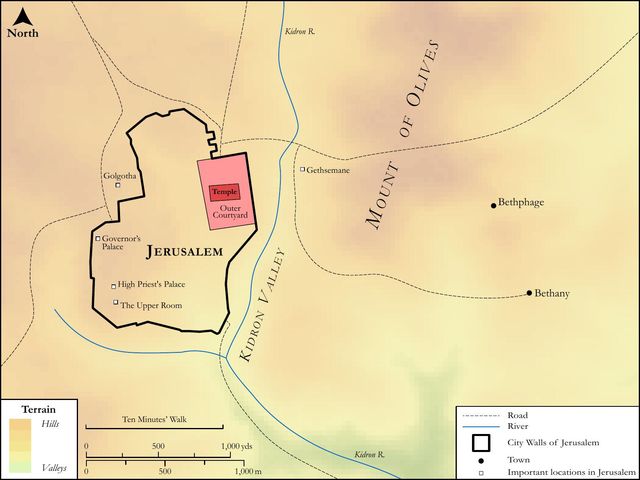
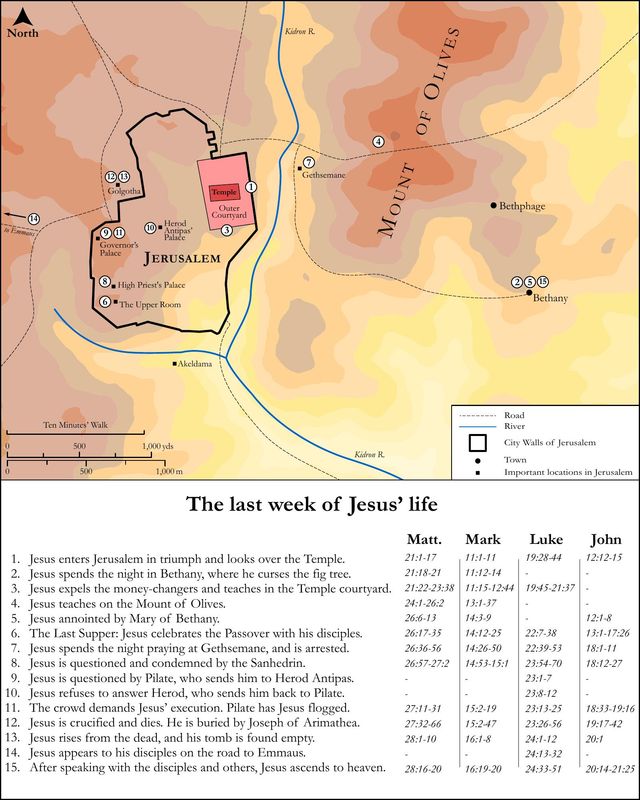
See on the biblical-era maps

Study this verse
Public-domain commentary
Matthew Henry
From his Commentary on the Whole Bible. Henry comments on passages, not single verses — this entry covers John 14:1–3. His four-level outline is real structure in the source text, so it is rendered as structure.
In these verses we have,
I.A general caution which Christ gives to his disciples against trouble of heart (Joh 14:1):
Let not your heart be troubled. They now began to be troubled, were entering into this temptation. Now here see,
1.How Christ took notice of it. Perhaps it was apparent in their looks; it was said (Joh 13:22), They looked one upon another with anxiety and concern, and Christ looked upon them all, and observed it; at least, it was intelligible to the Lord Jesus, who is acquainted with all our secret undiscovered sorrows, with the wound that bleeds inwardly; he knows not only how we are afflicted, but how we stand affected under our afflictions, and how near they lie to our hearts; he takes cognizance of all the trouble which his people are at any time in danger of being overwhelmed with; he knows our souls in adversity. Many things concurred to trouble the disciples now.
(1.)Christ had just told them of the unkindness he should receive from some of them, and this troubled them all. Peter, no doubt, looked very sorrowful upon what Christ said to him, and all the rest were sorry for him and for themselves too, not knowing whose turn it should be to be told next of some ill thing or other they should do. As to this, Christ comforts them; though a godly jealousy over ourselves is of great use to keep us humble and watchful, yet it must not prevail to the disquieting of our spirits and the damping of our holy joy.
(2.)He had just told them of his own departure from them, that he should not only go away, but go away in a cloud of sufferings. They must shortly hear him loaded with reproaches, and these will be as a sword in their bones; they must see him barbarously abused and put to death, and this also will be a sword piercing through their own souls, for they had loved him, and chosen him, and left all to follow him. When we now look upon Christ pierced, we cannot but mourn and be in bitterness, though we see the glorious issue and fruit of it; much more grievous must the sight be to them, who could then look no further. If Christ depart from them [1.] They will think themselves shamefully disappointed; for they looked that this had been he that should have delivered Israel, and should have set upon his kingdom in secular power and glory, and, in expectation of this, had lost all to follow him. Now, if he leave the world in the same circumstances of meanness and poverty in which he had lived, and worse, they are quite defeated. [2.] They will think themselves sadly deserted and exposed. They knew by experience what little presence of mind they had in difficult emergencies, that they could count upon nothing but being ruined and run down if they part with their Master. Now, in reference to all these, Let not your heart be troubled. Here are three words, upon any of which the emphasis may significantly be laid. First, Upon the word troubled, mē tarassesthō. Be not so troubled as to be put into a hurry and confusion, like the troubled sea when it cannot rest. He does not say, "Let not your hearts be sensible of the griefs, or sad because of them" but, "Be not ruffled and discomposed, be not cast down and disquieted," Psa 42:5. Secondly, Upon the word heart: "Though the nation and city be troubled, though your little family and flock be troubled, yet let not your heart be troubled. Keep possession of your own souls when you can keep possession of nothing else." The heart is the main fort; whatever you do, keep trouble from this, keep this with all diligence. The spirit must sustain the infirmity, therefore, see that this be not wounded. Thirdly, Upon the word your: "You that are my disciples and followers, my redeemed, chosen, sanctified ones, however others are overwhelmed with the sorrows of this present time, be not you so, for you know better; let the sinners in Zion tremble, but let the sons of Zion be joyful in their king." Herein Christ's disciples should do more than others, should keep their minds quiet, when every thing else is unquiet.
2.The remedy he prescribes against this trouble of mind, which he saw ready to prevail over them; in general, believe - pisteuete.
(1.)Some read it in both parts imperatively, "Believe in God, and his perfections and providence, believe also in me, and my mediation. Build with confidence upon the great acknowledged principles of natural religion: that there is a God, that he is most holy, wise, powerful, and good; that he is the governor of the world, and has the sovereign disposal of all events; and comfort yourselves likewise with the peculiar doctrines of that holy religion which I have taught you." But,
(2.)We read the former as an acknowledgment that they did believe in God, for which he commends them: "But, if you would effectually provide against a stormy day, believe also in me." Through Christ we are brought into covenant with God, and become interested in his favour and promise, which otherwise as sinners we must despair of, and the remembrance of God would have been our trouble; but, by believing in Christ as the Mediator between God and man, our belief in God becomes comfortable; and this is the will of God, that all men should honour the Son as they honour the Father, by believing in the Son as they believe in the Father. Those that rightly believe in God will believe in Jesus Christ, whom he has made known to them; and believing in God through Jesus Christ is an excellent means of keeping trouble from the heart. The joy of faith is the best remedy against the griefs of sense; it is a remedy with a promise annexed to it; the just shall live by faith; a remedy with a probatum est annexed to it. I had fainted unless I had believed.
II.Here is a particular direction to act faith upon the promise of eternal life, Joh 14:2, Joh 14:3.
He had directed them to trust to God, and to trust in him; but what must they trust God and Christ for? Trust them for a happiness to come when this body and this world shall be no more, and for a happiness to last as long as the immortal soul and the eternal world shall last. Now this is proposed as a sovereign cordial under all the troubles of this present time, to which there is that in the happiness of heaven which is admirably adapted and accommodated. The saints have encouraged themselves with this in their greatest extremities, That heaven would make amends for all. Let us see how this is suggested here.
1.Believe and consider that really there is such a happiness: In my Father's house there are many mansions; if it were not so, I would have told you, Joh 14:2.
(1.)See under what notion the happiness of heaven is here represented: as mansions, many mansions in Christ's Father's house.
[1.]Heaven is a house, not a tent or tabernacle; it is a house not made with hands, eternal in the heavens.
[2.]It is a Father's house: my Father's house; and his Father is our Father, to whom he was now ascending; so that in right of their elder brother all true believers shall be welcome to that happiness as to their home. It is his house who is King of kings and Lord of lords, dwells in light, and inhabits eternity.
[3.]There are mansions there; that is, First, Distinct dwellings, an apartment for each. Perhaps there is an allusion to the priests' chambers that were about the temple. In heaven there are accommodations for particular saints; though all shall be swallowed up in God, yet our individuality shall not be lost there; every Israelite had his lot in Canaan, and every elder a seat, Rev 4:4. Secondly, Durable dwellings. Monai, from mneiō, maneo, abiding places. The house itself is lasting; our estate in it is not for a term of years, but a perpetuity. Here we are as in an inn; in heaven we shall gain a settlement. The disciples had quitted their houses to attend Christ, who had not where to lay his head, but the mansions in heaven will make them amends.
[4.]There are many mansions, for there are many sons to be brought to glory, and Christ exactly knows their number, nor will be straitened for room by the coming of more company than he expects. He had told Peter that he should follow him (Joh 13:36), but let not the rest be discouraged, in heaven there are mansions for them all. Rehoboth, Gen 26:22.
(2.)See what assurance we have of the reality of the happiness itself, and the sincerity of the proposal of it to us: "If it were not so, I would have told you. If you had deceived yourselves, when you quitted your livelihoods, and ventured your lives for me, in prospect of a happiness future and unseen, I would soon have undeceived you." The assurance is built, [1.] Upon the veracity of his word. It is implied, "If there were not such a happiness, valuable and attainable, I would not have told you that there was." [2.] Upon the sincerity of his affection to them. As he is true, and would not impose upon them himself, so he is kind, and would not suffer them to be imposed upon. If either there were no such mansions, or none designed for them, who had left all to follow him, he would have given them timely notice of the mistake, that they might have made an honourable retreat to the world again, and have made the best they could of it. Note, Christ's good-will to us is a great encouragement to our hope in him. He loves us too well, and means us too well, to disappoint the expectations of his own raising, or to leave those to be of all men most miserable who have been of him most observant.
2.Believe and consider that the design of Christ's going away was to prepare a place in heaven for his disciples. "You are grieved to think of my going away, whereas I go on your errand, as the forerunner; I am to enter for you." He went to prepare a place for us; that is,
(1.)To take possession for us, as our advocate or attorney, and so to secure our title as indefeasible. Livery of seisin was given to Christ, for the use and behoof of all that should believe on him.
(2.)To make provision for us as our friend and father. The happiness of heaven, though prepared before the foundation of the world, yet must be further fitted up for man in his fallen state. It consisting much in the presence of Christ there, it was therefore necessary that he should go before, to enter into that glory which his disciples were to share in. Heaven would be an unready place for a Christian if Christ were not there. He went to prepare a table for them, to prepare thrones for them, Luk 22:30. Thus Christ declares the fitness of heaven's happiness for the saints, for whom it is prepared.
3.Believe and consider that therefore he would certainly come again in due time, to fetch them to that blessed place which he was now going to possess for himself and prepare for them (Joh 14:3): "If I go and prepare a place for you, if this be the errand of my journey, you may be sure, when every thing is ready, I will come again, and receive you to myself, so that you shall follow me hereafter, that where I am there you may be also." Now these are comfortable words indeed.
(1.)That Jesus Christ will come again; erchomai - I do come, intimating the certainty of it, that he will come and that he is daily coming. We say, We are coming, when we are busy in preparing for our coming, and so he is; all he does has a reference and tendency to his second coming. Note, The belief of Christ's second coming, of which he has given us the assurance, is an excellent preservative against trouble of heart, Phi 4:5; Jam 5:8.
(2.)That he will come again to receive all his faithful followers to himself. He sends for them privately at death, and gathers them one by one; but they are to make their public entry in solemn state all together at the last day, and then Christ himself will come to receive them, to conduct them in the abundance of his grace, and to welcome them in the abundance of his love. He will hereby testify the utmost respect and endearment imaginable. The coming of Christ is in order to our gathering together unto him, Th2 2:1.
(3.)That where he is there they shall be also. This intimates, what many other scriptures declare, that the quintessence of heaven's happiness is being with Christ there, Joh 17:24; Phi 1:23; Th1 4:17. Christ speaks of his being there as now present, that where I am; where I am to be shortly, where I am to be eternally; there you shall be shortly, there you shall be eternally: not only there, in the same place; but here, in the same state: not only spectators of his glory, as the three disciples on the mount, but sharers in it.
(4.)That this may be inferred from his going to prepare a place for us, for his preparations shall not be in vain. He will not build and furnish lodgings, and let them stand empty. He will be the finisher of that of which he is the author. If he has prepared the place for us, he will prepare us for it, and in due time put us in possession of it. As the resurrection of Christ is the assurance of our resurrection, so his ascension, victory, and glory, are an assurance of ours.
Historical interpretation
Historical reception
6 surviving comments on this verse. Each one is dated, so this reads as a timeline rather than a list.
Select a marker to jump to its quote. Markers stagger vertically where authors wrote within a few decades of each other.
Our Lord speaks in words deliberately chosen, so that whatever he claims for the Father, he signifies in modest language to be appropriate to himself. Take for example the command, “Believe in God, and believe in me.” He is identified with God in honor. How, I ask you, can he be separated from his nature? He says, “Believe in me also,” just as he said “Believe in God.” Do not the words “in me” signify his nature? Separate the two natures, but then you must also separate the two beliefs. If it is life that we should believe in God without Christ, strip Christ of the name and qualities of God. But if perfect life is given to those who believe in God only when they believe in Christ also, let the careful reader ponder the meaning of the saying, “Believe in God, and believe in me also,” for these words, uniting faith in him with faith in God, unite his nature to God’s. He enjoins first of all the duty of belief in God but adds to it the command that we should believe in himself also, which implies that he is God, since those who believe in God must also believe in him. Yet he excludes the suggestion of a unity contrary to religion, for the exhortation “Believe in God, believe in me also” forbids us to think of him as alone in solitude.
(Hom. lxxiii. 1) Faith too in Me, and in the Father that begat Me, is more powerful than any thing that shall come upon you; and will prevail in spite of all difficulties. He shows His divinity at the same time by discerning their inward feelings: Let not your heart be troubled.
Our special attention, brethren, must be earnestly turned to God, in order that we may be able to obtain some intelligent apprehension of the words of the holy Gospel, which have just been ringing in our ears. For the Lord Jesus saith: "Let not your heart be troubled. Believe in God, and believe [or, believe also] in me." That they might not as men be afraid of death, and so be troubled, He comforts them by affirming Himself also to be God. "Believe," He says, "in God, believe also in me." For it follows as a consequence, that if ye believe in God, ye ought to believe also in me: which were no consequence if Christ were not God. "Believe in God, and believe in" Him, who, by nature and not by robbery, is equal with God; for He emptied Himself; not, however, by losing the form of God, but by taking the form of a servant. You are afraid of death as regards this servant form, "let not your heart be troubled," the form of God will raise it again.
(Tr. lxvii. 1) Our Lord consoles His disciples, who, as men, would be naturally alarmed and troubled at the idea of His death, by assuring them of His divinity: Let not your heart be troubled: ye believe in God, believe also in Me; as if they must believe in Him, if they believed in God; which would not follow, unless Christ were God. Ye are in fear for this form of a servant; let not your heart be troubled; the form of God shall raise it up.
Ye believe in God, believe also in Me.
He is making an able soldier out of one who but now was a coward, and while the disciples were smarting with the anxieties of fear He bids them take to themselves the terrible power of faith. For thus are we safe, and not otherwise, according surely to the song of the Psalmist: The Lord is my illumination and my saviour; whom shall I fear? The Lord is the shield of my life; of tvhom shall I be afraid? For if the all-powerful God fights for us and shields us, who could ever have power to harm us? And who will by any chance advance to such a height of power as to keep the elect in subjection to him, and to force them to submit to the evil designs of his perverse imagination? Or who could take by his spear and lead captive those that wear the panoply of God? Faith therefore is a weapon whose blade is stout and broad, that drives away all cowardice that may spring from expectation of coming suffering, and that renders the darts of evil-doers utterly void of effect and utterly profitless of success in their temptations. And this being the nature of faith, we must further notice another point: Christ bade them believe not in God alone, but also on Himself, not implying thereby that He is at all different from the One Who is in His nature God, I mean as regards identity of essence; but that to believe in God and to suppose that the province of faith must be wholly bound up in this one phrase, is rather a peculiar characteristic of the Jewish imagination, whereas the inclusion of the name of the Son within the compass of faith in God indicates the acceptance of an injunction of evangelic preaching. For those at least who are rightly minded must believe in God the Father, and not merely in the Son, but also in the fact of His Incarnation, and in the Holy Ghost. For the Persons of the Holy and Consubstantial Trinity are distinguished both by difference of names and by the peculiar qualities and special offices of each: for the Father is Father and not Son, the Son again is Son and not Father, and the Holy Ghost is the Spirit peculiar to the Godhead. And yet the Trinity is summed up into a common Unity of Essence, so that our Creed gives us not three Gods, but one God. Still, I maintain that we must preserve accurately the definitions of our faith, not content with saying "We believe in God," but fully explaining our confession, and attaching to each Person the same measure of glory. For in our minds there should be no difference as to the intensity of our faith: our faith in the Father is not to be greater than our faith in the Son, or even than our faith in the Holy Ghost. But one and the same is the extent and the manner of our confession, uttered in regard to each of the three Persons with the same measure of faith; in such a way that herein again the Holy Trinity may appear in Unity of nature, so that the glory that encircles It may be seen in unchallenged perfection, and our souls may display our faith in the Father and in the Son, even in His Incarnation, and in the Holy Ghost. And I believe no man, if he were wise, would make any distinction between the Word of God and the Temple formed from the virgin, at least as regards the question of sonship; for there is One Lord, Jesus Christ, according to the saying of Paul. But let him who would sever into two sons Him Who is One and One alone, know surely that he is denying the faith. The inspired Paul, for instance, in working out very excellently and accurately the doctrine on this point, would have us confess our belief not simply in Christ as the Only-begotten, but also in Him as made like unto us, that is, made man, and as having both died and risen again from the dead. For what does he say? The word is nigh thee, in thy mouth, and in thy heart: that is, the word of faith, which we preach: that if thou shalt say with thy mouth, Jesus is Lord, and shalt believe in thy heart that God raised Him from the dead, thou shalt be saved: for with the heart man believeth unto righteousness; and with the mouth confession is made unto salvation. Now if we believe on the Son as having risen again, who was He that died so that He might rise again? But it is evident that He is reckoned to have died according to the flesh. For His own body was imprisoned in the bonds of death, and restored to life again: for it was a body that shared in our natural life, though containing in itself in full perfection that peculiar indwelling power so mysteriously united to it, namely an energy capable of bestowing life. Whensoever therefore any one shall sever these two natures, and in separating the flesh from Him Who corporeally dwelt therein shall dare to speak of two sons, let him know that he is believing on the flesh alone. For the Divine Scriptures teach us to believe on Him Who was crucified and died and rose again from the dead, as being no other than the Word of God Himself; not so much in regard to identity of essence, for the body of Christ is body and not Word, though it be the body of the Word; but rather in respect of veritable sonship. And if any one were to think that herein we are not speaking with all possible accuracy, he would have to come forward and show us the Word Who is from God dead as regards His Divine nature, a thing which it is impossible or rather impious even to conceive.
Let not your heart be troubled.
By saying that Peter's courage will fail him so utterly that he will deny his Master thrice, and will suffer so sad a downfall in one single night, He almost seems by the overwhelming weight of His words to arouse in the disciples the extremity of terror at the dangers before them. Whence it may very well have happened that the other disciples began at once to reason with one another, saying: "What can be the nature, the extent, or the exceeding heaviness of that dread of coming troubles, and of that temptation so irresistible as to attack the chief among us and overcome him, not once only, but many times by the same assault, and that within so brief a space of time? Surely, who among us will escape a yet worse plight, or how can any other among us withstand such an attack, when Peter wavers and yields as of necessity to the grievous weight of the trials that beset him? Vainly it seems have we endured toils for the sake of our duty in following Him: our efforts are ending only in the exhaustion of our vital powers, though they seemed to hold out to us a prospect of life with God." There is surely nothing improbable in supposing that the disciples were thus reasoning in their inmost thoughts: and since it was needful to restore again their drooping spirits, He introduces as it were the necessary antidote to the reasonings and fears that His words had aroused, and bids them arm themselves with a calm and untroubled spirit, saying to them: Let not your heart be troubled. Notice, however, in how guarded a manner He promises them the forgiveness of |232 their coming feebleness of spirit. He does not say plainly: "I will forgive you even in spite of your weakness," or. "I will be present with you none the less, although you deny Me and forsake Me;" His object therein being, not to completely remove their fears of shame, or completely take away their suspicions of failure, lest He should seem to make out their error to be a light matter and teach them to regard as of no account the blame they would incur in their denial of Him. But in bidding them not be troubled, He placed them as it were on the borderland betwixt hope and fear: so that, if they fell into weakness and suffering in their human frailty, the hope of His clemency might help them to recovery; while the fear of stumbling might urge them to fall but seldom, since they had not yet been endowed with the power never to fail at all, not having as yet been clothed with the power from above, from on high, I mean the grace that comes through the Spirit. He bids them therefore not to be troubled, teaching them at once that it was fitting that those who were prepared for the conflict, and ready to enter on the struggles for the sake of the glory that is on high, should be altogether superior to feelings of cowardice: for an untroubled mind is a great help towards a courageous temper: at the same time, with somewhat obscure and not very distinct intimations, yet certainly, sowing the seed of a germinant hope of forgiveness, if ever it should really happen to them in their human weakness to fall away into cowardice. For a mind that is not yet stablished by the grace that comes from above is timid and easily upset, and very apt to be disturbed. For this reason also surely the very wise Paul prays for certain to whom he is writing, in the words: And the peace of Christ, which passeth all understanding, shall guard your hearts. For this is in reality to be untroubled in heart.
Continue studying John 14:1 across the web’s major study libraries — every link below opens this exact verse, chapter, or book on the destination site.
Read & Compare
 BibleGatewayThis verse in more than 200 translations and 70 languages.
 Bible.comThe YouVersion reader — hundreds of translations, reading plans, and highlights.
 ESV.orgCrossway's official English Standard Version reader.
 NET BibleThe NET translation with 60,000+ translators' notes on every rendering decision.
 STEP BibleTyndale House's free study tool — original text, vocabulary, and scholarly resources.
 BibliaLogos Bible Software's free web reader.
 USCCBThe New American Bible (Revised Edition) with the U.S. bishops' study notes.
Commentaries
 BibleHub CommentariesDozens of classic commentaries on this verse, gathered on one page.
 StudyLightMore than 100 commentary sets — the largest collection on the web.
 BibleRefPlain-English commentary on what this verse means, verse by verse.
 Enduring WordDavid Guzik's free commentary on this chapter, widely used by Bible teachers.
 Bible Study ToolsVerse commentary alongside Greek and Hebrew study aids.
Original Language & Research
- BibleHub InterlinearThe verse word by word — original language, transliteration, and English.
- BibleHub LexiconEvery word's original-language definition and Strong's entry.
 Blue Letter BibleDeep-study tools — Strong's numbers, concordance, and word studies.
 CNTR CollationThe earliest Greek manuscripts of this verse, collated letter by letter.
Sermons, Hymns & Audio


TrulyRandomVerse is not affiliated with these sites and doesn’t control their content. They’re linked because they’re genuinely useful.
Summary
John 14:1 serves as Jesus' foundational command and comfort to His disciples, uttered in the intimate setting of the Upper Room amidst their profound distress. Following His announcement of impending departure, betrayal, and Peter's denial, Jesus directly addresses their inner turmoil, urging them not to allow their hearts to be overwhelmed by fear or anxiety. He grounds this imperative in a dual call to faith: first, acknowledging their existing belief in God the Father, and then, crucially, extending that same unwavering trust and reliance to Himself, thereby asserting His divine authority and co-equality with the Father as the ultimate source of peace and security.
Context
ShowHideLiterary Context
John 14:1 initiates Jesus' profound "Farewell Discourse," which spans John 13:31-16:33. This discourse immediately follows the Last Supper, where Jesus had performed the humble act of foot-washing, identified His betrayer, and announced His imminent departure (John 13:33). The disciples, particularly Peter, were deeply troubled by these revelations, grappling with the unthinkable prospect of Jesus leaving them and the shattering of their hopes for an earthly kingdom. Jesus' words in John 14:1 are a direct response to their palpable anxiety and confusion, setting the tone for the profound theological truths and comforting promises that unfold in the subsequent chapters.
Historical & Cultural Context
The disciples, as first-century Jews, lived with a deep-seated expectation of a Messiah who would liberate Israel from Roman oppression and establish a glorious earthly kingdom. Jesus' repeated allusions to His departure, suffering, and death were utterly confounding and deeply unsettling to their worldview. Their understanding of God's plan and the Messiah's role was being radically redefined. The setting, likely the Upper Room in Jerusalem, was a private, intimate space where Jesus could offer His closest followers final, crucial instructions and comfort before His passion. This context underscores the disciples' vulnerability and their need for a new framework of understanding and hope, one that transcended their earthly political aspirations.
Key Themes
ShowHideThis verse introduces several pivotal themes that permeate John 14 and the broader Farewell Discourse. The most prominent is Comfort in Distress, as Jesus explicitly commands His disciples not to be troubled, offering Himself as the ultimate source of peace amidst turmoil. This leads directly to the theme of Faith in God and Christ, where Jesus elevates belief in Himself to the same level as belief in the Father, a radical assertion of His divine identity and unity with God, as seen in John 10:30. Finally, John 14:1 lays the groundwork for Divine Assurance and Future Hope, as Jesus' command is immediately followed by promises of a dwelling place in the Father's house (John 14:2), His return (John 14:3), and the coming of the Holy Spirit (John 14:16-17), all designed to alleviate their anxiety and establish an enduring, spiritual hope.
Exposition and Analysis
ShowHideKey Word Analysis
ShowHideThis word signifies a deep agitation, disturbance, or stirring up, often referring to internal commotion or emotional distress. It's not merely a superficial worry but a profound unsettling of the mind and spirit, akin to water being stirred until it's murky. Jesus uses this same word to describe His own spirit being troubled before His betrayal (John 13:21). The command "Let not your heart be troubled" is therefore a powerful imperative against succumbing to overwhelming anxiety.
In biblical thought, the "heart" is far more than just the physical organ; it represents the very core of a person's being—the center of intellect, emotion, will, and conscience. When Jesus says "your heart," He is addressing the disciples' innermost being, their thoughts, feelings, and decisions. A troubled heart implies a disturbance at the deepest level of one's existence, affecting one's entire outlook and capacity for peace.
This verb means "to have faith (in, upon, or with respect to, a person or thing), i.e., credit; by implication, to entrust (especially one's spiritual well-being to Christ)." It denotes an active, continuous trust and reliance, not merely intellectual assent. The repetition of this imperative ("ye believe in God, believe also in me") underscores its critical importance as the antidote to a troubled heart, demanding an active commitment of trust in both the Father and the Son.
Verse Breakdown
ShowHide"Let not your heart be troubled"
This is a direct, emphatic command from Jesus, not a suggestion. The Greek construction implies "Stop letting your heart be troubled" or "Do not begin to let your heart be troubled." It acknowledges the disciples' current state of distress but issues an imperative to resist succumbing to it. It's an invitation to exercise control over their inner world, empowered by His words and presence.
"ye believe in God"
Jesus acknowledges the disciples' existing faith in Yahweh, the God of Israel. They were monotheists, raised in the tradition of Abraham, Isaac, and Jacob. This phrase serves as a foundational premise, a point of common ground from which Jesus builds His next, revolutionary statement. It confirms their established spiritual orientation.
"believe also in me"
This is the pivotal and revolutionary clause. By placing belief in Himself on par with belief in God the Father, Jesus makes an implicit but profound claim to divinity and equality with God. The same kind of trust and reliance they place in the Creator of the universe, they are now commanded to place in Him. This is the ultimate antidote to their troubled hearts, asserting that faith in Jesus is the pathway to true peace and security, regardless of external circumstances.
Literary Devices
ShowHideJohn 14:1 employs several powerful literary devices. The most prominent is the Imperative Mood ("Let not," "believe"), which conveys Jesus' authority and the urgency of His command. This is not a gentle suggestion but a direct instruction to actively resist fear and embrace faith. The verse also exhibits striking Parallelism, specifically a form of Synonymous Parallelism or Climactic Parallelism in the repetition of "believe in God, believe also in me." This structure emphasizes the equality and shared nature of the faith required, drawing a direct parallel between the Father and the Son as objects of ultimate trust. The "heart" functions as a potent Symbolism, representing the totality of the inner person—the seat of emotion, intellect, and will. By addressing the "heart," Jesus targets the very core of their being where anxiety takes root, offering a spiritual remedy for an emotional and existential crisis.
Theological and Thematic Connections
ShowHideJohn 14:1 stands as a profound theological statement, asserting the co-equality and unity of the Father and the Son as objects of saving faith. By commanding His disciples to place the same quality of belief in Him as they do in God, Jesus unequivocally declares His divine nature and His essential role in humanity's salvation and peace. This verse underscores that true peace is not found in the absence of external troubles, but in the unwavering presence of Christ and the active exercise of faith in Him. It redefines the source of security from earthly circumstances to a divine relationship, providing a spiritual anchor for the soul amidst life's storms. This foundational truth sets the stage for the subsequent promises of the Holy Spirit and the Father's house, all predicated on this radical call to trust in Christ.
Reflection and Application
ShowHideJohn 14:1 offers timeless comfort and a powerful directive for believers facing any form of distress in a world often characterized by uncertainty and turmoil. Jesus' command, "Let not your heart be troubled," is not a passive suggestion but an active invitation to engage our will and faith. It calls us to consciously choose trust over anxiety, to reorient our focus from the overwhelming circumstances to the unwavering character and promises of God and His Son. In moments of personal hardship, global crises, or existential doubt, this verse encourages us to shift our gaze from what is seen and temporal to what is unseen and eternal. Practical application involves intentionally surrendering our worries to God in prayer, meditating on His sovereignty, and actively recalling His faithfulness. It means making a deliberate choice to believe that Jesus Christ, who is one with the Father, is fully capable of sustaining us, providing peace that transcends human understanding, and guiding us through every challenge. This faith is not a one-time event but a continuous posture of reliance on the living Christ.
Questions for Reflection
ShowHideFAQ
ShowHideWhy were the disciples troubled, and what exactly was Jesus addressing?
ShowHideThe disciples were deeply troubled for several reasons, all stemming from Jesus' recent announcements. Firstly, Jesus had just revealed that one of them would betray Him (John 13:21), creating suspicion and fear within their close-knit group. Secondly, He had announced His imminent departure, stating, "Whither I go, ye cannot come" (John 13:33). This was devastating, as they had left everything to follow Him, expecting Him to establish an earthly kingdom. The idea of Him leaving shattered their hopes and left them feeling abandoned and without direction. Lastly, Peter's predicted denial (John 13:38) added to the atmosphere of foreboding and personal failure. Jesus was addressing their profound emotional and spiritual distress, their confusion regarding His future, and the perceived collapse of their Messianic expectations.
Does "believe also in me" imply Jesus is God?
ShowHideYes, by placing belief in Himself on the same level as belief in God the Father, Jesus makes a profound and unmistakable claim to His divine nature and co-equality with God. The Greek structure "ye believe in God, believe also in me" (πιστεύετε εἰς τὸν θεόν, καὶ εἰς ἐμὲ πιστεύετε) uses the same verb and prepositional phrase for both God and Jesus, indicating that the same quality and object of faith should be directed toward both. This is a clear assertion of His deity, consistent with other claims He makes throughout John's Gospel, such as "I and my Father are one" (John 10:30) and "He that hath seen me hath seen the Father" (John 14:9). For the disciples, who were strict monotheists, this statement would have been revolutionary, demanding a radical re-evaluation of Jesus' identity.
Christ-Centered Fulfillment
ShowHideJohn 14:1 finds its ultimate fulfillment in the person and work of Jesus Christ, who is not merely a messenger of peace but the very embodiment of it. His command, "Let not your heart be troubled," is empowered by His divine authority and His unique relationship with the Father. The peace He offers is not contingent on external circumstances but flows from His completed work on the cross, His glorious resurrection, and His ongoing intercession. He is the "Prince of Peace" (Isaiah 9:6) who has overcome the world (John 16:33). The call to "believe also in me" is a summons to trust in Him as the "way, the truth, and the life" (John 14:6), the only mediator through whom we can access the Father. His departure, which initially troubled the disciples, was necessary for the coming of the Holy Spirit, the Comforter (John 16:7), who continues to apply Christ's peace to troubled hearts. Ultimately, Jesus Himself is the promised dwelling place, the "Father's house" where believers will find eternal rest and security (John 14:2-3), fulfilling His promise to remove all trouble and bring us into perfect union with God.