


John 13:38
Bible text: King James Version (1769 Blayney text) · Public domain
Bible text: King James Version with Strong's numbers · Public domain
Bible text: Berean Standard Bible · Public domain
Bible text: American Standard Version (1901) · Public domain
Bible text: World English Bible, Messianic edition · Public domain
Bible text: Geneva Bible (1599) · Public domain
Bible text: Young's Literal Translation · Public domain
- ἀποκρίνεταιapokrinetaianswersG611V-PNI-3SVerb Present Middle Or Passive Deponent Indicative 3rd Singular
- αὐτῷautōto himG846P-DSMPersonal pronoun Dative Singular Masculine
- ὁho<the>G3588T-NSMDefinite article Nominative Singular Masculine
- Ἰησοῦς·IēsousJesusG2424N-NSM-PNoun Nominative Singular Masculine Individual
- τὴνtēnTheG3588T-ASFDefinite article Accusative Singular Feminine
- ψυχήνpsuchēnlifeG5590N-ASFNoun Accusative Singular Feminine
- σουsouof youG4771P-2GSPersonal pronoun Genitive 2nd Singular
- ὑπὲρhuperforG5228PREPPreposition
- ἐμοῦemouMeG1473S-1SGSNPossessive pronoun Genitive 1st Person Singular Neuter
- θήσεις;thēseiswill you lay down?G5087V-FAI-2SVerb Future Active Indicative 2nd Singular
- ἀμὴνamēnAmenG281INJ-HEBInterjection
- ἀμὴνamēnAmenG281INJ-HEBInterjection
- λέγωlegōI sayG3004V-PAI-1SVerb Present Active Indicative 1st Singular
- σοι·soito youG4771P-2DSPersonal pronoun Dative 2nd Singular
- οὐoucertainlyG3756PRT-NNegative Particle Negative
- μὴmēnotG3361PRT-NNegative Particle Negative
- ἀλέκτωρalektōr[the] roosterG220N-NSMNoun Nominative Singular Masculine
- φωνήσῃphōnēsēmay crowG5455V-AAS-3SVerb Aorist Active Subjunctive 3rd Singular
- ἕωςhe'ōsuntilG2193PREPPreposition
- οὗhouthatG3739R-GSMRelative pronoun Genitive Singular Masculine
- ἀρνήσῃarnēsēyou will denyG720V-FDI-2SVerb Future Middle Deponent Indicative 2nd Singular
- μεmeMeG3165P-1ASPersonal pronoun Accusative 1st Singular
- τρίςtristhree timesG5151ADVAdverb
English is a literal word-by-word gloss of the Greek, not the KJV's wording. Why?
This is the original text the KJV's translators worked from — each Greek word with its own literal English meaning in this verse, prepared by scholars at Tyndale House, Cambridge. The KJV translates whole sentences, not word by word, so its wording differs: one Greek word can become several English words, and the KJV may choose “charity” where the gloss reads “love”. Both are faithful — they answer different questions. For the KJV's own rendering, switch to the KJV text.
Details
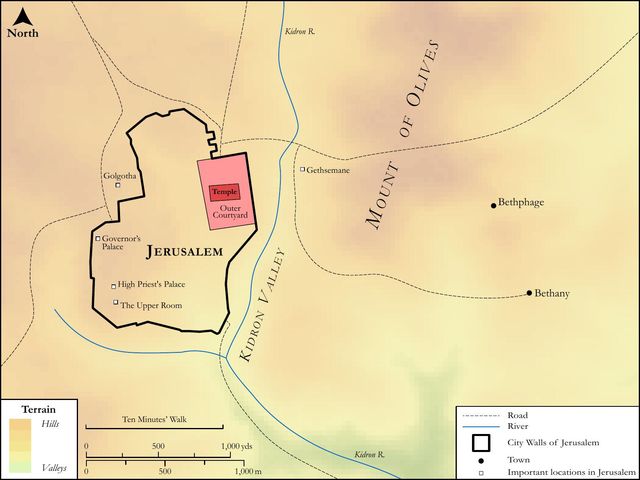
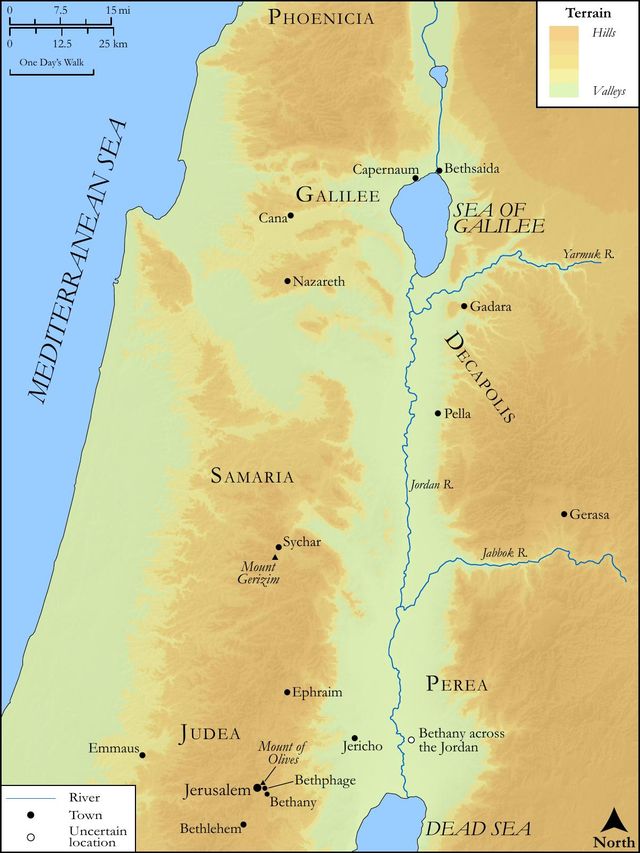
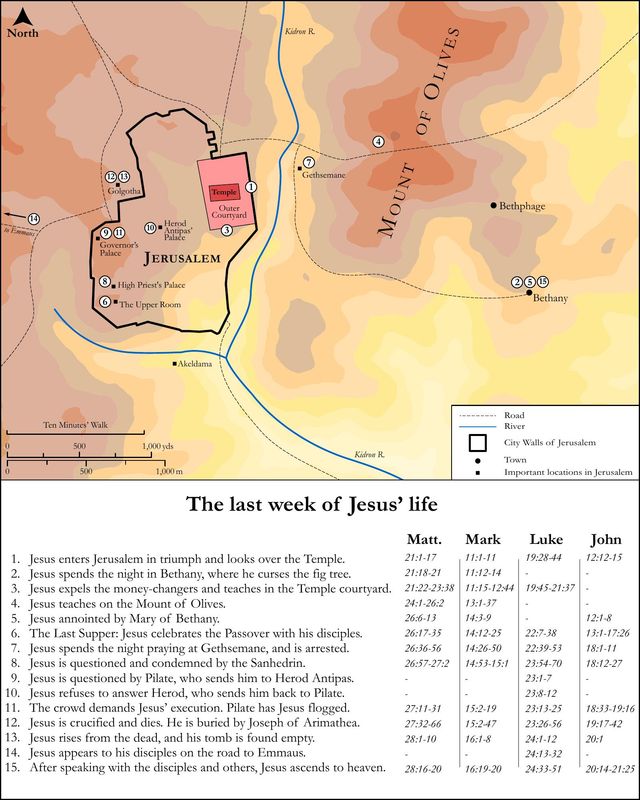
See on the biblical-era maps
Study this verse
Public-domain commentary
Matthew Henry
From his Commentary on the Whole Bible. Henry comments on passages, not single verses — this entry covers John 13:36–38. His four-level outline is real structure in the source text, so it is rendered as structure.
In these verses we have,
I.Peter's curiosity, and the check given to that.
1.Peter's question was bold and blunt (Joh 13:36): Lord, whither goest thou? referring to what Christ had said (Joh 13:33), Whither I go, you cannot come. The practical instructions Christ had given them concerning brotherly love he overlooks, and asks no questions upon them, but fastens upon that concerning which Christ purposely kept them in the dark. Note, It is a common fault among us to be more inquisitive concerning things secret, which belong to God only, than concerning things revealed, which belong to us and our children, more desirous to have our curiosity gratified than our consciences directed, to know what is done in heaven than what we may do to get thither. It is easy to observe it in the converse of Christians, how soon a discourse of that which is plain and edifying is dropped, and no more said to it, the subject is exhausted; which in a matter of doubtful disputation runs into an endless strife of words.
2.Christ's answer was instructive. He did not gratify him with any particular account of the world he was going to, nor ever foretold his glories and joys so distinctly as he did his sufferings, but said what he had said before (Joh 13:36): Let this suffice, thou canst not follow me now, but shalt follow me hereafter,
(1.)We may understand it of his following him to the cross: "Thou hast not yet strength enough of faith and resolution to drink of my cup;" and it appeared so by his cowardice when Christ was suffering. For this reason, when Christ was seized, he provided for the safety of his disciples. Let these go their way, because they could not follow him now. Christ considers the frame of his disciples, and will not cut out for them that work and hardship which they are not as yet fit for; the day shall be as the strength is. Peter, though designed for martyrdom, cannot follow Christ now, not being come to his full growth, but he shall follow him hereafter; he shall be crucified at last, like his Master. Let him not think that because he escapes suffering now he shall never suffer. From our missing the cross once, we must not infer that we shall never meet it; we may be reserved for greater trials than we have yet known.
(2.)We may understand it of his following him to the crown. Christ was now going to his glory, and Peter was very desirous to go with him: "No," saith Christ, "thou canst not follow me now, thou art not yet ripe for heaven, nor hast thou finished thy work on earth. The forerunner must first enter to prepare a place for thee, but thou shalt follow me afterwards, after thou hast fought the good fight, and at the time appointed." Note, Believers must not expect to be glorified as soon as they are effectually called, for there is a wilderness between the Red Sea and Canaan.
II.Peter's confidence, and the check given to that.
1.Peter makes a daring protestation of his constancy. He is not content to be left behind, but asks, "Lord why cannot I follow thee now? Dost thou question my sincerity and resolution? I promise thee, if there be occasion, I will lay down my life for thy sake." Some think Peter had a conceit, as the Jews had in a like case (Joh 7:35), that Christ was designing a journey or voyage into some remote country, and that he declared his resolution to go along with him wherever he went; but, having heard his Master so often speak of his own sufferings, surely he could not understand him any otherwise than of his going away by death; and he resolves as Thomas did that he will go and die with him; and better die with him than live without him. See here,
(1.)What an affectionate love Peter had to our Lord Jesus: "I will lay down my life for thy sake, and I can do no more." I believe Peter spoke as he thought, and though he was inconsiderate he was not insincere, in his resolution. Note, Christ should be dearer to us than our own lives, which therefore, when we are called to it, we should be willing to lay down for his sake, Act 20:24.
(2.)How ill he took it to have it questioned, intimated in that expostulation, "Lord, why cannot I follow thee now? Dost thou suspect my fidelity to thee?" Sa1 29:8. Note, It is with regret that true love hears its own sincerity arraigned, as Joh 21:17. Christ had indeed said that one of them was a devil, but he was discovered, and gone out, and therefore Peter thinks he may speak with the more assurance of his own sincerity; "Lord, I am resolved I will never leave thee, and therefore why cannot I follow thee?" We are apt to think that we can do any thing, and take it amiss to be told that this and the other we cannot do, whereas without Christ we can do nothing.
2.Christ gives him a surprising prediction of his inconstancy, Joh 13:38. Jesus Christ knows us better than we know ourselves, and has many ways of discovering those to themselves whom he loves, and will hide pride from.
(1.)He upbraids Peter with his confidence: Wilt thou lay down thy life for my sake? Me thinks, he seems to have said this with a smile: "Peter, thy promises are too large, too lavish to be relied on; thou dost not consider with what reluctancy and struggle a life is laid down, and what a hard task it is to die; not so soon done as said." Christ hereby puts Peter upon second thoughts, not that he might retract his resolution, or recede from it, but that he might insert into it that necessary proviso, "Lord, thy grace enabling me, I will lay down my life for thy sake." "Wilt thou undertake to die for me? What! thou that trembledst to walk upon the water to me? What! thou that, when sufferings were spoken of, criedst out, Be it far from thee, Lord? It was an easy thing to leave thy boats and nets to follow me, but not so easy to lay down thy life." His Master himself struggled when it came to his, and the disciple is not greater than his Lord. Note, It is good for us to shame ourselves out of our presumptuous confidence in ourselves. Shall a bruised reed set up for a pillar, or a sickly child undertake to be a champion? What a fool am I to talk so big.
(2.)He plainly foretels his cowardice in the critical hour. To stop the mouth of his boasting, lest Peter should say it again, Yea Master, that I will, Christ solemnly asserts it with, Verily, verily, I say unto thee, the cock shall not crow till thou hast denied me thrice. He does not say as afterwards, This night, for it seems to have been two nights before the passover; but, "Shortly thou wilt have denied me thrice within the space of one night; nay, within so short a space as between the first and last crowing of the cock: The cock shall not crow, shall not have crowed his crowing out, till thou has again and again denied me, and that for fear of suffering." The crowing of the cock is mentioned,
[1.]To intimate that the trial in which he would miscarry thus should be in the night, which was an improbable circumstance, but Christ's foretelling it was an instance of his infallible foresight.
[2.]Because the crowing of the cock was to be the occasion of his repentance, which of itself would not have been if Christ had not put this into the prediction. Christ not only foresaw that Judas would betray him though he only in heart designed it, but he foresaw that Peter would deny him though he did not design it, but the contrary. He knows not only the wickedness of sinners, but the weakness of saints. Christ told Peter, First, That he would deny him, would renounce and abjure him: "Thou wilt not only not follow me still, but wilt be ashamed to own that ever thou didst follow me." Secondly, That he would do this not once only by a hasty slip of the tongue, but after he had paused would repeat it a second and third time; and it proved too true. We commonly give it as a reason why the prophecies of scripture are expressed darkly and figuratively, because, if they did plainly describe the event, the accomplishment would thereby either be defeated or necessitated by a fatality inconsistent with human liberty; and yet this plain and express prophecy of Peter's denying Christ did neither, nor did in the least make Christ accessary to Peter's sin. But we may well imagine what a mortification it was to Peter's confidence of his own courage to be told this, and to be told it in such a manner that he durst not contradict it, else he would have said as Hazael, What! is thy servant a dog? This could not but fill him with confusion. Note, The most secure are commonly the least safe; and those most shamefully betray their own weakness that most confidently presume upon their own strength, Co1 10:12.
Historical interpretation
Three Centuries of Reception
11 surviving comments on this verse. Each one is dated, so this reads as a timeline rather than a list.
Select a marker to jump to its quote. Markers stagger vertically where authors wrote within a few decades of each other.
But, since great love made him apt for contradiction, He now sobereth him, that he might not in after times be subject to this, when he should have received the stewardship of the world, but remembering what he had suffered, might know himself. And look at the violence of his fall; it did not happen to him once or twice, but he was so beside himself, that in a short time thrice did he utter the words of denial, that he might learn that he did not so love as he was loved. And yet, to one who had so fallen He saith again, "Lovest thou Me more than these?" So that the denial was caused not by the cooling of his love, but from his having been stripped of aid from above. He accepteth then Peter's love, but cutteth off the spirit of contradiction engendered by it. "For if thou lovest, thou oughtest to obey Him who is beloved."
(Hom. lxxiii. 3) Great is love, and stronger than fire; nothing can stop its course. Peter the most ardent of all, as soon as he hears our Lord say, Whither I go ye cannot follow Me now, asks, Lord, whither goest Thou?
(Hom. lxxii. 1) Peter, on receiving this answer, does not check his desire, but hastily conceives favourable hopes from it, and having got rid of the fear of betraying our Lord, feels secure, and becomes himself the interrogator, while the rest are silent: Peter said unto Him, Lord, why cannot I follow Thee now? I will lay down my life for Thy sake. What sayest thou, Peter? He hath said, thou canst not, and thou sayest, thou canst: wherefore thou shalt know by experience, that thy love is nothing, unless thou art enabled from above: Jesus answered him, Will thou lay down thy life for My sake?
(Hom. lxxiii. 1) It is manifest that our Lord permitted Peter's fall. He might have recalled him to begin with, but as he persisted in his vehemence, though He did not drive him to a denial, He let him go without assistance, that He might learn his own weakness, and not fall into such sin again, when the superintendence of the world had come to him, but that remembering what had happened to himd, he might know himself.
Christ had said that He must be betrayed; Peter replied, "Be it far from Thee, Lord; this shall not happen unto Thee." He was rebuked, but not instructed. On the contrary, when Christ desired to wash his feet, he said, "Thou shall never wash my feet." Again, when he hears, "Thou canst not follow Me now," he saith, "Though all deny Thee, I will not deny Thee." Since then it was likely that he would be lifted up to folly by his practice of contradiction, Jesus next teacheth him not to oppose Him. This too Luke implies, when he telleth us that Christ said, "And I have prayed for thee, that thy faith fail not"; that is, "that thou be not finally lost." In every way teaching him humility, and proving that human nature by itself is nothing.
When he had shaken off the dread of being the traitor, and was shown to be one of His own, he afterwards asked boldly himself, while the others held their peace. "What sayest thou, Peter? He said, 'thou canst not,' and thou sayest, 'I can'? Therefore thou shalt know from this temptation that thy love is nothing without the presence of the impulse from above." Whence it is clear that in care for him He allowed even that fall. He desired indeed to teach him even by the first words, but when he continued in his vehemence, He did not indeed throw or force him into the denial, but left him alone, that he might learn his own weakness.
A great thing is love, and stronger than fire itself, and it goeth up to the very heaven; there is no hindrance which can restrain its tearing force. And so the most fervent Peter, when he hears, "Whither I go ye cannot come," what saith he? "Lord, whither goest thou?" and this he said, not so much from wish to learn, as from desire to follow. To say openly, "I go," he dared not yet, but, "Whither goest thou?" Christ answered, not to his words, but to his thoughts. For that this was his wish, is clear from what Christ said, "Whither I go thou canst not follow Me now." Seest thou that he longed for the following Him, and therefore asked the question? And when he heard, "thou shalt follow Me afterwards" not even so did he restrain his longing, and, though he had gained good hopes, he is so eager as to say, "Why cannot I follow Thee now? I will lay down my life for Thee."
"I will lay down my life for Thee." For since he had heard, "Greater love than this hath no man," he straightway sprang forward, insatiably eager and desirous to reach even to the highest pitch of virtue. But Christ, to show that it belonged to Himself alone to promise these things with authority, saith, "Before the cock crow." That is, "now"; there was but a little interval. He spake when it was late at night, and the first and second watch was past.
This is not contrary to what is said in Mark. For he said, “The rooster will not crow twice before you will deny me three times.” You see, as soon as he denied him, the rooster crowed. And as he denied for a third time, the rooster crowed for a second time, in some way bearing witness to the truthfulness of the Lord, as well as reminding Peter both what he said to the Lord and what he heard from him. Therefore, when he denied at first, by the will of the Lord the bird uttered a sound out of its proper time. But when he denied for the third time, then it crowed at the appointed time. However Mark, dictating the Gospel according to Peter’s view, also said how many times the bird crowed during the denial, as if he wanted to establish more clearly the reproach of Peter by his own sin.
(Tr. lxvi. 1) Wilt thou do that for Me, which I have not done yet for thee? Canst thou go before, who canst not come after? Why presumest thou so? Hear what thou art: Verily, verily, I say unto thee, The cock shall not crow, till thou hast denied Me thrice. Thou who promisest Me thy death, shall thrice deny thy life. Peter knew his great desire, his strength he knew not: he boasted of his will, while he was yet weak; but the Physician saw his weakness. (c. 2.). Some who perversely favour Peter, excuse him, and say that he did not deny Christ, because when asked by the servant maid, he said he did not know Him, as the other Evangelists witness more expressly. As if to deny the man Christ, was not to deny Christ; yea, that in Christ, which He was made for our sakes, that that which He made us, might not perish. By what is He the Head of the Church, but by His humanity? And how then is he in the body of Christ, who denies the man Christ? But why do I argue so long? Our Lord does not say, The cock shall not crow till thou deniest man, or the Son of man, but till thou deniest Me. What is Me, but that which He was? So then whatever Peter denied, he denied Christ: it is impious to doubt it. Christ said so, and Christ said true: beyond a doubt, Peter denied Christ. Let us not, to defend Peter, accuse Christ. The frailty of Peter himself, acknowledged its sin, when he witnessed by his tears the evil he had done in denying Christ. Nor do we say this, because we have pleasure in blaming the first of the Apostles; but that we may take warning from him, not to be confident of our own strength.
(Tr. lxvi. 2) That took place in the soul of Peter, which he offered in the body; though differently from what he meant. For before the death and resurrection of our Lord, he both died by his denial, and lived again by his tears.
(de Con. Evang. iii. c. 2. [5.]) This speech, The cock shall not crow, occurs in all the Evangelists, but not at the same time in all. Matthew and Mark introduce it after they have left the house, in which they were eating; Luke and John before. We may suppose either that the two former are recurring to what had passed, or the two latter anticipating what is coming. Or the great difference not only of the words, but of the subjects which precede the speech, and which excite Peter to the presumption of offering to die, for or with our Lord, may lead us to conclude that he made this offer three times, and that our Lord three times replied, Before the cock crow, thou shalt deny Me thrice.
"Jesus" therefore "answered him, Wilt thou lay down thy life for my sake?" Wilt thou do for me what I have not yet done for thee? "Wilt thou lay down thy life for my sake?" Canst thou go before, who art unable to follow? Why dost thou presume so far? what dost thou think of thyself? what dost thou imagine thyself to be? Hear what thou art: "Verily, verily, I say unto thee, The cock shall not crow, till thou hast denied me thrice." See, that is how thou wilt speedily become manifest to thyself, who art now talking so loftily, and knowest not that thou art but a child. Thou promisest me thy death, and thou wilt deny me thy life. Thou, who now thinkest thyself able to die for me, learn to live first for thyself; for in fearing the death of thy flesh, thou wilt occasion the death of thy soul. Just as much as it is life to confess Christ, it is death to deny Him.
Or was it that the Apostle Peter, as some with a perverse kind of favor strive to excuse him, did not deny Christ, because, when questioned by the maid, he replied that he did not know the man, as the other evangelists more expressly affirm? As if, indeed, he that denies the man Christ does not deny Christ; and so denies Him in respect of what He became on our account, that the nature He had given us might not be lost. Whoever, therefore, acknowledges Christ as God, and disowns Him as man, Christ died not for him; for as man it was that Christ died. He who disowns Christ as man, finds no reconciliation to God by the Mediator. For there is one God, and one Mediator between God and men, the man Christ Jesus. He that denies Christ as man is not justified: for as by the disobedience of one man, many were made sinners; so also by the obedience of one man shall many be made righteous. He that denies Christ as man, shall not rise again into the resurrection of life; for by man is death, and by man is also the resurrection of the dead: for as in Adam all die, even so in Christ shall all be made alive. And by what means is He the Head of the Church, but by His manhood, because the Word was made flesh, that is, God, the Only-begotten of God the Father, became man. And how then can one be in the body of Christ who denies the man Christ? Or how can one be a member who disowns the Head?
But why linger over a multitude of reasons when the Lord Himself undoes all the windings of human argumentation? For He says not, The cock shall not crow till thou hast denied the man; or, as He was wont to speak in His more familiar condescension with men, The cock shall not crow till thou hast thrice denied the Son of man; but He says, "till thou hast denied me thrice." What is that "me," but just what He was, and what was He but Christ? Whatever of Him, therefore, he denied, he denied Himself, he denied the Christ, he denied the Lord his God. For Thomas also, his fellow-disciple, when he exclaimed, "My Lord and my God," did not handle the Word, but only His flesh; and laid not his inquisitive hands on the incorporeal nature of God, but on His human body. And so he touched the man, and yet recognized his God. If, then, what the latter touched, Peter denied; what the latter invoked, Peter offended. "The cock shall not crow till thou hast denied me thrice." Although thou say, "I know not the man;" although thou say, "Man, I know not what thou sayest;" although thou say, "I am not one of His disciples;" thou wilt be denying me. If, which it were sinful to doubt, Christ so spake, and foretold the truth, then doubtless Peter denied Christ. Let us not accuse Christ in defending Peter. Let infirmity acknowledge its sin; for there is no falsehood in the Truth. When Peter's infirmity acknowledged its sin, his acknowledgment was full; and the greatness of the evil he had committed in denying Christ, he showed by his tears. He himself reproves his defenders, and for their conviction, brings his tears forward as witnesses.
Nor have we, on our part, in so speaking, any delight in accusing the first of the apostles; but in looking on him, we ought to take home the lesson to ourselves, that no man should place his confidence in human strength. For what else had our Teacher and Saviour in view, but to show us, by making the first of the apostles himself an example, that no one ought in any way to presume of himself? And that, therefore, really took place in Peter's soul, for which he gave cause in his body. And yet he did not go before in the Lord's behalf, as he rashly presumed, but did so otherwise than he reckoned. For before the death and resurrection of the Lord, he both died when he denied, and returned to life when he wept; but he died, because he himself had been proud in his presumption, and he lived again, because that Other had looked on him with kindness.
Wonderful as the zeal of Peter in this matter may be, his promises are beyond his power to fulfil: Christ, however, with the gloom of the threatening tempest in His mind, knowing well how severe will be the temptation and how bitter the persecution, seems as it were to shake His head in sorrow; and then, unfolding to Himself the whole extent of His sufferings, as though it were present to His bodily eyes, beholding the surpassing fury of the Jews in their madness, and seeing clearly all that will come to pass in that hour, He exclaims as though to say: "Dost thou, O Peter, lay down thy life for Me, and sayest thou that thy fear in this matter is as nothing? and supposest thou that thou wilt be strong enough to overcome the trials that will encompass thee? Nay, thou knowest not the grievous weight of the coming temptation, for the suffering that lies before thee is beyond thy strength to endure: thy heart shall fail thee utterly, even though thou wouldst not have it so: thrice shalt thou deny Me, and that too in one single night." We must surmise that Jesus means to speak somewhat to this effect: yet herein again it is fitting that we should admire the kindness to mankind that appeared in Him: for having predicted that the strength of Peter's courage will not be commensurate with the tone of his zealous assertions, but will fail and flag so utterly as to yield at the mere alarm of a coming danger, He added not one single word of threatening; erhaps for this reason, that Peter had not spoken under any Divine impulse: at all events, for some reason or other He does not hold out any threat of chastisement against one who suffered from human infirmities. For He knew that the nature of man was as yet enfeebled, and unable to endure the threat of death. Death had not yet been deprived of its power through His resurrection, and was still boastfully vaunting against the mind of all men, still strong enough to crush, even by fear and that alone, the hardiest and bravest of heroes. For human nature, being unnaturally subjected to death, yields to death as to a conquering power, or rather used to yield at that time: but now that our Saviour has burst its bonds, the approach of death is delightful to those who love Christ, even though it come in bitterness and pain. For the everlasting life has arisen in its stead, destroying the power of corruption.
And let no one here again imagine that Peter's denial and failure were caused by the words of Christ. He is not speaking by way of imposing any obligation on the disciple, or drawing him on by constraint to the sufferings of which He speaks; but rather He means to predict to His disciple exactly what as God He knows will most surely and certainly come to pass.
But seeing that all that happened to the men of former times has been written for the admonition of those who live after them, let us now say somewhat necessary to our edification, drawing our conclusions from this passage. I do not think that we ought to make any rash vows before God, or to promise to perform what may sometimes be beyond our power, as though we could control human events. And I say this in regard to the charges to which we render ourselves liable in case of failure: especially I consider that hasty statements, such as "I will do this," or, "I will do that," as the case may be, are not far removed from arrogance. For in all cases where one may have deliberately determined to undertake any matter, wishing to carry it out successfully, one's duty is always to use those words of the very wise disciple: If the Lord will, and we live. For while I maintain that a zeal for good works must be inherent in the souls of the godly, as well as eager willingness to carry these virtuous resolves with all our might into effect, yet our duty is to pray for the successful means of gaining this end through the gracious blessing that is from above, and not to make rash promises as though success lay already in our own grasp. Thus we shall be able to keep unbroken our promises to God of all that is good, and we shall have "our feet clear" of blame, according to the saying of the Greek poet. And on other authority: Better is it not to vow to any, than to vow and not pay.
Which sentence may be read in two ways: either as affirming, thou shalt lay down thy life for My sake, but now through fear of the death of the body, thou shalt incur spiritual death: or as mocking; as if He said,
Nevertheless, should any one fall, let the example of Peter save him from despair, and teach him that he can without delay obtain pardon from God.
Continue studying John 13:38 across the web’s major study libraries — every link below opens this exact verse, chapter, or book on the destination site.
Read & Compare
 BibleGatewayThis verse in more than 200 translations and 70 languages.
 Bible.comThe YouVersion reader — hundreds of translations, reading plans, and highlights.
 ESV.orgCrossway's official English Standard Version reader.
 NET BibleThe NET translation with 60,000+ translators' notes on every rendering decision.
 STEP BibleTyndale House's free study tool — original text, vocabulary, and scholarly resources.
 BibliaLogos Bible Software's free web reader.
 USCCBThe New American Bible (Revised Edition) with the U.S. bishops' study notes.
Commentaries
 BibleHub CommentariesDozens of classic commentaries on this verse, gathered on one page.
 StudyLightMore than 100 commentary sets — the largest collection on the web.
 BibleRefPlain-English commentary on what this verse means, verse by verse.
 Enduring WordDavid Guzik's free commentary on this chapter, widely used by Bible teachers.
 Bible Study ToolsVerse commentary alongside Greek and Hebrew study aids.
Original Language & Research
- BibleHub InterlinearThe verse word by word — original language, transliteration, and English.
- BibleHub LexiconEvery word's original-language definition and Strong's entry.
 Blue Letter BibleDeep-study tools — Strong's numbers, concordance, and word studies.
 CNTR CollationThe earliest Greek manuscripts of this verse, collated letter by letter.
Sermons, Hymns & Audio


TrulyRandomVerse is not affiliated with these sites and doesn’t control their content. They’re linked because they’re genuinely useful.
Summary
John 13:38 captures a profoundly sobering moment at the Last Supper, where Jesus directly confronts Peter's fervent but ultimately misplaced confidence. In response to Peter's bold declaration of willingness to die for him, Jesus issues a stark prophecy: before the rooster crows, Peter will deny him three times. This exchange powerfully highlights the chasm between human zeal and divine foreknowledge, setting the stage for the testing of Peter's faith and revealing the fragility of human resolve apart from Christ's sustaining grace.
Context
ShowHideLiterary Context
This verse is situated within the intimate and emotionally charged setting of the Last Supper, following Jesus' washing of the disciples' feet and his announcement of his impending departure. After Judas's departure, Jesus gives the "new commandment" to love one another John 13:34, explaining that where he is going, the disciples cannot follow immediately. Peter, ever impetuous and eager, presses Jesus about his destination and boldly declares his readiness to lay down his life for Jesus. John 13:38 is Jesus' direct and prophetic response to Peter's self-assured boast, immediately preceding Jesus' comforting words in John 14:1-3.
Historical & Cultural Context
The setting is a private room in Jerusalem during the Passover festival, a time of heightened religious and political tension. The disciples, like many Jews of their time, likely harbored expectations of a conquering Messiah who would establish an earthly kingdom, making Peter's offer to "lay down his life" understandable within a framework of military loyalty. The "cock crowing" was a common time marker, often referring to the third watch of the night (around 3 AM), or simply the actual crowing of a rooster. For Peter, a Galilean fisherman, the concept of denying his master, especially under the threat of association with a condemned man, would have been a profound cultural and personal disgrace, particularly given the public nature of arrest and trial under Roman occupation.
Key Themes
ShowHideJohn 13:38 powerfully contributes to several overarching themes within the Gospel of John and the broader biblical narrative. It underscores the theme of human frailty and overconfidence, contrasting Peter's sincere but ultimately flawed self-reliance with Jesus' perfect divine foreknowledge and sovereignty. The prediction of denial highlights the testing of faith that disciples inevitably face, revealing the gap between good intentions and the ability to stand firm under pressure. Furthermore, it subtly foreshadows the cost of true discipleship, which often involves suffering and vulnerability, and sets the stage for the theme of restoration and grace that will unfold later in Peter's story, particularly in John 21.
Exposition and Analysis
ShowHideKey Word Analysis
ShowHideThis word, transliterated from the Hebrew "amen," is used by Jesus exclusively in the Gospel of John, always doubled ("Verily, verily" or "Truly, truly"). According to G281, it signifies something "firm" or "trustworthy," and adverbially, "surely," often functioning as an interjection meaning "so be it." Its repetition here emphasizes the absolute certainty, solemnity, and divine authority of Jesus' pronouncement, underscoring that what he is about to say is an undeniable truth.
This verb means "to place" or "to put." While it can imply a passive or horizontal posture, its broader application here is "to commit," "to give," or "to set forth." Peter's boast, "Wilt thou lay down thy life for my sake?", uses this word to express a profound act of self-sacrifice. Ironically, Jesus will indeed "lay down" his life, but not in the way Peter imagines, and Peter himself will fail to do so in the immediate future, highlighting the contrast between Peter's human effort and Christ's divine, purposeful sacrifice.
Derived from G533, this word means "to deny utterly," or "to disown, abstain." It implies a complete repudiation or rejection. Jesus' use of this term for Peter's future action is stark, indicating not merely a casual oversight but a deliberate act of disassociation from Christ, driven by fear. This denial is a profound betrayal of Peter's earlier fervent declaration of loyalty, exposing the depth of human weakness when faced with extreme pressure.
Verse Breakdown
ShowHide"Jesus answered him, Wilt thou lay down thy life for my sake?"
This opening clause reveals Jesus' direct engagement with Peter's bold, yet ultimately naive, declaration. Jesus' question is rhetorical, designed not to elicit an answer but to highlight the stark contrast between Peter's self-assured zeal and the harsh reality of his impending failure. It subtly challenges Peter's understanding of what it truly means to "lay down one's life," foreshadowing the true, costly sacrifice that only Jesus himself would perfectly fulfill.
"Verily, verily, I say unto thee,"
This solemn declaration, marked by the double "amen," emphasizes the absolute certainty and divine authority of Jesus' prophecy. It signals that what follows is not a mere prediction based on human insight, but a divinely revealed truth that will inevitably come to pass. This phrase underscores Jesus' omniscient knowledge, extending even to the future actions of his closest disciples.
"The cock shall not crow, till thou hast denied me thrice."
This is the core of Jesus' prophecy. The "cock crowing" serves as a specific, time-bound marker, indicating that Peter's denial would occur within a very short timeframe, before dawn. The phrase "denied me thrice" is precise, foretelling the exact number of times Peter would disown his association with Jesus. This clause underscores the fragility of human resolve, even in the face of sincere intentions, and sets the stage for one of the most poignant moments of failure and subsequent restoration in the New Testament.
Literary Devices
ShowHideJohn 13:38 is rich with Irony, as Peter's confident boast to "lay down his life" is immediately met with Jesus' prophecy of his utter denial, highlighting the gap between intention and action. The verse functions as powerful Foreshadowing, setting up the dramatic events of Peter's betrayal and subsequent repentance. The specific detail of "The cock shall not crow" serves as a precise and memorable Symbolism for the timing and nature of Peter's failure, a stark reminder of human weakness. Furthermore, Peter's initial declaration can be seen as a form of Hyperbole, an exaggerated expression of loyalty that, while sincere, overestimates his own strength and resolve.
Theological and Thematic Connections
ShowHideThis verse is a profound theological statement on the nature of human weakness and divine sovereignty. It reveals that even the most devoted disciples, like Peter, are susceptible to failure when faced with fear and pressure, underscoring the biblical truth that "the spirit indeed is willing, but the flesh is weak" Matthew 26:41. Jesus' perfect foreknowledge of Peter's denial, spoken with solemn certainty, highlights his divine omniscience and control over all events, even the failures of his followers. Yet, this prediction is not a condemnation but a preparation, a painful truth that would ultimately lead Peter to a deeper understanding of his own need for grace and Christ's unwavering love, paving the way for his eventual restoration and powerful ministry. It reminds us that God often uses our failures, not just our successes, to shape us and reveal His greater purposes.
Reflection and Application
ShowHidePeter's bold declaration and subsequent denial serve as a timeless lesson for every believer. It teaches us the critical importance of humility and self-awareness, warning against the dangers of overestimating our own spiritual strength or relying solely on our good intentions. While Peter's zeal was genuine, his confidence was misplaced, rooted in his own ability rather than in Christ's enabling power. This passage calls us to examine where our confidence truly lies. Do we trust in our own resolve, or do we humbly acknowledge our dependence on God's grace for steadfastness in the face of temptation and adversity? Jesus knows our weaknesses even better than we do, and his predictions are often not to shame us, but to prepare us, to reveal our need for him, and to demonstrate the sufficiency of his grace even in our deepest failures. It is a powerful reminder that true strength comes not from never falling, but from being picked up by the One who knows us fully and loves us unconditionally.
Questions for Reflection
ShowHideFAQ
ShowHideWhy did Jesus predict Peter's denial so specifically?
ShowHideJesus' specific prediction of Peter's denial serves multiple purposes. Firstly, it demonstrates Jesus' divine omniscience and authority, proving that he knows all things, including future events and the hearts of his disciples. Secondly, it prepares Peter and the other disciples for the challenging events to come, showing them that even their failures are within God's sovereign plan. Thirdly, it underscores the fragility of human resolve apart from divine grace, teaching a profound lesson about humility and dependence on Christ. Finally, it sets the stage for Peter's ultimate restoration, highlighting Jesus' unwavering love and commitment to his disciples even after their failures, as seen later in John 21.
What is the significance of the "cock crowing" in this prophecy?
ShowHideThe "cock crowing" serves as a precise and memorable time marker, indicating that Peter's denial would occur within a specific, short timeframe, before dawn. In ancient times, the "cock crow" (Latin: gallicinium) was a recognized division of the night, typically the third watch, occurring around 3 AM. It also provides a stark, auditory reminder of Peter's failure, as recorded in all four Gospels. For Peter, the sound of the rooster would forever be associated with the painful memory of his betrayal, a symbol of human weakness and the accuracy of Jesus' prophetic word.
Did Peter's denial mean he was not truly a disciple?
ShowHideNo, Peter's denial did not mean he was not a true disciple. While his actions were a profound failure of faith and loyalty, they were a temporary lapse, not a permanent rejection of Christ. Jesus had already prayed for Peter that his faith would not fail Luke 22:32, indicating that his fall would not be final. Peter's deep remorse and subsequent restoration by Jesus, particularly in John 21, confirm his genuine discipleship and demonstrate Jesus' boundless grace and forgiveness. His experience serves as a powerful testament to God's ability to restore and use even those who have stumbled.
Christ-Centered Fulfillment
ShowHideJohn 13:38, while exposing Peter's profound human weakness, ultimately points to the perfect strength and unwavering faithfulness of Jesus Christ. Peter's boast to "lay down his life" is a poignant contrast to the reality that only Jesus could, and would, truly lay down his life—not for his own sake, but for the sake of all humanity, as the Lamb of God who takes away the sin of the world. Jesus' divine foreknowledge of Peter's denial underscores his absolute sovereignty and omniscience, demonstrating that even human failure is not outside of his divine plan, but can be woven into a narrative of redemption. Unlike Peter, who would falter under pressure, Jesus steadfastly set his face toward Jerusalem, enduring the cross for the joy set before him Hebrews 12:2. This passage, therefore, highlights Christ as the perfect, faithful High Priest who understands our weaknesses yet never succumbs to them Hebrews 4:15, and as the compassionate Shepherd who pursues and restores his wayward sheep, transforming failure into a foundation for deeper faith and service John 21:15-19.