


Luke 22:62
Bible text: King James Version (1769 Blayney text) · Public domain
Bible text: Berean Standard Bible · Public domain
Bible text: American Standard Version (1901) · Public domain
Bible text: World English Bible, Messianic edition · Public domain
Bible text: Geneva Bible (1599) · Public domain
Bible text: Young's Literal Translation · Public domain
- καὶkaiAndG2532CONJConjunction
- ἐξελθὼνexelthōnhaving gone forthG1831V-2AAP-NSMVerb 2nd Aorist Active Participle Nominative Singular Masculine
- ἔξωexōoutsideG1854PREPPreposition
- ὁho<the>G3588T-NSMDefinite article Nominative Singular Masculine
- ΠέτροςPetrosPeterG4074N-NSM-PNoun Nominative Singular Masculine Individual
- ἔκλαυσενeklausenhe weptG2799V-AAI-3SVerb Aorist Active Indicative 3rd Singular
- πικρῶςpikrōsbitterlyG4090ADVAdverb
English is a literal word-by-word gloss of the Greek, not the KJV's wording. Why?
This is the original text the KJV's translators worked from — each Greek word with its own literal English meaning in this verse, prepared by scholars at Tyndale House, Cambridge. The KJV translates whole sentences, not word by word, so its wording differs: one Greek word can become several English words, and the KJV may choose “charity” where the gloss reads “love”. Both are faithful — they answer different questions. For the KJV's own rendering, switch to the KJV text.
Details
See on the biblical-era maps
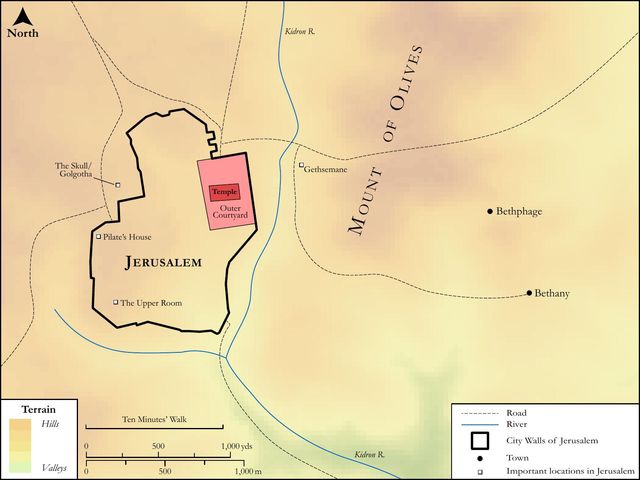
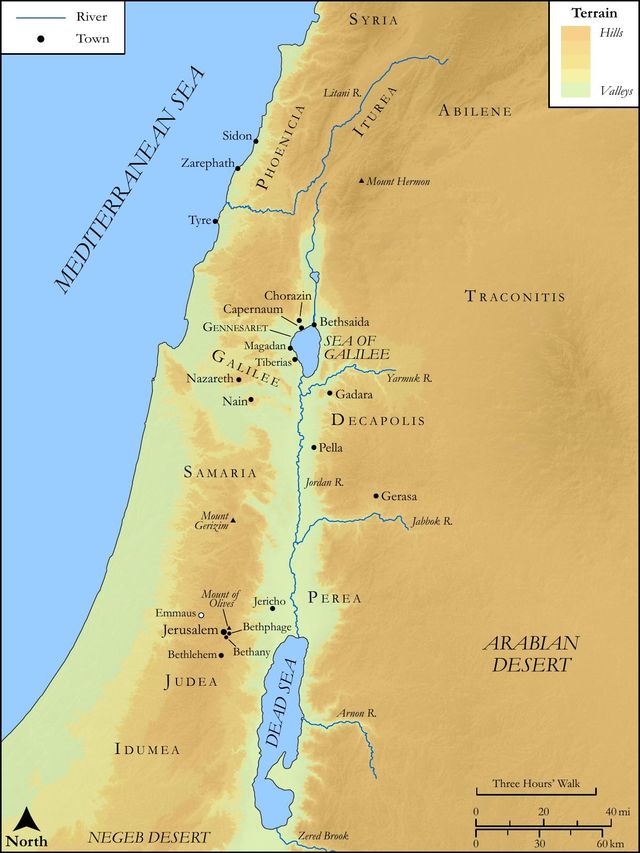

Study this verse
Public-domain commentary
Matthew Henry
From his Commentary on the Whole Bible. Henry comments on passages, not single verses — this entry covers Luke 22:54–62. His two-level outline is real structure in the source text, so it is rendered as structure.
We have here the melancholy story of Peter's denying his Master, at the time when he was arraigned before the high priest, and those that were of the cabal, that were ready to receive the prey, and to prepare the evidence for his arraignment, as soon as it was day, before the great sanhedrim, Luk 22:66. But notice is not taken here, as was in the other evangelists, of Christ's being now upon his examination before the high priest, only of his being brought into the high priest's house, Luk 22:54. But the manner of expression is observable. They took him, and led him, and brought him, which methinks is like that concerning Saul (Sa1 15:12): He is gone about, and passed on, and gone down; and intimates that, even when they had seized their prey, they were in confusion, and, for fear of the people, or rather struck with inward terror upon what they had seen and heard, they took him the furthest way about, or, rather, knew not which way they hurried him, such a hurry were they in in their own bosoms. Now observe,
I.Peter's falling.
1.It began in sneaking. He followed Christ when he was had away prisoner; this was well, and showed a concern for his Master. But he followed afar off, that he might be out of danger. He thought to trim the matter, to follow Christ, and so to satisfy his conscience, but to follow afar off, and so to save his reputation, and sleep in a whole skin.
2.It proceeded in keeping his distance still, and associating himself with the high priest's servants, when he should have been at his master's elbow. The servants kindled a fire in the midst of the hall and sat down together, to talk over their night-expedition. Probably Malchus was among them, and Peter sat down among them, as if he had been one of them, at least would be thought to be so. His fall itself was disclaiming all acquaintance with Christ, and relation to him, disowning him because he was now in distress and danger. He was charged by a sorry simple maid, that belonged to the house, with being a retainer to this Jesus, about whom there was now so much noise. She looked wistfully upon him as he at by the fire, only because he was a stranger, and one whom she had not seen before; and concluding that at this time of night there were no neuters there, and knowing him not to be any of the retinue of the high priest, she concludes him to be one of the retinue of this Jesus, or perhaps she had been some time or other looking about her in the temple, and had seen Jesus there and Peter with him, officious about him, and remembered him; and this man was with him, saith she. And Peter, as he had not the courage to own the charge, so he had not the wit and presence of mind to turn it off, as he might have done many ways, and therefore flatly and plainly denies it: Woman, I know him not. 4. His fall was repeated a second time (Luk 22:58): After a little while, before he had time to recollect himself, another saw him, and said, "Even thou art one of them, as slyly as thou sittest here among the high priest's servants." Not I, saith Peter; Man, I am not. And a third time, about the space of an hour after (for, saith the tempter, "When he is down, down with him; let us follow the blow, till we get him past recovery"), another confidently affirms, strenuously asserts it, "Of a truth this fellow also was with him, let him deny it if he can, for you may all perceive he is a Galilean." But he that has once told a lie is strongly tempted to persist in it; the beginning of that sin is as the letting forth of water. Peter now not only denies that he is a disciple of Christ, but that he knows any thing of him (Luk 22:60): "Man, I know not what thou sayest; I never heard of this Jesus."
II.Peter's getting up again.
See how happily he recovered himself, or, rather, the grace of God recovered him. See how it was brought about: -
1.The cock crew just as he was the third time denying that he knew Christ, and this startled him and put him upon thinking. Note, Small accidents may involve great consequences.
2.The Lord turned and looked upon him. This circumstance we had not in the other evangelists, but it is a very remarkable one. Christ is here called the Lord, for there was much of divine knowledge, power, and grace, appearing in this. Observe, Though Christ had now his back upon Peter, and was upon his trial (when, one would think, he had something else to mind), yet he knew all that Peter said. Note, Christ takes more notice of what we say and do than we think he does. When Peter disowned Christ, yet Christ did not disown him, though he might justly have cast him off, and never looked upon him more, but have denied him before his Father. It is well for us that Christ does not deal with us as we deal with him. Christ looked upon Peter, not doubting but that Peter would soon be aware of it; for he knew that, though he had denied him with his lips, yet his eye would still be towards him. Observe, Though Peter had now been guilty of a very great offence, and which was very provoking, yet Christ would not call to him, lest he should shame him or expose him; he only gave him a look which none but Peter would understand the meaning of, and it had a great deal in it. (1.) It was a convincing look. Peter said that he did not know Christ. Christ turned, and looked upon him, as if he should say, "Dost thou not know me, Peter? Look me in the face, and tell me so." (2.) It was a chiding look. We may suppose that he looked upon him and frowned, or some way signified his displeasure. Let us think with what an angry countenance Christ justly looks upon us when we have sinned. (3.) It was an expostulating upbraiding look: "What, Peter, art thou he that disownest me now, when thou shouldest come and witness for me? What thou a disciple? Thou that wast the most forward to confess me to be the Son of God, and didst solemnly promise thou wouldest never disown me?" (4.) It was a compassionate look; he looked upon him with tenderness. "Poor Peter, how weak is thine heart! How art thou fallen and undone if I do not help thee!" (5.) It was a directing look. Christ guided him with his eye, gave him a wink to go out from that sorry company, to retire, and bethink himself a little, and then he would soon see what he had to do. (6.) It was a significant look: it signified the conveying of grace to Peter's heart, to enable him to repent; the crowing of the cock would not have brought him to repentance without this look, nor will the external means without special efficacious grace. Power went along with this look, to change the heart of Peter, and to bring him to himself, to his right mind.
3.Peter remembered the words of the Lord. Note, The grace of God works in and by the word of God, brings that to mind, and sets that home upon the conscience, and so gives the soul a happy turn. Tolle et lege - Take it up, and read.
4.Then Peter went out, and wept bitterly. One look from Christ melted him into tears of godly sorrow for sin. The candle was newly put out, and then a little thing lighted it again. Christ looked upon the chief priests, and made no impression upon them as he did on Peter, who had the divine seed remaining in him to work upon. It was not the look from Christ, but the grace of God with it, that recovered Peter, and brought him to-rights.
Historical interpretation
Three Centuries of Reception
9 surviving comments on this verse. Each one is dated, so this reads as a timeline rather than a list.
Select a marker to jump to its quote. Markers stagger vertically where authors wrote within a few decades of each other.
(App. Serm. 79.) For to Peter were delivered the keys of the kingdom of heaven, to him were entrusted an innumerable multitude of people, who were wrapped up in sin. But Peter was somewhat too vehement, as the cutting off the car of the High Priest's servant betokens. If he then who was so stern and so severe had obtained the gift of not sinning, what pardon would he have given to the people committed to him? Therefore Divine Providence suffers him first to be holden of sin, that by the consciousness of his own fall he might soften his too harsh judgment towards sinners. When he wished to warm himself at the fire, a maid came to him, of whom it follows, But a certain maid beheld him, &c.
Why did he weep? Because guilt overtook him: I am accustomed to weeping, if guilt is lacking to me, that is, if I do not avenge myself, if I do not obtain what I wickedly desire. Peter was grieved and wept; because he erred as a man. I do not find what he said, I find that he wept: I read his tears, I do not read satisfaction: but what cannot be defended, can be washed away. Tears wash away the sin, which shame is too modest to confess with words. And tears seek both forgiveness and modesty. Tears speak of guilt without horror; tears confess a crime without causing offense; tears do not ask for forgiveness, and yet they deserve it. I found out why Peter remained silent, so that a quick request for forgiveness would not cause further offense. Before we cry, we must pray like this.
The wretched men understood not the mystery, nor had reverence unto an outpouring of compassion so merciful, that even His enemies He suffered not to be wounded. For it is said, Then look they him, &c. When we read of Jesus being holden, let us guard against thinking that He is holden with respect to His divine nature, and unwilling through weakness, for He is held captive and bound according to the truth of His bodily nature.
Rightly he followed afar off, soon about to deny, for he could never have denied if he had clung close to Christ. But herein must he be revered, that he forsook not our Lord, even though he was afraid. Fear is the effect of nature, solicitude of tender affection.
And by this time there was a fire burning in the house of the High Priest; as it follows, And when they had kindled a fire, &c. Peter came to warm himself, because his Lord being taken prisoner, the heart of his soul had been chilled in him.
What meaneth it, that a maid is the first to betray Peter, whereas surely men ought the more easily to have recognised him, save that that sex should be plainly implicated in our Lord's murder, in order that it might also be redeemed by His Passion? But Peter when discovered denies, for better that Peter should have denied, than our Lord's word should have failed. Hence it follows, And he denied, saying, Woman, I know him not.
Peter denied, because he promised rashly. He does not deny on the mount, nor in the temple, nor in his own house, but in the judgment-hall of the Jews. There he denies where Jesus was bound, where truth is not. And denying Him he says, I know him not. It were presumptuous to say that he knew Him whom the human mind can not grasp. For no one knoweth the Son but the Father. (Matt. 11:17). Again, a second time he denies Christ; for it follows, And after a little while another saw him, and said, Thou wert also one of them.
For he preferred to deny himself rather than Christ, or because he seemed to deny being of the company of Christ, he truly denied himself.
He is also asked a third time; for it follows, And about the space of one hour after, another confidently affirmed, saying, Of a truth this fellow also was with him.
That is, I know not your blasphemies. But we make excuse for him. He did not excuse himself. For an involved answer is not sufficient for our confessing Jesus, but an open confession is required. And therefore Peter is not represented to have answered this deliberately, for he afterwards recollected himself, and wept.
Lastly, those whom Jesus looks upon weep for their sins. Hence it follows, And Peter remembered the word of the Lord, how he had said to him, Before the cock crow, thou shalt deny me thrice. And he went out, and wept bitterly. Why did he weep? Because he sinned as man. I read of his tears, I do not read of his confession. Tears wash away an offence which it is shame to confess in words. The first and second time he denied and wept not, for as yet our Lord had not looked upon him. He denied the third time, Jesus looked upon him, and he wept bitterly. So then if thou wilt obtain pardon, wash away thy guilt in tears.
(Hom. 83. in Matt.) It is therefore said, to the house of the High Priest, that nothing whatever might be done without the consent of the chief of the Priests. For thither had they all assembled waiting for Christ. Now the great zeal of Peter is manifested in his not flying when he saw all the others doing so; for it follows, But Peter followed afar off.
(Hom. 83. in Joan.) Marvel now at the case of the Master, who though He was a prisoner, had exercised much forethought for His disciple, whom by a look He brought to Himself, and provoked to tears; for it follows, And the Lord turned, and looked upon Peter.
To wash away the sin of denial, Peter needed the baptism of tears. From where would he get this, unless the Lord gave him this too? That is why the apostle Paul gave this advice to his people concerning deviant opinions and about how they should deal with them. He said they must be “correcting his opponents with gentleness. God may perhaps grant that they will repent and come to know the truth.” So even repentance is a gift from God. The heart of the proud is hard ground. It is softened for repentance only if it is rained on by God’s grace.
By saying that Peter did penance, we have to take care not to think that he did it as those who are properly called penitents now do it in the church. Who could bear it that we should think the first of the apostles was numbered among such penitents? He repented of having denied Christ, as his tears show, for so it is written, "he wept bitterly." They had not yet been strengthened by the resurrection of the Lord, the coming of the Holy Spirit who appeared on the day of Pentecost, or by that breath which the Lord breathed on them after he rose from the dead.
Now Peter did not dare to weep openly, lest he should be detected by his tears, but he went out and wept. Ho wept not because of punishment, but because he denied his beloved Lord, which was more galling than any punishment.
For I consider Peter, I reflect upon the thief, I look at Zacchaeus, I gaze upon Mary, and I see nothing else in these except examples of hope and repentance placed before our eyes. For perhaps someone has fallen in faith; let him look to Peter, who wept bitterly because he had denied out of fear.
Did he not hold Peter in his mouth when he denied? But when he returned to life through repentance, this Leviathan in a certain way lost him as if through the hole in his jaw.
Now the Chief Priest means Caiaphas, who according to John was High Priest that year.
But that when our Lord was going to His Passion, Peter followed afar off represents the Church about to follow indeed, that is, to imitate our Lord's Passion, but in a far different manner, for the Church suffers for herself, our Lord suffered for the Church.
In this denial then of Peter we affirm that not only is Christ denied by him who says that He is not Christ, but by him also, who, being a Christian, says he is not.
But he adds, For he is a Galilæan; not that the Galilæans spoke a different language from the inhabitants of Jerusalem, who indeed were Hebrews, but that each separate province and country having its own peculiarities could not avoid a vernacular tone of speech. It follows, And Peter said, Man, I know not what thou sayest.
Holy Scripture is often wont to mark the character of certain events by the nature of the times in which they take place. Hence Peter who sinned at midnight repented at cock-crow; for it follows, And immediately, while he yet spake, the cock crew. The error he committed in the darkness of forgetfulness, he corrected by the remembrance of the true light.
This cock must, I think, be understood mystically as some great Teacher, who rouses the listless and sleepy, saying, Awake, ye righteous, and sin not.
For to look upon him is to have compassion, seeing that not only while penance is being practised, but that it may be practised, the mercy of God is necessary.
Continue studying Luke 22:62 across the web’s major study libraries — every link below opens this exact verse, chapter, or book on the destination site.
Read & Compare
 BibleGatewayThis verse in more than 200 translations and 70 languages.
 Bible.comThe YouVersion reader — hundreds of translations, reading plans, and highlights.
 ESV.orgCrossway's official English Standard Version reader.
 NET BibleThe NET translation with 60,000+ translators' notes on every rendering decision.
 STEP BibleTyndale House's free study tool — original text, vocabulary, and scholarly resources.
 BibliaLogos Bible Software's free web reader.
 USCCBThe New American Bible (Revised Edition) with the U.S. bishops' study notes.
Commentaries
 BibleHub CommentariesDozens of classic commentaries on this verse, gathered on one page.
 StudyLightMore than 100 commentary sets — the largest collection on the web.
 BibleRefPlain-English commentary on what this verse means, verse by verse.
 Enduring WordDavid Guzik's free commentary on this chapter, widely used by Bible teachers.
 Bible Study ToolsVerse commentary alongside Greek and Hebrew study aids.
Original Language & Research
- BibleHub InterlinearThe verse word by word — original language, transliteration, and English.
- BibleHub LexiconEvery word's original-language definition and Strong's entry.
 Blue Letter BibleDeep-study tools — Strong's numbers, concordance, and word studies.
 CNTR CollationThe earliest Greek manuscripts of this verse, collated letter by letter.
Sermons, Hymns & Audio


TrulyRandomVerse is not affiliated with these sites and doesn’t control their content. They’re linked because they’re genuinely useful.
Summary
Luke 22:62 powerfully depicts the immediate and profound remorse of Peter following his triple denial of Jesus. After Jesus' prophetic words were fulfilled by the crowing of a rooster and a direct, silent gaze from the Lord, Peter was overwhelmed by the crushing weight of his failure. His departure from the courtyard, marked by intense, bitter weeping, signifies a deep, agonizing realization of his unfaithfulness and the betrayal of his beloved Master, setting the stage for his eventual repentance and restoration.
Context
ShowHideLiterary Context
This verse is the climactic and emotional culmination of Peter's denial narrative, which spans Luke 22:54-62. Following Jesus' arrest in Gethsemane and His being led to the high priest's house, Peter, who had followed at a distance, found himself in the courtyard among those warming themselves by a fire. Three separate individuals successively identify Peter as a follower of Jesus, each time eliciting a vehement denial from him. The final denial in Luke 22:60 is immediately followed by the crowing of the rooster, precisely as Jesus had foretold in Luke 22:34. Luke uniquely adds the poignant detail that "the Lord turned, and looked upon Peter" (Luke 22:61) at that very moment, creating a devastating collision of prophecy, memory, and personal failure that drives Peter's reaction in Luke 22:62.
Historical & Cultural Context
The setting is the courtyard of the High Priest's house in Jerusalem, likely during the late hours of the night or early morning following Jesus' arrest. Jewish legal proceedings, though corrupted in this instance, would have been underway inside. Courtyards were common gathering places, especially at night for warmth around a fire, making Peter's presence among the servants and guards plausible. The act of denying an association with a condemned or accused person was a common survival instinct in a hostile environment, especially when one's own life or freedom might be at risk. The crowing of a rooster was a natural occurrence, marking the approach of dawn, but here it serves as a divinely appointed sign, a stark auditory reminder of Jesus' specific prophecy. Peter's public denial, while understandable from a human standpoint of fear, carried significant weight in a culture where loyalty and public association were highly valued.
Key Themes
ShowHideLuke 22:62 profoundly contributes to several key themes within Luke's Gospel and the broader biblical narrative. It highlights human frailty and the reality of failure, even among the most committed disciples, contrasting sharply with Peter's earlier confident boasts of loyalty unto death (Luke 22:33). The verse also underscores the certainty of divine prophecy and foreknowledge, as Jesus' words from Luke 22:34 are precisely fulfilled. Furthermore, Peter's "bitter weeping" introduces the theme of genuine remorse and the painful, yet necessary, pathway to repentance. While the verse itself focuses on the immediate sorrow, it implicitly foreshadows the grace, forgiveness, and ultimate restoration that Jesus would later extend to Peter, a central tenet of the gospel message found throughout the New Testament, particularly in John's post-resurrection account of Peter's reinstatement in John 21.
Exposition and Analysis
ShowHideKey Word Analysis
ShowHideThis verb (G1831) means "to issue (literally or figuratively)," "come forth," or "depart." In this context, it signifies Peter's physical departure from the high priest's courtyard. His immediate exit suggests an overwhelming need to remove himself from the scene of his failure, perhaps seeking solitude to process the crushing realization of what he had done. It's not merely a casual leaving but an urgent, compelled withdrawal.
This verb (G2799) describes a deep, audible sobbing, a wailing aloud. Unlike a silent tear, klaíō denotes an intense, unrestrained expression of grief and sorrow. It conveys a profound emotional breakdown, indicating that Peter's sorrow was not merely regret or embarrassment but a gut-wrenching anguish that could not be contained.
This adverb (G4090) modifies "wept," emphasizing the intensity and acuteness of Peter's sorrow. Derived from a root meaning "sharp" or "pungent," pikrōs conveys a sense of severe, violent, and agonizing grief. It suggests a sorrow that cuts deep, leaving a lasting, painful impression, far beyond superficial regret. Peter's weeping was not just tears, but a profound, soul-shattering lament.
Verse Breakdown
ShowHide"And Peter went out,"
This clause describes Peter's immediate physical action. Following the rooster's crow and Jesus' piercing gaze, Peter's response is to remove himself from the scene. His departure is not presented as a calm walk but an urgent, perhaps stumbling, exit, driven by an internal emotional storm. This act of "going out" marks a physical separation from the place of his denial and the presence of his Lord, allowing him to fully confront the reality of his actions.
"and wept bitterly."
This second clause reveals the profound emotional state of Peter. The combination of "wept" (an audible, wailing cry) and "bitterly" (with intense, piercing sorrow) conveys the depth of his remorse. This was not a quiet, private shedding of tears, but a raw, agonizing expression of grief and self-reproach. It signifies a moment of profound spiritual brokenness, where the weight of his betrayal, his broken vows, and the realization of Jesus' foreknowledge crashed down upon him, leading to an uncontrollable outpouring of anguish.
Literary Devices
ShowHideLuke's concise yet powerful description in Luke 22:62 employs several literary devices to convey its profound impact. The most prominent is Pathos, as the verse evokes deep sympathy and pity for Peter. His "bitter weeping" is a raw, unvarnished display of human anguish, allowing the reader to connect with the crushing weight of his failure and remorse. This emotional intensity is heightened by the preceding events, particularly Jesus' silent, knowing gaze in Luke 22:61, which serves as a catalyst for Peter's breakdown. The verse also utilizes Contrast; Peter's earlier bold, even arrogant, declarations of loyalty in Luke 22:33 stand in stark opposition to his present state of utter brokenness. This juxtaposition highlights the fragility of human resolve and the sobering reality of temptation. Finally, the entire scene functions as Prophecy Fulfillment, as Peter's actions and subsequent grief directly confirm Jesus' earlier prediction in Luke 22:34, underscoring the divine authority and foreknowledge of Christ.
Theological and Thematic Connections
ShowHideLuke 22:62 is a pivotal moment that encapsulates the human capacity for failure and the divine capacity for foreknowledge and grace. Peter's bitter weeping is not merely an expression of regret but a crucial step in the process of repentance. It demonstrates that true remorse involves a deep, agonizing sorrow over sin, not just its consequences. This profound brokenness is often a necessary precursor to genuine spiritual restoration, highlighting that even significant betrayals do not necessarily lead to permanent separation from God's grace. The scene underscores the reality that even those closest to Jesus are susceptible to temptation and fear, making Peter's story a universal testament to human weakness and the ever-present need for God's mercy.
Reflection and Application
ShowHidePeter's bitter weeping in Luke 22:62 serves as a timeless mirror for every believer. It reminds us that spiritual maturity does not exempt us from moments of profound failure, fear, or unfaithfulness. Peter, who had walked with Jesus, witnessed miracles, and even declared his unwavering loyalty, succumbed under pressure. His tears are a powerful testament to the crushing weight of realizing one has betrayed the One they love and serve. This scene calls us to honest self-assessment, encouraging us to confront our own shortcomings, our moments of denial, and our failures to live up to our convictions. It teaches us that genuine remorse, expressed through deep sorrow over sin, is not a sign of weakness but a vital step towards repentance and spiritual healing. Peter's story ultimately offers hope: his bitter weeping was not the end, but the painful beginning of a journey towards restoration, demonstrating that God's grace is sufficient even for our most grievous failures.
Questions for Reflection
ShowHideFAQ
ShowHideWhy did Peter weep so bitterly, and what does it signify?
ShowHidePeter wept bitterly because he was overwhelmed by the realization that he had denied Jesus three times, precisely as Jesus had predicted. His tears were not merely tears of embarrassment or fear, but of profound remorse, anguish, and self-reproach. The Greek word for "bitterly" (pikrōs) emphasizes the intensity and acuteness of his sorrow, indicating a deep, gut-wrenching pain over his betrayal. It signifies a moment of spiritual brokenness and the painful, yet necessary, first step towards repentance and eventual restoration. The look from Jesus in Luke 22:61 and the crow of the rooster served as immediate triggers, bringing the full weight of his failure crashing down upon him.
Does Peter's bitter weeping indicate true repentance?
ShowHideYes, Peter's bitter weeping is widely understood as a powerful indicator of true, godly sorrow leading to repentance. Unlike Judas's remorse, which led to despair and self-destruction (Matthew 27:3-5), Peter's sorrow, though agonizing, propelled him towards eventual restoration. His tears were a recognition of his sin against Jesus, a turning away from the path of denial, and a humble acknowledgment of his profound failure. This type of sorrow is described in 2 Corinthians 7:10 as "godly sorrow that produces a repentance that leads to salvation without regret."
Christ-Centered Fulfillment
ShowHideLuke 22:62, while focusing on Peter's profound human failure, paradoxically points to the steadfast grace and redemptive purpose of Christ. Peter's bitter weeping, though a painful consequence of his denial, was a necessary precursor to his restoration, a process initiated and completed by Jesus. The very fact that Jesus had predicted Peter's denial (Luke 22:34) demonstrates His divine foreknowledge, not merely as a passive observer, but as one who knew the depths of human weakness yet still chose to love and redeem. Peter's story, therefore, becomes a powerful illustration of the gospel: that even in our most grievous betrayals, Christ's grace is sufficient. His post-resurrection appearances and specific reinstatement of Peter in John 21:15-19 underscore that the Lamb of God not only takes away the sin of the world (John 1:29) but also restores the broken and empowers the repentant. Peter's tears foreshadow the joy of forgiveness and the power of resurrection life that transforms failure into a testimony of Christ's enduring love and redemptive power, ultimately equipping him to become a foundational leader in the early church as seen in Acts 2.