


Luke 22:61
Bible text: King James Version (1769 Blayney text) · Public domain
Bible text: King James Version with Strong's numbers · Public domain
Bible text: Berean Standard Bible · Public domain
Bible text: American Standard Version (1901) · Public domain
Bible text: World English Bible, Messianic edition · Public domain
Bible text: Geneva Bible (1599) · Public domain
Bible text: Young's Literal Translation · Public domain
- καὶkaiAndG2532CONJConjunction
- στραφεὶςstrapheishaving turnedG4762V-2APP-NSMVerb 2nd Aorist Passive Participle Nominative Singular Masculine
- ὁhotheG3588T-NSMDefinite article Nominative Singular Masculine
- κύριοςkuriosLordG2962N-NSM-TNoun Nominative Singular Masculine Title
- ἐνέβλεψενeneblepsenlooked atG1689V-AAI-3SVerb Aorist Active Indicative 3rd Singular
- τῷtō<the>G3588T-DSMDefinite article Dative Singular Masculine
- ΠέτρῳPetrōPeterG4074N-DSM-PNoun Dative Singular Masculine Individual
- καὶkaiandG2532CONJConjunction
- ὑπεμνήσθηhupemnēsthērememberedG5279V-API-3SVerb Aorist Passive Indicative 3rd Singular
- ὁho<the>G3588T-NSMDefinite article Nominative Singular Masculine
- ΠέτροςPetrosPeterG4074N-NSM-PNoun Nominative Singular Masculine Individual
- τοῦtoutheG3588T-GSNDefinite article Genitive Singular Neuter
- ῥήματοςrhēmatosdeclarationG4487N-GSNNoun Genitive Singular Neuter
- τοῦtouof theG3588T-GSMDefinite article Genitive Singular Masculine
- κυρίουkuriouLordG2962N-GSM-TNoun Genitive Singular Masculine Title
- ὡςhōshowG5613PRTParticle or Disjunctive
- εἶπενeipenHe had saidG2036V-2AAI-3SVerb 2nd Aorist Active Indicative 3rd Singular
- αὐτῷautōto himG846P-DSMPersonal pronoun Dative Singular Masculine
- ὅτιhotithatG3754CONJConjunction
- πρὶνprinBeforeG4250ADVAdverb
- ἀλέκτοραalektora[the] roosterG220N-ASMNoun Accusative Singular Masculine
- φωνῆσαιphōnēsaicrowingG5455V-AANVerb Aorist Active Infinitive
- ἀπαρνήσῃaparnēsēyou will denyG533V-FDI-2SVerb Future Middle Deponent Indicative 2nd Singular
- μεmeMeG3165P-1ASPersonal pronoun Accusative 1st Singular
- τρίςtristhree timesG5151ADVAdverb
English is a literal word-by-word gloss of the Greek, not the KJV's wording. Why?
This is the original text the KJV's translators worked from — each Greek word with its own literal English meaning in this verse, prepared by scholars at Tyndale House, Cambridge. The KJV translates whole sentences, not word by word, so its wording differs: one Greek word can become several English words, and the KJV may choose “charity” where the gloss reads “love”. Both are faithful — they answer different questions. For the KJV's own rendering, switch to the KJV text.
Details
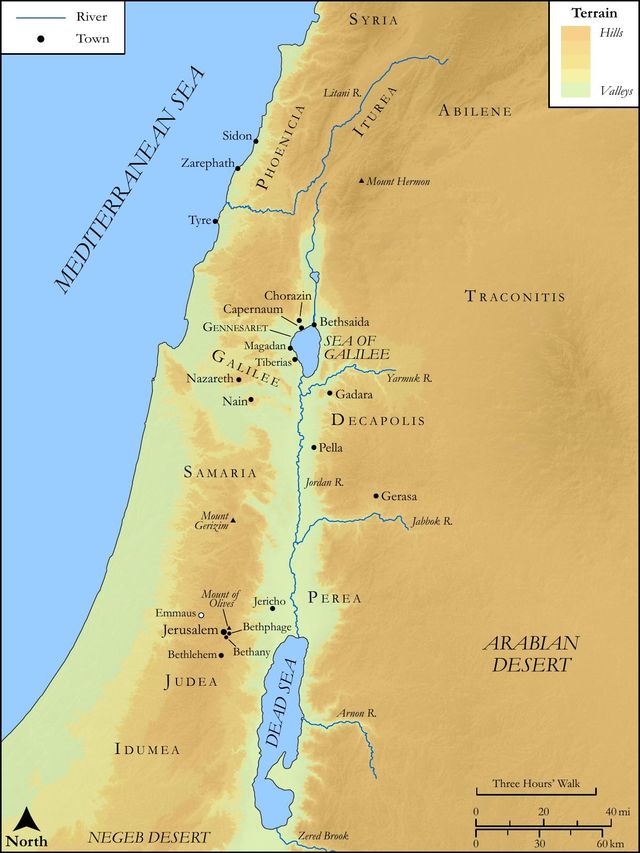
See on the biblical-era maps


Study this verse
Public-domain commentary
Matthew Henry
From his Commentary on the Whole Bible. Henry comments on passages, not single verses — this entry covers Luke 22:54–62. His two-level outline is real structure in the source text, so it is rendered as structure.
We have here the melancholy story of Peter's denying his Master, at the time when he was arraigned before the high priest, and those that were of the cabal, that were ready to receive the prey, and to prepare the evidence for his arraignment, as soon as it was day, before the great sanhedrim, Luk 22:66. But notice is not taken here, as was in the other evangelists, of Christ's being now upon his examination before the high priest, only of his being brought into the high priest's house, Luk 22:54. But the manner of expression is observable. They took him, and led him, and brought him, which methinks is like that concerning Saul (Sa1 15:12): He is gone about, and passed on, and gone down; and intimates that, even when they had seized their prey, they were in confusion, and, for fear of the people, or rather struck with inward terror upon what they had seen and heard, they took him the furthest way about, or, rather, knew not which way they hurried him, such a hurry were they in in their own bosoms. Now observe,
I.Peter's falling.
1.It began in sneaking. He followed Christ when he was had away prisoner; this was well, and showed a concern for his Master. But he followed afar off, that he might be out of danger. He thought to trim the matter, to follow Christ, and so to satisfy his conscience, but to follow afar off, and so to save his reputation, and sleep in a whole skin.
2.It proceeded in keeping his distance still, and associating himself with the high priest's servants, when he should have been at his master's elbow. The servants kindled a fire in the midst of the hall and sat down together, to talk over their night-expedition. Probably Malchus was among them, and Peter sat down among them, as if he had been one of them, at least would be thought to be so. His fall itself was disclaiming all acquaintance with Christ, and relation to him, disowning him because he was now in distress and danger. He was charged by a sorry simple maid, that belonged to the house, with being a retainer to this Jesus, about whom there was now so much noise. She looked wistfully upon him as he at by the fire, only because he was a stranger, and one whom she had not seen before; and concluding that at this time of night there were no neuters there, and knowing him not to be any of the retinue of the high priest, she concludes him to be one of the retinue of this Jesus, or perhaps she had been some time or other looking about her in the temple, and had seen Jesus there and Peter with him, officious about him, and remembered him; and this man was with him, saith she. And Peter, as he had not the courage to own the charge, so he had not the wit and presence of mind to turn it off, as he might have done many ways, and therefore flatly and plainly denies it: Woman, I know him not. 4. His fall was repeated a second time (Luk 22:58): After a little while, before he had time to recollect himself, another saw him, and said, "Even thou art one of them, as slyly as thou sittest here among the high priest's servants." Not I, saith Peter; Man, I am not. And a third time, about the space of an hour after (for, saith the tempter, "When he is down, down with him; let us follow the blow, till we get him past recovery"), another confidently affirms, strenuously asserts it, "Of a truth this fellow also was with him, let him deny it if he can, for you may all perceive he is a Galilean." But he that has once told a lie is strongly tempted to persist in it; the beginning of that sin is as the letting forth of water. Peter now not only denies that he is a disciple of Christ, but that he knows any thing of him (Luk 22:60): "Man, I know not what thou sayest; I never heard of this Jesus."
II.Peter's getting up again.
See how happily he recovered himself, or, rather, the grace of God recovered him. See how it was brought about: -
1.The cock crew just as he was the third time denying that he knew Christ, and this startled him and put him upon thinking. Note, Small accidents may involve great consequences.
2.The Lord turned and looked upon him. This circumstance we had not in the other evangelists, but it is a very remarkable one. Christ is here called the Lord, for there was much of divine knowledge, power, and grace, appearing in this. Observe, Though Christ had now his back upon Peter, and was upon his trial (when, one would think, he had something else to mind), yet he knew all that Peter said. Note, Christ takes more notice of what we say and do than we think he does. When Peter disowned Christ, yet Christ did not disown him, though he might justly have cast him off, and never looked upon him more, but have denied him before his Father. It is well for us that Christ does not deal with us as we deal with him. Christ looked upon Peter, not doubting but that Peter would soon be aware of it; for he knew that, though he had denied him with his lips, yet his eye would still be towards him. Observe, Though Peter had now been guilty of a very great offence, and which was very provoking, yet Christ would not call to him, lest he should shame him or expose him; he only gave him a look which none but Peter would understand the meaning of, and it had a great deal in it. (1.) It was a convincing look. Peter said that he did not know Christ. Christ turned, and looked upon him, as if he should say, "Dost thou not know me, Peter? Look me in the face, and tell me so." (2.) It was a chiding look. We may suppose that he looked upon him and frowned, or some way signified his displeasure. Let us think with what an angry countenance Christ justly looks upon us when we have sinned. (3.) It was an expostulating upbraiding look: "What, Peter, art thou he that disownest me now, when thou shouldest come and witness for me? What thou a disciple? Thou that wast the most forward to confess me to be the Son of God, and didst solemnly promise thou wouldest never disown me?" (4.) It was a compassionate look; he looked upon him with tenderness. "Poor Peter, how weak is thine heart! How art thou fallen and undone if I do not help thee!" (5.) It was a directing look. Christ guided him with his eye, gave him a wink to go out from that sorry company, to retire, and bethink himself a little, and then he would soon see what he had to do. (6.) It was a significant look: it signified the conveying of grace to Peter's heart, to enable him to repent; the crowing of the cock would not have brought him to repentance without this look, nor will the external means without special efficacious grace. Power went along with this look, to change the heart of Peter, and to bring him to himself, to his right mind.
3.Peter remembered the words of the Lord. Note, The grace of God works in and by the word of God, brings that to mind, and sets that home upon the conscience, and so gives the soul a happy turn. Tolle et lege - Take it up, and read.
4.Then Peter went out, and wept bitterly. One look from Christ melted him into tears of godly sorrow for sin. The candle was newly put out, and then a little thing lighted it again. Christ looked upon the chief priests, and made no impression upon them as he did on Peter, who had the divine seed remaining in him to work upon. It was not the look from Christ, but the grace of God with it, that recovered Peter, and brought him to-rights.
Historical interpretation
Five Centuries of Reception
11 surviving comments on this verse. Each one is dated, so this reads as a timeline rather than a list.
Select a marker to jump to its quote. Markers stagger vertically where authors wrote within a few decades of each other.
(App. Serm. 79.) For to Peter were delivered the keys of the kingdom of heaven, to him were entrusted an innumerable multitude of people, who were wrapped up in sin. But Peter was somewhat too vehement, as the cutting off the car of the High Priest's servant betokens. If he then who was so stern and so severe had obtained the gift of not sinning, what pardon would he have given to the people committed to him? Therefore Divine Providence suffers him first to be holden of sin, that by the consciousness of his own fall he might soften his too harsh judgment towards sinners. When he wished to warm himself at the fire, a maid came to him, of whom it follows, But a certain maid beheld him, &c.
What things, then, they be for which repentance seems just and due-that is, what things are to be set down under the head of sin-the occasion indeed demands that I should note down; but (to do so) may seem to be unnecessary. For when the Lord is known, our spirit, having been" looked back upon" by its own Author, emerges unbidden into the knowledge of the truth; and being admitted to (an acquaintance with) the divine precepts, is by them forthwith instructed that "that from which God bids us abstain is to be accounted sin: "inasmuch as, since it is generally agreed that God is some great essence of good, of course nothing but evil would be displeasing to good; in that, between things mutually contrary, friendship there is none.
Therefore, Peter wept very bitterly, he wept so that he could wash away his sin with tears: and you, if you want to deserve forgiveness, wash away your guilt with tears: at the same moment, at the same time, Christ looks at you. If you perhaps stumble in any way; because the witness of your secrets is present, he looks at you so that you may remember and confess your error. Imitate Peter saying elsewhere for a third time: Lord, you know that I love you. For indeed, because he had denied for the third time, for the third time he confesses: but he denied at night, he confesses in the day.
However, these things are written so that we may know that no one should boast; for if Peter fell, because he said, 'Even if all are made to stumble because of You, I will never be made to stumble,' who else has the right to presume about himself? And indeed, David, because he had said, 'I said in my prosperity, 'I shall never be moved',' openly admits that this was boasting, saying, 'You hid Your face, and I was troubled.'
The wretched men understood not the mystery, nor had reverence unto an outpouring of compassion so merciful, that even His enemies He suffered not to be wounded. For it is said, Then look they him, &c. When we read of Jesus being holden, let us guard against thinking that He is holden with respect to His divine nature, and unwilling through weakness, for He is held captive and bound according to the truth of His bodily nature.
Rightly he followed afar off, soon about to deny, for he could never have denied if he had clung close to Christ. But herein must he be revered, that he forsook not our Lord, even though he was afraid. Fear is the effect of nature, solicitude of tender affection.
And by this time there was a fire burning in the house of the High Priest; as it follows, And when they had kindled a fire, &c. Peter came to warm himself, because his Lord being taken prisoner, the heart of his soul had been chilled in him.
What meaneth it, that a maid is the first to betray Peter, whereas surely men ought the more easily to have recognised him, save that that sex should be plainly implicated in our Lord's murder, in order that it might also be redeemed by His Passion? But Peter when discovered denies, for better that Peter should have denied, than our Lord's word should have failed. Hence it follows, And he denied, saying, Woman, I know him not.
Peter denied, because he promised rashly. He does not deny on the mount, nor in the temple, nor in his own house, but in the judgment-hall of the Jews. There he denies where Jesus was bound, where truth is not. And denying Him he says, I know him not. It were presumptuous to say that he knew Him whom the human mind can not grasp. For no one knoweth the Son but the Father. (Matt. 11:17). Again, a second time he denies Christ; for it follows, And after a little while another saw him, and said, Thou wert also one of them.
For he preferred to deny himself rather than Christ, or because he seemed to deny being of the company of Christ, he truly denied himself.
He is also asked a third time; for it follows, And about the space of one hour after, another confidently affirmed, saying, Of a truth this fellow also was with him.
That is, I know not your blasphemies. But we make excuse for him. He did not excuse himself. For an involved answer is not sufficient for our confessing Jesus, but an open confession is required. And therefore Peter is not represented to have answered this deliberately, for he afterwards recollected himself, and wept.
Lastly, those whom Jesus looks upon weep for their sins. Hence it follows, And Peter remembered the word of the Lord, how he had said to him, Before the cock crow, thou shalt deny me thrice. And he went out, and wept bitterly. Why did he weep? Because he sinned as man. I read of his tears, I do not read of his confession. Tears wash away an offence which it is shame to confess in words. The first and second time he denied and wept not, for as yet our Lord had not looked upon him. He denied the third time, Jesus looked upon him, and he wept bitterly. So then if thou wilt obtain pardon, wash away thy guilt in tears.
(Hom. 83. in Matt.) It is therefore said, to the house of the High Priest, that nothing whatever might be done without the consent of the chief of the Priests. For thither had they all assembled waiting for Christ. Now the great zeal of Peter is manifested in his not flying when he saw all the others doing so; for it follows, But Peter followed afar off.
(Hom. 83. in Joan.) Marvel now at the case of the Master, who though He was a prisoner, had exercised much forethought for His disciple, whom by a look He brought to Himself, and provoked to tears; for it follows, And the Lord turned, and looked upon Peter.
When fear overwhelmed him, as the Lord had predicted, he three times denies the one for whom he promised to die. As it says, “The Lord looked at him and he, for his part, wept bitterly.” Remembrance of his denial was necessarily bitter, so that the grace of redemption might be even more sweet. If Christ had not left him to himself, he would not have denied. If Christ had not looked at him, he would not have wept. God hates people relying presumptuously on their own powers. Like a doctor, he lances this swollen tumor in those whom he loves. By lancing it, of course, he inflicts pain, but he also ensures health later. When he rises again, the Lord entrusts his sheep to Peter, to that one who denied him. Peter denied him because he relied on himself, but later Peter would feed his flock as a pastor, because he loved him. After all, why does he ask him three times about his love, if not to prick his conscience about his threefold denial?
How we should understand this, requires some careful consideration; for Matthew says, Peter was sitting without in the hall, which he would not have said unless the transaction relating to our Lord were passing within. Likewise also, where Mark said, And as Peter was beneath in the hall, he shows that the things he had been speaking of took place not only within but in the upper part. How then did our Lord look upon Peter? not with His bodily face, since Peter was without in the hall among those who were warming themselves, while these things were going on in the inner part of the house. Wherefore, that looking upon Peter seems to me to have been done in a divine manner. And as it was said, Look thou, and hear me, (Ps. 13:3.) and, Turn and deliver my soul, (Ps. 6:4.) so I think the expression here used, The Lord turned and looked upon Peter.
This miserable act arose from the affliction of human cowardice. The disciple’s conscience condemned him. The proof of this is his grieving immediately afterwards and his tears of repentance that fell from his eyes as for a serious sin. It says, “Having gone out, he wept bitterly,” after Christ had looked at him and reminded him of what he had said to Peter.
Then “the Lord looked at Peter.” Christ stood in the middle of the priests’ insults, the witnesses’ lies, and the injuries of those that struck him and spat on him. He met the troubled disciple with his eyes, the same eyes that had foreseen that Peter would undergo a struggle. In so doing, the gaze of truth entered Peter, directed toward the place where the amendment of his heart would be grounded. It was as if the Lord’s voice were echoing within Peter, saying, “What are you thinking, Peter? Why do you withdraw into yourself? Turn to me, trust in me”, and “follow me.” This is the time for my passion. The hour of your suffering has not yet come. Why do you fear what you yourself will also overcome? Do not let the weakness that I have accepted disturb you. I was anxious for you, but you should not worry about me.”
Now the Chief Priest means Caiaphas, who according to John was High Priest that year.
But that when our Lord was going to His Passion, Peter followed afar off represents the Church about to follow indeed, that is, to imitate our Lord's Passion, but in a far different manner, for the Church suffers for herself, our Lord suffered for the Church.
In this denial then of Peter we affirm that not only is Christ denied by him who says that He is not Christ, but by him also, who, being a Christian, says he is not.
But he adds, For he is a Galilæan; not that the Galilæans spoke a different language from the inhabitants of Jerusalem, who indeed were Hebrews, but that each separate province and country having its own peculiarities could not avoid a vernacular tone of speech. It follows, And Peter said, Man, I know not what thou sayest.
Holy Scripture is often wont to mark the character of certain events by the nature of the times in which they take place. Hence Peter who sinned at midnight repented at cock-crow; for it follows, And immediately, while he yet spake, the cock crew. The error he committed in the darkness of forgetfulness, he corrected by the remembrance of the true light.
This cock must, I think, be understood mystically as some great Teacher, who rouses the listless and sleepy, saying, Awake, ye righteous, and sin not.
For to look upon him is to have compassion, seeing that not only while penance is being practised, but that it may be practised, the mercy of God is necessary.
And the Lord turned and looked at Peter. And Peter remembered the word of the Lord, how He had said: "Before the rooster crows, you will deny me three times." And Peter went out and wept bitterly. With the Lord looking upon him, Peter's heart was pricked, and he wiped away the stain of denial with the tears of repentance, as it is not only while repentance is performed but also for it to be performed, that the mercy of God is necessary. For His looking is to show mercy. Hence the Psalmist says: "How long shall my enemy be exalted over me? Look upon me and answer me, O Lord my God" (Psalm 12), that is, have mercy and help me. How harmful indeed are the sayings of the treacherous! Peter, among the Jews, denied knowing the man he had confessed as the Son of God among his fellow disciples. But could he do penance while detained in Caiaphas' courtyard? He went out, so that, separated from the council of the impious, he might wash away the stains of fearful denial with unrestrained weeping.
Continue studying Luke 22:61 across the web’s major study libraries — every link below opens this exact verse, chapter, or book on the destination site.
Read & Compare
 BibleGatewayThis verse in more than 200 translations and 70 languages.
 Bible.comThe YouVersion reader — hundreds of translations, reading plans, and highlights.
 ESV.orgCrossway's official English Standard Version reader.
 NET BibleThe NET translation with 60,000+ translators' notes on every rendering decision.
 STEP BibleTyndale House's free study tool — original text, vocabulary, and scholarly resources.
 BibliaLogos Bible Software's free web reader.
 USCCBThe New American Bible (Revised Edition) with the U.S. bishops' study notes.
Commentaries
 BibleHub CommentariesDozens of classic commentaries on this verse, gathered on one page.
 StudyLightMore than 100 commentary sets — the largest collection on the web.
 BibleRefPlain-English commentary on what this verse means, verse by verse.
 Enduring WordDavid Guzik's free commentary on this chapter, widely used by Bible teachers.
 Bible Study ToolsVerse commentary alongside Greek and Hebrew study aids.
Original Language & Research
- BibleHub InterlinearThe verse word by word — original language, transliteration, and English.
- BibleHub LexiconEvery word's original-language definition and Strong's entry.
 Blue Letter BibleDeep-study tools — Strong's numbers, concordance, and word studies.
 CNTR CollationThe earliest Greek manuscripts of this verse, collated letter by letter.
Sermons, Hymns & Audio


TrulyRandomVerse is not affiliated with these sites and doesn’t control their content. They’re linked because they’re genuinely useful.
Summary
Luke 22:61 captures the profoundly poignant moment when Jesus, being led away by His captors, turns and fixes His gaze upon Peter, who has just completed his third denial of knowing Him. This direct, silent encounter immediately triggers Peter's memory of Jesus' earlier prophecy concerning his denial before the cock crowed, leading to his bitter remorse and eventual repentance. The verse powerfully underscores divine foreknowledge, the depth of human frailty, and the compassionate yet convicting power of Christ's presence.
Context
ShowHideLiterary Context
This verse is situated within the dramatic and somber narrative of Jesus' arrest, trial, and Peter's simultaneous denial. Immediately preceding Luke 22:61, Jesus has been betrayed by Judas (Luke 22:47-48), arrested in Gethsemane (Luke 22:54), and brought to the high priest's house for an illegal trial (Luke 22:54). While Jesus endures mockery and abuse inside, Peter, who had followed at a distance, is warming himself by a fire in the courtyard. The three denials of Peter, each escalating in intensity, are recounted in Luke 22:55-60. Verse 61 marks the precise moment of the third denial's completion, as the cock crows, and Jesus' gaze meets Peter's, fulfilling the prophecy given just hours before in Luke 22:34. The immediate aftermath is Peter's bitter weeping in Luke 22:62.
Historical & Cultural Context
The events unfold in Jerusalem during Passover, a time of heightened religious and political tension. Jesus' trial before the Sanhedrin, the Jewish high court, was conducted hastily and illegally, violating several Jewish legal traditions. Peter's presence in the courtyard, warming himself by a fire, reflects a common practice in cooler nights, and his attempts to blend in with the crowd highlight the danger faced by Jesus' followers. The "cock crow" refers to the third watch of the night, traditionally around 3 AM, known as gallicinium. This was a common way to mark time, especially before the widespread use of mechanical clocks, and it would have been a familiar sound to everyone in Jerusalem. The public nature of the courtyard setting meant Peter's denials were witnessed, adding to the pressure he felt.
Key Themes
ShowHideThis verse contributes significantly to several overarching themes in Luke's Gospel and the broader biblical narrative. It powerfully illustrates Divine Foreknowledge and Sovereignty, as Jesus' precise prophecy from Luke 22:34 is fulfilled to the letter, demonstrating His omniscience and control even amidst chaos and human failure. The theme of Human Frailty and Failure is starkly portrayed through Peter, a leading disciple who, despite his earlier bold vows of loyalty in Luke 22:33, succumbs to fear and denies his Lord. Yet, intertwined with this is the theme of Compassion and Grace, as Jesus' look is not one of condemnation but of sorrowful love, initiating Peter's Conviction and Repentance. This moment sets the stage for Peter's eventual restoration, a key aspect of Luke's portrayal of God's redemptive work even for those who stumble significantly.
Exposition and Analysis
ShowHideKey Word Analysis
ShowHideFrom the base of tropē, meaning "to twist," this word implies a deliberate and complete turning around, not just a casual glance. It signifies an intentional act by the Lord to face Peter, suggesting purpose and significance in His gaze rather than a mere accidental encounter.
Derived from en (in) and blepō (to see), this term denotes a direct, fixed, and penetrating gaze. It is more than just seeing; it implies looking intently, observing fixedly, and discerning clearly. This was a profound, soul-piercing look that conveyed deep meaning without words, cutting through Peter's fear and denial.
From hypo (under) and mimnēskō (to remind), this word means to remind quietly or suggest to one's own memory. In the middle voice, as here, it indicates Peter's active internal process of recalling. Jesus' look served as the catalyst that brought His earlier words forcefully and painfully back into Peter's consciousness.
Verse Breakdown
ShowHide"And the Lord turned, and looked upon Peter."
This clause describes Jesus' deliberate and powerful action. Despite His own suffering and the chaos of His trial, Jesus intentionally turns and fixes His gaze upon Peter. This "look" is the pivotal moment, a non-verbal communication that transcends the physical distance and the noise of the courtyard, directly confronting Peter's conscience. It is a look of divine knowledge, sorrow, and perhaps even tender compassion, yet it carries immense convicting power.
"And Peter remembered the word of the Lord,"
Immediately following Jesus' gaze, Peter's memory is activated. This is not a passive recollection but an acute, painful remembrance of a specific prophecy. The impact of Jesus' look is so profound that it instantly cuts through Peter's self-deception and fear, bringing the truth of his betrayal to the forefront of his mind.
"how he had said unto him, Before the cock crow, thou shalt deny me thrice."
This final clause reveals the content of Peter's remembrance: Jesus' precise and chilling prophecy, delivered only hours earlier in Luke 22:34. The crowing of the cock, which would have just occurred, serves as the undeniable, audible confirmation of the prophecy's fulfillment. This specific detail underscores the accuracy of Jesus' foreknowledge and the tragic reality of Peter's failure.
Literary Devices
ShowHideLuke employs several powerful literary devices in this verse. Foreshadowing is evident as Jesus' earlier prophecy in Luke 22:34 is brought to its dramatic Fulfillment. The Juxtaposition of Jesus' suffering and Peter's denial highlights the stark contrast between the Master's faithfulness and the disciple's failure. The "look" itself functions as a potent Symbolism of divine omniscience, compassion, and conviction, communicating volumes without a single word. It is a moment of profound Irony, as Peter, who vowed unwavering loyalty, now denies his Lord just as Jesus predicted. The sound of the cock crowing serves as an auditory trigger, a stark and undeniable sign that seals the prophecy's fulfillment and Peter's realization of his sin.
Theological and Thematic Connections
ShowHideLuke 22:61 is a profound theological statement on the nature of divine foreknowledge, human fallibility, and the pathway to repentance. It reveals that God's knowledge extends to the deepest recesses of human will and action, even in moments of profound failure. Yet, this foreknowledge is not presented as deterministic in a way that negates human responsibility; Peter freely chose to deny Jesus, despite his earlier boasts. The verse also highlights the incredible grace of Jesus, whose look, though convicting, was not condemning. It was a look that invited remembrance and, implicitly, repentance, demonstrating that even in our darkest moments of betrayal, the Lord's gaze can be the catalyst for our turning back to Him. This foundational truth assures believers that even after significant spiritual stumbling, the path to restoration remains open through confession and genuine remorse.
Reflection and Application
ShowHideLuke 22:61 offers a mirror for every believer, revealing the potential for spiritual failure even in the most devoted hearts. Peter's denial, born of fear and self-preservation, serves as a sobering reminder that our boasts of loyalty can quickly crumble under pressure if we rely solely on our own strength. This verse challenges us to examine our own lives: where might we be denying Christ, not necessarily with our words, but with our actions, our silence, or our priorities? Just as Jesus' look pierced Peter's soul, the Holy Spirit often brings conviction to our hearts, reminding us of God's Word and our own shortcomings. This conviction is not meant to crush us, but to lead us to repentance and restoration. The path back to God, even after significant failure, begins with acknowledging our sin, remembering His truth, and turning back to Him with a contrite heart. We are called to embrace humility, recognize our dependence on God's grace, and trust in His unfailing love and readiness to forgive and restore.
Questions for Reflection
ShowHideFAQ
ShowHideWhat was the significance of Jesus turning and looking at Peter?
ShowHideThe significance lies in the intentionality and power of Jesus' gaze. The Greek word emblépō (looked upon) implies a fixed, penetrating stare, not a casual glance. It was a deliberate act by Jesus, even in His own moment of profound suffering, to confront Peter with the truth of his denial. This look served as a direct, non-verbal communication that bypassed Peter's rationalizations and immediately brought to his mind Jesus' earlier prophecy, triggering conviction and leading to his bitter repentance. It was a look of divine knowledge, sorrow, and perhaps even compassionate grace, designed to awaken Peter's conscience.
Did Peter's denial mean he was not a true disciple?
ShowHideNo, Peter's denial, while a grave sin, did not mean he was not a true disciple. It highlighted his human frailty and the immense pressure he was under. The immediate and profound remorse Peter experienced, leading to his bitter weeping (Luke 22:62), is a strong indicator of a repentant heart and a genuine relationship with Christ. Furthermore, Jesus had prayed for Peter's faith not to fail (Luke 22:32), and after His resurrection, Jesus specifically sought out Peter to restore him and reaffirm his calling (John 21:15-19). Peter went on to become a pillar of the early church, demonstrating that even significant failure can be met with divine grace and lead to renewed purpose.
Christ-Centered Fulfillment
ShowHideLuke 22:61 is profoundly Christ-centered, revealing the Lord not merely as a prophet whose words are fulfilled, but as the compassionate and sovereign Son of God who knows the hearts of all men. Jesus' look at Peter, even as He is being led to His own suffering, underscores His unwavering focus on His disciples and His redemptive mission. He is the Good Shepherd who, even in His agony, does not forget the sheep who stray. His foreknowledge of Peter's denial (Luke 22:34) is not for condemnation but for ultimate restoration, foreshadowing His triumph over sin and death. This moment reveals Jesus as the perfect High Priest, who can sympathize with our weaknesses (Hebrews 4:15), having experienced human betrayal firsthand. His suffering on the cross, which immediately follows this scene, is the ultimate act of love that atones for Peter's sin and the sins of all who deny Him, offering a path to forgiveness and reconciliation that Peter would later preach with boldness (Acts 2:38). The look from Christ is a powerful symbol of His persistent grace, calling sinners to repentance and offering hope for restoration even after the most grievous failures, ultimately pointing to His finished work on the cross as the basis for all forgiveness.