


Luke 22:33
Bible text: King James Version (1769 Blayney text) · Public domain
Bible text: Berean Standard Bible · Public domain
Bible text: American Standard Version (1901) · Public domain
Bible text: World English Bible, Messianic edition · Public domain
Bible text: Geneva Bible (1599) · Public domain
Bible text: Young's Literal Translation · Public domain
- ὁho<the>G3588T-NSMDefinite article Nominative Singular Masculine
- δὲdeAndG1161CONJConjunction
- εἶπενeipenhe saidG2036V-2AAI-3SVerb 2nd Aorist Active Indicative 3rd Singular
- αὐτῷ·autōto HimG846P-DSMPersonal pronoun Dative Singular Masculine
- κύριεkurieLordG2962N-VSM-TNoun Vocative Singular Masculine Person Gentilic
- μετὰmetawithG3326PREPPreposition
- σοῦsouYouG4771P-2GSPersonal pronoun Genitive 2nd Singular
- ἕτοιμόςhetoimosreadyG2092A-NSMAdjective Nominative Singular Masculine
- εἰμιeimiI amG1510V-PAI-1SVerb Present Active Indicative 1st Singular
- καὶkaibothG2532CONJConjunction
- εἰςeistoG1519PREPPreposition
- φυλακὴνphulakēnprisonG5438N-ASFNoun Accusative Singular Feminine
- καὶkaiandG2532CONJConjunction
- εἰςeistoG1519PREPPreposition
- θάνατονthanatondeathG2288N-ASMNoun Accusative Singular Masculine
- πορεύεσθαιporeuesthaito goG4198V-PNNVerb Present Middle Or Passive Deponent Infinitive
English is a literal word-by-word gloss of the Greek, not the KJV's wording. Why?
This is the original text the KJV's translators worked from — each Greek word with its own literal English meaning in this verse, prepared by scholars at Tyndale House, Cambridge. The KJV translates whole sentences, not word by word, so its wording differs: one Greek word can become several English words, and the KJV may choose “charity” where the gloss reads “love”. Both are faithful — they answer different questions. For the KJV's own rendering, switch to the KJV text.
Details
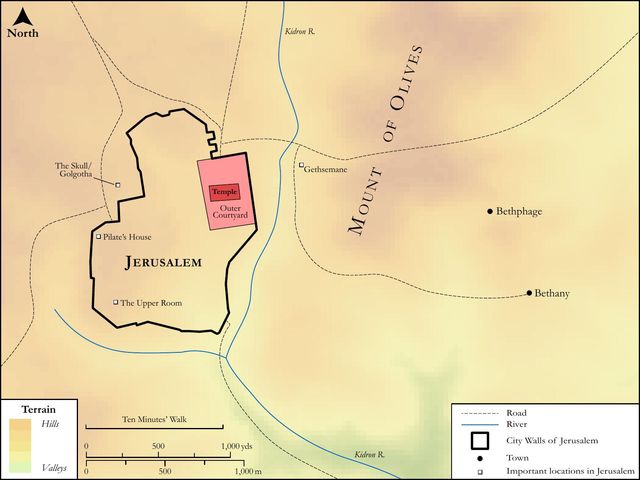
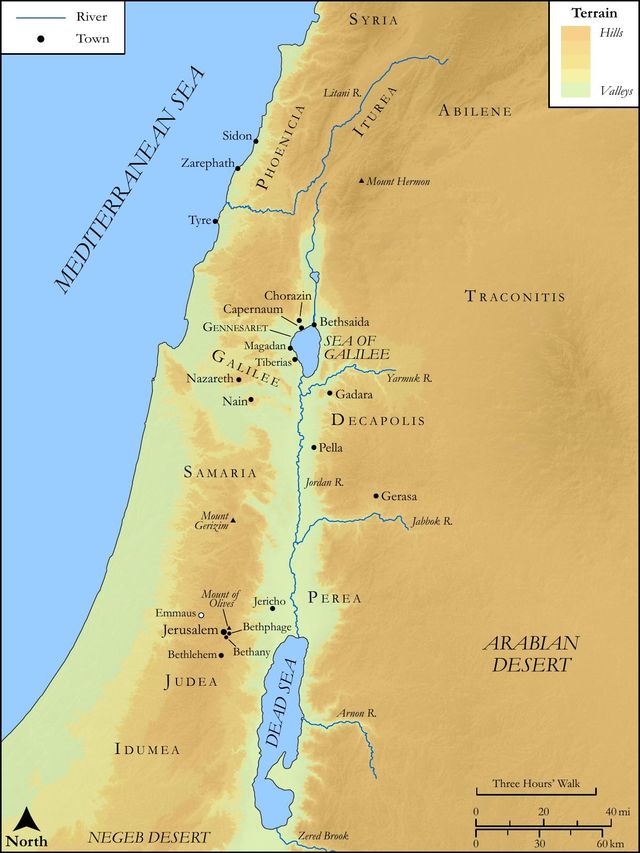
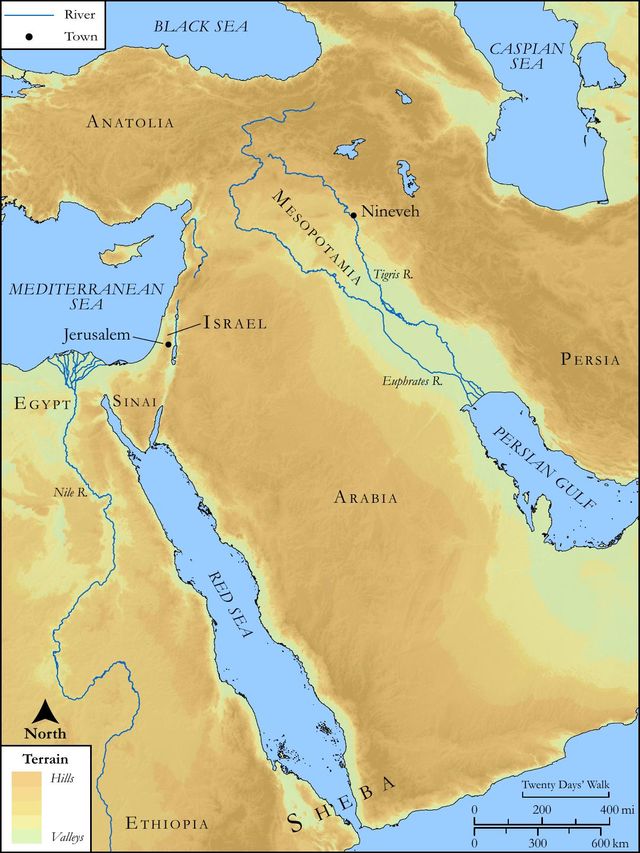
See on the biblical-era maps
Study this verse
Public-domain commentary
Matthew Henry
From his Commentary on the Whole Bible. Henry comments on passages, not single verses — this entry covers Luke 22:21–38. His four-level outline is real structure in the source text, so it is rendered as structure.
We have here Christ's discourse with his disciples after supper, much of which is new here; and in St. John's gospel we shall find other additions. We should take example from him to entertain and edify our family and friends with such discourse at table as is good and to the use of edifying, which may minister grace to the hearers; but especially after we have been at the Lord's table, by Christian conference to keep one another in a suitable frame. The matters Christ here discoursed of were of weight, and to the present purpose.
I.He discoursed with them concerning him that should betray him, who was now present.
1.He signifies to them that the traitor was now among them, and one of them, Luk 22:21. By placing this after the institution of the Lord's supper, though in Matthew and Mark it is placed before it, it seems plain that Judas did receive the Lord's supper, did eat of that bread and drink of that cup; for, after the solemnity was over, Christ said, Behold, the hand of him that betrayeth me is with me on the table. There have been those that have eaten bread with Christ and yet have betrayed him.
2.He foretels that the treason would take effect (Luk 22:22): Truly the Son of man goes as it was determined, goes to the place where he will be betrayed; for he is delivered up by the counsel and foreknowledge of God, else Judas could not have delivered him up. Christ was not driven to his sufferings, but cheerfully went to them. He said, Lo, I come.
3.He threatens the traitor: Woe to that man by whom he is betrayed. Note, Neither the patience of the saints under their sufferings, nor the counsel of God concerning their sufferings, will be any excuse for those that have any hand in their sufferings, or that persecute them. Though God has determined that Christ shall be betrayed and he himself has cheerfully submitted to it, yet Judas's sin or punishment is not at all the less.
4.He frightens the rest of the disciples into a suspicion of themselves, by saying that it was one of them, and not naming which (Luk 22:23): They began to enquire among themselves, to interrogate themselves, to put the question to themselves, who it was that should do this thing, that could be so base to so good a Master. The enquiry was not, Is it you? or, Is it such a one? but, Is it I?
II.Concerning the strife that was among them for precedency or supremacy.
1.See what the dispute was: Which of them should be accounted the greatest. Such and so many contests among the disciples for dignity and dominion, before the Spirit was poured upon them, were a sad presage of the like strifes for, and affections of, supremacy in the churches, after the Spirit should be provoked to depart from them. How inconsistent is this with that in the verse before! There they were enquiring which would be the traitor, and here which should be the prince. Could such an instance of humility, and such an instance of pride and vanity, be found in the same men, so near together? This is like sweet waters and bitter proceeding at the same time out of the same fountain. What a self-contradiction is the deceitful heart of man!
2.See what Christ said to this dispute. He was not sharp upon them, as might have been expected (he having so often reproved them for this very thing), but mildly showed them the sin and folly of it.
(1.)This was to make themselves like the kings of the Gentiles, who affect worldly pomp, and worldly power, Luk 22:25. They exercise lordship over their subjects, and are ever and anon striving to exercise lordship too over the princes that are about them, though as good as themselves, if they think them not so strong as themselves. Note, The exercising of lordship better becomes the kings of the Gentiles than the ministers of Christ. But observe, They that exercise authority, and take upon themselves to bear sway, and give law, they are called Benefactors - Euergetas, they call themselves so, and so their flatterers call them, and those that set themselves to serve their interests. It is pretended that they have been benefactors, and upon that account they should be admitted to have rule; nay, that in exercising authority they are benefactors. However they may really serve themselves, they would be thought to serve their country. One of the Ptolemies was surnamed Euergetes - The Benefactor. Now our Saviour, by taking notice of this, intimates,
[1.]That to do good is much more honourable than to look great; for these princes that were the terror of the mighty would not be called so, but rather the benefactors of the needy; so that, by their own confession, a benefactor to his country is much more valued than a ruler of his country.
[2.]That to do good is the surest way to be great, else they that aimed to be rulers would not have been so solicitous to be called Benefactors. This therefore he would have his disciples believe, that their greatest honour would be to do all the good they could in the world. They would indeed be benefactors to the world, by bringing the gospel to it. Let them value themselves upon that title, which they would indeed be entitled to, and then they need not strive which should be the greatest, for they would all be greater - greater blessings to mankind than the kings of the earth, that exercise lordship over them. If they have that which is confessedly the greater honour, of being benefactors, let them despise the less, of being rulers.
(2.)It was to make themselves unlike the disciples of Christ, and unlike Christ himself: "You shall not be so," Luk 22:26, Luk 22:27. "It was never intended that you should rule any otherwise than by the power of truth and grace, but that you should serve." When church-rulers affect external pomp and power, and bear up themselves by secular interests and influences, they debase their office, and it is an instance of degeneracy like that of Israel when they would have a king like the nations that were round about them, whereas the Lord was their King. See here,
[1.]What is the rule Christ gave to his disciples: He that is greater among you, that is senior, to whom precedency is due upon the account of his age, let him be as the younger, both in point of lowness of place (let him condescend to sit with the younger, and be free and familiar with them) and in point of labour and work. We say, Juniores ad labores, seniores ad honores - Let the young work, and the aged receive their honours. But let the elder take pains as well as the younger; their age and honour, instead of warranting them to take their ease, bind them to double work. And he that is chief, ho hēgoumenos - the president of the college or assembly, let him be as he that serves, hōs ho diakonōn - as the deacon; let him stoop to the meanest and most toilsome services for the public good, if there be occasion.
[2.]What was the example which he himself gave to this rule: Whether is greater, he that sitteth at meat or he that serveth? he that attendeth or he that is attended on? Now Christ was among his disciples just like one that waited at table. He was so far from taking state, or taking his ease, by commanding their attendance upon him, that he was ready to do any office of kindness and service for them; witness his washing their feet. Shall those take upon them the form of princes who call themselves followers of him that took upon him the form of a servant?
(3.)They ought not to strive for worldly honour and grandeur, because he had better honours in reserve for them, of another nature, a kingdom, a feast, a throne, for each of them, wherein they should all share alike, and should have no occasion to strive for precedency, Luk 22:28-30. Where observe,
[1.]Christ's commendation of his disciples for their faithfulness to him; and this was honour enough for them, they needed not to strive for any greater. It is spoken with an air of encomium and applause: "You are they who have continued with me in my temptations, you are they who have stood by me and stuck to me when others have deserted me and turned their backs upon me." Christ had his temptations; he was despised and rejected of men, reproached and reviled, and endured the contradiction of sinners. But his disciples continued with him, and were afflicted in all his afflictions. It was but little help that they could give him, or service that they could do him; nevertheless, he took it kindly that they continued with him, and he here owns their kindness, though it was by the assistance of his own grace that they did continue. Christ's disciples had been very defective in their duty. We find them guilty of many mistakes and weaknesses: they were very dull and very forgetful, and often blundered, yet their Master passes all by and forgets it; he does not upbraid them with their infirmities, but gives them this memorable testimonial, You are they who have continued with me. Thus does he praise at parting, to show how willing he is to make the best of those whose hearts he knows to be upright with him.
[2.]The recompence he designed them for their fidelity: I appoint, diatithemai, I bequeath, unto you a kingdom. Or thus, I appoint to you, as my Father has appointed a kingdom to me, that you may eat and drink at my table. Understand it, First, Of what should be done for them in this world. God gave his Son a kingdom among men, the gospel church, of which he is the living, quickening, ruling, Head. This kingdom he appointed to his apostles and their successors in the ministry of the gospel, that they should enjoy the comforts and privileges of the gospel, help to communicate them to others by gospel ordinances, sit on thrones as officers of the church, not only declaratively, but exhortatively judging the tribes of Israel that persist in their infidelity, and denouncing the wrath of God against them, and ruling the gospel Israel, the spiritual Israel, by the instituted discipline of the church, administered with gentleness and love. This is the honour reserved for you. Or, Secondly, Of what should be done for them in the other world, which I take to be chiefly meant. Let them go on in their services in this world; their preferments shall be in the other world. God will give them the kingdom, in which they shall be sure to have, 1. The richest dainties; for they shall eat and drink at Christ's table in his kingdom, of which he had spoken, Luk 22:16, Luk 22:18. They shall partake of those joys and pleasures which were the recompence of his services and sufferings. They shall have a full satisfaction of soul in the vision and fruition of God; and herein they shall have the best society, as at a feast, in the perfection of love. 2. The highest dignities: "You shall not only be provided for at the royal table, as Mephibosheth at David's, but you shall be preferred to the royal throne; shall sit down with me on my throne, Rev 3:21. In the great day you shall sit on thrones, as assessors with Christ, to approve of and applaud his judgment of the twelve tribes of Israel." If the saints shall judge the world (Co1 6:2), much more the church.
III.Concerning Peter's denying him. And in this part of the discourse we may observe,
1.The general notice Christ gives to Peter of the devil's design upon him and the rest of the apostles (Luk 22:31): The Lord said, Simon, Simon, observe what I say; Satan hath desired to have you, to have you all in his hands, that he may sift you as wheat. Peter, who used to be the mouth of the rest in speaking to Christ, is here made the ear of the rest; and what is designed for warning to them all (all you shall be offended, because of me) is directed to Peter, because he was principally concerned, being in particular manner struck at by the tempter: Satan has desired to have you. Probably Satan had accused the disciples to God as mercenary in following Christ, and aiming at nothing else therein but enriching and advancing themselves in this world, as he accused Job. "No," saith God, "they are honest men, and men of integrity." "Give me leave to try them," saith Satan, "and Peter particularly." He desired to have them, that he might sift them, that he might show them to be chaff, and not wheat. The troubles that were now coming upon them were sifting, would try what there was in them: but this was not all; Satan desired to sift them by his temptations, and endeavoured by those troubles to draw them into sin, to put them into a loss and hurry, as corn when it is sifted to bring the chaff uppermost, or rather to shake out the wheat and leave nothing but the chaff. Observe, Satan could not sift them unless God gave him leave: He desired to have them, as he begged of God a permission to try and tempt Job. Exētēsato - "He has challenged you, has undertaken to prove you a company of hypocrites, and Peter especially, the forwardest of you." Some suggest that Satan demanded leave to sift them as their punishment for striving who should be greatest, in which contest Peter perhaps was very warm: "Leave them to me, to sift them for it."
2.The particular encouragement he gave to Peter, in reference to this trial: "I have prayed for thee, because, though he desires to have them all, he is permitted to make his strongest onset upon thee only: thou wilt be most violently assaulted, but I have prayed for thee, that thy faith fail not, that it may not totally and finally fail." Note,
(1.)If faith be kept up in an hour of temptation, though we may fall, yet we shall not be utterly cast down. Faith will quench Satan's fiery darts.
(2.)Though there may be many failings in the faith of true believers, yet there shall not be a total and final failure of their faith. It is their seed, their root, remaining in them.
(3.)It is owing to the mediation and intercession of Jesus Christ that the faith of his disciples, though sometimes sadly shaken, yet is not sunk. If they were left to themselves, they would fail; but they are kept by the power of God and the prayer of Christ. The intercession of Christ is not only general, for all that believe, but for particular believers (I have prayed for thee), which is an encouragement for us to pray for ourselves, and an engagement upon us to pray for others too.
3.The charge he gives to Peter to help others as he should himself be helped of God: "When thou art converted, strengthen thy brethren; when thou art recovered by the grace of God, and brought to repentance, do what thou canst to recover others; when thou hast found they faith kept from failing, labour to confirm the faith of others, and to establish them; when thou hast found mercy with God thyself, encourage others to hope that they also shall find mercy." Note,
(1.)Those that have fallen into sin must be converted from it; those that have turned aside must return; those that have left their first love must do their first works.
(2.)Those that through grace are converted from sin must do what they can to strengthen their brethren that stand, and to prevent their falling; see Psa 51:11-13; Ti1 1:13.
4.Peter's declared resolution to cleave to Christ, whatever it cost him (Luk 22:33): Lord, I am ready to go with thee, both into prison and to death. This was a great word, and yet I believe no more than he meant at this time, and thought he should make good too. Judas never protested thus against denying Christ, though often warned of it; for his heart was as fully set in him to the evil as Peter's was against it. Note, All the true disciples of Christ sincerely desire and design to follow him, whithersoever he goes, and whithersoever he leads them, though into a prison, though out of the world.
5.Christ's express prediction of his denying him thrice (Luk 22:34): "I tell thee, Peter (thou dost not know thine own heart, but must be left to thyself a little, that thou mayest know it, and mayest never trust to it again), the cock shall not crow this day before thou even deny that thou knowest me." Note, Christ knows us better than we know ourselves, and knows the evil that is in us, and will be done by us, which we ourselves do not suspect. It is well for us that Christ knows where we are weak better than we do, and therefore where to come in with grace sufficient; that he knows how far a temptation will prevail, and therefore when to say, Hitherto shall it come, and no further.
IV.Concerning the condition of all the disciples.
1.He appeals to them concerning what had been, Luk 22:35. He had owned that they had been faithful servants to him, Luk 22:28. Now he expects, at parting, that they should acknowledge that he had been a kind and careful Master to them ever since they left all to follow him: When I sent you without purse, lacked you any thing?
(1.)He owns that he had sent them out in a very poor and bare condition, barefoot, and with no money in their purses, because they were not to go far, nor be out long; and he would thus teach them to depend upon the providence of God, and, under that, upon the kindness of their friends. If God thus send us out into the world, let us remember that better than we have thus begun low.
(2.)Yet ye will have them own that, notwithstanding this, they had lacked nothing; they then lived as plentifully and comfortably as ever; and they readily acknowledged it: "Nothing, Lord; I have all, and abound." Note,
[1.]It is good for us often to review the providences of God that have been concerning us all our days, and to observe how we have got through the straits and difficulties we have met with.
[2.]Christ is a good Master, and his service a good service; for though his servants may sometimes be brought low, yet he will help them; and though he try them, yet will he not leave them. Jehovah-jireh.
[3.]We must reckon ourselves well done by, and must not complain, but be thankful, if we have had the necessary supports of life, though we have had neither dainties nor superfluities, though we have lived from hand to mouth, and lived upon the kindness of our friends. The disciples lived upon contribution, and yet did not complain that their maintenance was precarious, but owned, to their Master's honour, that it was sufficient; they had wanted nothing.
2.He gives them notice of a very great change of their circumstances now approaching. For,
(1.)He that was their Master was now entering upon his sufferings, which he had often foretold (Luk 22:37): "Now that which is written must be fulfilled in me, and this among the rest, He was numbered among the transgressors - he must suffer and die as a malefactor, and in company with some of the vilest of malefactors. This is that which is yet to be accomplished, after all the rest, and then the things concerning me, the things written concerning me, will have an end; then I shall say, It is finished." Note, It may be the comfort of suffering Christians, as it was of a suffering Christ, that their sufferings were foretold, and determined in the counsels of heaven, and will shortly determine in the joys of heaven. They were written concerning them, and they will have an end, and will end well, everlastingly well.
(2.)They must therefore expect troubles, and must not think now to have such an easy and comfortable life as they had had; no, the scene will alter. They must now in some degree suffer with their Master; and, when he is gone, they must expect to suffer like him. The servant is not better than his Lord.
[1.]They must not now expect that their friends would be so kind and generous to them as they had been; and therefore, He that has a purse, let him take it, for he may have occasion for it, and for all the good husbandry he can use.
[2.]They must now expect that their enemies would be more fierce upon them than they had been, and they would need magazines as well as stores: He that has no sword wherewith to defend himself against robbers and assassins (Co2 11:26) will find a great want of it, and will be ready to wish, some time or other, that he had sold his garment and bought one. This is intended only to show that the times would be very perilous, so that no man would think himself safe if he had not a sword by his side. But the sword of the Spirit is the sword which the disciples of Christ must furnish themselves with. Christ having suffered for us, we must arm ourselves with the same mind (Pe1 4:1), arm ourselves with an expectation of trouble, that it may not be a surprise to us, and with a holy resignation to the will of God in it, that there may be no opposition in us to it: and then we are better prepared than if we had sold a coat to buy a sword. The disciples hereupon enquire what strength they had, and find they had among them two swords (Luk 22:38), of which one was Peter's. The Galileans generally travelled with swords. Christ wore none himself, but he was not against his disciples' wearing them. But he intimates how little he would have them depend upon this when he saith, It is enough, which some think is spoken ironically: "Two swords among twelve men! you are bravely armed indeed when our enemies are now coming out against us in great multitudes, and every one with a sword!" Yet two swords are sufficient for those who need none, having God himself to be the shield of their help and the sword of their excellency, Deu 33:29.
Historical interpretation
Nine Centuries of Reception
10 surviving comments on this verse. Each one is dated, so this reads as a timeline rather than a list.
Select a marker to jump to its quote. Markers stagger vertically where authors wrote within a few decades of each other.
The devil also asked for power to tempt the apostles, since he did not have it except with divine permission. In the Gospel, the Lord said to Peter, “Behold, Satan has desired to have you, that he may sift you as wheat; but I have prayed for you, that your faith may not fail.” That is to say, the devil could not have so much power as to be able to endanger the faith of Peter. We thus see that the threat to our faith as well as its protection are in the power of God.
(in Reg. Brev. ad int. 8.) We must know then, that God sometimes allows the rash to receive a fall, as a remedy to previous self-confidence. But although the rash man seems to have committed the same offence with other men, there is no slight difference. For the one has sinned by reason of certain secret assaults and almost against his will, but the others, having no care either for themselves or God, knowing no distinction between sin and virtuous actions. For the rash needing some assistance, in regard to this very thing in which he has sinned ought to suffer reproof. But the others, having destroyed all the good of their soul, must be afflicted, warned, rebuked, or made subject to punishment, until they acknowledge that God is a just Judge, and tremble.
Beware then of boasting, beware of the world; he is commanded to strengthen his own brethren, who said, Master, we have left all, and followed thee. (Matt. 19:27.)
Now Peter although earnest in spirit, yet still weak in bodily inclination, is declared about to deny his Lord; for he could not equal the constancy of the Divine will. Our Lord's Passion has rivals, but no equal.
Peter, though ready in spirit, was still weak in the body and was being prepared emotionally to deny the Lord; for he could not match the steadfastness of divine intention. The passion of the Lord has imitators, but not equals. Thus, I do not criticize him for his denial, but praise him for his tears. It is one thing to share in a common human condition, and another to possess a special virtue. And therefore, he is instructed to be cautious, not forced to deny.
(Hom. 82. in Matt.) Now He said not, 'I have granted,' but I have prayed. For He speaks humbly as approaching unto His Passion, and that He may manifest His human nature. For He who had spoken not in supplication, but by authority, Upon this rock I will build my Church, and I will give thee the keys of the kingdom of heaven, (Matt. 16:18.) how should He have need of prayer that He might stay one agitated soul? He does not say, "I have prayed that thou deny not," but that thou do not abandon thy faith.
The Savior once to Peter showed
What hidden power this bird may have,
And warned that ere the cock would crow
Himself three times must be denied.
For evil deeds are ever done
Before that herald of the dawn
Enlightens humankind and brings
An end to error and to sin.
Forthwith he wept his bitter fall
Whose lying lips denied the Christ,
The while his heart was innocent,
And steadfast faith his soul preserved.
And never more such word he spoke,
By slip of tongue or conscious fault,
For mindful of the crowing cock,
The just man ceased from ways of sin.
Hence all now hold in firm belief
That in the stillness of the night
When loudly crows the joyful cock
Our Lord came back from hell’s dim shore.
In the passion of his zeal, Peter professed steadfastness and endurance to the last extremity, saying that he would courageously resist the terrors of death and count chains as nothing. In so doing, he erred from what was right. When the Savior told Peter that he would be weak and contradict the Lord, he should not have loudly protested the contrary. The Truth could not lie. Peter should have rather asked strength from Christ, either that he might not suffer this or that he might be rescued immediately from harm. He was fervent in spirit, warm in his love toward Christ, and of unrestrained zeal in rightly performing those duties which fit a disciple in his service to his master. Peter declares that he will endure to the last extremity. Christ rebuked him for foolishly speaking against what was foreknown and for his unreasonable haste in contradicting the Savior's words. For this reason he says, "Truly I tell you, that the rooster will not crow tonight, until you have three times denied me." This proved true. Let us not think highly of ourselves, even if we see ourselves greatly distinguished for our virtues. Let us rather offer the praises of our thanks to Christ who redeems us and who grants us even the desire to be able to act correctly.
Lest the eleven should be boastful, and impute it to their own strength, that they almost alone among so many thousands of the Jews were said to have continued with our Lord in His temptations, He shows them, that if they had not been protected by the aid of their Master succouring them, they would have been beaten down by the same storm as the rest. Hence it follows, And the Lord said unto Simon, Simon, behold, Satan hath desired thee, that he may sift thee as wheat. That is, he hath longed to tempt you and to shake you, as he who cleanses wheat by winnowing. Wherein He teaches that no man's faith is tried unless God permits it.
As if to say, As I by prayer protected your faith that it should not fail, so do you remember to sustain the weaker brethren, that they despair not of pardon.
Because the Lord said He had prayed for Peter's faith, Peter conscious of present affection and fervent faith, but unconscious of his coming fall, does not believe he could in any way fall from Christ. As it follows, And he said unto him, Lord, I am ready to go with thee to prison and to death.
He said to him: "Lord, I am ready to go with you both to prison and to death." But he said: "I tell you, Peter, the cock will not crow today until you deny three times that you know me." Because the Lord had said that he had prayed for Peter's faith, he, aware of his present fervent affection and faith, but ignorant of his future fall, did not believe that he could in any way fail him. But he who alone knows what is in man, so that no faithful person may either confidently trust in their own stability or carelessly distrust their fall, foretells as God the manner, time, and number of his denial, and as a merciful one promises the help of his protection.
Now this was said to Peter, because he was bolder than the rest, and might feel proud because of the things which Christ had promised.
For albeit thou art for a time shaken, yet thou boldest stored up, a seed of faith; though the spirit has shed its leaves in temptation, yet the root is firm. Satan then seeks to harm thee, because he is envious of my love for thee, but notwithstanding that I have prayed for thee, thou shalt fall. Hence it follows, And when thou art converted, strengthen thy brethren. As if He says, After that thou hast wept and repented thy denial of Me, strengthen thy brethren, for I have deputed thee to be the head of the Apostles. For this befits thee who art with Me, the strength and rock of the Church. And this must be understood not only of the Apostles who then were, but of all the faithful who were about to be, even to the end of the world; that none of the believers might despair, seeing that Peter though an Apostle denied his Lord, yet afterwards by penitence obtained the high privilege of being the Ruler (ἐπιστάτης) of the world.
He burns forth indeed with too much love, and promises what is impossible to him. But it behoved him as soon as he heard from the Truth that he was to be tempted, to be no longer confident. Now the Lord, seeing that Peter spoke boastfully, reveals the nature of his temptation, namely, that he would deny Him; I tell thee, Peter, the cock shall not crow this day, before that thou thrice deny, &c.
From hence we draw a great doctrine, that human resolve is not sufficient without the Divine support. For Peter with all his zeal, nevertheless when forsaken of God was overthrown by the enemy.
Continue studying Luke 22:33 across the web’s major study libraries — every link below opens this exact verse, chapter, or book on the destination site.
Read & Compare
 BibleGatewayThis verse in more than 200 translations and 70 languages.
 Bible.comThe YouVersion reader — hundreds of translations, reading plans, and highlights.
 ESV.orgCrossway's official English Standard Version reader.
 NET BibleThe NET translation with 60,000+ translators' notes on every rendering decision.
 STEP BibleTyndale House's free study tool — original text, vocabulary, and scholarly resources.
 BibliaLogos Bible Software's free web reader.
 USCCBThe New American Bible (Revised Edition) with the U.S. bishops' study notes.
Commentaries
 BibleHub CommentariesDozens of classic commentaries on this verse, gathered on one page.
 StudyLightMore than 100 commentary sets — the largest collection on the web.
 BibleRefPlain-English commentary on what this verse means, verse by verse.
 Enduring WordDavid Guzik's free commentary on this chapter, widely used by Bible teachers.
 Bible Study ToolsVerse commentary alongside Greek and Hebrew study aids.
Original Language & Research
- BibleHub InterlinearThe verse word by word — original language, transliteration, and English.
- BibleHub LexiconEvery word's original-language definition and Strong's entry.
 Blue Letter BibleDeep-study tools — Strong's numbers, concordance, and word studies.
 CNTR CollationThe earliest Greek manuscripts of this verse, collated letter by letter.
Sermons, Hymns & Audio


TrulyRandomVerse is not affiliated with these sites and doesn’t control their content. They’re linked because they’re genuinely useful.
Summary
Luke 22:33 records Peter's fervent and sincere, yet ultimately overconfident, declaration of loyalty to Jesus, asserting his readiness to accompany his Lord even to imprisonment and death. This bold statement, made in the intimate setting of the Last Supper, immediately follows Jesus' somber prediction of Peter's impending denial, highlighting the stark contrast between human self-assurance and divine foreknowledge of human frailty. It captures a pivotal moment of genuine devotion before the crucible of testing reveals the limits of Peter's present strength.
Context
ShowHideLiterary Context
This verse is situated within the intensely significant narrative of Jesus' final hours before his crucifixion. Immediately preceding Jesus has instituted the New Covenant through the Lord's Supper (Luke 22:14-20), warned of the betrayal by Judas (Luke 22:21-23), and addressed the disciples' dispute over greatness (Luke 22:24-30). Crucially, in Luke 22:31-32, Jesus specifically warns Peter that Satan has sought to "sift him as wheat," but that Jesus has prayed for his faith not to fail. He then charges Peter to "strengthen your brothers once you have turned back." Peter's declaration in verse 33 is his immediate, impassioned response to this personal warning, demonstrating his initial, albeit misplaced, confidence in his own steadfastness. The very next verse, Luke 22:34, records Jesus' direct counter-prediction of Peter's threefold denial, setting up a dramatic irony that will soon unfold.
Historical & Cultural Context
In the 1st-century Jewish context, discipleship to a rabbi or teacher often involved a profound commitment, sometimes even to the point of sharing in their master's fate. However, the concept of a messianic leader facing imprisonment and death was profoundly counter-cultural to the prevailing Jewish expectations of a conquering political Messiah. Imprisonment (often in Roman or Herodian jails) and execution (especially crucifixion for sedition against Rome, or stoning for blasphemy under Jewish law) were common forms of punishment for those deemed threats to authority. Peter's declaration, therefore, was not a light promise; it invoked the most severe consequences imaginable for a follower of a condemned man. His willingness to speak of "prison" and "death" indicates an awareness of the very real dangers associated with openly identifying with Jesus, particularly as tensions with the religious authorities were escalating.
Key Themes
ShowHideThis verse contributes significantly to several overarching themes in Luke's Gospel and the broader biblical narrative. It powerfully illustrates the theme of human weakness versus divine strength, as Peter's sincere but self-reliant declaration is immediately contrasted with Jesus' knowing prediction of his failure. It also highlights the theme of discipleship and suffering, underscoring that true allegiance to Christ often involves a willingness to endure hardship, even if one's initial resolve proves insufficient without divine aid. Furthermore, it foreshadows the testing and restoration of faith, as Peter's fall and subsequent restoration (as alluded to in Luke 22:32) become a paradigm for all believers who stumble but are brought back by Christ's intercession and grace. The narrative also sets the stage for the sovereignty of God's plan, demonstrating that even human failures are woven into God's larger redemptive purposes, ultimately leading to a deeper, more humble faith.
Exposition and Analysis
ShowHideKey Word Analysis
ShowHideThis word signifies being prepared, adjusted, or in a state of readiness. Peter's use of hétoimos indicates his strong conviction that he was personally equipped and mentally prepared to face the extreme challenges he mentioned. It speaks to his present state of mind and perceived capability, rather than necessarily a divinely empowered readiness.
Literally meaning "a guarding" or "a watch," this term concretely refers to a place of custody, confinement, or imprisonment. For Peter, it represents the immediate and tangible threat of arrest and incarceration that followers of a controversial figure like Jesus might face. It implies a loss of freedom and the beginning of suffering.
This word denotes physical death, the cessation of life. In Peter's declaration, it represents the ultimate sacrifice and the most severe consequence of his allegiance to Jesus. It highlights the extremity of his stated commitment, indicating a willingness to lay down his life for his Lord.
Verse Breakdown
ShowHide"And he said unto him"
This phrase establishes the direct, personal nature of Peter's response to Jesus' preceding warning. The "him" refers to Jesus, indicating Peter's immediate and earnest address to his Master.
"Lord, I am ready to go with thee"
Peter addresses Jesus with the respectful and deferential title "Lord" (Kyrios), affirming his submission and devotion. His declaration "I am ready" (from hétoimos) expresses his current state of preparedness and resolute intention. The phrase "to go with thee" signifies his unwavering commitment to accompany Jesus wherever He might lead, even into perilous circumstances.
"both into prison, and to death"
This final clause specifies the extreme lengths to which Peter believes he is prepared to go. By mentioning "prison" (phylakḗ) and "death" (thánatos), Peter articulates his willingness to endure the severest forms of persecution and ultimate sacrifice, demonstrating what he genuinely believes is his unshakeable loyalty and courage in the face of the imminent trials.
Literary Devices
ShowHideLuke's account of Peter's declaration is rich in Irony. Peter's confident assertion of loyalty stands in stark contrast to Jesus' immediate and accurate prediction of Peter's denial, which follows in the very next verse (Luke 22:34). This dramatic irony highlights the chasm between human self-perception and divine foreknowledge, emphasizing the frailty of human resolve apart from divine strength. There is also an element of Foreshadowing, as Peter's words, though failing in the immediate future, ultimately point to his later martyrdom, fulfilling his declaration in a deeper, Spirit-empowered way decades later. Peter's statement can also be seen as an instance of Hyperbole from a human perspective, as his emotional zeal momentarily outstrips his true capacity for endurance in that specific moment of crisis.
Theological and Thematic Connections
ShowHidePeter's declaration in Luke 22:33 serves as a poignant theological statement on the nature of discipleship, human weakness, and divine grace. It reveals the sincere, yet ultimately insufficient, nature of self-reliant commitment. Peter's zeal is commendable, but his confidence is rooted in his own strength, not in the empowering grace of God, which he would later experience. This moment underscores the profound truth that while our intentions may be pure, our ability to stand firm in the face of extreme pressure is contingent upon God's sustaining power, not merely our own resolve. It teaches us humility and the necessity of depending on Christ's intercession and strength, especially when facing trials that threaten to overwhelm our faith.
Reflection and Application
ShowHidePeter's earnest declaration in Luke 22:33 offers a powerful mirror for self-reflection. We, like Peter, often possess genuine love and commitment to Christ, confidently asserting our readiness to follow Him through any hardship. Yet, this verse reminds us that our subjective resolve, however sincere, is often insufficient when confronted with the overwhelming pressures and temptations of life. True faithfulness is not merely a matter of strong will or good intentions, but a humble reliance on God's grace and strength. Peter's subsequent failure and restoration teach us that even when we stumble, God's love and Christ's intercession remain, offering a path to repentance, renewed faith, and a deeper, more humble dependence on Him. This passage calls us to examine the source of our confidence: is it in our own strength or in the unfailing power of Christ?
Questions for Reflection
ShowHideFAQ
ShowHideWhy did Peter make such a bold statement if he was going to deny Jesus?
ShowHidePeter's statement was undoubtedly sincere in the moment. He genuinely loved Jesus and believed himself capable of enduring anything for his Lord. His declaration reflects his passionate, impulsive nature and a profound, albeit self-reliant, devotion. However, it also reveals a lack of self-knowledge regarding his own human frailty and the immense spiritual pressure he was about to face. Jesus' warning was not a prediction of Peter's lack of love, but of his temporary failure under extreme duress, which would ultimately lead to a deeper, more humble faith forged through repentance and restoration. This highlights the difference between a heartfelt intention and the actual strength required to withstand a spiritual attack.
What does this verse teach us about human nature and faith?
ShowHideThis verse powerfully illustrates the tension between human confidence and human weakness. Peter's declaration exemplifies our natural tendency to overestimate our own spiritual fortitude, especially when we haven't yet faced the full intensity of a trial. It teaches us that genuine faith, while requiring commitment, must ultimately be rooted in humility and a complete dependence on God's grace, not on our own perceived strength. It demonstrates that even the most devoted disciples can stumble, but it also implicitly points to the possibility of restoration and growth through failure, as seen in Peter's later life. As Jeremiah 17:9 reminds us, "The heart is deceitful above all things, and desperately sick; who can understand it?"
Christ-Centered Fulfillment
ShowHideLuke 22:33, while a record of Peter's human frailty, ultimately points to the steadfast faithfulness of Christ. Peter's sincere but ultimately failed promise to go to "prison" and "death" for Jesus foreshadows the true Lamb of God who would indeed go to prison (figuratively, in His arrest and trial) and to death, not for His own sake, but for the sake of His disciples and all humanity. Jesus' prayer for Peter's faith not to fail (Luke 22:32) underscores His role as the Great High Priest, interceding for His own, even in their weakness. Unlike Peter, who would momentarily abandon Him, Jesus remained perfectly obedient to the Father, even to the point of death on a cross (Philippians 2:8). Peter's later restoration and Spirit-empowered ministry, where he did eventually suffer for Christ (as tradition holds, even martyrdom), is a testament to the enabling power of the resurrected Christ and the Holy Spirit (Acts 2:14-41). Thus, Peter's initial failure highlights the absolute necessity of Christ's perfect sacrifice and His ongoing intercession, which alone secures the perseverance of His saints and transforms human weakness into Spirit-empowered faithfulness.