


Joshua 19:16
Bible text: King James Version (1769 Blayney text) · Public domain
Bible text: Berean Standard Bible · Public domain
Bible text: American Standard Version (1901) · Public domain
Bible text: World English Bible, Messianic edition · Public domain
Bible text: Geneva Bible (1599) · Public domain
Bible text: Young's Literal Translation · Public domain
- זֹאתzotthisH2063PrtParticle Demonstrative
- נַחֲלַתna·cha·Lat[was] [the] inheritance ofH5159N-fscNoun Singular Feminine Construct
- בְּנֵיbe·nei[the] descendants ofH1121N-mpcNoun Plural Masculine Construct
- זְבוּלֻןze·vu·LunZebulunH2074N-proper-mNoun Proper Masculine
- לְמִשְׁפְּחוֹתָםle·mish·pe·cho·Tamto their clansH4940Prep-l ¦ N-fpc ¦ 3mpNoun Plural Feminine Constructלְtoמִשְׁפְּחוֹתָclansםtheir
- הֶעָרִיםhe·'a·Rimthe citiesH5892Art ¦ N-mpNoun Plural Masculine Absoluteהֶtheעָרִיםcities
- הָאֵלֶּהha·'E·leh<the> theseH428Art ¦ PrtParticle Demonstrativeהָ<the>אֵלֶּהthese
- וְחַצְרֵיהֶןve·chatz·rei·Henand their villagesH2691Conj-w ¦ N-mpc ¦ 3fpNoun Plural Masculine Constructוְandחַצְרֵיvillagesהֶןtheir
English is a literal word-by-word gloss of the Hebrew, not the KJV's wording. Why?
This is the original text the KJV's translators worked from — each Hebrew word with its own literal English meaning in this verse, prepared by scholars at Tyndale House, Cambridge. The KJV translates whole sentences, not word by word, so its wording differs: one Hebrew word can become several English words, and the KJV may choose “the LORD” where the gloss reads “Yahweh”. Both are faithful — they answer different questions. For the KJV's own rendering, switch to the KJV text.
Details
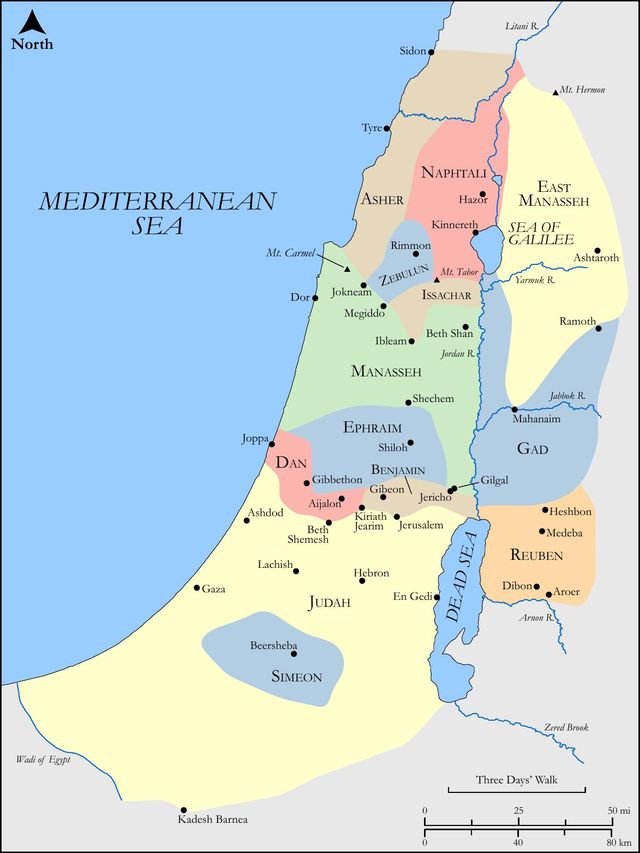
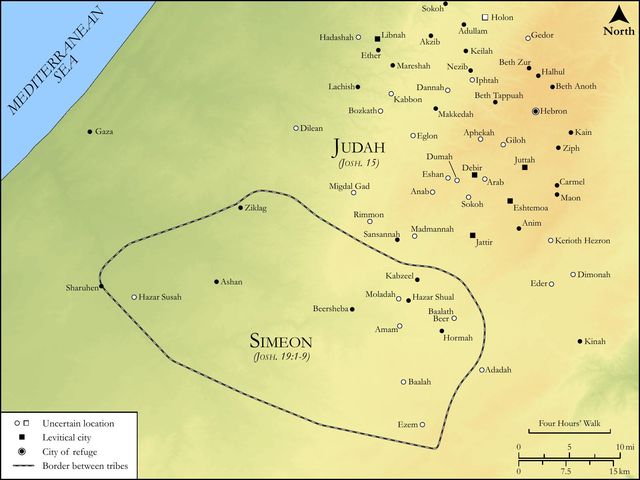
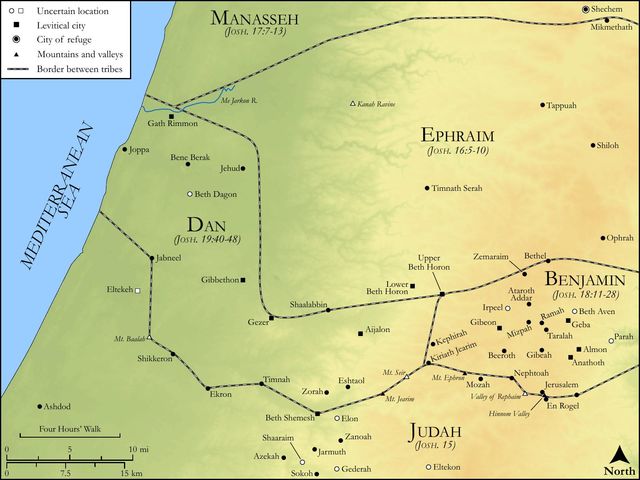
See on the biblical-era maps
Study this verse
Public-domain commentary
Matthew Henry
From his Commentary on the Whole Bible. Henry comments on passages, not single verses — this entry covers Joshua 19:10–16.
This is the lot of Zebulun, who, though born of Leah after Issachar, yet was blessed by Jacob and Moses before him; and therefore it was so ordered that his lot was drawn before that of Issachar, north of which it lay and south of Asher. 1. The lot of this tribe was washed by the great sea on the west, and by the sea of Tiberias on the east, answering Jacob's prophecy (Gen 49:13), Zebulun shall be a haven of ships, trading ships on the great sea and fishing ships on the sea of Galilee. 2. Though there were some places in this tribe which were made famous in the Old Testament, especially Mount Carmel, on which the famous trial was between God and Baal in Elijah's time, yet it was made much more illustrious in the New Testament; for within the lot of this tribe was Nazareth, where our blessed Saviour spent so much of his time on earth, and from which he was called Jesus of Nazareth, and Mount Tabor on which he was transfigured, and that coast of the sea of Galilee on which Christ preached so many sermons and wrought so many miracles.
Continue studying Joshua 19:16 across the web’s major study libraries — every link below opens this exact verse, chapter, or book on the destination site.
Read & Compare
 BibleGatewayThis verse in more than 200 translations and 70 languages.
 Bible.comThe YouVersion reader — hundreds of translations, reading plans, and highlights.
 ESV.orgCrossway's official English Standard Version reader.
 NET BibleThe NET translation with 60,000+ translators' notes on every rendering decision.
 STEP BibleTyndale House's free study tool — original text, vocabulary, and scholarly resources.
 BibliaLogos Bible Software's free web reader.
 USCCBThe New American Bible (Revised Edition) with the U.S. bishops' study notes.
Commentaries
 BibleHub CommentariesDozens of classic commentaries on this verse, gathered on one page.
 StudyLightMore than 100 commentary sets — the largest collection on the web.
 BibleRefPlain-English commentary on what this verse means, verse by verse.
 Enduring WordDavid Guzik's free commentary on this chapter, widely used by Bible teachers.
 Bible Study ToolsVerse commentary alongside Greek and Hebrew study aids.
Original Language & Research
- BibleHub InterlinearThe verse word by word — original language, transliteration, and English.
- BibleHub LexiconEvery word's original-language definition and Strong's entry.
 Blue Letter BibleDeep-study tools — Strong's numbers, concordance, and word studies.
 SefariaThe Hebrew text with Rashi and centuries of Jewish commentary.
Sermons, Hymns & Audio


TrulyRandomVerse is not affiliated with these sites and doesn’t control their content. They’re linked because they’re genuinely useful.
Summary
Joshua 19:16 serves as the definitive statement concluding the meticulous territorial allocation for the tribe of Zebulun within the Promised Land. This concise verse precisely outlines their inheritance, specifying that their divinely appointed portion included a collection of cities along with their surrounding villages, distributed equitably among their respective families. It stands as a powerful testament to God's unwavering faithfulness, His meticulous order, and the practical fulfillment of His covenant promises in establishing Israel as a settled nation.
Context
ShowHideLiterary Context
Joshua 19:16 concludes the detailed description of Zebulun's tribal inheritance, which is introduced in Joshua 19:10. This verse is an integral part of the broader section in the book of Joshua, specifically Joshua 13-21, which exhaustively chronicles the division of the land of Canaan among the twelve tribes of Israel. Following the narratives of conquest and initial victories, this extensive section demonstrates the practical and systematic fulfillment of God's ancient promise to grant the land to His people. The careful enumeration of boundaries, cities, and villages, as exemplified in Zebulun's portion, underscores the thoroughness, divine guidance, and legal precision behind the land distribution process, which was primarily conducted by lot at Shiloh under the oversight of Joshua and Eleazar the priest.
Historical & Cultural Context
In ancient Israel, land inheritance was not merely an economic asset but the fundamental basis of tribal identity, social stability, and the very concept of nationhood. The land was understood as a permanent, inalienable gift from Yahweh, directly tied to the covenant promises made to Abraham (Genesis 12:7) and continually reaffirmed through Moses. The division "according to their families" was paramount, ensuring that each family unit possessed a tangible stake in the land, a source of livelihood, and a visible connection to their lineage and the divine promises. This system was designed to prevent the permanent alienation of land from a family or tribe, thereby reinforcing the communal and covenantal nature of Israelite society. Such meticulous records, like those for Zebulun, functioned as vital legal documentation and a enduring historical witness to God's faithfulness.
Key Themes
ShowHideThis verse, situated within the broader narrative of land distribution, powerfully illustrates several core theological and narrative themes. Firstly, Divine Faithfulness is paramount, as God meticulously brings to pass His ancient promises to give the land to Abraham's descendants, demonstrating His unwavering reliability and covenant integrity. Secondly, Order and Structure are profoundly evident in the systematic and precise allocation of territory to each tribe and family, contrasting sharply with chaotic land grabs and highlighting God's purposeful design for His people's settlement and flourishing. Thirdly, Identity and Inheritance are deeply intertwined; the land provided not only a physical home and livelihood but also solidified the unique identity of each tribe and family within the larger nation of Israel, connecting them tangibly to their covenant heritage and God's abundant provision. This fulfillment of the promise to give the land provides a tangible demonstration of God's character, setting the stage for future covenant interactions.
Exposition and Analysis
ShowHideKey Word Analysis
ShowHideThis term signifies more than just a possession; it refers to something inherited, an occupancy, or concretely, an heirloom, estate, patrimony, or portion. In the context of the Promised Land, it emphasizes that the land was a divinely allotted, permanent, and often inalienable possession, a gift from God and an enduring legacy tied to His covenant promises. It speaks to God's sovereign provision and the secure future He intended for His people, distinguishing it from land acquired by conquest alone.
This word denotes a family, a circle of relatives, or by extension, a tribe or people. The phrase "according to their families" highlights the familial basis of the land distribution, signifying that the allocation was not merely tribal but meticulously subdivided down to the individual family unit. This ensured equity, prevented disputes, and reinforced the family as the fundamental social and economic unit of Israelite society, underscoring the meticulous nature of God's provision for each household.
This term refers to a yard (as inclosed by a fence), or a hamlet (as similarly surrounded with walls), also translated as court or tower. When paired with "cities," this specific phrasing indicates a comprehensive allocation that included both fortified urban centers and their surrounding agricultural lands, smaller settlements, and pasturage. It implies a fully functional and sustainable territory, providing for both defense and livelihood, leaving no ambiguity about the extent of Zebulun's allotted portion and its capacity for sustenance.
Verse Breakdown
ShowHide"This [is] the inheritance of the children of Zebulun"
This opening clause serves as a definitive summary statement, formally concluding the detailed description of Zebulun's boundaries and cities provided in the preceding verses. It declares the allocated territory as their permanent, divinely-granted possession, emphasizing its status as a direct fulfillment of God's promise.
"according to their families"
This crucial phrase underscores the principle governing the distribution of the land. It clarifies that the inheritance was not merely assigned to the tribe as a collective entity but was further meticulously divided and apportioned among the various family units within Zebulun. This ensured fairness, prevented internal disputes, and reinforced the social and economic structure of Israelite society, where land ownership was intrinsically linked to lineage and familial identity.
"these cities with their villages"
This final phrase precisely specifies the nature and extent of the inheritance. It clarifies that Zebulun's portion included not only open land but a defined collection of urban centers ("cities") along with their associated rural areas, hamlets, and agricultural lands ("villages"). This comprehensive description highlights the completeness and practicality of the divine allocation, ensuring both defense and sustainable livelihood for the tribe's settlement.
Literary Devices
ShowHideJoshua 19:16, as part of the broader land distribution narrative, employs several key literary devices that reinforce its message. Cataloging or Listing is a pervasive device throughout Joshua 13-21, evident in the precise enumeration of cities and boundaries for each tribe, including Zebulun. This meticulous detail serves to emphasize the precision, thoroughness, and divine order of God's fulfillment of His promises. The verse itself functions as a Summary Statement, concisely encapsulating the preceding detailed description of Zebulun's territory, providing a definitive conclusion to their portion. Furthermore, the entire section contributes significantly to the overarching Fulfillment Narrative of the book of Joshua, demonstrating how God's ancient promises to Abraham and Moses regarding the land of Canaan are being concretely and systematically realized. The Repetition of terms like "inheritance" (nachălâh') across these chapters reinforces the theological significance of the land as a divine gift and a permanent, covenantal possession.
Theological and Thematic Connections
ShowHideJoshua 19:16, while describing a specific historical event of land allocation, offers profound and enduring theological insights into God's character and His relationship with His people. It powerfully illustrates God's unwavering faithfulness to His covenant promises, demonstrating that what He declares, He meticulously and precisely brings to pass. Just as He provided a tangible, physical inheritance for Israel, He promises a spiritual inheritance for believers today. This inheritance is not earned by human merit but is a gift of grace, secured through the person and work of Jesus Christ, and it is described as incorruptible, undefiled, and eternal, far surpassing any earthly possession. This verse reminds us that God is a God of order, precision, and abundant provision, carefully planning and executing His purposes for His people, ensuring their security and flourishing.
Reflection and Application
ShowHideThe meticulous record of Zebulun's inheritance in Joshua 19:16, though rooted in ancient history, speaks enduring truths to believers today, calling us to reflect on the nature of God's promises and His unwavering faithfulness. Just as God precisely fulfilled His word to Israel, providing them with a tangible, secure inheritance, He is utterly trustworthy to fulfill every promise He has made to us in Christ. This profound truth should cultivate a deep sense of security and peace in our hearts, knowing that our future, our spiritual blessings, and our eternal home are secured by His unchangeable character and sovereign plan. Furthermore, the concept of each tribe receiving a unique, designated portion reminds us that God has a specific place and purpose for each believer within His vast kingdom. We are not generic parts of a whole but uniquely gifted individuals, called to embrace our particular roles and contribute to the flourishing of the body of Christ. This encourages us to diligently seek and faithfully fulfill our God-given calling, trusting that He has perfectly ordered our lives for His glory and our ultimate good.
Questions for Reflection
ShowHideFAQ
ShowHideWhy is this verse so specific about cities and villages, rather than just general boundaries?
ShowHideThe specificity in Joshua 19:16, detailing "these cities with their villages," underscores the comprehensive and legally precise nature of the land allocation. It wasn't merely a broad territorial claim but a meticulously defined inheritance that included both urban centers (essential for defense, administration, and trade) and the surrounding agricultural lands, smaller settlements, and pasturage (critical for livelihood and sustenance). This level of detail ensured clarity, minimized potential disputes among tribes and families, and provided a practical, livable, and sustainable territory for the tribe of Zebulun, demonstrating God's thorough provision and orderly establishment of His people in the land.
How was the land divided "according to their families" if it was done by lot?
ShowHideThe division of the land by lot, as described in Joshua 18:10, was indeed overseen by Joshua and Eleazar the priest at Shiloh, ensuring divine guidance in the overall allocation. While the initial tribal portions were determined by this sacred lot, the phrase "according to their families" implies that further, more detailed subdivisions within each tribal territory were then made based on the size, needs, and lineage of the individual family units. This ensured a fair and equitable distribution within the tribe, respecting the foundational importance of the family as the primary social and economic unit in Israelite society. Thus, the lot ensured divine sovereignty in the macro-distribution, while familial distribution ensured practical equity in the micro-distribution.
What was the significance of the "inheritance" (nachălâh') in ancient Israel beyond just owning land?
ShowHideIn ancient Israel, the "inheritance" (nachălâh') was far more than mere property ownership; it was a profound theological, social, and covenantal concept. It represented a permanent, inalienable possession divinely allotted to a family or tribe, directly tied to God's covenant promises to Abraham (Genesis 15:18) and his descendants. It provided a physical manifestation of God's faithfulness, secured tribal and familial identity, ensured economic stability for generations, and served as a perpetual reminder of their unique relationship with Yahweh. It was the foundation of their national existence, their place of worship, and their primary source of livelihood, making it central to their covenant identity and their future hope as God's chosen people.
Christ-Centered Fulfillment
ShowHideThe physical inheritance of land for Zebulun in Joshua 19:16, while a tangible fulfillment of God's covenant with Israel, ultimately points to the infinitely greater spiritual inheritance provided through Jesus Christ. Just as the land of Canaan was a promised possession secured by God's faithfulness and meticulous planning, so too is our eternal inheritance in Christ. Jesus, the true and greater Joshua, leads His people into a far superior rest and possession, not merely a physical land but a spiritual kingdom and eternal life in His presence. He is the ultimate fulfillment of all God's promises, for "all the promises of God find their Yes in him" (2 Corinthians 1:20). Through His atoning work on the cross and His glorious resurrection, we are granted an "inheritance that is imperishable, undefiled, and unfading, kept in heaven for you" (1 Peter 1:4). This spiritual inheritance encompasses every spiritual blessing in the heavenly places (Ephesians 1:3), the indwelling Holy Spirit as a guarantee and down payment of our future glory (Ephesians 1:13-14), and the glorious promise of co-heirship with Christ Himself (Romans 8:17). Thus, the meticulous division of land in Joshua foreshadows the meticulous and perfect provision of salvation and eternal life that is ours by grace through Christ, our ultimate and everlasting inheritance.