


Ruth 1:19
Bible text: King James Version (1769 Blayney text) · Public domain
Bible text: King James Version with Strong's numbers · Public domain
Bible text: Berean Standard Bible · Public domain
Bible text: American Standard Version (1901) · Public domain
Bible text: World English Bible, Messianic edition · Public domain
Bible text: Geneva Bible (1599) · Public domain
Bible text: Young's Literal Translation · Public domain
- וַתֵּלַכְנָהva·te·Lakh·nahand they wentH1980Conj-w ¦ V-Qal-ConsecImperf-3fpVerb Qal Consecutive Imperfect 3rd Plural Feminineוַandתֵּלַכְנָהthey went
- שְׁתֵּיהֶםshe·tei·Hem[the] two of themH8147N-fdc ¦ 3mpNoun Dual Feminine Constructשְׁתֵּי[the] two ofהֶםthem
- עַד'aduntilH5704PrepPreposition
- בֹּאָנָהbo·'A·nahthey cameH935V-Qal-Inf ¦ 3fpVerb Qal Infinitive Constructבֹּאָcameנָהthey
- בֵּיתbeitBeth-H1035N-properNoun Proper Location
- לָחֶםLa·chem-lehemH1035N-properNoun Proper Location
- וַיְהִיvay·Hiand it wasH1961Conj-w ¦ V-Qal-ConsecImperf-3msVerb Qal Consecutive Imperfect 3rd Singular Masculineוַandיְהִיit was
- כְּבֹאָנָהke·vo·'A·nahwhen they cameH935Prep-k ¦ V-Qal-Inf ¦ 3fpVerb Qal Infinitive Constructכְּwhenבֹאָcameנָהthey
- בֵּיתbeitBeth-H1035N-properNoun Proper Location
- לֶחֶםLe·chem-lehemH1035N-properNoun Proper Location
- וַתֵּהֹםva·te·Homand it was excitedH1949Conj-w ¦ V-Niphal-ConsecImperf-3fsVerb Niphal Consecutive Imperfect 3rd Singular Feminineוַandתֵּהֹםit was excited
- כָּלkolallH3605N-mscNoun Singular Masculine Construct
- הָעִירha·'Irthe cityH5892Art ¦ N-fsNoun Singular Feminine Absoluteהָtheעִירcity
- עֲלֵיהֶן'a·lei·Henon themH5921Prep ¦ 3fpPreposition Definiteעֲלֵיonהֶןthem
- וַתֹּאמַרְנָהva·to·Mar·nahand they [fem] saidH559Conj-w ¦ V-Qal-ConsecImperf-3fpVerb Qal Consecutive Imperfect 3rd Plural Feminineוַandתֹּאמַרְנָהthey [fem] said
- הֲזֹאתha·Zot¿ [is] thisH2063Interrog ¦ PrtParticle Demonstrativeהֲ¿זֹאת[is] this
- נָעֳמִיno·'o·MiNaomiH5281N-proper-fNoun Proper Feminine
English is a literal word-by-word gloss of the Hebrew, not the KJV's wording. Why?
This is the original text the KJV's translators worked from — each Hebrew word with its own literal English meaning in this verse, prepared by scholars at Tyndale House, Cambridge. The KJV translates whole sentences, not word by word, so its wording differs: one Hebrew word can become several English words, and the KJV may choose “the LORD” where the gloss reads “Yahweh”. Both are faithful — they answer different questions. For the KJV's own rendering, switch to the KJV text.
Details
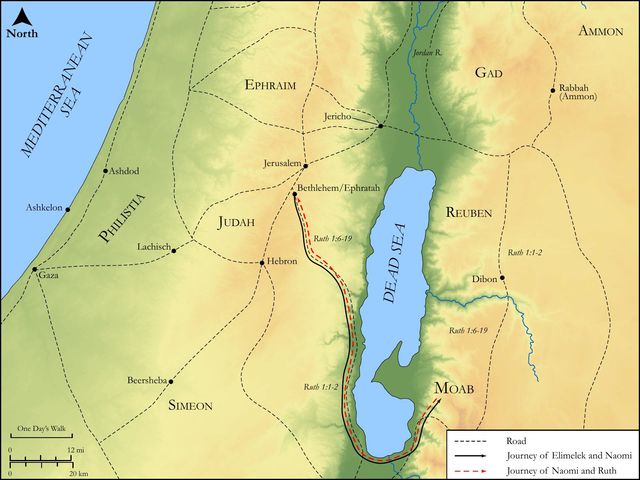
See on the biblical-era map
Study this verse
Public-domain commentary
Matthew Henry
From his Commentary on the Whole Bible. Henry comments on passages, not single verses — this entry covers Ruth 1:19–22. His three-level outline is real structure in the source text, so it is rendered as structure.
Naomi and Ruth, after many a weary step (the fatigue of the journey, we may suppose, being somewhat relieved by the good instructions Naomi gave to her proselyte and the good discourse they had together), came at last to Bethlehem. And they came very seasonably, in the beginning of the barley-harvest, which was the first of their harvests, that of wheat following after. Now Naomi's own eyes might convince her of the truth of what she had heard in the country of Moab, that the Lord had visited his people in giving them bread, and Ruth might see this good land in its best state; and now they had opportunity to provide for winter. Our times are in God's hand, both the events and the time of them. Notice is here taken,
I.Of the discomposure of the neighbours upon this occasion (Rut 1:19):
All the city was moved about them. Her old acquaintance gathered about her, to enquire concerning her state, and to bid her welcome to Bethlehem again. Or perhaps they were moved about her, lest she should be a charge to the town, she looked so bare. By this it appears that she had formerly lived respectably, else there would not have been so much notice taken of her. If those that have been in a high and prosperous condition break, or fall into poverty or disgrace, their fall is the more remarkable. And they said, Is this Naomi? The women of the city said it, for the word is feminine. Those with whom she had formerly been intimate were surprised to see her in this condition; she was so much broken and altered with her afflictions that they could scarcely believe their own eyes, nor think that this was the same person whom they had formerly seen, so fresh, and fair, and gay: Is this Naomi? So unlike is the rose when it is withered to what it was when it was blooming. What a poor figure does Naomi make now, compared with what she made in her prosperity! If any asked this question in contempt, upbraiding her with her miseries ("is this she that could not be content to fare as her neighbours did, but must ramble to a strange country? see what she has got by it!"), their temper was very base and sordid. Nothing more barbarous than to triumph over those that are fallen. But we may suppose that the generality asked it in compassion and commiseration: "Is this she that lived so plentifully, and kept so good a house, and was so charitable to the poor? How has the gold become dim!" Those that had seen the magnificence of the first temple wept when they saw the meanness of the second; so these here. Note, Afflictions will make great and surprising changes in a little time. When we see how sickness and old age alter people, change their countenance and temper, we may think of what the Bethlehemites said: "Is this Naomi? One would not take it to be the same person." God, by his grace, fit us for all such changes, especially the great change!
II.Of the composure of Naomi's spirit.
If some upbraided her with her poverty, she was not moved against them, as she would have been if she had been poor and proud; but, with a great deal of pious patience, bore that and all the other melancholy effects of her affliction (Rut 1:20, Rut 1:21): Call me not Naomi, call me Mara, etc. "Naomi signifies pleasant or amiable; but all my pleasant things are laid waste; call me Mara, bitter or bitterness, for I am now a woman of a sorrowful spirit." Thus does she bring her mind to her condition, which we all ought to do when our condition is not in every thing to our mind. Observe,
1.The change of her state, and how it is described, with a pious regard to the divine providence, and without any passionate murmurings or complaints.
(1.)It was a very sad and melancholy change. She went out full; so she thought herself when she had her husband with her and two sons. Much of the fulness of our comfort in this world arises from agreeable relations. But she now came home again empty, a widow and childless, and probably had sold her goods, and of all the effects she took with her brought home no more than the clothes on her back. So uncertain is all that which we call fulness in the creature, Sa1 2:5. Even in the fulness of that sufficiency we may be in straits. But there is a fulness, a spiritual and divine fulness, which we can never be emptied of, a good part which shall not be taken from those that have it.
(2.)She acknowledges the hand of God, his mighty hand, in the affliction. "It is the Lord that has brought me home again empty; it is the Almighty that has afflicted me." Note, Nothing conduces more to satisfy a gracious soul under an affliction than the consideration of the hand of God in it. It is the Lord, Sa1 3:18; Job 1:21. Especially to consider that he who afflicts us is Shaddai, the Almighty, with whom it is folly to contend and to whom it is our duty and interest to submit. It is that name of God by which he enters into covenant with his people: I am God Almighty, God All-sufficient, Gen 17:1. He afflicts as a God in covenant, and his all-sufficiency may be our support and supply under all our afflictions. He that empties us of the creature knows how to fill us with himself.
(3.)She speaks very feelingly of the impression which the affliction had made upon her: He has dealt very bitterly with me. The cup of affliction is a bitter cup, and even that which afterwards yields the peaceable fruit of righteousness, yet, for the present, is not joyous, but grievous, Heb 12:11. Job complains, Thou writest bitter things against me, Job 13:26.
(4.)She owns the affliction to come from God as a controversy: The Lord hath testified against me. Note, When God corrects us he testifies against us and contends with us (Job 10:17), intimating that he is displeased with us. Every rod has a voice, the voice of a witness.
2.The compliance of her spirit with this change: "Call me not Naomi, for I am no more pleasant, either to myself or to my friends; but call me Mara, a name more agreeable to my present state." Many that are debased and impoverished yet affect to be called by the empty names and titles of honour they have formerly enjoyed. Naomi did not so. Her humility regards not a glorious name in a dejected state. If God deal bitterly with her, she will accommodate herself to the dispensation, and is willing to be called Mara, bitter. Note, It well becomes us to have our hearts humbled under humbling providences. When our condition is brought down our spirits should be brought down with it. And then our troubles are sanctified to us when we thus comport with them; for it is not an affliction itself, but an affliction rightly borne, that does us good. Perdidisti tot mala, si nondum misera esse didicisti - So many calamities have been lost upon you if you have not yet learned how to suffer. Sen. ad Helv. Tribulation works patience.
Continue studying Ruth 1:19 across the web’s major study libraries — every link below opens this exact verse, chapter, or book on the destination site.
Read & Compare
 BibleGatewayThis verse in more than 200 translations and 70 languages.
 Bible.comThe YouVersion reader — hundreds of translations, reading plans, and highlights.
 ESV.orgCrossway's official English Standard Version reader.
 NET BibleThe NET translation with 60,000+ translators' notes on every rendering decision.
 STEP BibleTyndale House's free study tool — original text, vocabulary, and scholarly resources.
 BibliaLogos Bible Software's free web reader.
 USCCBThe New American Bible (Revised Edition) with the U.S. bishops' study notes.
Commentaries
 BibleHub CommentariesDozens of classic commentaries on this verse, gathered on one page.
 StudyLightMore than 100 commentary sets — the largest collection on the web.
 BibleRefPlain-English commentary on what this verse means, verse by verse.
 Enduring WordDavid Guzik's free commentary on this chapter, widely used by Bible teachers.
 Bible Study ToolsVerse commentary alongside Greek and Hebrew study aids.
Original Language & Research
- BibleHub InterlinearThe verse word by word — original language, transliteration, and English.
- BibleHub LexiconEvery word's original-language definition and Strong's entry.
 Blue Letter BibleDeep-study tools — Strong's numbers, concordance, and word studies.
 SefariaThe Hebrew text with Rashi and centuries of Jewish commentary.
Sermons, Hymns & Audio


TrulyRandomVerse is not affiliated with these sites and doesn’t control their content. They’re linked because they’re genuinely useful.
Summary
Ruth 1:19 powerfully depicts the poignant return of Naomi and her loyal Moabite daughter-in-law, Ruth, to Bethlehem, Naomi's ancestral home, after a decade of profound loss and hardship in Moab. Their arrival sends a ripple of astonishment through the entire city, culminating in the collective, disbelieving question, "Is this Naomi?" This moment starkly reveals the devastating impact of famine, bereavement, and destitution on Naomi's appearance and spirit, underscoring the deep transformation she has undergone. Yet, amidst this public display of suffering, the verse subtly marks a critical turning point, initiating the unfolding of God's sovereign and redemptive plan for these two vulnerable widows in the very place from which Naomi had departed in prosperity.
Context
ShowHideLiterary Context
Ruth 1:19 serves as a pivotal narrative hinge, marking the culmination of Naomi's journey of loss and setting the stage for her subsequent restoration. The preceding verses meticulously detail the tragic trajectory of Naomi's family: their initial departure from Bethlehem due to famine (Ruth 1:1-2), followed by a decade in Moab during which her husband, Elimelech, and both sons, Mahlon and Chilion, tragically die, leaving her a childless widow (Ruth 1:3-5). Overwhelmed by her sorrow and hearing that the famine in Judah had ended, Naomi resolves to return, urging her Moabite daughters-in-law, Orpah and Ruth, to remain in their homeland. However, Ruth's unwavering devotion and famous declaration of loyalty, "Where you go I will go, and where you lodge I will lodge; your people shall be my people, and your God my God" (Ruth 1:16), compel her to accompany Naomi. Their arduous journey together culminates in this verse, as they finally reach Bethlehem, initiating the next phase of the narrative centered on provision and redemption.
Historical & Cultural Context
The return of Naomi and Ruth to Bethlehem must be understood within the intricate social and legal framework of ancient Israelite society. Widows, particularly those without male heirs or family support, occupied the most precarious position, often facing destitution and dependence. The Mosaic Law provided certain provisions for their care, such as gleaning rights (Deuteronomy 24:19-22) and the institution of the kinsman-redeemer, but these required community awareness and participation. Naomi's return in poverty, accompanied by Ruth, a Moabite, would have been highly unusual and potentially controversial, as Moabites were often viewed with suspicion or outright hostility by Israelites due to historical conflicts and religious differences (Deuteronomy 23:3-6). The communal reaction of the city being "moved" reflects the close-knit, communal nature of ancient towns, where personal circumstances were often public knowledge, and such a significant event would inevitably cause a stir and immediate recognition of the profound change in Naomi's circumstances.
Key Themes
ShowHideThis verse powerfully contributes to several overarching themes woven throughout the Book of Ruth. It vividly portrays the theme of Loss and Grief, demonstrating the devastating physical and emotional toll of Naomi's experiences in Moab, which have rendered her almost unrecognizable. It simultaneously introduces the theme of Return and Redemption, as Bethlehem, ironically named the "house of bread," becomes the providential setting for God's redemptive work to unfold, despite the initial appearance of destitution. The community's reaction underscores the theme of Community and Compassion, as the townspeople's acknowledgment of Naomi's plight sets the stage for their eventual involvement in her restoration. Furthermore, the presence of Ruth, the Moabite, subtly but significantly introduces the theme of Inclusion and God's Universal Grace, foreshadowing the breaking down of ethnic barriers in God's redemptive plan, a theme that will culminate in Ruth's marriage to Boaz and her place in the lineage of David and ultimately, the Messiah (Ruth 4:13-22).
Exposition and Analysis
ShowHideKey Word Analysis
ShowHideFrom the Hebrew words for "house" and "bread," Bethlehem literally means "house of bread." This name carries profound irony in the context of Naomi's return, as she arrives during a time of famine, having left to find bread. Yet, it also serves as a powerful foreshadowing, for it is in this very "house of bread" that God's provision and redemption will miraculously unfold, not only for Naomi and Ruth but for all humanity through the lineage that will emerge from this town.
This verb signifies a deep commotion, agitation, or stirring. It describes not merely a quiet recognition but suggests a widespread buzz, a murmuring, or even a tumult that sweeps through the entire city. The use of this word indicates the profound impact of Naomi's unexpected return and the visible evidence of her suffering, implying a widespread, almost audible, reaction of astonishment, concern, and perhaps pity from the populace.
Derived from a root meaning "pleasantness" or "delight," Naomi's name stands in stark contrast to her current state of bitterness and sorrow. This contrast is explicitly highlighted in the following verse where she asks to be called "Mara" (bitter) instead (Ruth 1:20). The townspeople's question, "Is this Naomi?", underscores this tragic irony, emphasizing how far removed her present reality is from the pleasantness her name implies, making her a poignant symbol of suffering.
Verse Breakdown
ShowHide"So they two went until they came to Bethlehem."
This clause marks the culmination of their arduous and emotionally charged journey from Moab. The phrase "they two" emphasizes the solitary and vulnerable nature of their return – two widows, one a foreigner, entering a community that had known Naomi in vastly different, more prosperous circumstances. Bethlehem, despite its name "house of bread," receives them during a time of scarcity, yet it is precisely here that the seeds of future provision and redemption will be sown and blossom.
"And it came to pass, when they were come to Bethlehem, that all the city was moved about them,"
The arrival of Naomi and Ruth is far from a quiet, unnoticed event. The phrase "all the city" highlights the widespread impact and the communal, public nature of their society, where news traveled quickly and personal events were often communal experiences. The city being "moved" (from hûwm') indicates a significant stir, a commotion, or a buzz of astonishment and perhaps concern. This reaction powerfully underscores the dramatic change in Naomi's appearance and circumstances, immediately drawing public attention to her plight.
"and they said, [Is] this Naomi?"
This rhetorical question forms the emotional core of the verse. It expresses profound shock, disbelief, and a poignant sense of loss. It is not a genuine inquiry for identification but rather an exclamation of how deeply Naomi has been transformed by her decade of hardship, loss, and grief. Her physical appearance, her demeanor, and her impoverished state are so profoundly altered that she is barely recognizable to those who knew her well, visually demonstrating the visible and invisible scars of her suffering.
Literary Devices
ShowHideRuth 1:19 is rich with literary devices that amplify its emotional and theological impact. Irony is powerfully present in the contrast between Naomi's name, meaning "my pleasantness," and her current bitter reality, a disparity underscored by the townspeople's questioning her identity. The entire scene is a study in Contrast, juxtaposing Naomi's departure from Bethlehem in relative prosperity with her return in destitution and profound sorrow. The question, "Is this Naomi?", functions as a potent Rhetorical Question, designed not to elicit information but to express the profound shock, disbelief, and empathy of the community, thereby emphasizing the depth of Naomi's physical and emotional transformation. This moment also serves as subtle yet significant Foreshadowing, as the communal recognition of Naomi's plight sets the stage for the community's eventual involvement in her restoration, particularly through the pivotal role of the kinsman-redeemer, Boaz.
Theological and Thematic Connections
ShowHideRuth 1:19 profoundly illustrates the raw human experience of suffering and loss, demonstrating how deeply adversity can scar an individual, even altering their very appearance and identity. Yet, within this stark portrayal of brokenness and desolation, the verse subtly hints at the overarching theme of divine providence. Even in their lowest moment, God's hidden hand is guiding Naomi and Ruth back to Bethlehem, the very place where their redemption will begin. The community's reaction, though initially one of shock, also signifies recognition and concern, highlighting the importance of communal support and the potential for God to work through human compassion to bring about restoration. This verse reminds us that even when life seems to have stripped us bare and our circumstances appear hopeless, God's sovereign plan is still unfolding, often in ways we cannot yet perceive, preparing the way for unexpected blessings and renewed hope.
Reflection and Application
ShowHideRuth 1:19 offers a raw, honest portrayal of the profound impact of life's trials. It acknowledges that suffering can leave visible and invisible marks, transforming us to the point where even those who knew us best might struggle to recognize the person we once were. This verse invites us to embrace the reality of our brokenness and the vulnerability that comes with it, understanding that it is often in these moments of profound need that God begins to work most powerfully. It also highlights the vital role of community: the initial shock of Bethlehem's residents gives way to the compassion and support that will eventually lead to Naomi's and Ruth's restoration. For believers today, this verse is a powerful reminder that returning to our spiritual "home" – whether it's a place of worship, a community of faith, or simply a renewed commitment to God – even in our brokenness, is often the first step toward healing and the unfolding of God's redemptive plan in our lives. Our journey, like Naomi's, may be marked by deep sorrow and apparent emptiness, but it is always under the watchful eye of a sovereign and loving God who brings beauty from ashes and transforms our deepest wounds into testimonies of His faithfulness.
Questions for Reflection
ShowHideFAQ
ShowHideWhy was the city "moved" by Naomi and Ruth's arrival?
ShowHideThe Hebrew word translated "moved" (הָמָה, hûwm') conveys a sense of commotion, agitation, or a widespread stir. The city was "moved" because Naomi's return was entirely unexpected, and her appearance was dramatically altered by a decade of famine, loss, and grief. She had left Bethlehem with a husband and two sons, likely in a state of relative prosperity. Her return as a destitute, childless widow, accompanied by a foreign Moabite daughter-in-law, was a shocking and poignant sight that would have quickly spread through the close-knit community. It was a visible testament to the severe hardships she had endured, prompting a collective gasp of astonishment, pity, and perhaps even sorrow from the townspeople who remembered her former state.
What is the significance of the question "Is this Naomi?"
ShowHideThe question "Is this Naomi?" is a rhetorical question that powerfully expresses the profound shock and disbelief of the Bethlehemites. It's not a genuine inquiry about her identity, as they clearly recognized her, but rather an exclamation of how unrecognizable she had become due to her suffering. Naomi's name means "my pleasantness" or "my delight," which stood in stark contrast to her current bitter and sorrowful state. The question highlights this tragic irony and underscores the devastating toll that grief and hardship had taken on her, both physically and emotionally. It serves to emphasize the dramatic transformation she had undergone, making her a poignant symbol of profound loss and the visible scars of adversity.
How does this verse set up the rest of the Book of Ruth?
ShowHideRuth 1:19 is a pivotal verse that masterfully sets the entire stage for the unfolding narrative. First, it firmly establishes the setting in Bethlehem, the "house of bread," which will become the providential arena for God's provision and redemption to manifest. Second, it vividly portrays Naomi's desperate state of loss and destitution, creating the narrative tension and human need that necessitates the intervention of a kinsman-redeemer. Third, the communal reaction ("all the city was moved") highlights the public nature of their plight, which will be crucial as the community, particularly Boaz, becomes involved in their restoration. Finally, Ruth's presence as a Moabite in Bethlehem, though initially met with potential prejudice, subtly introduces the theme of God's inclusive grace, foreshadowing her eventual marriage to Boaz and her integration into the lineage of David and ultimately, the Messiah. The verse thus lays the essential groundwork for the profound themes of redemption, loyalty, divine sovereignty, and unexpected blessings that characterize the rest of the Book of Ruth, leading to the remarkable restoration of Naomi and the significant role of Ruth in salvation history (Ruth 4:13-22).
Christ-Centered Fulfillment
ShowHideThe poignant scene in Ruth 1:19, where Naomi returns to Bethlehem transformed by suffering, finds a profound Christ-centered fulfillment in the person and work of Jesus. Naomi's journey from prosperity to destitution, marked by loss and a change in appearance so drastic that she was barely recognizable, echoes the ultimate condescension of Christ. He, though "in the form of God, did not count equality with God a thing to be grasped, but emptied himself, by taking the form of a servant, being born in the likeness of men" (Philippians 2:6-7). Jesus left the glory of heaven to enter a world marred by sin and suffering, becoming "a man of sorrows and acquainted with grief" (Isaiah 53:3). Just as Naomi returned to Bethlehem, the "house of bread," in a state of emptiness and bitter need, Christ, the true Bread of Life (John 6:35), came to a humanity starving for spiritual nourishment. His journey culminated not in a question of "Is this Naomi?", but in the ultimate sacrifice on the cross, where He was disfigured for our transgressions, bearing the full weight of humanity's sin and sorrow (Isaiah 53:5). Yet, through His suffering, death, and glorious resurrection, Christ brings about a redemption far greater than Naomi's, offering not just physical provision but eternal life, spiritual restoration, and abundant grace to all who believe. He transforms our bitterness into joy, our emptiness into fullness, and our alienation into adoption, making us new creations in Him (2 Corinthians 5:17). Ultimately, the story of Naomi's return to Bethlehem, a place of eventual restoration, foreshadows the greater return of humanity to God through the redemptive work of Jesus Christ, our ultimate Kinsman-Redeemer, who brings us back into the Father's house.