


Ruth 1:20
Bible text: King James Version (1769 Blayney text) · Public domain
Bible text: Berean Standard Bible · Public domain
Bible text: American Standard Version (1901) · Public domain
Bible text: World English Bible, Messianic edition · Public domain
Bible text: Geneva Bible (1599) · Public domain
Bible text: Young's Literal Translation · Public domain
- וַתֹּאמֶרva·To·merand she saidH559Conj-w ¦ V-Qal-ConsecImperf-3fsVerb Qal Consecutive Imperfect 3rd Singular Feminineוַandתֹּאמֶרshe said
- אֲלֵיהֶן'a·lei·Hento themH413Prep ¦ 3fpPreposition Definiteאֲלֵיtoהֶןthem
- אַל'almay notH408NegParticle Negative
- תִּקְרֶאנָהtik·Re·nahyou callH7121V-Qal-Imperf-2fpVerb Qal Imperfect 2nd Plural Feminine
- לִיli<to> <the> mePrep-l ¦ 1csSuffix Personal 1st Singular common genderלִ<to> <the>יme
- נָעֳמִיno·'o·MiNaomiH5281N-proper-fNoun Proper Feminine
- קְרֶאןָke·Re·nacallH7121V-Qal-Imp-2fpVerb Qal Imperative 2nd Plural Feminine
- לִיli<to> <the> mePrep-l ¦ 1csSuffix Personal 1st Singular common genderלִ<to> <the>יme
- מָרָאma·Ra'MaraH4755Adj-fsAdjective Singular Feminine Absolute
- כִּיkiforH3588PrtParticle Conditional
- הֵמַרhe·Marhe has caused bitternessH4843V-Hiphil-Perf-3msVerb Hiphil Perfect 3rd Singular Masculine
- שַׁדַּיsha·Dai[the] AlmightyH7706N-properNoun Proper Title
- לִיlito <the> mePrep-l ¦ 1csSuffix Personal 1st Singular common genderלִto <the>יme
- מְאֹדme·'OdexceedinglyH3966Adj-msAdjective Numerical Singular Masculine Absolute
English is a literal word-by-word gloss of the Hebrew, not the KJV's wording. Why?
This is the original text the KJV's translators worked from — each Hebrew word with its own literal English meaning in this verse, prepared by scholars at Tyndale House, Cambridge. The KJV translates whole sentences, not word by word, so its wording differs: one Hebrew word can become several English words, and the KJV may choose “the LORD” where the gloss reads “Yahweh”. Both are faithful — they answer different questions. For the KJV's own rendering, switch to the KJV text.
Details
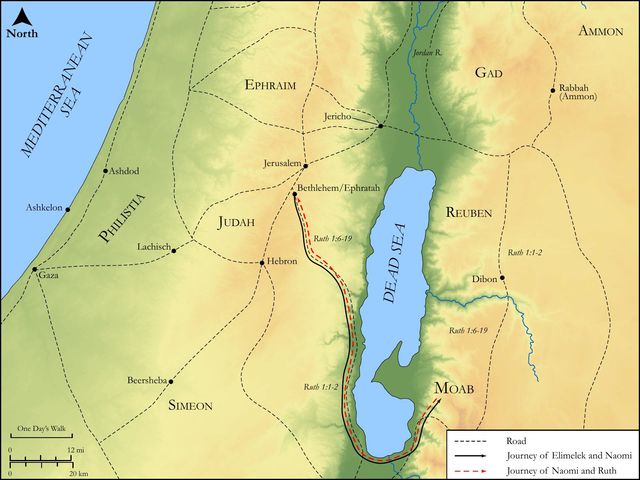
See on the biblical-era map
Study this verse
Public-domain commentary
Matthew Henry
From his Commentary on the Whole Bible. Henry comments on passages, not single verses — this entry covers Ruth 1:19–22. His three-level outline is real structure in the source text, so it is rendered as structure.
Naomi and Ruth, after many a weary step (the fatigue of the journey, we may suppose, being somewhat relieved by the good instructions Naomi gave to her proselyte and the good discourse they had together), came at last to Bethlehem. And they came very seasonably, in the beginning of the barley-harvest, which was the first of their harvests, that of wheat following after. Now Naomi's own eyes might convince her of the truth of what she had heard in the country of Moab, that the Lord had visited his people in giving them bread, and Ruth might see this good land in its best state; and now they had opportunity to provide for winter. Our times are in God's hand, both the events and the time of them. Notice is here taken,
I.Of the discomposure of the neighbours upon this occasion (Rut 1:19):
All the city was moved about them. Her old acquaintance gathered about her, to enquire concerning her state, and to bid her welcome to Bethlehem again. Or perhaps they were moved about her, lest she should be a charge to the town, she looked so bare. By this it appears that she had formerly lived respectably, else there would not have been so much notice taken of her. If those that have been in a high and prosperous condition break, or fall into poverty or disgrace, their fall is the more remarkable. And they said, Is this Naomi? The women of the city said it, for the word is feminine. Those with whom she had formerly been intimate were surprised to see her in this condition; she was so much broken and altered with her afflictions that they could scarcely believe their own eyes, nor think that this was the same person whom they had formerly seen, so fresh, and fair, and gay: Is this Naomi? So unlike is the rose when it is withered to what it was when it was blooming. What a poor figure does Naomi make now, compared with what she made in her prosperity! If any asked this question in contempt, upbraiding her with her miseries ("is this she that could not be content to fare as her neighbours did, but must ramble to a strange country? see what she has got by it!"), their temper was very base and sordid. Nothing more barbarous than to triumph over those that are fallen. But we may suppose that the generality asked it in compassion and commiseration: "Is this she that lived so plentifully, and kept so good a house, and was so charitable to the poor? How has the gold become dim!" Those that had seen the magnificence of the first temple wept when they saw the meanness of the second; so these here. Note, Afflictions will make great and surprising changes in a little time. When we see how sickness and old age alter people, change their countenance and temper, we may think of what the Bethlehemites said: "Is this Naomi? One would not take it to be the same person." God, by his grace, fit us for all such changes, especially the great change!
II.Of the composure of Naomi's spirit.
If some upbraided her with her poverty, she was not moved against them, as she would have been if she had been poor and proud; but, with a great deal of pious patience, bore that and all the other melancholy effects of her affliction (Rut 1:20, Rut 1:21): Call me not Naomi, call me Mara, etc. "Naomi signifies pleasant or amiable; but all my pleasant things are laid waste; call me Mara, bitter or bitterness, for I am now a woman of a sorrowful spirit." Thus does she bring her mind to her condition, which we all ought to do when our condition is not in every thing to our mind. Observe,
1.The change of her state, and how it is described, with a pious regard to the divine providence, and without any passionate murmurings or complaints.
(1.)It was a very sad and melancholy change. She went out full; so she thought herself when she had her husband with her and two sons. Much of the fulness of our comfort in this world arises from agreeable relations. But she now came home again empty, a widow and childless, and probably had sold her goods, and of all the effects she took with her brought home no more than the clothes on her back. So uncertain is all that which we call fulness in the creature, Sa1 2:5. Even in the fulness of that sufficiency we may be in straits. But there is a fulness, a spiritual and divine fulness, which we can never be emptied of, a good part which shall not be taken from those that have it.
(2.)She acknowledges the hand of God, his mighty hand, in the affliction. "It is the Lord that has brought me home again empty; it is the Almighty that has afflicted me." Note, Nothing conduces more to satisfy a gracious soul under an affliction than the consideration of the hand of God in it. It is the Lord, Sa1 3:18; Job 1:21. Especially to consider that he who afflicts us is Shaddai, the Almighty, with whom it is folly to contend and to whom it is our duty and interest to submit. It is that name of God by which he enters into covenant with his people: I am God Almighty, God All-sufficient, Gen 17:1. He afflicts as a God in covenant, and his all-sufficiency may be our support and supply under all our afflictions. He that empties us of the creature knows how to fill us with himself.
(3.)She speaks very feelingly of the impression which the affliction had made upon her: He has dealt very bitterly with me. The cup of affliction is a bitter cup, and even that which afterwards yields the peaceable fruit of righteousness, yet, for the present, is not joyous, but grievous, Heb 12:11. Job complains, Thou writest bitter things against me, Job 13:26.
(4.)She owns the affliction to come from God as a controversy: The Lord hath testified against me. Note, When God corrects us he testifies against us and contends with us (Job 10:17), intimating that he is displeased with us. Every rod has a voice, the voice of a witness.
2.The compliance of her spirit with this change: "Call me not Naomi, for I am no more pleasant, either to myself or to my friends; but call me Mara, a name more agreeable to my present state." Many that are debased and impoverished yet affect to be called by the empty names and titles of honour they have formerly enjoyed. Naomi did not so. Her humility regards not a glorious name in a dejected state. If God deal bitterly with her, she will accommodate herself to the dispensation, and is willing to be called Mara, bitter. Note, It well becomes us to have our hearts humbled under humbling providences. When our condition is brought down our spirits should be brought down with it. And then our troubles are sanctified to us when we thus comport with them; for it is not an affliction itself, but an affliction rightly borne, that does us good. Perdidisti tot mala, si nondum misera esse didicisti - So many calamities have been lost upon you if you have not yet learned how to suffer. Sen. ad Helv. Tribulation works patience.
Historical interpretation
Historical reception
1 surviving comment on this verse from the historical church.
In describing loftily the sweetness of contemplation, you have renewed the groans of my fallen state, since I hear what I have lost inwardly while mounting outwardly, though undeserving, to the summit of rule. Know then that I am stricken with so great sorrow that I can scarcely speak; for the dark shadows of grief obscure the eyes of my soul. Whatever is beheld is sad, whatever is thought delightful appears to my heart lamentable. For I reflect on what a dejected height of external advancement I have ascended in falling from the lofty summit of my rest. And, being sent for my faults into the exile of employment from the face of my Lord, I say with the prophet, in the words, as it were of destroyed Jerusalem, “He who should comfort me has departed far from me.” … For I, my good man, have, as it were, lost my children, since through earthly cares I have lost works of righteousness. Therefore “call me not Naomi, that is lovely; but call me Mara, for I am full of bitterness.”
Continue studying Ruth 1:20 across the web’s major study libraries — every link below opens this exact verse, chapter, or book on the destination site.
Read & Compare
 BibleGatewayThis verse in more than 200 translations and 70 languages.
 Bible.comThe YouVersion reader — hundreds of translations, reading plans, and highlights.
 ESV.orgCrossway's official English Standard Version reader.
 NET BibleThe NET translation with 60,000+ translators' notes on every rendering decision.
 STEP BibleTyndale House's free study tool — original text, vocabulary, and scholarly resources.
 BibliaLogos Bible Software's free web reader.
 USCCBThe New American Bible (Revised Edition) with the U.S. bishops' study notes.
Commentaries
 BibleHub CommentariesDozens of classic commentaries on this verse, gathered on one page.
 StudyLightMore than 100 commentary sets — the largest collection on the web.
 BibleRefPlain-English commentary on what this verse means, verse by verse.
 Enduring WordDavid Guzik's free commentary on this chapter, widely used by Bible teachers.
 Bible Study ToolsVerse commentary alongside Greek and Hebrew study aids.
Original Language & Research
- BibleHub InterlinearThe verse word by word — original language, transliteration, and English.
- BibleHub LexiconEvery word's original-language definition and Strong's entry.
 Blue Letter BibleDeep-study tools — Strong's numbers, concordance, and word studies.
 SefariaThe Hebrew text with Rashi and centuries of Jewish commentary.
Sermons, Hymns & Audio


TrulyRandomVerse is not affiliated with these sites and doesn’t control their content. They’re linked because they’re genuinely useful.
Summary
Ruth 1:20 captures Naomi's profound lament upon her return to Bethlehem, where she instructs the welcoming women to rename her "Mara," meaning "bitter," rather than "Naomi," meaning "pleasantness." This poignant request stems from the devastating losses she has endured—her husband and two sons—and her conviction that the Almighty God has directly afflicted her, dealing with her in a way that has filled her life with sorrow and hardship. The verse powerfully conveys the depth of human grief and the wrestling with divine providence in the face of overwhelming tragedy.
Context
ShowHideLiterary Context
This verse serves as a pivotal emotional anchor in the opening chapter of Ruth, immediately following Naomi's return to Bethlehem with her loyal daughter-in-law, Ruth. The townswomen of Bethlehem recognize Naomi, exclaiming, "Is this Naomi?" as recorded in Ruth 1:19. Her response in verse 20 is not one of joyful reunion but a stark, public declaration of her suffering and perceived abandonment by God. This lament establishes the deep emotional void in Naomi's life and the seemingly insurmountable challenges she faces, setting a somber tone for the narrative. It powerfully foreshadows the redemptive arc of the entire book, which will ultimately demonstrate God's hidden hand at work, transforming her declared bitterness into profound joy and restoration, moving from a state of emptiness to the fullness of a new family and renewed hope, as seen in the later chapters of Ruth.
Historical & Cultural Context
Naomi's return to Bethlehem takes place during the turbulent period of the Judges, a time often characterized by moral decline, social instability, and recurrent famine, as alluded to in Judges 21:25. Famine was a common and devastating occurrence in ancient Israel, frequently interpreted as either divine judgment or a severe test of faith. For a woman in this patriarchal society, the loss of a husband and two sons was catastrophic, signifying the complete loss of economic support, social standing, and the continuation of the family line. Childlessness was considered a great sorrow, and a widow without male heirs was uniquely vulnerable and often destitute. Naomi's public lament, including her desire to change her name, was a culturally understood and accepted expression of profound grief and a symbolic declaration of her altered status and identity. Her direct appeal to "the Almighty" reflects a deep-seated understanding of God's direct involvement and sovereignty over all aspects of life, both prosperity and adversity.
Key Themes
ShowHideRuth 1:20 powerfully articulates several core themes that resonate throughout the book of Ruth and the broader biblical narrative. Firstly, it highlights Profound Grief and Despair, illustrating the raw human experience of loss and the immense emotional toll it exacts. Naomi's desire to be called "Mara" is a visceral expression of a broken spirit, emphasizing the reality of deep sorrow in the face of significant tragedy, particularly the loss of her entire male lineage as described in Ruth 1:3-5. Secondly, the verse introduces the theme of Divine Sovereignty and Suffering. Naomi explicitly attributes her suffering to "the Almighty," underscoring the biblical conviction that God is ultimately in control of all circumstances, even those that bring immense pain. While her perspective is colored by her anguish, it acknowledges God's hand in her life, even if perceived as harsh. This sets the stage for the book to explore how God's providential care works even through seemingly bitter circumstances, leading to unexpected blessing and restoration, as ultimately demonstrated in Ruth 4:14-15. Lastly, the verse touches upon the Loss of Identity in the face of adversity. Naomi's name change signifies a perceived shift in her very essence, from "pleasantness" to "bitterness," reflecting how profound suffering can redefine one's self-perception and place in the world.
Exposition and Analysis
ShowHideKey Word Analysis
ShowHideDerived from a root meaning "pleasant," "delightful," or "my pleasantness." This name reflects a sense of joy, grace, and contentment. It signifies a person who brings pleasantness or experiences a pleasant life. Her original identity, encapsulated in her name, stands in stark contrast to her current desolate state, making her request to change it all the more poignant and emphasizing the depth of her perceived loss of identity and joy.
This name is directly related to the Hebrew word for "bitter" (מַר, mar). It conveys a state of deep sorrow, affliction, distress, or resentment. By asking to be called Mara, Naomi is not merely expressing her feelings but is attempting to redefine her very being and public identity in accordance with her perceived bitter fate. It is a declaration that her life has become the embodiment of suffering, a public acknowledgment of the profound anguish that has consumed her.
This is the Hebrew divine name El Shaddai, often translated as "God Almighty" or "Lord God Almighty." It emphasizes God's omnipotence, self-sufficiency, and sovereign power, particularly in His ability to bless and to judge. In contexts of suffering, attributing affliction to Shaddai underscores the belief in God's supreme authority over all events, even those that seem harsh or inexplicable. It is a name that evokes both God's power to provide and His power to bring hardship, reflecting a deep theological understanding of His absolute control over human destiny.
Verse Breakdown
ShowHide"And she said unto them, Call me not Naomi, call me Mara:"
This opening clause immediately establishes the dramatic shift in Naomi's self-perception and public identity. Her command to the women of Bethlehem is not a mere suggestion but a forceful declaration of her transformed state. She rejects the pleasant connotations of "Naomi," which now mock her circumstances, and insists on a name that accurately reflects her internal anguish and the perceived bitterness of her life. This is a public act of lament and a symbolic shedding of her former identity, signaling to her community the profound change wrought by her suffering.
"for the Almighty hath dealt very bitterly with me."
This explanatory clause provides the theological justification for Naomi's name change and the depth of her despair. She directly attributes her immense suffering and the "bitterness" of her life to the sovereign action of "the Almighty" (Shaddai). The phrase "dealt very bitterly" (הֵמַר לִי מְאֹד, hemar li me'od) emphasizes the intensity and totality of her perceived affliction, suggesting that God has not merely allowed her suffering but has actively brought it upon her. This underscores her profound sense of divine abandonment or judgment, revealing a deep, albeit pain-filled, theological conviction about God's direct involvement in human affairs, even when His actions seem harsh or inexplicable.
Literary Devices
ShowHideRuth 1:20 is rich with literary devices that amplify its emotional and theological impact, drawing the reader into Naomi's profound grief. The most prominent device is Symbolism, specifically through the contrasting names "Naomi" (meaning "pleasantness") and "Mara" (meaning "bitterness"). Naomi's insistence on being called "Mara" is a powerful symbolic act, transforming her very identity into a living embodiment of her suffering and the desolate state of her life. This creates a striking Irony, as her original name, which once signified delight and joy, now stands in stark opposition to her current desolate reality, highlighting the tragic reversal of her fortunes. Her declaration also functions as a Lament, a common biblical form of expressing deep sorrow, complaint, and even a form of accusation towards God in times of distress. The phrase "the Almighty hath dealt very bitterly with me" employs Anthropomorphism, attributing human-like action ("dealt") to God, and uses Hyperbole to emphasize the extreme and overwhelming nature of her suffering ("very bitterly"). The entire verse serves as a powerful Foreshadowing, setting the stage for the narrative's redemptive arc, where God's hidden providence will ultimately turn Naomi's bitterness back into joy and fullness, demonstrating His faithfulness even in the midst of perceived divine harshness.
Theological and Thematic Connections
ShowHideNaomi's lament in Ruth 1:20 confronts the profound theological question of suffering and divine sovereignty. Her direct attribution of her bitter circumstances to "the Almighty" (Shaddai) reflects a common biblical understanding that God is ultimately in control of all things, including hardship. While her perspective is born of deep pain and may not fully grasp God's redemptive purposes, it acknowledges His active involvement in human life. This verse reminds us that even in the darkest moments, when God's hand feels heavy or His presence seems absent, believers often wrestle with His character and His ways. It highlights the tension between human suffering and divine omnipotence, a tension that the Bible does not shy away from but often resolves through the unfolding of God's faithfulness and ultimate restoration. Naomi's story, beginning with this bitter declaration, ultimately becomes a powerful testimony to God's hidden providence and His ability to bring good out of seemingly insurmountable sorrow, demonstrating that even perceived divine judgment can pave the way for unexpected blessings.
Reflection and Application
ShowHideNaomi's raw and honest expression of grief in Ruth 1:20 offers profound permission for believers to lament openly before God. The Bible does not call us to suppress our pain or pretend that suffering is not real; instead, it provides ample space for genuine sorrow, even when that sorrow leads to questioning God's actions or perceiving His hand as harsh. Naomi's cry of "Mara" reminds us that it is acceptable to feel the bitterness of loss, to wrestle with divine providence, and to vocalize our deepest anguish without fear of condemnation. Her journey, however, also provides a crucial counterpoint: while it is vital to acknowledge and express our pain, we must also hold onto the hope that God's ultimate purposes are good, even when His ways are mysterious and His presence seems obscured. Her story ultimately pivots from profound bitterness to unexpected blessing, demonstrating that God's faithfulness can transform even the most desolate circumstances. For us, this means embracing the full spectrum of human emotion in our walk with God, trusting that even in our "Mara" moments, He is actively at work, weaving a tapestry of redemption and restoration, often through unexpected means and people.
Questions for Reflection
ShowHideFAQ
ShowHideWhy did Naomi attribute her suffering directly to "the Almighty"?
ShowHideNaomi's attribution of her suffering to "the Almighty" (Shaddai) reflects a common theological perspective in ancient Israel, where God was understood to be sovereign over all aspects of life, including both blessings and hardships. This was not necessarily an accusation of malevolence, but an acknowledgment of God's ultimate control and active involvement in human affairs. In the face of overwhelming tragedy—the loss of her husband and two sons, leaving her destitute and without male heirs—Naomi interpreted these events as direct dealings from a powerful God. Her lament is a wrestling with divine providence, expressing that the God who is all-powerful has, in her perception, chosen to bring great bitterness into her life. This perspective is found elsewhere in Scripture, such as in Job 2:10 where Job says, "Shall we indeed accept good from God and not accept adversity?"
What is the significance of Naomi wanting to change her name to Mara?
ShowHideThe desire to change her name from "Naomi" (meaning "pleasantness" or "my delight") to "Mara" (meaning "bitter") is profoundly significant in ancient cultural contexts where names often reflected a person's character, destiny, or the circumstances of their life. For Naomi, her original name now felt like a cruel mockery of her current desolate reality. By requesting to be called "Mara," she was publicly declaring that her life had been stripped of all pleasantness and had become synonymous with deep sorrow and affliction. It was a symbolic act of renouncing her former identity and embracing the bitter truth of her desolate circumstances. This act underscores the depth of her grief and her perception that God had fundamentally altered her life's trajectory from one of joy and fullness to one of profound sadness and emptiness.
Christ-Centered Fulfillment
ShowHideNaomi's journey from "Naomi" (pleasantness) to "Mara" (bitterness) and back to a state of unexpected joy and fullness through God's providential care beautifully foreshadows the ultimate redemptive work of Christ. Her initial lament, attributing her suffering to the Almighty, resonates deeply with the profound human experience of brokenness and the perception of God's absence or harshness in times of trial. Yet, the narrative of Ruth reveals God's hidden hand working through seemingly ordinary people and circumstances to bring about restoration, culminating in the birth of Obed, who would become the grandfather of King David, and thus a direct ancestor of Jesus Christ. This trajectory from bitterness to blessing, from emptiness to fullness, finds its ultimate fulfillment in Jesus. He is the one who truly experienced the "bitterness" of human suffering and divine abandonment on the cross, crying out, "My God, my God, why have you forsaken me?" as recorded in Matthew 27:46. Yet, through His suffering, death, and glorious resurrection, Christ transforms our bitterness into eternal joy, our emptiness into spiritual fullness, and our despair into an unshakeable hope. He is the true Kinsman-Redeemer who buys us back from the curse of sin and death, bringing us into a new family and an inheritance that never fades, as powerfully articulated in Ephesians 1:7. Just as Naomi's story culminates in the unexpected gift of a son and renewed hope, so too does Christ's work provide us with new life and a guaranteed future, turning our sorrow into everlasting gladness, as promised in Isaiah 61:3.