


2 Chronicles 11:6
Bible text: King James Version (1769 Blayney text) · Public domain
Bible text: Berean Standard Bible · Public domain
Bible text: American Standard Version (1901) · Public domain
Bible text: World English Bible, Messianic edition · Public domain
Bible text: Geneva Bible (1599) · Public domain
Bible text: Young's Literal Translation · Public domain
- וַיִּבֶןvai·Yi·venand he builtH1129Conj-w ¦ V-Qal-ConsecImperf-3msVerb Qal Consecutive Imperfect 3rd Singular Masculineוַandיִּבֶןhe built
- אֶת'et<obj.>H853DirObjMParticle Object Indicator
- בֵּיתbeitBeth-H1035N-properNoun Proper Location
- לֶחֶםLe·chem-lehemH1035N-properNoun Proper Location
- וְאֶתve·'Etand <obj.>H853Conj-w ¦ DirObjMParticle Object Indicatorוְandאֶת<obj.>
- עֵיטָם'ei·TamEtamH5862N-properNoun Proper Location
- וְאֶתve·'Etand <obj.>H853Conj-w ¦ DirObjMParticle Object Indicatorוְandאֶת<obj.>
- תְּקוֹעַte·Ko·a'TekoaH8620N-properNoun Proper Location
English is a literal word-by-word gloss of the Hebrew, not the KJV's wording. Why?
This is the original text the KJV's translators worked from — each Hebrew word with its own literal English meaning in this verse, prepared by scholars at Tyndale House, Cambridge. The KJV translates whole sentences, not word by word, so its wording differs: one Hebrew word can become several English words, and the KJV may choose “the LORD” where the gloss reads “Yahweh”. Both are faithful — they answer different questions. For the KJV's own rendering, switch to the KJV text.
Details
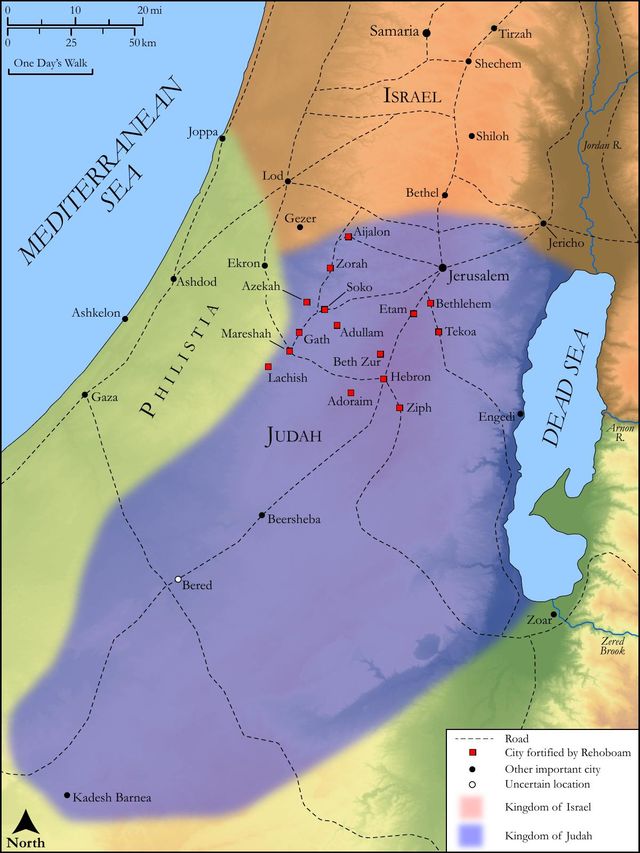
See on the biblical-era map
Study this verse
Public-domain commentary
Matthew Henry
From his Commentary on the Whole Bible. Henry comments on passages, not single verses — this entry covers 2 Chronicles 11:1–12.
How the ten tribes deserted the house of David we read in the foregoing chapter. They had formerly sat loose to that family (Sa2 20:1, Sa2 20:2), and now they quite threw it off, not considering how much it would weaken the common interest and take Israel down from that pitch of glory at which it had arrived in the last reign. But thus the kingdom must be corrected as well as the house of David. 1. Rehoboam at length, like a bold man, raises an army, with a design to reduce the revolters, Ch2 11:1. Judah and Benjamin were not only resolved to continue their allegiance to him, but ready to give him the best assistance they could for the recovery of his right. Judah was his own tribe, that owned him some years before the rest did; Benjamin was the tribe in which Jerusalem, or the greatest part of it, stood, which perhaps was one reason why that tribe clave to him. 2. Yet, like a conscientious man, when God forbade him to prosecute this design, in obedience to him he let it fall, either because he reverenced the divine authority or because he knew that he should not prosper if he should go contrary to God's command, but instead of retrieving what was lost would be in danger of losing what he had. It is dangerous undertaking any thing, but especially undertaking a war, contrary to the will of God. God calls him (Ch2 11:3), Rehoboam the son of Solomon, to intimate that this was determined for the sin of Solomon, and it would be to no purpose to oppose a decree that had gone forth. They obeyed the words of the Lord; and though it looked mean, and would turn to their reproach among their neighbours, yet, because God would have it so, they laid down their arms. 3. Like a discreet man, he fortified his own country. He saw it was to no purpose to think of reducing those that had revolted. A few good words might have prevented their defection, but now all the forces of his kingdom cannot bring them back. The think is done, and so it must rest; it is his wisdom to make the best of it. Perhaps the same young counsellors that had advised him to answer them roughly urged him to fight them, notwithstanding the divine inhibition; but he had paid dearly enough for being advised by them, and therefore now, we may suppose, his aged and experienced counsellors were hearkened to, and they advised him to submit to the will of God concerning what was lost, and to make it his business to keep what he had. It was probably by their advice that, (1.) He fortified his frontiers, and many of the principal cities of his kingdom, which, in Solomon's peaceable reign, no care had been taken for the defence of. (2.) He furnished them with good stores of victuals and arms, Ch2 11:11, Ch2 11:12. Because God forbade him to fight, he did not therefore sit down sullenly, and say that he would do nothing for the public safety if he might not do that, but prudently provided against an attack. Those that may not be conquerors, yet may be builders.
Continue studying 2 Chronicles 11:6 across the web’s major study libraries — every link below opens this exact verse, chapter, or book on the destination site.
Read & Compare
 BibleGatewayThis verse in more than 200 translations and 70 languages.
 Bible.comThe YouVersion reader — hundreds of translations, reading plans, and highlights.
 ESV.orgCrossway's official English Standard Version reader.
 NET BibleThe NET translation with 60,000+ translators' notes on every rendering decision.
 STEP BibleTyndale House's free study tool — original text, vocabulary, and scholarly resources.
 BibliaLogos Bible Software's free web reader.
 USCCBThe New American Bible (Revised Edition) with the U.S. bishops' study notes.
Commentaries
 BibleHub CommentariesDozens of classic commentaries on this verse, gathered on one page.
 StudyLightMore than 100 commentary sets — the largest collection on the web.
 BibleRefPlain-English commentary on what this verse means, verse by verse.
 Enduring WordDavid Guzik's free commentary on this chapter, widely used by Bible teachers.
 Bible Study ToolsVerse commentary alongside Greek and Hebrew study aids.
Original Language & Research
- BibleHub InterlinearThe verse word by word — original language, transliteration, and English.
- BibleHub LexiconEvery word's original-language definition and Strong's entry.
 Blue Letter BibleDeep-study tools — Strong's numbers, concordance, and word studies.
 SefariaThe Hebrew text with Rashi and centuries of Jewish commentary.
Sermons, Hymns & Audio


TrulyRandomVerse is not affiliated with these sites and doesn’t control their content. They’re linked because they’re genuinely useful.
Summary
Rehoboam, the initial king of Judah following the kingdom's division, embarked on an extensive program to fortify strategic cities within his territory. This verse specifically enumerates Bethlehem, Etam, and Tekoa among the fifteen cities he strengthened, underscoring his proactive and pragmatic efforts to secure the southern kingdom against potential threats from the newly established northern kingdom of Israel under Jeroboam. This act of fortification highlights Rehoboam's leadership in a period of significant political and military instability, aiming to establish robust defensive strongholds and ensure Judah's stability and survival.
Context
ShowHideLiterary Context
This verse is situated within the chronicler's detailed account of King Rehoboam's reign, specifically outlining his actions immediately after the tumultuous division of the united monarchy, a pivotal event narrated in 2 Chronicles 10:19. Following the secession of the northern tribes and their crowning of Jeroboam, Rehoboam initially contemplated military action to reclaim the lost territory. However, he was divinely restrained from engaging in civil war, as recorded in 2 Chronicles 11:1-4. Instead, he wisely redirected his focus to consolidating and securing the remaining southern kingdom of Judah. 2 Chronicles 11:5-12 provides a comprehensive list of fifteen cities that Rehoboam fortified, with verse 6 specifically highlighting Bethlehem, Etam, and Tekoa as integral components of this crucial defensive strategy. This passage emphasizes Rehoboam's shift from an initial impulse for offensive ambition to a more prudent defensive posture, ensuring the stability and survival of his smaller kingdom.
Historical & Cultural Context
The fragmentation of Israel into two distinct kingdoms—Judah in the south and Israel in the north—represented a monumental historical event with profound political, social, and religious ramifications. Rehoboam, ruling over Judah (which comprised the tribes of Judah and Benjamin), faced a new and challenging geopolitical reality: a potentially hostile neighbor to his immediate north. Fortifying cities was an indispensable and customary practice among the kings of that day, serving as a primary means of defense against invasion, controlling vital trade routes, and maintaining internal security. Cities such as Bethlehem, Etam, and Tekoa were strategically selected due to their advantageous geographical locations, often situated on elevated ground or in close proximity to essential resources like water, thereby offering inherent defensive advantages. Bethlehem, already possessing immense significance as King David's hometown, and Tekoa, a prominent wilderness outpost, would have constituted critical nodes within any defensive network designed to protect Jerusalem and the heartland of Judah. The act of "building" in this context typically implied strengthening existing walls, towers, and gates, and potentially establishing permanent garrisons, rather than constructing entirely new settlements from scratch.
Key Themes
ShowHideRehoboam's extensive fortification efforts, meticulously detailed in 2 Chronicles 11:5-12, illuminate several significant theological and narrative themes. Firstly, the theme of Pragmatic Leadership and Defense is prominently displayed. Despite his earlier folly and stubbornness that contributed to the kingdom's division (as seen in 2 Chronicles 10), Rehoboam demonstrates a practical and necessary response to a fragmented kingdom. He recognized the immediate imperative to secure his borders and internal territories, effectively shifting from a posture of aggression to one of strategic defense. Secondly, the passage underscores the Strategic Importance of Key Locations, with the specific mention of Bethlehem, Etam, and Tekoa emphasizing a calculated defensive strategy that shrewdly leveraged the natural topography and existing settlements. Bethlehem, of course, carried immense historical and prophetic weight, being the birthplace of David (see 1 Samuel 16:1) and later prophesied as the Messiah's birthplace (see Micah 5:2). Lastly, the chronicler subtly conveys the theme of Divine Providence Amidst Human Action. While Rehoboam's defensive measures were humanly conceived and executed, they ultimately aligned with God's established plan for the Davidic dynasty to continue in Judah, even as the northern kingdom splintered, demonstrating how human prudence can serve divine purposes.
Exposition and Analysis
ShowHideKey Word Analysis
ShowHideThis primitive root, while literally meaning "to build" or "to construct," carries a broader semantic range in contexts involving existing cities. It often signifies "to rebuild," "to fortify," "to strengthen," or "to repair." In 2 Chronicles 11:6, it implies Rehoboam's investment in existing infrastructure, enhancing the defensive capabilities of these cities rather than establishing entirely new settlements. His aim was to reinforce strategic strongholds to protect the kingdom of Judah.
Meaning "house of bread," Bethlehem was a small yet historically and prophetically significant town situated approximately six miles south of Jerusalem. It was renowned as the birthplace of King David (1 Samuel 17:12) and later prophesied as the birthplace of the Messiah (Micah 5:2). Its inclusion in Rehoboam's fortification program underscores its strategic importance in the defense of Judah's heartland, beyond its spiritual and historical resonance.
Located about ten miles south of Jerusalem, Tekoa was a town strategically positioned on a high ridge overlooking the wilderness of Judah. Its elevated position offered exceptional defensive advantages and served as a crucial outpost for observation and control of the surrounding terrain. It is also notably known as the hometown of the prophet Amos (Amos 1:1), further highlighting its prominence in Judah.
Verse Breakdown
ShowHide"He built even Bethlehem"
This clause directly attributes the action of fortification to Rehoboam, indicating his intentional and comprehensive program. The inclusion of "even" (or "also" in some translations) emphasizes that Bethlehem, despite its historical and religious significance, was selected as a critical component of this defensive network. The work involved strengthening its existing walls, reinforcing gates, and likely establishing a permanent military garrison to secure this vital southern approach to Jerusalem.
"and Etam"
The mention of Etam, likely situated south of Bethlehem and potentially near a significant water source, suggests its role as another crucial strategic point within Judah's arid region. Its fortification indicates a comprehensive defensive line designed to protect the southern approaches to Jerusalem and the central highlands, forming a vital link in Rehoboam's network of strongholds.
"and Tekoa"
The inclusion of Tekoa further illustrates the strategic depth and foresight of Rehoboam's defensive plan. Its commanding position on a high point overlooking the wilderness provided a critical vantage point for observing enemy movements and defending against incursions from the south or east. Together, these cities—Bethlehem, Etam, and Tekoa—formed an integrated network of strongholds meticulously designed to secure Judah's borders and ensure its internal stability in a time of political fragmentation.
Literary Devices
ShowHideThe verse primarily employs Enumeration and Selection to highlight Rehoboam's strategic and deliberate actions. By specifically listing Bethlehem, Etam, and Tekoa—cities that are part of a larger total mentioned in 2 Chronicles 11:5—the chronicler draws particular attention to their individual significance within the broader defensive scheme. This Specificity lends credibility and rich detail to the account of Rehoboam's fortification program, portraying it as a meticulously planned and executed endeavor rather than a vague generalization. Furthermore, the mention of Bethlehem, in particular, serves as a subtle form of Foreshadowing, given its profound future role in redemptive history as the birthplace of the Messiah, even as it is presented here primarily as a military stronghold.
Theological and Thematic Connections
ShowHideRehoboam's fortification efforts, while undeniably a pragmatic political and military response to the kingdom's division, carry profound theological implications. They underscore the divine permission for the kingdom's fragmentation (1 Kings 12:24) and the subsequent necessity for Judah to secure itself in a new geopolitical landscape. This act of building and strengthening reflects a timeless principle of responsible stewardship and preparedness in the face of adversity, even when that adversity is divinely ordained. It illustrates that human wisdom, effort, and strategic planning are not antithetical to God's sovereign plan but can, in fact, serve as instruments within it, especially when focused on preserving what God has entrusted. The chronicler frequently emphasizes the consequences of obedience and disobedience throughout his narrative, and here, Rehoboam's wise, albeit defensive, actions stand in stark contrast to his earlier folly, suggesting a measure of divine favor or at least a practical wisdom that significantly contributed to Judah's initial stability and survival.
Reflection and Application
ShowHideRehoboam's strategic decision to fortify cities like Bethlehem, Etam, and Tekoa serves as a powerful and enduring metaphor for the spiritual life of the believer. Just as he diligently sought to secure his physical kingdom against external threats, we are likewise called to actively build and strengthen our spiritual defenses. This vital process involves diligently cultivating our faith, fortifying our minds with the unchanging truth of God's Word, and vigilantly guarding our hearts against the subtle deceptions and overt attacks of the spiritual enemy. In a world replete with spiritual challenges, temptations, and uncertainties, wisdom dictates that we do not remain passive but proactively establish strong, resilient foundations for our faith, much like a well-fortified city. This spiritual preparedness is not born of fear, but rather of a sober recognition of spiritual realities and a fervent desire to stand firm and unyielding in Christ. It compels us to identify the "key cities" in our own lives—our core convictions, our vital relationships, our spiritual disciplines—and to invest intentionally in their strength and resilience, ensuring they are not easily breached by doubt, despair, or deception.
Questions for Reflection
ShowHideFAQ
ShowHideWhy did Rehoboam choose these specific cities for fortification?
ShowHideRehoboam chose Bethlehem, Etam, and Tekoa, along with twelve other cities (as comprehensively listed in 2 Chronicles 11:5-10), primarily for their strategic geographical locations and inherent defensive advantages. These cities were often situated on elevated ground, controlled critical access routes, or were near vital resources like water. Bethlehem, for instance, was a key town positioned strategically south of Jerusalem, controlling approaches to the capital. Etam, possibly known for its significant springs, would have been crucial for water supply in the arid region, while Tekoa, situated on a high ridge, offered excellent observation and defense capabilities over the wilderness. Together, these cities formed a meticulously planned network of strongholds designed to protect the heartland of Judah from potential incursions from the newly formed northern kingdom of Israel or other external threats. His choices reflect a pragmatic and well-thought-out defensive strategy to secure his kingdom after the traumatic division.
Christ-Centered Fulfillment
ShowHideWhile 2 Chronicles 11:6 describes Rehoboam's earthly efforts to build and secure a physical kingdom, it subtly points us to a greater, eternal King who builds an unshakeable spiritual kingdom. The prominent mention of Bethlehem, the birthplace of King David (1 Samuel 17:12), and later prophesied as the very birthplace of the Messiah (Micah 5:2), naturally draws our gaze to Jesus Christ. Unlike Rehoboam, whose kingdom was divided and whose fortifications were ultimately temporary and subject to destruction, Jesus builds a kingdom that "shall never be destroyed" (Daniel 2:44). He is the true builder, not of stone cities, but of living stones—His Church (1 Peter 2:5). His redemptive work on the cross and His glorious resurrection established an eternal defense against the pervasive power of sin and death, fortifying believers not with walls of brick and mortar but with the indwelling, impenetrable Spirit of God (Ephesians 2:20-22). The profound security we find in Christ is not rooted in physical strongholds or human ingenuity, but in His finished work, His ongoing intercession at the right hand of God (Hebrews 7:25), and the infallible promise that "the gates of hell shall not prevail against" His Church (Matthew 16:18). He is our ultimate refuge and strength, the one who truly builds, sustains, and eternally secures His people.