


2 Chronicles 11:7
Bible text: King James Version (1769 Blayney text) · Public domain
Bible text: Berean Standard Bible · Public domain
Bible text: American Standard Version (1901) · Public domain
Bible text: World English Bible, Messianic edition · Public domain
Bible text: Geneva Bible (1599) · Public domain
Bible text: Young's Literal Translation · Public domain
- וְאֶתve·'Etand <obj.>H853Conj-w ¦ DirObjMParticle Object Indicatorוְandאֶת<obj.>
- בֵּיתbeitBethH1049N-properNoun Proper Location
- צוּרtzurZurH1049N-properNoun Proper Location
- וְאֶתve·'Etand <obj.>H853Conj-w ¦ DirObjMParticle Object Indicatorוְandאֶת<obj.>
- שׂוֹכוֹso·KhoSocohH7755N-properNoun Proper Location
- וְאֶתve·'Etand <obj.>H853Conj-w ¦ DirObjMParticle Object Indicatorוְandאֶת<obj.>
- עֲדֻלָּם'a·du·LamAdullamH5725N-properNoun Proper Location
English is a literal word-by-word gloss of the Hebrew, not the KJV's wording. Why?
This is the original text the KJV's translators worked from — each Hebrew word with its own literal English meaning in this verse, prepared by scholars at Tyndale House, Cambridge. The KJV translates whole sentences, not word by word, so its wording differs: one Hebrew word can become several English words, and the KJV may choose “the LORD” where the gloss reads “Yahweh”. Both are faithful — they answer different questions. For the KJV's own rendering, switch to the KJV text.
Details
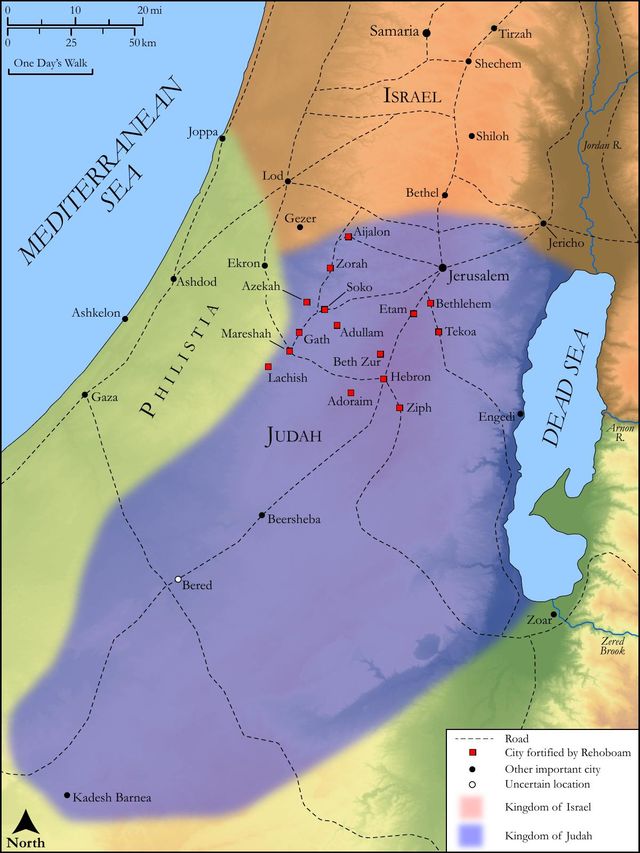
See on the biblical-era map
Study this verse
Public-domain commentary
Matthew Henry
From his Commentary on the Whole Bible. Henry comments on passages, not single verses — this entry covers 2 Chronicles 11:1–12.
How the ten tribes deserted the house of David we read in the foregoing chapter. They had formerly sat loose to that family (Sa2 20:1, Sa2 20:2), and now they quite threw it off, not considering how much it would weaken the common interest and take Israel down from that pitch of glory at which it had arrived in the last reign. But thus the kingdom must be corrected as well as the house of David. 1. Rehoboam at length, like a bold man, raises an army, with a design to reduce the revolters, Ch2 11:1. Judah and Benjamin were not only resolved to continue their allegiance to him, but ready to give him the best assistance they could for the recovery of his right. Judah was his own tribe, that owned him some years before the rest did; Benjamin was the tribe in which Jerusalem, or the greatest part of it, stood, which perhaps was one reason why that tribe clave to him. 2. Yet, like a conscientious man, when God forbade him to prosecute this design, in obedience to him he let it fall, either because he reverenced the divine authority or because he knew that he should not prosper if he should go contrary to God's command, but instead of retrieving what was lost would be in danger of losing what he had. It is dangerous undertaking any thing, but especially undertaking a war, contrary to the will of God. God calls him (Ch2 11:3), Rehoboam the son of Solomon, to intimate that this was determined for the sin of Solomon, and it would be to no purpose to oppose a decree that had gone forth. They obeyed the words of the Lord; and though it looked mean, and would turn to their reproach among their neighbours, yet, because God would have it so, they laid down their arms. 3. Like a discreet man, he fortified his own country. He saw it was to no purpose to think of reducing those that had revolted. A few good words might have prevented their defection, but now all the forces of his kingdom cannot bring them back. The think is done, and so it must rest; it is his wisdom to make the best of it. Perhaps the same young counsellors that had advised him to answer them roughly urged him to fight them, notwithstanding the divine inhibition; but he had paid dearly enough for being advised by them, and therefore now, we may suppose, his aged and experienced counsellors were hearkened to, and they advised him to submit to the will of God concerning what was lost, and to make it his business to keep what he had. It was probably by their advice that, (1.) He fortified his frontiers, and many of the principal cities of his kingdom, which, in Solomon's peaceable reign, no care had been taken for the defence of. (2.) He furnished them with good stores of victuals and arms, Ch2 11:11, Ch2 11:12. Because God forbade him to fight, he did not therefore sit down sullenly, and say that he would do nothing for the public safety if he might not do that, but prudently provided against an attack. Those that may not be conquerors, yet may be builders.
Continue studying 2 Chronicles 11:7 across the web’s major study libraries — every link below opens this exact verse, chapter, or book on the destination site.
Read & Compare
 BibleGatewayThis verse in more than 200 translations and 70 languages.
 Bible.comThe YouVersion reader — hundreds of translations, reading plans, and highlights.
 ESV.orgCrossway's official English Standard Version reader.
 NET BibleThe NET translation with 60,000+ translators' notes on every rendering decision.
 STEP BibleTyndale House's free study tool — original text, vocabulary, and scholarly resources.
 BibliaLogos Bible Software's free web reader.
 USCCBThe New American Bible (Revised Edition) with the U.S. bishops' study notes.
Commentaries
 BibleHub CommentariesDozens of classic commentaries on this verse, gathered on one page.
 StudyLightMore than 100 commentary sets — the largest collection on the web.
 BibleRefPlain-English commentary on what this verse means, verse by verse.
 Enduring WordDavid Guzik's free commentary on this chapter, widely used by Bible teachers.
 Bible Study ToolsVerse commentary alongside Greek and Hebrew study aids.
Original Language & Research
- BibleHub InterlinearThe verse word by word — original language, transliteration, and English.
- BibleHub LexiconEvery word's original-language definition and Strong's entry.
 Blue Letter BibleDeep-study tools — Strong's numbers, concordance, and word studies.
 SefariaThe Hebrew text with Rashi and centuries of Jewish commentary.
Sermons, Hymns & Audio


TrulyRandomVerse is not affiliated with these sites and doesn’t control their content. They’re linked because they’re genuinely useful.
Summary
Second Chronicles 11:7 is an integral part of the Chronicler's detailed account of King Rehoboam's strategic efforts to fortify the remaining southern kingdom of Judah and Benjamin after the devastating schism of the united monarchy. This verse specifically names Bethzur, Shoco, and Adullam as three of the fifteen key cities that Rehoboam diligently strengthened with defensive structures, garrisons, and provisions, thereby establishing a crucial network of strongholds designed to protect his diminished territory from both internal instability and external threats following the northern tribes' secession.
Context
ShowHideLiterary Context
This verse is deeply embedded within a meticulously detailed account of King Rehoboam's defensive strategy, spanning 2 Chronicles 11:5-12. The narrative immediately precedes this passage by recounting the tragic division of the united monarchy, where ten northern tribes rebelled against Rehoboam's harsh and unwise policies, forming their own kingdom under Jeroboam (2 Chronicles 10:1-19). Left with only the tribes of Judah and Benjamin, Rehoboam, despite his earlier folly, demonstrates a pragmatic wisdom in recognizing the precariousness of his position. The verses leading up to 2 Chronicles 11:7 establish the general principle of his extensive fortification program, while verses 6-10 provide a comprehensive, almost administrative, list of the specific cities he chose to fortify. This enumeration serves not only as a historical record but also as a testament to the king's diligence and the systematic nature of his efforts to secure his diminished, yet divinely preserved, territory.
Historical & Cultural Context
The period immediately following the death of Solomon (c. 931 BCE) was a watershed moment in Israelite history, marked by profound political upheaval and instability. The division of the kingdom, as vividly recounted in 1 Kings 12 and 2 Chronicles 10, left the newly formed kingdom of Judah vulnerable to internal strife, economic disruption, and external threats, particularly from the aggressive northern kingdom of Israel and perennial adversaries like the Philistines. Fortifying strategic cities was an indispensable and common practice for the monarchs of that day. These fortresses served multifaceted roles: they were military outposts guarding borders and key routes, administrative centers for regional governance, economic hubs controlling trade, and places of refuge for the populace during times of conflict. The cities listed in 2 Chronicles 11:7—Bethzur, Shoco, and Adullam—were chosen for their critical geographical locations, controlling vital access points into the Judean heartland from the west (the Shephelah, or lowlands) and the south (the Judean hills), reflecting a well-conceived and comprehensive defensive strategy.
Key Themes
ShowHideRehoboam's fortification efforts, as detailed in 2 Chronicles 11, contribute significantly to several overarching themes within the book of Chronicles. First, it powerfully illustrates the consequences of disobedience and division, as the urgent need for such extensive defense arose directly from the kingdom's catastrophic split, a direct result of Rehoboam's folly and a divine judgment against the house of David (compare 1 Kings 12:15). Second, the passage emphasizes human responsibility and strategic planning, showcasing Rehoboam taking pragmatic and necessary steps to ensure the survival and security of his remaining kingdom, even amidst the backdrop of divine judgment. This pragmatic approach contrasts sharply with later periods where reliance on foreign alliances often superseded trust in God. Third, the detailed geographical listing underscores the importance of the land and its defense, a recurring motif in Old Testament narratives concerning Israel's inheritance and security. Finally, it subtly introduces the theme of Judah's resilience and its continued existence as the lineage through which God's promises to David, particularly the promise of an enduring dynasty (2 Samuel 7:16), would ultimately be fulfilled, even if through a reduced and vulnerable state.
Exposition and Analysis
ShowHideKey Word Analysis
ShowHideDerived from the Hebrew words for "house" and "rock," this name literally means "House of (the) Rock" or "House of the Fortress." This etymology perfectly encapsulates its strategic significance. Located in the rugged Judean hills, approximately four miles north of Hebron, Bethzur was a historically pivotal fortress that commanded a crucial route leading to Jerusalem and the southern part of Judah. Its naturally elevated and defensible position made it an ideal choice for a stronghold, controlling access and providing a strong point in a region frequently contested.
This city, also known as Socoh, was situated in the Shephelah, the lowlands forming a buffer zone between the Judean hills and the Philistine plain. The name's root suggests "thorns" or "hedges," possibly implying a protective barrier or a difficult terrain. Its strategic location was paramount, as it controlled a vital access point from the west, making it essential for repelling potential Philistine incursions. It was notably near the Valley of Elah, famously associated with David's victory over Goliath, underscoring its long-standing military importance in the region.
Also located in the Shephelah, Adullam is most renowned for its extensive cave system, which famously served as a refuge for David when he fled from King Saul. While its etymology is debated, possibly meaning "refuge" or "justice of the people," its natural caves and strategic position provided excellent defensive capabilities and control over a significant area. Its historical association with a place of safety and its inherent defensive features made it a logical and invaluable asset for Rehoboam's network of strongholds.
Verse Breakdown
ShowHide"And Bethzur"
This phrase introduces the first of three specific cities mentioned in this verse that Rehoboam fortified. Bethzur's inclusion highlights its critical role as a stronghold in the southern Judean highlands, strategically positioned to guard the approach to Jerusalem from the south and serving as a key defensive point in a region historically prone to conflict and invasion.
"and Shoco"
The addition of Shoco underscores Rehoboam's comprehensive and geographically diverse approach to defense, extending his fortifications westward into the vital Shephelah region. Shoco's position was crucial for repelling threats from the Philistine plain, demonstrating a keen strategic awareness of the kingdom's most vulnerable western borders.
"and Adullam"
The final city listed in this verse, Adullam, further reinforces the strategic depth and foresight of Rehoboam's defensive network. Its historical association with David as a place of refuge and its formidable natural defensive features made it an invaluable asset for controlling the western approaches to Judah, providing both a strong point of resistance and a potential fallback position for the kingdom's forces.
Literary Devices
ShowHideThe primary literary device employed in 2 Chronicles 11:7 is Enumeration or Listing. The verse is part of a longer, meticulously detailed list of fifteen fortified cities (verses 6-10), which serves to emphasize the comprehensive, systematic, and diligent nature of Rehoboam's defensive strategy. This detailed enumeration lends an air of historical accuracy and thoroughness to the Chronicler's account, demonstrating the king's foresight and the tangible results of his efforts to secure his kingdom. Furthermore, there is an implied Synecdoche, where the naming of these specific, geographically significant cities stands in for the broader, extensive network of fortifications that Rehoboam established throughout Judah and Benjamin. Each city, by its inclusion, represents a vital component of the larger defensive whole, highlighting the king's strategic acumen and the kingdom's newfound, albeit physically constructed, security. The Geographical Specificity of the names also grounds the narrative in a concrete historical reality, allowing the reader to visualize the strategic landscape of Rehoboam's kingdom.
Theological and Thematic Connections
ShowHideRehoboam's diligent efforts to fortify his physical kingdom, as exemplified by the cities in 2 Chronicles 11:7, offer a compelling theological parallel to the concept of spiritual preparedness and the importance of wise stewardship. While Rehoboam relied on stone walls and garrisons, the ultimate security of God's people rests not in human strength or strategic planning alone, but in divine providence and faithfulness. However, this does not negate human responsibility; rather, it calls for proactive engagement and diligent preparation in the face of life's challenges. The very need for these fortifications arose from the tragic division of the kingdom, a direct consequence of sin and disobedience, reminding us that brokenness often necessitates a renewed focus on defense, rebuilding, and relying on God's wisdom in our efforts. Spiritually, believers are called to build up their defenses against the schemes of the enemy, not with physical walls, but with spiritual disciplines and an unwavering reliance on God's truth and strength.
Reflection and Application
ShowHideRehoboam's strategic fortification of cities like Bethzur, Shoco, and Adullam serves as a powerful and practical reminder of the importance of proactive preparation and wise stewardship in the face of adversity. Just as he assessed the vulnerabilities of his kingdom and invested significant resources to strengthen its defenses, we too are called to diligently evaluate the "vulnerabilities" in our own lives—whether spiritual, emotional, relational, or physical—and take intentional, God-honoring steps to build resilience. This might involve fortifying our faith through consistent engagement with God's Word and prayer, strengthening our relationships through intentional communication, forgiveness, and mutual support, or shoring up our personal boundaries against destructive influences and temptations. The passage implicitly challenges us to consider where we are investing our most precious energy and resources. Are we merely reacting to crises as they arise, or are we proactively building strong foundations—spiritual, mental, and relational—that can withstand the inevitable storms and challenges of life? True security, both in ancient Judah and in our contemporary world, comes not from complacency or naive optimism, but from a diligent, God-centered approach to preparation and protection.
Questions for Reflection
ShowHideFAQ
ShowHideWhy did Rehoboam need to fortify these cities so extensively?
ShowHideRehoboam's extensive fortification program, which included cities like Bethzur, Shoco, and Adullam, was a direct and necessary response to the profound political and military instability that followed the division of the united kingdom of Israel. After the ten northern tribes seceded to Jeroboam (1 Kings 12:19), Rehoboam was left with only the considerably smaller territories of Judah and Benjamin. This significantly reduced his military and economic resources, making the remaining southern kingdom highly vulnerable to external threats, particularly from the newly formed northern kingdom of Israel and traditional enemies like the Philistines. The fortifications were a pragmatic and essential measure to secure his diminished borders, protect key trade and travel routes, and establish strongholds for his remaining populace. This strategic network of fortresses was crucial for ensuring the survival and stability of the Davidic dynasty in Judah, providing both defense and administrative control over his territory.
Christ-Centered Fulfillment
ShowHideWhile 2 Chronicles 11:7 describes physical fortifications built by a king to secure his earthly kingdom, it points to a profound spiritual reality ultimately fulfilled in Jesus Christ. Rehoboam's strongholds were made of stone and mortar, designed to protect against human enemies and physical invasion. Yet, the ultimate "fortress," "refuge," and "strong tower" for God's people is not a city built by human hands, but the Lord Himself. The psalmist declares, "The Lord is my rock, my fortress and my deliverer; my God is my rock, in whom I take refuge". Jesus Christ is the ultimate fulfillment of this imagery. He is our impregnable stronghold against sin, death, and the powers of darkness. His kingdom is not of this world, nor is it defended by physical armies or stone walls (John 18:36). Instead, it is a spiritual kingdom, and His followers are called to put on the "full armor of God" to stand firm in the spiritual battle. In Christ, we find true and eternal security, a refuge more steadfast and enduring than any stone wall, for He has overcome the world (John 16:33) and offers an unshakable kingdom that cannot be moved (Hebrews 12:28).