


Matthew 2:5
Bible text: King James Version (1769 Blayney text) · Public domain
Bible text: Berean Standard Bible · Public domain
Bible text: American Standard Version (1901) · Public domain
Bible text: World English Bible, Messianic edition · Public domain
Bible text: Geneva Bible (1599) · Public domain
Bible text: Young's Literal Translation · Public domain
- οἱhoi<the>G3588T-NPMDefinite article Nominative Plural Masculine
- δὲdeAndG1161CONJConjunction
- εἶπανeipanthey saidG2036V-2AAI-3PVerb 2nd Aorist Active Indicative 3rd Plural
- αὐτῷ·autōto himG846P-DSMPersonal pronoun Dative Singular Masculine
- ἐνenInG1722PREPPreposition
- ΒηθλέεμBēthleemBethlehemG965N-DSF-LNoun Dative Singular Feminine Location
- τῆςtēs<the>G3588T-GSFDefinite article Genitive Singular Feminine
- ἸουδαίαςIoudaiasof JudeaG2449N-GSF-LNoun Genitive Singular Feminine Location
- οὕτωςhoutōsthusG3779ADVAdverb
- γὰρgarforG1063CONJConjunction
- γέγραπταιgegraptaiit has been writtenG1125V-RPI-3SVerb Perfect Passive Indicative 3rd Singular
- διὰdiathroughG1223PREPPreposition
- τοῦtoutheG3588T-GSMDefinite article Genitive Singular Masculine
- προφήτου·prophētouprophetG4396N-GSMNoun Genitive Singular Masculine
English is a literal word-by-word gloss of the Greek, not the KJV's wording. Why?
This is the original text the KJV's translators worked from — each Greek word with its own literal English meaning in this verse, prepared by scholars at Tyndale House, Cambridge. The KJV translates whole sentences, not word by word, so its wording differs: one Greek word can become several English words, and the KJV may choose “charity” where the gloss reads “love”. Both are faithful — they answer different questions. For the KJV's own rendering, switch to the KJV text.
Details
See on the biblical-era maps
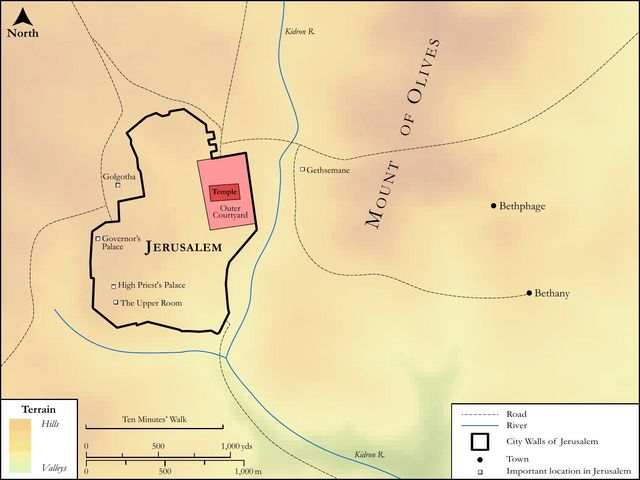
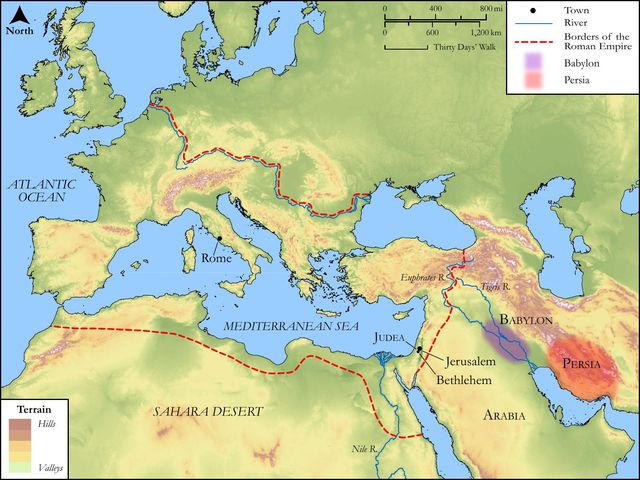
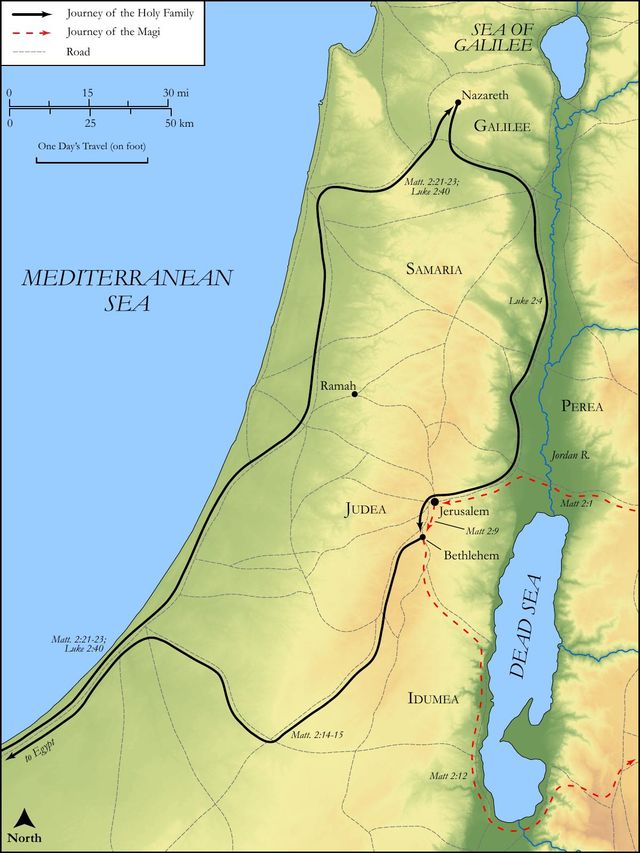
Study this verse
Public-domain commentary
Matthew Henry
From his Commentary on the Whole Bible. Henry comments on passages, not single verses — this entry covers Matthew 2:1–8. His two-level outline is real structure in the source text, so it is rendered as structure.
It was a mark of humiliation put upon the Lord Jesus that, though he was the Desire of all nations, yet his coming into the world was little observed and taken notice of, his birth was obscure and unregarded: herein he emptied himself, and made himself of no reputation. If the Son of God must be brought into the world, one might justly expect that he should be received with all the ceremony possible, that crowns and sceptres should immediately have been laid at his feet, and that the high and mighty princes of the world should have been his humble servants; such a Messiah as this the Jews expected, but we see none of all this; he came into the world, and the world knew him not; nay, he came to his own, and his own received him not; for having undertaken to make satisfaction to his Father for the wrong done him in his honour by the sin of man, he did it by denying himself in, and despoiling himself of, the honours undoubtedly due to an incarnate Deity; yet, as afterward, so in his birth, some rays of glory darted forth in the midst of the greatest instances of his abasement. Though there was the hiding of his power, yet he had horns coming out of his hand (Hab 3:4) enough to condemn the world, and the Jews especially, for their stupidity.
The first who took notice of Christ after his birth were the shepherds (Luk 2:15, etc.), who saw and heard glorious things concerning him, and made them known abroad, to the amazement of all that heard them, Luk 2:17, Luk 2:18. After that, Simeon and Anna spoke of him, by the Spirit, to all that were disposed to heed what they said, Luk 2:38. Now, one would think, these hints should have been taken by the men of Judah and the inhabitants of Jerusalem, and they should with both arms have embraced the long-looked-for Messiah; but, for aught that appears, he continued nearly two years after at Bethlehem, and no further notice was taken of him till these wise men came. Note, Nothing will awaken those that are resolved to be regardless. Oh the amazing stupidity of these Jews! And no less that of many who are called Christians! Observe,
I.When this enquiry was made concerning Christ.
It was in the days of Herod the king. This Herod was an Edomite, made king of Judea by Augustus and Antonius, the then chief rulers of the Roman state, a man made up of falsehood and cruelty; yet he was complimented with the title of Herod the Great. Christ was born in the 35th year of his reign, and notice is taken of this, to show that the sceptre had now departed from Judah, and the lawgiver from between his feet; and therefore now was the time for Shiloh to come, and to him shall the gathering of the people be: witness these wise men, Gen 49:10.
II.Who and what these wise men were; they are here called Magou - Magicians.
Some that it in a good sense; the Magi among the Persians were their philosophers and their priests; nor would they admit any one for their king who had not first been enrolled among the Magi; others think they dealt in unlawful arts; the word is used of Simon, the sorcerer (Act 8:9, Act 8:11), and of Elymas, the sorcerer (Act 13:6), nor does the scripture use it in any other sense; and then it was an early instance and presage of Christ's victory over the devil, when those who had been so much his devotees became the early adorers even of the infant Jesus; so soon were trophies of his victory over the powers of darkness erected. Well, whatever sort of wise men they were before, now they began to be wise men indeed when they set themselves to enquire after Christ.
This we are sure of, 1. That they were Gentiles, and not belonging to the commonwealth of Israel. The Jews regarded not Christ, but these Gentiles enquired him out. Note, Many times those who are nearest to the means, are furthest from the end. See Mat 8:11, Mat 8:12. The respect paid to Christ by these Gentiles was a happy presage and specimen of what would follow when those who were afar off should be made nigh by Christ. 2. That they were scholars. They dealt in arts, curious arts; good scholars should be good Christians, and then they complete their learning when they learn Christ. 3. That they were men of the east, who were noted for their soothsaying, Isa 2:6. Arabia is called the land of the east (Gen 25:6), and the Arabians are called men of the east, Jdg 6:3. The presents they brought were the products of that country; the Arabians had done homage to David and Solomon as types of Christ. Jethro and Job were of that country. More than this we have not to say of them. The traditions of the Romish church are frivolous, that they were in number three (though one of the ancients says that they were fourteen), that they were kings, and that they lie buried in Colen, thence called the three kings of Colen; we covet not to be wise above what is written.
III.What induced them to make this enquiry.
They, in their country, which was in the east, had seen an extraordinary star, such as they had not seen before; which they took to be an indication of an extraordinary person born in the land of Judea, over which land this star was seen to hover, in the nature of a comet, or a meteor rather, in the lowers regions of the air; this differed so much from any thing that was common that they concluded it to signify something uncommon. Note, Extraordinary appearances of God in the creatures should put us upon enquiring after his mind and will therein; Christ foretold signs in the heavens. The birth of Christ was notified to the Jewish shepherds by an angel, to the Gentile philosophers by a star: to both God spoke in their own language, and in the way they were best acquainted with. Some think that the light which the shepherds saw shining round about them, the night after Christ was born, was the very same which to the wise men, who lived at such a distance, appeared as a star; but this we cannot easily admit, because the same star which they had seen in the east they saw a great while after, leading them to the house where Christ lay; it was a candle set up on purpose to guide them to Christ. The idolaters worshipped the stars as the host of heaven, especially the eastern nations, whence the planets have the names of their idol-gods; we read of a particular star they had in veneration, Amo 5:26. Thus the stars that had been misused came to be put to the right use, to lead men to Christ; the gods of the heathen became his servants. Some think this star put them in mind of Balaam's prophecy, that a star should come out of Jacob, pointing at a sceptre, that shall rise out of Israel; see Num 24:17. Balaam came from the mountains of the east, and was one of their wise men. Others impute their enquiry to the general expectation entertained at that time, in those eastern parts, of some great prince to appear. Tacitus, in his history (lib. 5), takes notice of it; Pluribus persuasio inerat, antiquis sacerdotum literis contineri, eo ipso tempore fore, ut valesceret oriens, profectique Judaea rerum potirentur - A persuasion existed in the minds of many that some ancient writings of the priests contained a prediction that about that time an eastern power would prevail, and that persons proceeding from Judea would obtain dominion. Suetonius also, in the life of Vespasian, speaks of it; so that this extraordinary phenomenon was construed as pointing to that king; and we may suppose a divine impression made upon their minds, enabling them to interpret this star as a signal given by Heaven of the birth of Christ.
IV.How they prosecuted this enquiry.
They came from the east to Jerusalem, in further quest of this prince. Wither shall they come to enquire for the king of the Jews, but to Jerusalem, the mother-city, whither the tribes go up, the tribes of the Lord? They might have said, "If such a prince be born, we shall hear of him shortly in our own country, and it will be time enough then to pay our homage to him." But so impatient were they to be better acquainted with him, that they took a long journey on purpose to enquire after him. Note, Those who truly desire to know Christ, and find him, will not regard pains or perils in seeking after him. Then shall we know, if we follow on to know the Lord.
Their question is, Where is he that is born king of the Jews? They do not ask, whether there were such a one born? (they are sure of that, and speak of it with assurance, so strongly was it set home upon their hearts); but, Where is he born? Note, Those who know something of Christ cannot but covet to know more of him. They call Christ the King of the Jews, for so the Messiah was expected to be: and he is Protector and Ruler of all the spiritual Israel, he is born a King.
To this question they doubted not but to have a ready answer, and to find all Jerusalem worshipping at the feet of this new king; but they come from door to door with this question, and no man can give them any information. Note, There is more gross ignorance in the world, and in the church too, than we are aware of. Many that we think should direct us to Christ are themselves strangers to him. They ask, as the spouse of the daughters of Jerusalem, Saw ye him whom my soul loveth? But they are never the wiser. However, like the spouse, they pursue the enquiry, Where is he that is born king of the Jews? Are they asked, "Why do ye make this enquiry?" It is because they have seen his star in the east. Are they asked, "What business have ye with him? What have the men of the east to do with the King of the Jews?" They have their answer ready, We are come to worship him. They conclude he will, in process of time, be their king, and therefore they will betimes ingratiate themselves with him and with those about him. Note, Those in whose hearts the day-star is risen, to give them any thing of the knowledge of Christ, must make it their business to worship him. Have we seen Christ's star? Let us study to give him honour.
V.How this enquiry was treated at Jerusalem.
News of it at last came to court; and when Herod heard it he was troubled, Mat 2:3. He could not be a stranger to the prophecies of the Old Testament, concerning the Messiah and his kingdom, and the times fixed for his appearing by Daniel's weeks; but, having himself reigned so long and so successfully, he began to hope that those promises would for ever fail, and that his kingdom would be established and perpetuated in spite of them. What a damp therefore must it needs be upon him, to hear talk of this King being born, now, when the time fixed for his appearing had come! Note, Carnal wicked hearts dread nothing so much as the fulfilling of the scriptures.
But though Herod, an Edomite, was troubled, one would have thought Jerusalem should rejoice greatly to hear that her King comes; yet, it seems, all Jerusalem, except the few there that waited for the consolation of Israel, were troubled with Herod, and were apprehensive of I know not what ill consequences of the birth of this new king, that it would involve them in war, or restrain their lusts; they, for their parts, desired no king but Herod; no, not the Messiah himself. Note, The slavery of sin is foolishly preferred by many to the glorious liberty of the children of God, only because they apprehend some present difficulties attending that necessary revolution of the government in the soul. Herod and Jerusalem were thus troubled, from a mistaken notion that the kingdom of the Messiah would clash and interfere with the secular powers; whereas the star that proclaimed him king plainly intimated that his kingdom was heavenly, and not of this lower world. Note, The reason why the kings of the earth, and the people, oppose the kingdom of Christ, is because they do not know it, but err concerning it.
VI.What assistance they met with in this enquiry from the scribes and the priests, Mat 2:4-6.
Nobody can pretend to tell where the King of the Jews is, but Herod enquires where it was expected he should be born. The persons he consults are, the chief priests, who were teachers by office; and the scribes, who made it their business to study the law; their lips must keep knowledge, but then the people must enquire the law at their mouth, Mal 2:7. It was generally known that Christ should be born at Bethlehem (Joh 7:42); but Herod would have counsel's opinion upon it, and therefore applies himself to the proper persons; and, that he might be the better satisfied, he has them altogether, all the chief priests, and all the scribes; and demands of them what was the place, according to the scriptures of the Old Testament, where Christ should be born? Many a good question is put with an ill design, so was this by Herod.
The priests and scribes need not take any long time to give an answer to this query; nor do they differ in their opinion, but all agree that the Messiah must be born in Bethlehem, the city of David, here called Bethlehem of Judea, to distinguish it from another city of the same name in the land of Zebulun, Jos 19:15. Bethlehem signifies the house of bread; the fittest place for him to be born in who is the true manna, the bread which came down from heaven, which was given for the life of the world. The proof they produce is taken from Mic 5:2, where it is foretold that though Bethlehem be little among the thousands of Judah (so it is in Micah), no very populous place, yet it shall be found not the least among the princes of Judah (so it is here); for Bethlehem's honour lay not, as that of other cities, in the multitude of the people, but in the magnificence of the princes it produced. Though, upon some accounts, Bethlehem was little, yet herein it had the pre-eminence above all the cities of Israel, that the Lord shall count, when he writes up the people, that this man, even the man Christ Jesus, was born there, Psa 87:6. Out of thee shall come a Governor, the King of the Jews. Note, Christ will be a Saviour to those only who are willing to take him for their Governor. Bethlehem was the city of David, and David the glory of Bethlehem; there, therefore, must David's son and successor be born. There was a famous well at Bethlehem, by the gate, which David longed to drink of (Sa2 23:15); in Christ we have not only bread enough and to spare, but may come and take also of the water of life freely. Observe here how Jews and Gentiles compare notes about Jesus Christ. The Gentiles know the time of his birth by a star; the Jews know the place of it by the scriptures; and so they are capable of informing one another. Note, It would contribute much to the increase of knowledge, if we did thus mutually communicate what we know. Men grow rich by bartering and exchanging; so, if we have knowledge to communicate to others, they will be ready to communicate to us; thus many shall discourse, shall run to and fro, and knowledge shall be increased.
VII.The bloody project and design of Herod, occasioned by this enquiry, Mat 2:7, Mat 2:8.
Herod was now an old man, and had reigned thirty-five years; this king was but newly born, and not likely to enterprise any thing considerable for many years; yet Herod is jealous of him. Crowned heads cannot endure to think of successors, much less of rivals; and therefore nothing less than the blood of this infant king will satisfy him; and he will not give himself liberty to think that, if this new-born child should be indeed the Messiah, in opposing him, or making any attempts upon him, he would be found fighting against God, than which nothing is more vain, nothing more dangerous. Passion has got the mastery of reason and conscience.
Now, 1. See how cunningly he laid the project (Mat 2:7, Mat 2:8). He privily called the wise men, to talk with them about this matter. He would not openly own his fears and jealousies; it would be his disgrace to let the wise men know them, and dangerous to let the people know them. Sinners are often tormented with secret fears, which they keep to themselves. Herod learns of the wise men the time when the star appeared, that he might take his measures accordingly; and then employs them to enquire further, and bids them bring him an account. All this might look suspicious, if he had not covered it with a show of religion: that I may come and worship him also. Note, The greatest wickedness often conceals itself under a mask of piety. Absalom cloaks his rebellious project with a vow.
2.See how strangely he was befooled and infatuated in this, that he trusted it with the wise men, and did not choose some other managers, that would have been true to his interests. It was but seven miles from Jerusalem; how easily might he have sent spies to watch the wise men, who might have been as soon there to destroy the child as they to worship him! Note, God can hide from the eyes of the church's enemies those methods by which they might easily destroy the church; when he intends to lead princes away spoiled, his way is to make the judges fools.
Historical interpretation
Nine Centuries of Reception
15 surviving comments on this verse. Each one is dated, so this reads as a timeline rather than a list.
Select a marker to jump to its quote. Markers stagger vertically where authors wrote within a few decades of each other.
Seest thou how all things are done to convict the Jews? how, as long as He was out of their sight, the envy had not yet laid hold of them, and they rehearsed the testimonies of Him with truth; but when they saw the glory that arose from the miracles, a grudging spirit possessed them, and thenceforth they betrayed the truth.
However, the truth was exalted by all things, and strength was the more gathered for it even by its enemies. See for example in this very case, how wonderful and beyond expectation are the results secretly provided for. For both the barbarians and the Jews do the same time alike learn something more of one another, and teach one another. Thus the Jews, for their part, heard from the wise men, that a star also had proclaimed Him in the land of the Persians; the wise men, in their turn, were informed by the Jews that this Man, whom the star proclaimed, prophets also had made known from a long time of old. And the ground of their inquiry was made to both an occasion of setting forth clearer and more perfect instruction; and the enemies of the truth are compelled even against their will to read the writings in favor of the truth, and to interpret the prophecy; although not all of it. For having spoken of Bethlehem, and how that out of it He shall come that should rule Israel, they proceed not afterwards to add what follows, out of flattery to the king. And what was this? That "His goings forth are from of old, from everlasting."
Observe the exactness of the prophecy; it is not He shall be in Bethlehem, but shall come out of Bethlehem; showing that He should be only born there. What reason is there for applying this to Zorobabel, as some do? For his goings forth were not from everlasting; nor did he go forth from Bethlehem, but was born in Babylonia. The expression, art not the least, is a further proof, for none but Christ could make the town where He was born illustrious. And after that birth, there came men from the utmost ends of the earth to see the stable and manger. He calls Him not 'the Son of God,' but (he Ruler who shall govern My people Israel; for thus He ought to condescend at the first, that they should not be scandalized, but should preach such things as more pertained to salvation, that they might be gained. Who shall rule My people Israel, is said mystically, for those of the Jews who believed; for if Christ ruled not all the Jews, theirs is the blame. Meanwhile he is silent respecting the Gentiles, that the Jews might not be scandalized. Mark this wonderful ordinance; Jews and Magi mutually instruct each other; the Jews learn of the Magi that a star had proclaimed Christ in the east, the Magi from the Jews that the Prophets had spoken of Him of old. Thus confirmed by a twofold testimony, they would look with more ardent faith for One whom the brightness of the star and the voice of the Prophets equally proclaimed.
"But why," one may say, "if He was to come from thence, did He live in Nazareth after the birth, and obscure the prophecy?" Nay, He did not obscure it, but unfolded it the more. For the fact, that while His mother had her constant residence in the one place, He was born in the other, shows the thing to have been done by a Divine dispensation.
And for this cause, let me add, neither did He remove from thence straightway after His birth, but abode forty days, giving opportunity to them that were disposed to be inquisitive to examine all things accurately. Because there were in truth many things to move them to such an inquiry, at least if they had been disposed to give heed to them. Thus at the coming of the wise men the whole city was in a flutter, and together with the city the king, and the prophet was brought forward, and a court of high authority was summoned; and many other things too were done there, all which Luke relates minutely. Such were what concerns Anna, and Simeon, and Zacharias, and the angels, and the shepherds; all which things were to the attentive sufficient to give hints for ascertaining what had taken place.
(Epist. 57.) The Jews are here blamed for ignorance; for whereas the prophecy says, Thou Bethlehem Ephrata; they said, 'Bethlehem in the land of Judah.'
(in Mich. v. 2.) The following is the sense of the prophecy. Thou, Bethlehem, of the land of Judah, or Ephrata, (which is added to distinguish it from another Bethlehem in Galilee,) though thou art a small village among the thousand cities of Judah, yet out of thee shall be born Christ, who shall be the Ruler of Israel, who according to the flesh is of the seed of David, but was born of Me before the worlds; and therefore it is written, His goings forth are of old. In the beginning was the Word.
Verse 2. "Wherefore the king commanded that the soothsayers, the magi, the charmers, and the Chaldeans show the king his dream. And when they came, they stood in the presence of the king." Those whom we have translated as "soothsayers" (harioli) others have rendered as epaoidoi, that is, "enchanters." Well then, it seems to me that enchanters are people who perform a thing by means of words; magi are those who pursue individual lines of philosophic enquiry; charmers are those who employ blood and animal sacrifices and often have contact with corpses. Furthermore the term "astrologers" among the Chaldeans signifies, I believe, what the common people call mathematicians. But common usage and ordinary conversation understands the term magi as wicked enchanters . Yet they were regarded differently among their own nation, inasmuch as they were the philosophers of the Chaldeans, and even the kings and princes of this same nation do all they can to acquire a knowledge of this science. Wherefore also it was they who first at the nativity of our Lord and Savior learned of his birth, and who came to holy Bethlehem and adored the child, under the guidance of the star which shone above them (Matthew 2:1-12).
(Verse 5) But they said to him: in Bethlehem of Judea. For thus it is written by the prophet: And you, Bethlehem, land of Judah, are by no means least among the leaders of Judah. For from you shall come forth a ruler, who will shepherd my people Israel. This is an error of the scribes. We think that it was first written by the evangelist, as we read in the Hebrew itself, 'of Judah,' not 'of Judea.' For what other Bethlehem of the nations is there, that it should be distinguished here as 'of Judea'? But it is called Judaea for this reason, because there is another Bethleem in Galilee. Read the book of Joshua the son of Nun (Joshua 19). Finally, even in the testimony itself, which is taken from the prophecy of Micah, it is written thus: And you, O Bethlehem, land of Judah (Micah 5:2).
(Serm. 374. 2. 373. 4.) The star that guided the Magi to the spot where was the Infant God with His Virgin Mother, might have conducted them straight to the town; but it vanished, and showed not itself again to them till the Jews themselves had told them the place where Christ should be born; Bethlehem of Judaea. Like in this to those who built the ark for Noah, providing others with a refuge, themselves perished in the flood; or like to the stones by the road that show the miles, but themselves are not able to move. The enquirers heard and departed; the teachers spake and remained still. Even now the Jews show us something similar; for some Pagans, when clear passages of Scripture are shown them, which prophesy of Christ, suspecting them to be forged by the Christians, have recourse to Jewish copies. Thus they leave the Jews to read unprofitably, and go on themselves to believe faithfully.
(Serm. 1. ap. Conc. Eph.) Had He chosen the mighty city of Rome, it might have been thought that this change of the world had been wrought by the might of her citizens; had He been the son of the emperor, his power might have aided Him. But what was His choice? All that was mean, all that was in low esteem, that in this transformation of the world, divinity might at once be recognized. Therefore He chose a poor woman for His mother, a poor country for His native country; He has no money, and this stable is His cradle.
(ubi sup.) Thou art troubled, Herod, without cause. Thy nature cannot contain Christ, nor is the Lord of the world content with the narrow bounds of thy dominion. He, whom thou wouldest not should reign in Judæa, reigns every where.
(Serm. xxxvi. 2.) Herod represents the Devil; who as he then instigated him, so now he unweariedly imitates him. For he is grieved by the calling of the Gentiles, and by the daily ruin of his power.
(Serm. xxxi. 2.) The Magi, judging as men, sought in the royal city for Him, whom they had been told was born a King. But He who took the form of a servant, and came not to judge but to be judged, chose Bethlehem for His birth, Jerusalem for His death.
Were they then ignorant that Herod reigned in Jerusalem? Or that it is a capital treason to proclaim another King while one yet lives? But while they thought on the King to come, they feared not the king that was; while as yet they had not seen Christ, they were ready to die for Him. O blessed Magi! who before the face of a most cruel king, and before having beheld Christ, were made His confessors.
Herod was troubled when he heard that a King was born of Jewish lineage, lest, himself being an Idumæan, the kingdom should return again to native princes, and himself be expelled, and his seed after him. Great station is ever obnoxious to great fears, as the boughs of trees planted in high ground move when never so little wind blows, so high men are troubled with little rumours; while the lowly, like trees in the valley, remain at peace.
Both have their own causes of jealousy, both fear a successor in their kingdom; Herod an earthly successor, the Devil a spiritual. Even Jerusalem is troubled, which should have rejoiced at that news, when a Jewish King was said to be risen up. But they were troubled, for the wicked cannot rejoice at the coming of the good. Or perhaps it was in fear that Herod should wreak his wrath against a Jewish King on his race.
Why does Herod make this enquiry, seeing he believed not the Scriptures? Or if he did believe, how could he hope to be able to kill Him whom the Scriptures declared should be King? The Devil instigated him, who believed that Scripture lies not; such is the faith of devils, who are not permitted to have perfect belief, even of that which they do believe. That they do believe, it is the force of truth constrains them; that they do not believe, it is that they are blinded by the enemy. If they had perfect faith, they would live as about to depart from this world soon, not as to possess it for ever.
When they should have kept secret the mystery of the King appointed of God, especially before a foreign king, straightway they became not preachers of the word of God, but revealers of His mystery. And they not only display the mystery, but cite the passage of the prophet, viz. Micah.
By cutting short the prophecy, they became the cause of the murder of the Innocents. For the prophecy proceeds, From thee shall go forth a King who shall feed My people Israel, and His day shall be from everlasting. Had they cited the whole prophecy, Herod would not have raged so madly, considering that it could not be an earthly King whose days were spoken of as from everlasting.
They are called Scribes, not from the employment of writing, but from the interpretation of the Scriptures, for they were doctors of the law. Observe, he does not enquire where Christ is born, but where He should be born; the subtle purpose of this was to see if they would show pleasure at the birth of their King. He calls Him Christ, because he knew that the King of the Jews was anointed.
Or the sense is; though little among cities that have dominion, yet art thou not the least, for out of thee shall come the Ruler, who shall rule My people Israel; this Ruler is Christ, who rules and guides His faithful people.
(Hom. in Evang. i. 10.) At the birth of a King of Heaven, a king of earth is troubled; surely, earthly greatness is confounded, when heavenly greatness shows itself.
(Hom. in. Evang. viii. 1.) Rightly is He born in Bethlehem, which signifies the house of bread, who said, am the living bread, who came down from heaven.
For when questioned by Herod, they specify the place of His birth, which they had learned by the authority of Scripture. And they bring forth the testimony by which Bethlehem is shown to be honored by the birth of a new ruler, so that their very knowledge might become both a testimony of damnation for them and an aid to belief for us. Isaac indeed aptly prefigured them when he blessed his son Jacob; for with eyes grown dim yet prophesying, he did not see his son present before him, to whom he foresaw so many things in the future, because indeed the Jewish people, filled with the spirit of prophecy yet blind, did not recognize in His present coming the One about whom they had foretold so many things concerning the future.
. By which prophet? By Micah (Micah 5:2), who said:
(ord.) The King, he is called, though in comparison with him whom they are seeking he is an alien and a foreigner.
(ord.) Perhaps he was troubled not on his own account, but for fear of the displeasure of the Romans. They would not allow the title of King or of God to any without their permission.
(ord.) Jerusalem was troubled with him, as willing to favour him whom it feared; the vulgar always pay undue honour to one who tyrannizes over it. Observe the diligence of his enquiry. If he should find him, he would do to him as he showed afterwards his disposition; if he should not, he would at least be excused to the Romans.
(ord.) He quotes this prophecy as they quote who give the sense and not the words.
(non occ.) This latter half of the prophecy the Jews dropped; and other parts they altered, either through ignorance, (as was said above,) or for perspicuity, that Herod who was a foreigner might better understand the prophecy; thus for Ephrata, they said, land of Judah; and for little among the thousands of Judah, which expresses its smallness contrasted with the multitude of the people, they said, not the least among the princes, willing to show the high dignity that would come from the birth of the Prince. As if they had said, Thou art great among cities from which princes have come.
Continue studying Matthew 2:5 across the web’s major study libraries — every link below opens this exact verse, chapter, or book on the destination site.
Read & Compare
 BibleGatewayThis verse in more than 200 translations and 70 languages.
 Bible.comThe YouVersion reader — hundreds of translations, reading plans, and highlights.
 ESV.orgCrossway's official English Standard Version reader.
 NET BibleThe NET translation with 60,000+ translators' notes on every rendering decision.
 STEP BibleTyndale House's free study tool — original text, vocabulary, and scholarly resources.
 BibliaLogos Bible Software's free web reader.
 USCCBThe New American Bible (Revised Edition) with the U.S. bishops' study notes.
Commentaries
 BibleHub CommentariesDozens of classic commentaries on this verse, gathered on one page.
 StudyLightMore than 100 commentary sets — the largest collection on the web.
 BibleRefPlain-English commentary on what this verse means, verse by verse.
 Enduring WordDavid Guzik's free commentary on this chapter, widely used by Bible teachers.
 Bible Study ToolsVerse commentary alongside Greek and Hebrew study aids.
Original Language & Research
- BibleHub InterlinearThe verse word by word — original language, transliteration, and English.
- BibleHub LexiconEvery word's original-language definition and Strong's entry.
 Blue Letter BibleDeep-study tools — Strong's numbers, concordance, and word studies.
 CNTR CollationThe earliest Greek manuscripts of this verse, collated letter by letter.
Sermons, Hymns & Audio


TrulyRandomVerse is not affiliated with these sites and doesn’t control their content. They’re linked because they’re genuinely useful.
Summary
Matthew 2:5 captures the precise moment when the chief priests and scribes, consulted by King Herod, authoritatively declare Bethlehem of Judea as the prophesied birthplace of the Messiah. This verse serves as a crucial bridge, linking the Old Testament prophetic word directly to the unfolding events of Jesus' birth, underscoring the divine orchestration behind the seemingly ordinary details of His arrival. It highlights the religious leaders' accurate knowledge of scripture, even as their hearts remained hardened to its ultimate fulfillment.
Context
ShowHideLiterary Context
This verse is a direct response to King Herod's urgent inquiry in Matthew 2:4, where he "gathered all the chief priests and scribes of the people together, and demanded of them where Christ should be born." The preceding verses describe the arrival of the wise men from the East in Jerusalem, seeking the newborn "King of the Jews," which greatly disturbed Herod and all Jerusalem with him (Matthew 2:3). The answer provided in Matthew 2:5 sets the stage for the direct quotation of Micah 5:2 in Matthew 2:6, confirming Bethlehem as the Messiah's birthplace and leading to Herod's murderous plot.
Historical & Cultural Context
During this period, Judea was under Roman rule, but Herod the Great, an Idumean king, governed with Roman backing. Herod was notoriously paranoid and ruthless, having executed members of his own family to secure his throne. The arrival of "wise men" (Magi) seeking a new king would have been perceived as a direct threat to his authority. The "chief priests and scribes" were the leading religious authorities of the Jewish people, experts in the Mosaic Law and the prophetic writings. They represented the highest echelons of Jewish scholarship and religious leadership, possessing the knowledge of scripture necessary to answer Herod's question about the Messiah's birth. Bethlehem, a small town in Judea, held historical significance as the city of David (1 Samuel 17:12), which amplified its importance as the prophesied birthplace of the Messiah, who was expected to be a descendant of David.
Key Themes
ShowHideThe immediate and precise answer given by the religious leaders in Matthew 2:5 powerfully illustrates the Fulfillment of Prophecy. God's plan, meticulously laid out centuries in advance through His prophets, is unfolding exactly as foretold, demonstrating His Divine Sovereignty over human history and even the actions of kings. This verse also highlights the Authority of Scripture; the chief priests and scribes immediately turn to the written word as the definitive source for truth regarding the Messiah's identity and origin, acknowledging its reliability as the revealed will of God. This contrasts sharply with Herod's response, who, despite receiving clear scriptural guidance, chooses a path of violence rather than worship, revealing the theme of Rejection of the Messiah by those in power.
Exposition and Analysis
ShowHideKey Word Analysis
ShowHideMeaning to speak or say, often by word or writing. Here, it signifies the direct, authoritative declaration by the chief priests and scribes in response to Herod's inquiry, highlighting their immediate and certain knowledge derived from scripture. The verb choice indicates a clear, unequivocal statement.
Meaning to "grave" or write. In this context, it refers to the prophetic scriptures, emphasizing that the location of the Messiah's birth was not a new revelation but a pre-established truth, recorded and preserved. The perfect passive tense, gegraptai, implies that the action of writing was completed in the past and its results remain in effect; it "stands written," signifying its enduring authority and certainty of fulfillment.
Denoting a foreteller or inspired speaker. This term underscores the divine origin and authority of the Old Testament prediction, attributing the prophecy directly to God's chosen messenger. It emphasizes that the information is not human speculation but divinely revealed truth.
Verse Breakdown
ShowHide"And they said unto him,"
This phrase introduces the direct response of the chief priests and scribes to King Herod's demand. It highlights their role as the authoritative interpreters of Jewish law and prophecy, capable of providing the precise answer Herod sought regarding the Messiah's birthplace. Their immediate and unanimous reply indicates a well-known and accepted prophetic tradition.
"In Bethlehem of Judaea:"
This is the core of their answer, pinpointing the exact geographical location. Bethlehem, a small town, is specified further as "of Judaea" to distinguish it from any other place with a similar name. This detail is crucial for the fulfillment of prophecy and for subsequent events in the narrative.
"for thus it is written by the prophet,"
This clause provides the justification and authority for their answer. They do not offer an opinion or a guess, but a declaration grounded in the inspired word of God. The phrase "thus it is written" (Greek: hoútō gegraptai) is a formulaic expression used to introduce a scriptural quotation, affirming the divine origin and immutable truth of the prophecy. It establishes the Old Testament as the ultimate authority for understanding the Messiah's coming.
Literary Devices
ShowHideThe verse primarily employs Fulfillment of Prophecy, as the religious leaders' answer directly points to an Old Testament prediction concerning the Messiah's birthplace. This device is central to Matthew's gospel, which frequently demonstrates how Jesus' life and ministry align with ancient prophecies. There is also an implied Direct Quotation, as the phrase "for thus it is written by the prophet" immediately precedes the explicit citation of Micah 5:2 in the following verse, Matthew 2:6. This sets up the expectation for the reader to recognize the scriptural basis. Furthermore, the Grammatical Emphasis of the Greek perfect passive verb gegraptai ("it is written" or "it stands written") highlights the enduring authority and completed nature of the prophecy. It's not merely that something was written, but that it remains written and is therefore eternally valid and certain to come to pass. This subtle linguistic detail reinforces the immutability of God's word.
Theological and Thematic Connections
ShowHideMatthew 2:5 profoundly underscores God's meticulous plan for redemption, demonstrating that the birth of Jesus was not a random event but the precise fulfillment of divine prophecy. The religious leaders' ability to immediately identify Bethlehem based on scripture highlights the accessibility and clarity of God's revealed word concerning His Messiah. This verse serves as a powerful testament to the reliability and authority of the Old Testament, showing that centuries before Christ's advent, God had already laid out the blueprint for His Son's arrival, down to the very town of His birth. It reinforces the theme of God's sovereign control over history, ensuring that His purposes are perfectly executed, regardless of human intentions or political machinations.
Reflection and Application
ShowHideMatthew 2:5 reminds us that God is a God of meticulous detail and unwavering faithfulness. Just as He precisely orchestrated the birthplace of His Son to fulfill ancient prophecy, so too can we trust that His promises concerning our lives and His ultimate plan for the world will come to pass. This verse challenges us to engage deeply with Scripture, not just as a historical text, but as the living, active word of God that reveals His character, His purposes, and His Son. The religious leaders, despite their knowledge, failed to embrace the Messiah when He arrived. This serves as a cautionary tale: it is not enough to merely know the facts of scripture; we must also respond in faith and worship to the truths it reveals. Our understanding of God's word should lead us to a deeper trust in His sovereignty and a more profound commitment to His will.
Questions for Reflection
ShowHideFAQ
ShowHideWho were "they" who answered Herod in Matthew 2:5?
ShowHide"They" refers to the chief priests and scribes of the Jewish people, whom King Herod had gathered together in Matthew 2:4. These were the leading religious authorities and scholars of the Law and the Prophets, highly knowledgeable in the scriptures concerning the Messiah. Herod consulted them because they were the recognized experts on such matters within the Jewish community.
Why was Bethlehem of Judaea the prophesied birthplace of the Messiah?
ShowHideBethlehem was significant primarily because it was the ancestral home of King David (1 Samuel 17:12), and the Messiah was prophesied to be a descendant of David (Jeremiah 23:5). The specific prophecy identifying Bethlehem as the Messiah's birthplace is found in Micah 5:2, which is directly quoted by the religious leaders in Matthew 2:6. This prophecy underscored Bethlehem's humble origins contrasting with the greatness of the ruler who would emerge from it.
What specific prophecy is being referenced by "thus it is written by the prophet"?
ShowHideThe specific prophecy being referenced is from Micah 5:2, which is fully quoted in the very next verse, Matthew 2:6: "And thou Bethlehem, in the land of Juda, art not the least among the princes of Juda: for out of thee shall come a Governor, that shall rule my people Israel." This prophecy, written centuries before Jesus' birth, precisely foretold the small town from which the great Shepherd-King of Israel would come.
Christ-Centered Fulfillment
ShowHideMatthew 2:5 is a profound declaration of Christ's identity as the prophesied Messiah, the fulfillment of God's ancient promises. The chief priests and scribes, by pointing to Bethlehem, unwittingly confirm that Jesus, born in that very town, is the "Governor that shall rule my people Israel" (Matthew 2:6). This seemingly simple geographical detail underscores the divine precision with which God orchestrates His redemptive plan, ensuring that every prophecy concerning His Son is meticulously fulfilled. Jesus' birth in Bethlehem, the city of David, establishes His legitimate claim to the Davidic throne, fulfilling the covenant God made with David in 2 Samuel 7:12-16. He is the true King, not merely a political ruler like Herod, but the Shepherd of God's people, who would ultimately lay down His life for His flock (John 10:11). Thus, Matthew 2:5 is not just about a location; it is a foundational statement about who Jesus is: the long-awaited Son of David, the promised Messiah, whose very birth in Bethlehem testifies to His divine origin and His ultimate mission to save His people from their sins (Matthew 1:21).