


1 Kings 13:32
Bible text: King James Version (1769 Blayney text) · Public domain
Bible text: King James Version with Strong's numbers · Public domain
Bible text: Berean Standard Bible · Public domain
Bible text: American Standard Version (1901) · Public domain
Bible text: World English Bible, Messianic edition · Public domain
Bible text: Geneva Bible (1599) · Public domain
Bible text: Young's Literal Translation · Public domain
- כִּיkiforH3588PrtParticle Conditional
- הָיֹהha·Yohcertainly <to happen>H1961V-Qal-InfAbsVerb Qal Infinitive Absolute
- יִהְיֶהyih·Yehit will happenH1961V-Qal-Imperf-3msVerb Qal Imperfect 3rd Singular Masculine
- הַדָּבָרha·da·Varthe wordH1697Art ¦ N-msNoun Singular Masculine Absoluteהַtheדָּבָרword
- אֲשֶׁר'a·SherwhichH834RelParticle Relative
- קָרָאka·Ra'he called outH7121V-Qal-Perf-3msVerb Qal Perfect 3rd Singular Masculine
- בִּדְבַרbid·Varby [the] word ofH1697Prep-b ¦ N-mscNoun Singular Masculine Constructבִּbyדְבַר[the] word of
- יְהוָהYah·wehYahwehH3068N-properNoun Proper Title
- עַל'alonH5921PrepPreposition
- הַמִּזְבֵּחַha·miz·Be·achthe altarH4196Art ¦ N-msNoun Singular Masculine Absoluteהַtheמִּזְבֵּחַaltar
- אֲשֶׁר'a·SherwhichH834RelParticle Relative
- בְּבֵיתbe·veit[is] in Beth-H1008Prep-b ¦ N-properNoun Proper Locationבְּ[is] inבֵיתBeth-
- אֵל'El-elH1008N-properNoun Proper Location
- וְעַלve·'Aland onH5921Conj-w ¦ PrepPrepositionוְandעַלon
- כָּלkolallH3605N-mscNoun Singular Masculine Construct
- בָּתֵּיba·Tei[the] houses ofH1004N-mpcNoun Plural Masculine Construct
- הַבָּמוֹתha·ba·Motthe high placesH1116Art ¦ N-fpNoun Plural Feminine Absoluteהַtheבָּמוֹתhigh places
- אֲשֶׁר'a·SherwhichH834RelParticle Relative
- בְּעָרֵיbe·'a·Rei[are] in [the] cities ofH5892Prep-b ¦ N-mpcNoun Plural Masculine Constructבְּ[are] inעָרֵי[the] cities of
- שֹׁמְרוֹןsho·me·RonSamariaH8111N-properNoun Proper Location
English is a literal word-by-word gloss of the Hebrew, not the KJV's wording. Why?
This is the original text the KJV's translators worked from — each Hebrew word with its own literal English meaning in this verse, prepared by scholars at Tyndale House, Cambridge. The KJV translates whole sentences, not word by word, so its wording differs: one Hebrew word can become several English words, and the KJV may choose “the LORD” where the gloss reads “Yahweh”. Both are faithful — they answer different questions. For the KJV's own rendering, switch to the KJV text.
Details
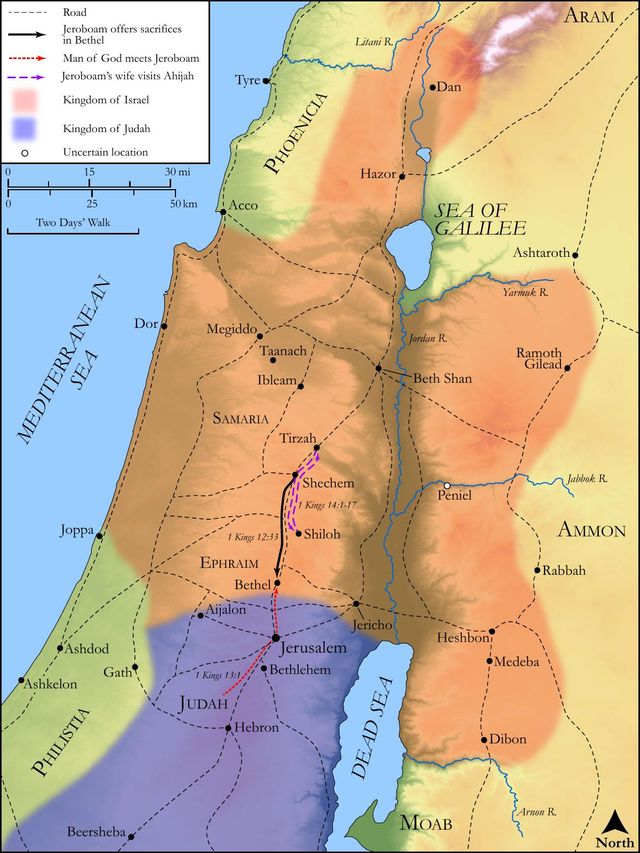
See on the biblical-era maps

Study this verse
Public-domain commentary
Matthew Henry
From his Commentary on the Whole Bible. Henry comments on passages, not single verses — this entry covers 1 Kings 13:23–34. His two-level outline is real structure in the source text, so it is rendered as structure.
Here is, I. The death of the deceived disobedient prophet. The old prophet that had deluded him, as if he would make him some amends for the wrong he had done him or help to prevent the mischief threatened him, furnished him with an ass to ride home on; but by the way a lion set upon him, and killed him, Kg1 13:23, Kg1 13:24. He did but return back to refresh himself when he was hungry, and behold he must die for it; see Sa1 14:43. But we must consider, 1. That his offence was great, and it would by no means justify him that he was drawn into it by a lie; he could not be so certain of the countermand sent by another as he was of the command given to himself, nor had he any ground to think that the command would be recalled, when the reason of it remained in force, which was that he might testify his detestation of the wickedness of that place. He had great reason to suspect the honesty of this old prophet, who did not himself bear his testimony, nor did God think fit to make use of him as a witness against the idolatry of the city he lived in. However, he should have taken time to beg direction from God, and not have complied so soon. Did he think this old prophet's house safer to eat in than other houses at Beth-el, when God had forbidden him to eat in any? That was to refine upon the command, and make himself wiser than God. Did he think to excuse himself that he was hungry? Had he never read that man lives not by bread alone? 2. That his death was for the glory of God; for by this it appeared, (1.) That nothing is more provoking to him than disobedience to an express command, though in a small matter, which makes his proceedings against our first parents, for eating the forbidden fruit, the easier to be accounted for. (2.) That God is displeased at the sins of his own people, and no man shall be protected in disobedience by the sanctity of his profession, the dignity of his office, his nearness to God, or any good services he has done for him. Perhaps God by this intended, in a way of righteous judgment, to harden Jeroboam's heart, since he was not reformed by the withering of his hand; for he would be apt to make a bad use of it, and to say that the prophet was well enough served for meddling with his altar, he had better have staid at home; any, he would say that Providence had punished him for his insolence, and the lion had done that which his withered hand might not do. However, by this God intended to warn all those whom he employs strictly to observe their orders, at their peril.
II.The wonderful preservation of his dead body, which was a token of God's mercy remembered in the midst of wrath.
The lion that gently strangled him, or tore him, did not devour his dead body, nor so much as tear the ass, Kg1 13:24, Kg1 13:25, Kg1 13:26. Nay, what was more, he did not set upon the travellers that passed by and saw it, nor upon the old prophet (who had reason enough to fear it) when he came to take up the corpse. His commission was to kill the prophet; hitherto he should go, but no further. Thus God showed that, though he was angry with him, his anger was turned away, and the punishment went no further than death.
III.The care which the old prophet took of his burial.
When he heard of this unusual accident, he concluded it was the man of God, who was disobedient to his Master (and whose fault was that?), therefore the Lord has delivered him to the lion, Kg1 13:26. It would well have become him to ask why the lion was not sent against him and his house, rather than against the good man whom he had cheated. He took up the corpse, Kg1 13:29. If there by any truth in the vulgar opinion, surely the corpse bled afresh when he touched it, for he was in effect the murderer, and it was but a poor reparation for the injury to inter the dead body. Perhaps when he cheated him into his ruin he intended to laugh at him; yet now his conscience so far relents that he weeps over him, and, like Joab at Abner's funeral, is compelled to be a mourner for him whom he had been the death of. They said, Alas! my brother, Kg1 13:30. The case was indeed very lamentable that so good a man, a prophet so faithful, and so bold in God's cause, should, for one offence, die as a criminal, while an old lying prophet lives at ease and an idolatrous prince in pomp and power. Thy way, O God! is in the sea, and thy path in the great waters. We cannot judge of men by their sufferings, nor of sins by their present punishments; with some the flesh is destroyed that the spirit may be saved, while with others the flesh is pampered that the soul may ripen for hell.
IV.The charge which the old prophet gave his sons concerning his own burial, that they should be sure to bury him in the same grave where the man of God was buried (Kg1 13:3): "Lay my bones beside his bones, close by them, as near as may be, so that my dust may mingle with his." Though he was a lying prophet, yet he desired to die the death of a true prophet. "Gather not my soul with the sinners of Beth-el, but with the man of God." The reason he gives is because what he cried against the altar of Beth-el, that men's bones should be burnt upon it, shall surely come to pass, Kg1 13:32. Thus,
1.He ratifies the prediction, that out of the mouth of two witnesses (and one of them such a one as St. Paul quotes, Tit 1:12, one of themselves, even a prophet of their own) the word might be established, if possible to convince and reclaim Jeroboam.
2.He does honour to the deceased prophet, as one whose word would not fall to the ground, though he did. Ministers die, die prematurely it may be; but the word of the Lord endures for ever, and does not die with them.
3.He consults his own interest. It was foretold that men's bones should be burnt upon Jeroboam's altar: "Lay mine (says he) close to his, and then they will not be disturbed;" and it was, accordingly, their security, as we find, Kg2 23:18. Sleeping and waking, living and dying, it is safe being in good company. No mention is made here of the inscription on the prophet's tomb; but it is spoken of Kg2 23:17, where Josiah asks, What title is that? and is told, It is the sepulchre of the man of God that came from Judah, who proclaimed these things which thou hast done; so that the epitaph upon the prophet's grave preserved the remembrance of his prophecy, and was a standing testimony against the idolatries of Beth-el, which it would not have been so remarkably if he had died and been buried elsewhere. The cities of Israel are here called cities of Samaria, though that name was not yet known; for, however the old prophet spoke, the inspired historian wrote in the language of his own time.
V.The obstinacy of Jeroboam in his idolatry (Kg1 13:33):
He returned not from his evil way; some hand was found that durst repair the altar God had rent, and then Jeroboam offered sacrifice on it again, and the more boldly because the prophet who disturbed him before was in his grave (Rev 11:10) and because the prophecy was for a great while to come. Various methods had been used to reclaim him, but neither threats nor signs, neither judgments nor mercies, wrought upon him, so strangely was he wedded to his calves. He did not reform, no, not his priesthood, but whoever would, he filled his hand, and made him priest, though ever so illiterate or immoral, and of what tribe soever; and this became sin, that is, a snare first, and then a ruin, to Jeroboam's house, to cut if off, Kg1 13:34. Note, The diminution, disquiet, and desolation of families, are the fruit of sin; he promised himself that the calves would secure the crown to his family, but it proved they lost it, and sunk his family. Those betray themselves that think by any sin to support themselves.
Continue studying 1 Kings 13:32 across the web’s major study libraries — every link below opens this exact verse, chapter, or book on the destination site.
Read & Compare
 BibleGatewayThis verse in more than 200 translations and 70 languages.
 Bible.comThe YouVersion reader — hundreds of translations, reading plans, and highlights.
 ESV.orgCrossway's official English Standard Version reader.
 NET BibleThe NET translation with 60,000+ translators' notes on every rendering decision.
 STEP BibleTyndale House's free study tool — original text, vocabulary, and scholarly resources.
 BibliaLogos Bible Software's free web reader.
 USCCBThe New American Bible (Revised Edition) with the U.S. bishops' study notes.
Commentaries
 BibleHub CommentariesDozens of classic commentaries on this verse, gathered on one page.
 StudyLightMore than 100 commentary sets — the largest collection on the web.
 BibleRefPlain-English commentary on what this verse means, verse by verse.
 Enduring WordDavid Guzik's free commentary on this chapter, widely used by Bible teachers.
 Bible Study ToolsVerse commentary alongside Greek and Hebrew study aids.
Original Language & Research
- BibleHub InterlinearThe verse word by word — original language, transliteration, and English.
- BibleHub LexiconEvery word's original-language definition and Strong's entry.
 Blue Letter BibleDeep-study tools — Strong's numbers, concordance, and word studies.
 SefariaThe Hebrew text with Rashi and centuries of Jewish commentary.
Sermons, Hymns & Audio


TrulyRandomVerse is not affiliated with these sites and doesn’t control their content. They’re linked because they’re genuinely useful.
Summary
1 Kings 13:32 serves as a powerful theological affirmation, declaring the absolute certainty of God's prophetic word despite the tragic disobedience and subsequent death of the very messenger who delivered it. This verse, spoken by the old prophet in Bethel, underscores the divine origin and infallible nature of the judgment pronounced against the idolatrous altar in Bethel and all the "high places" in the cities of Samaria, ensuring its future and inevitable fulfillment. It highlights God's unwavering sovereignty and faithfulness to His declared purposes, demonstrating that His word stands immutable, irrespective of human frailty or the passage of time, thereby setting the stage for the eventual eradication of Jeroboam's false worship.
CONTEXT
ShowHideExposition and Analysis
ShowHideKey Word Analysis
ShowHideThis term refers not merely to a spoken sound but to a "word," "matter," or "thing" that has been uttered, emphasizing the concrete reality and substance of the prophetic utterance. It conveys a decree, a command, or a prophetic declaration that carries inherent power and certainty. In this context, it highlights the specific, tangible nature of the judgment pronounced against the altar and high places, indicating a divine pronouncement that is as good as done.
This verb means "to call out to," "to proclaim," or "to cry out." It implies a public, authoritative, and often urgent declaration. The man of God did not merely whisper or suggest; he "cried" the message, indicating a forceful and divinely mandated proclamation designed to be heard and heeded by all, including King Jeroboam. The power of the message is inherent not only in its divine origin but also in its public, authoritative delivery, demanding attention and response.
Comprising H1697 (dâbâr) and H3068 (Yᵉhôvâh), this is a crucial theological phrase, denoting a divine revelation or instruction originating directly from God Himself. It signifies absolute authority, truth, and infallibility. The old prophet's use of this phrase acknowledges that the prophecy's power and certainty do not stem from the human messenger, but from the unchangeable character and sovereign will of Yahweh. It is the divine origin, not the human instrument, that guarantees its fulfillment, making it an immutable decree.
Verse Breakdown
ShowHide"For the saying which he cried by the word of the LORD"
This opening clause immediately establishes the divine origin and absolute authority of the prophecy. The "saying" (the specific judgment against the altar and high places) was not a human idea or opinion but was "cried" (proclaimed publicly and forcefully) "by the word of the LORD," meaning it was a direct, authoritative revelation from God Himself. This phrase underscores that the message's power and certainty derive solely from God, not from the character, faithfulness, or ultimate fate of the human messenger. It emphasizes that the message is God's own decree, delivered through His chosen instrument.
"against the altar in Bethel, and against all the houses of the high places which [are] in the cities of Samaria"
This clause precisely specifies the targets of the divine judgment, indicating the comprehensive nature of God's condemnation of idolatry. The "altar in Bethel" was the primary and most prominent site of Jeroboam's apostasy, a direct affront to God's command for centralized worship in Jerusalem. The inclusion of "all the houses of the high places which are in the cities of Samaria" broadens the scope of the judgment to encompass the entire idolatrous system established and perpetuated in the Northern Kingdom, which would later be known as Samaria. This demonstrates that God's judgment was not limited to a single site but extended to the widespread religious corruption that permeated the land.
"shall surely come to pass"
This concluding phrase is an emphatic declaration of certainty and inevitability. The Hebrew construction often uses an infinitive absolute before the verb for emphasis, conveying an undeniable, immutable fulfillment. Despite the man of God's tragic death, the passage of time, and the continued proliferation of idolatry, the old prophet affirms that the divine word is unchangeable and will be accomplished precisely as declared. This serves as a powerful testament to God's faithfulness to His word and His sovereign control over history, assuring that His purposes will ultimately prevail.
Literary Devices
ShowHideThe passage employs several significant literary devices to enhance its theological message. Foreshadowing is prominently featured, as the prophecy against the altar in Bethel explicitly names Josiah centuries before his birth, creating a powerful anticipation for its future fulfillment. This also serves to demonstrate God's omniscience and sovereign control over the unfolding of history. There is a strong element of Irony woven into the narrative: the man of God, divinely empowered to deliver a powerful message of judgment and miraculous signs, tragically falls victim to disobedience, yet the very prophet who deceived him is the one who ultimately affirms the unwavering truth and certainty of the original divine prophecy. This highlights that God's word is not dependent on the perfection or even the survival of its human instruments. Furthermore, the entire narrative functions as a Parable or Allegory for the reliability of God's word versus the fallibility of human obedience; the divine message endures and will be fulfilled, even if the messenger falters. Finally, the repeated emphasis on "the word of the LORD" functions as a Leitmotif, consistently reinforcing the central theme of divine authority and the absolute certainty of God's pronouncements throughout the chapter, grounding the entire narrative in the unshakeable truth of God's revelation.
Theological and Thematic Connections
ShowHide1 Kings 13:32 powerfully asserts the absolute reliability and enduring nature of God's word. It teaches that divine prophecy is not contingent upon the messenger's faithfulness, longevity, or even his physical well-being, but upon the immutable character of God Himself. The old prophet's solemn declaration, "shall surely come to pass," serves as a theological anchor, assuring readers that God's decrees, whether of blessing or judgment, will inevitably be fulfilled in His perfect timing. This unwavering certainty of davar Yahweh (the word of the LORD) is a foundational truth throughout Scripture, providing both comfort and warning to humanity. It underscores God's sovereignty over history and His unwavering commitment to upholding His covenant and executing His justice against idolatry and disobedience, demonstrating that His purposes cannot be thwarted.
Reflection and Application
ShowHide1 Kings 13:32 offers profound and enduring lessons for contemporary believers. It serves as a powerful reminder that the truth, authority, and power of God's word are not diminished by human imperfection, disobedience, or even outright failure. The message delivered by the man of God remained true and potent, despite his tragic personal downfall and death. This narrative encourages us to trust implicitly in the promises and warnings of Scripture, knowing with certainty that God's plans will unfold precisely as He declares, irrespective of our present circumstances, the actions of others, or any apparent delays in fulfillment. It also challenges us to consider our own stewardship of God's word: while our faithfulness in proclaiming and living out His truth is crucial, the ultimate efficacy and fulfillment of the message rests with God alone. We are called to be obedient, faithful conduits of His truth, but also to find deep assurance in the fact that His sovereign purposes will ultimately prevail. This verse invites us to live with a profound sense of divine certainty, understanding that God's word is the ultimate, unchanging reality upon which we can build our lives, guiding our choices, shaping our expectations for the future, and anchoring our hope in His unfailing character.
Questions for Reflection
ShowHideFAQ
ShowHideWhy did the old prophet, who deceived the man of God, affirm the prophecy's certainty?
ShowHideThe old prophet's affirmation in 1 Kings 13:32, despite his own role in the man of God's demise, highlights a crucial theological point: the truth and power of God's word are independent of the messenger's character or actions. The old prophet, though flawed and disobedient himself, still recognized and respected the divine origin of the message. His statement serves to underscore the absolute certainty of "the word of the LORD" itself, demonstrating that God's purposes will be accomplished regardless of human frailty or even sin. It's a testament to the inherent authority of God's revelation, which stands firm even when its human instruments stumble. This also serves a literary purpose, reinforcing the prophecy's validity to the reader, setting the stage for its eventual fulfillment centuries later by King Josiah.
Christ-Centered Fulfillment
ShowHide1 Kings 13:32, with its emphatic declaration of the certainty of God's prophetic word, finds its ultimate and most profound fulfillment in the person and work of Jesus Christ. Just as the word against the altar in Bethel "shall surely come to pass," so too all of God's prophetic word, from the Old Testament to the New, culminates and is perfectly fulfilled in Jesus. He is the Word made flesh, the very embodiment of God's eternal truth, promises, and redemptive plan. Every prophecy concerning the Messiah, from His miraculous birth in Bethlehem Micah 5:2 to His suffering and atoning death Isaiah 53:5 and His glorious resurrection Psalm 16:10, has "surely come to pass" in Him. Unlike the man of God from Judah, who tragically faltered in obedience, Jesus perfectly obeyed the Father's will, even to the point of death on the cross Philippians 2:8, thereby becoming the faithful and true messenger. He is the ultimate Prophet, Priest, and King whose words are eternal and whose mission perfectly accomplishes God's redemptive plan for humanity. In Christ, the certainty of God's word is not merely a historical fact but a living reality, offering assurance of salvation, the triumph of God's kingdom, and the promise of His return Revelation 22:20.