


1 Kings 13:31
Bible text: King James Version (1769 Blayney text) · Public domain
Bible text: King James Version with Strong's numbers · Public domain
Bible text: Berean Standard Bible · Public domain
Bible text: American Standard Version (1901) · Public domain
Bible text: World English Bible, Messianic edition · Public domain
Bible text: Geneva Bible (1599) · Public domain
Bible text: Young's Literal Translation · Public domain
- וַיְהִיvay·Hiand it wasH1961Conj-w ¦ V-Qal-ConsecImperf-3msVerb Qal Consecutive Imperfect 3rd Singular Masculineוַandיְהִיit was
- אַחֲרֵי'a·cha·ReiafterH310Adj-mpcAdjective Numerical Plural Masculine Construct
- קָבְרוֹka·ve·Rohe buriedH6912V-Qal-Inf ¦ 3msVerb Qal Infinitive Constructקָבְרburiedוֹhe
- אֹתוֹ'o·To<obj.> himH853DirObjM ¦ 3msParticle Object Indicatorאֹת<obj.>וֹhim
- וַיֹּאמֶרvai·Yo·merand he saidH559Conj-w ¦ V-Qal-ConsecImperf-3msVerb Qal Consecutive Imperfect 3rd Singular Masculineוַandיֹּאמֶרhe said
- אֶל'eltoH413PrepPreposition
- בָּנָיוba·Navhis sonsH1121N-mpc ¦ 3msNoun Plural Masculine Constructבָּנָיsonsוhis
- לֵאמֹרle·Mor<to> sayingH559Prep-l ¦ V-Qal-InfVerb Qal Infinitive Constructלֵ<to>אמֹרsaying
- בְּמוֹתִיbe·mo·Tiat my deathH4194Prep-b ¦ N-msc ¦ 1csNoun Singular Masculine Constructבְּatמוֹתִdeathיmy
- וּקְבַרְתֶּםu·ke·var·Temand you will buryH6912Conj-w ¦ V-Qal-ConsecPerf-2mpVerb Qal Consecutive Perfect 2nd Plural Masculineוּandקְבַרְתֶּםyou will bury
- אֹתִי'o·Ti<obj.> meH853DirObjM ¦ 1csParticle Object Indicatorאֹתִ<obj.>יme
- בַּקֶּבֶרba·Ke·verin the graveH6913Prep-b ¦ N-msNoun Singular Masculine Absoluteבַּin theקֶּבֶרgrave
- אֲשֶׁר'a·SherwhichH834RelParticle Relative
- אִישׁ'ish[the] man ofH376N-mscNoun Singular Masculine Construct
- הָאֱלֹהִיםha·'E·lo·Him<the> GodH430Art ¦ N-mpNoun Plural Masculine Absoluteהָ<the>אֱלֹהִיםGod
- קָבוּרka·Vur[is] buriedH6912V-Qal-PassPrtcpl-msVerb Qal Participle Passive Singular Masculine Absolute
- בּוֹboin <the> itPrep-b ¦ 3msSuffix Personal 3rd Singular Masculineבּin <the>וֹit
- אֵצֶל'E·tzelbesideH681N-cscNoun Singular common gender Construct
- עַצְמֹתָיו'atz·mo·Tavhis bonesH6106N-fpc ¦ 3msNoun Plural Feminine Constructעַצְמֹתָיbonesוhis
- הַנִּיחוּha·Ni·chuplaceH5117V-Hiphil-Imp-2mpVerb Hiphil Imperative 2nd Plural Masculine
- אֶת'et<obj.>H853DirObjMParticle Object Indicator
- עַצְמֹתָי'atz·mo·Taimy bonesH6106N-fpc ¦ 1csNoun Plural Feminine Constructעַצְמֹתָbonesיmy
English is a literal word-by-word gloss of the Hebrew, not the KJV's wording. Why?
This is the original text the KJV's translators worked from — each Hebrew word with its own literal English meaning in this verse, prepared by scholars at Tyndale House, Cambridge. The KJV translates whole sentences, not word by word, so its wording differs: one Hebrew word can become several English words, and the KJV may choose “the LORD” where the gloss reads “Yahweh”. Both are faithful — they answer different questions. For the KJV's own rendering, switch to the KJV text.
Details
See on the biblical-era maps
Study this verse
Public-domain commentary
Matthew Henry
From his Commentary on the Whole Bible. Henry comments on passages, not single verses — this entry covers 1 Kings 13:23–34. His two-level outline is real structure in the source text, so it is rendered as structure.
Here is, I. The death of the deceived disobedient prophet. The old prophet that had deluded him, as if he would make him some amends for the wrong he had done him or help to prevent the mischief threatened him, furnished him with an ass to ride home on; but by the way a lion set upon him, and killed him, Kg1 13:23, Kg1 13:24. He did but return back to refresh himself when he was hungry, and behold he must die for it; see Sa1 14:43. But we must consider, 1. That his offence was great, and it would by no means justify him that he was drawn into it by a lie; he could not be so certain of the countermand sent by another as he was of the command given to himself, nor had he any ground to think that the command would be recalled, when the reason of it remained in force, which was that he might testify his detestation of the wickedness of that place. He had great reason to suspect the honesty of this old prophet, who did not himself bear his testimony, nor did God think fit to make use of him as a witness against the idolatry of the city he lived in. However, he should have taken time to beg direction from God, and not have complied so soon. Did he think this old prophet's house safer to eat in than other houses at Beth-el, when God had forbidden him to eat in any? That was to refine upon the command, and make himself wiser than God. Did he think to excuse himself that he was hungry? Had he never read that man lives not by bread alone? 2. That his death was for the glory of God; for by this it appeared, (1.) That nothing is more provoking to him than disobedience to an express command, though in a small matter, which makes his proceedings against our first parents, for eating the forbidden fruit, the easier to be accounted for. (2.) That God is displeased at the sins of his own people, and no man shall be protected in disobedience by the sanctity of his profession, the dignity of his office, his nearness to God, or any good services he has done for him. Perhaps God by this intended, in a way of righteous judgment, to harden Jeroboam's heart, since he was not reformed by the withering of his hand; for he would be apt to make a bad use of it, and to say that the prophet was well enough served for meddling with his altar, he had better have staid at home; any, he would say that Providence had punished him for his insolence, and the lion had done that which his withered hand might not do. However, by this God intended to warn all those whom he employs strictly to observe their orders, at their peril.
II.The wonderful preservation of his dead body, which was a token of God's mercy remembered in the midst of wrath.
The lion that gently strangled him, or tore him, did not devour his dead body, nor so much as tear the ass, Kg1 13:24, Kg1 13:25, Kg1 13:26. Nay, what was more, he did not set upon the travellers that passed by and saw it, nor upon the old prophet (who had reason enough to fear it) when he came to take up the corpse. His commission was to kill the prophet; hitherto he should go, but no further. Thus God showed that, though he was angry with him, his anger was turned away, and the punishment went no further than death.
III.The care which the old prophet took of his burial.
When he heard of this unusual accident, he concluded it was the man of God, who was disobedient to his Master (and whose fault was that?), therefore the Lord has delivered him to the lion, Kg1 13:26. It would well have become him to ask why the lion was not sent against him and his house, rather than against the good man whom he had cheated. He took up the corpse, Kg1 13:29. If there by any truth in the vulgar opinion, surely the corpse bled afresh when he touched it, for he was in effect the murderer, and it was but a poor reparation for the injury to inter the dead body. Perhaps when he cheated him into his ruin he intended to laugh at him; yet now his conscience so far relents that he weeps over him, and, like Joab at Abner's funeral, is compelled to be a mourner for him whom he had been the death of. They said, Alas! my brother, Kg1 13:30. The case was indeed very lamentable that so good a man, a prophet so faithful, and so bold in God's cause, should, for one offence, die as a criminal, while an old lying prophet lives at ease and an idolatrous prince in pomp and power. Thy way, O God! is in the sea, and thy path in the great waters. We cannot judge of men by their sufferings, nor of sins by their present punishments; with some the flesh is destroyed that the spirit may be saved, while with others the flesh is pampered that the soul may ripen for hell.
IV.The charge which the old prophet gave his sons concerning his own burial, that they should be sure to bury him in the same grave where the man of God was buried (Kg1 13:3): "Lay my bones beside his bones, close by them, as near as may be, so that my dust may mingle with his." Though he was a lying prophet, yet he desired to die the death of a true prophet. "Gather not my soul with the sinners of Beth-el, but with the man of God." The reason he gives is because what he cried against the altar of Beth-el, that men's bones should be burnt upon it, shall surely come to pass, Kg1 13:32. Thus,
1.He ratifies the prediction, that out of the mouth of two witnesses (and one of them such a one as St. Paul quotes, Tit 1:12, one of themselves, even a prophet of their own) the word might be established, if possible to convince and reclaim Jeroboam.
2.He does honour to the deceased prophet, as one whose word would not fall to the ground, though he did. Ministers die, die prematurely it may be; but the word of the Lord endures for ever, and does not die with them.
3.He consults his own interest. It was foretold that men's bones should be burnt upon Jeroboam's altar: "Lay mine (says he) close to his, and then they will not be disturbed;" and it was, accordingly, their security, as we find, Kg2 23:18. Sleeping and waking, living and dying, it is safe being in good company. No mention is made here of the inscription on the prophet's tomb; but it is spoken of Kg2 23:17, where Josiah asks, What title is that? and is told, It is the sepulchre of the man of God that came from Judah, who proclaimed these things which thou hast done; so that the epitaph upon the prophet's grave preserved the remembrance of his prophecy, and was a standing testimony against the idolatries of Beth-el, which it would not have been so remarkably if he had died and been buried elsewhere. The cities of Israel are here called cities of Samaria, though that name was not yet known; for, however the old prophet spoke, the inspired historian wrote in the language of his own time.
V.The obstinacy of Jeroboam in his idolatry (Kg1 13:33):
He returned not from his evil way; some hand was found that durst repair the altar God had rent, and then Jeroboam offered sacrifice on it again, and the more boldly because the prophet who disturbed him before was in his grave (Rev 11:10) and because the prophecy was for a great while to come. Various methods had been used to reclaim him, but neither threats nor signs, neither judgments nor mercies, wrought upon him, so strangely was he wedded to his calves. He did not reform, no, not his priesthood, but whoever would, he filled his hand, and made him priest, though ever so illiterate or immoral, and of what tribe soever; and this became sin, that is, a snare first, and then a ruin, to Jeroboam's house, to cut if off, Kg1 13:34. Note, The diminution, disquiet, and desolation of families, are the fruit of sin; he promised himself that the calves would secure the crown to his family, but it proved they lost it, and sunk his family. Those betray themselves that think by any sin to support themselves.
Historical interpretation
Historical reception
2 surviving comments on this verse. Each one is dated, so this reads as a timeline rather than a list.
Select a marker to jump to its quote. Markers stagger vertically where authors wrote within a few decades of each other.
While this old man insists in saying to his sons that he wants them to bury him, their father, in the grave of the prophet Shemaiah and hopes that his bones will find peace, he represents the allegorical type of an ancient Adam who exhorts and even urges his sons to lower him into baptism, which is the grave of the Emmanuel. Through him all those who have been buried with him through baptism certainly hope for peace and life. On the other hand, when this same old man lies and deceives the other prophet, he represents the Jewish people, about whom we read in the psalm: “But they flattered him with their mouths; they lied to him with their tongues.”
Well did the man who had deceived the man of God bury him with honor in his own tomb and give orders that he himself should be buried next to his bones, hoping thus to spare his own bones. He knew that the time would come according to the prophecy of that man of God when Josiah, king of the Jews, would dig up in the land the bones of many dead and with them defile the sacrilegious altars that had been set up for graven images. He spared that tomb where the prophet lay who more than three hundred years before had predicted these things. And because of him the burying place of the man who deceived him was not violated. By that love because of which no one ever hated his own flesh, he provided for his own corpse, while he had slain his soul by deceit. From this fact, then, because each one naturally loves his own flesh, it was punishment for him to learn that he would not be in the tomb of his fathers. So he took care that his bones be spared by burying them next to him whose tomb no one would violate.
Continue studying 1 Kings 13:31 across the web’s major study libraries — every link below opens this exact verse, chapter, or book on the destination site.
Read & Compare
 BibleGatewayThis verse in more than 200 translations and 70 languages.
 Bible.comThe YouVersion reader — hundreds of translations, reading plans, and highlights.
 ESV.orgCrossway's official English Standard Version reader.
 NET BibleThe NET translation with 60,000+ translators' notes on every rendering decision.
 STEP BibleTyndale House's free study tool — original text, vocabulary, and scholarly resources.
 BibliaLogos Bible Software's free web reader.
 USCCBThe New American Bible (Revised Edition) with the U.S. bishops' study notes.
Commentaries
 BibleHub CommentariesDozens of classic commentaries on this verse, gathered on one page.
 StudyLightMore than 100 commentary sets — the largest collection on the web.
 BibleRefPlain-English commentary on what this verse means, verse by verse.
 Enduring WordDavid Guzik's free commentary on this chapter, widely used by Bible teachers.
 Bible Study ToolsVerse commentary alongside Greek and Hebrew study aids.
Original Language & Research
- BibleHub InterlinearThe verse word by word — original language, transliteration, and English.
- BibleHub LexiconEvery word's original-language definition and Strong's entry.
 Blue Letter BibleDeep-study tools — Strong's numbers, concordance, and word studies.
 SefariaThe Hebrew text with Rashi and centuries of Jewish commentary.
Sermons, Hymns & Audio


TrulyRandomVerse is not affiliated with these sites and doesn’t control their content. They’re linked because they’re genuinely useful.
Summary
First Kings 13:31 presents a deeply significant and ethically charged moment following the tragic death of the prophet from Judah, often identified as the "man of God." After retrieving and burying the deceased prophet, the old prophet of Bethel, who had deceptively led the man of God to his fatal disobedience, issues a solemn instruction to his own sons regarding his future burial. This directive reveals a profound, albeit belated, recognition of the man of God's authentic divine commission and a desperate desire for posthumous association with a true messenger of Yahweh, likely driven by an anticipation of the very judgment that the man of God had prophesied.
Context
ShowHideLiterary Context
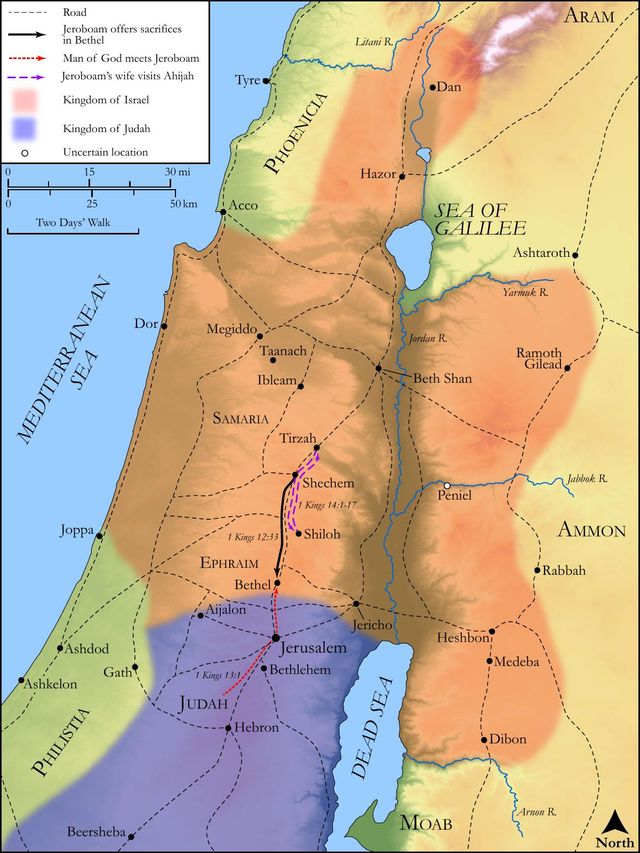
This verse serves as the concluding instruction in the dramatic and tragic narrative of 1 Kings 13. The chapter begins with a "man of God" sent from Judah to Bethel to deliver a prophecy against King Jeroboam's idolatrous altar and practices, specifically foretelling that "bones of men" would be burned upon it by a future king named Josiah (1 Kings 13:1-2). He was given a strict divine command not to eat or drink in Bethel and to return by a different route (1 Kings 13:9). However, an old prophet from Bethel, claiming a new message from an angel, deceptively lured him back, causing him to disobey the explicit word of the Lord. As a direct consequence of this disobedience, the man of God was killed by a lion (1 Kings 13:24). The old prophet, filled with remorse and perhaps a dawning realization of the gravity of his own actions, retrieved the body, mourned him, and buried him in his own sepulchre (1 Kings 13:29-30). Verse 31 directly follows this burial, revealing the old prophet's desperate desire to align himself, even in death, with the authentic prophet of God.
Historical & Cultural Context
The events of 1 Kings 13 unfold in the early days of the divided kingdom, shortly after Jeroboam I established his alternative worship centers in Bethel and Dan to prevent his people from returning to Jerusalem for worship (1 Kings 12:26-33). Bethel, once a sacred site associated with Abraham and Jacob, had tragically become a center of idolatry under Jeroboam, making the man of God's prophecy there particularly significant. Burial customs in ancient Israel placed great importance on family sepulchres and being laid with one's ancestors, signifying continuity and identity. The desire to be buried alongside another, especially a revered figure, indicated a profound identification with that person's legacy or status. The old prophet's request reflects a cultural understanding that one's burial place could signify spiritual or social alignment, and perhaps even offer a measure of protection or hope in the afterlife, particularly in the context of a foretold judgment.
Key Themes
ShowHideThe overarching theme of 1 Kings 13 is the absolute necessity of obedience to God's explicit commands, even for His chosen messengers. The tragic fate of the man of God serves as a stark warning against compromise and deception, highlighting that divine judgment falls even on those who err in seemingly small ways or under duress. Another key theme is the unwavering truth and fulfillment of God's prophetic word, regardless of human failure. Despite the man of God's disobedience and death, the prophecy against Jeroboam's altar and the mention of Josiah's future actions (1 Kings 13:2) remained valid and would eventually be fulfilled (2 Kings 23:15-18). The old prophet's request for burial alongside the man of God underscores a recognition of this prophetic authority and a desperate desire for posthumous association with divine truth, perhaps hoping to escape the coming judgment on Bethel by being identified with a true servant of Yahweh.
Exposition and Analysis
ShowHideKey Word Analysis
ShowHideFrom H376, this word refers to a man as an individual or a male person, often used to denote a specific, significant figure. In the phrase "man of God," it emphasizes the individual chosen by God. The old prophet's consistent use of this title for the prophet from Judah, even after his death and the circumstances leading to it, underscores his recognition of the divine authority behind the prophet's original message, regardless of the prophet's personal failure in obedience.
From H430, this is the plural form of ʼĕlôah, often used to refer to the supreme God, Yahweh, especially with the article. When combined with "man," it creates the title "man of God," signifying someone specially chosen, commissioned, and empowered by God to deliver His message, perform His will, or act as His representative. This title signifies divine authority and close relationship with Yahweh, highlighting the enduring truth of the message despite the messenger's stumble.
From H6913, this refers to a tomb or burial place, often a cave or rock-cut chamber, typically for family or esteemed individuals. In ancient Israel, the place of burial held significant cultural and spiritual weight. Being buried with one's ancestors or with a respected figure implied a connection to their legacy, identity, and destiny. The old prophet's desire to be buried in the same sepulchre as the man of God indicates a profound desire for identification and association, perhaps hoping to partake in the man of God's prophetic legacy or to be spared the judgment prophesied against Bethel and its idolatrous practices.
From H6106, this word refers to a bone, and by extension, the body or the very essence of a person, their enduring identity even after death. The prophecy against Jeroboam's altar specifically mentioned that "bones of men" would be burned upon it (1 Kings 13:2). The old prophet's instruction to "lay my bones beside his bones" is a direct response to this prophecy. He likely understood that the man of God's bones, as those of a true prophet, would be spared during the future fulfillment of the judgment, and he sought protection for his own remains through this association. This reflects a belief in the enduring power and truth of the divine message and a desperate hope for physical preservation in the face of impending judgment.
Verse Breakdown
ShowHide"And it came to pass, after he had buried him,"
This clause establishes the immediate temporal setting, directly following the old prophet's act of burying the man of God, as described in the preceding verses (1 Kings 13:29-30). It sets the stage for the old prophet's subsequent, significant instruction to his sons, indicating that his remorse and reflection on the man of God's fate have led to a decisive action concerning his own future.
"that he spake to his sons, saying,"
This highlights the solemn and intentional nature of the old prophet's instruction. By addressing his sons (H1121, bên), he is issuing a binding command regarding his final resting place, ensuring that his wishes will be carried out after his death (H4191, mûwth). This also emphasizes the intergenerational aspect of the narrative, as the sons are now entrusted with a task directly related to the prophetic events that have just unfolded.
"When I am dead, then bury me in the sepulchre wherein the man of God [is] buried;"
This is the core of the old prophet's command. It reveals his profound desire to be interred in the exact same tomb (H6913, qeber) as the man of God. This is not merely a practical instruction but a symbolic act of identification and association. Despite his own role in the man of God's demise, he seeks to be linked with the prophet's authenticity and divine favor, perhaps hoping to partake in any future protection or blessing associated with the true prophet of Yahweh.
"lay my bones beside his bones:"
This further specifies and reinforces the old prophet's desire for intimate posthumous association. The mention of "bones" (H6106, ʻetsem) is particularly potent given the prophecy in 1 Kings 13:2 that "bones of men" would be burned upon Jeroboam's altar. The old prophet's request to "lay" (H3240, yânach) his bones "beside" (H681, ʼêtsel) the man of God's suggests a deep awareness of this prophecy and a desperate hope that by being physically intertwined with the man of God, his own remains might be spared the desecration foretold for the idolatrous site of Bethel. It underscores his belief in the man of God's prophetic word, even as he grapples with the consequences of his own deceit.
Literary Devices
ShowHideThe narrative of 1 Kings 13:31 employs several potent literary devices. Irony is prominent, as the old prophet, who deceptively led the man of God into disobedience and thus to his death, now seeks to be buried alongside him. This act implicitly acknowledges the man of God's authentic prophetic status and the unwavering truth of his message, despite the tragic circumstances. This reversal of roles—the deceiver now seeking association with the deceived—underscores the profound impact of the man of God's death and prophecy. Foreshadowing is also present, as the old prophet's desire to protect his bones by associating them with the man of God's directly anticipates the future fulfillment of the prophecy by King Josiah. Centuries later, Josiah would indeed desecrate Jeroboam's altar by burning bones upon it, explicitly sparing the bones of the man of God and, by extension, those of the old prophet because they were buried together (2 Kings 23:16-18). Finally, Symbolism is evident in the act of burial itself and the emphasis on "bones." Burial in the same sepulchre symbolizes a desire for spiritual and eschatological alignment, while "bones" represent the enduring identity and legacy of an individual, here hoped to be preserved from judgment through association with divine truth.
Theological and Thematic Connections
ShowHideThe old prophet's request in 1 Kings 13:31 serves as a stark reminder of the enduring power and truth of God's word, even when delivered by a flawed messenger. Despite the man of God's fatal error of disobedience, the old prophet recognized the divine origin of his prophecy concerning Bethel and Jeroboam's altar. His desperate desire for posthumous association underscores a profound, albeit self-serving, belief in the coming judgment and a hope for personal preservation through identification with a true servant of Yahweh. This highlights that God's plan and prophetic declarations will be fulfilled irrespective of human frailty or failure, and that even those who deviate from His path may still acknowledge the authenticity of His message. The narrative ultimately affirms God's sovereignty and the certainty of His word.
Reflection and Application
ShowHideThe poignant request of the old prophet in 1 Kings 13:31 offers profound lessons for believers today. It compels us to consider the gravity of God's word and the absolute necessity of obedience, even when faced with deception or seemingly authoritative counter-claims. The old prophet's belated recognition of the man of God's authenticity, and his desire to be associated with him in death, speaks to the enduring power of truth and the human longing for alignment with what is genuinely divine. It reminds us that while God judges disobedience, His prophetic word remains steadfast and will ultimately be fulfilled. We are called to cultivate a discerning spirit, testing all things against the revealed Word of God, and to live lives of uncompromising faithfulness, trusting that God's purposes will prevail despite human frailty. Our ultimate hope lies not in posthumous association with a righteous person, but in a living, active relationship with the perfectly obedient Son of God, who alone can secure our future and deliver us from judgment.
Questions for Reflection
ShowHideFAQ
ShowHideWhy did the old prophet want to be buried with the man of God?
ShowHideThe old prophet's desire to be buried with the man of God stemmed from a complex mix of remorse, recognition, and self-preservation. He clearly recognized the authenticity of the man of God's divine commission and the truth of his prophecy against Jeroboam's altar (1 Kings 13:2). By requesting to be buried alongside him, the old prophet sought to identify himself with a true servant of Yahweh, perhaps hoping that this association would somehow protect his own bones from the judgment foretold for Bethel, which would involve the desecration of graves (2 Kings 23:16-18). It was a desperate attempt to align himself with divine truth and escape the consequences of his own deceit and the impending judgment on the idolatrous site.
Does the man of God's disobedience negate the truth of his prophecy?
ShowHideNo, the man of God's disobedience and subsequent death did not negate the truth or validity of his prophecy. The narrative of 1 Kings 13 powerfully demonstrates that God's word stands firm and will be fulfilled, regardless of the messenger's personal failings. The old prophet's actions in burying him and desiring to be buried with him underscore his belief in the prophecy's authenticity, even in the face of the prophet's tragic end. Centuries later, King Josiah explicitly fulfilled the prophecy, even sparing the bones of the man of God and the old prophet because they were buried together (2 Kings 23:16-18). This highlights God's sovereignty and the unwavering nature of His divine decrees.
Christ-Centered Fulfillment
ShowHideThe narrative of 1 Kings 13:31, with its themes of divine command, human disobedience, prophetic truth, and the desire for righteous association, finds profound Christ-centered fulfillment. Unlike the man of God who tragically failed in obedience, Jesus Christ perfectly fulfilled every divine command, living a life of absolute submission to the Father's will, even to the point of death on a cross (Philippians 2:8). The old prophet's desperate hope to be spared judgment by being buried with the man of God foreshadows the ultimate hope found in Christ: not a physical association in death, but a spiritual union with the One who conquered death. Through faith in Christ, believers are "buried with him by baptism into death" (Romans 6:4) and raised to new life, sharing in His resurrection and eternal inheritance, thereby escaping the judgment due to sin (Romans 8:1). Jesus is the ultimate "man of God," perfectly representing the Father and delivering His truth without compromise. His bones were not broken (John 19:36), fulfilling prophecy, and His tomb was not a permanent resting place but a temporary stop before His glorious resurrection, offering true and lasting protection from the curse of death for all who are united with Him (1 Corinthians 15:20-22). In Christ, we find not just posthumous association, but a living, transformative relationship that secures our eternal future and ensures our ultimate preservation.