


Matthew 19:8
Bible text: King James Version (1769 Blayney text) · Public domain
Bible text: King James Version with Strong's numbers · Public domain
Bible text: Berean Standard Bible · Public domain
Bible text: American Standard Version (1901) · Public domain
Bible text: World English Bible, Messianic edition · Public domain
Bible text: Geneva Bible (1599) · Public domain
Bible text: Young's Literal Translation · Public domain
- ΛέγειLegeiHe saysG3004V-PAI-3SVerb Present Active Indicative 3rd Singular
- αὐτοῖςautoisto themG846P-DPMPersonal pronoun Dative Plural Masculine
- ὅτιhotithatG3754CONJConjunction
- ΜωϋσῆςMōusēsMosesG3475N-NSM-PNoun Nominative Singular Masculine Individual
- πρὸςprosin view ofG4314PREPPreposition
- τὴνtēntheG3588T-ASFDefinite article Accusative Singular Feminine
- σκληροκαρδίανsklērokardianhardness of heartG4641N-ASFNoun Accusative Singular Feminine
- ὑμῶνhumōnof youG4771P-2GPPersonal pronoun Genitive 2nd Plural
- ἐπέτρεψενepetrepsenallowedG2010V-AAI-3SVerb Aorist Active Indicative 3rd Singular
- ὑμῖνhuminyouG4771P-2DPPersonal pronoun Dative 2nd Plural
- ἀπολῦσαιapolusaito divorceG630V-AANVerb Aorist Active Infinitive
- τὰςtastheG3588T-APFDefinite article Accusative Plural Feminine
- γυναῖκαςgunaikaswivesG1135N-APFNoun Accusative Plural Feminine
- ὑμῶν·humōnof youG4771P-2GPPersonal pronoun Genitive 2nd Plural
- ἀπ᾽ap᾽from [the]G575PREPPreposition
- ἀρχῆςarchēsbeginningG746N-GSFNoun Genitive Singular Feminine
- δὲdehoweverG1161CONJConjunction
- οὐounotG3756PRT-NNegative Particle Negative
- γέγονενgegonenwas [it]G1096V-2RAI-3SVerb 2nd Perfect Active Indicative 3rd Singular
- οὕτωςhoutōsthis wayG3779ADVAdverb
English is a literal word-by-word gloss of the Greek, not the KJV's wording. Why?
This is the original text the KJV's translators worked from — each Greek word with its own literal English meaning in this verse, prepared by scholars at Tyndale House, Cambridge. The KJV translates whole sentences, not word by word, so its wording differs: one Greek word can become several English words, and the KJV may choose “charity” where the gloss reads “love”. Both are faithful — they answer different questions. For the KJV's own rendering, switch to the KJV text.
Details
See on the biblical-era maps
Study this verse
Historical interpretation
Eighteen Centuries of Reception
21 surviving comments on this verse. Each one is dated, so this reads as a timeline rather than a list.
Select a marker to jump to its quote. Markers stagger vertically where authors wrote within a few decades of each other.
"Sir, if any one has a wife who trusts in the Lord, and if he detect her in adultery, does the man sin if he continue to live with her?" And he said to me, "As long as he remains ignorant of her sin, the husband commits no transgression in living with her. But if the husband know that his wife has gone astray, and if the woman does not repent, but persists in her fornication, and yet the husband continues to live with her, he also is guilty of her crime, and a sharer in her adultery." And I said to him, "What then, sir, is the husband to do, if his wife continue in her vicious practices?" And he said, "The husband should put her away, and remain by himself. But if he put his wife away and marry another, he also commits adultery." And I said to him, "What if the woman put away should repent, and wish to return to her husband: shall she not be taken back by her husband?" And he said to me, "Assuredly. If the husband do not take her back, he sins, and brings a great sin upon himself; for he ought to take back the sinner who has repented. But not frequently. For there is but one repentance to the servants of God. In case, therefore, that the divorced wife may repent, the husband ought not to marry another, when his wife has been put away. In this matter man and woman are to be treated exactly in the same way."
Concerning chastity, He uttered such sentiments as these: "Whosoever looketh upon a woman to lust after her, hath committed adultery with her already in his heart before God." And, "If thy right eye offend thee, cut it out; for it is better for thee to enter into the kingdom of heaven with one eye, than, having two eyes, to be cast into everlasting fire." And, "Whosoever shall marry her that is divorced from another husband, committeth adultery." And, "There are some who have been made eunuchs of men, and some who were born eunuchs, and some who have made themselves eunuchs for the kingdom of heaven's sake; but all cannot receive this saying." So that all who, by human law, are twice married, are in the eye of our Master sinners, and those who look upon a woman to lust after her. For not only he who in act commits adultery is rejected by Him, but also he who desires to commit adultery: since not only our works, but also our thoughts, are open before God.
And the voice of the Gospel teaches still more urgently concerning chastity, saying: "Whosoever looks on a woman who is not his own wife, to lust after her, has committed adultery with her already in his heart." [Matthew 5:28] "And he that marries," says [the Gospel], "her that is divorced from her husband, commits adultery; and whosoever puts away his wife, saving for the cause of fornication, causes her to commit adultery." [Matthew 5:32] Because Solomon says: "Can a man take fire in his bosom, and his clothes not be burned? Or can one walk upon hot coals, and his feet not be burned? So he that goes in to a married woman shall not be innocent." [Proverbs 6:27-29]
A person should either remain as he was born, or be content with one marriage; for a second marriage is only a specious adultery. "For whosoever puts away his wife," says He, "and marries another, commits adultery;" [Matthew 19:9] not permitting a man to send her away whose virginity he has brought to an end, nor to marry again. For he who deprives himself of his first wife, even though she be dead, is a cloaked adulterer, resisting the hand of God, because in the beginning God made one man and one woman, and dissolving the strictest union of flesh with flesh, formed for the intercourse of the race.
Concerning the words, "Not all can receive this saying. There are some eunuchs who were born so, and some who were made eunuchs by men, and some who have made themselves eunuchs for the sake of the kingdom of heaven; let him receive it who can receive it," they do not realize the context. After his word about divorce some asked him whether, if that is the position in relation to woman, it is better not to marry; and it was then that the Lord said: "Not all can receive this saying, but those to whom it is granted." What the questioners wanted to know was whether, when a man's wife has been condemned for fornication, it is allowable for him to marry another.
Now that the Scripture counsels marriage, and allows no release from the union, is expressly contained in the law, "Thou shalt not put away thy wife, except for the cause of fornication;" and it regards as fornication, the marriage of those separated while the other is alive. Not to deck and adorn herself beyond what is becoming, renders a wife free of calumnious suspicion, while she devotes herself assiduously to prayers and supplications; avoiding frequent departures from the house, and shutting herself up as far as possible from the view of all not related to her, and deeming housekeeping of more consequence than impertinent trifling. "He that taketh a woman that has been put away," it is said, "committeth adultery; and if one puts away his wife, he makes her an adulteress," that is, compels her to commit adultery. And not only is he who puts her away guilty of this, but he who takes her, by giving to the woman the opportunity of sinning; for did he not take her, she would return to her husband. What, then, is the law? In order to check the impetuosity of the passions, it commands the adulteress to be put to death, on being convicted of this; and if of priestly family, to be committed to the flames. And the adulterer also is stoned to death, but not in the same place, that not even their death may be in common. And the law is not at variance with the Gospel, but agrees with it. How should it be otherwise, one Lord being the author of both? She who has committed fornication liveth in sin, and is dead to the commandments; but she who has repented, being as it were born again by the change in her life, has a regeneration of life; the old harlot being dead, and she who has been regenerated by repentance having come back again to life. The Spirit testifies to what has been said by Ezekiel, declaring, "I desire not the death of the sinner, but that he should turn." Now they are stoned to death; as through hardness of heart dead to the law which they believed not. But in the case of a priestess the punishment is increased, because "to whom much is given, from him shall more be required."
So true, moreover, is it that divorce "was not from the beginning," that among the Romans it is not till after the six hundredth year from the building of the city that this kind of "hard-heartedness" is set down as having been committed.
There, while prohibiting divorce, He has given us a solution of this special question respecting it: "Moses," says He, "because of the hardness of your hearts, suffered you to give a bill of divorcement; but from the beginning it was not so" -for this reason, indeed, because He who had "made them male and female" had likewise said, "They twain shall become one flesh; what therefore God hath joined together, let not man put asunder.
Also He cures the Galileans on the borders of Judæa, that He might admit the sins of the Gentiles to that pardon which was prepared for the Jews.
If a layman divorces his own wife, and takes another, or one divorced by another, let him be suspended.
(Hom. lxii.) The Lord had before left Judæa because of their jealousy, but now He keeps Himself more to it, because His passion was near at hand. Yet does He not go up to Judæa itself, but into the borders of Judæa; whence it is said, And it came to pass when Jesus had ended all these sayings, he departed from Galilee.
It should be also observed, that the Lord is not either ever delivering doctrine, or ever working miracles, but one while does this, and again turns to that; that by His miracles faith might be given to what He said, and by His teaching might be showed the profit of those things which He wrought.
For indeed Christ so healed men, as to do good both to themselves, and through them to many other. For these men's healing was to others the occasion of their knowledge of God; but not to the Pharisees, who were only hardened by the miracles; whence it follows; And the Pharisees came to him, tempting him,, and saying, Is it lawful for a man to put away his wife for every cause?
Observe their wickedness even in the way of putting their question. The Lord had above disputed concerning thus law, but they now ask Him as though He had spoken nothing thereof, supposing He had forgot what He had before delivered in this matter.
But not by the law of creation only, but also by the practice of the law, He shows that they ought to be joined one and one, and never put asunder, And he said, For this cause shall a man leave his father and his mother, and shall cleave to his wife.
See the wisdom of the Teacher. Being asked, Is it lawful, He said not straight, It is not lawful, lest they should be troubled, but establishes it through a proof. For God made them from the beginning male and female, and not merely joined them together, but bade them quit father and mother; and not bade the husband merely approach his wife, but be joined to her, showing by this manner of speaking the inseparable bond. He even added a still closer union, saying, And they twain shall be one flesh.
When He had brought forward the words and facts of the old law, He then interprets it with authority, and lays down a law, saying, Therefore they are no more twain, but one flesh. For as those who love one another spiritually are said to be one soul, And all they that believed had one heart and one soul, (Acts 4:32.) so husband and wife who love each other after the flesh, are said to be one flesh. And as it is a wretched thing to cut the flesh, so is it an unjust thing to put away a wife.
He brings in God yet again, saying, What God has joined, let no man put asunder, showing that it is against both nature and God's law to put away a wife; against nature, because one flesh is therein divided; against law, because God has joined and forbidden to sunder them.
Had the Lord been opposed to the Old Testament, He would not thus have contended in Moses' behalf, nor have gone about to show that what was his was in agreement with the things of old. But the unspeakable wisdom of Christ made answer and excuse for these in this manner, He saith unto them, Moses for the hardness of your hearts suffered you to put away your wives. By this He clears Moses from their charge, and retorts it all upon their own head.
At last, because what He had said was severe, He goes back to the old law, saying, From the beginning it was not so.
Nevertheless, unspeakable wisdom maketh a defense even for these things, and saith, "Moses for the hardness of your hearts" thus made the law. And not even him doth He suffer to remain under accusation, forasmuch as He had Himself given him the law; but delivers him from the charge, and turns the whole upon their head, as everywhere He doth.
For again when they were blaming His disciples for plucking the ears of corn, He shows themselves to be guilty; and when they were laying a transgression to their charge as to their not washing their hands, He shows themselves to be the transgressors, and touching the Sabbath also: both everywhere, and here in like manner.
Then because the saying was hard to bear, and brought on them much blame, He quickly directs back His discourse to that ancient law, saying as He had said before also, "But in the beginning it was not so," that is, God by His acts at the beginning ordained the contrary. For in order that they may not say, Whence is it manifest, that "for our hardness Moses said this?" hereby again He stoppeth their mouths. For if this were the primary law, and for our good, that other would not have been given at the beginning; God in creating would not have so created, He would not have said such things.
(Verse 8.) He said to them: because Moses allowed you to divorce your wives due to the hardness of your hearts, but it was not like that from the beginning. This is what he meant: Can God be opposed to himself, so that he would command one thing before and then nullify his own command with a new one? It should not be understood this way. Rather, Moses, seeing that because of the desire for second wives, who were either richer, younger, or more beautiful, the first wives were being killed or leading a bad life, preferred to tolerate discord rather than continue with hatred and murders (Deut. XXIV). At the same time, consider that God did not allow it because of the hardness of your hearts, but Moses did, so that, according to the Apostle's counsel (1 Corinthians 7), it may be a human choice, not a commandment from God.
That they might have Him as it were between the horns of a syllogism, so that, whatever answer He should make, it would lie open to cavil. Should He allow a wife to be put away for any cause, and the marriage of another, he would seem to contradict Himself as a preacher of chastity. Should He answer that she may not be put away for any cause whatsoever, He will be judged to have spoken impiously, and to make against the teaching of Moses and of God.
But He so frames His answer as to evade their snare. He brings in the testimony of Holy Writ, and the law of nature, and opposing God's first sentence to this second, He answered and said unto them, Have ye not read, that he which made them at the beginning made them male and female? This is written in the beginning of Genesis. This teaches that second marriages are to be avoided, for He said not male and females, which was what was sought by the putting away of the first, but, male and female, implying only one tie of wedlock.
In like manner He says his wife, and not wives, and adds expressly, and they twain shall be one flesh. For it is the reward of marriage that one flesh, namely in the offspring, is made of two.
God has joined by making man and woman one flesh; this then man may not put asunder, but God only. Man puts asunder, when from desire of a second wife the first is put away; God puts asunder, who also had joined, when by consent for the service of God we so have our wives as though we had them not. (1 Cor. 7:29.)
Here they reveal the cavil which they had prepared; albeit the Lord had not given sentence of Himself, but had recalled to their minds ancient history, and the commands of God.
What He says is to this purpose. Is it possible that God should so contradict Himself, as to command one thing at first, and after defeat His own ordinance by a new statute? Think not so; but, whereas Moses saw that through desire of second wives who should be richer, younger, or fairer, that the first were put to death, or treated ill, he chose rather to suffer separation, than the continuance of hatred and assassination. Observe moreover that He said not God suffered you, but, Moses; showing that it was, as the Apostle speaks, a counsel of man, not a command of God. (1 Cor. 7:12.)
(ubi sup.) For how great was that hardness! When not even the intervention of a bill of divorce, which gave room for just and prudent men to endeavour to dissuade, could move them to renew the conjugal affection. And with what wit do the Manichæans blame Moses, as severing wedlock by a bill of divorce, and commend Christ as, on the contrary, confirming its force? Whereas according to their impious science they should have praised Moses for putting asunder what the devil had joined, and found fault with Christ who riveted the bonds of the devil.
PSEUDO-CHRYSOSTOM.e. As the righteous Lord of all, who loves these servants so as not to despise those.
They were conducting Him forth, as the young children of a father going on a far journey. And He setting forth as a father, left them as pledges of His love the healing of their diseases, as it is said, And he healed them.
But, as when you see one much pursuing the acquaintance of physicians, you know that he is sick, so, when you see either man or woman enquiring concerning divorce, know that that man is lustful and that woman unchaste. For chastity has pleasure in wedlock, but desire is tormented as though under a slavish bondage therein. And knowing that they had no sufficient cause to allege for their putting away their wives, save their own lewdness, they feigned many divers causes. They feared to ask Him for what cause, lest they should be tied down within the limits of fixed and certain causes; and therefore they asked if it were lawful for every cause; for they knew that appetite knows no limits, and cannot hold itself within the bounds of one marriage, but the more it is indulged the more it is kindled.
If then God created the male and female out of one, to this end that they should be one, why then henceforth were not they born man and wife at one birth, as it is with certain insects? Because God created male and female for the continuance of the species, yet is He ever a lover of chastity, and promoter of continence. Therefore did He not follow this pattern in all kinds, to the end that, if any man choose to marry, he may know what is, according to the first disposition of the creation, the condition of man and wife; but if he choose not to marry, he shall not be under necessity to marry by the circumstances of his birth, lest he should by his continence be the destruction of the other who was not willing to be continent; for which same cause God forbids that after being joined in wedlock one should separate if the other be unwilling.
If then because the wife is made of the man, and both one of one flesh, a man shall leave his father and his mother, then there should be yet greater affection between brothers and sisters, for these come of the same parents, but man and wife of different. But this is saying too much, because the ordinance of God is of more force than the law of nature. For God's precepts are not subject to the law of nature, but nature bends to the precepts of God. Also brethren are born of one, that they should seek out different roads; but the man and the wife are born of different persons, that they should coalesce in one. The order of nature also follows the appointment of God. For as is the sap in trees, so is affection in man. The sap ascends from the roots into the leaves, and passes forth into the seed. Therefore parents love their children, but are not so loved of them, for the desire of a man is not towards his parents, but towards the sons whom he has begot; and this is what is said, Therefore shall a man leave his father and his mother, and shall cleave unto his wife.
This sentence of chastity seemed hard to these adulterers; but they could not make answer to the argument. Howbeit, they will not submit to the truth, but betake themselves for shelter to Moses, as men having a bad cause fly to some powerful personage, that where justice is not, his countenance may prevail; They say unto him, Why did Moses then command to give a writing of divorcement, and to put her away?
Therefore said He well, Moses suffered, not commanded. For what we command, that we ever wish; but when we suffer, we yield against our will, because we have not the power to put full restraint upon the evil wills of men. He therefore suffered you to do evil that you might not do worse; thus in suffering this he was not enforcing the righteousness of God, but taking away its sinfulness from a sin; that while you did it according to His law, your sin should not appear sin.
The Apostle says that this is a mystery in Christ and the Church (Eph. 5:32.); for the Lord Jesus Christ left His Father when He came down from heaven to earth; and He left His mother, that is, the synagogue, because of its unbelief, and clave unto His wife, that is, the Holy Church, and they two are one flesh, that is, Christ and the Church are one body.
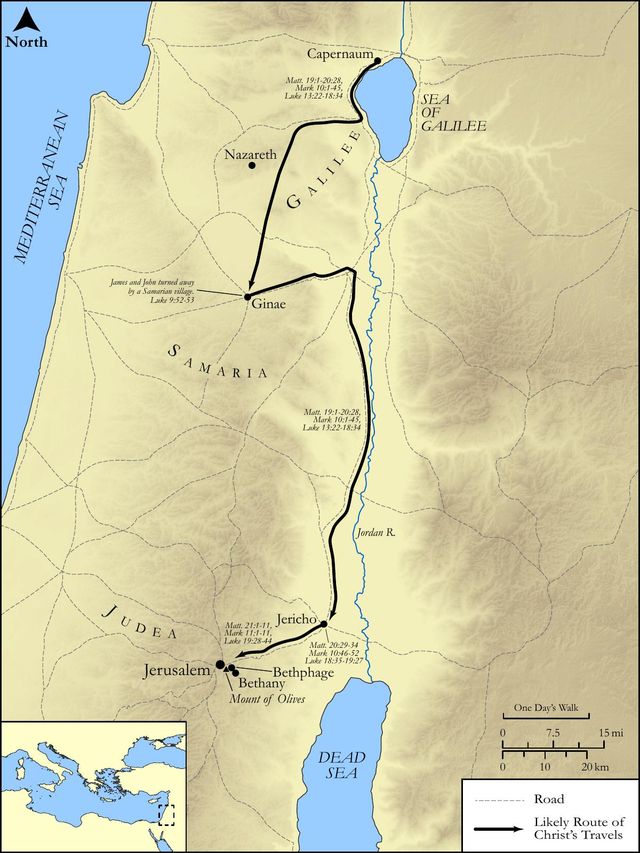
Here then He begins to relate what He did, taught, or suffered in Judæa. At first beyond Jordan eastward, afterwards on this side Jordan when He came to Jericho, Bethphage, and Jerusalem; whence it follows, And He came into the coasts of Judæa beyond Jordan.
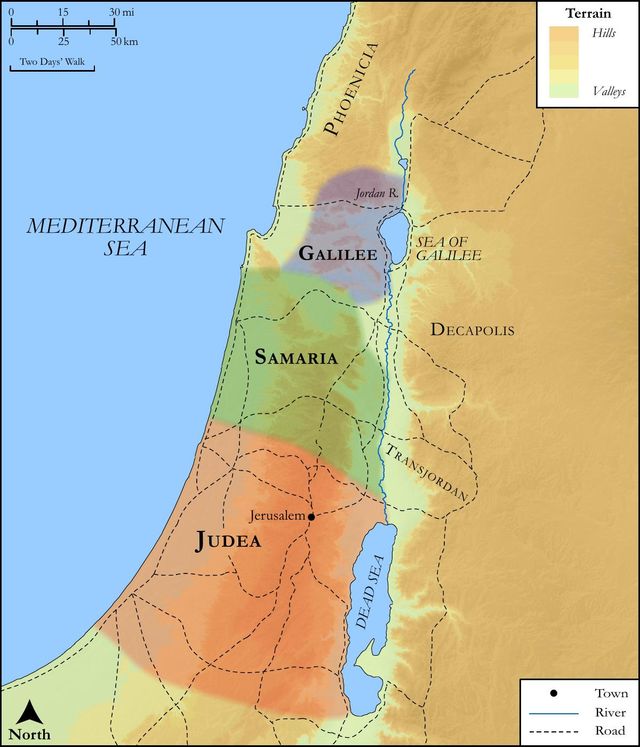
It should be known, that the whole territory of the Israelites was called Judæa, to distinguish it from other nations. But its southern portion, inhabited by the tribes of Judah and Benjamin, was called Judæa proper, to distinguish it from other districts in the same province as Samaria, Galilee, Decapolis, and the rest. It follows, And great multitudes followed him.
For by the wholesome design of God it was ordained that a man should have in the woman a part of his own body, and should not look upon as separate from himself that which he knew was formed out of himself.
(interlin.) Or, one flesh, that is in carnal connection.
Christianity teaches that marriage is for life. There is, of course, a difference here between different Churches: some do not admit divorce at all; some allow it reluctantly in very special cases. It is a great pity that Christians should disagree about such a question; but for an ordinary layman the thing to notice is that the Churches all agree with one another about marriage a great deal more than any of them agrees with the outside world. I mean, they all regard divorce as something like cutting up a living body, as a kind of surgical operation. Some of them think the operation so violent that it cannot be done at all; others admit it as a desparate remedy in extreme cases. They are all agreed that it is more like having both you legs cut off than it is like dissolving a business partnership or even deserting a regiment. What they all disagree with is the modern view that it is a simple readjustment of partners, to be made whenever people feel they are no longer in love with one another, or when either of them falls in love with someone else.
A man's dealings with women can be purely physical (they cannot really, of course: but I mean he can refuse to take other things into account, to the great damage of his soul (and body) and theirs); or 'friendly'; or he can be a 'lover' (engaging and blending all his affections and powers of mind and body in a complex emotion powerfully coloured and energized by 'sex'). This is a fallen world. The dislocation of sex-instinct is one of the chief symptoms of the Fall. The world has been 'going to the bad' all down the ages. The various social forms shift, and each new mode has its special dangers: but the 'hard spirit of concupiscence' has walked down every street, and sat leering in every house, since Adam fell. We will leave aside the 'immoral' results. These you desire not to be dragged into. To renunciation you have no call. 'Friendship' then? In this fallen world the 'friendship' that should be possible between all human beings, is virtually impossible between man and woman. The devil is endlessly ingenious, and sex is his favourite subject. He is as good every bit at catching you through generous romantic or tender motives, as through baser or more animal ones. This 'friendship' has often been tried: one side or the other nearly always fails. Later in life when sex cools down, it may be possible. It may happen between saints. To ordinary folk it can only rarely occur: two minds that have really a primarily mental and spiritual affinity may by accident reside in a male and a female body, and yet may desire and achieve a 'friendship' quite independent of sex. But no one can count on it. The other partner will let him (or her) down, almost certainly, by 'falling in love'. But a young man does not really (as a rule) want 'friendship', even if he says he does. There are plenty of young men (as a rule). He wants love: innocent, and yet irresponsible perhaps. Allas! Allas! that ever love was sinne! as Chaucer says. Then if he is a Christian and is aware that there is such a thing as sin, he wants to know what to do about it.
There is in our Western culture the romantic chivalric tradition still strong, though as a product of Christendom (yet by no means the same as Christian ethics) the times are inimical to it. It idealizes 'love' — and as far as it goes can be very good, since it takes in far more than physical pleasure, and enjoins if not purity, at least fidelity, and so self-denial, 'service', courtesy, honour, and courage. Its weakness is, of course, that it began as an artificial courtly game, a way of enjoying love for its own sake without reference to (and indeed contrary to) matrimony. Its centre was not God, but imaginary Deities, Love and the Lady. It still tends to make the Lady a kind of guiding star or divinity – of the old-fashioned 'his divinity' = the woman he loves – the object or reason of noble conduct. This is, of course, false and at best make-believe. The woman is another fallen human-being with a soul in peril. But combined and harmonized with religion (as long ago it was, producing much of that beautiful devotion to Our Lady that has been God's way of refining so much our gross manly natures and emotions, and also of warming and colouring our hard, bitter, religion) it can be very noble. Then it produces what I suppose is still felt, among those who retain even vestigiary Christianity, to be the highest ideal of love between man and woman. Yet I still think it has dangers. It is not wholly true, and it is not perfectly 'theocentric'. It takes, or at any rate has in the past taken, the young man's eye off women as they are, as companions in shipwreck not guiding stars. (One result is for observation of the actual to make the young man turn cynical.) To forget their desires, needs and temptations. It inculcates exaggerated notions of 'true love', as a fire from without, a permanent exaltation, unrelated to age, childbearing, and plain life, and unrelated to will and purpose. (One result of that is to make young folk look for a 'love' that will keep them always nice and warm in a cold world, without any effort of theirs; and the incurably romantic go on looking even in the squalor of the divorce courts).
Women really have not much part in all this, though they may use the language of romantic love, since it is so entwined in all our idioms. The sexual impulse makes women (naturally when unspoiled more unselfish) very sympathetic and understanding, or specially desirous of being so (or seeming so), and very ready to enter into all the interests, as far as they can, from ties to religion, of the young man they are attracted to. No intent necessarily to deceive: sheer instinct: the servient, helpmeet instinct, generously warmed by desire and young blood. Under this impulse they can in fact often achieve very remarkable insight and understanding, even of things otherwise outside their natural range: for it is their gift to be receptive, stimulated, fertilized (in many other matters than the physical) by the male. Every teacher knows that. How quickly an intelligent woman can be taught, grasp his ideas, see his point – and how (with rare exceptions) they can go no further, when they leave his hand, or when they cease to take a personal interest in him. But this is their natural avenue to love. Before the young woman knows where she is (and while the romantic young man, when he exists, is still sighing) she may actually 'fall in love'. Which for her, an unspoiled natural young woman, means that she wants to become the mother of the young man's children, even if that desire is by no means clear to her or explicit. And then things are going to happen: and they may be very painful and harmful, if things go wrong. Particularly if the young man only wanted a temporary guiding star and divinity (until he hitches his waggon to a brighter one), and was merely enjoying the flattery of sympathy nicely seasoned with a titillation of sex – all quite innocent, of course, and worlds away from 'seduction'.
You may meet in life (as in literature) women who are flighty, or even plain wanton — I don't refer to mere flirtatiousness, the sparring practice for the real combat, but to women who are too silly to take even love seriously, or are actually so depraved as to enjoy 'conquests', or even enjoy the giving of pain – but these are abnormalities, even though false teaching, bad upbringing, and corrupt fashions may encourage them. Much though modern conditions have changed feminine circumstances, and the detail of what is considered propriety, they have not changed natural instinct. A man has a life-work, a career, (and male friends), all of which could (and do where he has any guts) survive the shipwreck of 'love'. A young woman, even one 'economically independent', as they say now (it usually really means economic subservience to male commercial employers instead of to a father or a family), begins to think of the 'bottom drawer' and dream of a home, almost at once. If she really falls in love, the shipwreck may really end on the rocks. Anyway women are in general much less romantic and more practical. Don't be misled by the fact that they are more 'sentimental' in words – freer with 'darling', and all that. They do not want a guiding star. They may idealize a plain young man into a hero; but they don't really need any such glamour either to fall in love or to remain in it. If they have any delusion it is that they can 'reform' men. They will take a rotter open-eyed, and even when the delusion of reforming him fails, go on loving him. They are, of course, much more realistic about the sexual relation. Unless perverted by bad contemporary fashions they do not as a rule talk 'bawdy'; not because they are purer than men (they are not) but because they don't find it funny. I have known those who pretended to, but it is a pretence. It may be intriguing, interesting, absorbing (even a great deal too absorbing) to them: but it is just plumb natural, a serious, obvious interest; where is the joke?
They have, of course, still to be more careful in sexual relations, for all the contraceptives. Mistakes are damaging physically and socially (and matrimonially). But they are instinctively, when uncorrupt, monogamous. Men are not. .... No good pretending. Men just ain't, not by their animal nature. Monogamy (although it has long been fundamental to our inherited ideas) is for us men a piece of 'revealed' ethic, according to faith and not to the flesh. Each of us could healthily beget, in our 30 odd years of full manhood, a few hundred children, and enjoy the process. Brigham Young (I believe) was a healthy and happy man. It is a fallen world, and there is no consonance between our bodies, minds, and souls.
However, the essence of a fallen world is that the best cannot be attained by free enjoyment, or by what is called 'self-realization' (usually a nice name for self-indulgence, wholly inimical to the realization of other selves); but by denial, by suffering. Faithfulness in Christian marriage entails that: great mortification. For a Christian man there is no escape. Marriage may help to sanctify & direct to its proper object his sexual desires; its grace may help him in the struggle; but the struggle remains. It will not satisfy him – as hunger may be kept off by regular meals. It will offer as many difficulties to the purity proper to that state, as it provides easements. No man, however truly he loved his betrothed and bride as a young man, has lived faithful to her as a wife in mind and body without deliberate conscious exercise of the will, without self-denial. Too few are told that — even those brought up 'in the Church'. Those outside seem seldom to have heard it. When the glamour wears off, or merely works a bit thin, they think they have made a mistake, and that the real soulmate is still to find. The real soul-mate too often proves to be the next sexually attractive person that comes along. Someone whom they might indeed very profitably have married, if only —. Hence divorce, to provide the 'if only'. And of course they are as a rule quite right: they did make a mistake. Only a very wise man at the end of his life could make a sound judgement concerning whom, amongst the total possible chances, he ought most profitably to have married! Nearly all marriages, even happy ones, are mistakes: in the sense that almost certainly (in a more perfect world, or even with a little more care in this very imperfect one) both partners might have found more suitable mates. But the 'real soul-mate' is the one you are actually married to. You really do very little choosing: life and circumstance do most of it (though if there is a God these must be His instruments, or His appearances). It is notorious that in fact happy marriages are more common where the 'choosing' by the young persons is even more limited, by parental or family authority, as long as there is a social ethic of plain unromantic responsibility and conjugal fidelity. But even in countries where the romantic tradition has so far affected social arrangements as to make people believe that the choosing of a mate is solely the concern of the young, only the rarest good fortune brings together the man and woman who are really as it were 'destined' for one another, and capable of a very great and splendid love. The idea still dazzles us, catches us by the throat: poems and stories in multitudes have been written on the theme, more, probably, than the total of such loves in real life (yet the greatest of these tales do not tell of the happy marriage of such great lovers, but of their tragic separation; as if even in this sphere the truly great and splendid in this fallen world is more nearly achieved by 'failure' and suffering). In such great inevitable love, often love at first sight, we catch a vision, I suppose, of marriage as it should have been in an unfallen world. In this fallen world we have as our only guides, prudence, wisdom (rare in youth, too late in age), a clean, heart, and fidelity of will.....
My own history is so exceptional, so wrong and imprudent in nearly every point that it makes it difficult to counsel prudence. Yet hard cases make bad law; and exceptional cases are not always good guides for others.
[...]
Out of the darkness of my life, so much frustrated, I put before you the one great thing to love
on earth: the Blessed Sacrament. .... There you will find romance, glory, honour, fidelity, and the
true way of all your loves upon earth, and more than that: Death: by the divine paradox, that which
ends life, and demands the surrender of all, and yet by the taste (or foretaste) of which alone can
what you seek in your earthly relationships (love, faithfulness, joy) be maintained, or take on that
complexion of reality, of eternal endurance, which every man's heart desires.
Continue studying Matthew 19:8 across the web’s major study libraries — every link below opens this exact verse, chapter, or book on the destination site.
Read & Compare
 BibleGatewayThis verse in more than 200 translations and 70 languages.
 Bible.comThe YouVersion reader — hundreds of translations, reading plans, and highlights.
 ESV.orgCrossway's official English Standard Version reader.
 NET BibleThe NET translation with 60,000+ translators' notes on every rendering decision.
 STEP BibleTyndale House's free study tool — original text, vocabulary, and scholarly resources.
 BibliaLogos Bible Software's free web reader.
 USCCBThe New American Bible (Revised Edition) with the U.S. bishops' study notes.
Commentaries
 BibleHub CommentariesDozens of classic commentaries on this verse, gathered on one page.
 StudyLightMore than 100 commentary sets — the largest collection on the web.
 BibleRefPlain-English commentary on what this verse means, verse by verse.
 Enduring WordDavid Guzik's free commentary on this chapter, widely used by Bible teachers.
 Bible Study ToolsVerse commentary alongside Greek and Hebrew study aids.
Original Language & Research
- BibleHub InterlinearThe verse word by word — original language, transliteration, and English.
- BibleHub LexiconEvery word's original-language definition and Strong's entry.
 Blue Letter BibleDeep-study tools — Strong's numbers, concordance, and word studies.
 CNTR CollationThe earliest Greek manuscripts of this verse, collated letter by letter.
Sermons, Hymns & Audio


TrulyRandomVerse is not affiliated with these sites and doesn’t control their content. They’re linked because they’re genuinely useful.
Summary
Jesus profoundly clarifies the divine intent for marriage, explaining to the Pharisees that Moses' allowance for divorce was a concession, not an original command, granted solely "because of the hardness of your hearts." This pivotal statement reveals God's eternal standard for marriage as a lifelong, indissoluble union, contrasting it sharply with the human sinfulness that necessitated temporary legal provisions within the Mosaic Law.
Context
ShowHideLiterary Context
This verse is central to Jesus' discourse with the Pharisees on the controversial topic of divorce. The discussion begins in Matthew 19:3, where the Pharisees attempt to test Jesus by asking if it is lawful for a man to divorce his wife for any reason. Jesus initially redirects their focus to God's original creation design, quoting from Genesis 1:27 and Genesis 2:24, emphasizing the "one flesh" union and God's intention that "what therefore God hath joined together, let not man put asunder" (Matthew 19:6). When the Pharisees then challenge Him, citing Moses' permission for a certificate of divorce (Matthew 19:7), Jesus delivers the decisive explanation found in Matthew 19:8, distinguishing between divine ideal and human concession. The disciples' subsequent reaction and further questioning in Matthew 19:10-12 underscore the radical nature of Jesus' teaching.
Historical & Cultural Context
In Jesus' time, divorce was a common practice in Jewish society, often initiated by the husband. There were two dominant rabbinic schools of thought regarding the grounds for divorce, based on interpretations of Deuteronomy 24:1. The School of Shammai held a stricter view, allowing divorce only for sexual immorality ("some uncleanness"), while the School of Hillel adopted a much more lenient stance, permitting divorce for virtually any reason that displeased the husband, even trivial matters like burning a meal. This legal and cultural backdrop highlights the significance of Jesus' teaching, as He bypasses these contemporary debates by appealing directly to the foundational principles of creation, thereby challenging the prevailing norms and interpretations that had diluted God's original intent for marriage. The Mosaic provision was primarily a protective measure for women in a patriarchal society, ensuring a legal document for remarriage and preventing greater social or economic destitution.
Key Themes
ShowHideThis verse powerfully contributes to several overarching themes within the Gospels and the broader biblical narrative. Firstly, it highlights God's Original Design for Marriage, emphasizing its sacred, covenantal nature as instituted at creation, a theme foundational to understanding human relationships and divine order. Secondly, it underscores the pervasive impact of Human Sinfulness and Fallenness, specifically manifested as "hardness of heart," which obstructs humanity's ability to live according to God's perfect will. This concept of spiritual insensitivity is crucial for understanding why certain concessions were made in the Mosaic Law. Lastly, the verse illuminates the distinction between Divine Ideal and Legal Concession, demonstrating that not all biblical allowances represent God's ultimate desire but rather His compassionate accommodation to fallen humanity's limitations, while still pointing towards a higher standard. Jesus' teaching here elevates the discussion from mere legalism to the profound theological principles governing human relationships under God.
Exposition and Analysis
ShowHideKey Word Analysis
ShowHideThis verb, stemming from a root meaning "to turn over" or "transfer," signifies to "allow," "permit," or "give leave." Jesus' use of "suffered" (or "permitted") is crucial because it indicates that Moses' provision for divorce was not a divine command or endorsement, but rather a concession or allowance. It implies a reluctant permission, granted due to circumstances, rather than an active institution or approval of divorce as God's ideal. This highlights the distinction between a divine mandate and a legal regulation designed to manage the consequences of human sin.
This compound noun literally means "hard-heartedness" (from sklēros "hard" and kardía "heart"). In biblical theology, "hardness of heart" refers to a spiritual insensitivity, stubbornness, and an unwillingness to respond to God's truth, will, or grace. It signifies a state of spiritual rebellion or resistance, where individuals are unwilling to humble themselves and obey divine principles. Jesus identifies this human condition—this recalcitrance and lack of compassion—as the underlying reason Moses permitted divorce, not because divorce was good, but because people's hearts were so hardened that a legal provision was necessary to prevent even greater societal evils or injustices.
This noun refers to a "commencement," "origin," or "first estate." By stating "from the beginning it was not so," Jesus directly appeals to the primordial state of creation as described in Genesis 1 and Genesis 2. This phrase establishes God's original, perfect design for marriage as a permanent, exclusive, and indissoluble union, predating the fall and any subsequent legal concessions. It sets the divine ideal as the ultimate standard, against which the Mosaic allowance is seen as a temporary deviation necessitated by human sin, rather than a reflection of God's perfect will.
Verse Breakdown
ShowHide"He saith unto them"
This phrase establishes Jesus' authoritative voice and direct response to the Pharisees' challenge. He is not merely offering an opinion but declaring divine truth.
"Moses because of the hardness of your hearts suffered you to put away your wives"
This clause identifies the specific reason for the Mosaic allowance of divorce. It was not a divine command but a permission (suffered) granted by Moses, not due to God's preference for divorce, but as an accommodation to the deep-seated spiritual insensitivity and stubbornness (hardness of your hearts) of the people. This "hardness" led to abuses and injustices within marriage, necessitating a legal framework to regulate an already existing problem and protect the vulnerable, particularly women.
"but from the beginning it was not so"
This powerful contrasting statement immediately shifts the focus from the Mosaic concession back to God's original, perfect design for marriage. "From the beginning" refers to the creation account, where God instituted marriage as a lifelong, "one flesh" union between a man and a woman, intended to be indissoluble. This highlights that divorce was never part of God's ideal plan for humanity, serving as a clear theological distinction between God's perfect will and the temporary provisions made for a fallen world.
Literary Devices
ShowHideThe verse primarily employs Contrast and Metaphor. The stark Contrast is evident in Jesus' juxtaposition of "Moses because of the hardness of your hearts suffered you to put away your wives" with "but from the beginning it was not so." This highlights the tension between a temporary, human-necessitated allowance and God's eternal, perfect design. The phrase "hardness of your hearts" functions as a powerful Metaphor for spiritual insensitivity, stubbornness, and an unwillingness to conform to God's perfect will. It is not a literal physical hardening but a spiritual condition that resists divine truth and love, leading to relational breakdown. This metaphorical language effectively conveys the deep-seated human sinfulness that necessitated the Mosaic concession.
Theological and Thematic Connections
ShowHideMatthew 19:8 serves as a profound theological statement on the nature of marriage and the impact of sin. Jesus re-establishes God's original, pre-Fall design for marriage as a permanent, covenantal union, moving beyond the legalistic debates of His day. He reveals that the Mosaic allowance for divorce was not an endorsement of divorce itself, but a compassionate regulation for a fallen humanity whose "hardness of heart" made living up to God's ideal difficult, if not impossible, without divine intervention. This highlights the tension between God's perfect will and His gracious accommodation to human brokenness, while simultaneously calling humanity back to the higher standard. The verse underscores that sin, particularly the stubborn refusal to love and forgive, is the root cause of marital breakdown, not a flaw in God's design.
Reflection and Application
ShowHideMatthew 19:8 challenges us to look beyond mere legalistic interpretations of marriage and divorce and to grasp God's profound, beautiful ideal for this sacred union. While acknowledging the painful reality of human brokenness and the devastating effects of sin, Jesus calls us to cultivate "soft hearts"—hearts that are receptive to God's will, quick to forgive, and committed to sacrificial love. For those in marriage, this means striving to embody the "one flesh" union, prioritizing reconciliation, seeking grace to overcome personal failings, and resisting the "hardness of heart" that leads to relational decay. For all believers, it's a call to uphold the sanctity of marriage within the church and society, praying for and supporting those who struggle, and recognizing that God's grace is sufficient to transform even the most hardened hearts, enabling us to live closer to His perfect design. This verse encourages us not to settle for concessions but to pursue the divine ideal with God's help.
Questions for Reflection
ShowHideFAQ
ShowHideDid Moses contradict God's will by allowing divorce?
ShowHideNo, Moses did not contradict God's will. As Jesus explains in Matthew 19:8, the Mosaic provision for a certificate of divorce (Deuteronomy 24:1) was not a divine command or an endorsement of divorce as God's ideal. Instead, it was a concession, a legal allowance ("suffered you to put away your wives"), made "because of the hardness of your hearts." This means it was a regulation of an existing practice that arose from human sinfulness, designed to manage its consequences and provide some protection, particularly for the divorced woman, rather than to promote divorce itself. God's original and perfect will for marriage, as established "from the beginning" (Genesis 2:24), was a lifelong, indissoluble union.
Does "hardness of heart" justify or excuse divorce today?
ShowHideNo, Jesus' statement in Matthew 19:8 does not justify or excuse divorce today. Rather, it identifies the reason for Moses' allowance in a fallen world. Jesus' teaching elevates the standard back to God's original design, implying that "hardness of heart" is a sinful condition that Christians are called to overcome, not to embrace as a justification for breaking covenant. While acknowledging the reality of sin and its devastating effects on relationships, Jesus' message is a call to repentance, forgiveness, and a renewed commitment to God's ideal for marriage. The New Testament, particularly in passages like Ephesians 4:32 and Colossians 3:13, consistently calls believers to cultivate soft, forgiving hearts, reflecting the character of Christ.
Christ-Centered Fulfillment
ShowHideMatthew 19:8 finds its ultimate fulfillment in the person and work of Jesus Christ. While Jesus unequivocally declares God's original, perfect design for marriage, He also confronts the "hardness of heart" which is the root cause of its breakdown. This hardness is a manifestation of humanity's fallen nature, a spiritual insensitivity to God's will. Christ's redemptive work on the cross directly addresses this deep-seated sin. Through His sacrifice, He provides the means for a new heart, as promised in the New Covenant (Ezekiel 36:26). The Holy Spirit, given to believers, empowers them to overcome the "hardness of heart" and live according to God's perfect will, including in their marriages. Furthermore, marriage itself becomes a profound picture of Christ's covenantal relationship with His Church (Ephesians 5:25-32), where His sacrificial love, forgiveness, and unwavering commitment serve as the divine model for husbands and wives. Thus, Jesus not only articulates the divine ideal but also provides the spiritual resources necessary for humanity to strive towards that ideal, transforming hearts and enabling relationships to reflect the glory of God.