


Mark 10:5
- ΚαὶKaiandG2532CONJConjunction
- ἀποκριθεὶςapokritheisansweringG611V-AOP-NSMVerb Aorist Passive Deponent Participle Nominative Singular Masculine
- ὁho<the>G3588T-NSMDefinite article Nominative Singular Masculine
- ἸησοῦςIēsousJesusG2424N-NSM-PNoun Nominative Singular Masculine Individual
- εἶπενeipensaidG2036V-2AAI-3SVerb 2nd Aorist Active Indicative 3rd Singular
- αὐτοῖς·autoisto themG846P-DPMPersonal pronoun Dative Plural Masculine
- πρὸςprosBecause ofG4314PREPPreposition
- τὴνtēntheG3588T-ASFDefinite article Accusative Singular Feminine
- σκληροκαρδίανsklērokardianhardness of heartG4641N-ASFNoun Accusative Singular Feminine
- ὑμῶνhumōnof youG4771P-2GPPersonal pronoun Genitive 2nd Plural
- ἔγραψενegrapsenHe wroteG1125V-2AAI-3SVerb 2nd Aorist Active Indicative 3rd Singular
- ὑμῖνhuminfor youG4771P-2DPPersonal pronoun Dative 2nd Plural
- τὴνtēn<the>G3588T-ASFDefinite article Accusative Singular Feminine
- ἐντολὴνentolēncommandmentG1785N-ASFNoun Accusative Singular Feminine
- ταύτην·tautēnthisG3778D-ASFDemonstrative pronoun Accusative Singular Feminine
English is a literal word-by-word gloss of the Greek, not the KJV's wording. Why?
This is the original text the KJV's translators worked from — each Greek word with its own literal English meaning in this verse, prepared by scholars at Tyndale House, Cambridge. The KJV translates whole sentences, not word by word, so its wording differs: one Greek word can become several English words, and the KJV may choose “charity” where the gloss reads “love”. Both are faithful — they answer different questions. For the KJV's own rendering, switch to the KJV text.
Details
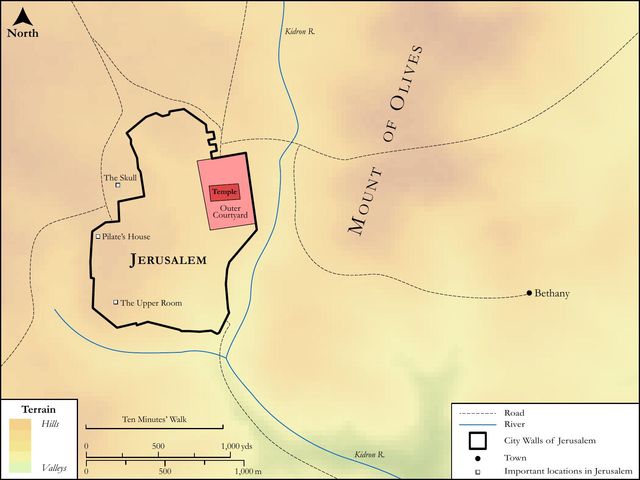
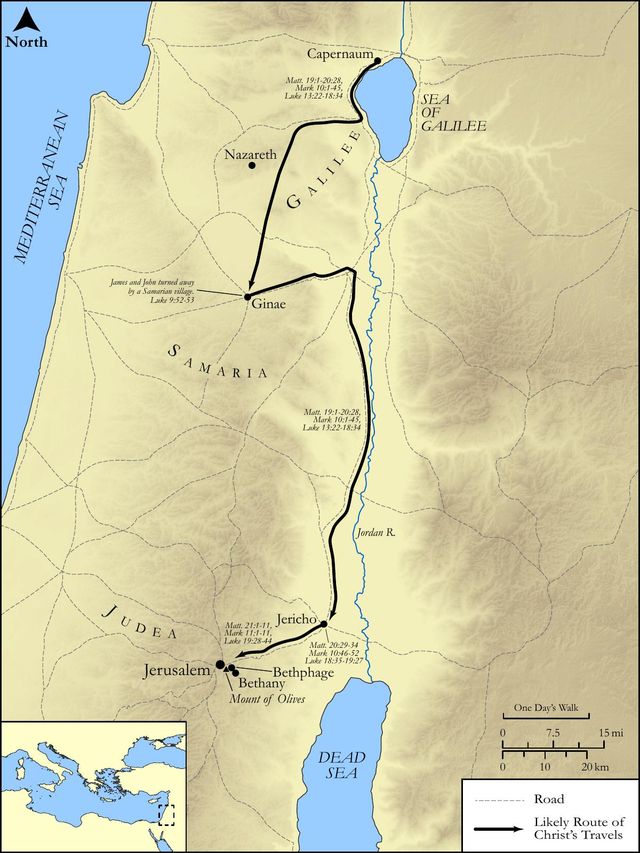
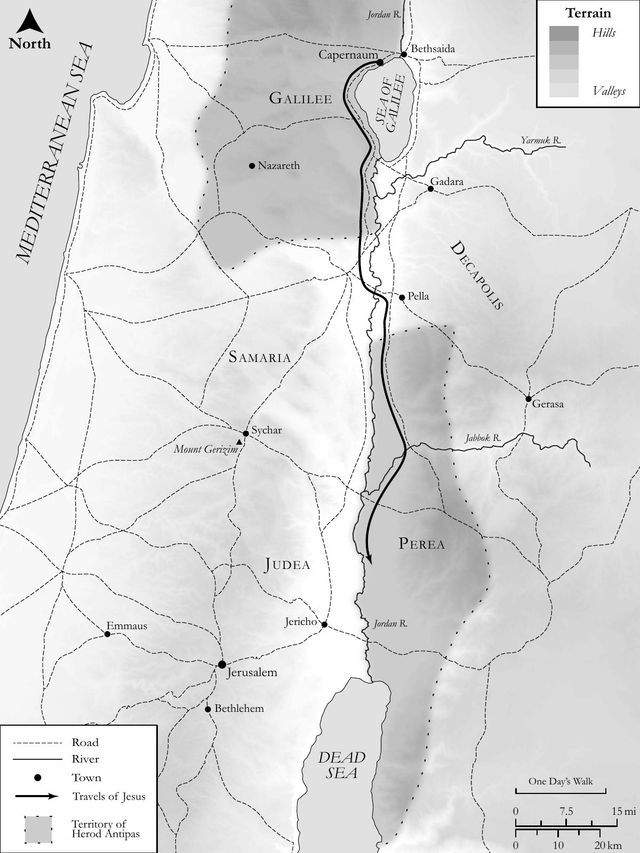
See on the biblical-era maps
Study this verse
Public-domain commentary
Matthew Henry
From his Commentary on the Whole Bible. Henry comments on passages, not single verses — this entry covers Mark 10:1–12. His three-level outline is real structure in the source text, so it is rendered as structure.
Our Lord Jesus was an itinerant Preacher, did not continue long in a place, for the whole land of Canaan was his parish, or diocese, and therefore he would visit every part of it, and give instructions to those in the remotest corners of it. Here we have him in the coasts of Judea, by the further side of Jordan eastward, as we found him, not long since, in the utmost borders westward, near Tyre and Sidon. Thus was his circuit like that of the sun, from whose light and heat nothing is hid. Now here we have him,
I.Resorted to by the people, Mar 10:1.
Wherever he was, they flocked after him in crowds; they came to him again, as they had done when he had formerly been in these parts, and, as he was wont, he taught them again. Note, Preaching was Christ's constant practice; it was what he was used to, and, wherever he came, he did as he was wont. In Matthew it is said, He healed them; here it is said, He taught them: his cures were to confirm his doctrine, and to recommend it, and his doctrine was to explain his cures, and illustrate them. He taught them again. Note, Even those whom Christ hath taught, have need to be taught again. Such is the fulness of the Christian doctrine, that there is still more to be learned; and such our forgetfulness, that we need to be reminded of what we do know.
II.We have him disputed with by the Pharisees, who envied the progress of his spiritual arms, and did all they could to obstruct and oppose it; to divert him, to perplex him, and to prejudice the people against him.
Here is, 1. A question they started concerning divorce (Mar 10:2); Is it lawful for a man to put away his wife? This was a good question, if it had been well put, and with a humble desire to know the mind of God in this matter; but they proposed it, tempting him, seeking an occasion against him, and an opportunity to expose him, which side soever he should take of the question. Ministers must stand upon their guard, lest, under pretence of being advised with, they be ensnared.
2.Christ's reply to them with a question (Mar 10:3); What did Moses command you? This he asked them, to testify his respect to the law of Moses, and to show that he came not to destroy it; and to engage them to a universal impartial respect for Moses's writings and to compare one part of them with another.
3.The fair account they gave of what they found in the law of Moses, expressly concerning divorce, Mar 10:4. Christ asked, What did Moses command you? They own that Moses only suffered, or permitted, a man to write his wife a bill of divorce, and to put her away, Deu 24:1. "If you will do it, you must do it in writing, delivered into her own hand, and so put her away, and never return to her again."
4.The answer that Christ gave to their question, in which he abides by the doctrine he had formerly laid down in this case (Mat 5:32), That whosoever puts away his wife, except for fornication, causeth her to commit adultery. And to clear this he here shows,
(1.)That the reason why Moses, in his law, permitted divorce, was such, as that they ought not to make use of that permission; for it was only for the hardness of their hearts (Mar 10:5), lest, if they were not permitted to divorce their wives, they should murder them; so that none must put away their wives but such as are willing to own that their hearts were so hard as to need this permission.
(2.)That the account which Moses, in this history, gives of the institution of marriage, affords such a reason against divorce, as amounts to a prohibition of it. So that if the question be, What did Moses command? (Mar 10:3), it must be answered, "Though by a temporary proviso he allowed divorce to the Jews, yet by an eternal reason he forbade it to all the children of Adam and Eve, and that is it which we must abide by."
Moses tells us, [1.] That God made man male and female, one male, and one female; so that Adam could not put away his wife and take another, for there was no other to take, which was an intimation to all his sons, that they must not. [2.] When this male and this female were, by the ordinance of God, joined together in holy marriage, the law was, That a man must leave his father and mother, and cleave to his wife (Mar 10:7); which intimates not only the nearness of the relation, but the perpetuity of it; he shall so cleave to his wife as not to be separated from her. [3.] The result of the relation is, That, though they are two, yet they are one, they are one flesh, Mar 10:8. The union between them is the most intimate that can be, and, as Dr. Hammond expresses it, a sacred thing that must not be violated. [4.] God himself was joined them together; he has not only, as Creator, fitted them to be comforts and helps meet for each other, but he has, in wisdom and goodness, appointed them who are thus joined together, to live together in love till death parts them. Marriage is not an invention of men, but a divine institution, and therefore is to be religiously observed, and the more, because it is a figure of the mystical inseparable union between Christ and his church.
Now from all this he infers, that men ought not to put their wives asunder from them, whom God has put so near them. The bond which God himself has tied, is not to be lightly untied. They who are divorcing their wives for every offence, would do well to consider what would become of them, if God should in like manner deal with them. See Isa 50:1; Jer 3:1.
5.Christ's discourse with his disciples, in private, about this matter, Mar 10:10-12. It was an advantage to them, that they had opportunity of personal converse with Christ, not only about gospel mysteries, but about moral duties, for further satisfaction. No more is here related of this private conference, that the law Christ laid down in this case - That it is adultery for a man to put away his wife, and marry another; it is adultery against the wife he puts away, it is a wrong to her, a breach of his contract with her, Mar 10:11. He adds, If a woman shall put away her husband, that is, elope from him, leave him by consent, and be married to another, she commits adultery (Mar 10:12), and it will be no excuse at all for her to say that it was with the consent of her husband. Wisdom and grace, holiness and love, reigning in the heart, will make those commands easy which to the carnal mind may be as a heavy yoke.
Historical interpretation
Eleven Centuries of Reception
10 surviving comments on this verse. Each one is dated, so this reads as a timeline rather than a list.
Select a marker to jump to its quote. Markers stagger vertically where authors wrote within a few decades of each other.
This second question is said to be asked again by the Apostles, because it is on the subject of which the Pharisees had asked Him, that is, concerning the state of marriage; and this is said by Mark in his own person.
So true, moreover, is it that divorce "was not from the beginning," that among the Romans it is not till after the six hundredth year from the building of the city that this kind of "hard-heartedness" is set down as having been committed.
"Whence it is impossible without His teaching to attain to saving truth, though one seek it for ever where the thing that is sought is not. But it was, and is, in the word of our Jesus. Accordingly, He, knowing the true things of the law, said to the Sadducees, asking on what account Moses permitted to marry seven, 'Moses gave you commandments according to your hard-heartedness; for from the beginning it was not so: for He who created man at first, made him male and female.' "
(Vict. Ant. e Cat. in Marc. et v. Chrys. Hom. 62) For being asked, whether it is lawful, he does not immediately reply, it is not lawful, lest they should raise an outcry, but He first wished them to answer Him as to the sentence of the law, that they by their answer might furnish Him with what it was right to say. Wherefore it goes on, And he answered and said unto them, What did Moses command you? And afterwards, And they said, Moses suffered to write a bill of divorcement, and to put her away. They put forward indeed this that Moses had said either on account of the question of our Saviour, or wishing to excite against Him a multitude of men. For divorce was an indifferent thing among the Jews, and all practised it, as though it were permitted by the law.
(ubi sup.) If however he had wished one wife to be put away and another to be brought in, He would have created several women. Nor did God only join one woman to one man, but He also bade a man quit his parents and cleave to his wife. Wherefore it goes on: And he said, (that is, God said by Adam,) For this cause shall a man leave his father and mother, and cleave to his wife. From the very mode of speech, showing the impossibility of severing marriage, because He said, He shall cleave.
(ubi sup.) Being framed out of one root, they will join into one body. It goes on: So then they are no more twain, but one flesh.
(ubi sup.) After this, bringing forward an awful argument, He said not, do not divide, but He concluded, What therefore God hath joined together, let not man put asunder.
(non occ.) But if two persons, whom God has joined together, are not to be separated; much more is it wrong to separate from Christ, the Church, which God has joined to Him.
(cont. Faust. xix. 26) Moses, however, was against a man's dismissing his wife, for he interposed this delay, that a person whose mind was bent on separation, might be deterred by the writing of the bill, and desist; particularly, since, as is related, among the Hebrews, no one was allowed to write Hebrew characters but the scribes. The law therefore wished to send him, whom it ordered to give a bill of divorcement, before he dismissed his wife, to them, who ought to be wise interpreters of the law, and just opponents of quarrel. For a bill could only be written for him by men, who by their good advice might overrule him, since his circumstances and necessity had put him into their hands, and so by treating between him and his wife they might persuade them to love and concord. But if a hatred so great had arisen that it could not be extinguished and corrected, then indeed a bill was to be written, that he might not lightly put away her who was the object of his hate, in such a way as to prevent his being recalled to the love, which he owed her by marriage, through the persuasion of the wise. For this reason it is added, For the hardness of your heart, he wrote this precept; for great was the hardness of heart which could not be melted or bent to the taking back and recalling the love of marriage, even by the interposition of a bill in a way which gave room for the just and wise to dissuade them.
(Cat. in Marc. Oxon.) Or else, it is said, For the hardness of your hearts, because it is possible for a soul purged from desires and from anger to bear the worst of women; but if those passions have a redoubled force over the mind, many evils will arise from hatred in marriage. (Chrys. ubi sup.). Thus then, He saves Moses, who had given the law, from their accusation, and turns the whole upon their head. But since what He had said was grievous to them, He at once brings back the discourse to the old law, saying, But from the beginning of the creation, God made them male and female.
(Vict. Ant. e Cat. in Marc.) The Lord calls by the name of adultery cohabitation with her who is not a man's wife; she is not, however, a wife, whom a man has taken to him, after quitting his first; and for this reason he commits adultery upon her, that is, upon the second, whom he brings in. And the same thing is true in the case of the woman; wherefore it goes on, And if a woman shall put away her husband, and marry another, she committeth adultery; for she cannot be joined to another as her own husband, if she leave him who is really her own husband. The law indeed forbade what was plainly adultery; but the Saviour forbids this, which was neither plain, nor known to all, though it was contrary to nature.
(Vict. Ant. e Cat. in Marc.) There is no contrariety in Matthew's relating that He spoke these words to the Pharisees, though Mark says that they were spoken to the disciples; for it is possible that He may have spoken them to both.
"What," he said, "did Moses command you?" They replied, "Moses permitted a man to write a certificate of divorce and send her away." To which Jesus responded, "It was because of the hardness of your hearts that he wrote you this, etc." What he says is this: Can God be contrary to himself, commanding one thing at first and then breaking his own decree with a new command? It should not be thought so. But Moses, when he saw that due to the desire for subsequent wives, who might be wealthier, younger, or more beautiful, the first wives were either being killed or leading a miserable life, chose to allow discord rather than for hatred and murders to continue and be perpetrated. At the same time, notice that he did not say, because of the hardness of your hearts, God permitted you, but Moses; that, according to the Apostle, it may be seen as the counsel of a man, not a command of God.
(in Marc. 3, 40) Up to this time Mark hath related what our Lord said and did in Galilee; here he begins to relate what He did, taught, or suffered in Judæa, and first indeed across the Jordan on the east; and this is what is said in these words: And he arose from thence, and cometh into the coasts of Jadœa, by the farther side of Jordan; then also on this side Jordan, when He came to Jericho, Bethany, and Jerusalem. And though all the province of the Jews is generally called Judæa, to distinguish it from other nations, more especially, however, its southern portion was called Judæa, to distinguish it from Samaria, Galilee, Decapolis, and the other regions in the same province.
(ubi sup.) Mark the difference of temper in the multitude and in the Pharisees. The former meet together, in order to be taught, and that their sick may be healed, as Matthew relates; the latter come to Him, to try to deceive their Saviour by tempting Him. Wherefore there follows, And the Pharisees came to him, and asked him, Is it lawful for a man to put away his wife? tempting Him. (Matt. 19:2)
(ubi sup.) He says not male and females, which the sense would have required had it referred to the divorce of former wives, but male and female, so that they might be bound by the tie of one wife.
(ubi sup.) And in like manner, because He says, he shall cleave to his wife, not wives. It goes on: And they twain shall be one flesh.
(ubi sup.) The reward then of marriage is of two to become one flesh. Virginity being joined to the Spirit, becomes of one spirit.
(ubi sup.) What therefore God hath conjoined by making one flesh of a man and a woman, that man cannot separate, but God alone. Man separates, when we dismiss the first wife because we desire a second; but it is God who separates, when by common consent, for the sake of serving God, we so have wives as though we had none.n
(ubi sup.) In Matthew it is more fully expressed, Whosoever shall put away his wife, except it be for fornication. (Matt. 19:9.) The only carnal cause then is fornication; the only spiritual cause is the fear of God, that a man should put away his wife to enter into religiono, as we read that many have done. But there is no cause allowed by the law of God for marrying another, during the lifetime of her who is quitted.
But He enters the region of Judæa, which the envy of the Jews had often caused Him to leave, because His Passion was to take place there. He did not, however, then go up to Jerusalem, but to the confines of Judæa, that He might do good to the multitudes, who were not evil; for Jerusalem was, from the malice of the Jews, the worker of all the wickedness. Wherefore it goes on: And the people resort unto him again, and, as he was wont, he taught them again.
They come to Him indeed, and do not quit Him, lest the multitudes should believe on Him; and by continually coming to Him, they thought to bring Him into difficulty, and to confuse Him by their questions. For they proposed to Him a question, which had on either side a precipice, so that whether He said that it was lawful for a man to put away his wife, or that it was not lawful, they might accuse Him, and contradict what He said, out of the doctrines of Moses. Christ, therefore, being Very Wisdom, in answering their question, avoids their snares.
But the disciples were offended, as not being fully satisfied with what had been said; for this reason they again question Him, wherefore there follows, And in the house, his disciples asked him again of the same matter.
(non occ.) For a repetition of a saying of the Word, produces not weariness, but thirst and hunger; (Ecclus. 24:29) wherefore it is said, They that eat me shall yet be hungry, and they that drink me shall yet be thirsty; for the tasting of the honied words of wisdom yields all manner of savour to them who love her. Wherefore the Lord instructs His disciples over again; for it goes on, And he saith unto them, Whosoever shall put away his wife and marry another, committeth adultery upon her.
Continue studying Mark 10:5 across the web’s major study libraries — every link below opens this exact verse, chapter, or book on the destination site.
Read & Compare
 BibleGatewayThis verse in more than 200 translations and 70 languages.
 Bible.comThe YouVersion reader — hundreds of translations, reading plans, and highlights.
 ESV.orgCrossway's official English Standard Version reader.
 NET BibleThe NET translation with 60,000+ translators' notes on every rendering decision.
 STEP BibleTyndale House's free study tool — original text, vocabulary, and scholarly resources.
 BibliaLogos Bible Software's free web reader.
 USCCBThe New American Bible (Revised Edition) with the U.S. bishops' study notes.
Commentaries
 BibleHub CommentariesDozens of classic commentaries on this verse, gathered on one page.
 StudyLightMore than 100 commentary sets — the largest collection on the web.
 BibleRefPlain-English commentary on what this verse means, verse by verse.
 Enduring WordDavid Guzik's free commentary on this chapter, widely used by Bible teachers.
 Bible Study ToolsVerse commentary alongside Greek and Hebrew study aids.
Original Language & Research
- BibleHub InterlinearThe verse word by word — original language, transliteration, and English.
- BibleHub LexiconEvery word's original-language definition and Strong's entry.
 Blue Letter BibleDeep-study tools — Strong's numbers, concordance, and word studies.
 CNTR CollationThe earliest Greek manuscripts of this verse, collated letter by letter.
Sermons, Hymns & Audio


TrulyRandomVerse is not affiliated with these sites and doesn’t control their content. They’re linked because they’re genuinely useful.
Summary
In Mark 10:5, Jesus directly confronts the Pharisees' legalistic interpretation of divorce by revealing the underlying reason for Moses's concession: the stubborn and unyielding nature of the human heart. Far from endorsing divorce, Jesus clarifies that the Mosaic allowance for a bill of divorcement was a practical accommodation to human sinfulness, not a reflection of God's original, perfect design for marriage as an indissoluble union established at creation.
Context
ShowHideLiterary Context
This verse is central to Jesus's teaching on marriage and divorce, following immediately after the Pharisees' attempt to trap Him with a question about the lawfulness of divorce (Mark 10:2). They appeal to the Mosaic law in Deuteronomy 24:1-4, which permitted a man to write a certificate of divorce. Jesus's response in Mark 10:3-9 systematically dismantles their premise, moving the discussion from legalistic loopholes back to the foundational principles of creation. Verse 5 serves as the pivot, explaining why Moses gave this precept, setting the stage for Jesus to reassert God's original intent for marriage.
Historical & Cultural Context
In first-century Judaism, divorce was a common practice, though its grounds were debated, particularly between the schools of Hillel (liberal, allowing divorce for almost any reason) and Shammai (conservative, allowing divorce only for sexual immorality). The Pharisees' question to Jesus was likely an attempt to align Him with one school or the other, or to provoke Him into contradicting Moses, thereby undermining His authority. Moses's allowance for a bill of divorcement (Deuteronomy 24:1) was intended to protect women from arbitrary dismissal and to regulate a practice that already existed, preventing greater injustices rather than endorsing divorce as God's ideal. Jesus's teaching transcends these contemporary debates by appealing to a higher authority: God's original design.
Key Themes
ShowHideThe passage in Mark 10 powerfully articulates several core themes. First, it highlights the Divine Intent vs. Human Concession, emphasizing that God's perfect will, as seen in Genesis 1:27 and Genesis 2:24, stands in stark contrast to human compromises. Second, the concept of the Hardness of Heart (sklērokardía) is central, revealing humanity's persistent rebellion and resistance to God's perfect standards, a theme echoed in Matthew 19:8. Third, Jesus underscores the Sanctity and Indissolubility of Marriage, elevating it as a sacred covenant established by God, intended for lifelong union, and reflecting the divine order. This teaching sets a high standard for discipleship and kingdom living, challenging believers to align their lives with God's ultimate design, not merely legal minimums.
Exposition and Analysis
ShowHideKey Word Analysis
ShowHideFeminine of a compound of σκληρός (sklēros, "hard") and καρδία (kardia, "heart"). This term signifies "hard-heartedness," specifically denoting a destitution of spiritual perception or a stubborn, unyielding disposition. In this context, it refers to a spiritual insensitivity and resistance to God's will, making people unwilling to uphold the covenantal demands of marriage. It implies a lack of compassion, faithfulness, and receptivity to divine truth.
A primary verb meaning "to grave," especially to write; figuratively, to describe. Here, it refers to Moses's act of inscribing or documenting the precept concerning a bill of divorcement. Jesus acknowledges Moses's authorship but immediately qualifies its intent, distinguishing it from God's original, pre-fall design for marriage.
From ἐντέλλομαι (entellomai, "to command"). This noun refers to an injunction or an authoritative prescription. In this verse, it specifically denotes the Mosaic command or allowance regarding divorce. Jesus's use of "precept" acknowledges the legal standing of Moses's instruction but positions it as a practical regulation given for a specific human condition, rather than an eternal, immutable divine ideal for marriage.
Verse Breakdown
ShowHide"And Jesus answered and said unto them,"
This clause sets the scene for Jesus's authoritative response to the Pharisees' question about the lawfulness of divorce. It signals a direct, decisive, and divinely-inspired clarification, moving beyond mere legal debate to reveal deeper theological truth. Jesus is not just offering an opinion; He is speaking with the authority of God.
"For the hardness of your heart"
This is the pivotal phrase, providing the divine rationale for Moses's allowance. "Hardness of heart" (Greek: sklērokardía) denotes a spiritual insensitivity, stubbornness, and unwillingness to submit to God's perfect will. It implies a lack of spiritual perception, compassion, and faithfulness that made it impossible for people to live up to the ideal of lifelong, indissoluble marriage. Moses's precept was a concession to this fallen human condition, a regulation for a sinful reality, not an endorsement of divorce as God's design.
"he wrote you this precept."
This final clause identifies Moses as the author of the "precept" (Greek: entolḗ), referring to the law allowing a bill of divorcement. Jesus confirms that Moses indeed gave this instruction, but critically links it directly to the "hardness of your heart." This connection recontextualizes the Mosaic law, showing it as a temporary, remedial measure given because of human sin, rather than an expression of God's original, perfect will for marriage.
Literary Devices
ShowHideJesus's statement in Mark 10:5 employs several powerful literary devices. The primary device is Causality, explicitly stating that Moses "wrote you this precept" for ("πρὸς," G4314) the "hardness of your heart." This establishes a direct cause-and-effect relationship, revealing the underlying reason for the Mosaic allowance. This stands in stark Contrast to the Pharisees' legalistic focus on the permissibility of divorce, shifting the discussion from legal technicalities to the moral and spiritual condition of humanity. There is also an element of Rhetorical Reframing, as Jesus takes the Pharisees' question about the law and reinterprets it through a divine lens, moving from the letter of the law to the spirit and original intent. This reframing challenges their assumptions and exposes their spiritual blindness.
Theological and Thematic Connections
ShowHideJesus's teaching in Mark 10:5 profoundly reorients the understanding of divine law and human sinfulness. It reveals that while God's ultimate will is perfect and unchanging, His law sometimes includes provisions that accommodate human fallenness, not as an endorsement of sin, but as a means of mitigating its worst effects or guiding a rebellious people. The "hardness of heart" is a recurring biblical theme representing humanity's resistance to God's truth and love, necessitating a divine intervention to restore spiritual sensitivity. This verse underscores the sanctity of marriage as a divine institution, intended by God from creation to be an indissoluble union, a reflection of His own faithfulness.
Reflection and Application
ShowHideJesus's words in Mark 10:5 serve as a timeless challenge to all who seek to live according to God's will. They compel us to look beyond the surface of legalistic interpretations and delve into the heart of God's perfect design. Instead of searching for loopholes or minimum requirements, we are called to strive for God's highest ideal in all relationships, especially marriage. The warning against "hardness of heart" is particularly poignant; it urges us to cultivate a spirit of humility, teachability, and compassion, readily submitting to God's word rather than allowing our own desires or stubbornness to dictate our actions. This verse reminds us that true spiritual maturity involves a willingness to repent, to embrace God's grace not as an excuse for sin, but as empowering us to live in renewed commitment to His righteous standards. It is a call to align our hearts with His, seeking transformation rather than mere compliance.
Questions for Reflection
ShowHideFAQ
ShowHideWhat does "hardness of your heart" truly mean in this context?
ShowHide"Hardness of your heart" (Greek: sklērokardía) refers to a spiritual insensitivity, stubbornness, and unwillingness to submit to God's perfect will. It signifies a lack of spiritual perception, compassion, and faithfulness. In the context of marriage, it means people were unwilling to uphold the lifelong covenant, leading to practices like arbitrary divorce. Moses's allowance was a concession to this rebellious human condition, not an endorsement of divorce as God's ideal. This concept is also found in Matthew 19:8, where Jesus reiterates this point.
Did Moses's law contradict God's original intent for marriage?
ShowHideNo, Moses's law did not contradict God's original intent, but it regulated a practice that arose due to human sin. Jesus clarifies that Moses's precept regarding a bill of divorcement (Deuteronomy 24:1) was a concession made "for the hardness of your heart," not a reflection of God's perfect design. God's original intent, as established in Genesis 2:24, was for marriage to be a permanent, indissoluble union between one man and one woman. Moses's law served to mitigate the negative consequences of divorce in a fallen society, providing a measure of protection, particularly for women, rather than promoting divorce itself.
Christ-Centered Fulfillment
ShowHideMark 10:5, while seemingly a statement about Mosaic law and human sin, deeply points to Christ. Jesus, as the perfect interpreter of the Law, reveals its true spirit and God's original intent, contrasting it with human compromise. He is not merely explaining an Old Testament precept but demonstrating His divine authority to unveil God's heart. The "hardness of heart" that necessitated Moses's concession is precisely the human condition that Jesus came to redeem. Through His atoning work on the cross, Christ provides the means for a new heart, as prophesied in Ezekiel 36:26, where God promises to remove the "heart of stone" and give a "heart of flesh." Jesus Himself perfectly embodied the faithful, covenant-keeping spouse, demonstrating unwavering commitment to His Father's will and His bride, the Church (Ephesians 5:25-27). His teaching here, therefore, is not just about marriage, but about the transformative power of the Kingdom of God, where hearts are softened by grace, enabling believers to live in alignment with God's perfect, original design, a life made possible only through union with Him (John 15:5).