


Matthew 19:3
Bible text: King James Version (1769 Blayney text) · Public domain
Bible text: King James Version with Strong's numbers · Public domain
Bible text: Berean Standard Bible · Public domain
Bible text: American Standard Version (1901) · Public domain
Bible text: World English Bible, Messianic edition · Public domain
Bible text: Geneva Bible (1599) · Public domain
Bible text: Young's Literal Translation · Public domain
- καὶkaiAndG2532CONJConjunction
- προσῆλθονprosēlthoncameG4334V-2AAI-3PVerb 2nd Aorist Active Indicative 3rd Plural
- αὐτῷautōto HimG846P-DSMPersonal pronoun Dative Singular Masculine
- οἱhoi<the>G3588T-NPMDefinite article Nominative Plural Masculine
- ΦαρισαῖοιPharisaioiPhariseesG5330N-NPM-TNoun Nominative Plural Masculine Title
- πειράζοντεςpeirazontestestingG3985V-PAP-NPMVerb Present Active Participle Nominative Plural Masculine
- αὐτὸνautonHimG846P-ASMPersonal pronoun Accusative Singular Masculine
- καὶkaiandG2532CONJConjunction
- λέγοντεςlegontessayingG3004V-PAP-NPMVerb Present Active Participle Nominative Plural Masculine
- αὐτῷ·autōto himG846P-DSMPersonal pronoun Dative Singular Masculine
- εἰeiIfG1487CONDConjunction
- ἔξεστινexestinis it lawfulG1832V-PAI-3SVerb Present Active Indicative 3rd Singular
- ἀνθρώπῳanthrōpōfor a manG444N-DSMNoun Dative Singular Masculine
- ἀπολῦσαιapolusaito divorceG630V-AANVerb Aorist Active Infinitive
- τὴνtēntheG3588T-ASFDefinite article Accusative Singular Feminine
- γυναῖκαgunaikaa wifeG1135N-ASFNoun Accusative Singular Feminine
- αὐτοῦautouof himG846P-GSMPersonal pronoun Genitive Singular Masculine
- κατὰkataforG2596PREPPreposition
- πᾶσανpasaneveryG3956A-ASFAdjective Accusative Singular Feminine
- αἰτίαν;aitiancause?G156N-ASFNoun Accusative Singular Feminine
English is a literal word-by-word gloss of the Greek, not the KJV's wording. Why?
This is the original text the KJV's translators worked from — each Greek word with its own literal English meaning in this verse, prepared by scholars at Tyndale House, Cambridge. The KJV translates whole sentences, not word by word, so its wording differs: one Greek word can become several English words, and the KJV may choose “charity” where the gloss reads “love”. Both are faithful — they answer different questions. For the KJV's own rendering, switch to the KJV text.
Details
See on the biblical-era maps
Study this verse
Historical interpretation
Eighteen Centuries of Reception
19 surviving comments on this verse. Each one is dated, so this reads as a timeline rather than a list.
Select a marker to jump to its quote. Markers stagger vertically where authors wrote within a few decades of each other.
"Sir, if any one has a wife who trusts in the Lord, and if he detect her in adultery, does the man sin if he continue to live with her?" And he said to me, "As long as he remains ignorant of her sin, the husband commits no transgression in living with her. But if the husband know that his wife has gone astray, and if the woman does not repent, but persists in her fornication, and yet the husband continues to live with her, he also is guilty of her crime, and a sharer in her adultery." And I said to him, "What then, sir, is the husband to do, if his wife continue in her vicious practices?" And he said, "The husband should put her away, and remain by himself. But if he put his wife away and marry another, he also commits adultery." And I said to him, "What if the woman put away should repent, and wish to return to her husband: shall she not be taken back by her husband?" And he said to me, "Assuredly. If the husband do not take her back, he sins, and brings a great sin upon himself; for he ought to take back the sinner who has repented. But not frequently. For there is but one repentance to the servants of God. In case, therefore, that the divorced wife may repent, the husband ought not to marry another, when his wife has been put away. In this matter man and woman are to be treated exactly in the same way."
Concerning chastity, He uttered such sentiments as these: "Whosoever looketh upon a woman to lust after her, hath committed adultery with her already in his heart before God." And, "If thy right eye offend thee, cut it out; for it is better for thee to enter into the kingdom of heaven with one eye, than, having two eyes, to be cast into everlasting fire." And, "Whosoever shall marry her that is divorced from another husband, committeth adultery." And, "There are some who have been made eunuchs of men, and some who were born eunuchs, and some who have made themselves eunuchs for the kingdom of heaven's sake; but all cannot receive this saying." So that all who, by human law, are twice married, are in the eye of our Master sinners, and those who look upon a woman to lust after her. For not only he who in act commits adultery is rejected by Him, but also he who desires to commit adultery: since not only our works, but also our thoughts, are open before God.
And the voice of the Gospel teaches still more urgently concerning chastity, saying: "Whosoever looks on a woman who is not his own wife, to lust after her, has committed adultery with her already in his heart." [Matthew 5:28] "And he that marries," says [the Gospel], "her that is divorced from her husband, commits adultery; and whosoever puts away his wife, saving for the cause of fornication, causes her to commit adultery." [Matthew 5:32] Because Solomon says: "Can a man take fire in his bosom, and his clothes not be burned? Or can one walk upon hot coals, and his feet not be burned? So he that goes in to a married woman shall not be innocent." [Proverbs 6:27-29]
A person should either remain as he was born, or be content with one marriage; for a second marriage is only a specious adultery. "For whosoever puts away his wife," says He, "and marries another, commits adultery;" [Matthew 19:9] not permitting a man to send her away whose virginity he has brought to an end, nor to marry again. For he who deprives himself of his first wife, even though she be dead, is a cloaked adulterer, resisting the hand of God, because in the beginning God made one man and one woman, and dissolving the strictest union of flesh with flesh, formed for the intercourse of the race.
Concerning the words, "Not all can receive this saying. There are some eunuchs who were born so, and some who were made eunuchs by men, and some who have made themselves eunuchs for the sake of the kingdom of heaven; let him receive it who can receive it," they do not realize the context. After his word about divorce some asked him whether, if that is the position in relation to woman, it is better not to marry; and it was then that the Lord said: "Not all can receive this saying, but those to whom it is granted." What the questioners wanted to know was whether, when a man's wife has been condemned for fornication, it is allowable for him to marry another.
Now that the Scripture counsels marriage, and allows no release from the union, is expressly contained in the law, "Thou shalt not put away thy wife, except for the cause of fornication;" and it regards as fornication, the marriage of those separated while the other is alive. Not to deck and adorn herself beyond what is becoming, renders a wife free of calumnious suspicion, while she devotes herself assiduously to prayers and supplications; avoiding frequent departures from the house, and shutting herself up as far as possible from the view of all not related to her, and deeming housekeeping of more consequence than impertinent trifling. "He that taketh a woman that has been put away," it is said, "committeth adultery; and if one puts away his wife, he makes her an adulteress," that is, compels her to commit adultery. And not only is he who puts her away guilty of this, but he who takes her, by giving to the woman the opportunity of sinning; for did he not take her, she would return to her husband. What, then, is the law? In order to check the impetuosity of the passions, it commands the adulteress to be put to death, on being convicted of this; and if of priestly family, to be committed to the flames. And the adulterer also is stoned to death, but not in the same place, that not even their death may be in common. And the law is not at variance with the Gospel, but agrees with it. How should it be otherwise, one Lord being the author of both? She who has committed fornication liveth in sin, and is dead to the commandments; but she who has repented, being as it were born again by the change in her life, has a regeneration of life; the old harlot being dead, and she who has been regenerated by repentance having come back again to life. The Spirit testifies to what has been said by Ezekiel, declaring, "I desire not the death of the sinner, but that he should turn." Now they are stoned to death; as through hardness of heart dead to the law which they believed not. But in the case of a priestess the punishment is increased, because "to whom much is given, from him shall more be required."
But grant that these argumentations may be thought to be forced and founded on conjectures, if no dogmatic teachings have stood parallel with them which the Lord uttered in treating of divorce, which, permitted formerly, He now prohibits, first because "from the beginning it was not so," like plurality of marriage; secondly, because "What God hath conjoined, man shall not separate," -for fear, namely, that he contravene the Lord: for He alone shall "separate" who has "conjoined" (separate, moreover, not through the harshness of divorce, which (harshness) He censures and restrains, but through the debt of death) if, indeed, "one of two sparrows falleth not on the ground without the Father's will.
Seeing the Lord thus tempted, let none of His disciples who is set to teach think it hard if he also be by some tempted. Howbeit, He replies to His tempters with the doctrines of piety.
Also He cures the Galileans on the borders of Judæa, that He might admit the sins of the Gentiles to that pardon which was prepared for the Jews.
If a layman divorces his own wife, and takes another, or one divorced by another, let him be suspended.
But not so to the Pharisees, but even for this self-same thing they become more fierce, and come unto Him tempting Him. For because they could not lay hold of the works that were doing, they propose to Him questions.
O folly! They thought to silence Him by their questions, although they had already received certain proof of this power in Him. When at least they argued much about the Sabbath, when they said, "He blasphemeth," when they said, "He hath a devil," when they found fault with His disciples as they were walking in the corn fields, when they argued about unwashen hands, on every occasion having sewed fast their mouths, and shut up their shameless tongue, He thus sent them away. Nevertheless, not even so do they keep off from Him. For such is wickedness, such is envy, shameless and bold; though it be put to silence ten thousand times, ten thousand times doth it assault again.
But mark thou, I pray thee, their craft also from the form of their question. For neither did they say unto Him, Thou didst command not to put away a wife, for indeed He had already discoursed about this law; but nevertheless they made no mention of those words; but took occasion from hence, and thinking to make their snare the greater, and being minded to drive Him to a necessity of contradicting the law, they say not, why didst Thou enact this or that? but as though nothing had been said, they ask, "Is it lawful?" expecting that He had forgotten having said it; and being ready if on the one hand He said, "It is lawful to put away," to bring against Him the things He Himself had spoken, and to say, How then didst Thou affirm the contrary? but if the same things now again as before, to bring against Him the words of Moses.
What then said He? He said not, "tempt ye me, ye hypocrites?" although afterwards He saith this, but here He speaks not thus. Why can this be? In order that together with His power He might show forth His gentleness also. For He doth neither always keep silence, lest they should suppose they are hidden; nor doth He always reprove, in order that He may instruct us to bear all things with gentleness.
(Hom. lxii.) The Lord had before left Judæa because of their jealousy, but now He keeps Himself more to it, because His passion was near at hand. Yet does He not go up to Judæa itself, but into the borders of Judæa; whence it is said, And it came to pass when Jesus had ended all these sayings, he departed from Galilee.
It should be also observed, that the Lord is not either ever delivering doctrine, or ever working miracles, but one while does this, and again turns to that; that by His miracles faith might be given to what He said, and by His teaching might be showed the profit of those things which He wrought.
For indeed Christ so healed men, as to do good both to themselves, and through them to many other. For these men's healing was to others the occasion of their knowledge of God; but not to the Pharisees, who were only hardened by the miracles; whence it follows; And the Pharisees came to him, tempting him,, and saying, Is it lawful for a man to put away his wife for every cause?
Observe their wickedness even in the way of putting their question. The Lord had above disputed concerning thus law, but they now ask Him as though He had spoken nothing thereof, supposing He had forgot what He had before delivered in this matter.
But not by the law of creation only, but also by the practice of the law, He shows that they ought to be joined one and one, and never put asunder, And he said, For this cause shall a man leave his father and his mother, and shall cleave to his wife.
See the wisdom of the Teacher. Being asked, Is it lawful, He said not straight, It is not lawful, lest they should be troubled, but establishes it through a proof. For God made them from the beginning male and female, and not merely joined them together, but bade them quit father and mother; and not bade the husband merely approach his wife, but be joined to her, showing by this manner of speaking the inseparable bond. He even added a still closer union, saying, And they twain shall be one flesh.
When He had brought forward the words and facts of the old law, He then interprets it with authority, and lays down a law, saying, Therefore they are no more twain, but one flesh. For as those who love one another spiritually are said to be one soul, And all they that believed had one heart and one soul, (Acts 4:32.) so husband and wife who love each other after the flesh, are said to be one flesh. And as it is a wretched thing to cut the flesh, so is it an unjust thing to put away a wife.
He brings in God yet again, saying, What God has joined, let no man put asunder, showing that it is against both nature and God's law to put away a wife; against nature, because one flesh is therein divided; against law, because God has joined and forbidden to sunder them.
Had the Lord been opposed to the Old Testament, He would not thus have contended in Moses' behalf, nor have gone about to show that what was his was in agreement with the things of old. But the unspeakable wisdom of Christ made answer and excuse for these in this manner, He saith unto them, Moses for the hardness of your hearts suffered you to put away your wives. By this He clears Moses from their charge, and retorts it all upon their own head.
At last, because what He had said was severe, He goes back to the old law, saying, From the beginning it was not so.
(Chapter XIX. — Verse 1 and following) And it came to pass when Jesus had finished these sayings, he departed from Galilee and came into the borders of Judea, beyond the Jordan; and great multitudes followed him, and he healed them there. And the Pharisees came to him, tempting him and saying: Is it lawful for a man to put away his wife for any cause? He had come from Galilee to Judea; therefore, the faction of the Pharisees and Scribes questioned him, whether it is lawful for a man to put away his wife for any cause, so that they may hold him in a trap as if he were caught in a syllogism, and whatever he answers, may be used against him. If he says that wives should be dismissed for any reason whatsoever, and other wives should be taken, he will appear to preach against chastity. But if he responds that not every reason warrants dismissal, he will be held guilty of sacrilege as if he were a transgressor of the law given through Moses and by Moses from God. Therefore, the Lord tempers his response so that their disciple may understand, citing sacred Scripture as evidence and opposing the natural law and the first intention of God with the second intention, which was granted not by the will of God but by the necessity of sinners.
That they might have Him as it were between the horns of a syllogism, so that, whatever answer He should make, it would lie open to cavil. Should He allow a wife to be put away for any cause, and the marriage of another, he would seem to contradict Himself as a preacher of chastity. Should He answer that she may not be put away for any cause whatsoever, He will be judged to have spoken impiously, and to make against the teaching of Moses and of God.
But He so frames His answer as to evade their snare. He brings in the testimony of Holy Writ, and the law of nature, and opposing God's first sentence to this second, He answered and said unto them, Have ye not read, that he which made them at the beginning made them male and female? This is written in the beginning of Genesis. This teaches that second marriages are to be avoided, for He said not male and females, which was what was sought by the putting away of the first, but, male and female, implying only one tie of wedlock.
In like manner He says his wife, and not wives, and adds expressly, and they twain shall be one flesh. For it is the reward of marriage that one flesh, namely in the offspring, is made of two.
God has joined by making man and woman one flesh; this then man may not put asunder, but God only. Man puts asunder, when from desire of a second wife the first is put away; God puts asunder, who also had joined, when by consent for the service of God we so have our wives as though we had them not. (1 Cor. 7:29.)
Here they reveal the cavil which they had prepared; albeit the Lord had not given sentence of Himself, but had recalled to their minds ancient history, and the commands of God.
What He says is to this purpose. Is it possible that God should so contradict Himself, as to command one thing at first, and after defeat His own ordinance by a new statute? Think not so; but, whereas Moses saw that through desire of second wives who should be richer, younger, or fairer, that the first were put to death, or treated ill, he chose rather to suffer separation, than the continuance of hatred and assassination. Observe moreover that He said not God suffered you, but, Moses; showing that it was, as the Apostle speaks, a counsel of man, not a command of God. (1 Cor. 7:12.)
PSEUDO-CHRYSOSTOM.e. As the righteous Lord of all, who loves these servants so as not to despise those.
They were conducting Him forth, as the young children of a father going on a far journey. And He setting forth as a father, left them as pledges of His love the healing of their diseases, as it is said, And he healed them.
But, as when you see one much pursuing the acquaintance of physicians, you know that he is sick, so, when you see either man or woman enquiring concerning divorce, know that that man is lustful and that woman unchaste. For chastity has pleasure in wedlock, but desire is tormented as though under a slavish bondage therein. And knowing that they had no sufficient cause to allege for their putting away their wives, save their own lewdness, they feigned many divers causes. They feared to ask Him for what cause, lest they should be tied down within the limits of fixed and certain causes; and therefore they asked if it were lawful for every cause; for they knew that appetite knows no limits, and cannot hold itself within the bounds of one marriage, but the more it is indulged the more it is kindled.
If then God created the male and female out of one, to this end that they should be one, why then henceforth were not they born man and wife at one birth, as it is with certain insects? Because God created male and female for the continuance of the species, yet is He ever a lover of chastity, and promoter of continence. Therefore did He not follow this pattern in all kinds, to the end that, if any man choose to marry, he may know what is, according to the first disposition of the creation, the condition of man and wife; but if he choose not to marry, he shall not be under necessity to marry by the circumstances of his birth, lest he should by his continence be the destruction of the other who was not willing to be continent; for which same cause God forbids that after being joined in wedlock one should separate if the other be unwilling.
If then because the wife is made of the man, and both one of one flesh, a man shall leave his father and his mother, then there should be yet greater affection between brothers and sisters, for these come of the same parents, but man and wife of different. But this is saying too much, because the ordinance of God is of more force than the law of nature. For God's precepts are not subject to the law of nature, but nature bends to the precepts of God. Also brethren are born of one, that they should seek out different roads; but the man and the wife are born of different persons, that they should coalesce in one. The order of nature also follows the appointment of God. For as is the sap in trees, so is affection in man. The sap ascends from the roots into the leaves, and passes forth into the seed. Therefore parents love their children, but are not so loved of them, for the desire of a man is not towards his parents, but towards the sons whom he has begot; and this is what is said, Therefore shall a man leave his father and his mother, and shall cleave unto his wife.
This sentence of chastity seemed hard to these adulterers; but they could not make answer to the argument. Howbeit, they will not submit to the truth, but betake themselves for shelter to Moses, as men having a bad cause fly to some powerful personage, that where justice is not, his countenance may prevail; They say unto him, Why did Moses then command to give a writing of divorcement, and to put her away?
Therefore said He well, Moses suffered, not commanded. For what we command, that we ever wish; but when we suffer, we yield against our will, because we have not the power to put full restraint upon the evil wills of men. He therefore suffered you to do evil that you might not do worse; thus in suffering this he was not enforcing the righteousness of God, but taking away its sinfulness from a sin; that while you did it according to His law, your sin should not appear sin.
The Apostle says that this is a mystery in Christ and the Church (Eph. 5:32.); for the Lord Jesus Christ left His Father when He came down from heaven to earth; and He left His mother, that is, the synagogue, because of its unbelief, and clave unto His wife, that is, the Holy Church, and they two are one flesh, that is, Christ and the Church are one body.
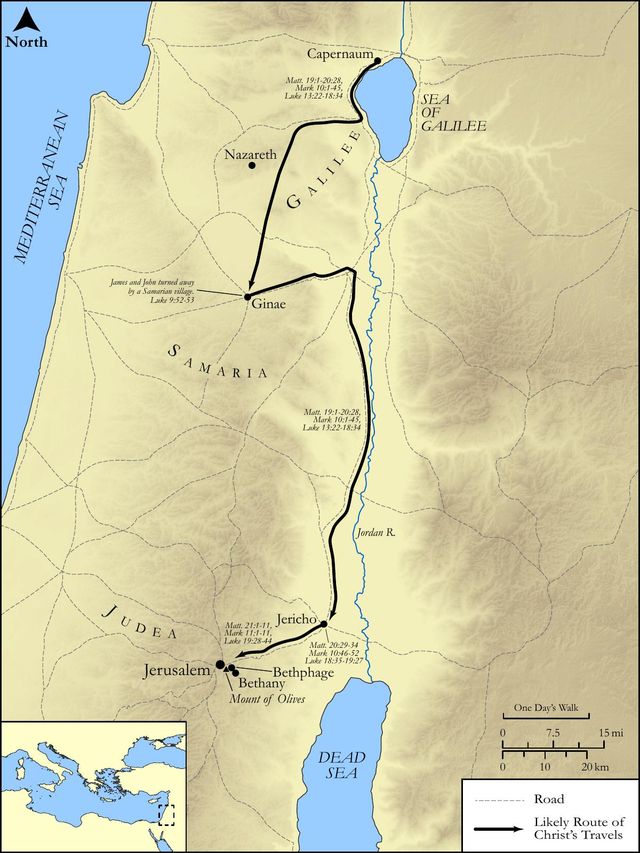
Here then He begins to relate what He did, taught, or suffered in Judæa. At first beyond Jordan eastward, afterwards on this side Jordan when He came to Jericho, Bethphage, and Jerusalem; whence it follows, And He came into the coasts of Judæa beyond Jordan.
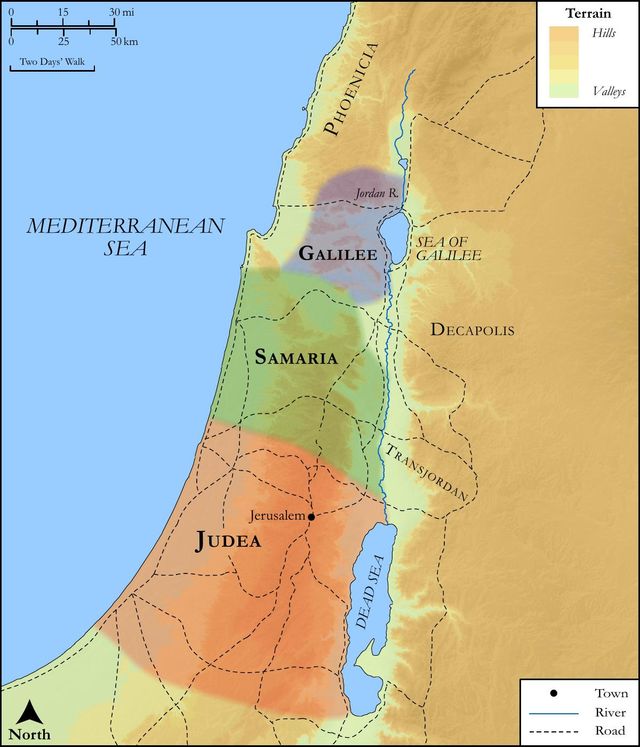
It should be known, that the whole territory of the Israelites was called Judæa, to distinguish it from other nations. But its southern portion, inhabited by the tribes of Judah and Benjamin, was called Judæa proper, to distinguish it from other districts in the same province as Samaria, Galilee, Decapolis, and the rest. It follows, And great multitudes followed him.
For by the wholesome design of God it was ordained that a man should have in the woman a part of his own body, and should not look upon as separate from himself that which he knew was formed out of himself.
(interlin.) Or, one flesh, that is in carnal connection.
The Christian idea of marriage is based on Christ's words that a man and wife are to be regarded as a single organism - for that is what the words 'one flesh' would be in modern English. And the Christians believe that when He said this He was not expressing a sentiment but stating a fact - just as one is stating a fact when one says that a lock and its key are one mechanism, or that a violin and a bow are one musical instrument. The inventor of the human machine was telling us that its two halves, the male and the female, were made to be combined together in pairs, not simply on the sexual level, but totally combined. The monstrosity of sexual intercourse outside marriage is that those who indulge in it are trying to isolate one kind of union (the sexual) from all the other kinds of union which were intended to go along with it and make up the total union. The Christian attitude does not mean that there is anything wrong about sexual pleasure, any more than about the pleasure of eating. It means that you must not isolate that pleasure and try to get it by itself, any more than you ought to try to get the pleasures of taste without swallowing and digesting, by chewing things and spitting them out again.
Continue studying Matthew 19:3 across the web’s major study libraries — every link below opens this exact verse, chapter, or book on the destination site.
Read & Compare
 BibleGatewayThis verse in more than 200 translations and 70 languages.
 Bible.comThe YouVersion reader — hundreds of translations, reading plans, and highlights.
 ESV.orgCrossway's official English Standard Version reader.
 NET BibleThe NET translation with 60,000+ translators' notes on every rendering decision.
 STEP BibleTyndale House's free study tool — original text, vocabulary, and scholarly resources.
 BibliaLogos Bible Software's free web reader.
 USCCBThe New American Bible (Revised Edition) with the U.S. bishops' study notes.
Commentaries
 BibleHub CommentariesDozens of classic commentaries on this verse, gathered on one page.
 StudyLightMore than 100 commentary sets — the largest collection on the web.
 BibleRefPlain-English commentary on what this verse means, verse by verse.
 Enduring WordDavid Guzik's free commentary on this chapter, widely used by Bible teachers.
 Bible Study ToolsVerse commentary alongside Greek and Hebrew study aids.
Original Language & Research
- BibleHub InterlinearThe verse word by word — original language, transliteration, and English.
- BibleHub LexiconEvery word's original-language definition and Strong's entry.
 Blue Letter BibleDeep-study tools — Strong's numbers, concordance, and word studies.
 CNTR CollationThe earliest Greek manuscripts of this verse, collated letter by letter.
Sermons, Hymns & Audio


TrulyRandomVerse is not affiliated with these sites and doesn’t control their content. They’re linked because they’re genuinely useful.
Summary
Matthew 19:3 records a pivotal moment where the Pharisees, seeking to ensnare Jesus, confront Him with a contentious question about the legality of divorce for any reason. This encounter serves as a deliberate challenge to Jesus' authority and wisdom, aiming to force Him into a position that would alienate either the strict or lenient rabbinical schools of thought, thereby setting the stage for Jesus' profound and counter-cultural teaching on the sanctity and permanence of marriage as originally instituted by God.
Context
ShowHideLiterary Context
This verse initiates a significant discourse on marriage and divorce within Matthew's Gospel. Immediately preceding this passage, Jesus has concluded His ministry in Galilee and is now moving towards Judea and beyond the Jordan, a journey that ultimately leads to Jerusalem and His passion. The narrative flow in Matthew 18 concludes with teachings on forgiveness and reconciliation, making the transition to the topic of marriage and its dissolution particularly poignant. The Pharisees' question in Matthew 19:3 directly precedes Jesus' definitive teaching on marriage's divine institution and the limited grounds for divorce (Matthew 19:4-9), followed by the disciples' reaction and Jesus' further remarks on celibacy for the kingdom (Matthew 19:10-12). This entire section underscores Jesus' authority to interpret and fulfill the Mosaic Law, moving beyond mere legalism to the heart of God's original design.
Historical & Cultural Context
First-century Jewish society was deeply divided on the issue of divorce, primarily due to differing interpretations of Deuteronomy 24:1-4. The text permitted a man to write a certificate of divorce if he found "some indecency" (עֶרְוַת דָּבָר, ervat davar) in his wife. Two dominant rabbinical schools, Shammai and Hillel, offered contrasting interpretations. The School of Shammai held a stricter view, asserting that "indecency" referred only to sexual immorality or a grave moral fault. In contrast, the School of Hillel adopted a far more lenient stance, interpreting "indecency" broadly to include trivial matters, such as a wife burning a meal or speaking disrespectfully of her husband's mother. This lenient view was widely popular and allowed men to divorce their wives for virtually "every cause." The Pharisees' question to Jesus, "Is it lawful for a man to put away his wife for every cause?", was a direct attempt to force Him to align with one of these schools, thereby alienating the other and potentially undermining His popular support or exposing Him to accusations of contradicting the Mosaic Law.
Key Themes
ShowHideThis verse introduces several crucial themes that resonate throughout Jesus' ministry and the broader biblical narrative. Firstly, it highlights The Adversarial Nature of the Religious Establishment, showcasing the ongoing tension and conflict between Jesus and the Pharisees, who consistently sought to discredit Him (Matthew 12:1-14). Their intent here is clearly to "tempt" or "test" Him, not to learn. Secondly, the question itself, despite its malicious intent, brings to the forefront The Sanctity and Permanence of Marriage. Jesus' subsequent response elevates marriage beyond a mere legal contract to a sacred covenant established by God at creation (Matthew 19:4-6). Finally, the debate underscores the theme of Divine Law vs. Human Interpretation. The Pharisees' question reflects a human tendency to seek loopholes or convenient interpretations of God's commands, rather than embracing the spirit and heart of the law as intended by the Lawgiver. Jesus' teaching consistently calls His followers to a higher righteousness that transcends mere external adherence to rules, emphasizing internal transformation and the original intent of God's commands (e.g., Matthew 5:21-48).
Exposition and Analysis
ShowHideKey Word Analysis
ShowHideThis word signifies to test, try, or tempt with the intent to discover what someone is capable of or what their true character is. In this context, it carries a hostile connotation, indicating that the Pharisees' aim was not to genuinely seek knowledge or truth from Jesus, but to ensnare Him in His words, hoping He would utter something that could be used against Him, either politically or religiously. It implies a malicious, rather than inquisitive, motive.
Derived from apo (from) and luō (to loose, release), this verb literally means "to free fully," "release," or "dismiss." In legal and social contexts of the time, it was the standard term for divorce, signifying the legal dismissal or separation of a spouse. The use of this specific term highlights the legal and societal implications of the Pharisees' question, focusing on the formal act of dissolving a marriage.
This term refers to a reason, motive, or legal case/charge. When combined with "every" (pas), it directly points to the core of the rabbinical debate: whether a man could divorce his wife for any and every conceivable reason, no matter how trivial, as advocated by the School of Hillel, or only for a specific, grave fault. The Pharisees' inclusion of "every cause" reveals their attempt to push Jesus into taking a stance on this highly divisive contemporary issue.
Verse Breakdown
ShowHide"The Pharisees also came unto him,"
This opening clause establishes the protagonists and the setting. The Pharisees, a prominent and influential Jewish religious sect known for their strict adherence to the Law and traditions, actively sought out Jesus. Their "coming" is not presented as a casual encounter but as a deliberate approach with a specific agenda, often adversarial, as seen throughout the Gospels.
"tempting him, and saying unto him,"
This phrase immediately reveals the malicious intent behind their approach. The Greek word for "tempting" (G3985, peirázō) indicates a testing with a hostile purpose, aiming to trap or expose a perceived flaw in Jesus' teaching or character. Their subsequent "saying unto him" introduces the direct challenge, framing their question as a calculated attempt to corner Him.
"Is it lawful for a man to put away his wife for every cause?"
This is the core of their trap. The question directly addresses the highly contentious issue of divorce, specifically probing the grounds for it. By asking "for every cause," they are directly referencing the lenient Hillelite interpretation of Deuteronomy 24:1, forcing Jesus to either affirm a popular but lax standard, contradict Moses, or alienate a significant portion of the population. The term "lawful" (G1832, éxesti) emphasizes the legal and religious implications of the query within Jewish law.
Literary Devices
ShowHideThe verse employs several significant literary devices. Interrogation is central, as the entire verse culminates in a direct question posed to Jesus. This question, however, functions as a Rhetorical Question designed not to elicit information for genuine understanding, but to corner Jesus and expose Him to criticism. There is clear Antagonism and Conflict established from the outset, highlighting the ongoing tension between Jesus and the religious authorities who consistently sought to undermine His ministry. The phrase "tempting him" explicitly states this adversarial intent. Furthermore, there is an element of Irony: the very individuals who meticulously uphold the Law are using a legal question to trap the One who perfectly embodies and fulfills the Law. Their legalistic approach misses the deeper, divine intent of marriage that Jesus will subsequently reveal.
Theological and Thematic Connections
ShowHideMatthew 19:3 serves as a critical theological hinge, moving the discussion from the letter of the Mosaic Law to the spirit of God's original design for humanity. The Pharisees' legalistic trap inadvertently provides Jesus with an opportunity to re-establish the divine institution of marriage as a permanent, covenantal union, rooted in creation rather than human concession. This encounter highlights the tension between human interpretations of God's commands, often driven by convenience or cultural norms, and God's unchanging, foundational will. It underscores the biblical principle that while God may permit certain things due to human fallenness (like divorce for hardness of heart), His ideal remains steadfast and reflects His character. This passage ultimately points to the sanctity of covenant and the profound implications of breaking it, setting the stage for Jesus' teaching that elevates marriage to a sacred bond.
Reflection and Application
ShowHideThis encounter with the Pharisees in Matthew 19:3 holds significant contemporary relevance, challenging us to examine our own approach to God's Word and His divine institutions. Are we, like the Pharisees, seeking loopholes or justifications for our preferences, or are we genuinely seeking to understand and submit to God's original intent and higher standards? The passage reminds us that God's truth often transcends cultural norms and convenient interpretations. For believers, it underscores the profound sacredness of the marriage covenant, calling for commitment, perseverance, and a willingness to work through difficulties rather than seeking easy exits for "every cause." It also serves as a warning against approaching spiritual matters with a critical, testing spirit, rather than with a humble heart eager to learn and obey. Ultimately, it invites us to align our lives, especially our most intimate relationships, with God's perfect design, trusting in His wisdom and grace to sustain us.
Questions for Reflection
ShowHideFAQ
ShowHideWhy did the Pharisees ask Jesus about divorce "for every cause"?
ShowHideThe Pharisees asked this question not out of genuine curiosity, but to trap Jesus. In first-century Judaism, there were two main rabbinical schools of thought regarding divorce, based on Deuteronomy 24:1. The School of Shammai held a strict view, allowing divorce only for sexual immorality. The School of Hillel, however, interpreted the law very broadly, permitting divorce for almost any reason, even trivial ones. By asking if it was lawful "for every cause," the Pharisees were trying to force Jesus to take a side. If He agreed with the strict Shammai view, He would alienate the large number of people who followed Hillel. If He agreed with the lenient Hillel view, He might be seen as contradicting the spirit of the Law or even Moses himself. Their intent was to discredit Him, as indicated by the word "tempting" in the verse.
What was the common practice of divorce in Jesus' time?
ShowHideDivorce was a common practice in first-century Jewish society, though it was almost exclusively initiated by the husband. A man could issue a "bill of divorce" to his wife, effectively dismissing her from the marriage. The legal basis for this was Deuteronomy 24:1, which stated that a man could divorce his wife if he found "some indecency" in her. As discussed above, the interpretation of "indecency" varied widely, leading to both strict and very lenient practices. The lenient Hillelite view, which allowed divorce for almost any reason, was quite prevalent, making divorce a relatively easy option for men. Jesus' teaching, which follows this verse, challenges these prevailing cultural norms and interpretations by pointing back to God's original design for marriage.
Christ-Centered Fulfillment
ShowHideMatthew 19:3, though seemingly a legalistic trap, ultimately serves to highlight Jesus' role as the authoritative interpreter and fulfiller of God's Law, pointing to His ultimate mission. The Pharisees' question about divorce for "every cause" attempts to confine the divine institution of marriage within human legalistic frameworks. However, Jesus, as the divine Son, transcends these limited interpretations by recalling God's original design for marriage in Genesis 1:27 and Genesis 2:24. He reveals that the Mosaic allowance for divorce was a concession to human "hardness of heart" (Matthew 19:8), not God's perfect will. In doing so, Jesus restores marriage to its Edenic purity, reflecting the unbreakable covenant between God and His people. This foreshadows His own covenant with the Church, His bride, which is characterized by unwavering faithfulness and an eternal bond (Ephesians 5:25-32). Just as Jesus did not come to abolish the Law but to fulfill it (Matthew 5:17), His teaching on marriage elevates it from a mere legal contract to a sacred, lifelong union that mirrors His own steadfast love and commitment to those He redeems. He is the ultimate "cause" for which all things hold together, including the sacred institution of marriage, which finds its deepest meaning and permanence in Him (Colossians 1:17).