


Genesis 15:2
- וַיֹּאמֶרvai·Yo·merand he saidH559Conj-w ¦ V-Qal-ConsecImperf-3msVerb Qal Consecutive Imperfect 3rd Singular Masculineוַandיֹּאמֶרhe said
- אַבְרָם'av·RamAbramH87N-proper-mNoun Proper Masculine
- אֲדֹנָי'a·do·NaiO LordH136N-properNoun Proper Title
- יֱהוִהYah·wehYahwehH3069N-properNoun Proper Title
- מַהmahwhat?H4100InterrogPronoun Interrogative
- תִּתֶּןti·tenwill you giveH5414V-Qal-Imperf-2msVerb Qal Imperfect 2nd Singular Masculine
- לִיLito <the> mePrep-l ¦ 1csSuffix Personal 1st Singular common genderלִto <the>יme
- וְאָנֹכִיve·'a·no·Khiand IH595Conj-w ¦ Pro-1csPronoun Personal 1st Singular common genderוְandאָנֹכִיI
- הוֹלֵךְho·Lekh[am] goingH1980V-Qal-Prtcpl-msVerb Qal Participle Singular Masculine Absolute
- עֲרִירִי'a·ri·RichildlessH6185Adj-msAdjective Singular Masculine Absolute
- וּבֶןu·venand [the] son ofH1121Conj-w ¦ N-mscNoun Singular Masculine Constructוּandבֶן[the] son of
- מֶשֶׁקMe·shek[the] acquisition ofH4943N-mscNoun Singular Masculine Construct
- בֵּיתִיbei·Timy householdH1004N-msc ¦ 1csNoun Singular Masculine Constructבֵּיתִhouseholdיmy
- הוּאhu'heH1931Pro-3msPronoun Personal 3rd Singular Masculine
- דַּמֶּשֶׂקda·Me·sek[is] DamascusH1834N-properNoun Proper Location
- אֱלִיעֶזֶר'e·li·'E·zerEliezerH461N-proper-mNoun Proper Masculine
English is a literal word-by-word gloss of the Hebrew, not the KJV's wording. Why?
This is the original text the KJV's translators worked from — each Hebrew word with its own literal English meaning in this verse, prepared by scholars at Tyndale House, Cambridge. The KJV translates whole sentences, not word by word, so its wording differs: one Hebrew word can become several English words, and the KJV may choose “the LORD” where the gloss reads “Yahweh”. Both are faithful — they answer different questions. For the KJV's own rendering, switch to the KJV text.
Details
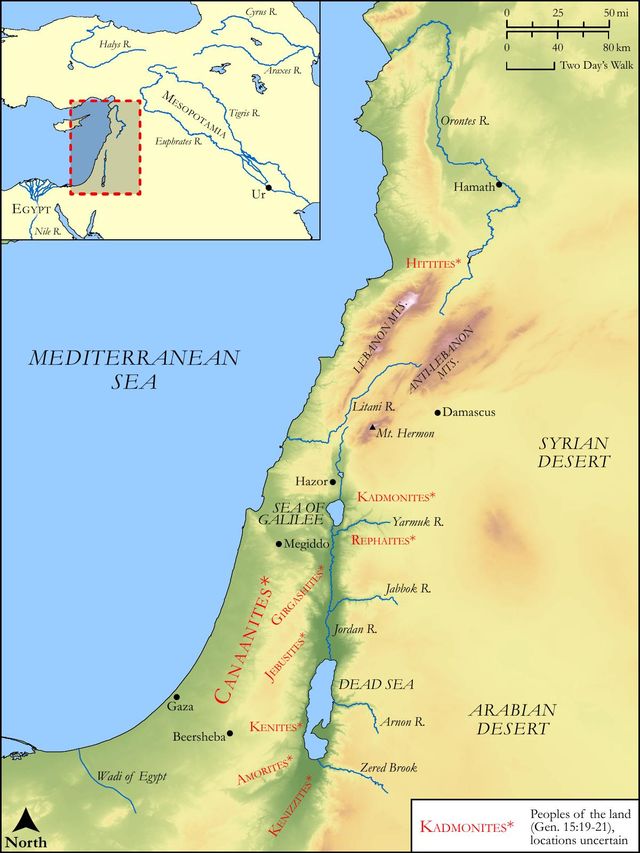
See on the biblical-era maps


Study this verse
Public-domain commentary
Matthew Henry
From his Commentary on the Whole Bible. Henry comments on passages, not single verses — this entry covers Genesis 15:2–6. His three-level outline is real structure in the source text, so it is rendered as structure.
We have here the assurance given to Abram of a numerous offspring which should descend from him, in which observe,
I.Abram's repeated complaint, Gen 15:2, Gen 15:3.
This was that which gave occasion to this promise. The great affliction that sat heavy upon Abram was the want of a child; and the complaint of this he here pours out before the Lord, and shows before him his trouble, Psa 142:2. Note, Though we must never complain of God, yet we have leave to complain to him, and to be large and particular in the statement of our grievances; and it is some ease to a burdened spirit to open its case to a faithful and compassionate friend: such a friend God is, whose ear is always open. Now his complaint is four-fold: - 1. That he had no child (Gen 15:3): Behold, to me thou hast given no seed; not only no son, but no seed; if he had had a daughter, from her the promised Messiah might have come, who was to be the seed of the woman; but he had neither son nor daughter. He seems to lay an emphasis on that, to me. His neighbours were full of children, his servants had children born in his house. "But to me," he complains, "thou hast given none;" and yet God had told him he should be a favourite above all. Note, Those that are written childless must see God writing them so. Again, God often withholds those temporal comforts from his own children which he gives plentifully to others that are strangers to him. 2. That he was never likely to have any, intimated in that I go, or "I am going, childless, going into years, going down the hill apace; nay, I am going out of the world, going the way of all the earth. I die childless," so the Septuagint, "I leave the world, and leave no child behind me." 3. That his servants were for the present and were likely to be to him instead of sons. While he lived, the steward of his house was Eliezer of Damascus; to him he committed the care of his family and estate, who might be faithful, but only as a servant, not as a son. When he died, one born in his house would be his heir, and would bear rule over all that for which he had laboured, Ecc 2:18, Ecc 2:19, Ecc 2:21. God had already told him that he would make of him a great nation (Gen 12:2), and his seed as the dust of the earth (Gen 13:16); but he had left him in doubt whether it should be his seed begotten or his seed adopted, by a son of his loins or only a son of his house. "Now, Lord," says Abram, "if it be only an adopted son it must be one of my servants, which will reflect disgrace upon the promised seed, that is to descend from him." Note, While promised mercies are delayed our unbelief and impatience are apt to conclude them denied. 4. That the want of a son was so great a trouble to him that it took away the comfort of all his enjoyments: "Lord, what wilt thou give me? All is nothing to me, if I have not a son." Now, If we suppose that Abram looked no further than a temporal comfort, this complaint was culpable. God had, by his providence, given him some good things, and more by his promise; and yet Abram makes no account of them, because he has not a son. It did very ill become the father of the faithful to say, What wilt thou give me, seeing I go childless, immediately after God had said, I am thy shield, and thy exceedingly great reward. Note, Those do not rightly value the advantages of their covenant-relation to God and interest in him who do not think them sufficient whatever. But, (2.) If we suppose that Abram, herein, had a eye to the promised seed, the importunity of his desire was very commendable: all was nothing to him, if he had not the earnest of that great blessing, and an assurance of his relation to the Messiah, of which God had already encouraged him to maintain the expectation. He has wealth, and victory, and honour; but, while he is kept in the dark about the main matter, it is all nothing to him. Note, Till we have some comfortable evidence of our interest in Christ and the new covenant, we should not rest satisfied with any thing else. "This, and the other, I have; but what will all this avail me, if I go Christless?" Yet thus far the complaint was culpable, that there was some diffidence of the promise at the bottom of it, and a weariness of waiting God's time. Note, True believers sometimes find it hard to reconcile God's promises and his providences, when they seem to disagree.
II.God's gracious answer to this complaint.
To the first part of the complaint (Gen 15:2) God gave no immediate answer, because there was something of fretfulness in it; but, when he renews his address somewhat more calmly (Gen 15:3), God answered him graciously. Note, If we continue instant in prayer, and yet pray with a humble submission to the divine will, we shall not seek in vain.
1.God gave him an express promise of a son, Gen 15:4. This that is born in thy house shall not be thy heir, as thou fearest, but one that shall come forth out of thy own bowels shall be thy heir. Note,
(1.)God makes heirs; he says, "This shall not, and this shall;" and whatever men devise and design, in settling their estates, God's counsel shall stand.
(2.)God is often better to us than our own fears, and gives the mercy we had long despaired of.
2.To affect him the more with this promise, he took him out, and showed him the stars (this vision being early in the morning, before day), and then tells him, So shall thy seed be, Gen 15:5.
(1.)So numerous; the stars seem innumerable to a common eye: Abram feared he should have no child at all, but God assured him that the descendants from his loins should be so many as not to be numbered.
(2.)So illustrious, resembling the stars in splendour; for to them pertained the glory, Rom 9:4. Abram's seed, according to his flesh, were like the dust of the earth (Gen 13:16), but his spiritual seed are like the stars of heaven, not only numerous, but glorious, and very precious.
III.Abram's firm belief of the promise God now made him, and God's favourable acceptance of his faith, Gen 15:6.
1.He believed in the Lord, that is, he believed the truth of that promise which God had now made him, resting upon the irresistible power and the inviolable faithfulness of him that made it. Hath he spoken, and shall he not make it good? Note, Those who would have the comfort of the promises must mix faith with the promises. See how the apostle magnifies this faith of Abram, and makes it a standing example, Rom 4:19-21. He was not weak in faith; he staggered not at the promise; he was strong in faith; he was fully persuaded. The Lord work such a faith in every one of us! Some think that his believing in the Lord respected, not only the Lord promising, but the Lord promised, the Lord Jesus, the Mediator of the new covenant. He believed in him, that is, received and embraced the divine revelation concerning him, and rejoiced to see his day, though at so great a distance, Joh 8:56.
2.God counted it to him for righteousness; that is, upon the score of this he was accepted of God, and, as the rest of the patriarchs, by faith he obtained witness that he was righteous, Heb 11:4. This is urged in the New Testament to prove that we are justified by faith without the works of the law (Rom 4:3; Gal 3:6); for Abram was so justified while he was yet uncircumcised. If Abram, that was so rich in good works was not justified by them, but by his faith, much less can we, that are so poor in them. This faith, which was imputed to Abram for righteousness, had lately struggled with unbelief (Gen 15:2), and, coming off a conqueror, it was thus crowned, thus honoured. Note, A fiducial practical acceptance of, and dependence upon, God's promise of grace and glory, in and through Christ, is that which, according to the tenour of the new covenant, gives us a right to all the blessings contained in that promise. All believers are justified as Abram was, and it was his faith that was counted to him for righteousness.
Historical interpretation
Three Centuries of Reception
6 surviving comments on this verse. Each one is dated, so this reads as a timeline rather than a list.
Select a marker to jump to its quote. Markers stagger vertically where authors wrote within a few decades of each other.
But the holy and prophetic mind is more concerned with an eternal posterity. What Abraham desires is in fact the offspring of wisdom and the inheritance of faith. This is why he says, “What will you give me, since I am about to depart without children?” What he desired was the progeny of the church. What he was requesting was a descendancy that would be not servile but free, not according to the flesh but according to grace.
Let us also consider what recompense he requests from the Lord. He does not ask for riches, as would a greedy person, nor for a long life in this world, as would one who fears death, nor for power. Rather he asks for an heir worthy of his work. “What will you give me?”—he says—“I am about to depart without children.” And then he says, “Because you have not given me posterity, a slave born in my house will be my heir.” Let everyone learn therefore not to despise marriage. Let them not unite with disreputable persons, so as not to have children of such a standing that they are unable to be their heirs. In view of the inheritance to be transmitted, if they are not moved by any consideration of decency, they at least should desire a worthy marriage.
These words reveal the extreme degree of the pain in his soul. [It is if he were saying] to God, Far from being granted what my slave was, I am to pass away without child or heir, whereas my slave will inherit the gifts granted me by you, despite the promise received from you more than once in the words “to your descendants I will give this land.” Consider, I ask you, the just man’s virtue in this case also in the fact that while entertaining these thoughts in his mind he did not protest nor say any harsh words. Instead, driven on in this case by the words spoken to him, he spoke boldly to the Lord, revealed the tumult of his interior thoughts and made no secret of the wound to his spirit. Hence in turn he received instant healing.
Since God had promised him a reward, a wonderfully, exceedingly great reward, Abraham revealed his grief of spirit and the disappointment affecting him constantly on account of his childless condition. He says, “Lord, what sort of thing will you give me? After all, you can see, I have reached the height of old age and am to pass on without children.” See how from the outset the just man showed his sound thinking in calling his departure from here a “passing on.” I mean, people who live an assiduous life of virtue really pass on from struggle, as it were, and are freed from their bonds when they transfer from this life. You see, for people living virtuously it is a kind of transfer from a worse situation to a better, from a temporary existence to an everlasting one that is protected from death and has no end.
(Chapter 15, Verses 2, 3.) Lord God, what will you give me? And I go without children: and the son of my household, this Damascus Eliezer. And Abram said: Behold to me you have not given seed: and the son of my household will be my heir. Whereby we have, and the son of my household: in Hebrew it is written, Uben Mesech Bethi: which Aquila translated, the son of the one who gives drink to my house: that is, the son who gives drink to my house. But Theodotius, and the son of my servant: that is, his son, who is in charge of my house. And as for what he says, this is it: I die without children, and the son of my steward, or overseer, who manages and distributes all the food of my household, is called Damascus Eliezer, and he will be my heir. Moreover, Eliezer means 'my God is my helper'. They say that Damascus was founded and named after him.
And Abram said: Lord God, what will you give me? I go childless, and the son of the steward of my house is this Damascus Eliezer. And Abram added: You have given me no offspring; and behold, my servant will be my heir. He does not ask as though doubtful of God's promises, but simply inquires what reward he, who has no son in whom to rejoice as heir and participant of the divine promise, will receive from the Lord, and whether his servant will be his heir instead. This servant was called by two names, that is, Damascus, Eliezer, by whom, they say, the city of Damascus was both founded and named. But the Lord, favoring Abram's desires, promised him this reward which he sought, when he immediately added:
Continue studying Genesis 15:2 across the web’s major study libraries — every link below opens this exact verse, chapter, or book on the destination site.
Read & Compare
 BibleGatewayThis verse in more than 200 translations and 70 languages.
 Bible.comThe YouVersion reader — hundreds of translations, reading plans, and highlights.
 ESV.orgCrossway's official English Standard Version reader.
 NET BibleThe NET translation with 60,000+ translators' notes on every rendering decision.
 STEP BibleTyndale House's free study tool — original text, vocabulary, and scholarly resources.
 BibliaLogos Bible Software's free web reader.
 USCCBThe New American Bible (Revised Edition) with the U.S. bishops' study notes.
Commentaries
 BibleHub CommentariesDozens of classic commentaries on this verse, gathered on one page.
 StudyLightMore than 100 commentary sets — the largest collection on the web.
 BibleRefPlain-English commentary on what this verse means, verse by verse.
 Enduring WordDavid Guzik's free commentary on this chapter, widely used by Bible teachers.
 Bible Study ToolsVerse commentary alongside Greek and Hebrew study aids.
Original Language & Research
- BibleHub InterlinearThe verse word by word — original language, transliteration, and English.
- BibleHub LexiconEvery word's original-language definition and Strong's entry.
 Blue Letter BibleDeep-study tools — Strong's numbers, concordance, and word studies.
 SefariaThe Hebrew text with Rashi and centuries of Jewish commentary.
Sermons, Hymns & Audio


TrulyRandomVerse is not affiliated with these sites and doesn’t control their content. They’re linked because they’re genuinely useful.
Summary
In a moment of profound vulnerability, Abram expresses his deep concern to the Lord GOD regarding his childless state, despite divine promises of countless descendants. He highlights the practical reality that Eliezer of Damascus, his trusted chief servant, is currently the de facto heir to his vast household. This lament reveals Abram's human struggle to reconcile God's magnificent promises with his present circumstances, setting the stage for a pivotal reaffirmation and expansion of God's covenant.
Context
ShowHideLiterary Context
Genesis 15:2 immediately follows God's powerful reassurance to Abram in Genesis 15:1, where the Lord appears in a vision, declaring, "Fear not, Abram: I am thy shield, and thy exceeding great reward." This divine declaration is meant to alleviate Abram's fears, likely stemming from his recent military victory and potential retribution (as seen in Genesis 14). However, Abram's response in Genesis 15:2 pivots from external threats to an internal, deeply personal struggle: the lack of an heir. This transition highlights that for Abram, the most pressing concern was not wealth or safety, but the fulfillment of God's promise of a numerous offspring, which seemed impossible given his and Sarai's advanced age and barrenness. The direct, conversational nature of this exchange sets the tone for the subsequent covenant ceremony in Genesis 15:7-21, where God formally ratifies His promises.
Historical & Cultural Context
In the ancient Near East, particularly during the time of Abram (early 2nd millennium BCE), the concept of family continuity and inheritance was paramount. Childlessness, especially the absence of a male heir, was considered a significant misfortune, a potential curse, and a threat to the family's legacy and property. Laws and customs from Mesopotamia, such as those found in the Nuzi tablets (15th-14th century BCE), shed light on the practice Abram references. These documents indicate that in the absence of a natural son, a childless couple might adopt a trusted servant (often a slave born in the household) as an heir. This adopted son would manage the estate during the parents' lifetime and inherit upon their death. However, such an arrangement was typically contingent: if a natural son was later born, the adopted son's inheritance rights would usually revert, or he would receive a lesser portion. Abram's mention of Eliezer as his "steward" and potential heir reflects this cultural reality, underscoring the urgency and gravity of his childless state in a society where lineage was everything. Damascus, a prominent city in Syria, would have been a known and significant place, adding a layer of authenticity to Eliezer's identity.
Key Themes
ShowHideThis verse contributes significantly to several overarching themes within Genesis and the broader biblical narrative. The most prominent is God's Covenant Faithfulness, as Abram's lament serves as a catalyst for God to reiterate and expand His promises, demonstrating His unwavering commitment despite human doubt or perceived delays. It also highlights the theme of Divine Promise and Human Expectation, showcasing the tension between God's supernatural assurances and the natural limitations and expectations of humanity. Abram's honest questioning underscores the theme of Honesty in Prayer, validating the act of bringing one's deepest fears and perceived contradictions directly to God. Furthermore, the emphasis on a biological heir points to the crucial theme of Lineage and Redemptive History, as the promised "seed" (ultimately Christ) would come through this specific, divinely appointed line, underscoring the meticulous nature of God's plan for salvation, which begins with the call of Abram in Genesis 12:1-3.
Exposition and Analysis
ShowHideKey Word Analysis
ShowHideThis is a profound and significant address. ʼĂdônây (H136) is an emphatic form of "master" or "lord," used here as a proper name for God, emphasizing Abram's submission and reverence for God's sovereignty as his Master. Yᵉhôvih (H3069) is a variation of YHWH (the Tetragrammaton), the personal, covenantal name of God, which Jews would often pronounce as Elohim or Adonai to avoid misusing the sacred name. The combination "Lord GOD" (Adonai YHWH) therefore signifies a deeply personal, reverent, yet direct appeal to the sovereign, covenant-keeping God.
Derived from a root meaning "bare" or "destitute," this word vividly describes Abram's condition: he is without children, specifically without a male heir. This term encapsulates the deep personal and societal void that Abram felt, highlighting the central tension between God's promise of numerous descendants and his current reality of barrenness. It signifies not merely a lack of offspring, but a state of being stripped of the expected legacy and continuity in his culture.
From an unused root meaning "to hold" or "possession," this term refers to one who manages or possesses on behalf of another. In this context, it describes Eliezer's role as the chief administrator of Abram's vast household and possessions. The word here points to the practical reality of inheritance in the absence of a natural heir, where a trusted servant would take on the responsibility of managing and potentially inheriting the estate. This highlights the contrast between a divinely promised biological heir and a culturally acceptable, but ultimately insufficient, arrangement.
Verse Breakdown
ShowHide"And Abram said, Lord GOD"
This opening establishes a direct and intimate dialogue between Abram and the Almighty. Abram addresses God with deep reverence, using the combined title "Lord GOD" (Adonai YHWH), indicating both his submission to God's authority and his recognition of God's personal, covenantal relationship with him. It sets the tone for a heartfelt and honest plea.
"what wilt thou give me, seeing I go childless"
This is Abram's core lament and rhetorical question. Despite God's recent reassurance and previous promises of blessing and a great nation, Abram's immediate concern is his lack of a biological heir. This is not necessarily a doubt in God's power, but an honest wrestling with the how and when of God's fulfillment, given his advanced age and the apparent impossibility of the situation. The phrase "I go childless" (literally, "I am going, childless") emphasizes his ongoing state and the perceived finality of his condition.
"and the steward of my house [is] this Eliezer of Damascus?"
This clause provides the practical context for Abram's concern. He identifies Eliezer, his chief servant, as the one who would inherit his estate in the absence of a natural son. This highlights the ancient Near Eastern custom of adopting a trusted servant as an heir when no biological son was present. Abram's question implicitly asks, "Is this the fulfillment of your promise? Is Eliezer, a servant from Damascus, to be the heir through whom you will build a great nation, rather than a son of my own body?" It underscores the perceived inadequacy of the current situation against the magnitude of God's promise.
Literary Devices
ShowHideThe verse employs several significant literary devices. Lament is evident in Abram's direct expression of sorrow and concern over his childless state, a common biblical motif for expressing deep distress to God. His question, "what wilt thou give me, seeing I go childless," functions as a Rhetorical Question, not seeking information but rather expressing frustration, bewilderment, and an implicit plea for divine intervention. There is also a subtle Irony at play: God has promised a lineage as numerous as the stars, yet Abram's immediate reality forces him to consider a servant as his heir, highlighting the vast gap between divine promise and present human circumstance. This setup heightens the dramatic tension, preparing the reader for God's extraordinary and direct response.
Theological and Thematic Connections
ShowHideAbram's honest lament in Genesis 15:2 serves as a pivotal moment, demonstrating that God welcomes genuine, even questioning, dialogue from His people. It underscores the profound tension between divine promise and human experience, revealing God's patience and faithfulness in the face of perceived delays and human limitations. This passage affirms that God's plans are not thwarted by our circumstances but often unfold in ways that transcend natural possibilities, ultimately revealing His sovereign power and unwavering commitment to His covenant.
Reflection and Application
ShowHideAbram's raw honesty in Genesis 15:2 provides a powerful model for our own walk of faith. We are often tempted to hide our doubts or fears from God, believing that such vulnerability might displease Him. However, Abram's example shows that God invites our authentic selves, even our deepest struggles and questions about the fulfillment of His promises. When our current circumstances seem to contradict God's word, this passage encourages us to bring those tensions directly to Him, rather than succumbing to despair or trying to figure it out on our own. It reminds us that God's faithfulness is not contingent on our perfect understanding or immediate gratification, but on His unchanging character. Our faith is refined in the crucible of waiting and trusting, as we learn that God's "how" and "when" are always perfect, even when they defy our expectations. Just as God responded to Abram with a dramatic reaffirmation, He meets our honest pleas with grace and a deeper revelation of His purposes.
Questions for Reflection
ShowHideFAQ
ShowHideWhy was Abram so concerned about being childless?
ShowHideIn ancient Near Eastern culture, having a male heir was profoundly important for family continuity, inheritance, and legacy. Childlessness was considered a great misfortune and a potential threat to the family's future and property. Abram's concern was not just personal but deeply rooted in the societal norms and, more importantly, the implications for the divine promise of a great nation that would descend from him (Genesis 12:2).
What is the significance of "Lord GOD" in this verse?
ShowHideThe Hebrew phrase is Adonai YHWH (rendered "Lord GOD" in KJV). Adonai (H136) means "my Lord" or "my Master," indicating Abram's submission and reverence. YHWH (H3069), the personal, covenantal name of God, emphasizes His faithfulness and His unique relationship with His people. The combination signifies a personal, respectful, yet deeply earnest appeal to the sovereign Creator who has entered into a covenant relationship with Abram.
Did Abram doubt God's promise?
ShowHideAbram's question reflects a human struggle with the practical fulfillment of God's promise given his current circumstances, rather than an outright doubt in God's power or character. He is wrestling with how God will accomplish what He said, especially concerning an heir, given his and Sarai's advanced age. This honest questioning is met not with rebuke, but with a further, more detailed reaffirmation of God's covenant (Genesis 15:4-5), demonstrating God's patience and willingness to engage with human vulnerability and perceived impossibilities.
Christ-Centered Fulfillment
ShowHideAbram's deep longing for a biological heir in Genesis 15:2, which seemed impossible by natural means, finds its ultimate and most profound fulfillment in Jesus Christ. While God promised Abram a physical descendant, the New Testament reveals that the true "seed" through whom all nations would be blessed is Christ Himself (Galatians 3:16). Through Christ, the promise of countless descendants is realized not merely by physical birth, but by spiritual adoption into God's family through faith. Believers, whether Jew or Gentile, become spiritual children of Abraham and "heirs according to the promise" through their union with Christ (Galatians 3:29). Jesus, as the Son of Abraham (Matthew 1:1), is the one who ultimately inherits all things and through whom God establishes a spiritual nation far vaster and more glorious than Abram could have ever conceived, whose inheritance is eternal life and participation in God's kingdom (Romans 8:17).