


Genesis 15:7
- וַיֹּאמֶרvai·Yo·merand he saidH559Conj-w ¦ V-Qal-ConsecImperf-3msVerb Qal Consecutive Imperfect 3rd Singular Masculineוַandיֹּאמֶרhe said
- אֵלָיו'e·Lavto himH413Prep ¦ 3msPreposition Definiteאֵלָיtoוhim
- אֲנִי'a·NiIH589Pro-1csPronoun Personal 1st Singular common gender
- יְהוָהYah·weh[am] YahwehH3068N-properNoun Proper Title
- אֲשֶׁר'a·SherwhoH834RelParticle Relative
- הוֹצֵאתִיךָho·tze·Ti·khaI brought out youH3318V-Hiphil-Perf-1cs ¦ 2msVerb Hiphil Perfect 1st Singular common genderהוֹצֵאתִיI brought outךָyou
- מֵאוּרme·'Urfrom UrH218Prep-m ¦ N-properNoun Proper LocationמֵfromאוּרUr
- כַּשְׂדִּיםkas·Dimof [the] ChaldeansH3778N-properNoun Proper Location
- לָתֶתLa·tetto giveH5414Prep-l ¦ V-Qal-InfVerb Qal Infinitive Constructלָtoתֶתgive
- לְךָle·Khato <the> youPrep-l ¦ 2msSuffix Personal 2nd Singular Masculineלְto <the>ךָyou
- אֶת'et<obj.>H853DirObjMParticle Object Indicator
- הָאָרֶץha·'A·retzthe landH776Art ¦ N-fsNoun Singular Feminine Absoluteהָtheאָרֶץland
- הַזֹּאתha·Zot<the> thisH2063Art ¦ PrtParticle Demonstrativeהַ<the>זֹּאתthis
- לְרִשְׁתָּהּle·rish·Tahto take possession of itH3423Prep-l ¦ V-Qal-Inf ¦ 3fsVerb Qal Infinitive Constructלְtoרִשְׁתָּtake possession ofהּit
English is a literal word-by-word gloss of the Hebrew, not the KJV's wording. Why?
This is the original text the KJV's translators worked from — each Hebrew word with its own literal English meaning in this verse, prepared by scholars at Tyndale House, Cambridge. The KJV translates whole sentences, not word by word, so its wording differs: one Hebrew word can become several English words, and the KJV may choose “the LORD” where the gloss reads “Yahweh”. Both are faithful — they answer different questions. For the KJV's own rendering, switch to the KJV text.
Details
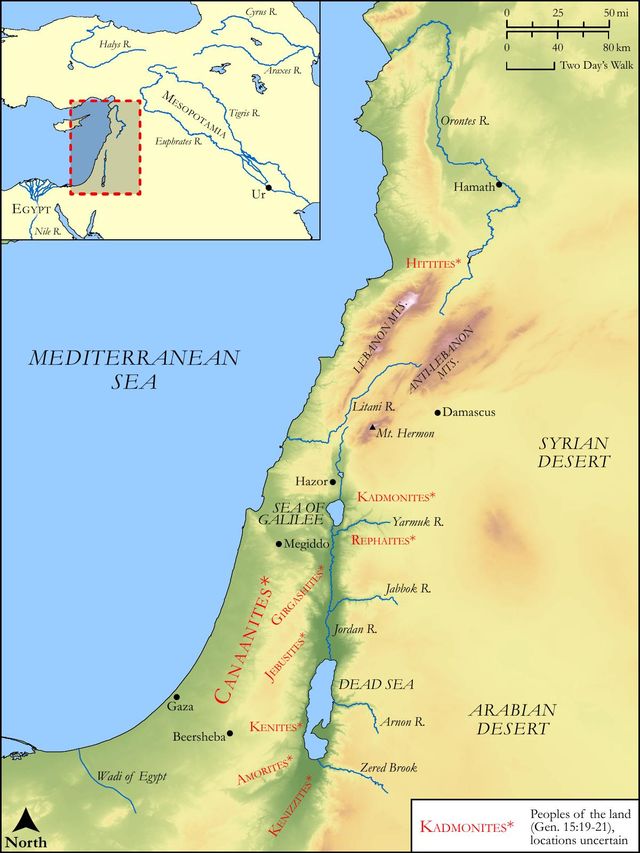
See on the biblical-era map


Study this verse
Public-domain commentary
Matthew Henry
From his Commentary on the Whole Bible. Henry comments on passages, not single verses — this entry covers Genesis 15:7–11. His three-level outline is real structure in the source text, so it is rendered as structure.
We have here the assurance given to Abram of the land of Canaan for an inheritance.
I.God declares his purpose concerning it, Gen 15:7.
Observe here, Abram made no complaint in this matter, as he had done for the want of a child. Note, Those that are sure of an interest in the promised seed will see no reason to doubt of a title to the promised land. If Christ is ours, heaven is ours. Observe again, When he believed the former promise (Gen 15:6) then God explained and ratified this to him. Note, To him that has (improves what he has) more shall be given. Three things God here reminds Abram of, for his encouragement concerning the promise of this good land: -
1.What God is in himself: I am the Lord Jehovah; and therefore, (1.) "I may give it to thee, for I am sovereign Lord of all, and have a right to dispose of the whole earth." (2.) "I can give it to thee, whatever opposition may be made, though by the sons of Anak." God never promises more than he is able to perform, as men often do. (3.) "I will make good my promise to thee." Jehovah is not a man that he should lie.
2.What he had done for Abram. He had brought him out of Ur of the Chaldees, out of the fire of the Chaldees, so some, that is, either from their idolatries (for the Chaldeans worshipped the fire), or from their persecutions. The Jewish writers have a tradition that Abram was cast into a fiery furnace for refusing to worship idols, and was miraculously delivered. It is rather a place of that name. Thence God brought him by an effectual call, brought him with a gracious violence, snatched him as a brand out of the burning. This was,
(1.)A special mercy: "I brought thee, and left others, thousands, to perish there." God called him alone, Isa 51:2.
(2.)A spiritual mercy, a mercy to his soul, a deliverance from sin and its fatal consequences. If God save our souls, we shall want nothing that is good for us.
(3.)A fresh mercy, lately bestowed, and therefore should be the more affecting, as that in the preface to the commandments, I am the Lord that brought thee out of Egypt lately.
(4.)A foundation mercy, the beginning of mercy, peculiar mercy to Abram, and therefore a pledge and earnest of further mercy, Isa 66:9. Observe how God speaks of it as that which he gloried in: I am the Lord that brought thee out. He glories in it as an act both of power and grace; compare Isa 29:22, where he glories in it, long afterwards. Thus saith the Lord who redeemed Abraham, redeemed him from sin.
3.What he intended to do yet further for him: "I brought thee hither, on purpose to give thee this land to inherit it, not only to possess it, but to possess it as an inheritance, which is the sweetest and surest title." Note,
(1.)The providence of God has secret but gracious designs in all its various dispensations towards good people; we cannot conceive the projects of Providence, till the event shows them in all their mercy and glory.
(2.)The great thing God designs in all his dealings with his people is to bring them safely to heaven. They are chosen to salvation (Th2 2:13), called to the kingdom (Th1 2:12), begotten to the inheritance (Pe1 1:3, Pe1 1:4), and by all made meet for it, Col 1:12, Col 1:13; Co2 4:17.
II.Abram desires a sign:
Whereby shall I know that I shall inherit it? Gen 15:8. This did not proceed from distrust of God's power or promise, as that of Zacharias; but he desired this,
1.For the strengthening and confirming of his own faith; he believed (Gen 15:6), but here he prays, Lord, help me against my unbelief. Now he believed, but he desired a sign to be treasured up against an hour of temptation, not knowing how his faith might, by some event or other, be shocked and tried. Note, We all need, and should desire, helps from heaven for the confirming of our faith, and should improve sacraments, which are instituted signs, for that purpose. See Jdg 6:36-40; Kg2 20:8-10; Isa 7:11, Isa 7:12.
2.For the ratifying of the promise to his posterity, that they also might be brought to believe it. Note, Those that are satisfied themselves should desire that others also may be satisfied of the truth of God's promises. John sent his disciples to Christ, not so much for his own satisfaction as for theirs, Mat 11:2, Mat 11:3. Canaan was a type of heaven. Note, It is a very desirable thing to know that we shall inherit the heavenly Canaan, that is, to be confirmed in our belief of the truth of that happiness, and to have the evidences of our title to it more and more cleared up to us.
III.God directs Abram to make preparations for a sacrifice, intending by that to give him a sign, and Abram makes preparation accordingly (Gen 15:9-11): Take me a heifer, etc. Perhaps Abram expected some extraordinary sign from heaven; but God gives him a sign upon a sacrifice. Note, Those that would receive the assurances of God's favour, and would have their faith confirmed, must attend instituted ordinances, and expect to meet with God in them. Observe,
1.God appointed that each of the beasts used for this service should be three years old, because then they were at their full growth and strength: God must be served with the best we have, for he is the best.
2.We do not read that God gave Abram particular directions how to manage these beasts and fowls, knowing that he was so well versed in the law and custom of sacrifices that he needed not any particular directions; or perhaps instructions were given him, which he carefully observed, thought they are not recorded: at least it was intimated to him that they must be prepared for the solemnity of ratifying a covenant; and he well knew the manner of preparing them.
3.Abram took as God appointed him, though as yet he knew not how these things should become a sign to him. This was not the first instance of Abram's implicit obedience. He divided the beasts in the midst, according to the ceremony used in confirming covenants, Jer 34:18, Jer 34:19, where it is said, They cut the calf in twain, and passed between the parts.
4.Abram, having prepared according to God's appointment, now set himself to wait for the sign God might give him by these, like the prophet upon his watch-tower, Hab 2:1. While God's appearing to own his sacrifice was deferred, Abram continued waiting, and his expectations were raised by the delay; when the fowls came down upon the carcasses to prey upon them, as common and neglected things, Abram drove them away (Gen 15:11), believing that the vision would, at the end, speak, and not lie. Note, A very watchful eye must be kept upon our spiritual sacrifices, that nothing be suffered to prey upon them and render them unfit for God's acceptance. When vain thoughts, like these fowls, come down upon our sacrifices, we must drive them away, and not suffer them to lodge within us, but attend on God without distraction.
Historical interpretation
Three Centuries of Reception
2 surviving comments on this verse. Each one is dated, so this reads as a timeline rather than a list.
Select a marker to jump to its quote. Markers stagger vertically where authors wrote within a few decades of each other.
(Verse 7.) I am God, who brought you out from the land of the Chaldeans. This is what we said a little while ago is written in Hebrew: who brought you out from Ur of the Chaldeans, that is, from the fire of the Chaldeans.
And he said to him: I am the Lord, who brought you out of Ur of the Chaldeans, to give you this land to possess it. Some think Ur is the name of a place, but because Ur is interpreted as Fire, it is better understood according to the tradition of the Hebrews, as we said above, that he was rescued from the fire of the Chaldeans, who wanted to consume him with flames because he refused to worship and adore the fire which they worshipped as God. But, with God protecting him, they could not accomplish this.
Continue studying Genesis 15:7 across the web’s major study libraries — every link below opens this exact verse, chapter, or book on the destination site.
Read & Compare
 BibleGatewayThis verse in more than 200 translations and 70 languages.
 Bible.comThe YouVersion reader — hundreds of translations, reading plans, and highlights.
 ESV.orgCrossway's official English Standard Version reader.
 NET BibleThe NET translation with 60,000+ translators' notes on every rendering decision.
 STEP BibleTyndale House's free study tool — original text, vocabulary, and scholarly resources.
 BibliaLogos Bible Software's free web reader.
 USCCBThe New American Bible (Revised Edition) with the U.S. bishops' study notes.
Commentaries
 BibleHub CommentariesDozens of classic commentaries on this verse, gathered on one page.
 StudyLightMore than 100 commentary sets — the largest collection on the web.
 BibleRefPlain-English commentary on what this verse means, verse by verse.
 Enduring WordDavid Guzik's free commentary on this chapter, widely used by Bible teachers.
 Bible Study ToolsVerse commentary alongside Greek and Hebrew study aids.
Original Language & Research
- BibleHub InterlinearThe verse word by word — original language, transliteration, and English.
- BibleHub LexiconEvery word's original-language definition and Strong's entry.
 Blue Letter BibleDeep-study tools — Strong's numbers, concordance, and word studies.
 SefariaThe Hebrew text with Rashi and centuries of Jewish commentary.
Sermons, Hymns & Audio


TrulyRandomVerse is not affiliated with these sites and doesn’t control their content. They’re linked because they’re genuinely useful.
Summary
In Genesis 15:7, God profoundly identifies Himself to Abram as "the LORD" (Yahweh), underscoring His eternal, covenant-keeping nature and His active involvement in human history. He reminds Abram of His past faithfulness by recounting the pivotal act of bringing him out of Ur of the Chaldees, establishing this foundational deliverance as the unwavering guarantee for His future promise to bestow the land of Canaan upon Abram and his descendants as an everlasting inheritance. This divine declaration powerfully reinforces God's absolute reliability and the certain fulfillment of His covenant promises.
Context
ShowHideLiterary Context
Genesis 15:7 occurs at a critical juncture in the narrative of the Abrahamic covenant. Immediately preceding this verse, Abram has expressed his deep concern about not having an heir and the uncertainty of inheriting the promised land, despite God's earlier assurances. In response, God reaffirms His promise of countless descendants, likening them to the stars in the heavens, which Abram "believed the LORD" (Genesis 15:5-6). This declaration of faith is foundational. Genesis 15:7 then serves as God's direct self-identification and a specific, historical reminder of His past actions, providing a tangible basis for Abram's continued trust. It directly precedes the formal covenant ceremony in Genesis 15:9-21, where God ratifies His promises through a solemn, binding ritual, making this verse a crucial bridge between Abram's faith and God's covenantal commitment.
Historical & Cultural Context
Abram's original home, Ur of the Chaldees, was a highly advanced and influential Sumerian city-state in Mesopotamia, characterized by its sophisticated urban planning, extensive trade networks, and, significantly, its pervasive polytheistic worship, particularly of the moon god Nanna (Sin). God's call to Abram to leave this familiar, prosperous, and idolatrous environment (Genesis 12:1-3) was a radical act of divine initiative, demanding complete reliance on an unseen God. The concept of "inheritance" (Hebrew: yārash) was deeply significant in the ancient Near East, often involving the transfer of property, status, or blessings from one generation to the next, typically through a legal process or conquest. God's promise of a land inheritance would have resonated with Abram's understanding of patrimony and security, yet it was entirely contingent on divine power and promise rather than human effort or existing legal frameworks.
Key Themes
ShowHideThis verse powerfully contributes to several overarching themes within Genesis and the broader biblical narrative. It highlights Divine Sovereignty and Initiative, as God is the one who calls, acts, and promises, initiating the relationship with Abram and orchestrating his deliverance. The theme of God's Faithfulness (Hesed) is central, demonstrated by His consistent character in fulfilling past promises and guaranteeing future ones. This builds upon the concept of Covenant, establishing the framework for God's relationship with His chosen people, where His promises are binding and reliable. The Land Promise is a recurring and vital theme, representing not merely a physical territory but the place where God's people would dwell securely, multiply, and serve Him, foreshadowing the ultimate spiritual inheritance. Finally, it reinforces the theme of Divine Self-Revelation, as God progressively discloses His identity, most notably as "the LORD" (Yahweh), to deepen Abram's understanding and trust in Him.
Exposition and Analysis
ShowHideKey Word Analysis
ShowHideFrom the Hebrew H3068, this is the sacred, personal name of God, often transliterated as Yahweh. It signifies "the self-Existent" or "the Eternal," emphasizing God's absolute being, His unchanging nature, and His covenant faithfulness. By identifying Himself as "the LORD," God reveals His unique identity as the sovereign, personal God who actively enters into relationship and keeps His promises, distinguishing Himself from all other deities.
From the Hebrew H3318, this primitive root means "to go out" or, in its causative form as used here, "to bring out." It denotes a powerful, deliberate, and active intervention. God's act of bringing Abram out of Ur was not a passive leading but a decisive, sovereign act of deliverance, demonstrating His power to separate, deliver, and initiate a new path for His chosen one. This past action serves as a concrete example of God's ability to fulfill His word.
From the Hebrew H3423, this root means "to occupy (by driving out previous tenants, and possessing in their place); by implication, to seize, to rob, to inherit." In this context, it speaks of receiving a possession as a rightful heir, implying not just temporary occupation but permanent ownership and dominion. God's promise to "inherit" the land signifies a secure, lasting possession, a foundational element of the covenant that ensures a place for Abram's descendants and the fulfillment of God's redemptive purposes.
Verse Breakdown
ShowHide"And he said unto him,"
This opening phrase signifies a direct, personal communication from God to Abram, highlighting the intimate and authoritative nature of the divine address. It sets the stage for a revelation of God's identity and purpose, reinforcing the covenantal dialogue already established between them.
"I [am] the LORD"
This is a profound divine self-disclosure, where God reveals His personal, covenant name, Yahweh (H3068). It is a declaration of His self-existence, eternal nature, and His unique relationship with His people. This statement establishes the speaker's absolute authority and trustworthiness, distinguishing Him from any other power or deity Abram might have known.
"that brought thee out of Ur of the Chaldees,"
God grounds His identity and authority in a specific, undeniable historical act. Ur of the Chaldees (H218, H3778) was Abram's pagan homeland, and God's act of bringing him out (H3318) was a powerful demonstration of His sovereign initiative and power. This past deliverance serves as a tangible, verifiable proof of God's faithfulness and ability to act on behalf of His chosen.
"to give thee this land to inherit it."
This clause explicitly states the divine purpose behind Abram's deliverance from Ur. The act of "bringing out" was directly linked to the promise of "giving" (H5414) and "inheriting" (H3423) the land (H776). This reiterates the central land promise of the Abrahamic Covenant, emphasizing that the land is a divine gift and a permanent, secure inheritance, providing the geographical and cultural context for the future nation of Israel.
Literary Devices
ShowHideGenesis 15:7 employs several powerful literary devices. The most prominent is Divine Self-Disclosure, where God explicitly reveals His personal name, "the LORD" (Yahweh), which is a pivotal moment in the biblical narrative, establishing His unique identity and covenantal relationship. This is immediately followed by Historical Grounding, as God anchors His identity and future promises in a verifiable past event ("that brought thee out of Ur of the Chaldees"). This rhetorical strategy provides a concrete, undeniable basis for Abram's trust. The verse also utilizes Covenant Language, as the promise of "this land to inherit it" is deeply embedded in the established covenant promises, reinforcing their binding and enduring nature. Furthermore, there is an element of Repetition and Reiteration, as the land promise, first given in Genesis 12, is reaffirmed here, emphasizing its importance and God's unwavering commitment to its fulfillment.
Theological and Thematic Connections
ShowHideGenesis 15:7 is a powerful declaration of God's unwavering character and covenant faithfulness. By revealing Himself as "the LORD" (Yahweh) and recalling His past act of bringing Abram out of Ur, God provides a firm foundation for Abram's faith in the future promise of the land. This verse underscores that God's identity is intrinsically linked to His actions and His word; He is the sovereign, self-existent God who initiates relationships, delivers His people, and unfailingly fulfills His promises. The past deliverance from Ur serves as a powerful testament to God's ability to overcome any obstacle to His purposes, thereby guaranteeing the future inheritance of the land. This consistent pattern of divine faithfulness provides a model for understanding God's reliability across all generations.
Reflection and Application
ShowHideGenesis 15:7 offers profound insights for our own walk of faith. Just as God reminded Abram of His past faithfulness in delivering him from Ur to assure him of the future land inheritance, we too are called to remember and reflect upon God's consistent interventions and provisions in our lives and throughout redemptive history. This verse teaches us that our confidence in God's future guidance, provision, and fulfillment of His promises should be firmly rooted in His proven track record. When faced with uncertainty or doubt, we can look back at the "Urs" from which God has brought us out – whether they be spiritual bondage, challenging circumstances, or past failures – and draw strength from His unchanging character. It encourages us to cultivate a deep trust in the God who is faithful to complete what He has begun, knowing that His identity as "the LORD" guarantees His unwavering commitment to His covenant people. This calls us to a life of active remembrance and confident expectation, believing that the God who has acted powerfully in the past will surely continue to lead us into our promised inheritance.
Questions for Reflection
ShowHideFAQ
ShowHideWhy does God remind Abram of Ur of the Chaldees?
ShowHideGod reminds Abram of Ur of the Chaldees to underscore His sovereignty, initiative, and faithfulness. Bringing Abram out of his idolatrous homeland was a powerful, miraculous act of divine intervention, demonstrating God's ability and commitment to His chosen one. This past act serves as a tangible guarantee and a firm foundation for Abram to trust in God's future promise to give him the land, reinforcing that the God who initiates a work is faithful to complete it. It's a reminder that God's promises are rooted in His demonstrated power and steadfast love, providing a historical anchor for future faith.
What is the significance of God identifying Himself as "the LORD" (Yahweh) here?
ShowHideGod's identification as "the LORD" (Yahweh) is profoundly significant because it is His personal, covenant name (H3068). Unlike generic titles for deity, Yahweh signifies God's self-existence, His eternal nature, and His unique, faithful relationship with His people. By revealing this name, God assures Abram that the one making the promises is the sovereign, trustworthy God who actively intervenes in history and keeps His word, establishing a personal bond of trust and distinguishing Himself from the false gods of Abram's past. This self-revelation builds the foundation for all subsequent covenant interactions.
How does the promise of "this land to inherit it" relate to God's broader redemptive plan?
ShowHideThe promise of "this land to inherit it" (H776, H3423) is foundational to God's broader redemptive plan, serving as a crucial step towards the establishment of His kingdom. It provides a physical space where Abram's descendants would grow into a distinct nation, Israel, through whom God would reveal His law, establish His worship, and ultimately bring forth the Messiah. The land represents not only a physical inheritance but also a place of security, identity, and the fulfillment of God's covenant purposes, foreshadowing the spiritual inheritance and eternal rest promised to all believers in Christ (Hebrews 4:9). It is a tangible expression of God's commitment to His people and His plan to bless all nations through them, culminating in Christ.
Christ-Centered Fulfillment
ShowHideWhile Genesis 15:7 directly concerns the physical land promise to Abram, its ultimate fulfillment and theological trajectory point powerfully to Christ. The land of Canaan, though a significant earthly inheritance, was a type and shadow of the greater spiritual inheritance and eternal rest found in Christ. Just as God sovereignly brought Abram out of the idolatry of Ur into a promised land, Christ delivers believers from the bondage of sin and the dominion of this fallen world, bringing them into the spiritual kingdom of God and promising an eternal inheritance that is imperishable, undefiled, and unfading, kept in heaven (1 Peter/1-3-5). The faithfulness of God demonstrated in bringing Abram out and giving him the land is perfectly fulfilled in Christ, who secures for His people a far greater and everlasting inheritance through His new covenant of grace (Hebrews 9:15). Through Christ, believers become heirs according to the promise, inheriting not merely a physical territory but a spiritual reality that encompasses reconciliation with God, eternal life, and participation in the new heavens and new earth, where righteousness dwells (Romans 8:17; Revelation 21:1-7).