


Genesis 13:17
Bible text: King James Version (1769 Blayney text) · Public domain
Bible text: Berean Standard Bible · Public domain
Bible text: American Standard Version (1901) · Public domain
Bible text: World English Bible, Messianic edition · Public domain
Bible text: Geneva Bible (1599) · Public domain
Bible text: Young's Literal Translation · Public domain
- קוּםkumariseH6965V-Qal-Imp-2msVerb Qal Imperative 2nd Singular Masculine
- הִתְהַלֵּךְhit·ha·Lekhwalk aboutH1980V-Hithpael-Imp-2msVerb Hithpael Imperative 2nd Singular Masculine
- בָּאָרֶץba·'A·retzin the landH776Prep-b ¦ N-fsNoun Singular Feminine Absoluteבָּin theאָרֶץland
- לְאָרְכָּהּle·'a·re·Kahto its lengthH753Prep-l ¦ N-msc ¦ 3fsNoun Singular Masculine Constructלְtoאָרְכָּlengthהּits
- וּלְרָחְבָּהּu·le·ra·che·Bahand to its breadthH7341Conj-w ¦ Prep-l ¦ N-msc ¦ 3fsNoun Singular Masculine Constructוּandלְtoרָחְבָּbreadthהּits
- כִּיkiforH3588PrtParticle Conditional
- לְךָle·Khato <the> youPrep-l ¦ 2msSuffix Personal 2nd Singular Masculineלְto <the>ךָyou
- אֶתְּנֶנָּה'et·te·Ne·nahI will give itH5414V-Qal-Imperf-1cs ¦ 3fsVerb Qal Imperfect 1st Singular common genderאֶתְּנֶI will giveנָּהit
English is a literal word-by-word gloss of the Hebrew, not the KJV's wording. Why?
This is the original text the KJV's translators worked from — each Hebrew word with its own literal English meaning in this verse, prepared by scholars at Tyndale House, Cambridge. The KJV translates whole sentences, not word by word, so its wording differs: one Hebrew word can become several English words, and the KJV may choose “the LORD” where the gloss reads “Yahweh”. Both are faithful — they answer different questions. For the KJV's own rendering, switch to the KJV text.
Details
See on the biblical-era maps


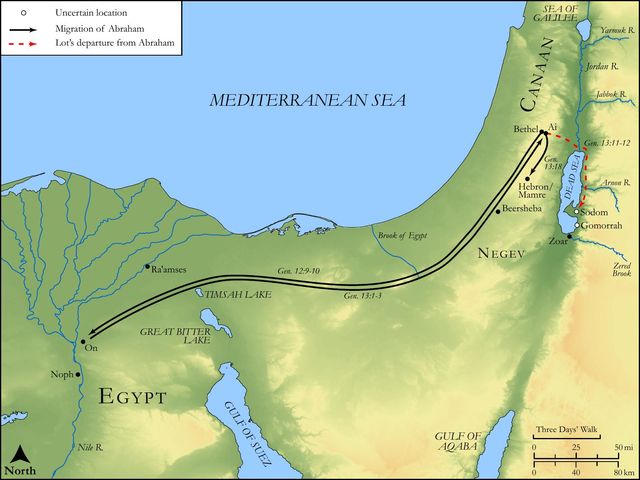
Study this verse
Public-domain commentary
Matthew Henry
From his Commentary on the Whole Bible. Henry comments on passages, not single verses — this entry covers Genesis 13:14–18. His three-level outline is real structure in the source text, so it is rendered as structure.
We have here an account of a gracious visit which God paid to Abram, to confirm the promise to him and his. Observe,
I.When it was that God renewed and ratified the promise: After that Lot was separated from him, that is,
1.After the quarrel was over; for those are best prepared for the visits of divine grace whose spirits are calm and sedate, and not ruffled with any passion.
2.After Abram's humble self-denying condescensions to Lot for the preserving of peace. It was then that God came to him with this token of his favour. Note, God will abundantly make up in spiritual peace what we lose for the preservation of neighbourly peace. When Abram had willingly offered Lot one-half of his right, God came, and confirmed the whole to him.
3.After he had lost the comfortable society of his kinsman, by whose departure his hands were weakened and his heart was saddened, then God came to him with these good words and comfortable words. Note, Communion with God may, at any time, serve to make up the want of conversation with our friends; when our relations are separated from us, yet God is not.
4.After Lot had chosen that pleasant fruitful vale, and had gone to take possession of it, lest Abram should be tempted to envy him and to repent that he had given him the choice, God comes to him, and assures him that what he had should remain to him and his heirs for ever; so that, though Lot perhaps had the better land, yet Abram had the better title. Lot had the paradise, such as it was, but Abram had the promise; and the event soon made it appear that, however it seemed now, Abram had really the better part. See Job 22:20. God owned Abram after his strife with Lot, as the churches owned Paul after his strife with Barnabas, Act 15:39, Act 15:40.
II.The promises themselves with which God now comforted and enriched Abram. Two things he assures him of - a good land, and a numerous issue to enjoy it.
1.Here is the grant of a good land, a land famous above all lands, for it was to be the holy land, and Immanuel's land; this is the land here spoken of.
(1.)God here shows Abram the land, as he had promised (Gen 12:1), and afterwards he showed it to Moses from the top of Pisgah. Lot had lifted up his eyes and beheld the plain of Jordan (Gen 13:10), and he had gone to enjoy what he saw: "Come," says God to Abram, "now lift thou up thy eyes, and look, and see thy own." Note, That which God has to show us is infinitely better and more desirable than any thing that the world has to offer our view. The prospects of an eye of faith are much more rich and beautiful than those of an eye of sense. Those for whom the heavenly Canaan is designed in the other world have sometimes, by faith, a comfortable prospect of it in their present state; for we look at the things that are not seen, as real, though distant.
(2.)He secures this land to him and his seed for ever (Gen 13:15): To thee will I give it; and again (Gen 13:17) I will give it unto thee; every repetition of the promise is a ratification of it. To thee and thy seed, not to Lot and his seed; they were not to have their inheritance in this land, and therefore Providence so ordered it that Lot should be separated from Abram first, and then the grant should be confirmed to him and his seed. Thus God often brings good out of evil, and makes men's sins and follies subservient to his own wise and holy counsels. To thee and thy seed - to thee to sojourn in as a stranger, to thy seed to dwell and rule in as proprietors. To thee, that is, to thy seed. The granting of it to him and his for ever intimates that it was typical of the heavenly Canaan, which is given to the spiritual seed of Abram for ever, Heb 11:14.
(3.)He gives him livery and seisin of it, though it was a reversion: "Arise, walk through the land, Gen 13:17. Enter, and take possession, survey the parcels, and it will appear better than upon a distant prospect." Note, God is willing more abundantly to show to the heirs of promise the immutability of his covenant, and the inestimable worth of covenant blessings. Go, walk about Sion, Psa 48:12.
2.Here is the promise of a numerous issue to replenish this good land, so that it should never be lost for want of heirs (Gen 13:16): I will make thy seed as the dust of the earth, that is, "They shall increase incredibly, and, take them altogether, they shall be such a great multitude as no man can number." They were so in Solomon's time, Kg1 4:20, Judah and Israel were many as the sand which is by the sea in multitude. This God here gives him the promise of. Note, The same God that provides the inheritance provides the heirs. He that has prepared the holy land prepares the holy seed; he that gives glory gives grace to make meet for glory.
Lastly, We are told what Abram did when God had thus confirmed the promise to him, Gen 13:18. 1. He removed his tent. God bade him walk through the land, that is, "Do not think of fixing in it, but expect to be always unsettled, and walking through it to a better Canaan:" in compliance with God's will herein, he removes his tent, confirming himself to the condition of a pilgrim. 2. He built there an altar, in token of his thankfulness to God for the kind visit he had paid him. Note, When God meets us with gracious promises, he expects that we should attend him with our humble praises.
Continue studying Genesis 13:17 across the web’s major study libraries — every link below opens this exact verse, chapter, or book on the destination site.
Read & Compare
 BibleGatewayThis verse in more than 200 translations and 70 languages.
 Bible.comThe YouVersion reader — hundreds of translations, reading plans, and highlights.
 ESV.orgCrossway's official English Standard Version reader.
 NET BibleThe NET translation with 60,000+ translators' notes on every rendering decision.
 STEP BibleTyndale House's free study tool — original text, vocabulary, and scholarly resources.
 BibliaLogos Bible Software's free web reader.
 USCCBThe New American Bible (Revised Edition) with the U.S. bishops' study notes.
Commentaries
 BibleHub CommentariesDozens of classic commentaries on this verse, gathered on one page.
 StudyLightMore than 100 commentary sets — the largest collection on the web.
 BibleRefPlain-English commentary on what this verse means, verse by verse.
 Enduring WordDavid Guzik's free commentary on this chapter, widely used by Bible teachers.
 Bible Study ToolsVerse commentary alongside Greek and Hebrew study aids.
Original Language & Research
- BibleHub InterlinearThe verse word by word — original language, transliteration, and English.
- BibleHub LexiconEvery word's original-language definition and Strong's entry.
 Blue Letter BibleDeep-study tools — Strong's numbers, concordance, and word studies.
 SefariaThe Hebrew text with Rashi and centuries of Jewish commentary.
Sermons, Hymns & Audio


TrulyRandomVerse is not affiliated with these sites and doesn’t control their content. They’re linked because they’re genuinely useful.
Summary
Genesis 13:17 marks a profound moment in the narrative of Abram, where God, immediately following the separation from Lot, reconfirms and expands His foundational covenant promise of the land. This divine directive to "Arise, walk through the land in the length of it and in the breadth of it; for I will give it unto thee" is not merely an instruction but a symbolic act of claiming possession, a tangible demonstration of faith, and an emphatic reaffirmation of God's unwavering faithfulness to His chosen servant and His sovereign intent to bestow a vast inheritance.
Context
ShowHideLiterary Context
This divine utterance to Abram occurs at a pivotal juncture in the book of Genesis, serving as a direct sequel to the amicable, yet necessary, separation between Abram and his nephew Lot in Genesis 13:5-13. The increasing prosperity of both their flocks and herds had led to strife among their herdsmen, necessitating a division of the land. Lot, enticed by the well-watered plains of the Jordan, chose that fertile region, leaving Abram in the less immediately appealing land of Canaan. It is precisely at this moment of potential diminishment or uncertainty for Abram that God graciously intervenes, reiterating and expanding upon the promises first articulated in Genesis 12:1-3. This immediate divine affirmation underscores God's active involvement in Abram's life and His commitment to His covenant, independent of human choices or perceived losses.
Historical & Cultural Context
The act of physically traversing a piece of land was a symbolic gesture of claiming ownership, as the LORD later told Joshua that every place the sole of his foot should tread upon was given to him, even if legal possession had not yet been fully established. It was a visible, public declaration of intent. For Abram, a nomadic sojourner in a foreign land, this command would have resonated deeply, transforming his pilgrimage into an act of prophetic possession. The land of Canaan itself, though not yet fully settled by its future inhabitants, was strategically important, lying at the crossroads of major trade routes and fertile crescent civilizations. God's promise of this specific land to Abram and his descendants was revolutionary, challenging the prevailing notion of land ownership tied to established kingdoms and instead rooting it in a divine, unilateral grant.
Key Themes
ShowHideGenesis 13:17 powerfully contributes to several overarching themes within the Abrahamic narrative and the broader book of Genesis. It reinforces the theme of God's Covenant Faithfulness, demonstrating His unwavering commitment to His promises even when human circumstances shift or appear to diminish. It highlights the theme of Divine Sovereignty and Gift, emphasizing that the land is a gracious bestowal from God, not something earned or achieved by human effort. Furthermore, it underscores the theme of Faith and Obedience, as Abram's active "walking through the land" becomes a tangible expression of his trust in God's word, even before the full realization of the promise. This passage also subtly introduces the concept of Inheritance, which will become a central motif throughout the Pentateuch, culminating in the eventual possession of the land by Israel, as seen in Joshua 21:43-45.
Exposition and Analysis
ShowHideGenesis 13:17 is a concise yet profoundly significant divine command, encapsulating God's sovereign gift and Abram's faithful response. The imperative "Arise, walk through the land in the length of it and in the breadth of it" is immediately followed by the declarative "for I will give it unto thee," establishing both the human action and the divine source of the promise.
Key Word Analysis
ShowHideThis word, often translated as "rise" or "stand up," carries a sense of immediate action, readiness, and often, the initiation of a significant task or journey. In this context, it is a divine summons to Abram to actively engage with the promise, moving from a state of rest or contemplation to one of purposeful movement. It implies a call to a new phase of activity in response to God's word.
More than just casual strolling, hâlak here, particularly in its imperative form and coupled with "through," denotes a deliberate, surveying, and comprehensive traversing. It signifies a journey with a purpose—to inspect, to claim, to personally connect with the vastness of the promised territory. It is an act of physical engagement that mirrors a spiritual appropriation of the divine promise.
This verb is central to the verse, emphasizing the unilateral and sovereign nature of God's action. It signifies a bestowal, a grant, or a transfer of possession. The use of nâthan here firmly establishes the land as a gift from God, not something Abram earns or conquers by his own might. It highlights God's power, authority, and unwavering commitment to His covenant promise.
Verse Breakdown
ShowHide"Arise,"
This is a direct, emphatic divine command, signaling an immediate call to action for Abram. It implies a transition from a state of passive reception to active engagement, urging Abram to physically move and respond to God's renewed promise.
"walk through the land in the length of it and in the breadth of it;"
This clause details the specific action Abram is to undertake. The act of "walking through" signifies a comprehensive survey and a symbolic act of taking possession. The phrases "in the length of it and in the breadth of it" emphasize the vast, encompassing scope of the territory God is promising, indicating that the entire land, from north to south and east to west, is included in this divine grant. It is an invitation for Abram to personally apprehend the immensity of his future inheritance.
"for I will give it unto thee."
This concluding clause provides the divine rationale and the ultimate guarantee for Abram's action. The "for" (כִּי, kî) indicates the reason or basis for the command: God's sovereign and unconditional promise. The future tense "I will give" underscores that the land is a divine bestowal, a gracious gift from God's hand, not contingent on Abram's merit but solely on God's faithfulness and power. This promise forms the bedrock of the Abrahamic Covenant, ensuring its fulfillment regardless of immediate circumstances.
Literary Devices
ShowHideThe verse primarily employs Divine Command as a central literary device, where God directly issues an imperative to Abram, highlighting His authority and active involvement in human affairs. The instruction to "walk through the land" functions as Symbolism, where a physical action represents a deeper spiritual reality—the act of claiming and possessing a promised inheritance. This symbolic act is not a condition for the promise, but a tangible expression of faith in its reality. Furthermore, the phrase "in the length of it and in the breadth of it" uses Merism, a rhetorical device where two contrasting or complementary parts are used to represent a whole (i.e., length and breadth encompass the entire land), emphasizing the comprehensive and expansive nature of God's gift.
Theological and Thematic Connections
ShowHideGenesis 13:17 is a powerful testament to God's unwavering covenant faithfulness and His sovereign generosity. It reveals a God who not only initiates promises but actively reiterates and expands upon them, especially in moments of human uncertainty or perceived loss. This divine reassurance to Abram, immediately after his separation from Lot, underscores that God's plan is not derailed by human decisions but rather reaffirmed and clarified. The command to "walk through the land" transforms Abram's nomadic existence into a prophetic act of faith, demonstrating that while the promise is God's sovereign gift, human faith often involves active, obedient steps in response to His word. This passage thus serves as a foundational text for understanding the nature of God's promises, the role of human faith, and the expansive scope of divine blessing.
Reflection and Application
ShowHideGenesis 13:17 offers profound encouragement for contemporary believers, reminding us of God's unwavering faithfulness to His promises, even when our immediate circumstances seem to contradict them or when we experience relational or material loss. Just as God reassured Abram after a period of uncertainty and separation from Lot, He remains faithful to His commitments to us, often reaffirming His word when we feel most vulnerable or alone. This passage encourages us to trust God's overarching plan for our lives, to take active steps of faith in response to His Word, and to recognize that what we receive—whether spiritual blessings, opportunities, or future provisions—is ultimately a gracious gift from His hand, rather than something earned by our own efforts. Our "walking through the land" today might involve spiritually surveying the "territory" God has promised us in our callings, ministries, or personal lives, actively engaging with His directives even before their full manifestation, trusting that His "I will give it unto thee" is eternally secure.
Questions for Reflection
ShowHideFAQ
ShowHideWhat does "walk through the land" symbolize?
ShowHideThe act of walking through the land symbolized a physical and spiritual act of claiming possession and acknowledging God's gift. It was a tangible expression of Abram's faith and obedience, allowing him to personally connect with the vastness of the territory God promised to give him and his descendants. This action was not a condition for God's giving, but a response of faith to an already declared and sovereign promise, an invitation for Abram to actively engage with the reality of his future inheritance.
Was Abram's act of walking necessary for God to give him the land?
ShowHideNo, the land was given by God's sovereign will and unconditional promise, as explicitly indicated by the phrase "for I will give it unto thee." Abram's walking was not a condition to earn the land, nor did it obligate God. Rather, it was an act of faith and obedience in response to an already established divine promise. It was God's way of inviting Abram to personally apprehend and engage with the reality of the gift, to internalize the scope of the inheritance, and to demonstrate his trust in the divine Giver. This act served to deepen Abram's understanding and personal connection to the promise.
Christ-Centered Fulfillment
ShowHideWhile Genesis 13:17 speaks of a physical land promise to Abram and his descendants, its ultimate and most profound fulfillment is found in Christ. Jesus, as the true and ultimate heir of all things, embodies the spiritual inheritance promised to Abraham's seed. The "land" expands from a geographical territory to the boundless spiritual kingdom of God, encompassing the new heavens and new earth, which believers inherit through their union with Christ. Just as Abram walked by faith in a promised land he did not yet fully possess, believers today walk by faith toward a heavenly inheritance, understanding that "all the promises of God find their 'Yes' in Him" (2 Corinthians 1:20). Christ is the ultimate fulfillment and guarantee of all God's promises, providing not merely a physical land but eternal life and a spiritual kingdom that transcends earthly boundaries, as foreshadowed in passages like Romans 4:13. Through Christ, the spiritual descendants of Abraham inherit "the world" (Romans 4:13) and become "heirs according to the promise" (Galatians 3:29).