


John 8:56
- ἈβραὰμAbraamAbrahamG11N-NSM-PNoun Nominative Singular Masculine Individual
- ὁhotheG3588T-NSMDefinite article Nominative Singular Masculine
- πατὴρpatērfatherG3962N-NSMNoun Nominative Singular Masculine
- ὑμῶνhumōnof youG4771P-2GPPersonal pronoun Genitive 2nd Plural
- ἠγαλλιάσατοēgalliasatorejoicedG21V-ADI-3SVerb Aorist Middle Deponent Indicative 3rd Singular
- ἵναinain thatG2443CONJConjunction
- ἴδῃidēhe may seeG1492V-2AAS-3SVerb 2nd Aorist Active Subjunctive 3rd Singular
- τὴνtēn<the>G3588T-ASFDefinite article Accusative Singular Feminine
- ἡμέρανhēmerandayG2250N-ASFNoun Accusative Singular Feminine
- τὴνtēn<the>G3588T-ASFDefinite article Accusative Singular Feminine
- ἐμὴνemēnof MineG1473S-1SASFPossessive pronoun Accusative 1st Person Singular Feminine
- καὶkaiandG2532CONJConjunction
- εἶδενeidenhe sawG1492V-2AAI-3SVerb 2nd Aorist Active Indicative 3rd Singular
- καὶkaiandG2532CONJConjunction
- ἐχάρηecharērejoicedG5463V-2AOI-3SVerb 2nd Aorist Passive Deponent Indicative 3rd Singular
English is a literal word-by-word gloss of the Greek, not the KJV's wording. Why?
This is the original text the KJV's translators worked from — each Greek word with its own literal English meaning in this verse, prepared by scholars at Tyndale House, Cambridge. The KJV translates whole sentences, not word by word, so its wording differs: one Greek word can become several English words, and the KJV may choose “charity” where the gloss reads “love”. Both are faithful — they answer different questions. For the KJV's own rendering, switch to the KJV text.
Details
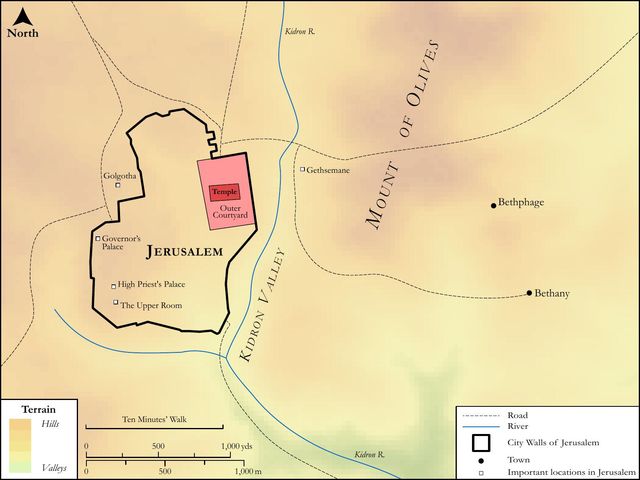
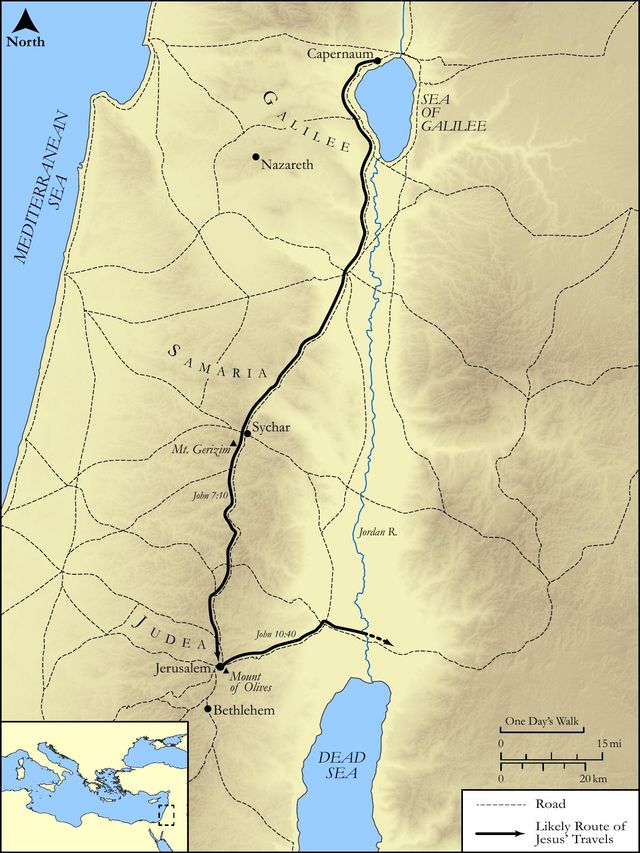
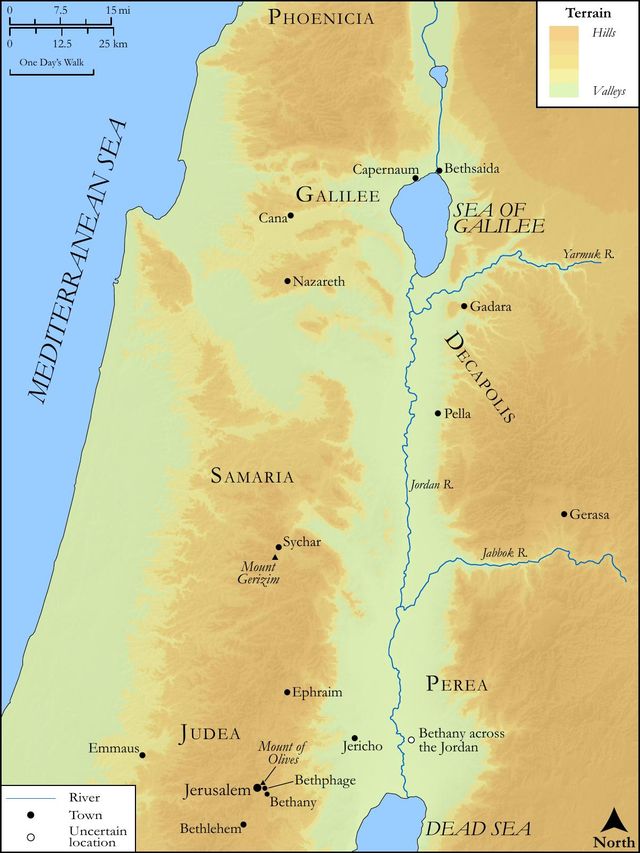
See on the biblical-era map
Study this verse
Public-domain commentary
Matthew Henry
From his Commentary on the Whole Bible. Henry comments on passages, not single verses — this entry covers John 8:51–59. His four-level outline is real structure in the source text, so it is rendered as structure.
In these verses we have,
I.The doctrine of the immortality of believers laid down, Joh 8:51.
It is ushered in with the usual solemn preface, Verily, verily, I say unto you, which commands both attention and assent, and this is what he says, If a man keep my sayings, he shall never see death. Here we have,
1.The character of a believer: he is one that keeps the sayings of the Lord Jesus, ton logon ton emon - my word; that word of mine which I have delivered to you; this we must not only receive, but keep; not only have, but hold. We must keep it in mind and memory, keep it in love and affection, so keep it as in nothing to violate it or go contrary to it, keep it without spot (Ti1 6:14), keep it as a trust committed to us, keep in it as our way, keep to it as our rule.
2.The privilege of a believer: He shall by no means see death for ever; so it is in the original. Not as if the bodies of believers were secured from the stroke of death. No, even the children of the Most High must die like men, and the followers of Christ have been, more than other men, in deaths often, and killed all the day long; how then is this promise made good that they shall not see death? Answer,
(1.)The property of death is so altered to them that they do not see it as death, they do not see the terror of death, it is quite taken off; their sight does not terminate in death, as theirs does who live by sense; no, they look so clearly, so comfortably, through death, and beyond death, and are so taken up with their state on the other side death, that they overlook death, and see it not.
(2.)The power of death is so broken that though there is no remedy, but they must see death, yet they shall not see death for ever, shall not be always shut up under its arrests, the day will come when death shall be swallowed up in victory.
(3.)They are perfectly delivered from eternal death, shall not be hurt of the second death. That is the death especially meant here, that death which is for ever, which is opposed to everlasting life; this they shall never see, for they shall never come into condemnation; they shall have their everlasting lot where there will be no more death, where they cannot die any more, Luk 20:36. Though now they cannot avoid seeing death, and tasting it too, yet they shall shortly be there where it will be seen no more for ever, Exo 14:13.
II.The Jews cavil at this doctrine.
Instead of laying hold of this precious promise of immortality, which the nature of man has an ambition of (who is there that does not love life, and dread the sight of death?) they lay hold of this occasion to reproach him that makes them so kind an offer: Now we know that thou hast a devil. Abraham is dead. Observe here,
1.Their railing: "Now we know that thou hast a devil, that thou art a madman; thou ravest, and sayest thou knowest not what." See how these swine trample underfoot the precious pearls of gospel promises. If now at last they had evidence to prove him mad, why did they say (Joh 8:48), before they had that proof, Thou hast a devil? But this is the method of malice, first to fasten an invidious charge, and then to fish for evidence of it: Now we know that thou hast a devil. If he had not abundantly proved himself a teacher come from God, his promises of immortality to his credulous followers might justly have been ridiculed, and charity itself would have imputed them to a crazed fancy; but his doctrine was evidently divine, his miracles confirmed it, and the Jews' religion taught them to expect such a prophet, and to believe in him; for them therefore thus to reject him was to abandon that promise to which their twelve tribes hoped to come, Act 26:7.
2.Their reasoning, and the colour they had to run him down thus. In short, they look upon him as guilty of an insufferable piece of arrogance, in making himself greater than Abraham and the prophets: Abraham is dead, and the prophets, they are dead too; very true, by the same token that these Jews were the genuine offspring of those that killed them. Now,
(1.)It is true that Abraham and the prophets were great men, great in the favour of God, and great in the esteem of all good men.
(2.)It is true that they kept God's sayings, and were obedient to them; and yet,
(3.)It is true that they died; they never pretended to have, much less to give, immortality, but every one in his own order was gathered to his people. It was their honour that they died in faith, but die they must. Why should a good man be afraid to die, when Abraham is dead, and the prophets are dead? They have tracked the way through that darksome valley, which should reconcile us to death and help to take off the terror of it. Now they think Christ talks madly, when he saith, If a man keep my sayings, he shall never taste death. Tasting death means the same thing with seeing it; and well may death be represented as grievous to several of the senses, which is the destruction of them all. Now their arguing goes upon two mistakes: - [1.] They understood Christ of an immortality in this world, and this was a mistake. In the sense that Christ spoke, it was not true that Abraham and the prophets were dead, for God is still the God of Abraham and the God of the holy prophets (Rev 22:6); now God is not the God of the dead, but of the living; therefore Abraham and the prophets are still alive, and, as Christ meant it, they had not seen nor tasted death. [2.] They thought none could be greater than Abraham and the prophets, whereas they could not but know that the Messiah would be greater than Abraham or any of the prophets; they did virtuously, but he excelled them all; nay, they borrowed their greatness from him. It was the honour of Abraham that he was the Father of the Messiah, and the honour of the prophets that they testified beforehand concerning him: so that he certainly obtained a far more excellent name than they. Therefore, instead of inferring from Christ's making himself greater than Abraham that he had a devil, they should have inferred from his proving himself so (by doing the works which neither Abraham nor the prophets ever did) that he was the Christ; but their eyes were blinded. They scornfully asked, Whom makest thou thyself? As if he had been guilty of pride and vain-glory; whereas he was so far from making himself greater than he was that he now drew a veil over his own glory, emptied himself, and made himself less than he was, and was the greatest example of humility that ever was.
III.Christ's reply to this cavil; still he vouchsafes to reason with them, that every mouth may be stopped.
No doubt he could have struck them dumb or dead upon the spot, but this was the day of his patience.
1.In his answer he insists not upon his own testimony concerning himself, but waives it as not sufficient nor conclusive (Joh 8:54): If I honour myself, my honour is nothing, ean egō doxazō - if I glorify myself. Note, Self-honour is no honour; and the affectation of glory is both the forfeiture and the defeasance of it: it is not glory (Pro 25:27), but so great a reproach that there is no sin which men are more industrious to hide than this; even he that most affects praise would not be thought to do it. Honour of our own creating is a mere chimera, has nothing in it, and therefore is called vain-glory. Self-admirers are self-deceivers. Our Lord Jesus was not one that honoured himself, as they represented him; he was crowned by him who is the fountain of honour, and glorified not himself to be made a high priest, Heb 5:4, Heb 5:5.
2.He refers himself to his Father, God; and to their father, Abraham.
(1.)To his Father, God: It is my Father that honoureth me. By this he means,
[1.]That he derived from his Father all the honour he now claimed; he had commanded them to believe in him, to follow him, and to keep his word, all which put an honour upon him; but it was the Father that laid help upon him, that lodged all fulness in him, that sanctified him, and sealed him, and sent him into the world to receive all the honours due to the Messiah, and this justified him in all these demands of respect.
[2.]That he depended upon his Father for all the honour he further looked for. He courted not the applauses of the age, but despised them; for his eye and heart were upon the glory which the Father had promised him, and which he had with the Father before the world was. He aimed at an advancement with which the Father was to exalt him, a name he was to give him, Phi 2:8, Phi 2:9. Note, Christ and all that are his depend upon God for their honour; and he that is sure of honour where he is known cares not though he be slighted where he is in disguise. Appealing thus often to his Father, and his Father's testimony of him, which yet the Jews did not admit nor give credit to,
First, He here takes occasion to show the reason of their incredulity, notwithstanding this testimony - and this was their unacquaintedness with God; as if he had said, "But why should I talk to you of my Father's honouring me, when he is one you know nothing of? You say of him that he is your God, yet you have not known him." Here observe,
a.The profession they made of relation to God: "You say that he is your God, the God you have chosen, and are in covenant with; you say that you are Israel; but all are not so indeed that are of Israel," Rom 9:6. Note, Many pretend to have an interest in God, and say that he is theirs, who yet have no just cause to say so. Those who called themselves the temple of the Lord, having profaned the excellency of Jacob, did but trust in lying words. What will it avail us to say, He is our God, if we be not in sincerity his people, nor such as he will own? Christ mentions here their profession of relation to God, as that which was an aggravation of their unbelief. All people will honour those whom their God honours; but these Jews, who said that the Lord was their God, studied how to put the utmost disgrace upon one upon whom their God put honour. Note, The Profession we make of a covenant relation to God, and an interest in him, if it be not improved by us will be improved against us.
b.Their ignorance of him, and estrangement from him, notwithstanding this profession: Yet you have not known him. (a.) You know him not at all. These Pharisees were so taken up with the study of their traditions concerning things foreign and trifling that they never minded the most needful and useful knowledge; like the false prophets of old, who caused people to forget God's name by their dreams, Jer 23:27. Or, (b.) You know him not aright, but mistake concerning him; and this is as bad as not knowing him at all, or worse. Men may be able to dispute subtly concerning God, and yet may think him such a one as themselves, and not know him. You say that he is yours, and it is natural to us to desire to know our own, yet you know him not. Note, There are many who claim-kindred to God who yet have no acquaintance with him. It is only the name of God which they have learned to talk of, and to hector with; but for the nature of God, his attributes and perfections, and relations to his creatures, they know nothing of the matter; we speak this to their shame, Co1 15:34. Multitudes satisfy themselves, but deceive themselves, with a titular relation to an unknown God. This Christ charges upon the Jews here, [a.] To show how vain and groundless their pretensions of relation to God were. "You say that he is yours, but you give yourselves the lie, for it is plain that you do not know him;" and we reckon that a cheat is effectually convicted if it be found that he is ignorant of the persons he pretends alliance to. [b.] To show the true reason why they were not wrought upon by Christ's doctrine and miracles. They knew not God; and therefore perceived not the image of God, nor the voice of God in Christ. Note, The reason why men receive not the gospel of Christ is because they have not the knowledge of God. Men submit not to the righteousness of Christ because they are ignorant of God's righteousness, Rom 10:3. They that know not God, and obey not the gospel of Christ, are put together, Th2 1:8.
Secondly, He gives them the reason of his assurance that his Father would honour him and own him: But I know him; and again, I know him; which bespeaks, not only his acquaintance with him, having lain in his bosom, but his confidence in him, to stand by him, and bear him out in his whole undertaking; as was prophesied concerning him (Isa 50:7, Isa 50:8), I know that I shall not be ashamed, for he is near that justifies; and as Paul, "I know whom I have believed (Ti2 1:12), I know him to be faithful, and powerful, and heartily engaged in the cause which I know to be his own." Observe, 1. How he professes his knowledge of his Father, with the greatest certainty, as one that was neither afraid nor ashamed to own it: If I should say I know him not, I should be a liar like unto you. He would not deny his relation to God, to humour the Jews, and to avoid their reproaches, and prevent further trouble; nor would he retract what he had said, nor confess himself either deceived or a deceiver; if he should, he would be found a false witness against God and himself. Note, Those who disown their religion and relation to God, as Peter, are liars, as much as hypocrites are, who pretend to know him, when they do not. See Ti1 6:13, Ti1 6:14. Mr Clark observes well, upon this, that it is a great sin to deny God's grace in us. 2. How he proves his knowledge of his Father: I know him and keep his sayings, or his word. Christ, as man, was obedient to the moral law, and, as Redeemer, to the mediatorial law; and in both he kept his Father's word, and his own word with the Father. Christ requires of us (Joh 8:51) that we keep his sayings; and he has set before us a copy of obedience, a copy without a blot: he kept his Father's sayings; well might he who learned obedience teach it; see Heb 5:8, Heb 5:9. Christ by this evinced that he knew the Father. Note, The best proof of our acquaintance with God is our obedience to him. Those only know God aright that keep his word; it is a ruled case, Jo1 2:3. Hereby we know that we know him (and do not only fancy it), if we keep his commandments.
(2.)Christ refers them to their father, whom they boasted so much of a relation to, and that was Abraham, and this closes the discourse.
[1.]Christ asserts Abraham's prospect of him, and respect to him: Your father Abraham rejoiced to see my day, and he saw it, and was glad, Joh 8:56. And by this he proves that he was not at all out of the way when he made himself greater than Abraham. Two things he here speaks of as instances of that patriarch's respect to the promised Messiah: -
First, The ambition he had to see his day: He rejoiced, ēgalliasto - he leaped at it. The word, though it commonly signifies rejoicing, must here signify a transport of desire rather than of joy, for otherwise the latter part of the verse would be a tautology; he saw it, and was glad. He reached out, or stretched himself forth, that he might see my day; as Zaccheus, that ran before, and climbed the tree, to see Jesus. The notices he had received of the Messiah to come had raised in him an expectation of something great, which he earnestly longed to know more of. The dark intimation of that which is considerable puts men upon enquiry, and makes them earnestly ask Who? and What? and Where? and When? and How? And thus the prophets of the Old Testament, having a general idea of a grace that should come, searched diligently (Pe1 1:10), and Abraham was as industrious herein as any of them. God told him of a land that he would give his posterity, and of the wealth and honour he designed them (Gen 15:14); but he never leaped thus to see that day, as he did to see the day of the Son of man. He could not look with so much indifferency upon the promised seed as he did upon the promised land; in that he was, but to the other he could not be, contentedly a stranger. Note, Those who rightly know any thing of Christ cannot but be earnestly desirous to know more of him. Those who discern the dawning of the light of the Sun of righteousness cannot but wish to see his rising. The mystery of redemption is that which angels desire to look into, much more should we, who are more immediately concerned in it. Abraham desired to see Christ's day, though it was at a great distance; but this degenerate seed of his discerned not his day, nor bade it welcome when it came. The appearing of Christ, which gracious souls love and long for, carnal hearts dread and loathe.
Secondly, The satisfaction he had in what he did see of it: He saw it, and was glad. Observe here,
a.How God gratified the pious desire of Abraham; he longed to see Christ's day, and he saw it. Though he saw it not so plainly, and fully, and distinctly as we now see it under the gospel, yet he saw something of it, more afterwards than he did at first. Note, To him that has, and to him that asks, shall be given; to him that uses and improves what he has, and that desires and prays for more of the knowledge of Christ, God will give more. But how did Abraham see Christ's day? (a.) Some understand it of the sight he had of it in the other world. The separate soul of Abraham, when the veil of flesh was rent, saw the mysteries of the kingdom of God in heaven. Calvin mentions this sense of it, and does not much disallow it. Note, The longings of gracious souls after Jesus Christ will be fully satisfied when they come to heaven, and not till then. But, (b.) It is more commonly understood of some sight he had of Christ's day in this world. They that received not the promises, yet saw them afar off, Heb 11:13. Balaam saw Christ, but not now, not nigh. There is room to conjecture that Abraham had some vision of Christ and his day, for his own private satisfaction, which is not, nor must be, recorded in his story, like that of Daniel's, which must be shut up, and sealed unto the time of the end, Dan 12:4. Christ knew what Abraham saw better than Moses did. But there are divers things recorded in which Abraham saw more of that which he longed to see than he did when the promise was first made to him. He saw in Melchizedek one made like unto the Son of God, and a priest for ever; he saw an appearance of Jehovah, attended with two angels, in the plains of Mamre. In the prevalency of his intercession for Sodom he saw a specimen of Christ's intercession; in the casting out of Ishmael, and the establishment of the covenant with Isaac, he saw a figure of the gospel day, which is Christ's day; for these things were an allegory. In offering Isaac, and the ram instead of Isaac, he saw a double type of the great sacrifice; and his calling the place Jehovah-jireh - It shall be seen, intimates that he saw something more in it than others did, which time would produce; and in making his servant put his hand under his thigh, when he swore, he had a regard to the Messiah.
b.How Abraham entertained these discoveries of Christ's day, and bade them welcome: He saw, and was glad. He was glad of what he saw of God's favour to himself, and glad of what he foresaw of the mercy God had in store for the world. Perhaps this refers to Abraham's laughing when God assured him of a son by Sarah (Gen 17:16, Gen 17:17), for that was not a laughter of distrust as Sarah's but of joy; in that promise he saw Christ's day, and it filled him with joy unspeakable. Thus he embraced the promises. Note, A believing sight of Christ and his day will put gladness into the heart. No joy like the joy of faith; we are never acquainted with true pleasure till we are acquainted with Christ.
[2.]The Jews cavil at this, and reproach him for it (Joh 8:57): Thou art not yet fifty years old, and hast thou seen Abraham? Here, First, They suppose that if Abraham saw him and his day he also had seen Abraham, which yet was not a necessary innuendo, but this turn of his words would best serve to expose him; yet it was true that Christ had seen Abraham, and had talked with him as a man talks with his friend. Secondly, They suppose it a very absurd thing for him to pretend to have seen Abraham, who was dead so many ages before he was born. The state of the dead is an invisible state; but here they ran upon the old mistake, understanding that corporally which Christ spoke spiritually. Now this gave them occasion to despise his youth, and to upbraid him with it, as if he were but of yesterday, and knew nothing: Thou art not yet fifty years old. They might as well have said, Thou art not forty; for he was now but thirty-two or thirty-three years old. As to this, Irenaeus, one of the first fathers, with this passage supports the tradition which he says he had from some that had conversed with St. John, that our Saviour lived to be fifty years old, which he contends for, Advers. Haeres. lib. 2, cap. 39, 40. See what little credit is to be given to tradition; and, as to this here, the Jews spoke at random; some year they would mention, and therefore pitched upon one that they thought he was far enough short of; he did not look to be forty, but they were sure he could not be fifty, much less contemporary with Abraham. Old age is reckoned to begin at fifty (Num 4:47), so that they meant no more than this, "Thou art not to be reckoned an old man; many of us are much thy seniors, and yet pretend not to have seen Abraham." Some think that his countenance was so altered, with grief and watching, that, together with the gravity of his aspect, it made him look like a man of fifty years old: his visage was so marred, Isa 52:14.
[3.]Our Saviour gives an effectual answer to this cavil, by a solemn assertion of his own seniority even to Abraham himself (Joh 8:58): "Verily, verily, I say unto you; I do not only say it in private to my own disciples, who will be sure to say as I say, but to you my enemies and persecutors; I say it to your faces, take it how you will: Before Abraham was, I am;" prin Abraam genesthaî egō eimi, Before Abraham was made or born, I am. The change of the word is observable, and bespeaks Abraham a creature, and himself the Creator; well therefore might he make himself greater than Abraham. Before Abraham he was, First, As God. I am, is the name of God (Exo 3:14); it denotes his self-existence; he does not say, I was, but I am, for he is the first and the last, immutably the same (Rev 1:8); thus he was not only before Abraham, but before all worlds, Joh 1:1; Pro 8:23. Secondly, As Mediator. He was the appointed Messiah, long before Abraham; the Lamb slain from the foundation of the world (Rev 13:8), the channel of conveyance of light, life, and love from God to man. This supposes his divine nature, that he is the same in himself from eternity (Heb 13:8), and that he is the same to man ever since the fall; he was made of God wisdom, righteousness, sanctification, and redemption, to Adam, and Abel, and Enoch, and Noah, and Shem, and all the patriarchs that lived and died by faith in him before Abraham was born. Abraham was the root of the Jewish nation, the rock out of which they were hewn. If Christ was before Abraham, his doctrine and religion were no novelty, but were, in the substance of them, prior to Judaism, and ought to take place of it.
[4.]This great word ended the dispute abruptly, and put a period to it: they could bear to hear no more from him, and he needed to say no more to them, having witnessed this good confession, which was sufficient to support all his claims. One would think that Christ's discourse, in which shone so much both of grace and glory, should have captivated them all; but their inveterate prejudice against the holy spiritual doctrine and law of Christ, which were so contrary to their pride and worldliness, baffled all the methods of conviction. Now was fulfilled that prophecy (Mal 3:1, Mal 3:2), that when the messenger of the covenant should come to his temple they would not abide the day of his coming, because he would be like a refiner's fire. Observe here,
First, How they were enraged at Christ for what he said: They took up stones to cast at him, Joh 8:59. Perhaps they looked upon him as a blasphemer, and such were indeed to be stoned (Lev 24:16); but they must be first legally tried and convicted. Farewell justice and order if every man pretend to execute a law at his pleasure. Besides, they had said but just now that he was a distracted crack-brained man, and if so it was against all reason and equity to punish him as a malefactor for what he said. They took up stones. Dr. Lightfoot will tell you how they came to have stones so ready in the temple; they had workmen at this time repairing the temple, or making some additions, and the pieces of stone which they hewed off served for this purpose. See here the desperate power of sin and Satan in and over the children of disobedience. Who would think that ever there should be such wickedness as this in men, such an open and daring rebellion against one that undeniably proved himself to be the Son of God? Thus every one has a stone to throw at his holy religion, Act 28:22.
Secondly, How he made his escape out of their hands. 1. He absconded; Jesus hid himself; ekrubē - he was hid, either by the crowd of those that wished well to him, to shelter him (he that ought to have been upon a throne, high and lifted up, is content to be lost in a crowd); or perhaps he concealed himself behind some of the walls or pillars of the temple (in the secret of his tabernacle he shall hide me, Psa 27:5); or by a divine power, casting a mist before their eyes, he made himself invisible to them. When the wicked rise a man is hidden, a wise and good man, Pro 28:12, Pro 28:28. Not that Christ was afraid or ashamed to stand by what he had said, but his hour was not yet come, and he would countenance the flight of his ministers and people in times of persecution, when they are called to it. The Lord hid Jeremiah and Baruch, Jer 36:26. 2. He departed, he went out of the temple, going through the midst of them, undiscovered, and so passed by. This was not a cowardly inglorious flight, nor such as argued either guilt or fear. It was foretold concerning him that he should not fail nor be discouraged, Isa 42:4. But, (1.) It was an instance of his power over his enemies, and that they could do no more against him than he gave them leave to do; by which it appears that when afterwards he was taken in their pits he offered himself, Joh 10:18. They now thought they had made sure of him and yet he passed through the midst of them, either their eyes being blinded or their hands tied, and thus he left them to fume, like a lion disappointed of his prey. (2.) It was an instance of his prudent provision for his own safety, when he knew that his work was not done, nor his testimony finished; thus he gave an example to his own rule, When they persecute you in one city flee to another; nay, if occasion be, to a wilderness, for so Elijah did (Kg1 19:3, Kg1 19:4), and the woman, the church, Rev 12:6. When they took up loose stones to throw at Christ, he could have commanded the fixed stones, which did cry out of the wall against them, to avenge his cause, or the earth to open and swallow them up; but he chose to accommodate himself to the state he was in, to make the example imitable by the prudence of his followers, without a miracle. (3.) It was a righteous deserting of those who (worse than the Gadarenes, who prayed him to depart) stoned him from among them. Christ will not long stay with those who bid him be gone. Christ did again visit the temple after this; as one loth to depart, he bade oft farewell; but at last he abandoned it for ever, and left it desolate. Christ now went through the midst of the Jews, and none of them courted his stay, nor stirred up himself to take hold of him, but were even content to let him go. Note, God never forsakes any till they have first provoked him to withdraw, and will have none of him. Calvin observes that these chief priests, when they had driven Christ out of the temple, valued themselves on the possession they kept of it: "But," says he, "those deceive themselves who are proud of a church or temple which Christ has forsaken." Longe falluntur, cum templum se habere putant Deo vacuum. When Christ left them it is said that he passed by silently and unobserved; parēgen houtōs, so that they were not aware of him. Note, Christ's departures from a church, or a particular soul, are often secret, and not soon taken notice of. As the kingdom of God comes not, so it goes not, with observation. See Jdg 16:20. Samson wist not that the Lord was departed from him. Thus it was with these forsaken Jews, God left them, and they never missed him.
Historical interpretation
Ten Centuries of Reception
19 surviving comments on this verse. Each one is dated, so this reads as a timeline rather than a list.
Select a marker to jump to its quote. Markers stagger vertically where authors wrote within a few decades of each other.
And again, "Your father Abraham rejoiced to see My day, and he saw it, and was glad; for before Abraham was, I am."
Abraham also, knowing the Father through the Word who made heaven and earth, confessed that he was God. Having learned by an announcement [made to him] that the Son of God would be a man among men—by whose advent his seed should be as the stars of heaven—he desired to see that day so that he might himself also embrace Christ. Seeing it through the spirit of prophecy, he rejoiced.
Existing before all, and going before all.
For when the Lord said to them, "Your father Abraham rejoiced to see My day; and he saw it, and was glad "they answered Him, "Thou art not yet fifty years old, and hast Thou seen Abraham? ".
And teaching this very thing, He said to the Jews: "Your father Abraham rejoiced that he should see my day; and he saw it, and was glad".
Since, therefore, Abraham was a prophet and saw in the Spirit the day of the Lord's coming, and the dispensation of His suffering, through whom both he himself and all who, following the example of his faith, trust in God, should be saved, he rejoiced exceedingly. The Lord, therefore, was not unknown to Abraham, whose day he desired to see;
Abraham was a prophet and saw in the Spirit the day of the Lord’s coming and the dispensation of his suffering through whom both he himself and all who trust in God would be saved, following the example of his faith. Since he saw this, he rejoiced exceedingly. The Lord, therefore, was not unknown to Abraham whose day he desired to see. The Lord’s Father also was not unknown. For Abraham had learned from the Word of the Lord and believed him. Therefore it was accounted to him by the Lord for righteousness.
Christ himself … together with the Father is the God of the living who spoke to Moses and who was also manifested to the patriarchs. In teaching this very thing he said to the Jews, “Your father Abraham rejoiced that he would see my day; he saw it and was glad.” What did he intend when he said this? “Abraham believed God, and it was imputed unto him for righteousness.” In the first place, [Abraham believed] that he was the maker of heaven and earth, the only God. Second, he believed that God would make his seed as the stars of heaven. This is what is meant by Paul, [when he says], “as lights in the world.” Righteously, therefore, having left his earthly family, he followed the Word of God walking as a pilgrim with the Word so that he might [afterwards] make his home with the Word.
[Jesus] certainly proves [here] that it was not the Father that appeared to Abraham but the Son.
“Abraham was hoping to see my day.” He is the one about whom it was said, “The nations will be blessed by your seed.” “He indeed saw and rejoiced,” because he saw in the symbol of the lamb the salvation of all the nations. “You are not fifty years old, but Abraham saw you?” He said to them, “Before Abraham was, I am,” because he existed but he was concealed when Isaac was redeemed; his sign was seen in the lamb. When, moreover, there descended into Egypt the seed of the one who was saved by a lamb, and they were there for quite some time—this was shown beforehand in a type by Isaac—they were also delivered by a type, by a lamb. And from that time onwards they would sacrifice a lamb until the time that the true lamb came. When he drew near to John, he [John] announced him by saying, “See, the Lamb of God!” And when the true lamb had come, these others, which were types, ceased.
(Hom. lv. 1) He says, keep, i. e. not by faith, but by purity of life. And at the same time too He means it as a tacit intimation that they can do nothing to Him. For if whoever keepeth His word, shall never die, much less is it possible that He Himself should die.
(Hom. lv. 1) Again, they have recourse to the vainglorious argument of their descent: Art Thou greater than our father Abraham, winch is dead? They might have said, Art Thou greater than God, whose words they are dead who heard? But they do not say this, because they thought Him inferior even to Abraham.
(Hom. liv. 1, 2. c. 5) This is to answer their suspicions; as above, If I bear witness of Myself, My witness is not true.
(Hom. lv. 2) He adds, Of whom ye say that He is your God; meaning to tell them that they were not only ignorant of the Father, but even of God.
(Hom. lv. 2) As if to say, As ye, saying that ye know Him, lie; so were I a liar, did I say I knew Him not. It follows, however, (which is the greatest proof of all that He was sent from God,) But I know Him.
(Hom. lv. 2) In answer then to their question, Art Thou greater than our father Abraham, He shows them that He is greater than Abraham; Your father Abraham rejoiced to see My day: he saw it, and was glad; he must have rejoiced, because My day would benefit him, which is to acknowledge Me greater than himself.
(Hom. liv. 2) They are aliens from Abraham if they grieve over what he rejoiced in. By this day perhaps He means the day of the cross, which Abraham prefigured by the offering up of Isaac and the ram: intimating hereby that He did not come to His passion unwillingly.
"And I keep His saying." Here they might, if at least they had anything to say, have refuted Him, for it was the strongest proof of His having been sent by God.
"Your father Abraham rejoiced to see My day, and he saw it, and was glad." Again, He showeth that they were aliens from the race of Abraham, if they grieved at what he rejoiced in. "My day," seems to me to mean the day of the Crucifixion, which Abraham foreshowed typically by the offering of the ram and of Isaac.
[Daniel 8:15] "And it came to pass that when I, Daniel, had seen the vision, I sought to understand it." He beheld the vision by way of a picture or likeness, and he failed to understand it. Consequently, not everyone who sees comprehends what he has seen; it is just as if we read the Holy Scripture with our eyes and do not understand it with our heart,
"...And behold, one stood before me who resembled the appearance of a man." Angels, after all, are not actually men by nature, but they resemble men in appearance. For example, three persons appeared as men to Abraham at the oak of Mamre (Genesis 18:1-2), and yet they certainly were not men, for one of them was worshipped as the Lord. And so the Savior also stated in the Gospel: "Abraham beheld My day; he beheld it and rejoiced" (John 8:56).
Therefore, he says, after my Father’s testimony about me has been explained, now listen to what is in conformity with that [testimony] about me: I am certainly enough of Abraham’s superior that he also wished and hoped to see the time when I would reform the world through my passion. And in his desire he saw this, as much as he was allowed to, and clearly rejoiced when, by sacrificing his own son, he revealed his will and received from God the revelation so that he might know what would happen. As he accepted giving his son as a victim for God, so also God would give his Only Begotten for the salvation of the world.
(Tr. xliii. 16) He did not fear, but rejoiced to see: he rejoiced in hope, believing, and so by faith saw. It admits of doubt whether He is speaking here of the temporal day of the Lord, that, viz. of His coming in the flesh, or of that day which knows neither rising or setting. I doubt not however that our father Abraham knew the whole: as he says to his servant whom he sent, Put thy hand under my thigh, and swear to me by the God of heaven. (Gen. 24:2) What did that oath signify, but that the God of heaven was to come in the flesh, out of the stock of Abraham.
(Tr. xliii. 16) If they rejoiced to whom the Word appeared in the flesh, what was his joy, who beheld in spiritual vision the light ineffable, the abiding Word, the bright illumination of pious souls, the indefectible wisdom, still abiding with God the Father, and sometime to come in the flesh, but not to leave the Father's bosom.
"Your father Abraham rejoiced to see my day; and he saw, and was glad." Abraham's seed, Abraham's Creator, bears a great testimony to Abraham. "Abraham rejoiced," He says, "to see my day." He did not fear, but "rejoiced to see it." For in him there was the love that casteth out fear. He says not, rejoiced because he saw; but "rejoiced that he might see." Believing, at all events, he rejoiced in hope to see with the understanding. "And he saw." And what more could the Lord Jesus Christ say, or what more ought He to have said? "And he saw," He says, "and was glad." Who can unfold this joy, my brethren? If those rejoiced whose bodily eyes were opened by the Lord, what joy was his who saw with the eyes of his soul the light ineffable, the abiding Word, the brilliance that dazzles the minds of the pious, the unfailing Wisdom, God abiding with the Father, and at some time come in the flesh and yet not to withdraw from the bosom of the Father? All this did Abraham see.
He here calls day nought else save the time of His Advent wherein the Very Light beamed upon us and the Sun of Righteousness arose, the darkness relaxed that held us like a mist while the prince of this world yet tyrannized, darkening (so to speak) the whole world with his perversities, thrusting it down unto idolatrous error, diversely darkening the mind of each one. Therefore the Divine Psalmist too knowing as a day the thrice-longed-for time of His Advent, fore-uttered it in the Spirit, This is the Day which the Lord made, let us exult and rejoice in it. Otherwise, it is the custom of the holy Scripture to call the time for each work, day, as, For the day of the Lord of Hosts is upon every insulter and haughty one and they shall be abased, and again, What will ye do in the day of the assembly and in the day of the feast of the Lord? yea and the Psalmist says that in that day shall the thoughts of certain perish, donning again as day the time of the Divine and looked-for Tribunal, wherein will nought avail to the renowned of the world the deceit of their olden thoughts and the empty swelling of the brow at its wealth.
Your father Abraham therefore (He says) exulted to see My Day and saw and rejoiced. And how or when we shall suppose that blessed Abraham saw the Day of our Saviour Christ, i. e., the time of His Advent with flesh? Not open to view is the utterance (for one cannot take it and just speak and explain it) yet considering well what belongs hereto (as we are able) we will say that God revealed His own Mystery just as to one of the holy Prophets. Or we shall grant that he truly saw the day of the Lord's slaughter (on account whereof all things have turned out auspiciously unto us and were made prosperous), when for a type of Him he was enjoined to offer up for a sacrifice his only-begotten and first-born, Isaac: for it is like that as he was executing the priest's office at that time, the exact force of the Mystery was made clear as in a type in that which was wrought.
One may give other occasions also for this to those who are more zealous for learning. For he saw three men at the oak in Mamre, yea and received promise from God that he should be a father of many nations, which could in no other way be fulfilled, save that the Gentiles were called through the faith Christ-ward, inscribing Abraham their father and about to sit down with him in the kingdom of heaven and to co-partake with him in the munificence unto all good things of our Saviour. Blessed Abraham therefore (He says) saw and seeing rejoiced at My Day. And why Christ proceeds to say these things also, we must needs speak of.
The Jews beholding Him a Man by reason of the veil of flesh, were conceiving of nothing God-befitting about Him, but were supposing that He too is mortal like us, as being brought from not being into being, and they would not of their great ill-counsel believe that He was Eternal, as being of the Eternal Father. In order then that He might clearly show, that He is not recent nor just-made as are we, but that He was known of their very oldest Fathers also as being Eternal, does He say these things. In the same does He (it seems) profitably reproach them, because acting ill-advisedly and foolishly minded they spurn what was a very gala to the beginner of their race. For he did but see and he rejoiced, they having Him and it being in their power to enjoy Him insult Him by their unbelief and set themselves in braggart wise against so glorious grace. Or perhaps He covertly intimates this that He is both greater and superior to Abraham seeing it was to him a festal assembly, to only know somewhat of Him: for He could not say it openly and apart from any veil, by reason of their being mighty to wrath, but He indicates it in another way.
And let no one suppose that Jesus in saying Abraham your father [died], contradicts Himself, in that He in one place removes them from relation with Abraham, saying, If ye were Abraham's children, ye would do the works of Abraham, but now again calls them Abraham's sons: but we must know that well does He in either case direct His discourse unto the truth. For in the former, defining the quality of spiritual nobility, He depicts a relation in sameness of habits, here He allots them mere bare kindred of the flesh, that both in the former He may be true, and here not false.
Or, we shall truly grant that he saw the day of the Lord’s slaughter … when, as a type of Christ, he was enjoined to offer up for a sacrifice his only begotten and firstborn, Isaac. For [Abraham] was similarly executing the priest’s office at that time, making clear the exact force of the Mystery in a type in what happened.
Abraham saw three men at the oak in Mamre and received the promise from God that he would be a father of many nations. The only way this could be fulfilled would be for the Gentiles to be called to faith in Christ, inscribing Abraham as their father and sitting down with him in the kingdom of heaven and sharing with him in all good things through the generosity of our Savior. Therefore, Christ says, "Blessed Abraham saw, and seeing, he rejoiced at my day."
And it should be noted that the Lord saw them resisting Him with open hostility, and yet He did not cease to preach to them with repeated words, saying: "Your father Abraham rejoiced to see my day; he saw it, and was glad." For Abraham saw the day of the Lord when, as a figure of the supreme Trinity, he received three angels as guests; and having received them, he spoke to the three as if to one, because although there is a number of Trinity in the persons, there is a unity of divinity in nature.
(Hom. xv. in Evang.) Abraham saw the day of the Lord even then, when he entertained the three Angels, a figure of the Trinity.
As if to say, He regarded My day, as a day to be desired, and full of joy; not as if I was an unimportant or common person.
Continue studying John 8:56 across the web’s major study libraries — every link below opens this exact verse, chapter, or book on the destination site.
Read & Compare
 BibleGatewayThis verse in more than 200 translations and 70 languages.
 Bible.comThe YouVersion reader — hundreds of translations, reading plans, and highlights.
 ESV.orgCrossway's official English Standard Version reader.
 NET BibleThe NET translation with 60,000+ translators' notes on every rendering decision.
 STEP BibleTyndale House's free study tool — original text, vocabulary, and scholarly resources.
 BibliaLogos Bible Software's free web reader.
 USCCBThe New American Bible (Revised Edition) with the U.S. bishops' study notes.
Commentaries
 BibleHub CommentariesDozens of classic commentaries on this verse, gathered on one page.
 StudyLightMore than 100 commentary sets — the largest collection on the web.
 BibleRefPlain-English commentary on what this verse means, verse by verse.
 Enduring WordDavid Guzik's free commentary on this chapter, widely used by Bible teachers.
 Bible Study ToolsVerse commentary alongside Greek and Hebrew study aids.
Original Language & Research
- BibleHub InterlinearThe verse word by word — original language, transliteration, and English.
- BibleHub LexiconEvery word's original-language definition and Strong's entry.
 Blue Letter BibleDeep-study tools — Strong's numbers, concordance, and word studies.
 CNTR CollationThe earliest Greek manuscripts of this verse, collated letter by letter.
Sermons, Hymns & Audio


TrulyRandomVerse is not affiliated with these sites and doesn’t control their content. They’re linked because they’re genuinely useful.
Summary
In this pivotal statement, Jesus asserts that Abraham, the revered patriarch of Israel, not only anticipated but also rejoiced to witness the advent of Jesus' "day"—a profound declaration that challenges the Jewish leaders' understanding of their heritage and highlights Jesus' pre-existence and central role in God's redemptive plan. This verse serves as a powerful prelude to Jesus' even more startling claim of divine identity in the verses that follow, underscoring the spiritual nature of true lineage and the timeless scope of God's covenant promises.
Context
ShowHideLiterary Context
John 8:56 is embedded within one of the most intense and confrontational discourses between Jesus and the Jewish leaders in the Gospel of John, specifically from John 8:12 to John 8:59. The debate escalates from Jesus' identity as the "Light of the World" to the true nature of freedom, sin, and spiritual lineage. The Jewish leaders repeatedly assert their physical descent from Abraham as proof of their righteousness and connection to God (John 8:33). Jesus systematically dismantles this claim, arguing that true children of Abraham would believe in Him and obey His word (John 8:39-47). His statement about Abraham seeing "my day" directly precedes and sets the stage for His climactic and irrefutable claim of pre-existence and divine identity in John 8:58, which provokes the leaders to attempt to stone Him.
Historical & Cultural Context
For the Jewish people of Jesus' time, Abraham was the foundational patriarch, the father of their nation, and the recipient of God's foundational covenant promises. Their identity, pride, and religious standing were inextricably linked to their physical descent from Abraham. The idea that anyone, especially a man like Jesus, could claim a spiritual preeminence over Abraham, or that Abraham himself would have looked forward to Jesus' "day," was deeply offensive and blasphemous in their eyes. The concept of a Messiah was well-established, but their expectations were largely for a political deliverer who would restore Israel's earthly kingdom, not a divine figure who would redefine their spiritual heritage and challenge their traditional understanding of the Law and the patriarchs. Jesus' statement directly confronts this deeply ingrained cultural and religious framework, forcing them to grapple with a radical reinterpretation of their sacred history.
Key Themes
ShowHideThis verse powerfully contributes to several overarching themes in John's Gospel and biblical theology. Firstly, it underscores Jesus' Divine Identity and Pre-existence, asserting His existence and significance long before His earthly incarnation, a theme consistently highlighted by John, as seen in the prologue where the Word was with God and was God. Secondly, it reveals Abraham's Prophetic Faith, demonstrating that Abraham's faith was not merely retrospective but forward-looking, anticipating the ultimate fulfillment of God's promises in Christ, aligning with the New Testament's understanding that the gospel was preached beforehand to Abraham. Thirdly, it emphasizes the Continuity of God's Redemptive Plan, showing that God's work through Christ was not an afterthought but the culmination of a plan set in motion from the earliest covenants, binding the Old and New Testaments together. Finally, it reinforces the theme of Spiritual vs. Physical Lineage, as Jesus consistently redefines what it means to be a "child of Abraham," shifting the focus from physical descent to spiritual faith in Him, as further developed in passages like Romans 4.
Exposition and Analysis
ShowHideKey Word Analysis
ShowHideThis word signifies a deep, exuberant joy, a "jumping for joy" or exultation. It is a stronger term than simply "being glad." In this context, it emphasizes the profound spiritual delight Abraham experienced in his divinely-granted foresight, indicating that his anticipation of Christ's "day" was not merely intellectual assent but an emotional and spiritual celebration.
While eídō can mean literal physical sight, its use here, especially in the perfect tense, implies a deeper understanding or knowledge. Abraham did not physically see Jesus' earthly ministry, but through divine revelation and prophetic insight, he "saw" or comprehended the reality of Christ's coming and its redemptive significance. This "seeing" is akin to the spiritual perception of faith, where one grasps a truth not yet physically manifest.
While literally meaning a 24-hour period, hēméra often figuratively denotes a specific period, an age, or a significant time defined by context. Here, "my day" refers to the entire epoch of Jesus' redemptive work: His incarnation, earthly ministry, suffering, death, resurrection, and the inauguration of His kingdom. It encompasses the full scope of His saving activity, which Abraham, through faith, was given to understand and rejoice in.
Verse Breakdown
ShowHide"Your father Abraham rejoiced to see my day"
This initial clause is a direct challenge to the Jewish leaders' pride in their ancestral connection to Abraham. Jesus asserts that Abraham, whom they revered, did not merely exist as their progenitor but actively "rejoiced" (agalliáō – a deep, exultant joy) in anticipation of Jesus' "day." This "day" refers to the entire redemptive era inaugurated by Jesus' earthly life, death, and resurrection. The implication is that Abraham, through divine revelation, foresaw the coming of the Messiah and the salvation He would bring, finding profound joy in that future reality.
"and he saw [it], and was glad"
This second clause confirms and reiterates the first, emphasizing the certainty and the positive outcome of Abraham's foresight. The repetition of "saw" (eídō) reinforces that Abraham's perception was not a mere hope but a divinely granted insight into the future. His "gladness" (chaírō – a calmer, settled happiness) signifies the deep contentment and satisfaction that came from this understanding. This statement implies that Abraham's faith was not blind but was rooted in a revealed truth about the Messiah, and that this truth brought him immense spiritual satisfaction.
Literary Devices
ShowHideThe verse employs several literary devices. Irony is prominent, as Jesus uses the very patriarch the Jewish leaders venerate to undermine their claims of spiritual superiority, suggesting Abraham's faith was more aligned with Jesus than their own. There is also a strong element of Foreshadowing, as this statement directly precedes Jesus' profound "Before Abraham was, I am" declaration in John 8:58, hinting at His pre-existence and divine nature. The phrase "my day" functions as Symbolism, representing the entirety of Christ's redemptive work and the new covenant era He inaugurated, rather than a literal 24-hour period. Furthermore, the concept of Abraham "seeing" the future through divine revelation can be seen as a form of Prophetic Vision, emphasizing the continuity of God's plan across generations.
Theological and Thematic Connections
ShowHideJohn 8:56 profoundly connects the Old Testament promises with their New Testament fulfillment in Christ, demonstrating that God's redemptive plan is singular and continuous. It reveals that Abraham's faith was not merely in a future nation or land, but in the ultimate Seed, the Messiah, through whom all nations would be blessed. This verse underscores the timeless nature of Christ's significance, portraying Him as the focal point of salvation history, anticipated by the patriarchs themselves. It challenges any notion that the Old Covenant was a separate or superseded plan, instead showing it as a preparatory stage pointing directly to Jesus. Abraham's joy in seeing Christ's day serves as a model for all believers, whose faith, like Abraham's, looks to Jesus as the author and perfecter of salvation.
Reflection and Application
ShowHideThe profound truth embedded in John 8:56 invites us to consider the depth and scope of God's eternal plan for salvation, a plan so ancient and central that even Abraham, the father of faith, rejoiced in its future manifestation. This verse challenges us to move beyond a superficial understanding of our spiritual heritage and to embrace a faith that, like Abraham's, is rooted in the person and work of Jesus Christ. Our joy, like Abraham's, should be found in the completed work of Christ on the cross and the promise of His return. It reminds us that true spiritual lineage is not determined by physical descent or adherence to external rituals, but by a living, active faith in Jesus. We are called to share in Abraham's forward-looking joy, recognizing that the promises he anticipated have been gloriously fulfilled in our Savior. This should inspire a deep gratitude for God's faithfulness across generations and a renewed commitment to living out the implications of such a profound and timeless salvation.
Questions for Reflection
ShowHideFAQ
ShowHideHow could Abraham "see" Jesus' day when he lived thousands of years before Christ?
ShowHideAbraham did not physically see Jesus' earthly ministry. The "seeing" referred to in John 8:56 is understood as a spiritual or prophetic vision, granted by divine revelation. Through God's promises to him, particularly those concerning his "seed" through whom all nations would be blessed (Genesis 12:3), Abraham was given a spiritual foresight into the coming of the Messiah and the salvation He would bring. This aligns with the New Testament's portrayal of Abraham's faith, which looked forward to a greater reality than just an earthly inheritance, as seen in Hebrews 11:10. His joy was in the certainty of God's ultimate fulfillment of these promises in Christ.
What exactly does "my day" refer to in this verse?
ShowHideIn John 8:56, "my day" (Greek: hēméra) refers to the entire era and reality of Jesus' redemptive work. This encompasses His incarnation, earthly ministry, teachings, miraculous signs, His atoning death on the cross, His glorious resurrection, and His ascension, which inaugurated the new covenant and the kingdom of God. It signifies the pivotal time when God's ultimate plan of salvation was fully revealed and enacted through His Son. Abraham's "seeing" and "rejoicing" in this "day" means he understood, by faith, the profound significance of the coming Messiah and the salvation He would accomplish.
Christ-Centered Fulfillment
ShowHideJohn 8:56 stands as a profound testament to the Christ-centered nature of God's entire redemptive history. Jesus' declaration that Abraham rejoiced to see "my day" reveals that Christ is not merely a figure who appeared at a specific point in time, but the eternal Son, the very purpose and culmination of all God's promises and covenants. Abraham's faith, often lauded as the paradigm of belief, was not blind but was divinely illuminated to perceive the coming of the Messiah. This means that from the very beginning of God's covenant with Abraham, the ultimate goal was Christ, the "seed" through whom all nations would be blessed (Galatians 3:16). The Old Testament, therefore, is not a separate narrative but a continuous unfolding of God's plan, with every promise, prophecy, and sacrifice pointing forward to Jesus. As Jesus Himself declared, all the Scriptures speak of Him, and the Law and Prophets were fulfilled in Him. Thus, Abraham's joy in "seeing" Christ's day foreshadows the joy of all who, by faith, look to Jesus as the ultimate fulfillment of God's saving purposes, the one in whom all the promises of God are Yes and Amen.