


Genesis 11:29
Bible text: King James Version (1769 Blayney text) · Public domain
Bible text: King James Version with Strong's numbers · Public domain
Bible text: Berean Standard Bible · Public domain
Bible text: American Standard Version (1901) · Public domain
Bible text: World English Bible, Messianic edition · Public domain
Bible text: Geneva Bible (1599) · Public domain
Bible text: Young's Literal Translation · Public domain
- וַיִּקַּחvai·yi·Kachand he tookH3947Conj-w ¦ V-Qal-ConsecImperf-3msVerb Qal Consecutive Imperfect 3rd Singular Masculineוַandיִּקַּחhe took
- אַבְרָם'av·RamAbramH87N-proper-mNoun Proper Masculine
- וְנָחוֹרve·na·Chorand NahorH5152Conj-w ¦ N-proper-mNoun Proper MasculineוְandנָחוֹרNahor
- לָהֶםla·Hemfor <the> themselvesPrep-l ¦ 3mpSuffix Personal 3rd Plural Masculineלָfor <the>הֶםthemselves
- נָשִׁיםna·ShimwivesH802N-mpNoun Plural Masculine Absolute
- שֵׁםshem[the] name ofH8034N-mscNoun Singular Masculine Construct
- אֵשֶׁת'e·shet[the] wife ofH802N-fscNoun Singular Feminine Construct
- אַבְרָם'av·RamAbramH87N-proper-mNoun Proper Masculine
- שָׂרָיsa·Rai[was] SaraiH8297N-proper-fNoun Proper Feminine
- וְשֵׁםve·Shemand [the] name ofH8034Conj-w ¦ N-mscNoun Singular Masculine Constructוְandשֵׁם[the] name of
- אֵשֶׁת'e·shet[the] wife ofH802N-fscNoun Singular Feminine Construct
- נָחוֹרna·chOrNahorH5152N-proper-mNoun Proper Masculine
- מִלְכָּהmil·Kah[was] MilcahH4435N-proper-fNoun Proper Feminine
- בַּתbat[the] daughter ofH1323N-fscNoun Singular Feminine Construct
- הָרָןha·RanHaranH2039N-proper-mNoun Proper Masculine
- אֲבִי'a·vi[the] father ofH1N-mscNoun Singular Masculine Construct
- מִלְכָּהmil·KahMilcahH4435N-proper-fNoun Proper Feminine
- וַאֲבִיva·'a·Viand [the] father ofH1Conj-w ¦ N-mscNoun Singular Masculine Constructוַandאֲבִי[the] father of
- יִסְכָּהyis·KahIscahH3252N-proper-fNoun Proper Feminine
English is a literal word-by-word gloss of the Hebrew, not the KJV's wording. Why?
This is the original text the KJV's translators worked from — each Hebrew word with its own literal English meaning in this verse, prepared by scholars at Tyndale House, Cambridge. The KJV translates whole sentences, not word by word, so its wording differs: one Hebrew word can become several English words, and the KJV may choose “the LORD” where the gloss reads “Yahweh”. Both are faithful — they answer different questions. For the KJV's own rendering, switch to the KJV text.
Details
See on the biblical-era maps


Study this verse
Public-domain commentary
Matthew Henry
From his Commentary on the Whole Bible. Henry comments on passages, not single verses — this entry covers Genesis 11:27–32. His three-level outline is real structure in the source text, so it is rendered as structure.
Here begins the story of Abram, whose name is famous, henceforward, in both Testaments. We have here,
I.His country:
Ur of the Chaldees. This was the land of his nativity, an idolatrous country, where even the children of Eber themselves had degenerated. Note, Those who are, through grace, heirs of the land of promise, ought to remember what was the land of their nativity, what was their corrupt and sinful state by nature, the rock out of which they were hewn.
II.His relations, mentioned for his sake, and because of their interest in the following story.
1.His father was Terah, of whom it is said (Jos 24:2) that he served other gods, on the other side of the flood, so early did idolatry gain footing in the world, and so hard is it even for those that have some good principles to swim against the stream. Though it is said (Gen 11:26) that when Terah was seventy years old he begat Abram, Nahor, and Haran (which seems to tell us that Abram was the eldest son of Terah, and was born in his seventieth year), yet, by comparing Gen 11:32, which makes Terah to die in his 205th year, with Act 7:4 (where it is said that he was but seventy-five years old when he removed from Haran), it appears that he was born in the 130th year of Terah, and probably was his youngest son; for, in God's choices, the last are often first and the first last. We have,
2.Some account of his brethren.
(1.)Nahor, out of whose family both Isaac and Jacob had their wives.
(2.)Haran, the father of Lot, of whom it is here said (Gen 11:28) that he died before his father Terah. Note, Children cannot be sure that they shall survive their parents; for death does not go by seniority, taking the eldest first. The shadow of death is without any order, Job 10:22. It is likewise said that he died in Ur of the Chaldees, before the happy removal of the family out of that idolatrous country. Note, It concerns us to hasten out of our natural state, lest death surprise us in it.
3.His wife was Sarai, who some think, was the same with Iscah, the daughter of Haran. Abram himself says of her that she was the daughter of his father, but not the daughter of his mother, Gen 20:12. She was ten years younger than Abram.
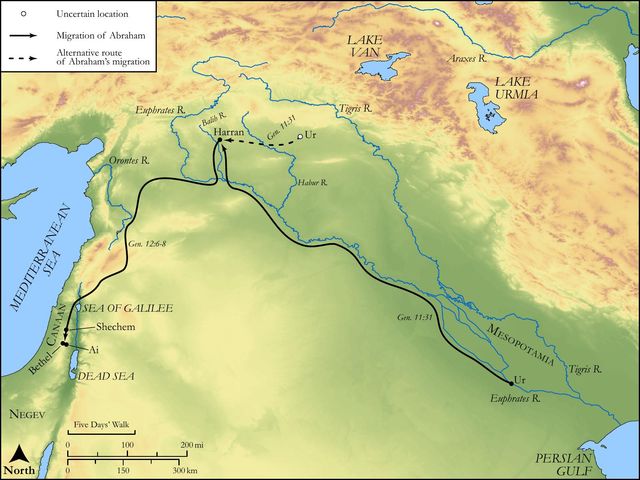
III.His departure out of Ur of the Chaldees, with his father Terah, his nephew Lot, and the rest of his family, in obedience to the call of God, of which we shall read more, Gen 12:1, etc. This chapter leaves them in Haran, or Charran, a place about mid-way between Ur and Canaan, where they dwelt till Terah's head was laid, probably because the old man was unable, through the infirmities of age, to proceed in his journey. Many reach to Charran, and yet fall short of Canaan; they are not far from the kingdom of God, and yet never come thither.
Historical interpretation
Three Centuries of Reception
3 surviving comments on this verse. Each one is dated, so this reads as a timeline rather than a list.
Select a marker to jump to its quote. Markers stagger vertically where authors wrote within a few decades of each other.
(Verse 29) And Abram and Nachor took wives for themselves. The name of Abram's wife was Sarai, and the name of Nachor's wife was Milcah, the daughter of Haran. The father of Milcah was also the father of Iscah. Haran fathered two daughters, Milcah and Iscah, who were both called by the same name. Of these, Milcah became the wife of Nachor, and Sarai became the wife of Abram. At that time, marriage between cousins and between siblings was not yet prohibited by law, as it later became among all people, even among brothers and sisters.
"And Abram and Nahor took them wives: the name of Abram's wife was Sarai; and the name of Nahor's wife Milcah, the daughter of Haran, the father of Milcah, and the father of Iscah." This Iscah is supposed to be the same as Sarai, Abraham's wife.
Abram and Nachor took wives. The name of Abram's wife was Sarai, and the name of Nachor's wife was Melcha, the daughter of Aran, the father of Melcha and the father of Jescha. Our elders say that Jescha is the same as Sarai, the wife of Abraham, since evidently the brothers Abraham and Nachor had two sisters, the daughters of Aran, as wives. But if this is so, Aran, their father, cannot be the one who was the younger brother of Abraham and Nachor, but instead must be another person with the same name. For it is known that Abraham was only ten years older than his wife Sarai, as he himself said before the Lord: "Will a son be born to a hundred-year-old man, and will Sarah at ninety years old bear a child?" (Genesis XVII, 17). And how could his younger brother have a daughter who would be ten years younger than he, while he himself would be only seven or at most eight years older than her?
Continue studying Genesis 11:29 across the web’s major study libraries — every link below opens this exact verse, chapter, or book on the destination site.
Read & Compare
 BibleGatewayThis verse in more than 200 translations and 70 languages.
 Bible.comThe YouVersion reader — hundreds of translations, reading plans, and highlights.
 ESV.orgCrossway's official English Standard Version reader.
 NET BibleThe NET translation with 60,000+ translators' notes on every rendering decision.
 STEP BibleTyndale House's free study tool — original text, vocabulary, and scholarly resources.
 BibliaLogos Bible Software's free web reader.
 USCCBThe New American Bible (Revised Edition) with the U.S. bishops' study notes.
Commentaries
 BibleHub CommentariesDozens of classic commentaries on this verse, gathered on one page.
 StudyLightMore than 100 commentary sets — the largest collection on the web.
 BibleRefPlain-English commentary on what this verse means, verse by verse.
 Enduring WordDavid Guzik's free commentary on this chapter, widely used by Bible teachers.
 Bible Study ToolsVerse commentary alongside Greek and Hebrew study aids.
Original Language & Research
- BibleHub InterlinearThe verse word by word — original language, transliteration, and English.
- BibleHub LexiconEvery word's original-language definition and Strong's entry.
 Blue Letter BibleDeep-study tools — Strong's numbers, concordance, and word studies.
 SefariaThe Hebrew text with Rashi and centuries of Jewish commentary.
Sermons, Hymns & Audio


TrulyRandomVerse is not affiliated with these sites and doesn’t control their content. They’re linked because they’re genuinely useful.
Summary
Genesis 11:29 meticulously records the wives of Abram and Nahor, introducing Sarai as Abram's wife and Milcah as Nahor's wife, who is also identified as the daughter of Haran and sister of Iscah. This seemingly simple genealogical detail is pivotal, establishing the immediate family unit of the patriarch-to-be, Abram, and laying crucial groundwork for the unfolding narrative of God's covenant promises, particularly concerning the lineage and the challenge of barrenness that will define Sarai's role.
Context
ShowHideLiterary Context
This verse is deeply embedded within the lengthy genealogies of Genesis, specifically following the listing of Terah's three sons: Abram, Nahor, and Haran, and immediately preceding the crucial mention of Sarai's barrenness in Genesis 11:30. The book of Genesis shifts from a broad, universal history of humanity (creation, fall, flood, nations, as seen in Genesis 1, Genesis 2, Genesis 3, Genesis 4, Genesis 5, Genesis 6, Genesis 7, Genesis 8, Genesis 9, Genesis 10, Genesis 11) to a focused, particular history of a chosen family, beginning with Abram. These detailed records are not mere historical footnotes but serve a profound theological purpose, meticulously tracing the lineage from Adam through Noah and Shem to Abram, highlighting God's faithfulness in preserving a chosen line through whom His redemptive plan would ultimately unfold. The specific mention of wives here, particularly Sarai, immediately sets the stage for the challenges and divine interventions that will characterize Abram's journey, especially in light of the impending promise of a son and nationhood.
Historical & Cultural Context
The setting of this verse is Ur of the Chaldeans, a highly urbanized and culturally sophisticated city. In this period, lineage and family were paramount, serving as the fundamental units of society, economy, and identity. Marriages, especially within close relatives (endogamy), were common and often preferred practices. Such unions helped maintain family property, preserve tribal identity, and strengthen alliances. The patriarchal narratives frequently illustrate this custom, which, while later restricted under the Mosaic Law (e.g., Leviticus 18), was normative for the time of the patriarchs. The detailed listing of wives and their paternal lineage underscores the importance of proper family records in establishing social standing and inheritance rights within this cultural framework.
Key Themes
ShowHideGenesis 11:29 contributes significantly to several key themes. Firstly, it highlights Divine Sovereignty in Lineage, demonstrating God's meticulous hand in preparing and preserving a specific family line through whom His redemptive purposes will be realized. Even in seemingly mundane genealogical entries, God is at work. Secondly, the verse emphasizes the Significance of Naming, as the specific identification of Sarai and Milcah, unlike other wives in earlier genealogies, signals their crucial roles in the unfolding narrative. This particularity immediately sets the stage for the Preparation for Covenant, as the familial groundwork laid here, especially concerning Abram and Sarai, directly precedes and anticipates God's covenant with Abram in Genesis 12. Finally, the introduction of Sarai, immediately followed by the mention of her barrenness in Genesis 11:30, establishes the theme of Anticipation of Divine Intervention, setting up the need for a miraculous act of God to fulfill His promise of descendants.
Exposition and Analysis
ShowHideKey Word Analysis
ShowHideThis verb (H3947) signifies "to take" in a broad sense, often implying acquisition or reception. In the context of marriage, it denotes the act of a man taking a woman as his wife, formally establishing a household and a legal union. This "taking" was a foundational step in the patriarchal society, signifying the beginning of a new family unit and the continuation of the lineage.
The term (H802) refers to a woman, specifically in the context of being a spouse. In ancient Israelite society, the wife played a crucial role in establishing and maintaining the family, particularly through childbearing, which was essential for the continuation of the family line and the fulfillment of God's promises regarding descendants. The naming of these specific wives underscores their individual importance in the unfolding narrative.
This primitive word (H1) denotes a literal and immediate paternal relationship, but can also extend to figurative or remote applications. In this verse, it precisely identifies Haran as the biological father of Milcah and Iscah, clearly defining the familial relationships within Terah's household and establishing the lineage that will connect Nahor to Rebekah through Milcah.
Verse Breakdown
ShowHide"And Abram and Nahor took them wives"
This opening clause establishes the marital status of Terah's two sons, Abram and Nahor. It signifies the formal establishment of their respective households, a crucial step in the genealogical progression from Terah to the next generation and the continuation of the family line.
"the name of Abram's wife [was] Sarai"
This part specifically identifies Abram's wife as Sarai. Her introduction here is of paramount importance, as her character and, notably, her barrenness (mentioned in the very next verse) will become central to the unfolding narrative of God's covenant with Abram and the miraculous birth of Isaac. Her name, meaning "my princess," hints at her significant, albeit challenging, role.
"and the name of Nahor's wife, Milcah, the daughter of Haran, the father of Milcah, and the father of Iscah"
This clause provides more detailed genealogical information for Nahor's wife, Milcah. It explicitly states that she is the daughter of Haran, who was Abram and Nahor's deceased brother. This means Milcah is Nahor's niece (and Abram's niece), illustrating the common practice of endogamy in the households of the patriarchs. This detail is crucial for understanding the intricate family relationships and will later prove significant as Milcah becomes the grandmother of Rebekah, Isaac's wife, thus connecting two key patriarchal lines. The mention of Iscah as Milcah's sister further clarifies Haran's offspring, though Iscah herself does not play a further role in the biblical narrative.
Literary Devices
ShowHideGenesis 11:29 primarily employs Genealogy as its literary device, meticulously tracing the family line to establish the foundational unit from which God's chosen people will emerge. This is not merely a historical record but a theological statement about God's sovereign preservation of a specific lineage. The Naming of Sarai, Milcah, and Iscah is also significant, highlighting the individual importance of these women within the broader narrative, especially Sarai, whose future role is pivotal. While not explicit in this verse alone, the detailed introduction of Sarai immediately foreshadows the narrative tension that will arise from her barrenness, setting the stage for the miraculous intervention of God necessary to fulfill His promises. The Repetition of "the father of Milcah, and the father of Iscah" emphasizes Haran's paternity and the close familial ties, reinforcing the genealogical precision.
Theological and Thematic Connections
ShowHideThis seemingly simple genealogical entry is profoundly significant, underscoring God's meticulous and sovereign involvement in preparing the way for His redemptive plan. It demonstrates that even the most ordinary details of human relationships and family lines are integral to God's grand narrative. By precisely identifying Abram and Sarai, the verse sets the stage for the challenges and miraculous interventions that will characterize the Abrahamic covenant, highlighting the foundational role of individuals, particularly women, in salvation history. It shows God's faithfulness in preserving a chosen lineage through whom His promises will be realized, anticipating the miraculous fulfillment of those promises despite human limitations.
Reflection and Application
ShowHideGenesis 11:29 reminds us that God's grand redemptive plans often begin with seemingly ordinary human relationships and family details. Even in the meticulous records of lineage, God is actively at work, preparing individuals and families for their unique roles in His overarching story. This encourages us to recognize that every aspect of our lives, including our family histories and connections, has a place in God's sovereign design. It teaches us to appreciate the significance of our own seemingly small details within His larger purpose, knowing that God uses the mundane to accomplish the miraculous. It also highlights that God often works through challenging circumstances, as the introduction of Sarai here immediately precedes the revelation of her barrenness, setting the stage for a divine intervention that will demonstrate His power and faithfulness.
Questions for Reflection
ShowHideFAQ
ShowHideWhy are Abram and Nahor's wives specifically named in this genealogy?
ShowHideThe specific naming of Sarai and Milcah, unlike other wives in earlier genealogies, highlights their crucial roles in the unfolding patriarchal narrative. Sarai's identity as Abram's wife is essential due to her barrenness, revealed in Genesis 11:30, and the subsequent divine miracle of Isaac's birth, which is central to the covenant and the continuation of the promised line. Milcah's lineage is important because she becomes the grandmother of Rebekah, who will marry Isaac (Genesis 24:15-16), thus continuing the lineage of promise. These details are not incidental but foundational to the story of God's chosen people.
What is the significance of Nahor marrying his niece, Milcah?
ShowHideThe marriage of Nahor to Milcah, his niece (daughter of his brother Haran), reflects common marital practices in the households of the patriarchs. Such endogamous marriages (within the family or clan) were often preferred to maintain family property, preserve tribal identity, and strengthen alliances. The Bible records several instances of close-kin marriage among the patriarchs, indicating cultural norms of the time. It is important to note that these practices were later restricted under the Mosaic Law, as seen in passages like Leviticus 18:6-18, which prohibited certain degrees of kinship in marriage.
Christ-Centered Fulfillment
ShowHideWhile Genesis 11:29 is a genealogical entry, it is profoundly Christ-centered in its ultimate fulfillment. By meticulously tracing the lineage of Abram and Sarai, this verse establishes the foundational family unit from which the promised "seed" would eventually come. The introduction of these specific individuals is a crucial step in the unfolding of God's plan to bless all nations through a particular line, a promise that finds its ultimate realization in Jesus Christ. The very existence of this family, and the challenges they faced (like Sarai's barrenness, which immediately follows this verse), underscore the miraculous nature of God's faithfulness in preserving the lineage through which the Messiah, the true Son of Abraham and fulfillment of all covenants, would enter the world. This meticulously preserved lineage, traced through figures like Abram and Sarai in Matthew 1:1-17 and Luke 3:23-38, ultimately points to Christ as the singular "seed" through whom the Abrahamic blessing comes to all who believe, as articulated by Paul in Galatians 3:16. Thus, this seemingly simple verse is a vital thread in the grand tapestry of salvation history, pointing forward to God's ultimate provision in Jesus.