


Job 10:22
Bible text: King James Version (1769 Blayney text) · Public domain
Bible text: Berean Standard Bible · Public domain
Bible text: American Standard Version (1901) · Public domain
Bible text: World English Bible, Messianic edition · Public domain
Bible text: Geneva Bible (1599) · Public domain
Bible text: Young's Literal Translation · Public domain
- אֶרֶץ'E·retz[the] land ofH776N-fscNoun Singular Feminine Construct
- עֵיפָתָה'ei·Fa·tahdarknessH5890N-fsNoun Singular Feminine Absolute
- כְּמוֹke·MolikeH3644PrepPreposition
- אֹפֶל'O·felgloom ofH652N-mscNoun Singular Masculine Construct
- צַלְמָוֶתTzal·ma·vetdeep darknessH6757N-msNoun Singular Masculine Absolute
- וְלֹאve·Lo'and notH3808Conj-w ¦ NegParticle Negativeוְandלֹאnot
- סְדָרִיםse·da·Rimorder<s>H5468N-mpNoun Plural Masculine Absolute
- וַתֹּפַעva·To·fa'and it shone forthH3313Conj-w ¦ V-Hiphil-ConsecImperf-3fsVerb Hiphil Consecutive Imperfect 3rd Singular Feminineוַandתֹּפַעit shone forth
- כְּמוֹke·movlikeH3644PrepPreposition
- אֹפֶל'O·felgloomH652N-msNoun Singular Masculine Absolute
English is a literal word-by-word gloss of the Hebrew, not the KJV's wording. Why?
This is the original text the KJV's translators worked from — each Hebrew word with its own literal English meaning in this verse, prepared by scholars at Tyndale House, Cambridge. The KJV translates whole sentences, not word by word, so its wording differs: one Hebrew word can become several English words, and the KJV may choose “the LORD” where the gloss reads “Yahweh”. Both are faithful — they answer different questions. For the KJV's own rendering, switch to the KJV text.
Details
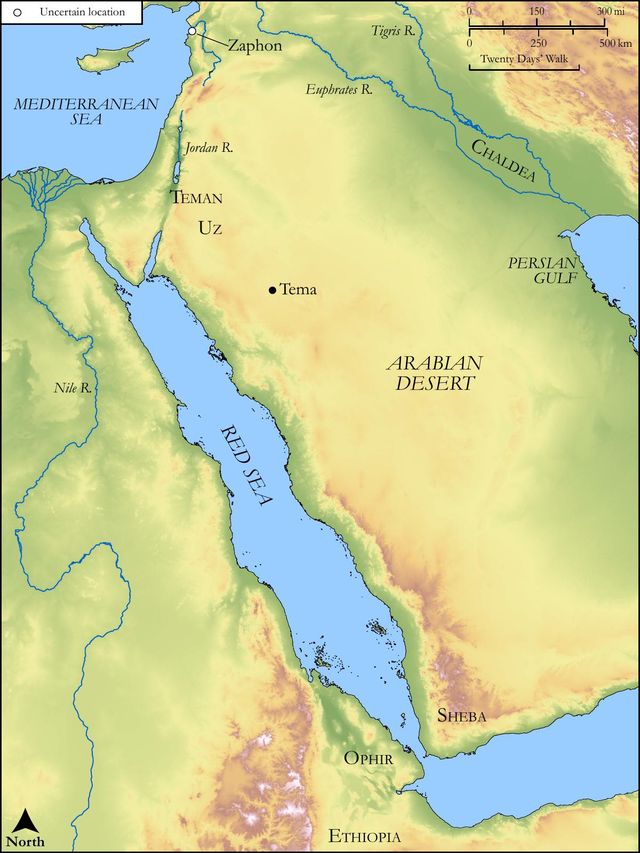
See on the biblical-era map
Study this verse
Public-domain commentary
Matthew Henry
From his Commentary on the Whole Bible. Henry comments on passages, not single verses — this entry covers Job 10:14–22. His three-level outline is real structure in the source text, so it is rendered as structure.
Here we have,
I.Job's passionate complaints.
On this harsh and unpleasant string he harps much, in which, though he cannot be justified, he may be excused. He complained not for nothing, as the murmuring Israelites, but had cause to complain. If we think it looks ill in him, let it be a warning to us to keep our temper better.
1.He complains of the strictness of God's judgment and the rigour of his proceedings against him, and is ready to call it summum jus - justice bordering on severity.
(1.)That he took all advantages against him: "If I sin, then thou markest me, Job 10:14.(1.) If I do but take one false step, misplace a word, or cast a look awry, I shall be sure to hear of it. Conscience, thy deputy, will be sure to upbraid me with it, and to tell me that this gripe, this twitch of pain, is to punish me for that." If God should thus mark iniquities, we should be undone; but we must acknowledge the contrary, that, though we sin, God does not deal in extremity with us.
(2.)That he prosecuted those advantages to the utmost: Thou wilt not acquit me from my iniquity. While his troubles he could not take the comfort of his pardon, nor hear that voice of joy and gladness; so hard is it to see love in God's heart when we see frowns in his face and a rod in his hand.
(3.)That, whatever was his character, his case at present was very uncomfortable, Job 10:15. [1.] If he be wicked, he is certainly undone in the other world: If I be wicked, woe to me. Note, A sinful state is a woeful state. This we should each of us believe, as Job here, with application to ourselves: "If I be wicked, though prosperous and living in pleasure, yet woe to me." Some especially have reason to dread double woes if they be wicked. "I that have knowledge, that have made a great profession of religion, that have been so often under strong convictions, and have made so many fair promises - I that was born of such good parents, blessed with a good education, that have lived in good families, and long enjoyed the means of grace - if I be wicked, woe, and a thousand woes, to me." [2.] If he be righteous, yet he dares not lift up his head, dares not answer as before, Job 9:15. He is so oppressed and overwhelmed with his troubles that he cannot look up with any comfort or confidence. Without were fightings, within were fears; so that, between both, he was full of confusion, not only confusion of face for the disgrace he was brought down to and the censures of his friends, but confusion of spirit; his mind was in a constant hurry, and he was almost distracted, Psa 88:15.
2.He complains of the severity of the execution. God (he thought) did not only punish him for every failure, but punish him in a high degree, Job 10:16, Job 10:17. His affliction was,
(1.)Grievous, very grievous, marvellous, exceedingly marvellous. God hunted him as a lion, as a fierce lion hunts and runs down his prey. God was not only strange to him, but showed himself marvellous upon him, by bringing him into uncommon troubles and so making him prodigy, a wonder unto many. All wondered that God would inflict and that Job could bear so much. That which made his afflictions most grievous was that he felt God's indignation in them; it was this that made them taste so bitter and lie so heavy. They were God's witnesses against him, tokens of his displeasure; this made the sores of his body wounds in his spirit.
(2.)It was growing, still growing worse and worse. This he insists much upon; when he hoped the tide would turn, and begin to ebb, still it flowed higher and higher. His affliction increased, and God's indignation in the affliction. He found himself no better, no way better. These witnesses were renewed against him, that, if one did not reach to convict him, another might. Changes and war were against him. If there was any change with him, it was not for the better; still he was kept in a state of war. As long as we are here in this world we must expect that the clouds will return after the rain, and perhaps the sorest and sharpest trials may be reserved for the last. God was at war with him, and it was a great change. He did not use to be so, which aggravated the trouble and made it truly marvellous. God usually shows himself kind to his people; if at any time he shows himself otherwise, it is his strange work, his strange act, and he does in it show himself marvellous.
3.He complains of his life, and that ever he was born to all this trouble and misery (Job 10:18, Job 10:19): "If this was designed for my lot, why was I brought out of the womb, and not smothered there, or stifled in the birth?" This was the language of his passion, and it was a relapse into the same sin he fell into before. He had just now called life a favour (Job 10:12), yet now he calls it a burden, and quarrels with God for giving it, or rather laying it upon him. Mr. Caryl gives this a good turn in favour of Job. "We may charitably suppose," says he, "that what troubled Job was that he was in a condition of life which (as he conceived) hindered the main end of his life, which was the glorifying of God. His harp was hung on the willow-tress, and he was quite out of tune for praising God. Nay, he feared lest his troubles should reflect dishonour upon God and give occasion to his enemies to blaspheme; and therefore he wishes, O that I had given up the ghost! A godly man reckons that he lives to no purpose if he do not live to the praise and glory of God." If that was his meaning, it was grounded on a mistake; for we may glorify the Lord in the fires. But this use we may make of it, not to be over-fond of life, since the case has been such sometimes, even with wise and good men, that they have complained of it. Why should we dread giving up the ghost, or covet to be seen of men, since the time may come when we may be ready to wish we had given up the ghost and no eye had seen us? Why should we inordinately lament the death of our children in their infancy, that are as if they had not been, and are carried from the womb to the grave, when perhaps we ourselves may sometimes wish it had been our own lot?
II.Job's humble requests. He prays,
1.That God would see his affliction (Job 10:15), take cognizance of his case, and take it into his compassionate consideration. Thus David prays (Psa 25:18), Look upon my affliction and my pain. Thus we should, in our troubles, refer ourselves to God, and may comfort ourselves with this, that he knows our souls in adversity.
2.That God would grant him some ease. If he could not prevail for the removal of his trouble, yet might he not have some intermission? "Lord, let me not be always upon the rack, always in extremity: O let me alone, that I may take comfort a little! Job 10:20. Grant me some respite, some breathing-time, some little enjoyment of myself." This he would reckon a great favour. Those that are not duly thankful for constant ease should think how welcome one hour's ease would be if they were in constant pain. Two things he pleads: - (1.) That life and its light were very short: "Are not my days few? Job 10:20. Yes, certainly they are, very few. Lord, let them not be all miserable, all in the extremity of misery. I have but a little time to live; let me have some comfort of life while it does last." This plea fastens on the goodness of God's nature, the consideration of which is very comfortable to an afflicted spirit. And, if we would use this as a plea with God for mercy ("Are not my days few? Lord, pity me"), we should use it as a plea with ourselves, to quicken us to duty: "Are not my days few? Then it concerns me to redeem time, to improve opportunities, what my hand finds to do to do it with all my might, that I may be ready for the days of eternity, which shall be many." (2.) That death and its darkness were very near and would be very long (Job 10:21, Job 10:22): "Lord, give me some ease before I die," that is, "lest I die of my pain." Thus David pleads (Psa 13:3), "Lest I sleep the sleep of death, and then it will be too late to expect relief; for wilt thou show wonders to the dead?" Psa 88:10. "Let me have a little comfort before I die, that I may take leave of this world calmly, and not in such confusion as I am now in." Thus earnest should we be for grace, and thus we should plead, "Lord, renew me in the inward man; Lord, sanctify me before I die, for otherwise it will never be done." See how he speaks here of the state of the dead. [1.] It is a fixed state, whence we shall not return ever again to live such a life as we now live, Job 7:10. At death we must bid a final farewell to this world. The body must then be laid where it will lie long, and the soul adjudged to that state in which it must be for ever. That had need be well done which is to be done but once, and done for eternity. [2.] It is a very melancholy state; so it appears to us. Holy souls, at death, remove to a land of light, where there is no death; but their bodies they leave to a land of darkness and the shadow of death. He heaps up expressions here of the same import to show that he has as dreadful apprehensions of death and the grave as other men naturally have, so that it was only the extreme misery he was in that made him wish for it. Come and let us look a little into the grave, and we shall find, First, That there is no order there: it is without any order, perpetual night, and no succession of day. All there lie on the same level, and there is no distinction between prince and peasant, but the servant is there free from his master, Job 3:19. No order is observed in bringing people to the grave, not the eldest first, not the richest, not the poorest, and yet every one in his own order, the order appointed by the God of life. Secondly, That there is no light there. In the grave there is thick darkness, darkness that cannot be felt indeed, yet cannot but be feared by those that enjoy the light of life. In the grave there is no knowledge, no comfort, no joy, no praising God, no working out our salvation, and therefore no light. Job was so much ashamed that others should see his sores, and so much afraid to see them himself, that the darkness of the grave, which would hide them and huddle them up, would upon that account be welcome to him. Darkness comes upon us; and therefore let us walk and work while we have the light with us. The grave being a land of darkness, it is well we are carried thither with our eyes closed, and then it is all one. The grave is a land of darkness to man; our friends that have gone thither we reckon removed into darkness, Psa 88:18. But that it is not so to God will appear by this, that the dust of the bodies of the saints, though scattered, though mingled with other dust, will none of it be lost, for God's eye is upon every grain of it and it shall be forth-coming in the great day.
Historical interpretation
Two Centuries of Reception
3 surviving comments on this verse. Each one is dated, so this reads as a timeline rather than a list.
Select a marker to jump to its quote. Markers stagger vertically where authors wrote within a few decades of each other.
Someone could think that Job’s statement comes from desperation, but that is proven wrong by what God has said: “Do you believe I treated you like this for any other reason than to reveal your righteousness?” Job, who previously had said, “If I am wicked, woe to me,” does not contradict this assumption but reveals the bitterness of life. An evil person would not do that, for he rejoices in this [life]. Above all, Job wants to reveal to his friends the reason why he did not die at the moment of his birth, namely, because he was to be an example of energy and strength. According to a different interpretation, even the life in the flesh is indicated, about which Paul writes, “If for this life only we have hoped in Christ, we are of all people most to be pitied.” Job experiences the pleasant as well as the bitter sides of life; no one who has rid himself of the flesh rejoices in wealth or excess, nor is he plagued by hardship. Job has tasted this life and its pleasures, for he was blessed with many good children and was rich and healthy. But since his situation turned into its opposite, he also experienced the reverse of his previous life and acknowledged in real life the vanity of these things. This is why Job teaches us not to long for them by saying, “Why did you bring me forth from the womb? Would that I had died before any eye had seen me, and were as though I had not been.”Job expresses this in the form of a prayer, for his burdens were not light and he endured the pains not without feeling them. For it would not have been manful had he not felt his sufferings. But he teaches that he endured the pain with the help of God’s power, by praying in gratefulness. Paul also expresses this: “It was not I, but the grace of God that is with me.”
Job wants to find relief before he has to go from where he cannot return. Therefore, he does not pray for himself, but to teach the friends who think that those who suffer hardship are evil but those who are free from hardship are righteous. He desired that they should gain certainty regarding the divine resolutions about him. One should not assume that Job denies the resurrection of the dead. Rather, Job says, “From where I will not return to lead a mortal life.” Job knows that he will rise as immortal.
Although the brave one was in pain, he talked about the coming age. So he says—not to deny the resurrection—“Before I go from where I will not return.” Job calls the land “a land of gloom and deep darkness, where light is like darkness,” since the holy one ascribes only little to himself. For it would not have been suitable to say, “Before I am in the kingdom of the heavens and in the land of our promises, my God.” Job wants his listener to be instructed about the divine judgment. There has not yet been restitution for deeds done.
In order to avoid scandalizing many who see his life end in affliction and sadness, it is not without reason that the righteous man asks for the termination of his ordeals. That is why [Job] said, “Before I go, never to return,” evidently, to his human life, as if to say “In fact, if I return down here and receive here the reward of my toils, I will not be worn out and will not renounce the fight to the death in my ordeals. Those who are here, knowing my justice, will see that I receive my reward by coming back here. But if they see me die now in my ordeals, they will either think that Job is wicked or will believe that nothing useful comes from justice.”
96. ‘Misery’ has relation to pain, ‘darkness’ relates to blindness. That land then which holds all those that are banished the presence of the strict Judge, is entitled ‘a land of misery and darkness,’ for pain without torments those, whom blindness darkens within, severed from the true Light. Not but that ‘the land of misery and darkness’ may be understood in another sense also. For this land too, in which we are born, is indeed ‘a land of misery,’ but not ‘of darkness,’ in that we here suffer the many ills of our corrupt condition, yet whilst we are in it, we are still brought back to the light through the grace of conversion; as Truth counsels us, Who saith, Walk while ye have the light, lest darkness come upon you. [John 12, 35] But that land is ‘a land of misery and darkness’ together, for everyone, that has gone down to suffer the woes thereof, never any further returns to the light; for the describing of which same it is further added,
Where is the shadow of death, without any order.
97. As external death divides the flesh from the soul, so internal death severs the soul from God. Thus the ‘shadow of death’ is the darkness of separation, in that every one of the damned, whilst he is consumed with everlasting fire, is in darkness to the internal light. Now it is the nature of fire to give out both light and a property of consuming from itself, but the fire that is the avenger of past sins has a consuming property but no light. It is hence that ‘Truth’ saith to the lost, Depart from Me, ye cursed, into everlasting fire, prepared for the devil and his angels. [Mat. 25, 41] And representing in one individual the whole body of them all, He saith, Bind him hand and foot, and take him away, and cast him into outer darkness. [Mat. 22, 1] Accordingly, if the fire that torments the lost could have had light, he that is cast off would never be said to ‘be cast into darkness.’ Hence too the Psalmist hath it; Fire hath fallen upon them, and they have not seen the sun. [Ps. 58, 8. Vulg.] For ‘fire falls’ upon the ungodly, but ‘the sun is not seen’ on the fire falling; for as the flame of hell devours them, it blinds them to the vision of the true Light, that at the same time both the pain of consuming fire should torment them without, and the infliction of blindness darken them within, so that they, who have done wrong against their Maker both in body and in heart, may at one and the same time be punished in body and in heart, and that they may be made to feel pangs in both ways, who, whilst they lived here, ministered to their depraved gratifications in both. Whence it is well said by the Prophet, Which are gone down to hell with their weapons of war. [Ezek. 32, 37] For the arms of sinners are the members of the body, by means of which they execute the wrong desires they conceive. Hence it is said rightly by Paul, Neither yield ye your members as instruments if unrighteousness unto sin. [Rom. 6, 19] And so to ‘go down into hell with the weapons of war’ is together with those same members, with which they fulfilled the gratifications of self-indulgence, to undergo the torrents of eternal condemnation, that at that time woe may every way swallow them up, who being now subjected to their gratifications, every way fight against His justice, Who judgeth justly.
98. But that is very wonderful that is said, without order, since Almighty God, Who punishes evil things well, never permits even the torments to be ‘without order;’ because [read ‘quia’] the very punishments that proceed from the scales of justice, cannot in any way be inflicted ‘without order.’ For how is it that there is no order in His punishment, since according to the measure of his guilt is likewise the recompense of vengeance which pursues everyone of the damned. For hence it is written, But mighty men, shall be mightily tormented, and stronger torment shall come upon the stronger ones. [Wisd. 6, 6. 8.] Hence it is uttered in the sentence of Babylon, How much she hath glorified herself, and lived deliciously, so much torment and sorrow give her. [Rev. 18, 7] If then the infliction is marked out according to the measure of the sin, it is undeniably true that there is order preserved in the punishments, and except the acts of desert did distribute His aggregate of torment, the Judge that shall come would never declare that He will say to the reapers, Gather ye together first the tares, and bind them in bundles to burn them. [Mat. 13, 30] For if there were no order observed in dealing punishment, why are the tares that are to be burnt bound in bundles? But doubtless to bind up the bundles for the burning, is to unite like to like of those that are destined to be given over to everlasting fire, that all whom a like sin pollutes, an equal punishment may bind in one, and that they who were defiled by iniquity in no degree dissimilar, may suffer by torments not dissimilar either, that condemnation may dash to the earth together those whom pride uplifted together, and that all, whom ambition made to swell in no unlike proportion, no unlike proportion of suffering may wring hard, and a like flame of punishment torment those whom a like flame of sin kindled in the fire of lust. For as in the house of our Father there are ‘many mansions’ [John 14, 2] according to the diversities in virtue, so a difference in guilt subjects the damned to a difference of punishment in the fires of hell, which hell, though it be one and the same for all, by no means burns all men in one and the same sort. For as we are all reached by one sun, yet we do not all glow beneath it in one class; for it is according to the kind of the body that the burthen of the heat too is felt, in the same way there is to the damned, but one hell that torments all, yet not one that consumes all men in one kind of manner, for what on the one side an unequal degree of healthiness in bodies occasions, that same on the other an unequal case of merit produces. How then is it said that there is ‘no order’ in the punishments, wherein without doubt every man is tormented after the measure of his sin?
99. But after the holy man brought in the shadow of death he adds what great disorder there is in the souls of the damned, since the very punishments, which come well ordered by justice, are doubtless far from well ordered in the heart of those undergoing death. For as we have said above, whilst every one of the damned is consumed with flames without, he is devoured by the fire of blindness within, and being in the midst of woe, he is confounded both within and without; so that he is worse tormented by his own confusion. Thus to rejected souls there will be ‘no order’ in their punishment, because their very confusion of mind torments most cruelly in their death; which same His equity in judging appoints by His wonderful power, that a punishment as it were ‘without order’ may confound the soul. Or, verily, order is said to be wanting to His punishments, in that when things arise for their punishment, their proper character is not preserved to them. Whence the words are forthwith introduced;
And everlasting horror dwells.
100. In the torments of this life fear has pain, pain has no fear, in that pain never torments the mind, when it has already begun to suffer what it feared. But hell both ‘the shadow of death’ darkens and ‘everlasting horror inhabits;’ in that they all, that are given over to its fires, both in their punishments undergo pain, and, in the pressure of pain coming upon them, they are ever stricken with fear, so that they both suffer what they dread, and unceasingly dread What they are suffering. For it is written concerning them, For their worm shall not die, neither their fire be quenched. [Is. 66, 24] Here the flame that burns gives light; There, as we have shown by the words of the Psalmist, the fire that torments veils the light. Here fear is gone so soon as the thing that was feared has begun to be suffered; There pain rends at the same time that fear pinches. Thus in a horrible manner there will then be to the damned pain along with terror, a flame together with dimness. Then, then, alas! the weight of heavenly equity must be felt by the damned, that they who whilst they lived were not afraid to be at variance with the Will of the Creator, may one day in their destruction find their very torments at variance with their own properties, that in proportion as they are at strife with themselves, their torments may be increased, and as they issue in diverse lines may be felt in many ways. And these punishments doth torture those that are plunged therein beyond their powers, and at the same time preserve them alive, extinguishing in them the forces of life, that the end may so afflict the life, that torment may ever live without end, in that it is both hastening after an end through torments, and failing holds on without end. Therefore there is done upon the wretches death without death, an end without ending, failing without failing; in that both death lives, and the end is ever beginning, and the failing is unable to fail. Therefore whereas death at the same time slays and does not extinguish, pain torments but does not banish fear, the flame burns but does not dispel the darkness, for all that is gathered from a knowledge of the present life, the punishments are without order, in that they do not retain their own character through all particulars.
101. Though there the fire both gives no light for comfort, yet, that it may torment the more, it does give light for a purpose. For the damned shall see, by the flame lighting them, all their followers along with themselves in torment, for the love of whom they transgressed, that whereas they had loved the life of such in a carnal manner against the precepts of the Creator, the destruction of those very persons may also afflict them for the increase of their condemnation. Which doubtless we gather from the testimony of the Gospel, wherein, as ‘Truth’ declares, that rich man, whose lot it was to descend into the torments of eternal fire, is described as remembering his five brethren, in that he asked of Abraham that he would send to them for their instruction, lest a like punishment should torment them coming thither at some future time. Therefore it is plain without doubt that he who remembers his absent kindred to the increase of his pain might a little while after even see them present to his eyes to the augmentation of his punishment. But what wonder is it if he beholds the damned also burnt along with himself, who to the increase of his woe saw that Lazarus whom he has scorned in the bosom of Abraham. He, therefore, to whom the very Elect Saint appeared, that his pangs might, be added to, why are we not to believe that he might behold in punishment those, whom he had loved in opposition to God? From which it is collected, that those whom the sons of perdition now love with inordinate affection, by a marvellous disposition of judgment, they will then see their fellows in torment; that the carnal tie, which was preferred to their Maker, may increase the pangs of their own punishment, being cursed before their eyes by a like retribution. Thus the fire that torments in darkness must be supposed to preserve light for torture. And if we cannot prove this from testimonies by the expression of the very thing, then it remains that we show it from the reverse.
102. For the Three Children of the Hebrew People, when the fire of the furnace was kindled by command of the king of Chaldaea, were cast into it with hands and feet tied. Yet when that king commiserating them sought them in the fire of the furnace, he saw them walking about with untouched garments. Where it is plain to infer, that by the wonderful dispensation of our Creator, the property of fire, being modified into an opposite power, at the same time never touched their garments, and yet burnt their chains, and for those holy men the flame was both cooled for the infliction of torment, and burnt out for the service of unbinding. And so as fire knows how to burn to the Elect in consolation, and yet knows not how to burn in punishment, so in the reverse case, at the same time that the flame of hell yields no light to the damned in the grace of consolation, it does yield light in punishment, that the fire of punishment may both glow with no brightness to the eyes of the damned, and for the increase of their pain may show how the objects of their affection are tormented. And what wonder is it if we suppose that hell fire contains at the same time the infliction of darkness and of light, when we know by experience that the flame of torches too burns and is dark. The devouring flame then consumes those, whom carnal gratification now pollutes. The gaping and immeasurable gulf of hell swallows up Then all whom vainglory exalts now, and they who by any sinful practice fulfilled here below the will of the crafty counsellor, then being cast off are brought to torments along with their leader.
103. And though there is a great difference between the nature of men and angels, yet those are involved in one and the same punishment, who are bound by one and the same guilt in sin. Which is well and shortly conveyed by the Prophet, when he says, Asshur is there and all his company: his graves are about him. [Ezek. 32, 22] For who is set forth by the title of Asshur, the proud king, saving that old enemy who fell by pride, who for that he draws numbers into sin, descends with all his multitude into the dungeons of hell. Now ‘graves’ are a shelter for the dead. And what other suffered a bitterer death than he, who, in setting his Creator at nought, forsook life? And when human hearts admit him in this state of death, assuredly they become his graves. Now ‘his graves are about him,’ in that all in whose souls he now buries himself by their affections, hereafter he joins to himself by torments. And whereas the lost now admit evil spirits within themselves by committing unlawful deeds, then the graves will burn together with the dead.
104. See how we are informed, what punishment is in store for the damned, and, by Holy Writ instructing us, have no reason to question, how great may be the fire in damnation, how great the darkness in that fire, how great the terror in that darkness. But what does it advantage us to foreknow these things, if it is not our lot to escape them? Therefore with the whole bent of our mind, we must make it our business, that when the opportunity of being at liberty is ours, by application to living well, we escape the avenging torments of evil doers. For it is hence said by Solomon, Whatsoever thy hand findeth to do, do it with thy might; for there is no work, nor device, nor knowledge, nor wisdom, in the grave, whither thou goest. [Eccles. 9, 10] Hence Isaiah saith, Seek ye the Lord while He may be found, call ye upon Him while He is near. [Is. 55, 6] Hence Paul says, Behold now is the accepted time; behold now is the day of salvation. [2 Cor. 6, 2] Hence he says again, Whilst we have opportunity, let us do good unto all men. [Gal. 6, 10]
105. But very often the soul girds itself up to walk in the way of uprightness, shakes off sloth, and is so transported into heavenly realms in affection, that it well nigh seems that there is nothing of it left here below; and yet when it is brought back to take account of the flesh, without which the course of the present life can never be accomplished, this keeps it weighed down below, as if it had not as yet reached aught of things above. When the words of the heavenly oracle are heard, the soul is uplifted into love of the heavenly land; but when the occupation of the present life rises up anew, it is buried under the heap of earthly cares, and the seed of the hope above comes to nothing in the soil of the heart, because the thorn of care below grows rank. Which same thorn ‘Truth’ uproots with the hand of holy exhortation by Himself, saying, Take therefore no thought for the morrow. [Matt. 6, 34] And in opposition to this, it is said by Paul, Make not provision for the flesh to fulfil the lusts thereof. [Rom. 13, 14] But in, these words of the Captain and the soldier we see that the soul is then pierced thereby with a mortal wound, when a balance of measure is not kept therein.
106. For whilst we still live in mortal flesh, concern for the flesh is not wholly cut away from us; but it is regulated so that it should serve the mind as discretion dictates. For whereas ‘Truth’ forbids us to be anxious for the morrow, He does not deny us to take thought in a certain way for the present things, which He does forbid us to extend to the time that succeeds. And truly while Paul will not let provision be made for the flesh in the lusts thereof, most certainly he does permit it to be made in things of necessity. Thus the care of the flesh must be restrained under the discreet guidance of a complete control, that it may always obey and never rule, that it may not as a mistress bring the soul under its power, but being subjected to the dominion of the mind, may like a handmaid wait in attendance, that it may come when bidden, and when repressed dart off at a beck of the heart; that it may scarcely show itself in the rear of holy thought, and never present itself to one front to front when full of right thoughts. Which is well conveyed to us in the account contained in the sacred Lesson, when Abraham is related to have met the three Angels. [Gen. 18, 2. 9. &c.] For he met them by himself, as they were coming, without the door of the tent, but Sarah stood behind the door; for the Man and the master as it were of the spiritual house, i.e. our understanding, ought, in the acknowledgment of the Trinity, to issue out of the close chamber of the flesh, and, as it were, to go forth out of the door of his dwelling-place below; but let care of the flesh, as a woman, not show herself out of doors, and let her be ashamed to display herself ostentatiously, that being as it were behind the back of the husband, under the discreet guidance of the Spirit, busied with necessary things alone, she may learn never to go wantonly uncovered, but to be regulated by modesty. But oftentimes, when she is charged never to presume on herself, but to resign herself wholly to undoubting hope in God, she turns away her ear, and disbelieves that, her exertions ceasing, the means of life can be forthcoming to her. And hence this same Sarah, upon hearing the promises of God, laughs, and for laughing is chidden, and still, so soon as she is chidden, she is made a fruitful mother. And she who in the vigour of youth had no power to conceive, when broken by the years of age, conceived in a withered womb; in that when care of the flesh has ceased to entertain confidence in self, by promise from God it receives against hope that which from human reasoning it doubted its ever obtaining. Hence he that is begotten is well called Isaac, i.e. ‘laughing,’ in that when it conceives sureness of hope in the Highest, what else does our mind give birth to but joy? Therefore we must take heed lest care of the flesh either transgress the limits of necessity, or in that which it discharges with moderation, presume on itself. For oftentimes the mind is betrayed to account that to be necessary, which it desires for pleasure, so that it reckons all that takes its fancy to be ‘the useful’ that we owe to life. And often because the effect follows the forecasting, the mind is lifted up in self-confidence. And when that is in its hand which is lacking to the rest, it exults in secret thought for the greatness of its foresight, and is so much the further removed from real foresight, in proportion as it is ignorant of the exaltation that it is feeling. Therefore we ought to bethink ourselves, with a heedful earnestness of vigilance, whether of what we execute in deed or what we revolve in heart, lest either earthly care, to the incumbrand of the mind, be multiplied without, or at least lest the spirit be lifted up within for its control thereof; that whilst we dread the judgment of God with temporal heed, we may escape the woes of ‘everlasting horror.’
Continue studying Job 10:22 across the web’s major study libraries — every link below opens this exact verse, chapter, or book on the destination site.
Read & Compare
 BibleGatewayThis verse in more than 200 translations and 70 languages.
 Bible.comThe YouVersion reader — hundreds of translations, reading plans, and highlights.
 ESV.orgCrossway's official English Standard Version reader.
 NET BibleThe NET translation with 60,000+ translators' notes on every rendering decision.
 STEP BibleTyndale House's free study tool — original text, vocabulary, and scholarly resources.
 BibliaLogos Bible Software's free web reader.
 USCCBThe New American Bible (Revised Edition) with the U.S. bishops' study notes.
Commentaries
 BibleHub CommentariesDozens of classic commentaries on this verse, gathered on one page.
 StudyLightMore than 100 commentary sets — the largest collection on the web.
 BibleRefPlain-English commentary on what this verse means, verse by verse.
 Enduring WordDavid Guzik's free commentary on this chapter, widely used by Bible teachers.
 Bible Study ToolsVerse commentary alongside Greek and Hebrew study aids.
Original Language & Research
- BibleHub InterlinearThe verse word by word — original language, transliteration, and English.
- BibleHub LexiconEvery word's original-language definition and Strong's entry.
 Blue Letter BibleDeep-study tools — Strong's numbers, concordance, and word studies.
 SefariaThe Hebrew text with Rashi and centuries of Jewish commentary.
Sermons, Hymns & Audio


TrulyRandomVerse is not affiliated with these sites and doesn’t control their content. They’re linked because they’re genuinely useful.
Summary
Job 10:22 serves as the chilling culmination of Job's lament, painting a stark, poetic portrait of the grave (Sheol) as a terrifying, chaotic realm. It is depicted as a land of absolute, oppressive darkness, where even the faintest glimmer of light is indistinguishable from gloom, and all semblance of divine order is absent. This verse encapsulates the profound depth of Job's despair and his perception of death not as a peaceful rest, but as an ultimate descent into an oppressive, disordered void, reflecting the overwhelming nature of his suffering and his feeling of abandonment by God.
Context
ShowHideLiterary Context
Job 10:22 functions as the climactic and most vivid descriptor in Job's extended lament, which spans from Job 3 through Job 14. Specifically, within Job 10, Job transitions from directly challenging God's motives and actions (as seen in Job 10:1-7) to pleading for respite from his unbearable suffering, even if that respite comes through death (as expressed in Job 10:18-22). Having questioned why he was ever born (Job 10:18) and begged for a brief moment of peace before his demise (Job 10:20-21), this verse provides the ultimate, most terrifying imagery of the destination he envisions. It is the final, most desperate articulation of his anticipated end, emphasizing the utter bleakness of the grave as he perceives it—a place that offers escape from pain but no solace, hope, or divine presence. This profound description sets the stage for the subsequent dialogues with his friends, who will attempt to impose their rigid theological frameworks on Job's raw anguish.
Historical & Cultural Context
In Hebrew thought, the concept of the afterlife, often referred to as Sheol, was generally understood as a shadowy, subterranean realm where all the dead, whether righteous or wicked, descended. It was not typically conceived as a place of individual reward or punishment in the developed sense of later theological traditions, but rather as a realm of diminished existence, silence, and inactivity. Crucially, it was perceived as a place cut off from the vibrant world of the living and, more significantly, from the active, life-giving presence of God. This understanding is reflected in various Old Testament passages, such as Psalm 88:10-12 which describes the dead as unable to praise God, and Isaiah 38:18. Job's description of Sheol as "a land of darkness" and "without any order" aligns with this general Hebrew understanding, emphasizing its grim, chaotic, and hopeless nature from a human perspective. It is vital to recognize that Job's lament is a personal, poetic expression of profound despair, not a systematic theological treatise on the afterlife, though it draws heavily upon prevailing cultural understandings of death and the grave.
Key Themes
ShowHideThis verse powerfully contributes to several pervasive themes within the Book of Job. Primarily, it underscores the theme of profound despair and suffering, illustrating the depths of Job's anguish where death, even a terrifying one, seems preferable to his current torment. It also delves into the nature of Sheol from Job's perspective, portraying it as a realm of absolute darkness, chaos, and the "shadow of death," contrasting sharply with the divine order and light that Job once knew and desperately yearned for. This chaotic depiction of the grave ("without any order") highlights Job's perception of a world, and even an afterlife, that has lost its divine structure and meaning in the face of his inexplicable suffering. The verse further emphasizes the perceived absence of God's presence in this realm of death, a stark contrast to the light and life associated with God in passages like Psalm 36:9 ("For with you is the fountain of life; in your light we see light."). Job's lament thus serves as a raw human cry against the perceived injustice and chaos of his world, where even the hope of an ordered afterlife is extinguished, reflecting a soul grappling with the profound mystery of divine sovereignty and human suffering.
Exposition and Analysis
ShowHideKey Word Analysis
ShowHideThis word, repeated for emphasis ("darkness, as darkness itself" and "light is as darkness"), denotes not merely the absence of light but a thick, oppressive, and often terrifying gloom. It signifies dusk, obscurity, or privily. In biblical thought, "darkness" can symbolize evil, judgment, ignorance, and chaos, as seen in the primeval state of creation in Genesis 1:2. Here, its repetition intensifies the sense of an absolute, impenetrable void, far beyond mere night, emphasizing a total lack of clarity, warmth, or hope.
This is a powerful compound term, literally meaning "shade of death." It conveys a much deeper sense of mortal gloom, extreme peril, and the very darkness of the grave. It implies a place where death casts its oppressive, inescapable pall, signifying ultimate despair and the very brink of annihilation. This poignant term is also found in Psalm 23:4, where the psalmist walks through "the valley of the shadow of death."
This word means "arrangement" or "sequence." The phrase "without any order" (Hebrew, lo' çeder') profoundly conveys a state of utter disarray, chaos, and lawlessness. Çeder implies divine structure, proper arrangement, or a natural sequence. The negation, lo' çeder, therefore describes a place utterly devoid of structure, purpose, or divine governance. For Job, who once experienced a well-ordered life under God's blessing, this description of the grave as chaotic underscores his complete disillusionment and the perceived breakdown of all divine and natural order in his world.
Verse Breakdown
ShowHide"A land of darkness, as darkness [itself; and] of the shadow of death"
This opening clause immediately establishes the grim nature of the "land" (Sheol/the grave) Job imagines. The repetition of "darkness" (using the KJV's "as darkness [itself]") functions as a superlative, emphasizing an absolute, unmitigated gloom. It is not merely dimly lit, but the very essence of darkness, a place where light has no dominion. The addition of "the shadow of death" intensifies this imagery, painting a picture of a place where death's oppressive, inescapable presence is palpable and all-encompassing, a realm of ultimate peril and despair.
"without any order"
This crucial phrase highlights the chaotic and disordered nature of this realm. In stark contrast to the divinely ordered creation (e.g., Genesis 1) and the structured, purposeful life Job once knew, the grave is depicted as a place where all form, structure, and divine arrangement are absent. It is a realm of lawlessness and utter disarray, reflecting Job's current experience of a life that feels similarly devoid of divine logic or justice, where his suffering seems to defy any rational explanation or divine purpose.
"and [where] the light [is] as darkness"
This final clause is a powerful oxymoron, serving as the ultimate expression of hopelessness. It means that even if there were any semblance of light (Hebrew, yâphaʻ, H3313, "to shine"), it would be so distorted, so minimal, or so utterly overwhelmed by the pervasive gloom that it would be indistinguishable from darkness itself. This hyperbole underscores Job's complete disillusionment, where even the fundamental distinction between light and dark, hope and despair, has collapsed, mirroring his internal state of utter spiritual and emotional desolation. It suggests a place where the very nature of reality is inverted, and all hope for illumination or understanding is extinguished.
Literary Devices
ShowHideJob 10:22 is exceptionally rich in Imagery, painting a vivid and terrifying picture of the grave. The repeated use of "darkness" and "shadow of death" creates a pervasive atmosphere of impenetrable gloom and profound despair. The phrase "as darkness itself" employs Simile to emphasize the absolute nature of this darkness, suggesting it is not merely dark, but the very embodiment or essence of darkness. Hyperbole is powerfully evident in the description "the light is as darkness," which exaggerates the absence of hope, clarity, and life to an extreme degree, indicating that any potential for relief or understanding is utterly extinguished. The entire verse functions as a profound Metaphor for Job's internal state—a soul plunged into a chaotic, incomprehensible darkness, where all order has collapsed and hope has vanished. The structure also exhibits a form of Parallelism, where each descriptive clause ("land of darkness," "shadow of death," "without any order," "light is as darkness") cumulatively builds on and intensifies the overarching theme of utter desolation and chaos.
Theological and Thematic Connections
ShowHideJob's grim portrayal of the grave in Job 10:22 reflects a common, though not exhaustive, Old Testament understanding of Sheol as a shadowy, silent realm of diminished existence, cut off from the land of the living and the active presence of God. This perspective underscores the profound human struggle with suffering and the fear of the unknown beyond death, particularly when divine order seems to have collapsed in one's earthly experience. However, this lament, while deeply personal and culturally informed, does not represent the full biblical revelation concerning life after death or God's sovereignty over all realms. Later biblical revelation, especially in the New Testament, profoundly transforms this understanding, presenting a vibrant hope that transcends the darkness Job describes, revealing God's ultimate dominion even over death and the grave.
Reflection and Application
ShowHideJob 10:22 offers a raw, unfiltered glimpse into the depths of human despair when suffering seems endless and God's presence feels agonizingly absent. It reminds us that it is permissible to articulate our deepest fears and anxieties, even about death and the unknown, before God. Job's lament validates the experience of those who feel overwhelmed by life's chaos, where "light is as darkness" and order seems to have vanished. While his understanding of the afterlife is limited by his historical context, his honesty serves as a powerful reminder of the human need for hope, order, and divine presence in the face of mortality. For us, this verse highlights the profound contrast between Job's grim outlook and the transformative hope offered in Christ. It compels us to consider where we find our ultimate order and light, especially when life descends into chaos and meaning seems to dissipate. It challenges us to minister with profound empathy to those in deep despair, acknowledging their pain and validating their struggle, while gently pointing to the greater light, ultimate order, and eternal purposes found in God's redemptive plan through Christ.
Questions for Reflection
ShowHideFAQ
ShowHideWhat is "Sheol" in the Old Testament, and how does Job's description relate to it?
ShowHideIn the Old Testament, "Sheol" (often translated as "the grave," "the pit," or "the underworld") refers to the common abode of the dead. It was generally conceived as a shadowy, subterranean realm, a place of silence and inactivity, where the dead existed in a diminished state, cut off from the vibrant world of the living and, crucially, from active communion with God. Job's description of this "land of darkness, as darkness [itself; and] of the shadow of death, without any order, and [where] the light [is] as darkness" aligns with and intensifies this prevailing Hebrew view. It emphasizes the grim, chaotic, and hopeless aspects of Sheol, reflecting Job's personal despair rather than a definitive theological statement. While the Old Testament occasionally hints at God's sovereignty even over Sheol (e.g., Psalm 139:8), Job's lament here focuses on its terrifying, chaotic nature from his suffering perspective.
Does Job 10:22 offer a definitive theological statement about the afterlife?
ShowHideNo, Job 10:22 is not presented as a definitive theological statement about the afterlife in the same way that, for example, New Testament passages on resurrection are. Instead, it is a deeply poetic and desperate expression of Job's personal anguish and his perception of death as an escape from his unbearable suffering. It reflects the common Hebrew understanding of Sheol as a dark and chaotic place, but it is filtered through the intense lens of Job's profound despair and disillusionment. The Bible's understanding of the afterlife develops progressively throughout its narrative, with later revelations, particularly through Christ's resurrection, offering a much fuller and more hopeful picture of life beyond the grave. Job's lament highlights the raw human experience of suffering and the limited understanding of divine purposes in the face of inexplicable pain, serving as a poignant cry from the depths of human experience rather than a systematic doctrine.
Christ-Centered Fulfillment
ShowHideJob 10:22, with its chilling depiction of death as a "land of darkness... without any order, and where the light is as darkness," stands in stark contrast to the glorious reality revealed in Jesus Christ. Where Job saw an ultimate descent into chaos and an absolute absence of light, Christ bursts forth as the very embodiment of divine order, radiant light, and eternal life. Jesus declared, "I am the light of the world. Whoever follows me will not walk in darkness, but will have the light of life", directly confronting the pervasive gloom Job lamented. His resurrection from the dead fundamentally redefines the "shadow of death," transforming it from a terrifying abyss into a conquered foe. Through Christ, death is no longer the final word or a chaotic void, but a passage to eternal life in God's presence. As the Apostle Paul triumphantly proclaims, "Death is swallowed up in victory" because of Christ's triumph over the grave and His power to bring order out of chaos. The disordered realm Job imagined is utterly overcome by the perfect order and radiant presence of God in the New Heavens and New Earth, where "there will be no more night... for the Lord God will be their light" and "the Lamb is its lamp". Thus, Job's desperate cry for an end to suffering, even in a land of darkness, ultimately points to the One who brings true light, ultimate order, and eternal hope to all who believe.