


Genesis 11:28
Bible text: King James Version (1769 Blayney text) · Public domain
Bible text: Berean Standard Bible · Public domain
Bible text: American Standard Version (1901) · Public domain
Bible text: World English Bible, Messianic edition · Public domain
Bible text: Geneva Bible (1599) · Public domain
Bible text: Young's Literal Translation · Public domain
- וַיָּמָתvai·Ya·motand he diedH4191Conj-w ¦ V-Qal-ConsecImperf-3msVerb Qal Consecutive Imperfect 3rd Singular Masculineוַandיָּמָתhe died
- הָרָןha·RanHaranH2039N-proper-mNoun Proper Masculine
- עַל'alonH5921PrepPreposition
- פְּנֵיpe·Nei[the] face ofH6440N-mpcNoun Plural Masculine Construct
- תֶּרַחTe·rachTerahH8646N-proper-mNoun Proper Masculine
- אָבִיו'a·Vivhis fatherH1N-msc ¦ 3msNoun Singular Masculine Constructאָבִיfatherוhis
- בְּאֶרֶץbe·'E·retzin [the] land ofH776Prep-b ¦ N-fscNoun Singular Feminine Constructבְּinאֶרֶץ[the] land of
- מוֹלַדְתּוֹmo·lad·Tohis kindredH4138N-fsc ¦ 3msNoun Singular Feminine Constructמוֹלַדְתּkindredוֹhis
- בְּאוּרbe·'Urin UrH218Prep-b ¦ N-properNoun Proper LocationבְּinאוּרUr
- כַּשְׂדִּיםkas·Dimof [the] ChaldeansH3778N-properNoun Proper Location
English is a literal word-by-word gloss of the Hebrew, not the KJV's wording. Why?
This is the original text the KJV's translators worked from — each Hebrew word with its own literal English meaning in this verse, prepared by scholars at Tyndale House, Cambridge. The KJV translates whole sentences, not word by word, so its wording differs: one Hebrew word can become several English words, and the KJV may choose “the LORD” where the gloss reads “Yahweh”. Both are faithful — they answer different questions. For the KJV's own rendering, switch to the KJV text.
Details
See on the biblical-era maps


Study this verse
Public-domain commentary
Matthew Henry
From his Commentary on the Whole Bible. Henry comments on passages, not single verses — this entry covers Genesis 11:27–32. His three-level outline is real structure in the source text, so it is rendered as structure.
Here begins the story of Abram, whose name is famous, henceforward, in both Testaments. We have here,
I.His country:
Ur of the Chaldees. This was the land of his nativity, an idolatrous country, where even the children of Eber themselves had degenerated. Note, Those who are, through grace, heirs of the land of promise, ought to remember what was the land of their nativity, what was their corrupt and sinful state by nature, the rock out of which they were hewn.
II.His relations, mentioned for his sake, and because of their interest in the following story.
1.His father was Terah, of whom it is said (Jos 24:2) that he served other gods, on the other side of the flood, so early did idolatry gain footing in the world, and so hard is it even for those that have some good principles to swim against the stream. Though it is said (Gen 11:26) that when Terah was seventy years old he begat Abram, Nahor, and Haran (which seems to tell us that Abram was the eldest son of Terah, and was born in his seventieth year), yet, by comparing Gen 11:32, which makes Terah to die in his 205th year, with Act 7:4 (where it is said that he was but seventy-five years old when he removed from Haran), it appears that he was born in the 130th year of Terah, and probably was his youngest son; for, in God's choices, the last are often first and the first last. We have,
2.Some account of his brethren.
(1.)Nahor, out of whose family both Isaac and Jacob had their wives.
(2.)Haran, the father of Lot, of whom it is here said (Gen 11:28) that he died before his father Terah. Note, Children cannot be sure that they shall survive their parents; for death does not go by seniority, taking the eldest first. The shadow of death is without any order, Job 10:22. It is likewise said that he died in Ur of the Chaldees, before the happy removal of the family out of that idolatrous country. Note, It concerns us to hasten out of our natural state, lest death surprise us in it.
3.His wife was Sarai, who some think, was the same with Iscah, the daughter of Haran. Abram himself says of her that she was the daughter of his father, but not the daughter of his mother, Gen 20:12. She was ten years younger than Abram.
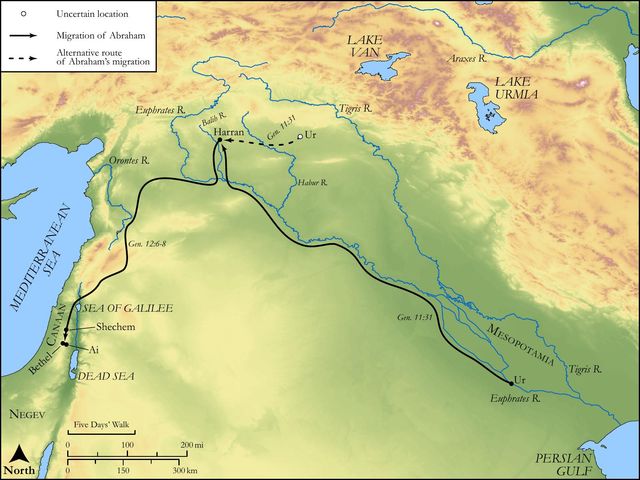
III.His departure out of Ur of the Chaldees, with his father Terah, his nephew Lot, and the rest of his family, in obedience to the call of God, of which we shall read more, Gen 12:1, etc. This chapter leaves them in Haran, or Charran, a place about mid-way between Ur and Canaan, where they dwelt till Terah's head was laid, probably because the old man was unable, through the infirmities of age, to proceed in his journey. Many reach to Charran, and yet fall short of Canaan; they are not far from the kingdom of God, and yet never come thither.
Historical interpretation
Three Centuries of Reception
3 surviving comments on this verse. Each one is dated, so this reads as a timeline rather than a list.
Select a marker to jump to its quote. Markers stagger vertically where authors wrote within a few decades of each other.
(Chapter 11, Verse 28) And Haran died before his father in the land of his birth, in the region of the Chaldeans. As we read, in the region of the Chaldeans, in Hebrew it is written, in Ur of the Chaldeans, that is, in the fire of the Chaldeans. However, the Hebrews relate a legend from this occasion: that Abraham was thrown into the fire because he refused to worship the fire that the Chaldeans worship, and with God's help, he was freed and escaped from the fire of idolatry. This is written in the following passages, that Terah went out with his family from the region of the Chaldeans, for which it is written in Hebrew, from the burning of the Chaldeans. And this is what is now said: Aran died before the sight of his father Thare in the land of his nativity, in the fire of the Chaldeans: namely, because he did not wish to adore the fire, he was consumed by the fire. But the Lord spoke afterwards to Abraham: I am the one who brought you out of the fire of the Chaldeans.
“And Aran [Haran] died before his father in the land in which he was born in the territory of the Chaldeans.” In place of what we read [in the LXX] as “in the territory of the Chaldeans,” in the Hebrew it has “in ur Chesdim,” that is, “in the fire of the Chaldeans.” Moreover the Hebrews, taking the opportunity afforded by this verse, hand on a story of this sort to the effect that Abraham was put into the fire because he refused to worship the fire, which the Chaldeans honor, and that he escaped through God’s help and fled from the fire of idolatry. What is written [in the LXX] in the following verses, that Thara [Terah] with his offspring “went out from the territory of the Chaldeans,” stands in place of what is contained in the Hebrew, “from the fire of the Chaldeans.” And they maintain that this refers to what is said in this verse: “Aran died before the face of Thara in the land of his birth in the fire of the Chaldeans”; that is, because he refused to worship fire, he was consumed by fire.
Moreover, Aran begot Lot, and Aran died before his father Thare in the land of his birth, in Ur of the Chaldeans. What is said before Thare may designate both presence and time; time, evidently, because he died before his father; presence, indeed, because he passed away before him, that is, in his presence. Finally, some Codices have that he died before the face of his father Thare. That what is said in Ur of the Chaldeans seems to be the name of the place where he was buried; whose tomb, as Josephus reports, is shown today, from which it seems that the same Aran had been of some great excellence or dignity. Moreover, because among the Hebrews Ur means Fire, they narrate that he was consumed by the fire of the Chaldeans; because clearly, recognizing the true God with Abraham, his elder brother, he refused to worship the fire which they worshipped; and thus, both being cast into the fire by the Chaldeans, he was consumed by the flames; but Abraham, by the merit of his higher faith, was delivered by the Lord: hence it speaks to him subsequently: I am the Lord, who brought you out of the fire of the Chaldeans; and on account of this dissension of Abraham, although he escaped the fire, he could not dwell among the Chaldeans; but with his kindred, he was transferred by his parent to another land: with which agree the words of Achior, the leader of all the Moabites and Ammonites, who, as a renowned man, could not ignore what had happened in the nearby and related people, indeed from whom he himself had sprung: for speaking of the people of Israel to Holofernes, the leader of the Assyrian army, he says: This people is from the lineage of the Chaldeans: they first dwelt in Mesopotamia because they refused to follow the Gods of their fathers, who were in the land of the Chaldeans. Forsaking therefore the ceremonies of their fathers, which were among the multitude of gods, they worshiped the one God of heaven, who also commanded them to leave there and dwell in Haran (Judith 5:6).
Continue studying Genesis 11:28 across the web’s major study libraries — every link below opens this exact verse, chapter, or book on the destination site.
Read & Compare
 BibleGatewayThis verse in more than 200 translations and 70 languages.
 Bible.comThe YouVersion reader — hundreds of translations, reading plans, and highlights.
 ESV.orgCrossway's official English Standard Version reader.
 NET BibleThe NET translation with 60,000+ translators' notes on every rendering decision.
 STEP BibleTyndale House's free study tool — original text, vocabulary, and scholarly resources.
 BibliaLogos Bible Software's free web reader.
 USCCBThe New American Bible (Revised Edition) with the U.S. bishops' study notes.
Commentaries
 BibleHub CommentariesDozens of classic commentaries on this verse, gathered on one page.
 StudyLightMore than 100 commentary sets — the largest collection on the web.
 BibleRefPlain-English commentary on what this verse means, verse by verse.
 Enduring WordDavid Guzik's free commentary on this chapter, widely used by Bible teachers.
 Bible Study ToolsVerse commentary alongside Greek and Hebrew study aids.
Original Language & Research
- BibleHub InterlinearThe verse word by word — original language, transliteration, and English.
- BibleHub LexiconEvery word's original-language definition and Strong's entry.
 Blue Letter BibleDeep-study tools — Strong's numbers, concordance, and word studies.
 SefariaThe Hebrew text with Rashi and centuries of Jewish commentary.
Sermons, Hymns & Audio


TrulyRandomVerse is not affiliated with these sites and doesn’t control their content. They’re linked because they’re genuinely useful.
Summary
Genesis 11:28 serves as a concise yet profoundly significant genealogical marker, recording the death of Haran, brother of Abram and Nahor, prior to his father Terah's demise, in their ancestral home of Ur of the Chaldees. This brief statement not only establishes a crucial early loss within the patriarchal lineage but also sets the stage for Lot's subsequent role in the narrative, clarifies the family's geographical origins, and underscores the sovereign hand of God in orchestrating circumstances that would ultimately lead to Abram's pivotal call and the commencement of redemptive history.
Context
ShowHideLiterary Context
This verse is embedded within the "toledot" (generations) of Shem, specifically detailing the family line of Terah, found in Genesis 11:27-32. Following the global dispersion from the Tower of Babel, the narrative narrows its focus dramatically to a single family, tracing the lineage from Shem through Arphaxad, Shelah, Eber, Peleg, Reu, Serug, Nahor, and Terah, finally arriving at Abram. Haran's death is the first significant event recorded in this specific family unit, immediately preceding the introduction of Abram as the central figure and his subsequent call. It provides essential background for understanding why Lot, Haran's son, would become part of Abram's household and journey.
Historical & Cultural Context
Ur of the Chaldees, identified as the family's "land of nativity," was a prominent Sumerian city-state in southern Mesopotamia (modern-day Iraq) during the early second millennium BCE. At the time of the patriarchs, Ur was a sophisticated urban center, known for its advanced civilization, monumental architecture, extensive trade networks, and a deeply entrenched polytheistic religious system, in which, as Joshua recounts, Terah's house "served other gods." The "Chaldees" (or Kasdim) were a Semitic people who would later rise to prominence in the region. Living in such a vibrant, yet idolatrous, cultural hub highlights the significance of God's later call to Abram to separate himself from this environment, foreshadowing a broader theological theme of divine election and separation from the world.
Key Themes
ShowHideGenesis 11:28 contributes to several overarching themes within the broader biblical narrative. Firstly, it underscores the theme of mortality and human vulnerability, even within the long-lived patriarchal era, serving as a stark reminder of the effects of the Fall (Genesis 3:19). Secondly, it reinforces the theme of God's sovereign preparation, as Haran's premature death indirectly facilitates Lot's inclusion in Abram's journey, a relationship that proves significant in later events (e.g., Genesis 13:5-12). Thirdly, the precise geographical identification of "Ur of the Chaldees" establishes the pagan origins from which God would call Abram, initiating the theme of divine election and separation that culminates in the formation of a covenant people (see Genesis 12:1-3).
Exposition and Analysis
ShowHideKey Word Analysis
ShowHideThis primitive root (H4191) signifies "to die" literally or figuratively, and causatively, "to kill." In this context, it denotes the physical cessation of life, emphasizing the finality of Haran's existence. The use of this common verb highlights the universal reality of death, even for individuals within a lineage central to God's unfolding plan, underscoring the pervasive impact of sin and mortality on humanity.
This plural noun (H6440), often used singularly, literally means "face" and carries a wide range of applications, including "presence" or "before" (with a prepositional prefix). Here, "before his father Terah" indicates that Haran's death occurred while Terah was still alive, a reversal of the natural order and a significant detail that would have carried emotional weight and implications for the family structure, particularly regarding inheritance and care for dependents.
This term (H3778) refers to a Kasdite or descendant of Kesed, implying a Chaldaean. By extension, it also came to denote an astrologer, reflecting the Chaldeans' reputation for wisdom and divination. In Genesis 11:28, "Ur of the Chaldees" precisely locates the family's origin within the powerful and culturally advanced, yet idolatrous, Chaldean civilization, providing a crucial geographical and spiritual backdrop for God's subsequent call to Abram to leave this pagan environment.
Verse Breakdown
ShowHide"And Haran died before his father Terah"
This clause delivers the central piece of information: Haran's premature death. The phrase "before his father Terah" is crucial, indicating a significant event in the family's history—a son predeceasing his father, which was often seen as a tragedy and a disruption of the natural order. This detail immediately establishes Haran as a non-continuing figure in the direct patriarchal line, while simultaneously highlighting the remaining family members (Terah, Abram, Nahor) and, by implication, Haran's orphaned son, Lot, whose future would become intertwined with Abram's.
"in the land of his nativity, in Ur of the Chaldees"
This clause provides the precise geographical and cultural setting for Haran's death and, by extension, the family's origin. "The land of his nativity" emphasizes that Ur was their homeland, where they were born and raised. "Ur of the Chaldees" pins down this location to a specific, well-known ancient city in Mesopotamia. This detail is not merely geographical but also deeply theological, as it identifies the pagan, polytheistic environment from which God would later call Abram to embark on a journey of faith into an unknown land, initiating the covenant relationship.
Literary Devices
ShowHideThe brevity of Genesis 11:28, a single declarative sentence, is a powerful literary device in itself, highlighting the stark reality of death within the genealogical record. The phrase "before his father Terah" employs irony and pathos, as it describes an unnatural and sorrowful reversal of the expected order of life and death, immediately introducing an element of loss into the family narrative. Furthermore, the specific mention of "Ur of the Chaldees" functions as a significant symbolism. It represents the idolatrous, worldly system from which God would call Abram, foreshadowing the theme of separation and the establishment of a distinct, covenant people. The precise naming of the location also serves as a narrative anchor, grounding the subsequent journey of Abram in a specific, historical context.
Theological and Thematic Connections
ShowHideGenesis 11:28, though a brief genealogical note, is replete with theological significance, underscoring God's meticulous orchestration of history and His sovereign hand even in seemingly tragic events. Haran's death, occurring prematurely in a pagan land, serves as a poignant reminder of the pervasive reality of human mortality and the brokenness introduced by the Fall, even as it paradoxically sets the stage for the divine call that will initiate the redemptive narrative. It highlights the principle that God's plan unfolds not in a vacuum, but within the messy realities of human life, loss, and the need for divine intervention to establish a people for Himself. The identification of "Ur of the Chaldees" as the family's origin point emphasizes the radical nature of God's call to Abram to leave behind his familiar, idolatrous world, foreshadowing the spiritual separation required for all who would follow God.
Reflection and Application
ShowHideGenesis 11:28, despite its brevity, offers profound lessons for contemporary believers. Haran's early death serves as a stark reminder of the fragility and unpredictability of life, urging us to hold loosely to earthly plans and to recognize that our days are ultimately in God's hands. It underscores the universal reality of loss and sorrow within the human experience, even for those within God's unfolding redemptive narrative. Yet, even in such moments of tragedy, we can discern God's sovereign wisdom at work, orchestrating circumstances—like Haran's death leading to Lot's integration into Abram's household—to fulfill His greater purposes. For us today, "Ur of the Chaldees" can symbolize any "homeland" or cultural context—be it a mindset, an attachment, or a way of life—that God may call us to leave behind. Just as Abram was called to separate from a pagan culture to embark on a journey of faith, so too are believers called to step out in obedience, trusting God to lead them into new spiritual territory, even if it means leaving behind the familiar or comfortable.
Questions for Reflection
ShowHideFAQ
ShowHideWhy is Haran's death recorded in such a brief manner?
ShowHideThe biblical narrative is teleological, meaning it focuses on details pertinent to the unfolding of God's redemptive plan. Haran's death is recorded concisely because its primary significance lies not in a detailed biography of Haran himself, but in its impact on the family dynamics—specifically establishing Lot's relationship with Abram—and providing the precise geographical and cultural context for Abram's future call. The focus quickly shifts to Abram as the chosen vessel through whom God's covenant promises will be fulfilled, making Haran's death a necessary, though brief, precursor to that larger narrative.
What was Ur of the Chaldees like during this period?
ShowHideUr of the Chaldees was a highly advanced and influential Sumerian city-state in southern Mesopotamia (modern-day Iraq) during the early second millennium BCE, the likely period of the patriarchs. It was a bustling urban center characterized by monumental architecture, sophisticated administrative and legal systems, extensive trade networks, and a rich, complex polytheistic religious culture, in which Terah's house, as Joshua records, "served other gods." It represented the pinnacle of Chaldean civilization, yet it was also a center of profound idolatry, making God's call to Abram to depart from it a radical act of separation and faith.
Does Haran's death before his father have any special significance beyond family dynamics?
ShowHideWhile primarily serving to set up Lot's role in the narrative, Haran's premature death also carries broader theological significance. It highlights the reality of mortality and the brokenness of the human condition, even in the long-lived patriarchal era, underscoring that death is a universal consequence of the Fall (Romans 5:12). Theologically, it can be seen as part of the fallen human experience, contrasting sharply with the promise of life and blessing that God would offer through the covenant with Abram, ultimately fulfilled in Christ. It also subtly emphasizes God's sovereign control, as even tragic events are woven into His overarching plan.
Christ-Centered Fulfillment
ShowHideGenesis 11:28, while a simple genealogical detail, is profoundly Christ-centered in its foundational role within the unfolding narrative of redemption. Haran's death, though seemingly minor, is a crucial link in the chain that leads directly to Abram, the father of faith, through whom God established the covenant and promised a lineage that would ultimately bring forth the Messiah. The very act of God calling Abram out of "Ur of the Chaldees," a pagan and idolatrous land, foreshadows the greater spiritual call that comes through Christ. Just as Abram was called to leave behind his old life and homeland to inherit a promised land and a new identity, so too are believers called to "come out from among them and be separate" (2 Corinthians 6:17) from the world's systems and idolatries. We are called out of the "dominion of darkness" into the "kingdom of His beloved Son" (Colossians 1:13), inheriting not merely a physical land but eternal life and a spiritual inheritance in Christ (Ephesians 1:11). Haran's death, therefore, is a subtle but essential part of the divine tapestry, setting the stage for the lineage and the radical call that culminates in the person and work of Jesus Christ, who delivers us from the ultimate "death" and calls us into His glorious light (1 Peter 2:9).