


1 Chronicles 21:17
Bible text: King James Version (1769 Blayney text) · Public domain
Bible text: King James Version with Strong's numbers · Public domain
Bible text: Berean Standard Bible · Public domain
Bible text: American Standard Version (1901) · Public domain
Bible text: World English Bible, Messianic edition · Public domain
Bible text: Geneva Bible (1599) · Public domain
Bible text: Young's Literal Translation · Public domain
- וַיֹּאמֶרvai·Yo·merand he saidH559Conj-w ¦ V-Qal-ConsecImperf-3msVerb Qal Consecutive Imperfect 3rd Singular Masculineוַandיֹּאמֶרhe said
- דָּוִידda·VidDavidH1732N-proper-mNoun Proper Masculine
- אֶל'eltoH413PrepPreposition
- הָאֱלֹהִיםha·'E·lo·Him<the> GodH430Art ¦ N-mpNoun Plural Masculine Absoluteהָ<the>אֱלֹהִיםGod
- הֲלֹאha·Lo'¿ notH3808Interrog ¦ NegParticle Negativeהֲ¿לֹאnot
- אֲנִי'a·NiIH589Pro-1csPronoun Personal 1st Singular common gender
- אָמַרְתִּי'a·Mar·tidid I sayH559V-Qal-Perf-1csVerb Qal Perfect 1st Singular common gender
- לִמְנוֹתlim·Notto countH4487Prep-l ¦ V-Qal-InfVerb Qal Infinitive Constructלִtoמְנוֹתcount
- בָּעָםba·'Am<in> the peopleH5971Prep-b ¦ N-msNoun Singular Masculine Absoluteבָּ<in> theעָםpeople
- וַאֲנִיva·'a·niand IH589Conj-w ¦ Pro-1csPronoun Personal 1st Singular common genderוַandאֲנִיI
- הוּאhu'[am] heH1931Pro-3msPronoun Personal 3rd Singular Masculine
- אֲשֶׁר'a·SherwhoH834RelParticle Relative
- חָטָאתִיcha·Ta·tiI have sinnedH2398V-Qal-Perf-1csVerb Qal Perfect 1st Singular common gender
- וְהָרֵעַve·ha·Re·a'and exceedingly <do evil>H7489Conj-w ¦ V-Hiphil-InfVerb Hiphil Infinitive Constructוְandהָרֵעַexceedingly <do evil>
- הֲרֵעוֹתִיha·re·'o·tiI have done evilH7489V-Hiphil-Perf-1csVerb Hiphil Perfect 1st Singular common gender
- וְאֵלֶּהve·'E·lehand theseH428Conj-w ¦ PrtParticle Demonstrativeוְandאֵלֶּהthese
- הַצֹּאןha·Tzonthe sheepH6629Art ¦ N-csNoun Singular common gender Absoluteהַtheצֹּאןsheep
- מֶהmehwhat?H4100InterrogPronoun Interrogative
- עָשׂוּ'a·Suhave they doneH6213V-Qal-Perf-3cpVerb Qal Perfect 3rd Plural common gender
- יְהוָהYah·wehO YahwehH3068N-properNoun Proper Title
- אֱלֹהַי'e·lo·Haimy GodH430N-mpc ¦ 1csNoun Plural Masculine ConstructאֱלֹהַGodיmy
- תְּהִיte·Hilet it beH1961V-Qal-Imperf-3fsVerb Qal Imperfect 3rd Singular Feminine
- נָאna'pleaseH4994PrtParticle Interjection
- יָדְךָya·de·Khayour handH3027N-csc ¦ 2msNoun Singular common gender Constructיָדְhandךָyour
- בִּיbion mePrep-b ¦ 1csSuffix Personal 1st Singular common genderבִּonיme
- וּבְבֵיתu·ve·Veitand on [the] house ofH1004Conj-w ¦ Prep-b ¦ N-mscNoun Singular Masculine Constructוּandבְonבֵית[the] house of
- אָבִי'a·Vimy fatherH1N-msc ¦ 1csNoun Singular Masculine Constructאָבִfatherיmy
- וּבְעַמְּךָu·ve·'a·me·Khaand on your peopleH5971Conj-w ¦ Prep-b ¦ N-msc ¦ 2msNoun Singular Masculine Constructוּandבְonעַמְּpeopleךָyour
- לֹאlo'notH3808NegParticle Negative
- לְמַגֵּפָהle·ma·ge·Fahto a plagueH4046Prep-l ¦ N-fsNoun Singular Feminine Absoluteלְtoמַגֵּפָהa plague
- הָרֹעֶהha·ro·'Ehthe shepherdH7462Art ¦ V-Qal-Prtcpl-msVerb Qal Participle Singular Masculine Absoluteהָtheרֹעֶהshepherd
English is a literal word-by-word gloss of the Hebrew, not the KJV's wording. Why?
This is the original text the KJV's translators worked from — each Hebrew word with its own literal English meaning in this verse, prepared by scholars at Tyndale House, Cambridge. The KJV translates whole sentences, not word by word, so its wording differs: one Hebrew word can become several English words, and the KJV may choose “the LORD” where the gloss reads “Yahweh”. Both are faithful — they answer different questions. For the KJV's own rendering, switch to the KJV text.
Details
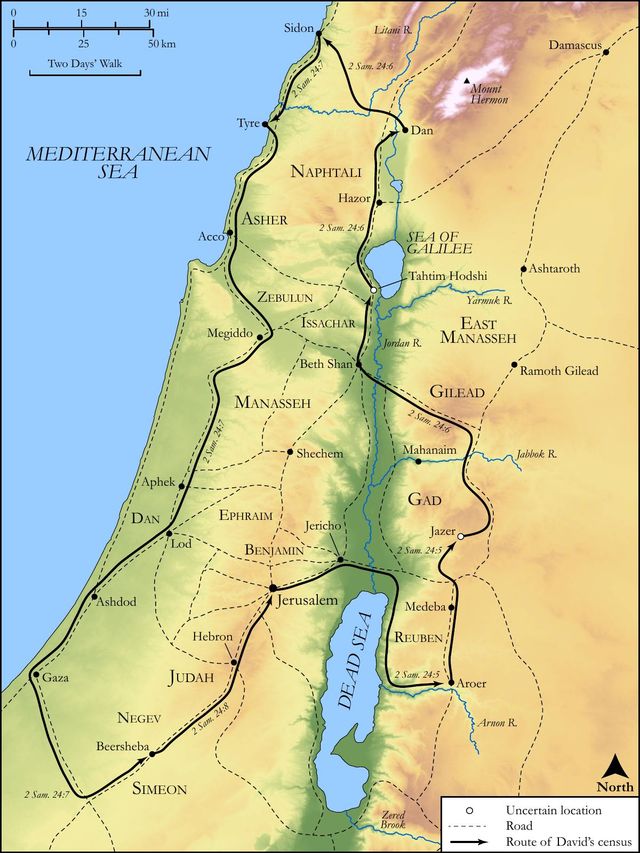
See on the biblical-era map
Study this verse
Public-domain commentary
Matthew Henry
From his Commentary on the Whole Bible. Henry comments on passages, not single verses — this entry covers 1 Chronicles 21:7–17. His two-level outline is real structure in the source text, so it is rendered as structure.
David is here under the rod for numbering the people, that rod of correction which drives out the foolishness that is bound up in the heart, the foolishness of pride. Let us briefly observe,
I.How he was corrected. If God's dearest children do amiss, they must expect to smart for it.
1.He is given to understand that God is displeased; and that it is no small uneasiness to so good a man as David, Ch1 21:7. God takes notice of, and is displeased with, the sins of his people; and no sin is more displeasing to him than pride of heart: nor is anything more humbling, and grieving, and mortifying to a gracious soul, than to see itself under God's displeasure.
2.He is put to his choice whether he will be punished by war, famine, or pestilence; for punished he must be, and by one of these. Thus, for his further humiliation, he is put into a strait, a great strait, and has the terror of all the three judgments impressed upon his mind, no doubt to his great amazement, while he is considering which he shall choose.
3.He hears of 70,000 of his subjects who in a few hours were struck dead by the pestilence, Ch1 21:14. He was proud of the multitude of his people, but divine Justice took a course to make them fewer. Justly is that taken from us, weakened, or embittered to us, which we are proud of. David must have the people numbered: Bring me the number of them, says he, that I may know it. But now God numbers them after another manner, numbers to the sword, Isa 65:12. And David had another number of them brought, more to his confusion than was to his satisfaction, namely, the number of the slain - a black bill of mortality, which is a drawback to his muster-roll.
4.He sees the destroying angel, with his sword drawn against Jerusalem, Ch1 21:16. This could not but be very terrible to him, as it was a visible indication of the anger of Heaven, and threatened the utter destruction of that beloved city. Pestilences make the greatest devastations in the most populous places. The sight of an angel, though coming peaceably and on a friendly errand, has made even mighty men to tremble; how dreadful then must this sight be of an angel with a drawn sword in his hand, a flaming sword, like that of the cherubim, which turned every way to keep the way of the tree of life! While we lie under the wrath of God the holy angels are armed against us, though we see them not as David did.
II.How he bore the correction.
1.He made a very penitent confession of his sin, and prayed earnestly for the pardon of it, Ch1 21:8. Now he owned that he had sinned, had sinned greatly, had done foolishly, very foolishly; and he entreated that, however he might be corrected for it, the iniquity of it might be done away.
2.He accepted the punishment of his iniquity: "Let thy hand be on me, and on my father's house, Ch1 21:17. I submit to the rod, only let me be the sufferer, for I am the sinner; mine is the guilty head at which the sword should be pointed." 3. He cast himself upon the mercy of God (though he knew he was angry with him) and did not entertain any hard thoughts of him. However it be, Let us fall into the hands of the Lord, for his mercies are great, Ch1 21:13. Good men, even when God frowns upon them, think well of him. Though he slay me, yet will I trust in him. 4. He expressed a very tender concern for the people, and it went to his heart to see them plagued for his transgression: These sheep, what have they done?
Continue studying 1 Chronicles 21:17 across the web’s major study libraries — every link below opens this exact verse, chapter, or book on the destination site.
Read & Compare
 BibleGatewayThis verse in more than 200 translations and 70 languages.
 Bible.comThe YouVersion reader — hundreds of translations, reading plans, and highlights.
 ESV.orgCrossway's official English Standard Version reader.
 NET BibleThe NET translation with 60,000+ translators' notes on every rendering decision.
 STEP BibleTyndale House's free study tool — original text, vocabulary, and scholarly resources.
 BibliaLogos Bible Software's free web reader.
 USCCBThe New American Bible (Revised Edition) with the U.S. bishops' study notes.
Commentaries
 BibleHub CommentariesDozens of classic commentaries on this verse, gathered on one page.
 StudyLightMore than 100 commentary sets — the largest collection on the web.
 BibleRefPlain-English commentary on what this verse means, verse by verse.
 Enduring WordDavid Guzik's free commentary on this chapter, widely used by Bible teachers.
 Bible Study ToolsVerse commentary alongside Greek and Hebrew study aids.
Original Language & Research
- BibleHub InterlinearThe verse word by word — original language, transliteration, and English.
- BibleHub LexiconEvery word's original-language definition and Strong's entry.
 Blue Letter BibleDeep-study tools — Strong's numbers, concordance, and word studies.
 SefariaThe Hebrew text with Rashi and centuries of Jewish commentary.
Sermons, Hymns & Audio


TrulyRandomVerse is not affiliated with these sites and doesn’t control their content. They’re linked because they’re genuinely useful.
Summary
1 Chronicles 21:17 captures King David's profound moment of repentance and selfless intercession before God. Following a divinely displeasing census, David confronts the devastating plague afflicting his people. In this poignant prayer, he unequivocally assumes full responsibility for his sin, acknowledging his sole culpability, and then, with a heart broken for the innocent, pleads for God's hand of judgment to fall upon himself and his household rather than continue to devastate the nation, demonstrating a deep compassion and a leader's willingness to vicariously bear the consequences for his flock.
Context
ShowHideLiterary Context
This verse serves as the emotional and theological climax of the narrative in 1 Chronicles 21. Immediately preceding this, David, prompted by Satan (as stated in 1 Chronicles 21:1), ordered a census of Israel and Judah, an act that deeply displeased God. Despite the warnings from his commander Joab in 1 Chronicles 21:3-4, David proceeded with the enumeration. As a direct consequence, God presented David with three options for divine punishment, from which David chose to "fall into the hand of the LORD" (1 Chronicles 21:13). A severe plague then swept through Israel, causing seventy thousand deaths (1 Chronicles 21:14). It is at this critical juncture, seeing the angel of the Lord poised to destroy Jerusalem (1 Chronicles 21:15), that David, along with the elders, falls on his face and utters this heartfelt confession and plea, demonstrating a profound shift from prideful self-reliance to humble submission and intercession. This account closely parallels the narrative found in 2 Samuel 24, providing a dual witness to the event's significance.
Historical & Cultural Context
The act of numbering the people in ancient Israel was not inherently sinful, as censuses were conducted for legitimate military or administrative purposes (e.g., Numbers 1). However, David's census in this particular context is understood as an act of pride, a reliance on military strength and human resources rather than on God's sovereign provision and power. It may have also lacked the proper atonement money required by the Mosaic Law (Exodus 30:12) for those being numbered. In Hebrew thought, a king's actions often had corporate consequences for the entire nation, reflecting the concept of corporate solidarity where the head's sin could bring judgment upon the body. Thus, David's sin brought widespread judgment upon all of Israel. David's plea to take the punishment upon himself and his "father's house" reflects the understanding of dynastic responsibility and the king's role as a representative head. The location of this event, the threshing floor of Ornan the Jebusite, is also historically significant, as it later became the divinely designated site for the construction of Solomon's Temple (1 Chronicles 21:18-22:1).
Key Themes
ShowHideThis verse powerfully articulates several crucial themes that resonate throughout biblical theology. Firstly, Personal Responsibility and Repentance are central, as David unequivocally takes full blame for his transgression, stating, "Is it not I that commanded... even I it is that have sinned and done evil indeed." This profound admission of guilt underscores the necessity of direct and unreserved confession before God, a theme richly explored in David's own penitential prayers, such as Psalm 51:3-4. Secondly, Intercession for the Innocent is vividly portrayed through David's heart-wrenching concern for his people, whom he tenderly refers to as "these sheep," innocent victims of his sin. His plea, "let thine hand... be on me, and on my father's house; but not on thy people, that they should be plagued," showcases a leader's willingness to vicariously bear the consequences for his flock, foreshadowing the ultimate intercession of Christ. Thirdly, the narrative profoundly illustrates The Impact of Leadership, demonstrating how the actions of a leader, whether righteous or sinful, can have far-reaching and devastating consequences for the entire community, emphasizing the weighty responsibility inherent in authority. Lastly, the passage highlights God's Justice and Mercy, as divine judgment is met with a pathway for repentance and the ultimate cessation of the plague through atonement, as seen in the subsequent events at Ornan's threshing floor.
Exposition and Analysis
ShowHideKey Word Analysis
ShowHideThis common biblical term refers to a flock of sheep or goats, a collective name for small cattle. In this context, David uses it metaphorically to describe the people of Israel. The metaphor emphasizes their vulnerability, their blamelessness in his specific sin, and their dependence, much like a flock relies on its shepherd. By likening his people to "sheep," David underscores their innocence and appeals to God's compassion for His defenseless flock, highlighting their status as a "flock" under divine care.
This primitive root means "to miss," and figuratively, "to miss the mark," "to go astray," "to incur guilt," or "to offend." David's emphatic declaration, "even I it is that have sinned and done evil indeed," signifies a full and unequivocal admission of guilt. It implies a deliberate transgression against God's will and a recognition of the moral failure inherent in his actions, which brought about severe consequences. It expresses his acknowledgment of having "missed the mark" of divine expectation.
Derived from a root meaning "to strike," this noun refers to a "pestilence," "slaughter," or "stroke," often specifically a divine judgment or punishment. In this narrative, it refers to the severe pestilence sent by God upon Israel as a consequence of David's sin. David's plea, "but not on thy people, that they should be plagued," is a desperate cry for the cessation of this divine judgment, seeking to divert its destructive force from the innocent multitude and prevent further "slaughter" or "stroke" upon them.
Verse Breakdown
ShowHide"And David said unto God, [Is it] not I [that] commanded the people to be numbered?"
David's opening is a powerful rhetorical question that functions as an unequivocal confession. He immediately and fully takes responsibility, asserting his sole culpability for the census that provoked God's wrath. This is not a question seeking information, but a declarative statement emphasizing his personal initiative and authority in the sinful act, leaving no room for doubt or deflection.
"even I it is that have sinned and done evil indeed;"
This clause reinforces David's confession with emphatic language and strong affirmation. The repetition and intense phrasing ("even I it is," "indeed") leave no doubt about his recognition of his own profound moral failure and the inherent wickedness of his deed in God's sight. He acknowledges the depth of his transgression without excuse or attempt to mitigate his guilt.
"but [as for] these sheep, what have they done?"
Here, David shifts from self-accusation to compassionate intercession for his people. By referring to them as "these sheep," he employs a tender and vulnerable metaphor, highlighting their innocence and blamelessness in his sin. The rhetorical question "what have they done?" powerfully underscores their lack of culpability and appeals to God's mercy on their behalf, emphasizing the injustice of their suffering for a sin they did not commit.
"let thine hand, I pray thee, O LORD my God, be on me, and on my father's house;"
This is the profound core of David's sacrificial plea. He is willing to bear the divine judgment himself, offering himself and his entire household as substitutes for the nation. "Thine hand" here refers to God's hand of judgment or punishment. This demonstrates a profound act of self-sacrifice and a leader's willingness to suffer personally and corporately for the sake of his people.
"but not on thy people, that they should be plagued."
This final clause articulates the ultimate purpose of David's intercession: to divert the devastating plague from the nation. It is a desperate cry for God's mercy to spare His chosen people, emphasizing David's deep love and concern for his flock, even at the cost of personal and familial suffering. It highlights his desire for the cessation of the "plague" or "stroke" upon the innocent.
Literary Devices
ShowHide1 Chronicles 21:17 is rich with rhetorical devices that amplify its emotional and theological impact. The verse opens with a powerful rhetorical question, "Is it not I that commanded the people to be numbered?", which functions not as an inquiry but as a forceful and unequivocal confession of guilt, immediately establishing David's full culpability. This is followed by emphatic repetition and affirmation ("even I it is that have sinned and done evil indeed"), underscoring the sincerity and depth of his repentance. A profound metaphor is employed when David refers to the people as "these sheep," evoking imagery of vulnerability, innocence, and dependence, and contrasting their blamelessness with his own sin. This contrast is further highlighted by a second rhetorical question, "what have they done?", which emphasizes the injustice of their suffering for his transgression. Finally, the verse culminates in a powerful intercession characterized by parallelism and antithesis: "let thine hand... be on me, and on my father's house; but not on thy people." This structure starkly contrasts David's willingness to bear the judgment with his desperate plea for his people's deliverance, showcasing his sacrificial leadership and profound empathy.
Theological and Thematic Connections
ShowHide1 Chronicles 21:17 is a profound theological statement on the nature of sin, repentance, and divine justice and mercy. David's immediate and unreserved confession ("even I it is that have sinned and done evil indeed") exemplifies true repentance, acknowledging personal culpability without deflection. This act highlights the biblical truth that sin, especially from those in leadership, can have corporate consequences, impacting an entire community. Yet, in the midst of judgment, God remains responsive to a contrite heart. David's willingness to bear the punishment for his "sheep" foreshadows the ultimate act of vicarious suffering, where an innocent party takes on the consequences of another's sin. This moment at Ornan's threshing floor, where the plague is stopped by an altar and sacrifice, also establishes the future site of the Temple, symbolizing that atonement and reconciliation are found where God's presence dwells and sacrifice is offered, pointing to the ongoing need for propitiation for sin.
Reflection and Application
ShowHideDavid's prayer in 1 Chronicles 21:17 offers timeless and challenging lessons for believers today. Firstly, it calls us to a radical honesty in our repentance. When confronted with our sin, are we quick to confess unequivocally, or do we seek to minimize, excuse, or deflect blame? David's immediate and emphatic "I it is that have sinned" sets a high standard for genuine contrition, urging us to take full ownership of our transgressions before God. Secondly, this passage underscores the profound ripple effect of our actions, particularly for those in positions of leadership or influence—whether as parents, pastors, employers, or community members. Our choices, good or bad, inevitably impact those under our care, reminding us of the weighty responsibility that accompanies authority. David's willingness to bear the consequences for his people challenges us to consider the broader impact of our decisions and to cultivate a heart of selfless responsibility. Finally, David's intercession for the innocent "sheep" serves as a powerful model for prayer. It reminds us of our call to intercede for others, to stand in the gap, and to plead for God's mercy, especially when we witness suffering that seems undeserved or is a consequence of others' failings. This passage ultimately points to the merciful character of God, who, even in judgment, responds to humility and provides a way for atonement and reconciliation.
Questions for Reflection
ShowHideFAQ
ShowHideWhy was numbering the people a sin in this context, when other censuses were commanded by God?
ShowHideThe sin was not in the act of numbering itself, but in David's underlying motive and the manner in which it was conducted. While God commanded censuses for specific, legitimate purposes (e.g., for military readiness or taxation, as seen in Numbers 1), David's census here appears to have stemmed from pride, a desire to rely on his own military strength and numbers rather than on God's power and provision. It may also have been conducted without the proper atonement money required by the Law for those being numbered (Exodus 30:12), which served as a recognition that life belongs to God and a symbolic act of propitiation. The Chronicler also explicitly states that "Satan stood up against Israel and incited David to number Israel" (1 Chronicles 21:1), highlighting the malevolent spiritual influence behind David's flawed motivation and the spiritual rebellion inherent in his act.
Why did innocent people suffer for David's sin?
ShowHideThe suffering of the innocent for the sin of a leader is a difficult but recurring theme in the Old Testament, reflecting the concept of corporate solidarity in ancient Israel. In a covenant community, the actions of the king, as the representative head, could have far-reaching consequences for the entire nation. This communal judgment served several purposes: it underscored the extreme gravity of sin, especially that of a leader who was meant to embody righteousness; it demonstrated God's absolute sovereignty and justice; and it often served to humble the people and turn them back to God in repentance. While seemingly harsh from a modern individualistic perspective, it highlights David's profound responsibility and the devastating impact of his pride, prompting his heartfelt repentance and intercession, which ultimately led to the cessation of the plague.
How does God's response to David's prayer demonstrate both His justice and His mercy?
ShowHideGod's response perfectly balances justice and mercy. Justice is evident in the sending of the plague, which was a direct consequence of David's sin, demonstrating that God does not overlook disobedience and that sin carries severe consequences. The severe loss of life underscored the seriousness of the transgression. However, God's mercy is also profoundly displayed. He gave David a choice of punishments (1 Chronicles 21:10-12), allowing David to "fall into the hand of the LORD" (1 Chronicles 21:13), trusting in God's great mercy. Crucially, upon David's confession and intercession, God relented from the plague (1 Chronicles 21:15), commanded David to build an altar, and accepted the sacrifice (1 Chronicles 21:26-27), providing a clear way for atonement and the cessation of judgment. This act of relenting, coupled with the establishment of the Temple site, illustrates God's compassionate nature and His desire for reconciliation.
Christ-Centered Fulfillment
ShowHideDavid's poignant intercession in 1 Chronicles 21:17, where he offers himself and his household to bear the plague instead of his "sheep," powerfully foreshadows the ultimate, perfect intercession and vicarious suffering of Jesus Christ. David, though a king and a shepherd of his people, could only wish to bear the judgment for their sins; he could not fully atone for them or truly remove the plague of sin. His plea, while noble and demonstrating a shepherd's heart, was a partial act of intercession that pointed to a greater reality. Jesus, however, is the true Good Shepherd who lays down His life for the sheep. He did not merely wish to bear the consequences of our sin; He actually became sin for us, bearing the full wrath of God on the cross (2 Corinthians 5:21). The plague that fell upon Israel due to David's sin finds its ultimate resolution in the suffering of Christ, who was "pierced for our transgressions" and "by His stripes we are healed" (Isaiah 53:5). David's desperate desire to divert the plague onto himself finds its perfect fulfillment in Christ, who perfectly diverted God's judgment from humanity onto Himself, offering a complete and eternal atonement. As our great High Priest, Jesus continues to intercede for us, not with a desperate plea for a temporary reprieve, but with an eternal and effective mediation that ensures our salvation (Hebrews 7:25). Thus, David's imperfect yet heartfelt act of substitutionary love points us directly to the flawless and saving work of our Lord Jesus Christ, the ultimate sin-bearer and intercessor.