


1 Samuel 22:5
Bible text: King James Version (1769 Blayney text) · Public domain
Bible text: King James Version with Strong's numbers · Public domain
Bible text: Berean Standard Bible · Public domain
Bible text: American Standard Version (1901) · Public domain
Bible text: World English Bible, Messianic edition · Public domain
Bible text: Geneva Bible (1599) · Public domain
Bible text: Young's Literal Translation · Public domain
- וַיֹּאמֶרvai·yo·Merand he saidH559Conj-w ¦ V-Qal-ConsecImperf-3msVerb Qal Consecutive Imperfect 3rd Singular Masculineוַandיֹּאמֶרhe said
- גָּדgadGadH1410N-proper-mNoun Proper Masculine
- הַנָּבִיאha·na·Vi'the prophetH5030Art ¦ N-msNoun Singular Masculine Absoluteהַtheנָּבִיאprophet
- אֶל'eltoH413PrepPreposition
- דָּוִדda·VidDavidH1732N-proper-mNoun Proper Masculine
- לֹאlo'notH3808NegParticle Negative
- תֵשֵׁבte·Shevyou must remainH3427V-Qal-Imperf-2msVerb Qal Imperfect 2nd Singular Masculine
- בַּמְּצוּדָהba·me·tzu·Dahin the strongholdH4686Prep-b ¦ N-fsNoun Singular Feminine Absoluteבַּin theמְּצוּדָהstronghold
- לֵךְlekhgoH1980V-Qal-Imp-2msVerb Qal Imperative 2nd Singular Masculine
- וּבָאתָu·va·taand you will goH935Conj-w ¦ V-Qal-ConsecPerf-2msVerb Qal Consecutive Perfect 2nd Singular Masculineוּandבָאתָyou will go
- לְּךָle·Khafor <the> yourselfPrep-l ¦ 2msSuffix Personal 2nd Singular Masculineלְּfor <the>ךָyourself
- אֶרֶץ'E·retz[the] land ofH776N-fscNoun Singular Feminine Construct
- יְהוּדָהye·hu·DahJudahH3063N-properNoun Proper Location
- וַיֵּלֶךְvai·Ye·lekhand he wentH1980Conj-w ¦ V-Qal-ConsecImperf-3msVerb Qal Consecutive Imperfect 3rd Singular Masculineוַandיֵּלֶךְhe went
- דָּוִדda·VidDavidH1732N-proper-mNoun Proper Masculine
- וַיָּבֹאvai·ya·Vo'and he cameH935Conj-w ¦ V-Qal-ConsecImperf-3msVerb Qal Consecutive Imperfect 3rd Singular Masculineוַandיָּבֹאhe came
- יַעַרYa·'ar[the] forest ofH3293N-mscNoun Singular Masculine Construct
- חָרֶתCha·retHerethH2802N-properNoun Proper Location
English is a literal word-by-word gloss of the Hebrew, not the KJV's wording. Why?
This is the original text the KJV's translators worked from — each Hebrew word with its own literal English meaning in this verse, prepared by scholars at Tyndale House, Cambridge. The KJV translates whole sentences, not word by word, so its wording differs: one Hebrew word can become several English words, and the KJV may choose “the LORD” where the gloss reads “Yahweh”. Both are faithful — they answer different questions. For the KJV's own rendering, switch to the KJV text.
Details
See on the biblical-era map
Study this verse
Public-domain commentary
Matthew Henry
From his Commentary on the Whole Bible. Henry comments on passages, not single verses — this entry covers 1 Samuel 22:1–5. His two-level outline is real structure in the source text, so it is rendered as structure.
Here, I. David shelters himself in the cave of Adullam, Sa1 22:1. Whether it was a natural or artificial fastness does not appear; it is probable that the access to it was so difficult that David thought himself able, with Goliath's sword, to keep it against all the forces of Saul, and therefore buried himself alive in it, while he was waiting to see (and he says here, Sa1 22:3) what God would do with him. The promise of the kingdom implied a promise of preservation to it, and yet David used proper means for his own safety, otherwise he would have tempted God. He did not do any thing that aimed to destroy Saul, but only to secure himself. He that might have done great service to his country as a judge or general is here shut up in a cave, and thrown by as a vessel in which there was no pleasure. We must not think it strange if sometimes shining lights be thus eclipsed and hidden under a bushel. Perhaps the apostle refers to this instance of David, among others, when he speaks of some of the Old Testament worthies that wandered in deserts, in dens and caves of the earth, Heb 11:38. It was at this time that David penned Psa 142:1-7, which is entitled, A prayer when David was in the cave; and there he complains that no man would know him and that refuge failed him, but hopes that shortly the righteous would compass him about.
II.Thither his relations flocked to him, his brethren and all his father's house, to be protected by him, to give assistance to him, and to take their lot with him. A brother is born for adversity. Now, Joab, and Abishai, and the rest of his relations, came to him, to suffer and venture with him, in hopes shortly to be advanced with him; and they were so. The first three of his worthies were those that first owed him when he was in the cave, Ch1 11:15, etc.
III.Here he began to raise forces in his own defence, Sa1 22:2.
He found by the late experiments he had made that he could not save himself by flight, and therefore was necessitated to do it by force, wherein he never acted offensively, never offered any violence to his prince nor gave any disturbance to the peace of the kingdom, but only used his forces as a guard to his own person. But, whatever defence his soldiers were to him, they did him no great credit, for the regiment he had was made up not of great men, nor rich men, nor stout men, no, nor good men, but men in distress, in debt, and discontented, men of broken fortunes and restless spirits, that were put to their shifts, and knew not well what to do with themselves. When David had fixed his headquarters in the cave of Adullam, they came and enlisted themselves under him to the number of about 400. See what weak instruments God sometimes makes use of, by which to bring about his own purposes. The Son of David is ready to receive distressed souls, that will appoint him their captain and be commanded by him.
IV.He took care to settle his parents in a place of safety.
No such place could he find in all the land of Israel while Saul was so bitterly enraged against him and all that belonged to him for his sake; he therefore goes with them to the king of Moab, and puts them under his protection, Sa1 22:3, Sa1 22:4. Observe here,
1.With what a tender concern he provided for his aged parents. It was not fit they should be exposed either to the frights or to the fatigues which he must expect during his struggle with Saul (their age would by no means bear such exposure); therefore the first thing he does is to find them a quiet habitation, whatever became of himself. Let children learn from this to show pity at home and requite their parents (Ti1 5:4), in every thing consulting their ease and satisfaction. Though ever so highly preferred, and ever so much employed, let them not forget their aged parents.
2.With what a humble faith he expects the issue of his present distresses: Till I know what God will do for me. He expresses his hopes very modestly, as one that had entirely cast himself upon God and committed his way to him, expecting a good issue, not from his own arts, or arms, or merits, but from what the wisdom, power, and goodness of God would do for him. Now David's father and mother forsook him, but God did not, Psa 27:10.
V.He had the advice and assistance of the prophet Gad, who probably was one of the sons of the prophets that were brought up under Samuel, and was by him recommended to David for his chaplain or spiritual guide. Being a prophet, he would pray for him and instruct him in the mind of God; and David, though he was himself a prophet, was glad of his assistance. He advised him to go into the land of Judah (Sa1 22:5), as one that was confident of his own innocency, and was well assured of the divine protection, and was desirous, even in his present hard circumstances, to do some service to his tribe and country. Let him not be ashamed to own his own cause nor decline the succours that would be offered him. Animated by this word, there he determined to appear publicly. Thus are the steps of a good man ordered by the Lord.
Historical interpretation
Historical reception
1 surviving comment on this verse from the historical church.
The prophet Gad said to David: Do not remain in the stronghold, etc. Prophecy speaks to Christ, which has not omitted to sing of his sacraments, that, with the fullness of the Gentiles entering, his faith should no longer strive to protect itself with the weakest safeguard from the insidious believing Jews of the Church but rather should see fit to save the remnants of the Israelite people according to the election of grace; who, fulfilling the prophecies of the prophets, will come at the appointed time to the long desolate hearts of proud people, but now to be exalted by itself, whose name Hareth fittingly means skepticism. Therefore, it is she to whom her author, as to a virgin betrothed to him but long deferred from the nuptial joys, speaks through the prophet: You will wait for me many days; you will not be a harlot nor be with a man, but I will wait for you (Hosea III). As the same prophet consequently explained what he said: Because the children of Israel will sit many days without a king, without a prince, without a sacrifice, without an altar, without ephod, and without theraphim. And after this, the children of Israel will turn back and seek the Lord their God and David their king, and they will fear the Lord and his goodness in the last days.
Continue studying 1 Samuel 22:5 across the web’s major study libraries — every link below opens this exact verse, chapter, or book on the destination site.
Read & Compare
 BibleGatewayThis verse in more than 200 translations and 70 languages.
 Bible.comThe YouVersion reader — hundreds of translations, reading plans, and highlights.
 ESV.orgCrossway's official English Standard Version reader.
 NET BibleThe NET translation with 60,000+ translators' notes on every rendering decision.
 STEP BibleTyndale House's free study tool — original text, vocabulary, and scholarly resources.
 BibliaLogos Bible Software's free web reader.
 USCCBThe New American Bible (Revised Edition) with the U.S. bishops' study notes.
Commentaries
 BibleHub CommentariesDozens of classic commentaries on this verse, gathered on one page.
 StudyLightMore than 100 commentary sets — the largest collection on the web.
 BibleRefPlain-English commentary on what this verse means, verse by verse.
 Enduring WordDavid Guzik's free commentary on this chapter, widely used by Bible teachers.
 Bible Study ToolsVerse commentary alongside Greek and Hebrew study aids.
Original Language & Research
- BibleHub InterlinearThe verse word by word — original language, transliteration, and English.
- BibleHub LexiconEvery word's original-language definition and Strong's entry.
 Blue Letter BibleDeep-study tools — Strong's numbers, concordance, and word studies.
 SefariaThe Hebrew text with Rashi and centuries of Jewish commentary.
Sermons, Hymns & Audio


TrulyRandomVerse is not affiliated with these sites and doesn’t control their content. They’re linked because they’re genuinely useful.
Summary
This verse captures a pivotal moment in David's fugitive existence, where the prophet Gad, acting as God's direct messenger, commands David to abandon his current stronghold and return to the land of Judah. David's immediate and unquestioning obedience to this divinely issued directive, despite the inherent dangers of re-entering Saul's sphere of influence, powerfully illustrates God's active guidance in his life and David's profound trust in divine providence, even when human logic might counsel otherwise.
Context
ShowHideLiterary Context
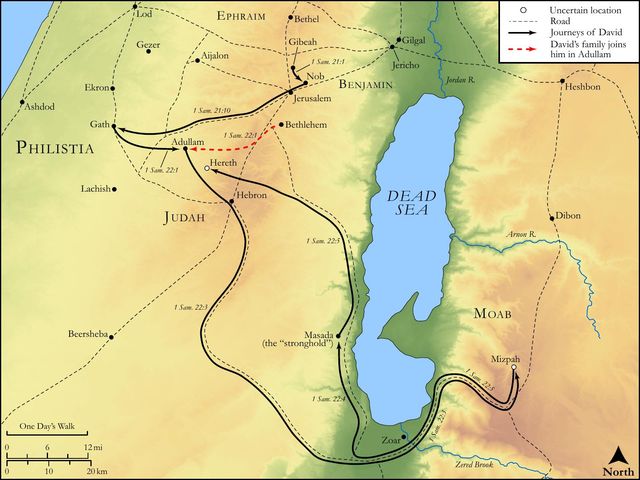
1 Samuel 22:5 is strategically placed within a highly volatile and perilous period of David's life, following his desperate flight from King Saul's relentless pursuit. Prior to this verse, David has sought refuge in various locations, notably at Nob, where his interaction with Ahimelech the priest inadvertently led to the tragic massacre of the priests by Saul (see 1 Samuel 22:9-19). Subsequently, David gathered a diverse company of the distressed, indebted, and discontented in the cave of Adullam, a significant "hold" or natural fortress (as described in 1 Samuel 22:1-2). His concern for his family's safety then led him to relocate his parents to Mizpeh of Moab (see 1 Samuel 22:3-4), indicating a reliance on temporary, human-devised security measures. It is precisely at this juncture, when David is in a state of precarious uncertainty and relying on such temporary solutions, that the prophet Gad emerges, signaling a direct and crucial divine intervention that fundamentally alters David's immediate trajectory.
Historical & Cultural Context
The historical backdrop is the nascent Israelite monarchy, a period where the role of prophets, like Gad, was indispensable for conveying God's direct will to His people and their leaders. David, though divinely anointed by Samuel (as recorded in 1 Samuel 16:13), is currently an outlaw, relentlessly hunted by the reigning king, Saul. The "holds" (Hebrew: mâtsûwd), mentioned in the text, were common natural fortresses—often rugged caves or mountain strongholds—prevalent in the Judean wilderness, providing essential temporary refuge for those fleeing persecution or engaging in guerrilla warfare. For David to receive a divine command to abandon such a place of perceived safety and return to "the land of Judah"—his tribal homeland, yet simultaneously the epicenter of Saul's authority and control—was a profoundly counter-intuitive and risky directive. This period vividly illustrates the inherent tension between human efforts to secure safety and the imperative of divine guidance, underscoring the unique and authoritative role of prophets in shaping the destiny of the nation.
Key Themes
ShowHideThis verse powerfully articulates several foundational themes central to the book of 1 Samuel and the unfolding narrative of David's life. Firstly, it highlights Divine Guidance in Adversity, demonstrating God's unwavering and personal involvement in the life of His chosen servant, even when David is a hunted fugitive. God does not abandon David but provides precise, timely direction, reinforcing the biblical principle of seeking and heeding divine wisdom and direction. Secondly, David's Immediate Obedience stands out as a defining characteristic of his faith. His prompt departure from the "hold" stands in stark contrast to King Saul's repeated and often self-serving acts of disobedience, which ultimately led to his rejection by God (a theme powerfully articulated in 1 Samuel 15:22-23). David's readiness to follow God's instruction, even when it meant relinquishing a place of perceived security, serves as a profound testament to his deep faith and trust. Lastly, the verse underscores God's Sovereign Providence. God directs David not to remain in a distant, isolated stronghold but to return to the heartland of Israel, specifically the land of Judah. This seemingly illogical move was an integral part of God's larger, overarching plan to prepare David for his future kingship and to maintain him within the sphere of the covenant people, even as a fugitive, subtly guiding him towards his ultimate destiny as the future king of Israel (a theme that finds its fuller realization in 2 Samuel 5:1-5).
Exposition and Analysis
ShowHideKey Word Analysis
ShowHideFrom גּוּד; Gad, a son of Jacob, including his tribe and its territory; also a prophet. In this context, Gad is introduced specifically as "the prophet," signifying his role as a direct messenger of God to David. His appearance underscores the divine origin of the command David receives, marking a crucial moment of supernatural intervention in David's desperate circumstances. Gad later becomes known as "David's seer" (e.g., 2 Samuel 24:11), indicating his enduring and trusted role as a conduit for divine communication throughout David's life and reign.
Or (feminine) מְצוּדָה; for מָצוֹד; a net, or (abstractly) capture; also a fastness; castle, defense, fort(-ress), (strong) hold, be hunted, net, snare, strong place. This term refers to a fortified place, a stronghold, or a natural fortress, often a cave or a rugged mountain retreat. David had sought such locations for refuge from Saul. The divine command to "abide not in the hold" is a direct challenge to David's reliance on human-devised security, urging him to move beyond a false sense of safety and to place his trust entirely in God's specific, albeit seemingly riskier, leading.
A primitive root (compare הָלַךְ); to walk (literally or figuratively); causatively, to carry (in various senses); [idiom] again, away, bear, bring, carry (away), come (away), depart, flow, [phrase] follow(-ing), get (away, hence, him), (cause to, made) go (away, -ing, -ne, one's way, out), grow, lead (forth), let down, march, prosper, [phrase] pursue, cause to run, spread, take away (-journey), vanish, (cause to) walk(-ing), wax, [idiom] be weak. This verb emphasizes the immediate and decisive action required of David. It is not merely a suggestion but a command to physically move, to leave his current location. The breadth of its meaning, from "walk" to "depart," highlights the dynamic nature of God's guidance, often requiring physical movement and a relinquishing of the familiar.
Verse Breakdown
ShowHide"And the prophet Gad said unto David"
This introductory phrase immediately establishes the authoritative source of the message. It is not David's own strategic calculation or the counsel of his men, but a direct word from God, delivered through His appointed messenger, Gad. This highlights God's active, personal, and sovereign involvement in guiding David's steps during a period of intense vulnerability.
"Abide not in the hold; depart, and get thee into the land of Judah"
This constitutes a clear, multi-faceted divine command. "Abide not in the hold" instructs David to vacate his current place of refuge, which, despite its apparent safety, might have fostered a false sense of security or hindered God's larger purpose. "Depart" reinforces the urgency and necessity of immediate movement. "And get thee into the land of Judah" provides the specific, divinely ordained destination. This directive is counter-intuitive from a human perspective, as Judah was the very heartland of Saul's dominion, yet it was essential for David's preparation for kingship and to keep him intimately connected to the covenant people and the land of promise.
"Then David departed, and came into the forest of Hareth"
This concluding clause powerfully demonstrates David's immediate, unreserved, and unquestioning obedience. Without hesitation, argument, or delay, he acts decisively upon the divine word. This prompt and faithful response is a consistent and distinguishing characteristic of David's faith, setting him apart from King Saul, who frequently displayed hesitation or outright disobedience to God's commands. David's arrival in the "forest of Hareth" signifies the successful and precise execution of the divine directive, underscoring the effectiveness of God's guidance.
Literary Devices
ShowHideThe passage employs several significant literary devices that enrich its meaning and impact. Divine Intervention is prominently featured, as the sudden and specific appearance of the prophet Gad underscores God's direct and personal involvement in David's life, actively guiding his steps even as a hunted fugitive. This stands in stark Contrast to King Saul's increasing spiritual isolation and lack of divine counsel. There is also a clear thematic Contrast between the "hold" (symbolizing human-devised security, hiding, and stagnation) and "the land of Judah" (representing a return to the heartland of Israel, a place of greater exposure but also divine purpose and destiny). This highlights the crucial theme of trusting God's leading over human logic, comfort, or perceived safety. David's immediate and unhesitating action serves as a powerful Motif of Obedience, a recurring characteristic that distinguishes him as "a man after God's own heart" in stark opposition to Saul's pattern of disobedience. Finally, David's return to Judah, his tribal homeland, subtly Foreshadows his future kingship, first over Judah and eventually over all Israel, indicating that God's sovereign plan is meticulously unfolding despite the current adversity and David's status as an outlaw.
Theological and Thematic Connections
ShowHideThis verse profoundly illustrates God's meticulous and personal involvement in the lives of His chosen servants, even amidst their deepest trials, uncertainties, and periods of apparent abandonment. It underscores the vital theological principle that true security and genuine progress are found not in human-contrived strongholds, self-reliant strategies, or distant refuges, but in faithful and immediate obedience to God's specific guidance, even when that guidance leads to seemingly more dangerous, counter-intuitive, or uncomfortable paths. David's prompt departure from his place of safety signifies a profound and unwavering trust in God's sovereign providence, a conviction that God's ultimate plan for him would unfold most effectively within the very land from which he was fleeing. This kept him intimately connected to his destiny and the covenant community. The passage teaches us that God often calls His people out of their comfort zones and perceived safe havens to position them for His greater purposes, thereby refining their faith, deepening their dependence on Him, and preparing them for future roles and responsibilities.
Reflection and Application
ShowHideIn our contemporary lives, we often instinctively seek out "holds"—places of perceived security, comfort zones, or familiar patterns—whenever we are confronted with uncertainty, fear, or adversity. These "holds" can manifest in various forms: financial stability, a particular relationship, a specific job, a habitual routine, or even a deeply ingrained way of thinking that we believe keeps us safe and in control. However, just as God directly called David out of his physical stronghold, He may, in His sovereign wisdom, call us to depart from our own "holds" to step into a new, divinely appointed territory that may initially appear less secure, but is ultimately where His perfect will can be fully realized and our spiritual growth accelerated. This verse challenges us to honestly examine what "holds" we might be clinging to, perhaps out of fear or a lack of trust, that God is now asking us to release. David's immediate and unquestioning obedience serves as a powerful, timeless model for us. True security, spiritual progress, and the unfolding of God's perfect plan in our lives often come not from stubbornly clinging to our perceived safe places, but from faithfully and courageously following God's commands, even when they lead us into unfamiliar, uncomfortable, or seemingly illogical territory. Embracing this trust, even when the path ahead seems unclear, is foundational to experiencing God's transformative power and deepening our dependence on Him.
Questions for Reflection
ShowHideFAQ
ShowHideWho was Gad, and why is he important here?
ShowHideGad is introduced in this verse as "the prophet," signifying his role as a direct and authoritative messenger from God to David. His appearance is profoundly significant because it marks a clear instance of divine intervention in David's life during a period of extreme vulnerability, fear, and uncertainty. While David was relying on human-contrived strongholds for physical safety, God sovereignly sent Gad to deliver specific, timely, and counter-intuitive guidance. Gad's role here highlights God's active, personal, and unwavering involvement in the lives of His chosen servants, ensuring they remain on His intended path despite their circumstances. Gad later became known as "David's seer" and continued to provide divine counsel to David during his reign, most notably after David's census, as recorded in 2 Samuel 24:11.
What is the significance of David leaving the "hold" for the "land of Judah"?
ShowHideThe "hold" (Hebrew: mâtsûwd) represented a place of human-contrived safety and refuge, likely a remote cave or mountain fortress where David and his growing band of men could hide from King Saul's relentless pursuit. God's command, delivered through the prophet Gad, to leave this perceived safe haven and return to "the land of Judah" was profoundly significant and counter-intuitive. From a purely human perspective, returning to Judah, the heartland of Israel and the very domain where Saul's authority was concentrated, seemed to be a move into greater danger. However, this divine directive served multiple, crucial purposes: it was a profound test of David's faith and obedience, demonstrating his willingness to trust God's leading over his own logic, fear, or desire for security. More importantly, it kept David within the covenant land and his tribal territory, strategically positioning him for his future role as king. God was sovereignly orchestrating David's movements, not allowing him to become isolated in a distant refuge, but preparing him for the throne and ensuring he remained connected to the people he was destined to rule, even as a fugitive. This move powerfully underscores God's providential care and His strategic guidance in the fulfillment of His divine promises.
Christ-Centered Fulfillment
ShowHideDavid's journey as a fugitive, specifically his obedience to God's direct word delivered through the prophet Gad to leave a place of perceived safety and enter a seemingly more dangerous territory, beautifully foreshadows the life and redemptive mission of Jesus Christ. Like David, who was God's anointed king but lived as an outcast, Jesus, though the rightful King of Kings and Lord of Lords, frequently had "nowhere to lay his head" (Matthew 8:20). He did not cling to earthly security, human comfort, or any "holds" of worldly power, but consistently and perfectly submitted to the Father's will, even when that path led to profound suffering, rejection, and ultimately, death on a cross (Philippians 2:8). Just as Gad directed David to a specific, divinely appointed location within Judah, the Holy Spirit sovereignly led Jesus into the wilderness for temptation (Matthew 4:1) and later, Jesus resolutely "set his face to go to Jerusalem," fully aware of the suffering and crucifixion that awaited Him there (Luke 9:51). David's act of obedience—leaving a place of physical safety for a divinely appointed, yet dangerous, path—mirrors Christ's ultimate act of obedience in leaving the ineffable glory of heaven to "get thee into the land" of humanity, to fully embody our human condition, and to fulfill God's redemptive plan. This culminated in His perfect sacrifice as the Lamb of God, who takes away the sin of the world (John 1:29), and His subsequent glorious exaltation as the reigning King over all creation (Revelation 19:16).