


1 Samuel 22:6
Bible text: King James Version (1769 Blayney text) · Public domain
Bible text: King James Version with Strong's numbers · Public domain
Bible text: Berean Standard Bible · Public domain
Bible text: American Standard Version (1901) · Public domain
Bible text: World English Bible, Messianic edition · Public domain
Bible text: Geneva Bible (1599) · Public domain
Bible text: Young's Literal Translation · Public domain
- וַיִּשְׁמַעvai·yish·Ma'and he heardH8085Conj-w ¦ V-Qal-ConsecImperf-3msVerb Qal Consecutive Imperfect 3rd Singular Masculineוַandיִּשְׁמַעhe heard
- שָׁאוּלsha·'UlSaulH7586N-proper-mNoun Proper Masculine
- כִּיkithatH3588PrtParticle Conditional
- נוֹדַעno·Da'he was knownH3045V-Niphal-Perf-3msVerb Niphal Perfect 3rd Singular Masculine
- דָּוִדda·VidDavidH1732N-proper-mNoun Proper Masculine
- וַאֲנָשִׁיםva·'a·na·Shimand [the] menH582Conj-w ¦ N-mpNoun Plural Masculine Absoluteוַandאֲנָשִׁים[the] men
- אֲשֶׁר'a·SherwhoH834RelParticle Relative
- אִתּוֹ'i·To[were] with himH854Prep ¦ 3msPreposition Definiteאִתּ[were] withוֹhim
- וְשָׁאוּלve·sha·'Uland SaulH7586Conj-w ¦ N-proper-mNoun Proper MasculineוְandשָׁאוּלSaul
- יוֹשֵׁבyo·Shev[was] sittingH3427V-Qal-Prtcpl-msVerb Qal Participle Singular Masculine Absolute
- בַּגִּבְעָהba·giv·'Ahat <the> GibeahH1390Prep-b ¦ N-properNoun Proper Locationבַּat <the>גִּבְעָהGibeah
- תַּחַתta·chatunderH8478N-mscNoun Singular Masculine Construct
- הָאֶשֶׁלha·'E·shelthe tamarisk treeH815Art ¦ N-msNoun Singular Masculine Absoluteהָtheאֶשֶׁלtamarisk tree
- בָּרָמָהba·ra·Mahat the high placeH7413Prep-b ¦ N-fsNoun Singular Feminine Absoluteבָּat theרָמָהhigh place
- וַחֲנִיתוֹva·cha·ni·Toand his spearH2595Conj-w ¦ N-fsc ¦ 3msNoun Singular Feminine Constructוַandחֲנִיתspearוֹhis
- בְיָדוֹve·ya·Do[was] in his handH3027Prep-b ¦ N-csc ¦ 3msNoun Singular common gender Constructבְ[was] inיָדhandוֹhis
- וְכָלve·kholand allH3605Conj-w ¦ N-mscNoun Singular Masculine Constructוְandכָלall
- עֲבָדָיו'a·va·Davhis servantsH5650N-mpc ¦ 3msNoun Plural Masculine Constructעֲבָדָיservantsוhis
- נִצָּבִיםni·tza·Vim[were] standingH5324V-Niphal-Prtcpl-mpVerb Niphal Participle Plural Masculine Absolute
- עָלָיו'a·Lavwith himH5921Prep ¦ 3msPreposition Definiteעָלָיwithוhim
English is a literal word-by-word gloss of the Hebrew, not the KJV's wording. Why?
This is the original text the KJV's translators worked from — each Hebrew word with its own literal English meaning in this verse, prepared by scholars at Tyndale House, Cambridge. The KJV translates whole sentences, not word by word, so its wording differs: one Hebrew word can become several English words, and the KJV may choose “the LORD” where the gloss reads “Yahweh”. Both are faithful — they answer different questions. For the KJV's own rendering, switch to the KJV text.
Details
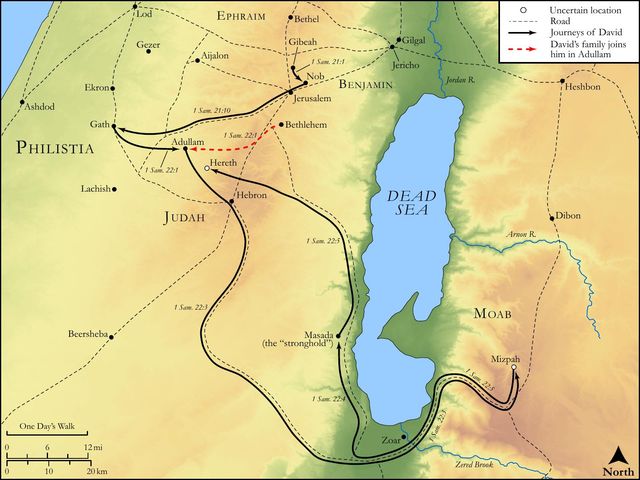
See on the biblical-era map
Study this verse
Public-domain commentary
Matthew Henry
From his Commentary on the Whole Bible. Henry comments on passages, not single verses — this entry covers 1 Samuel 22:6–19. His four-level outline is real structure in the source text, so it is rendered as structure.
We have seen the progress of David's troubles; now here we have the progress of Saul's wickedness. He seems to have laid aside the thoughts of all other business and to have devoted himself wholly to the pursuit of David. He heard at length, by the common fame of the country, that David was discovered (that is, that he appeared publicly and enlisted men into his service); and hereupon he called all his servants about him, and sat down under a tree, or grove, in the high place at Gibeah, with his spear in his hand for a sceptre, intimating the force by which he designed to rule, and the present temper of his spirit, or its distemper rather, which was to kill all that stood in his way. In this bloody court of inquisition,
I.Saul seeks for information against David and Jonathan, Sa1 22:7, Sa1 22:8.
Two things he was willing to suspect and desirous to see proved, that he might wreak his malice upon two of the best and most excellent men he had about him: - 1. That his servant David did lie in wait for him and seek his life, which was utterly false. He really sought David's life, and therefore pretended that David sought his life, though he could not charge him with any overt act that gave the least shadow of suspicion. 2. That his son Jonathan stirred him up to do so, and was confederate with him in compassing and imagining the death of the king. This also was notoriously false. A league of friendship there was between David and Jonathan, but no conspiracy in any evil thing; none of the articles of their covenant carried any mischief to Saul. If Jonathan had agreed, after the death of Saul, to resign to David, in compliance with the revealed will of God, what harm would that do to Saul? Yet thus the best friends to their prince and country have often been odiously represented as enemies to both; even Christ himself was so. Saul took it for granted that Jonathan and David were in a plot against him, his crown and dignity, and was displeased with his servants that they did not give him information of it, supposing that they could not but know it; whereas really there was no such thing. See the nature of a jealous malice, and its pitiful arts to extort discoveries of things that are not. He looked upon all about him as his enemies because they did not say just as he said; and told them, (1.) That they were very unwise, and acted against the interest both of their tribe (for they were Benjamites, and David, if he were advanced, would bring the honour into Judah which was now in Benjamin) and of their families; for David would never be able to give them such rewards as he had for them, of fields and vineyards, and such preferments, to be colonels and captains. (2.) That they were unfaithful: You have conspired against me. What a continual agitation and torment are those in that give way to a spirit of jealousy! If a ruler hearken to lies, all his servants are wicked (Pro 29:12), that is, they seem to be so in his eyes. (3.) That they were very unkind. He thought to work upon their good nature with that word: There is none of you that is so much as sorry for me, or solicitous for me, as some read it. By these reasonings he stirred them up to act vigorously, as the instruments of his malice, that they might take away his suspicions of them.
II.Though he could not learn any thing from his servants against David or Jonathan, yet he got information from Doeg against Ahimelech the priest.
1.An indictment is brought against Ahimelech by Doeg, and he himself is evidence against him, Sa1 22:9, Sa1 22:10. Perhaps Doeg, as bad as he was, would not have given this information if Saul had not extorted it, for had he been very forward to it he would have done it sooner: but now he thinks they must be all deemed traitors if none of them be accusers, and therefore tells Saul what kindness Ahimelech had shown to David, which he himself happened to be an eye-witness of. He had enquired of God for him (which the priest used not to do but for public persons and about public affairs) and he had furnished him with bread and a sword. All this was true; but it was not the whole truth. He ought to have told Saul further that David had made Ahimelech believe he was then going upon the king's business; so that what service he did to David, however it proved, was designed in honour to Saul, and this would have cleared Ahimelech, whom Saul had in his power, and would have thrown all the blame upon David, who was out of his reach.
2.Ahimelech is seized, or summoned rather to appear before the king, and upon this indictment he is arraigned. The king sent for him and all the priests who then attended the sanctuary, whom he supposed to be aiding and abetting; and they, not being conscious of any guilt, and therefore not apprehensive of any danger, came all of them to the king (Sa1 22:11), and none of them attempted to make an escape, or to flee to David for shelter, as they would have done now that he had set up his standard if they had been as much in his interests as Saul suspected they were. Saul arraigns Ahimelech himself with the utmost disdain and indignation (Sa1 22:12): Hear now, thou son of Ahitub; not so much as calling him by his name, much less giving him his title of distinction. By this it appears that he had cast off the fear of God, that he showed no respect at all to his priests, but took a pleasure in affronting them and insulting them. Ahimelech holds up his hand at the bar in those words: "Here I am, my lord, ready to hear my charge, knowing I have done no wrong." He does not object to the jurisdiction of Saul's court, nor insist upon an exemption as a priest, no, not though he is a high priest, to which office that of the judge, or chief magistrate, had not long since been annexed; but Saul having now the sovereignty vested in him, in things pertaining to the king, even the high priest sets himself on a level with common Israelites. Let every soul be subject (even clergymen) to the higher powers.
3.His indictment is read to him (Sa1 22:13), that he, as a false traitor, had joined himself with the son of Jesse in a plot to depose and murder the king. "His design" (says Saul) "was to rise up against me, and thou didst assist him with victuals and arms." See what bad constructions the most innocent actions are liable to, how unsafe those are that live under a tyrannical government, and what reason we have to be thankful for the happy constitution and administration of the government we are under.
4.To this indictment he pleads, Not guilty, Sa1 22:14, Sa1 22:15. He owns the fact, but denies that he did it traitorously or maliciously, or with any design against the king. He pleads that he was so far from knowing of any quarrel between Saul and David that he really took David to have been then as much in favour at court as ever he had been. Observe, He does not plead that David had told him an untruth, and with that had imposed upon him, though really it was so, because he would not proclaim the weakness of so good a man, no, not for his own vindication, especially to Saul, who sought all occasions against him; but he insists upon the settled reputation David had as the most faithful of all the servants of Saul, the honour the king had put upon him in marrying his daughter to him, the use the king had often made of him, and the trust he had reposed on him: "He goes at thy bidding, and is honourable in thy house, and therefore any one would think it a meritorious piece of service to the crown to show him respect, so far from apprehending it to be a crime." He pleads that he had been wont to enquire of God for him when he was sent by Saul upon any expedition, and did it now as innocently as ever he had done it. He protests his abhorrence of the thought of being in a plot against the king: "Be it far from me. I mind my own business, and meddle not with state matters." He begs the king's favour: "Let him not impute any crime to us;" and concludes with a declaration of his innocency: Thy servant knew nothing of all this. Could any man plead with more evidences of sincerity? Had he been tried by a jury of honest Israelites, he would certainly have been acquitted, for who can find any fault in him? But,
5.Saul himself gives judgment against him (Sa1 22:16): Thou shalt surely die, Ahimelech, as a rebel, thou and all thy father's house. What could be more unjust? I saw under the sun the place of judgment, that wickedness was there, Ecc 3:16.
(1.)It was unjust that Saul should himself, himself alone, give judgment in his own cause, without any appeal to judge or prophet, to his privy council, or to a council of war.
(2.)That so fair a plea should be overruled and rejected without any reason given, or any attempt to disprove the allegations of it, but purely with a high hand.
(3.)That sentence should be passed so hastily and with so much precipitation, the judge taking no time himself to consider of it, nor allowing the prisoner any time to move in arrest of judgment.
(4.)That the sentence should be passed not only on Ahimelech, himself, who was the only person accused by Doeg, but on all his father's house, against whom nothing was alleged: must the children be put to death for the fathers?
(5.)That the sentence should be pronounced in passion, not for the support of justice, but for the gratification of his brutish rage.
6.He issues out a warrant (a verbal warrant only) for the immediate execution of this bloody sentence.
(1.)He ordered his footmen to be the executioners of this sentence, but they refused, Sa1 22:17. Hereby he intended to put a further disgrace upon the priests; they may not die by the hands of the men of war (as Kg1 2:29) or his usual ministers of justice, but his footmen must triumph over them, and wash their hands in their blood.
[1.]Never was the command of a prince more barbarously given: Turn and slay the priests of the Lord. This is spoken with such an air of impiety as can scarcely be paralleled. Had he seemed to forget their sacred office or relation to God, and taken no notice of that, he would thereby have intimated some regret that men of that character should fall under his displeasure; but to call them the priests of the Lord, when he ordered his footmen to cut their throats, looked as if, upon that very account, he hated them. God having rejected him, and ordered another to be anointed in his room, he seems well pleased with this opportunity of being revenged on the priests of the Lord, since God himself was out of his reach. What wickedness will not the evil spirit hurry men to, when he gets the dominion! He alleged, in his order that which was utterly false and unproved to him, that they knew when David fled; whereas they knew nothing of the matter. But malice and murder are commonly supported with lies.
[2.]Never was the command of a prince more honourably disobeyed. The footmen had more sense and grace than their master. Though they might expect to be turned out of their places, if not punished and put to death for their refusal, yet, come on them what would, they would not offer to fall upon the priests of the Lord, such a reverence had they for their office, and such a conviction of their innocence.
(2.)He ordered Doeg (the accuser) to be the executioner, and he obeyed. One would have thought that the footmen's refusal would awaken Saul's conscience, and that he would not insist upon the doing of a thing so barbarous as that his footmen startled at the thought of it. But his mind was blinded and his heart hardened, and, if they will not do it, the hands of the witness shall be upon the victims, Deu 17:7. The most bloody tyrants have found out instruments of their cruelty as barbarous as themselves. Doeg is no sooner commanded to fall upon the priests than he does it willingly enough, and, meeting with no resistance, slays with his own hand (for aught that appears) on that same day eighty-five priests that were of the age of ministration, between twenty and fifty, for they wore a linen ephod (Sa1 22:18), and perhaps appeared at this time before Saul in their habits, and were slain in them. This (one would think) was enough to satiate the most blood-thirsty; but the horseleech of persecution still cries, "Give, give." Doeg, by Saul's order no doubt, having murdered the priests, went to their city Nob, and put all to the sword there (Sa1 22:19), men, women, and children, and the cattle too. Barbarous cruelty, and such as one cannot think of without horror! Strange that ever it should enter into the heart of man to be so impious, so inhuman! We may see in this,
[1.]The desperate wickedness of Saul when the Spirit of the Lord had departed from him. Nothing so vile but those may be hurried to it who have provoked God to give them up to their hearts' lusts. He that was so compassionate as to spare Agag and the cattle of the Amalekites, in disobedience to the command of God, could now, with unrelenting bowels, see the priests of the Lord murdered, and nothing spared of all that belonged to them. For that sin God left him to this.
[2.]The accomplishment of the threatenings long since pronounced against the house of Eli; for Ahimelech and his family were descendants from him. Though Saul was unrighteous in doing this, yet God was righteous in permitting it. Now God performed against Eli that at which the ears of those that heard it must needs tingle, as he had told him that he would judge his house for ever Sa1 3:11-13. No word of God shall fall to the ground.
[3.]This may be considered as a great judgment upon Israel, and the just punishment of their desiring a king before the time God intended them one. How deplorable was the state of religion at this time in Israel! Though the ark had long been in obscurity, yet it was some comfort to them that they had the altar, and priests to serve at it; but now to see their priests weltering in their own blood, and the heirs of the priesthood too, and the city of the priests made a desolation, so that the altar of God must needs be neglected for want of attendants, and this by the unjust and cruel order of their own king to satisfy his brutish rage - this could not but go to the heart of all pious Israelites, and make them wish a thousand times they had been satisfied with the government of Samuel and his sons. The worst enemies of their nation could not have done them a greater mischief.
Historical interpretation
Historical reception
1 surviving comment on this verse from the historical church.
But Saul, while he remained in Gibeah, etc. The people, persecutors from the Jews, when they remained at that time in Gibeah, that is, on the hill of prophecy, not evidently of understanding, but of reading only, and were delighted in the shadowy eloquence of the law and the prophets, which is in Ramah, that is, in the high place of spiritual sense, incomparable to other Scriptures, lifted up from the glory of an earthly kingdom, which in those times of the Antichrist is not doubted to be future, and all his associates in the same persecution surrounded him, watching, standing in perfidy, acting strongly to overthrow all the defenses of faith and charity. Encouraged by these words of this sort, he will stir them up to assault faith and the constancy of the good: Hear, children of Jemini, that is, of my right hand, evidently to be blessed with a better life and joy with me. For by the name of the left hand I mean to mark those who, although they may prefer to be condemned with the Nazarenes rather than to reign and live with Christ, who appeared to us. Indeed, can Jesus, who is not doubted to have come from the root of Jesse, give to all of you in this world the fruits of perfected works and the wine of saving wisdom, which gladdens the heart of man (Psalm 103), and in the future make you all sit upon the seats to judge, as he often promised, the twelve tribes of Israel (Matthew 15), understand, like I do? Who can also teach perfect wisdom with good works, and reward those who act rightly and wisely with blessed reward, because you have all conspired in the faith of his name; nor is there anyone who shows me where his faithful worshippers worthy of punishment are hidden, especially since, even educated by me in the law no less, he has made a greater covenant with Jesus the Nazarene, believing and confessing him to be the Son of God, who, deformed in servile habit, appeared much more vile to me, and taught him to worship God to my injury, who has strived to corrupt his own legal decrees by insidiously spreading his Gospel, which he in no way ceases to do through his ministers to this day. These and countless things of this sort do not escape the notice of the ministers of the Antichrist, to blaspheme against the brave hearts of Christ, to prevent whom from persistently remaining in faith, the host of impious men will soon reveal what they harbor within. For it follows:
Continue studying 1 Samuel 22:6 across the web’s major study libraries — every link below opens this exact verse, chapter, or book on the destination site.
Read & Compare
 BibleGatewayThis verse in more than 200 translations and 70 languages.
 Bible.comThe YouVersion reader — hundreds of translations, reading plans, and highlights.
 ESV.orgCrossway's official English Standard Version reader.
 NET BibleThe NET translation with 60,000+ translators' notes on every rendering decision.
 STEP BibleTyndale House's free study tool — original text, vocabulary, and scholarly resources.
 BibliaLogos Bible Software's free web reader.
 USCCBThe New American Bible (Revised Edition) with the U.S. bishops' study notes.
Commentaries
 BibleHub CommentariesDozens of classic commentaries on this verse, gathered on one page.
 StudyLightMore than 100 commentary sets — the largest collection on the web.
 BibleRefPlain-English commentary on what this verse means, verse by verse.
 Enduring WordDavid Guzik's free commentary on this chapter, widely used by Bible teachers.
 Bible Study ToolsVerse commentary alongside Greek and Hebrew study aids.
Original Language & Research
- BibleHub InterlinearThe verse word by word — original language, transliteration, and English.
- BibleHub LexiconEvery word's original-language definition and Strong's entry.
 Blue Letter BibleDeep-study tools — Strong's numbers, concordance, and word studies.
 SefariaThe Hebrew text with Rashi and centuries of Jewish commentary.
Sermons, Hymns & Audio


TrulyRandomVerse is not affiliated with these sites and doesn’t control their content. They’re linked because they’re genuinely useful.
Summary
1 Samuel 22:6 vividly portrays King Saul's deepening paranoia and his desperate grip on power as news of David's discovery and growing following reaches him. The verse captures Saul in Gibeah, his capital, in a posture of tense, armed waiting, clutching his spear—a potent symbol of his volatile authority—surrounded by his apprehensive servants. This scene not only highlights Saul's psychological decline but also underscores the profound shift in Israel's leadership, contrasting the rejected king's tyranny with the emerging, divinely appointed successor.
Context
ShowHideLiterary Context
This verse is strategically placed within the escalating narrative of Saul's relentless persecution of David. Immediately prior, David has been a fugitive, first seeking refuge and provisions from Ahimelech the priest in Nob (1 Samuel 21:1-9), then feigning madness to escape capture in Gath (1 Samuel 21:10-15). Chapter 22 opens with David's retreat to the cave of Adullam, where a diverse assembly of about 400 distressed, indebted, and discontented men gathers around him, forming the nascent core of his future army (1 Samuel 22:1-2). The intelligence of David's whereabouts and his burgeoning company acts as the direct catalyst for Saul's heightened anxiety and his subsequent, tragic actions, including the massacre of the priests of Nob. The entire chapter vividly illustrates Saul's descent into tyrannical rule and paranoia, driven by his desperate attempts to cling to his forfeited throne and eliminate God's chosen king.
Historical & Cultural Context
Saul's reign, as Israel's first monarch, was characterized by an ongoing struggle for stability and fidelity to divine commands. Gibeah, a significant stronghold within the territory of Benjamin, served as Saul's capital, symbolizing his centralized authority. The act of a king holding court "under a tree" was a customary practice in Israel, a public place for legal judgments, counsel, or communal gatherings, as when the children of Israel came up to Deborah for judgment under her palm tree. The specific mention of "a tree in Ramah" likely refers to a well-known landmark, possibly a tamarisk tree ('eshel in Hebrew), which offered shade and served as a traditional meeting point. Saul's spear was more than a mere weapon; it functioned as a potent emblem of his royal authority and military prowess, akin to a scepter. However, in Saul's hands, it had devolved into an instrument of his volatile temper and irrational violence, as demonstrated by his repeated attempts to spear David (1 Samuel 18:10-11; 1 Samuel 19:9-10) and even his own son, Jonathan (1 Samuel 20:33). The presence of "all his servants standing about him" reflects the formal setting of a royal court, yet subtly conveys the atmosphere of fear and suspicion that pervaded Saul's inner circle.
Key Themes
ShowHideThis verse powerfully contributes to several overarching themes within the book of 1 Samuel. Firstly, it profoundly underscores Saul's deepening paranoia and obsession with David, revealing a king consumed by the fear of losing his throne rather than prioritizing the welfare of his kingdom. His immediate, intense reaction to David's "discovery" highlights his singular, destructive focus. Secondly, the scene emphasizes the contrast between legitimate and illegitimate authority. Saul, though still king by title, has been rejected by God due to his disobedience (1 Samuel 15:23), and his rule is increasingly characterized by tyranny and spiritual decay. In stark contrast, David, despite being a fugitive, is God's anointed and enjoys divine protection. Thirdly, the symbolism of the spear is crucial, representing not only Saul's kingship but also his violent and unstable nature, foreshadowing further acts of aggression. Finally, the theme of divine sovereignty versus human will is implicitly present, as Saul's desperate attempts to thwart God's sovereign plan for David ultimately prove futile.
Exposition and Analysis
ShowHideKey Word Analysis
ShowHideThe Hebrew verb יָדַע (yâdaʻ) means "to know," "to ascertain," or "to perceive." In this context, it signifies that David's whereabouts and the fact that he had gathered a company of men had become known to Saul. It implies a loss of secrecy or concealment, which, for Saul, represents a direct and immediate threat to his perceived security and authority. The news of David's "being known" or "discovered" immediately triggers Saul's intense, paranoid reaction, confirming his worst fears about David's growing influence.
The Hebrew verb יָשַׁב (yâshab) means "to sit," "to dwell," "to remain," or "to inhabit." Here, it describes Saul's posture and location. While it can simply mean "to be located," in the context of a king, "sitting" often implies a position of authority, judgment, or settled presence. Saul is not merely passing through; he is "abiding," suggesting a deliberate, perhaps anxious, waiting or holding court in a specific, known location. His "abode" is one of tense anticipation, underscoring his fixed, fearful state.
The Hebrew noun חֲנִית (chănîyth) refers specifically to a "spear" or "lance." Beyond its function as a weapon, the spear held significant symbolic weight in ancient Israelite kingship, often representing royal power, military leadership, and personal authority. For Saul, it was a constant companion and a literal extension of his volatile character, used not only in battle but also in fits of rage against those he perceived as threats, including David and Jonathan. Its presence in his hand here underscores his readiness for violent action and his deep-seated paranoia.
Verse Breakdown
ShowHide"When Saul heard that David was discovered, and the men that [were] with him,"
This opening clause establishes the immediate cause of Saul's reaction. The news of David's whereabouts becoming known, coupled with the alarming detail that he had gathered a significant number of men, directly fuels Saul's paranoia. This "discovery" is not merely a geographical update but a strategic threat to Saul's reign, confirming his worst fears about David's growing influence and the erosion of his own power.
"(now Saul abode in Gibeah under a tree in Ramah,"
This parenthetical clause provides the precise setting for Saul's reception of the news. Gibeah was Saul's capital, a fortified city in Benjamin. The phrase "under a tree in Ramah" likely refers to a specific, well-known landmark, possibly a tamarisk tree, that served as a public gathering or judgment place. This detail anchors the scene geographically and culturally, emphasizing that Saul is in a public, authoritative posture, yet one marked by profound internal turmoil and a sense of being cornered.
"having his spear in his hand,"
This vivid detail is highly significant and deeply symbolic. The spear, a traditional emblem of royal authority and military power, is not merely present but actively "in his hand." This suggests a king who is constantly on guard, ready for conflict, and perhaps pathologically unable to let go of the instruments of his power or his personal rage. It immediately conveys Saul's agitated, aggressive, and deeply insecure state of mind.
"and all his servants [were] standing about him;)"
This final clause describes Saul's immediate entourage. The presence of "all his servants" indicates a formal court setting, where the king is surrounded by his advisors and loyalists. However, given Saul's known volatility and fits of rage, their presence also implies a cautious, perhaps fearful, attendance, highlighting Saul's profound isolation in his paranoia despite being physically surrounded by his retinue.
Literary Devices
ShowHideThe verse masterfully employs several potent literary devices to convey Saul's psychological state and the narrative's mounting tension. Juxtaposition is powerfully evident in the contrast between the news of David, the dynamic, growing leader of the future, and Saul, the static, fear-ridden king clinging desperately to his throne. The image of Saul "abiding" in one fixed place, clutching his spear, sharply contrasts with David's active movement and the gathering of followers. Symbolism is paramount, particularly with the spear, which represents not only Saul's royal authority but also, more tragically, his personal rage, paranoia, and readiness for violence. It is a physical manifestation of his internal turmoil and his reliance on brute force rather than divine guidance. The tree under which Saul sits can also be seen as symbolic, perhaps of a false sense of security or a public stage for his increasingly tyrannical and unstable rule. The parenthetical structure of the verse, describing Saul's state at the very moment he hears the unsettling news, creates a powerful sense of immediacy and draws the reader into the scene, emphasizing the profound psychological impact of David's "discovery" on the king. The entire scene effectively foreshadows the escalating conflict between Saul and David, culminating in further violence and Saul's inevitable downfall.
Theological and Thematic Connections
ShowHideThis verse serves as a stark theological commentary on the nature of kingship and the destructive power of unchecked human ambition and fear. Saul, once God's chosen king, has progressively deviated from divine instruction, leading to his rejection and the anointing of David. His paranoia and violent clinging to power in 1 Samuel 22:6 illustrate the tragic consequences of ruling by human will rather than divine guidance. The scene underscores the biblical principle that true authority and security come from God, not from human strength or position. Saul's desperate grip on his spear and his throne stands in stark contrast to the trust and patient endurance exemplified by David, who, despite being hunted, consistently relied on God's protection and timing. This narrative warns against the spiritual decay that accompanies envy, suspicion, and a refusal to yield to God's sovereign plan, demonstrating that human attempts to thwart divine purposes are ultimately futile.
Reflection and Application
ShowHide1 Samuel 22:6 offers a profound cautionary tale for all believers, illustrating the destructive nature of unchecked sin in the human heart. Saul's descent into paranoia, fueled by jealousy and a desperate need to maintain control, exemplifies how fear can corrupt leadership and personal integrity. His inability to surrender his perceived threat (David) to God's sovereign plan led him down a path of increasing tyranny, isolating him even amidst his loyal servants. For us, this verse highlights the vital importance of trusting God's timing and sovereignty, especially when our plans are disrupted or when others seem to be rising while we feel threatened or overlooked. It challenges us to examine our own hearts for seeds of envy, fear, or a desire for control that might lead to bitterness or destructive actions. True security and peace are found not in clinging to power or worldly possessions, but in humbly submitting to God's will and resting in His unfailing providence. Like David, who consistently sought God's guidance and demonstrated integrity even in dire circumstances, we are called to respond to life's challenges with faith and patience, rather than fear and manipulation.
Questions for Reflection
ShowHideFAQ
ShowHideWhy was Saul "under a tree in Ramah" but also "in Gibeah"?
ShowHideThe KJV's phrasing "Saul abode in Gibeah under a tree in Ramah" can be understood as Saul being in Gibeah, his capital city, but specifically at a certain prominent tree that was located near or associated with the area of Ramah. Ramah was a broader region, and it's common in ancient texts for specific landmarks (like a significant tree) within or near a city to be mentioned to pinpoint a location more precisely. The Hebrew word for "tree" here ('eshel) often refers to a tamarisk tree, known for its shade and longevity, often serving as a landmark or meeting place. This detail grounds the narrative in a specific, observable location, emphasizing the real-world setting of Saul's reign and his desperate measures to maintain control, even in a seemingly public and traditional setting.
What is the significance of Saul holding his spear?
ShowHideSaul holding his spear is highly symbolic and characteristic. The spear was not just a weapon but a potent symbol of his royal authority, military power, and personal kingship. However, in Saul's hands, it also became a sign of his volatile temper, irrational violence, and deep-seated paranoia. He had previously attempted to spear David on multiple occasions (1 Samuel 18:11; 1 Samuel 19:10) and even his own son, Jonathan (1 Samuel 20:33). Its presence in his hand in 1 Samuel 22:6 signifies his continued readiness for violent action against David and his inability to let go of his aggressive, fear-driven approach to maintaining power, highlighting his spiritual and psychological decay.
How does Saul's state here contrast with David's situation at this time?
ShowHideThe contrast between Saul and David at this point in the narrative is stark and deliberate, serving to highlight the spiritual and moral decline of the former and the providential rise of the latter. Saul, the reigning king, is depicted as paranoid, isolated in his fear, and clinging to power through violence, even though he is surrounded by his servants in his capital. He is reactive, driven by the news of David's activities. In contrast, David, though a fugitive and an outcast, is actively gathering a company of distressed, indebted, and discontented men (1 Samuel 22:2). While Saul is consumed by fear and control, David is demonstrating a nascent form of leadership, attracting those in need and trusting in God's provision and protection. This contrast underscores Saul's spiritual decay versus David's reliance on God, even in adversity, foreshadowing the inevitable transfer of the kingdom.
Christ-Centered Fulfillment
ShowHideThe tragic figure of King Saul in 1 Samuel 22:6, clutching his spear in paranoid fear and desperately clinging to a kingdom he has forfeited, serves as a profound foil to the ultimate King, Jesus Christ. Saul's earthly kingship, founded on human strength and marred by disobedience, exemplifies the inherent failure of human leadership to truly secure and bless God's people. His violent pursuit of David, God's anointed, foreshadows the world's rejection and persecution of God's true Son. Unlike Saul, who sought to eliminate rivals and consolidate power through fear, Jesus, the Son of David and the promised King, came not to be served but to serve, and to give His life as a ransom for many (Mark 10:45). His kingdom is not of this world, nor is it established by force, fear, or worldly power (John 18:36). While Saul held a spear in his hand, ready to strike, Jesus willingly submitted to the cross, allowing His hands to be pierced, not to wield power, but to offer salvation and healing for humanity's transgressions (Isaiah 53:5). Saul's fearful grip on a temporary and failing throne contrasts sharply with Christ's eternal and unshakable reign, established through humility, sacrificial love, and resurrection, inviting all to find true security and belonging in His perfect, everlasting kingdom (Philippians 2:5-11; Revelation 11:15).