


1 Chronicles 21:9
Bible text: King James Version (1769 Blayney text) · Public domain
Bible text: Berean Standard Bible · Public domain
Bible text: American Standard Version (1901) · Public domain
Bible text: World English Bible, Messianic edition · Public domain
Bible text: Geneva Bible (1599) · Public domain
Bible text: Young's Literal Translation · Public domain
- וַיְדַבֵּרvay·da·Berand he spokeH1696Conj-w ¦ V-Piel-ConsecImperf-3msVerb Piel Consecutive Imperfect 3rd Singular Masculineוַandיְדַבֵּרhe spoke
- יְהוָהYah·wehYahwehH3068N-properNoun Proper Title
- אֶל'eltoH413PrepPreposition
- גָּדGadGadH1410N-proper-mNoun Proper Masculine
- חֹזֵהcho·Zeh[the] seer ofH2374N-mscNoun Singular Masculine Construct
- דָוִידda·VidDavidH1732N-proper-mNoun Proper Masculine
- לֵאמֹרle·Mor<to> sayingH559Prep-l ¦ V-Qal-InfVerb Qal Infinitive Constructלֵ<to>אמֹרsaying
English is a literal word-by-word gloss of the Hebrew, not the KJV's wording. Why?
This is the original text the KJV's translators worked from — each Hebrew word with its own literal English meaning in this verse, prepared by scholars at Tyndale House, Cambridge. The KJV translates whole sentences, not word by word, so its wording differs: one Hebrew word can become several English words, and the KJV may choose “the LORD” where the gloss reads “Yahweh”. Both are faithful — they answer different questions. For the KJV's own rendering, switch to the KJV text.
Details
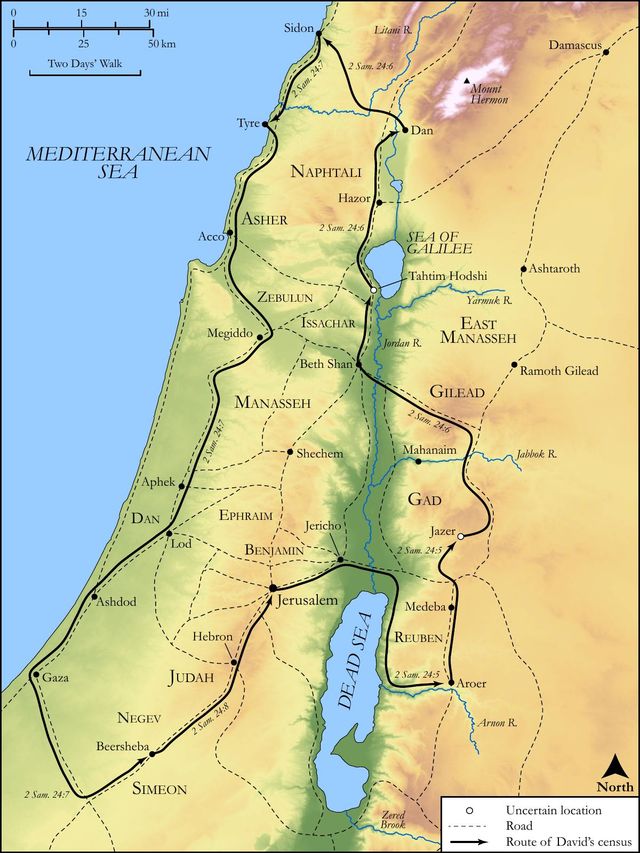
See on the biblical-era map
Study this verse
Public-domain commentary
Matthew Henry
From his Commentary on the Whole Bible. Henry comments on passages, not single verses — this entry covers 1 Chronicles 21:7–17. His two-level outline is real structure in the source text, so it is rendered as structure.
David is here under the rod for numbering the people, that rod of correction which drives out the foolishness that is bound up in the heart, the foolishness of pride. Let us briefly observe,
I.How he was corrected. If God's dearest children do amiss, they must expect to smart for it.
1.He is given to understand that God is displeased; and that it is no small uneasiness to so good a man as David, Ch1 21:7. God takes notice of, and is displeased with, the sins of his people; and no sin is more displeasing to him than pride of heart: nor is anything more humbling, and grieving, and mortifying to a gracious soul, than to see itself under God's displeasure.
2.He is put to his choice whether he will be punished by war, famine, or pestilence; for punished he must be, and by one of these. Thus, for his further humiliation, he is put into a strait, a great strait, and has the terror of all the three judgments impressed upon his mind, no doubt to his great amazement, while he is considering which he shall choose.
3.He hears of 70,000 of his subjects who in a few hours were struck dead by the pestilence, Ch1 21:14. He was proud of the multitude of his people, but divine Justice took a course to make them fewer. Justly is that taken from us, weakened, or embittered to us, which we are proud of. David must have the people numbered: Bring me the number of them, says he, that I may know it. But now God numbers them after another manner, numbers to the sword, Isa 65:12. And David had another number of them brought, more to his confusion than was to his satisfaction, namely, the number of the slain - a black bill of mortality, which is a drawback to his muster-roll.
4.He sees the destroying angel, with his sword drawn against Jerusalem, Ch1 21:16. This could not but be very terrible to him, as it was a visible indication of the anger of Heaven, and threatened the utter destruction of that beloved city. Pestilences make the greatest devastations in the most populous places. The sight of an angel, though coming peaceably and on a friendly errand, has made even mighty men to tremble; how dreadful then must this sight be of an angel with a drawn sword in his hand, a flaming sword, like that of the cherubim, which turned every way to keep the way of the tree of life! While we lie under the wrath of God the holy angels are armed against us, though we see them not as David did.
II.How he bore the correction.
1.He made a very penitent confession of his sin, and prayed earnestly for the pardon of it, Ch1 21:8. Now he owned that he had sinned, had sinned greatly, had done foolishly, very foolishly; and he entreated that, however he might be corrected for it, the iniquity of it might be done away.
2.He accepted the punishment of his iniquity: "Let thy hand be on me, and on my father's house, Ch1 21:17. I submit to the rod, only let me be the sufferer, for I am the sinner; mine is the guilty head at which the sword should be pointed." 3. He cast himself upon the mercy of God (though he knew he was angry with him) and did not entertain any hard thoughts of him. However it be, Let us fall into the hands of the Lord, for his mercies are great, Ch1 21:13. Good men, even when God frowns upon them, think well of him. Though he slay me, yet will I trust in him. 4. He expressed a very tender concern for the people, and it went to his heart to see them plagued for his transgression: These sheep, what have they done?
Continue studying 1 Chronicles 21:9 across the web’s major study libraries — every link below opens this exact verse, chapter, or book on the destination site.
Read & Compare
 BibleGatewayThis verse in more than 200 translations and 70 languages.
 Bible.comThe YouVersion reader — hundreds of translations, reading plans, and highlights.
 ESV.orgCrossway's official English Standard Version reader.
 NET BibleThe NET translation with 60,000+ translators' notes on every rendering decision.
 STEP BibleTyndale House's free study tool — original text, vocabulary, and scholarly resources.
 BibliaLogos Bible Software's free web reader.
 USCCBThe New American Bible (Revised Edition) with the U.S. bishops' study notes.
Commentaries
 BibleHub CommentariesDozens of classic commentaries on this verse, gathered on one page.
 StudyLightMore than 100 commentary sets — the largest collection on the web.
 BibleRefPlain-English commentary on what this verse means, verse by verse.
 Enduring WordDavid Guzik's free commentary on this chapter, widely used by Bible teachers.
 Bible Study ToolsVerse commentary alongside Greek and Hebrew study aids.
Original Language & Research
- BibleHub InterlinearThe verse word by word — original language, transliteration, and English.
- BibleHub LexiconEvery word's original-language definition and Strong's entry.
 Blue Letter BibleDeep-study tools — Strong's numbers, concordance, and word studies.
 SefariaThe Hebrew text with Rashi and centuries of Jewish commentary.
Sermons, Hymns & Audio


TrulyRandomVerse is not affiliated with these sites and doesn’t control their content. They’re linked because they’re genuinely useful.
Summary
1 Chronicles 21:9 marks a pivotal moment in the narrative of King David's unauthorized census, signaling God's direct and authoritative response to David's sin and subsequent confession. Following David's act of pride in numbering Israel and his immediate remorse, this verse introduces Gad, David's trusted seer, as the divine messenger through whom the Lord will communicate the consequences of David's disobedience, underscoring God's active involvement in human affairs and His commitment to justice even amidst mercy.
Context
ShowHideLiterary Context
This verse is strategically placed immediately after David's confession of sin in 1 Chronicles 21:8. The preceding verses (1 Chronicles 21:1-7) detail the instigation of Satan, David's decision to conduct a census against Joab's wise counsel, and the completion of this ill-advised numbering of Israel. The census itself was an act rooted in pride and a lack of trust in God's provision and protection, relying instead on military strength. Verse 9 then transitions from David's internal state of remorse to God's external, direct intervention, setting the stage for the divine judgment and the subsequent events that lead to the establishment of the altar on the threshing floor of Ornan, a place of immense future significance for the temple.
Historical & Cultural Context
In ancient Israel, the king was expected to rule under God's sovereignty, and prophets or seers served as crucial intermediaries, conveying divine will, warnings, and instructions. David's reign, though largely righteous, was marked by significant failures, and the census was one such instance, mirroring a similar event recorded in 2 Samuel 24. Censuses were often undertaken for military conscription or taxation, but when done without divine command or from a place of self-reliance rather than faith, they could be seen as an affront to God's covenantal care. Gad, identified as "David's seer," was a recognized prophetic figure who had previously advised David (1 Samuel 22:5). His role here reinforces the established pattern of divine communication through chosen individuals, emphasizing that God's word was not arbitrary but delivered through recognized channels of authority.
Key Themes
ShowHide1 Chronicles 21 is rich with several key themes. Firstly, Divine Sovereignty and Intervention is paramount, as God actively responds to human sin, demonstrating His ultimate control over events and His direct involvement in the lives of His people. Secondly, the Consequences of Sin are starkly highlighted; even after confession and repentance, there are often repercussions that must be faced, underscoring the seriousness of disobedience. Thirdly, the Role of Prophetic Mediation is central, with Gad serving as the indispensable link between God's will and David's understanding. Finally, the chapter, including this verse, subtly introduces the theme of Atonement and Redemption, as the subsequent events lead to the building of an altar and the eventual site of the Temple, pointing towards God's provision for reconciliation despite human failure.
Exposition and Analysis
ShowHideKey Word Analysis
ShowHideThis is the Jewish national name of God, emphasizing His identity as the self-existent or eternal God. Its use here highlights that the communication is not from a generic deity but from the specific, sovereign God who has established a relationship with David and His people, making the message profoundly significant and authoritative.
This verb signifies a direct, authoritative, and intentional act of speaking. It implies a declarative utterance, a command, or a message being conveyed. Unlike other verbs that might suggest a whisper or a thought, dâbar indicates a clear, articulate communication, underscoring the clarity and certainty of the divine message Gad is about to receive and deliver.
This term specifically denotes one who is a "beholder in vision," receiving divine revelation often through visual means. While often overlapping with the role of a prophet, chôzeh emphasizes the direct and visual nature of the divine encounter, suggesting that Gad's message was based on a clear, divinely imparted insight or vision, lending it undeniable authority and authenticity.
Verse Breakdown
ShowHide"And the LORD spake"
This opening phrase immediately establishes the divine origin and authority of the message that follows. It signifies that God Himself, the sovereign covenant Lord, is initiating communication, not merely a human interpretation or suggestion. This direct divine action underscores the gravity of David's sin and the seriousness of the impending consequences.
"unto Gad, David's seer"
This identifies the specific recipient and mediator of the divine message. Gad is not just any prophet but "David's seer," indicating a trusted and established relationship with the king, ensuring that the message would be received by one who had the king's ear and spiritual authority. The title "seer" highlights his unique capacity to receive direct, visual revelations from God.
"saying,"
This conjunction signals that what follows will be the direct words or content of God's communication. It prepares the reader for the specific instructions, judgments, or declarations that God is about to impart through Gad, emphasizing the precise nature of the divine message.
Literary Devices
ShowHideThe verse employs several significant literary devices. The most prominent is Direct Discourse, indicated by the word "saying," which immediately precedes God's direct instructions to Gad in the subsequent verses. This technique immerses the reader directly into the divine communication, emphasizing its immediacy and authority. Furthermore, the verse exemplifies Divine Intervention, as God actively steps into the human narrative to address David's sin, demonstrating His sovereignty and His active governance over His people. The phrase "And the LORD spake unto Gad" also functions as a Prophetic Formula, a common introductory device in biblical literature that establishes the divine origin and authority of the message about to be delivered, reinforcing the legitimacy of Gad's role as God's messenger.
Theological and Thematic Connections
ShowHide1 Chronicles 21:9 powerfully illustrates the theological truth that God is not a distant deity but actively engaged in the affairs of humanity, particularly with His covenant people. His communication through a prophet like Gad underscores His commitment to revealing His will, His standards, and the consequences of disobedience. Even after David's confession, God's response is one of justice tempered with mercy, demonstrating that while sin has repercussions, God remains faithful to His covenant and provides a path for reconciliation. This verse sets the stage for a profound lesson on accountability, divine discipline, and the ultimate provision for atonement.
Reflection and Application
ShowHideThis seemingly simple verse holds profound implications for contemporary believers. It serves as a powerful reminder that God still speaks, though primarily through His written Word, the Holy Spirit, and godly counsel. Just as Gad was David's trusted seer, we are called to listen attentively to God's voice, whether through personal study of Scripture, the guidance of the Spirit, or the wisdom of spiritual mentors. David's experience teaches us that even sincere confession does not always negate the consequences of our actions, yet God's justice is always intertwined with His mercy, offering a path forward. We are encouraged to embrace accountability, learn from our mistakes, and trust in God's perfect plan even when facing the repercussions of our choices, knowing that He works all things for good for those who love Him.
Questions for Reflection
ShowHideFAQ
ShowHideWhat was David's sin that prompted God's communication in 1 Chronicles 21:9?
ShowHideDavid's sin, as detailed in 1 Chronicles 21:1-7, was conducting an unauthorized census of Israel. While a census itself wasn't inherently wrong, this particular act was instigated by Satan and stemmed from David's pride and a lack of trust in God. Instead of relying solely on God's power and provision for the nation's strength and security, David sought to quantify his military might, demonstrating a reliance on human resources over divine faithfulness. This act was a serious offense against God's sovereignty and covenant.
Who was Gad, and what was his role as "David's seer"?
ShowHideGad was a prophet and a "seer" (Hebrew: chôzeh) who served as a trusted spiritual advisor to King David. His role as a "seer" indicates that he was someone who received direct divine revelations, often through visions, and was tasked with conveying God's will, warnings, and instructions to the king and the people. Gad had a long-standing relationship with David, having previously advised him during his time as a fugitive (1 Samuel 22:5) and later assisting in the organization of temple music (2 Chronicles 29:25). In 1 Chronicles 21:9, he acts as God's direct messenger, delivering the divine judgment and instructions concerning David's sin.
Why is it significant that God "spake" to Gad, rather than directly to David?
ShowHideGod often chose to communicate through prophets and seers to mediate His word to His people, especially kings. This practice underscored the authority of the divine message and the established order of spiritual leadership in Israel. While God did speak directly to individuals at times, using a prophet like Gad affirmed Gad's legitimate role as a divine messenger and ensured that the message was received through an appointed channel. It also highlighted the seriousness of the communication, as it came through a recognized figure of spiritual authority, emphasizing that the message was God's authoritative word, not merely David's own thoughts or feelings.
Christ-Centered Fulfillment
ShowHide1 Chronicles 21:9, with God speaking through Gad, foreshadows the ultimate and perfect communication of God through His Son, Jesus Christ. While Gad was a "seer" who conveyed God's word, Jesus is the very Word of God incarnate (John 1:1-3, John 1:14), the one through whom God has spoken His final and most complete revelation (Hebrews 1:1-2). David's census revealed a human king's reliance on his own strength, leading to judgment; Christ, however, is the true King who perfectly trusts in the Father, and through His perfect obedience, He takes away the sin of the world (John 1:29). The judgment announced through Gad points to the ultimate judgment against sin, which Christ bore on the cross, becoming the atoning sacrifice for humanity (Romans 5:8). Thus, the divine communication in this verse, while bringing judgment, ultimately points to the greater divine communication and redemptive work accomplished in Jesus, who is both the perfect Prophet, revealing God's truth, and the perfect Sacrifice, reconciling humanity to God.