


1 Chronicles 21:10
Bible text: King James Version (1769 Blayney text) · Public domain
Bible text: Berean Standard Bible · Public domain
Bible text: American Standard Version (1901) · Public domain
Bible text: World English Bible, Messianic edition · Public domain
Bible text: Geneva Bible (1599) · Public domain
Bible text: Young's Literal Translation · Public domain
- לֵךְleKhgoH1980V-Qal-Imp-2msVerb Qal Imperative 2nd Singular Masculine
- וְדִבַּרְתָּve·di·bar·Taand you will speakH1696Conj-w ¦ V-Piel-ConsecPerf-2msVerb Piel Consecutive Perfect 2nd Singular Masculineוְandדִבַּרְתָּyou will speak
- אֶל'eltoH413PrepPreposition
- דָּוִידda·VidDavidH1732N-proper-mNoun Proper Masculine
- לֵאמֹרle·Mor<to> sayingH559Prep-l ¦ V-Qal-InfVerb Qal Infinitive Constructלֵ<to>אמֹרsaying
- כֹּהkohthusH3541AdvAdverb
- אָמַר'a·Marhe saysH559V-Qal-Perf-3msVerb Qal Perfect 3rd Singular Masculine
- יְהוָהYah·wehYahwehH3068N-properNoun Proper Title
- שָׁלוֹשׁsha·Lo·oshthree [things]H7969N-csNoun Singular common gender Absolute
- אֲנִי'a·NiIH589Pro-1csPronoun Personal 1st Singular common gender
- נֹטֶהno·Teh[am] holding outH5186V-Qal-Prtcpl-msVerb Qal Participle Singular Masculine Absolute
- עָלֶיךָ'a·Lei·khaover youH5921Prep ¦ 2msPrepositionעָלֶיoverךָyou
- בְּחַרbe·charchooseH977V-Qal-Imp-2msVerb Qal Imperative 2nd Singular Masculine
- לְךָle·Khafor yourselfPrep-l ¦ 2msSuffix Personal 2nd Singular Masculineלְforךָyourself
- אַחַת'a·ChatoneH259N-fsNoun Singular Feminine Absolute
- מֵהֵנָּהme·He·nahfrom themPrep-m ¦ Pro-3fpPronoun Personal 3rd Plural Feminineמֵfromהֵנָּהthem
- וְאֶעֱשֶׂהve·'e·'e·sehso I may do [it]H6213Conj-w ¦ V-Qal-ConjImperf-1csVerb Qal Conjunction+Imperfect 1st Singular common genderוְsoאֶעֱשֶׂהI may do [it]
- לָּךְLakhto youPrep-l ¦ 2msSuffix Personal 2nd Singular Masculineלָּtoךְyou
English is a literal word-by-word gloss of the Hebrew, not the KJV's wording. Why?
This is the original text the KJV's translators worked from — each Hebrew word with its own literal English meaning in this verse, prepared by scholars at Tyndale House, Cambridge. The KJV translates whole sentences, not word by word, so its wording differs: one Hebrew word can become several English words, and the KJV may choose “the LORD” where the gloss reads “Yahweh”. Both are faithful — they answer different questions. For the KJV's own rendering, switch to the KJV text.
Details
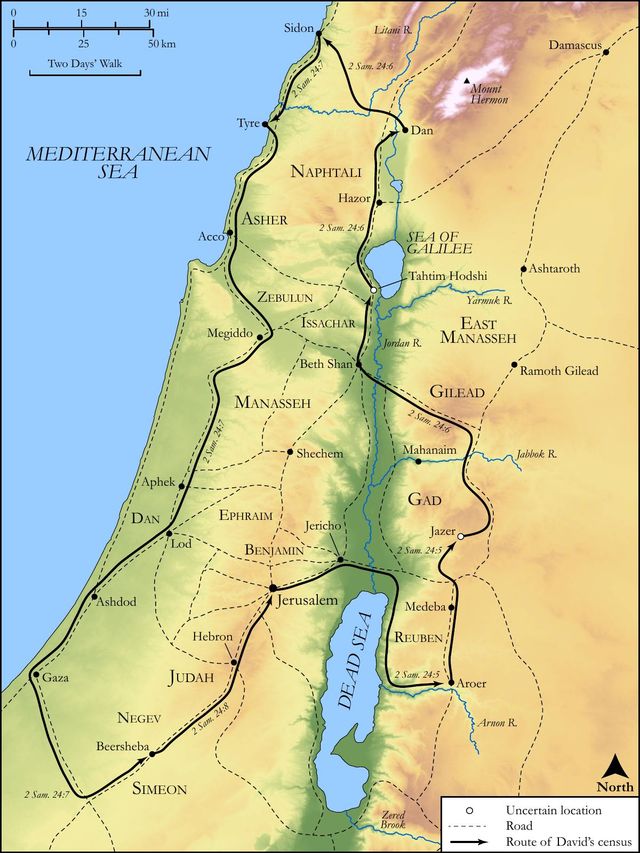
See on the biblical-era map
Study this verse
Public-domain commentary
Matthew Henry
From his Commentary on the Whole Bible. Henry comments on passages, not single verses — this entry covers 1 Chronicles 21:7–17. His two-level outline is real structure in the source text, so it is rendered as structure.
David is here under the rod for numbering the people, that rod of correction which drives out the foolishness that is bound up in the heart, the foolishness of pride. Let us briefly observe,
I.How he was corrected. If God's dearest children do amiss, they must expect to smart for it.
1.He is given to understand that God is displeased; and that it is no small uneasiness to so good a man as David, Ch1 21:7. God takes notice of, and is displeased with, the sins of his people; and no sin is more displeasing to him than pride of heart: nor is anything more humbling, and grieving, and mortifying to a gracious soul, than to see itself under God's displeasure.
2.He is put to his choice whether he will be punished by war, famine, or pestilence; for punished he must be, and by one of these. Thus, for his further humiliation, he is put into a strait, a great strait, and has the terror of all the three judgments impressed upon his mind, no doubt to his great amazement, while he is considering which he shall choose.
3.He hears of 70,000 of his subjects who in a few hours were struck dead by the pestilence, Ch1 21:14. He was proud of the multitude of his people, but divine Justice took a course to make them fewer. Justly is that taken from us, weakened, or embittered to us, which we are proud of. David must have the people numbered: Bring me the number of them, says he, that I may know it. But now God numbers them after another manner, numbers to the sword, Isa 65:12. And David had another number of them brought, more to his confusion than was to his satisfaction, namely, the number of the slain - a black bill of mortality, which is a drawback to his muster-roll.
4.He sees the destroying angel, with his sword drawn against Jerusalem, Ch1 21:16. This could not but be very terrible to him, as it was a visible indication of the anger of Heaven, and threatened the utter destruction of that beloved city. Pestilences make the greatest devastations in the most populous places. The sight of an angel, though coming peaceably and on a friendly errand, has made even mighty men to tremble; how dreadful then must this sight be of an angel with a drawn sword in his hand, a flaming sword, like that of the cherubim, which turned every way to keep the way of the tree of life! While we lie under the wrath of God the holy angels are armed against us, though we see them not as David did.
II.How he bore the correction.
1.He made a very penitent confession of his sin, and prayed earnestly for the pardon of it, Ch1 21:8. Now he owned that he had sinned, had sinned greatly, had done foolishly, very foolishly; and he entreated that, however he might be corrected for it, the iniquity of it might be done away.
2.He accepted the punishment of his iniquity: "Let thy hand be on me, and on my father's house, Ch1 21:17. I submit to the rod, only let me be the sufferer, for I am the sinner; mine is the guilty head at which the sword should be pointed." 3. He cast himself upon the mercy of God (though he knew he was angry with him) and did not entertain any hard thoughts of him. However it be, Let us fall into the hands of the Lord, for his mercies are great, Ch1 21:13. Good men, even when God frowns upon them, think well of him. Though he slay me, yet will I trust in him. 4. He expressed a very tender concern for the people, and it went to his heart to see them plagued for his transgression: These sheep, what have they done?
Continue studying 1 Chronicles 21:10 across the web’s major study libraries — every link below opens this exact verse, chapter, or book on the destination site.
Read & Compare
 BibleGatewayThis verse in more than 200 translations and 70 languages.
 Bible.comThe YouVersion reader — hundreds of translations, reading plans, and highlights.
 ESV.orgCrossway's official English Standard Version reader.
 NET BibleThe NET translation with 60,000+ translators' notes on every rendering decision.
 STEP BibleTyndale House's free study tool — original text, vocabulary, and scholarly resources.
 BibliaLogos Bible Software's free web reader.
 USCCBThe New American Bible (Revised Edition) with the U.S. bishops' study notes.
Commentaries
 BibleHub CommentariesDozens of classic commentaries on this verse, gathered on one page.
 StudyLightMore than 100 commentary sets — the largest collection on the web.
 BibleRefPlain-English commentary on what this verse means, verse by verse.
 Enduring WordDavid Guzik's free commentary on this chapter, widely used by Bible teachers.
 Bible Study ToolsVerse commentary alongside Greek and Hebrew study aids.
Original Language & Research
- BibleHub InterlinearThe verse word by word — original language, transliteration, and English.
- BibleHub LexiconEvery word's original-language definition and Strong's entry.
 Blue Letter BibleDeep-study tools — Strong's numbers, concordance, and word studies.
 SefariaThe Hebrew text with Rashi and centuries of Jewish commentary.
Sermons, Hymns & Audio


TrulyRandomVerse is not affiliated with these sites and doesn’t control their content. They’re linked because they’re genuinely useful.
Summary
1 Chronicles 21:10 records the solemn pronouncement of the prophet Gad to King David, delivering an unadulterated message directly from the LORD. As a divine consequence for David's grievous sin in numbering Israel, God presents the king with an inescapable ultimatum: three distinct options for divine judgment, from which David must choose one. This pivotal moment profoundly underscores the gravity of David's transgression, the certainty of God's righteous response, and His unwavering sovereignty, even over His chosen king.
Context
ShowHideLiterary Context
This verse is strategically placed at a critical juncture in the narrative of King David's reign, immediately following his unauthorized census of Israel. The preceding verses, specifically 1 Chronicles 21:1-8, meticulously detail how Satan incited David to undertake this census, an act that profoundly displeased the LORD. Despite the astute warnings of Joab, David stubbornly persisted, leading to God's severe displeasure and the impending judgment. Verse 9 then introduces the prophet Gad, David's trusted seer, whom the LORD instructs to present the king with the three options for judgment. The subsequent verses, 1 Chronicles 21:11-17, describe David's agonizing choice, the ensuing devastating plague, his heartfelt repentance, and ultimately, God's merciful intervention. This account parallels the narrative found in 2 Samuel 24, offering a slightly different theological emphasis, particularly regarding the instigator of the census.
Historical & Cultural Context
Censuses in ancient Israel were typically conducted for legitimate purposes such as military conscription, taxation, or land distribution. However, they often required a specific atonement payment or divine authorization, as seen in Exodus 30:12. David's census, in this instance, appears to have been driven by an underlying spirit of pride, a desire to rely on the sheer number of his fighting men rather than on divine provision and protection, or perhaps a profound lack of faith in God's ability to defend His people. Such an act, undertaken without divine command or proper ritual observance, was perceived as a usurpation of God's sovereignty and a blatant display of human arrogance. Prophets like Gad served as God's direct spokespersons, delivering divine messages—often of judgment or deliverance—to kings and the populace. Their role was absolutely crucial in holding leaders accountable to the covenant stipulations. The concept of corporate responsibility was also deeply ingrained in ancient Israelite culture, where the sin of a leader could indeed bring severe consequences upon the entire nation.
Key Themes
ShowHideThe passage powerfully illuminates the theme of divine judgment for disobedience, unequivocally demonstrating that even a king "after God's own heart" is not exempt from the inevitable consequences of sin. God's sovereignty and absolute authority are paramount, as He is the one who initiates the judgment and dictates its terms. The profound phrase "Thus saith the LORD" underscores His ultimate and unchallengeable control over all circumstances. The indispensable role of the prophet as God's authoritative messenger is clearly depicted, emphasizing the vital importance of hearing and heeding divine warnings. Furthermore, the offering of a choice, even within the grim context of judgment, reveals a remarkable facet of God's mercy and grace, allowing David agency and a profound opportunity to acknowledge his sin and rely on God's compassion, as beautifully articulated in Psalm 103:8. This event also significantly contributes to the broader Chronicler's overarching theme of retribution theology, where obedience consistently brings blessing and disobedience invariably brings judgment, a motif consistently explored throughout 1 Chronicles and 2 Chronicles.
Exposition and Analysis
ShowHideKey Word Analysis
ShowHideA primitive root meaning "to say," used with extensive latitude to convey various forms of communication, including commanding, declaring, pronouncing, and even thinking. In this context, coupled with "Thus," it signifies a direct, authoritative, and unalterable divine utterance, leaving no room for negotiation or misinterpretation. It underscores the absolute truth and certainty of the message delivered by Gad.
A primitive root meaning "to stretch or spread out," but by implication, "to bend away," "incline," or "lay upon." Here, it goes beyond a mere casual presentation; it conveys the sense of God "laying upon" David these options, or "imposing" them as unavoidable consequences. It emphasizes that these are not suggestions but divinely determined judgments that David must confront.
A primitive root meaning "to try" or "to select." The imperative form here ("choose thee") highlights David's forced agency within the framework of divine judgment. He is compelled to make a selection from pre-determined severe consequences. This act of choosing forces David to actively engage with the reality of his sin and its impending repercussions, potentially leading to deeper repentance and reliance on God's mercy rather than human escape.
Verse Breakdown
ShowHide"Go and tell David, saying"
This opening imperative emphasizes the prophet Gad's direct and immediate obedience as God's messenger. It highlights the urgency and directness of God's communication with His king, even when delivering a difficult and severe word of judgment. The prophet acts as a faithful conduit for the divine will.
"Thus saith the LORD"
This authoritative prophetic formula establishes the indisputable divine origin and absolute truth of the message. It unequivocally underscores that the words are not Gad's personal opinion or interpretation, but God's own pronouncement, thereby removing any possibility of negotiation, dismissal, or questioning based on human authority.
"I offer thee three [things]:"
This clause reveals God Himself as the one presenting the options for judgment. It powerfully signifies His absolute sovereignty over the consequences of sin. The "three things" refer to the specific, severe punishments detailed in the subsequent verse (famine, flight from enemies, or plague), underscoring the gravity and certainty of the impending divine retribution.
"choose thee one of them, that I may do [it] unto thee."
This concluding clause underscores David's grim, forced agency within the framework of divine judgment. He is given the solemn, albeit painful, privilege of selecting the specific form of punishment. However, the certainty of its execution ("that I may do [it] unto thee") is absolute and non-negotiable. This choice compels David to directly reckon with the profound link between his personal sin and its devastating national consequences.
Literary Devices
ShowHideThe passage employs several potent literary devices that amplify its theological impact. The most prominent is the Ultimatum, where God presents David with a stark, non-negotiable choice between three severe punishments, emphasizing the inescapable nature of divine justice and the certainty of consequences for sin. This is inextricably linked to Divine Speech, as the recurring phrase "Thus saith the LORD" directly attributes the message to God, lending it ultimate authority, solemnity, and unquestionable truth. There is also a strong element of Foreshadowing, as the very act of offering a choice hints at the dire and inevitable consequences that will follow, building significant narrative tension and suspense. Furthermore, a subtle yet profound Irony can be perceived: David's sin was rooted in a prideful desire for human strength, manifested through the numbering of his fighting men, and the judgment offered directly attacks those numbers through famine, war, or plague, thereby diminishing the very strength and security he sought apart from God.
Theological and Thematic Connections
ShowHide1 Chronicles 21:10 profoundly illustrates the enduring biblical principle that sin, even for God's most chosen and favored leaders, carries inevitable and often severe consequences. It powerfully underscores God's unwavering righteousness, His unyielding commitment to justice, and His holiness, which demands a proportionate response to disobedience. Yet, remarkably, even within the framework of judgment, God's character is revealed as one who offers a measure of choice, reflecting His profound compassion and His desire for His people to acknowledge their transgressions and turn back to Him in humility. This passage serves as a potent reminder that accountability extends to all, regardless of status or position, and that true, godly leadership necessitates profound humility and absolute reliance on divine wisdom and provision rather than human strength, pride, or self-sufficiency. The ultimate goal of such divine discipline is often restoration, deeper repentance, and a more profound understanding of God's holy and merciful character.
Reflection and Application
ShowHideThe narrative of 1 Chronicles 21:10 offers timeless and profound lessons for believers today, particularly concerning the inherent gravity of sin and the intricate nature of divine justice intertwined with divine mercy. It compels us to undertake a rigorous examination of our own hearts, searching for any areas where we might be tempted to rely on our own strength, human wisdom, or finite resources rather than placing our complete and unwavering trust in God's sovereign provision and infinite wisdom. David's sin of numbering Israel was fundamentally an act of pride and a profound lack of faith, and its devastating consequences were not confined to him alone but extended tragically to the entire nation. This serves as a stark reminder that our choices, especially those of leaders, have far-reaching and often communal implications. When confronted with the inevitable consequences of our own disobedience, whether personal or corporate, this passage challenges us to respond with genuine humility, heartfelt repentance, and a courageous willingness to choose the path that ultimately honors God, even if it involves enduring difficult and painful circumstances. Ultimately, it reassures us that even in the midst of severe judgment, God's boundless compassion allows for a choice, inviting us to lean deeply into His mercy rather than succumbing to despair.
Questions for Reflection
ShowHideFAQ
ShowHideWhy did God punish David for numbering Israel?
ShowHideThe sin was not merely the act of counting, but the underlying motivation and the context in which it was performed. In ancient Israel, censuses were sometimes conducted by divine command (e.g., Numbers 1), but David's census was unauthorized and seemingly driven by pride, a desire for military strength, or a profound lack of trust in God's provision. It represented a reliance on human power and might rather than on divine power and faithfulness. Furthermore, some interpretations suggest it was a failure to collect the atonement money required for a census as prescribed in Exodus 30:12, which would have made it an act of presumption and disobedience. Joab's explicit warning in 1 Chronicles 21:3 clearly indicates that it was recognized as a serious transgression against God.
What were the three choices offered to David as punishment?
ShowHideAs precisely detailed in 1 Chronicles 21:12, the three choices presented to David were:
David ultimately chose the third and most immediate option, preferring to fall into the hand of the LORD because "His mercies are great" (1 Chronicles 21:13).
How does God's offer of a choice demonstrate His character?
ShowHideGod's offer of a choice, even within the context of severe judgment, reveals a profound and complex aspect of His divine character. It unequivocally demonstrates His justice, as consequences for sin are certain, unavoidable, and divinely ordained. However, it also powerfully highlights His boundless mercy and compassion. By allowing David to choose, God extends a measure of grace, acknowledging David's agency and providing a critical opportunity for him to lean into divine mercy rather than a human-orchestrated or purely arbitrary outcome. David's profound choice to "fall into the hand of the LORD" rather than into the hand of man (1 Chronicles 21:13) underscores his deep understanding that God's judgment, while severe and righteous, is always tempered with immeasurable mercy and compassion.
Christ-Centered Fulfillment
ShowHideThe narrative of David's sin and the subsequent divine judgment in 1 Chronicles 21:10 finds its profound and ultimate Christ-centered fulfillment in the person and redemptive work of Jesus Christ. David's census, born of human pride and a misguided reliance on earthly strength, brought devastating consequences upon the people of Israel. The plague, a direct result of this sin, ceased at the threshing floor of Ornan the Jebusite, a site that would later become the hallowed location for the building of the Temple, a sacred place of atonement and sacrifice (2 Chronicles 3:1). This historical event powerfully foreshadows the ultimate, perfect sacrifice. While David's agonizing choice led to suffering for his people, Jesus, the greater Son of David and the perfect King, made a willing choice that brought eternal salvation for all humanity. He willingly chose to bear the ultimate penalty for sin, becoming the spotless Lamb of God who takes away the sin of the world (John 1:29). The biblical truth that the wages of sin are death (Romans 6:23) and that without the shedding of blood there is no forgiveness of sins (Hebrews 9:22) finds its complete satisfaction in Christ. His sacrificial death on the cross became the definitive act of atonement, effectively stopping the plague of sin and eternal death for all who believe in Him. He is the ultimate mercy provided by God, absorbing the righteous judgment we rightfully deserved, so that by His wounds we might be eternally healed and reconciled to God (Isaiah 53:5). The severity of God's justice seen in David's time serves to underscore the immeasurable grace, unfathomable love, and profound mercy so gloriously demonstrated in Christ's self-offering for the redemption of humanity.